Mannlicher M1901 & M1903 · Volume 1
Ferdinand Mannlicher's Pistols, 1894 to 1905
The engineer, the blow-forward M1894, the two families that followed it, the trials none of them won, and why two different pistols were both called 'm/1901' in 1902
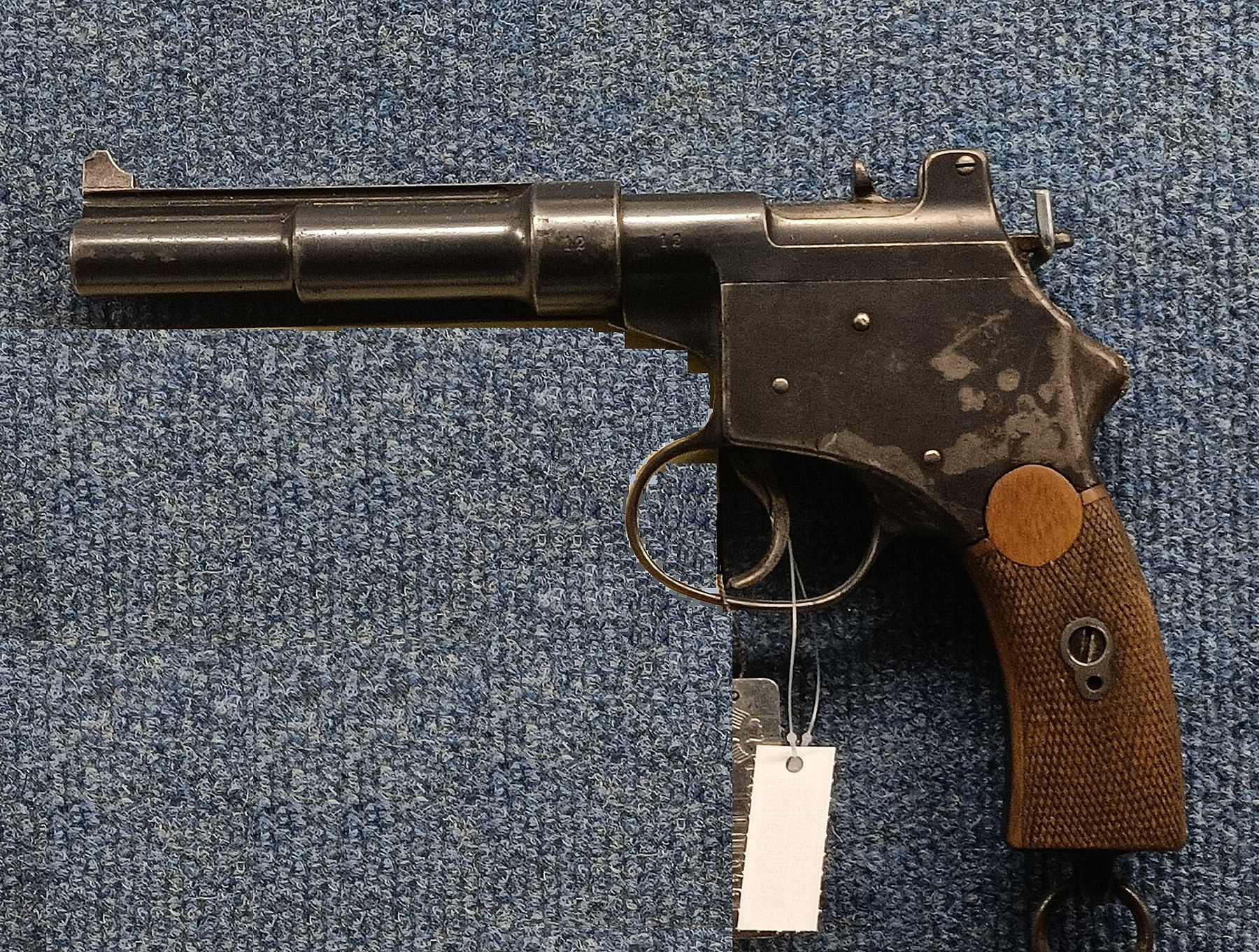
1.1 What this dive covers
Ferdinand Mannlicher is remembered for rifles: the straight-pull Austrian service rifles, the clip that bears his name and the Mannlicher-Schönauer. Between 1894 and his death in 1904 he also designed a series of self-loading pistols, and two of them reached production. They are the subject of this dive.
The two are not variants of one gun. They work on different principles, take different magazines and fire different cartridges.
- The blowback pistol, made from 1900 as the M1900, then as the M1901 and the M1905. It has a fixed barrel, an unlocked breechblock delayed by a spring-loaded cam, a fixed magazine in the grip loaded by stripper clip, and a straight-cased 7.63 mm Mannlicher cartridge. Argentina adopted it as the Modelo 1905. This is the common one.
- The locked-breech pistol, usually called the M1903 by collectors and sometimes the M1896/03. It has a recoiling barrel locked to the breech by a pivoting strut, a detachable box magazine ahead of the trigger guard, a concealed hammer with an external cocking lever, and a bottlenecked 7.65 mm Mannlicher cartridge the same length as the 7.63 Mauser. It was also made as a pistol with a leather holster-stock and as a carbine. It is rare.
Vol 2 is the blowback pistol’s history and Argentine service; Vol 3 the locked-breech line, drawn chiefly from a 1902 German description of it; Vol 4 how each works; Vol 5 how to tell them apart; Vol 6 their disassembly, care and repair; Vol 7 the cartridges, and the dangerous confusions between them and the 7.63 Mauser; Vol 8 the market and the law; Vol 9 how one could be built.
Three other dives in this hub share ground and are linked rather than repeated. The Borchardt C-93 dive tells the Swiss and American pistol trials of 1897 to 1900 in which Mannlicher pistols competed. The Mauser C96 dive owns the 7.63 Mauser cartridge. The Steyr AUG dive tells the history of the Steyr works, from Josef Werndl’s foundation in 1864 to Steyr Arms.
1.2 Ferdinand Ritter von Mannlicher
The Neue Deutsche Biographie entry, by Walter Hummelberger (1990), is the most authoritative short life found.1 Its facts, in brief:
- Born in Mainz on 30 January 1848, where his father served in the Austrian garrison of the federal fortress; the family moved to Vienna in 1857. Died in Vienna on 20 January 1904.
- Studied mechanical engineering at the Technische Hochschule in Vienna and worked for private railway companies, last in the design office of the Nordbahn.
- Left the railway, by the NDB’s account, in 1878, a decision it attributes to his visit to the 1876 Centennial Exhibition in Philadelphia, where he studied Patent Office files and a large collection of models.
- Set up a private test establishment, at his own expense, in Vienna’s ninth district.
- Ennobled in 1892 (the entry’s title gives “österreichischer Adel 1892”) and made a member of the Austrian upper house in 1899.
One date conflicts. Ed Buffaloe’s collector history of the M1900 says Mannlicher “retired from railroad work in 1887”.2 The NDB says 1878. The two figures are given separately; neither source cites its own.
The NDB’s works list ends with a sentence that this dive cannot accept as it stands: “Repetierpistole M. 96 u. Repetierpistole M. 1900 blieben nur Prototypen u. kamen nicht zur Erzeugung”, that is, the M96 and M1900 pistols “remained prototypes only and never went into production”.1 Pistols of the M1900 line were made in their thousands, at Steyr and before that at Sömmerda, and Argentina bought them by contract (Vol 2). Some hundreds of the original 8 mm M1900 are also reported (below). If the NDB means only the experimental pistols that bore those exact designations, it may be right; read as a statement about the pistols in this dive, it is wrong.
1.3 The M1894: a pistol whose barrel blew forward
Mannlicher’s first pistol to be made in any number was the M1894. In it the breech stood still and the barrel moved. The US Office of Naval Intelligence described it in its General Information Series for 1901:3
“In this pistol the operations of loading and ejecting the empty cartridge case are performed by a backward and forward movement of the barrel. It consists of a frame which contains the lock mechanism and the magazine, a sliding barrel, and a cover or casing in which the barrel slides. The magazine, which holds five cartridges, is of the fixed-box type and is within the handle or stock.”
“The lock operates in a manner similar to the lock of an ordinary double-action revolver. When the pistol is fired, the friction of the bullet as it passes through the bore carries the barrel forward against a spiral spring, where it is held by a stop, which continues to act until the trigger is released.”
The same page gives the figures in the table below, transcribed as printed.3
Table 1 — The M1894: a pistol whose barrel blew forward
| Item | ONI, 1901, as printed |
|---|---|
| Caliber | 7.6 millimeters |
| Weight | 2 pounds, 2 ounces |
| Length of barrel | 7¼ inches |
| Weight of cartridge | 171½ grains |
| Cartridges in magazine | 5 |
| Weight of bullet | 112 grains |
| Powder charge | 40 grains |
| Velocity at 53 feet from muzzle | 798.6 feet per second |
| Penetration at 25 yards | 6.3 inches of white pine |
One printed figure cannot be right. A 171½-grain cartridge with a 112-grain bullet leaves 59½ grains for the case, primer and powder together, so a 40-grain powder charge is impossible in a pistol case of this size. The figure is reproduced as printed and not corrected, since the intended value is not known; 4.0 grains is a plausible reading, but it is a guess. The ONI’s verdict: “This weapon has so far failed to fulfill required tests for acceptance, but it has many features desirable in a war arm.”3
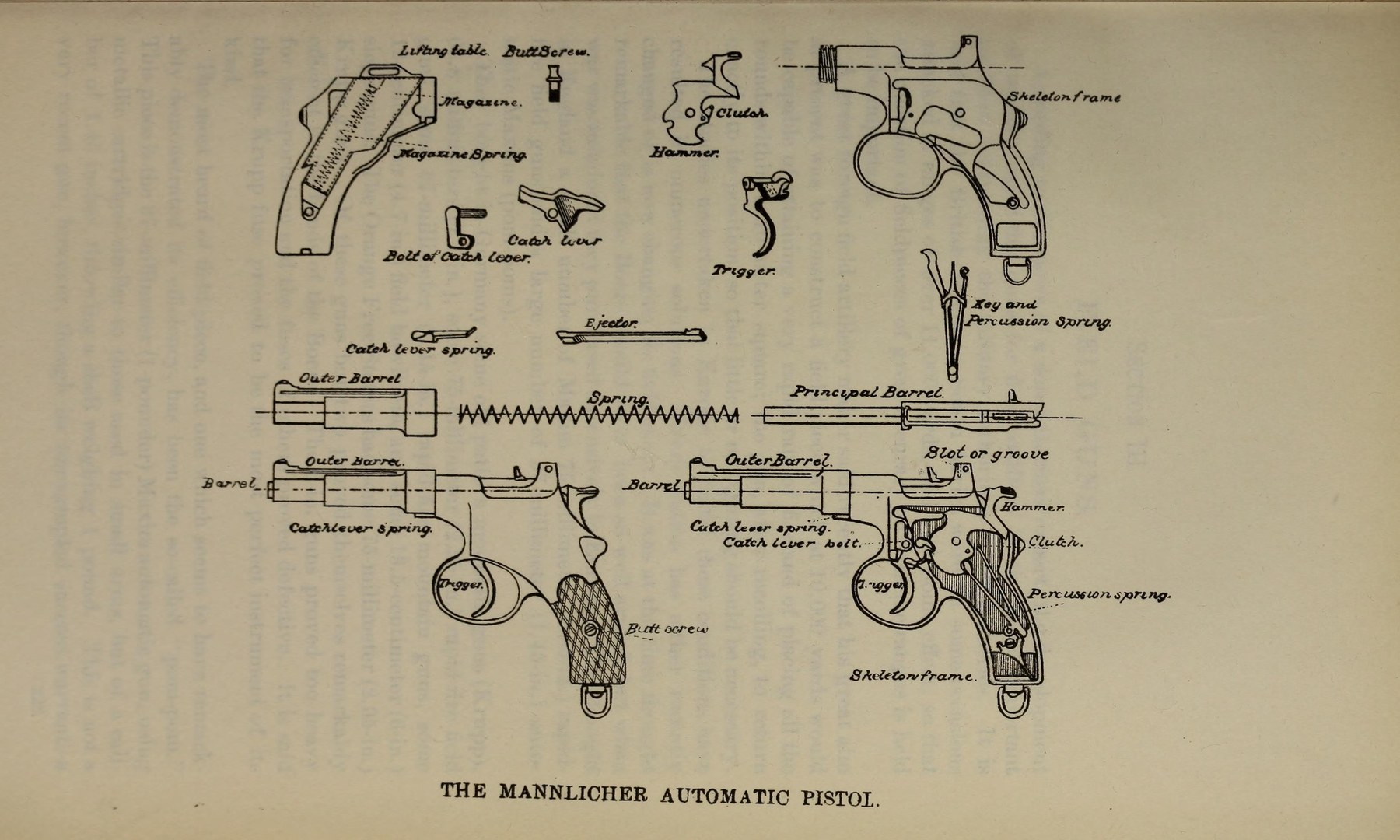
The ONI’s description dates from 1901, when the M1900 blowback pistol was already being made. The 1901 report calls the M1894 “the Mannlicher automatic pistol”, as if it were the current design; by then it had been superseded.
Hugh Pollard’s Automatic Pistols (1920) adds that the M1894 “was really a semi-automatic, for it had to be cocked for each shot though a model with a double-action trigger pull similar to a revolver was also made”.4 English Wikipedia’s article, citing Leonardo Antaris in American Rifleman (2017) and W.H.B. Smith’s Mannlicher Rifles and Pistols (1947), gives fewer than 300 made between 1894 and 1897, by the Swiss works at Neuhausen and by Steyr, in 6.5 mm and 7.6 mm rimmed calibres, and reports a US Army test at Springfield Armory in June 1900 in which “the barrel burst after the 281st round”, citing William Brophy’s history of the Springfield Armory.5 The Brophy source was not seen. The Springfield figure is unverified.
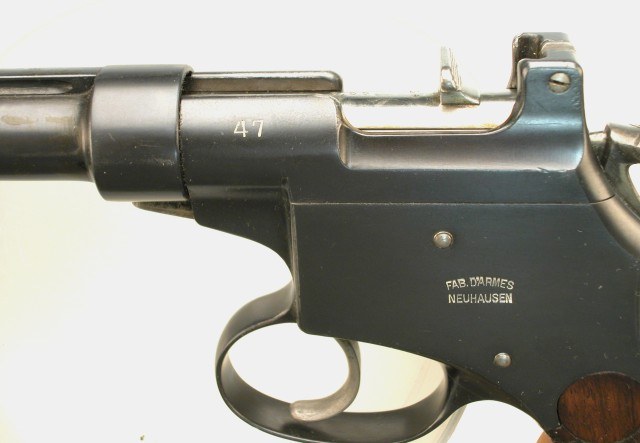
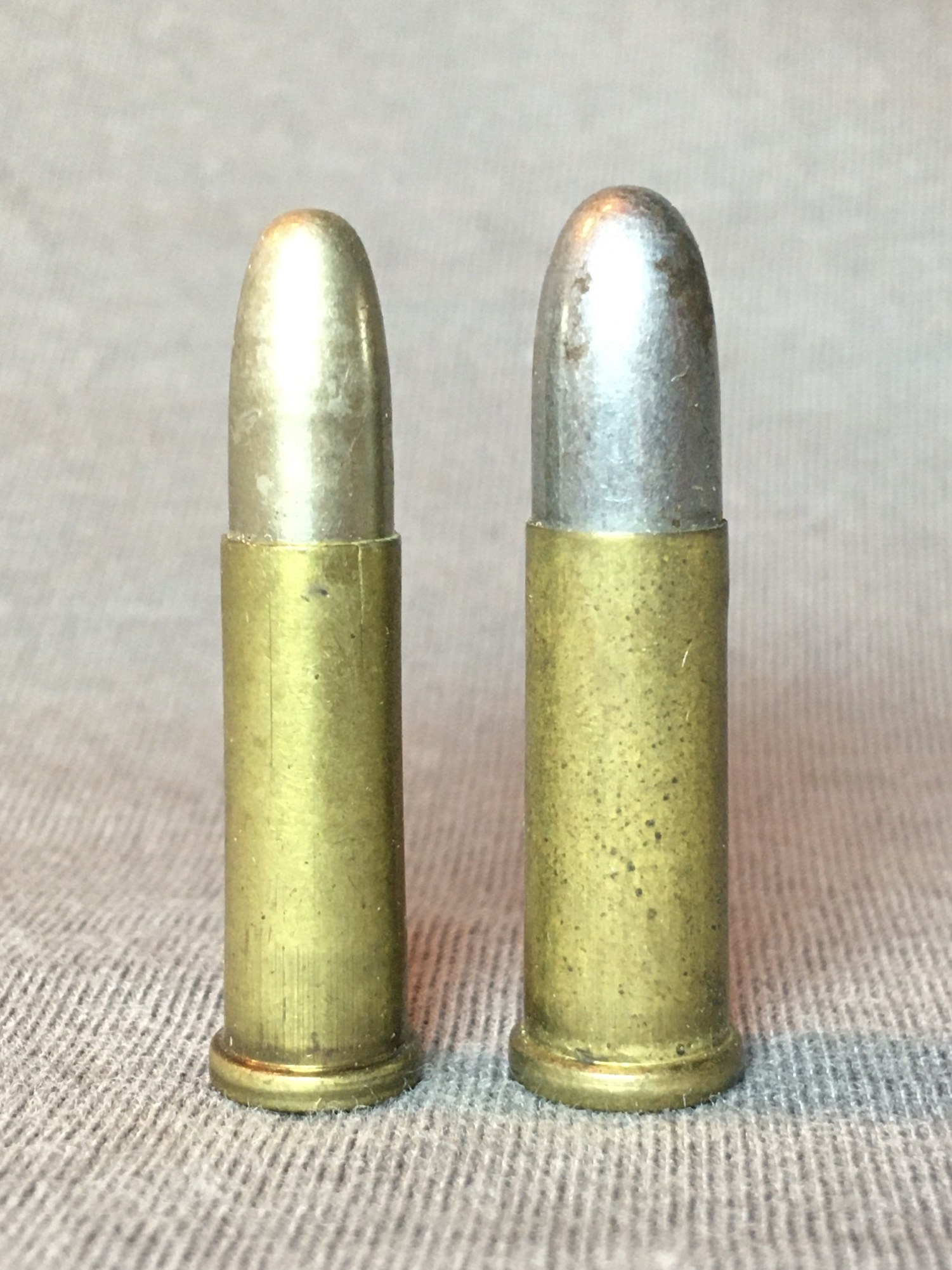
The blow-forward principle did not survive in Mannlicher’s later pistols. What followed went two ways.
1.4 Two families from one designer
After 1896 Mannlicher’s pistols split into two lines that ran side by side until his death. One locked the breech; the other did not. A 1902 German description of the locked-breech carbine, by R. Wille, a Generalmajor z. D. (a major general on the inactive list), gives the reason for the split in the inventor’s terms, and is the clearest period statement found of why there were two:6
“Während daher beispielshalber für v. Mannlichers 6,5- und 7,65 mm Pistole m/1901 die gewählte Anordnung eines festgelagerten Laufs mit gefedertem Verschluss ohne starre Verriegelung durchaus zulässig und angebracht erscheint … würde diese Konstruktion für den so viel stärker beanspruchten Karabiner schwerlich zu empfehlen sein.”
That is: a fixed barrel with a spring-loaded breech and no rigid lock “appears entirely permissible and appropriate” for the m/1901 pistol in 6.5 and 7.65 mm, “especially in view of the braking devices so substantially improved by the inventor”, but would “hardly be advisable” for the far more heavily loaded carbine. The lighter cartridge got the simple blowback; the more powerful one got the lock. Wille’s mention of a 6.5 mm m/1901 is the only one found; no surviving 6.5 mm blowback pistol was located in this research.
1.5 The locked-breech line, 1896 to 1904
The first of the locked-breech pistols is generally called the M1896. English Wikipedia, citing Wilson’s Textbook of Automatic Pistols (1943), describes it as externally resembling the Mauser C96, with a fixed magazine ahead of the trigger “holding six or seven cartridges”, followed by an “improved M1897/01” with a detachable six-shot magazine in the same place, both chambered for the 7.65×25 mm Mannlicher and loadable from the top by clip; it puts the total of both at under 1,000, including stocked pistols, carbines and a Swiss trial model.7 A collector history on thinlineweapons.com, whose text closely follows Hogg and Walter’s Pistols of the World, says development began in 1896, that a gun “possibly made by Waffenfabrik Neuhausen” was tested in Switzerland in 1897 and 1898, and that “it is doubtful if more than a thousand 1903-type pistols and pistol-carbines were made”.8 James D. Julia’s auction catalogue of 2009 quotes the same sentence from page 202 of Pistols of the World.9
ATF’s curios and relics list has an entry, in the section reserved for pre-1898 guns removed from the National Firearms Act, for “Mannlicher, Model 1896, cal. 7.63mm Mannlicher, pistol-carbine, utilizing a pistol frame and lockwork and a regular type rifle butt stock and forearm and 11-3/4” barrel”.10 The law that follows from that listing is in Vol 8.
Wille’s 1902 book describes the developed form of the line as the Selbstlade-Karabiner and Karabiner-Pistole m/1901, and it says, in a footnote, that the “older pattern of the weapon, originally designed only as a pistol” is covered in Konrad von Kromar’s 1900 catalogue of Mannlicher’s systems at page 14 and plate 34.6 The carbine-pistol came in a long and a short form; the long one could be carried in a stiff leather holster that clipped to the grip as a shoulder stock. That family is the subject of Vol 3.
1.6 The blowback line, 1898 to 1905
The blowback pistol’s ancestry, as English Wikipedia gives it after Wilson, runs through an M1898 that moved the magazine into the grip for loading from an eight-round clip, and an M1899 with a large safety lever on the left of the frame; embellished examples were presented to Kaiser Wilhelm II and to the Ottoman Sultan Abdul Hamid II, and production of the two was “less than 350”.7
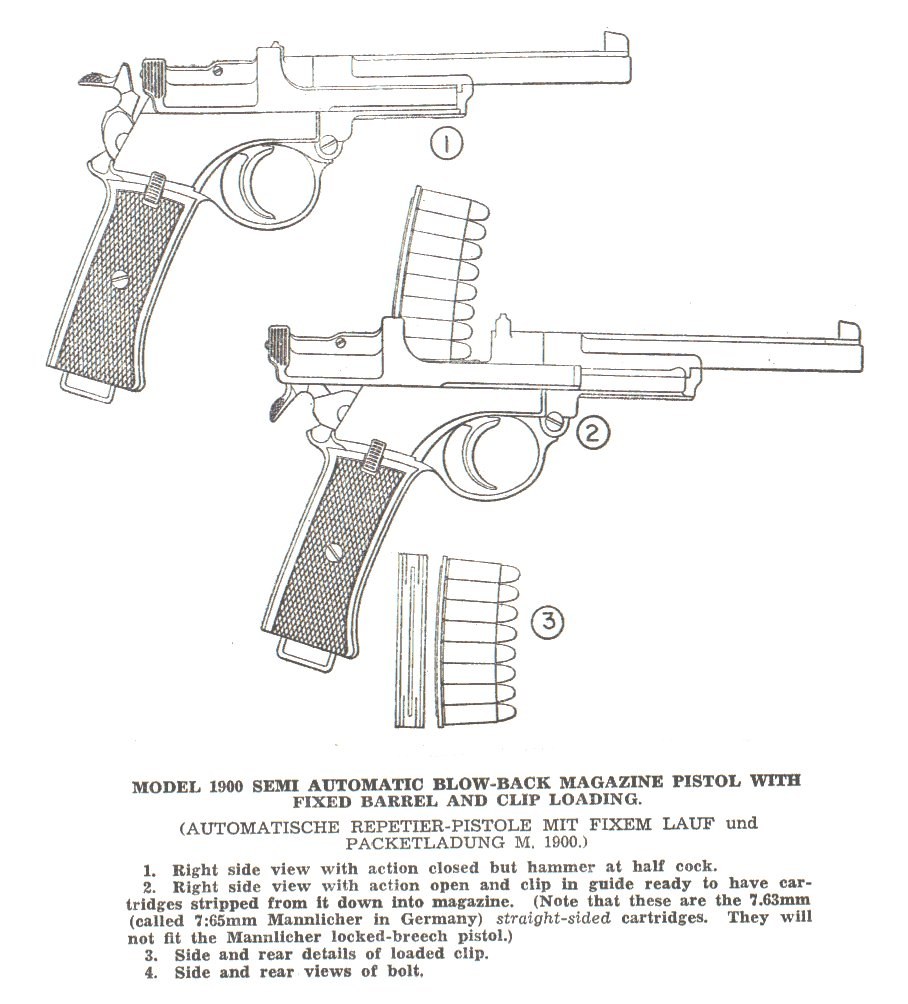
Buffaloe dates the production pistol’s patent to Austrian patent 48-5681 of 29 November 1897, and says it was introduced in 1900, in an 8 mm rimmed cartridge, of which “only about 300 of the original M-1900 in 8mm were manufactured”, before its reintroduction in 1901 in the 7.63 mm Mannlicher.2 English Wikipedia says the same from “Steyr factory records”: patented in 1898, introduced as the “Model 1900”, using a special 8 mm cartridge.7 The factory name, as Smith’s 1947 drawing of it gives it, was the Automatische Repetier-Pistole mit fixem Lauf und Packetladung M. 1900: automatic repeating pistol with fixed barrel and packet (clip) loading.11
The patent year differs between the sources (1897 for the grant, Buffaloe; 1898, Wikipedia) and is given both ways. The Austrian patent itself was not seen.
Vol 2 carries the blowback pistol’s history from there: the M1901, the M1905 and the Argentine contract.
1.7 Who made them
Three works made Mannlicher pistols. None of the pistols in this dive was made by Mannlicher himself.
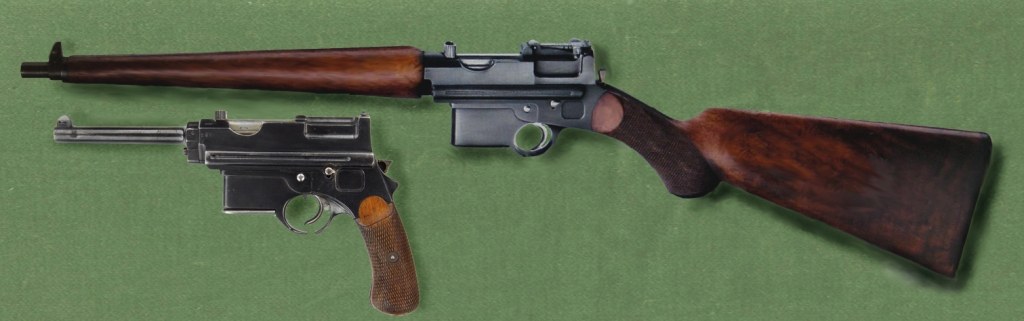
- Neuhausen, Switzerland. The Schweizerische Industrie-Gesellschaft’s arms works, marked FAB. D’ARMES NEUHAUSEN, made M1894 pistols (photograph above) and, by the reports cited above, early locked-breech guns and two experimental carbines.
- Sömmerda, Germany. The earliest M1901-pattern blowback pistols carry the maker’s name on the rib, “MUN. & WAFFENFABR. SOEMMERDA A-G. VORM. V. DREYSE.”, the former Dreyse works, and the slide marking “PATENT MANNLICHER.”, which Rock Island Auction calls “a marking only seen on the first few hundred produced”.12 Buffaloe names the early maker as “Rheinische Metallwaaren und Maschinenfabrik (RM&M)”, Rheinmetall, which owned the Sömmerda works.2 The two names describe the same early production.
- Steyr, Austria. The Österreichische Waffenfabriks-Gesellschaft made the rest of the blowback pistols, marked WAFFENFABRIK STEYR, and, on the evidence of Wille’s 1902 book and the auction record, the locked-breech pistols and carbines too. The firm’s history is in the Steyr AUG dive. The NDB adds that all Mannlicher’s service rifles were made “ausschließlich” at Steyr and at the company’s Budapest branch.1
1.8 The trials
Mannlicher’s pistols were tried by at least five governments, and adopted by one.
- Switzerland, 1895 to 1899. A Mannlicher was presented in 1895, tested with the Bergmann, Mauser and Borchardt in June 1897, and finally eliminated in May 1899, when the Borchardt-Luger won. The Swiss record is set out, from the Stiftung HAM report of 2021, in the Borchardt C-93 dive’s Vol 3, and not repeated here. Which Mannlicher the Swiss tested is not stated in that report; thinlineweapons.com says it was the locked-breech line, “possibly made by Waffenfabrik Neuhausen”.8
- United States, 1898 to 1900. An Army board of 1898 examined “the Borchardt, the Mannlicher, the Mauser, the Colt, and the Bergmann” and concluded that “the development of this type of pistol has not yet reached such a stage as to justify its adoption in place of the revolver”; the quotation and its source are in the Borchardt C-93 dive’s Vol 3. American Rifleman, as cited there, adds a further evaluation of the Colt, Mannlicher and Mauser in 1899. The M1894 test at Springfield in June 1900 is reported above. Rock Island Auction says the M1901 “caught the eye of Colonel Frank Phipps, the commanding officer at Springfield Armory, who unsuccessfully petitioned to give the 1901 a second look”.12 No primary record of that petition was found.
- The Netherlands. James D. Julia’s 2014 catalogue says Steyr “made a small number (ten were submitted to the Dutch Army) of short grip M1901/M1905 pistols for Dutch military testing in which the safety lever was reconfigured and moved to the left side of the slide at the request of the Dutch”.13 It sold one. No Dutch record was consulted.
- Austria-Hungary, 1904 to 1905. English Wikipedia says the M1901 “was not officially adopted following military trials in 1904–1905”, though some officers bought it privately.7 The Austrian trial records were not seen. Pollard’s claim in 1920 that the M1901 was “used in the Austrian service” and was “standard issue for Austrian officers” conflicts with every other source, and is best read as describing private purchase.4
- Argentina, 1905. The one adoption. Vol 2.
1.9 The naming tangle
No pistol in this dive was called, at the time, exactly what collectors call it now, and two different pistols shared one name.
In February 1902 Wille published two booklets with the same publisher in Berlin. One, v. Mannlichers Selbstlade-Pistole m/1901, described the blowback pistol; it was not found online, though Rock Island Auction sold a copy with an early pistol in December 2024.12 The other, v. Mannlichers Selbstlade-Karabiner und Karabiner-Pistole m/1901, described the locked-breech carbine and pistol, and says in its foreword that it continues the first.6 So in 1902, both of Mannlicher’s production pistols were “m/1901”. Forgotten Weapons, which hosts the scan of the second booklet, notes that its subject “is often called the 1903 model elsewhere”.14 Where the name “1903” came from was not established; it is in use by Hogg and Walter and by every auction house consulted.
The table gathers the names.
Table 2 — The naming tangle
| Collector name | Period or official name found | Mechanism | Magazine | Cartridge |
|---|---|---|---|---|
| M1894 | (ONI 1901: “the Mannlicher automatic pistol”) | Blow-forward barrel | Fixed, in grip, 5 | 6.5 mm or 7.6 mm rimmed |
| M1896, M1897, M1896/03, M1903 | Karabiner-Pistole m/1901 (Wille 1902); ATF: “M1903” and “m/01, m/02, and m/06 pistol-carbines” | Recoiling barrel, strut lock | Detachable box ahead of trigger, 6 (7 in one carbine form) | 7.65 mm Mannlicher, bottlenecked |
| M1900 | Automatische Repetier-Pistole … M. 1900 (Smith 1947) | Retarded blowback | Fixed, in grip, by clip | 8 mm rimmed |
| M1901 | Selbstlade-Pistole m/1901 (Wille 1902) | Retarded blowback | Fixed, in grip, by clip | 7.63 mm Mannlicher, straight |
| M1905 | ”Md.1905” (the pistol’s own marking); Argentine Modelo 1905 | Retarded blowback | Fixed, in grip, by clip | 7.63 mm Mannlicher, straight |
The cartridge names are no better. The blowback pistol’s straight-cased round was sold in Austria as the 7.63 mm Mannlicher and in Germany as the 7.65 mm Mannlicher; the locked-breech pistol’s bottlenecked round is also called the 7.65 mm Mannlicher.15 Smith’s 1947 caption is the plainest warning in print: the straight cases “will not fit the Mannlicher locked-breech pistol.”11 ATF’s list gives one calibre, “7.63mm Mannlicher”, for the M1900, M1901, M1903 and M1905 together, which is wrong for the M1903.10 And Pollard, in 1920, describes the M1901 on one page as holding “a clip of six shots” with “special cartridges … a long 7.65 mm”, and on another as “a ten-shot pistol firing the 7.63 mm. Mauser cartridge (.300), 85 grain bullet, muzzle velocity about 1,394 ft. per sec.”4 The second set of figures is the Mauser C96’s. A pistol writer was confusing the Mannlicher with the Mauser round in print within twenty years of the pistols’ introduction. Vol 7 explains why that confusion is dangerous.
This dive uses M1901 and M1905 for the blowback pistols, as their own markings and the auction trade do, and M1903 for the locked-breech pistols, with the period name given where it matters.
1.10 What could not be established
- The NDB’s sources for “prototypes only” and the precise models it meant.
- The year Mannlicher left the railway (1878, NDB; 1887, Buffaloe).
- The Austrian patents named by Buffaloe, which were not seen; the year of the blowback patent (1897 or 1898).
- The June 1900 Springfield test of the M1894 and its burst barrel, reported by Wikipedia from Brophy; not seen.
- The origin of the collector name “M1903”, and whether a 6.5 mm m/1901 blowback pistol, mentioned by Wille, was ever made in numbers.
- Kromar’s 1900 catalogue of Mannlicher’s systems, cited by Wille and by the NDB, which was not obtained.
References
Footnotes
-
Walter Hummelberger, “Mannlicher, Ferdinand Ritter von (österreichischer Adel 1892)”, Neue Deutsche Biographie 16 (1990), pp. 75 f., online at https://www.deutsche-biographie.de/sfz57832.html, consulted 2026-10-19. ↩ ↩2 ↩3
-
Ed Buffaloe, “The Steyr-Mannlicher M-1900”, Unblinking Eye, copyright 2009–2013, https://unblinkingeye.com/Guns/SM1900/sm1900.html, consulted 2026-10-19. ↩ ↩2 ↩3
-
Office of Naval Intelligence, General Information Series No. XX (Washington, 1901), pp. 221–222 and plate “The Mannlicher Automatic Pistol”. Internet Archive, https://archive.org/details/generalinformati3541unit, consulted 2026-10-19. ↩ ↩2 ↩3
-
Hugh B. C. Pollard, Automatic Pistols (London: Pitman, 1920), pp. 14–15, 24, 97. Internet Archive, https://archive.org/details/automaticpistolspollard1920, consulted 2026-10-19. ↩ ↩2 ↩3
-
“Mannlicher M1894”, English Wikipedia, revision of 2 August 2026, https://en.wikipedia.org/wiki/Mannlicher_M1894, consulted 2026-10-19; it cites L. M. Antaris, “In the Beginning”, American Rifleman 165 (10), 2017, and W. S. Brophy, Arsenal of Freedom: The Springfield Armory 1890–1948 (1991). ↩
-
R. Wille, v. Mannlichers Selbstlade-Karabiner und Karabiner-Pistole m/1901 (Berlin: R. Eisenschmidt, 1902), foreword dated 16 February 1902, pp. 1, 31–32. Scan hosted by Forgotten Weapons, http://www.forgottenweapons.com/wp-content/uploads/manuals/Mannlicher%201901.pdf, consulted 2026-10-19. Translations in this dive are its own. ↩ ↩2 ↩3
-
“Mannlicher M1901”, English Wikipedia, https://en.wikipedia.org/wiki/Mannlicher_M1901, consulted 2026-10-19; it cites R. K. Wilson, Textbook of Automatic Pistols (1943), pp. 134–137, and W. H. B. Smith, Mannlicher Rifles and Pistols (1947). ↩ ↩2 ↩3 ↩4
-
“Austro-Hungarian Mannlicher M1903 Pistol”, Austro-Hungarian Weapons, thinlineweapons.com, https://thinlineweapons.com/Hungariae/Mann03P.htm, consulted 2026-10-19. The text closely follows Hogg and Walter, Pistols of the World, which it does not name. ↩ ↩2
-
James D. Julia, Spring 2009 firearms auction, lot 1156, “Exceptionally rare Mannlicher Model 1903 pistol carbine”, https://jamesdjulia.com/?p=463137, consulted 2026-10-19. ↩
-
ATF, Firearms Curios or Relics List — January 1972 through April 2025 (ATF P 5300.11, electronic edition), Sections II, III and IIIA. Read from the Internet Archive copy https://web.archive.org/web/20260426215034if_/https://www.atf.gov/media/19856/download (snapshot 2026-04-26), consulted 2026-10-19. ↩ ↩2
-
W. H. B. Smith, Mannlicher Rifles and Pistols (Harrisburg: Military Service Publishing, 1947), pp. 214, 216, 218, as reproduced on Wikimedia Commons (File:Page 214.jpg, File:Page 216.jpg, File:Page 218.jpg), consulted 2026-10-19. ↩ ↩2
-
Rock Island Auction Company, sale 4093, 7 December 2024, lot 1430, “Rare Steyr Mannlicher Patent Model 1901 Semi-Automatic Pistol”, https://www.rockislandauction.com/detail/4093/1430/rare-steyr-mannlicher-patent-model-1901-semiautomatic-pistol, consulted 2026-10-19. ↩ ↩2 ↩3
-
James D. Julia, October 2014 firearms auction, lot 1292, “Extremely rare Mannlicher M1901, Dutch test trial”, https://jamesdjulia.com/?p=522445, consulted 2026-10-19. ↩
-
Ian McCollum, “Mannlicher m/1901 manual”, Forgotten Weapons, 6 July 2011, https://www.forgottenweapons.com/mannlicher-m1901-manual/, consulted 2026-10-19. ↩
-
“7.65×21mm Mannlicher”, English Wikipedia, revision of 25 March 2024, https://en.wikipedia.org/wiki/7.65%C3%9721mm_Mannlicher, consulted 2026-10-19. ↩
Comments (0)