Mannlicher M1901 & M1903 · Volume 5
Identifying a Mannlicher Pistol: Families, Models, Markings
Blowback or locked breech at a glance, then M1900, M1901 and M1905, commercial, Austrian, Dutch and Argentine, and the long pistol, short pistol and carbine of the locked-breech line

5.1 First: which family
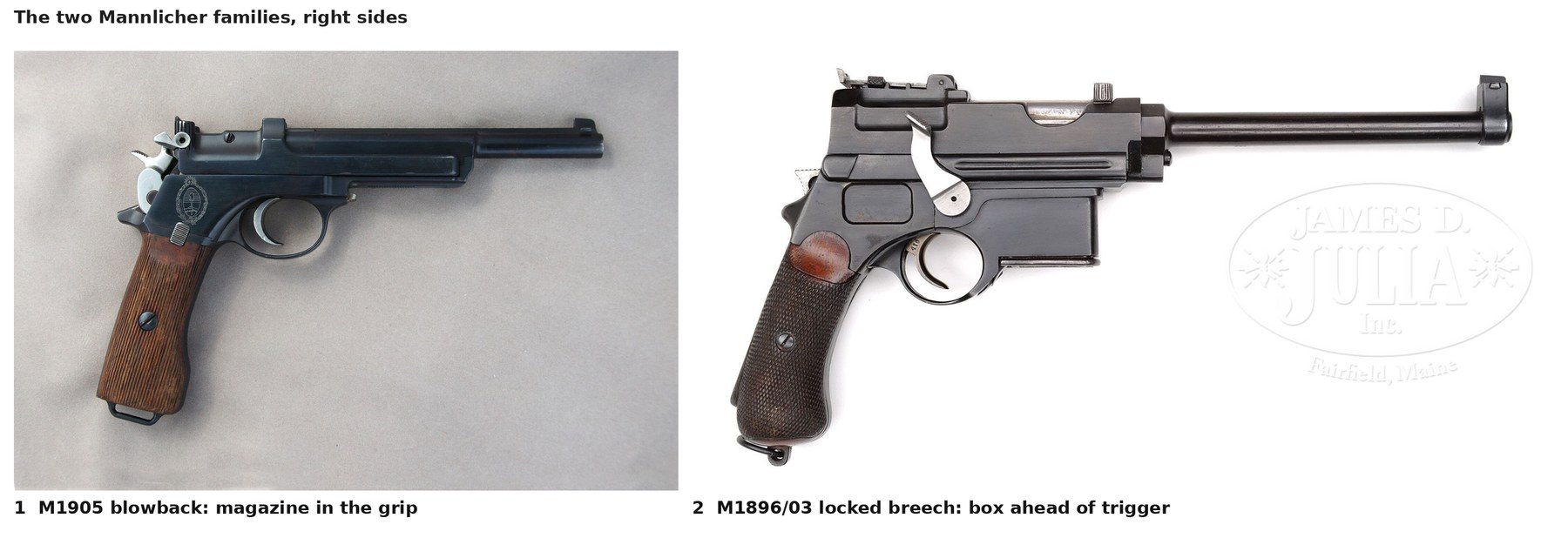
The two Mannlicher families (Vol 1) are easy to tell apart from either side, and it matters, because they fire different cartridges (Vol 7). Look at where the magazine is.
- Magazine in the grip, no box ahead of the trigger, external hammer, slide arms running forward under the barrel: the blowback pistol, M1900, M1901 or M1905.
- Box magazine ahead of the trigger guard, no visible hammer, a cocking lever on the right of the frame, a closed receiver like a Mauser C96’s: the locked-breech pistol (M1903 family), or one of its carbines.
5.2 Tell them apart: the table
Table 1 — Tell them apart: the table
| Feature | Blowback (M1900, M1901, M1905) | Locked breech (M1896, M1896/03, “M1903”) | Where to look |
|---|---|---|---|
| Magazine | Fixed in the grip; filled from the top; emptied by a serrated lever on the right of the grip | Detachable box ahead of the trigger guard, released by a button at the front of the guard | Below the action; front of the trigger guard |
| Hammer | External, behind the breechblock | Concealed; a cocking lever on the right of the lock housing | Rear of the frame; right side |
| Top of the action | Open: a short breechblock behind the fixed chamber, slide arms along the barrel | Closed receiver with a bolt inside it and a knurled grip on top | Above the trigger |
| Barrel | Fixed; slide arms beneath it | Moves with the receiver; no slide arms | Under the barrel |
| Stock fitting | None known | T-slot milled in the back of the grip strap (long pistol) | Back of the grip |
| Cartridge | 7.63 mm Mannlicher, straight case (M1900: 8 mm rimmed) | 7.65 mm Mannlicher, bottlenecked | Chamber, never the barrel marking alone |
Sources: Vol 3 and Vol 4, from Wille (1902), Smith (1947), Hogg and Walter, and the auction records cited there.
5.3 Within the blowback pistols
The blowback pistols differ in maker, markings, safety and, by some accounts, grip and magazine. The table sets out what the sources say; it is the identification rule this dive applied to every photograph.
Table 2 — Within the blowback pistols
| Model or group | Markings | Other features | Source |
|---|---|---|---|
| M1900, 8 mm | Not described in the sources consulted beyond Mannlicher’s motif on 1898-type guns | 8 mm rimmed chamber; early guns with a left-side safety lever above the grip plate, or none; side cover held by a screw through the trigger guard | Buffaloe1; thinline2 |
| M1901, early (Sömmerda) | Rib: “MUN. & WAFFENFABR. SOEMMERDA A-G. VORM. V. DREYSE.”; left slide: “PATENT MANNLICHER.” | Fixed 8-round magazine; 5½ in barrel | RIA lot 14303 |
| M1900–1901 generally | ”PATENT MANNLICHER” on the front of the left slide arm | — | Thinline2 |
| M1901, Steyr | ”WAFFENFABRIK STEYR” on the left lock cover | Slide-mounted hammer-blocking safety | Thinline2; Terrell photograph |
| M1901, Dutch trial | Split: left “WAFFENFABRIK / STEYR”, right “SYSTEM / MANNLICHER”; encircled “T” proof | Safety lever on the LEFT of the slide; described as short grip | Julia lot 12924 |
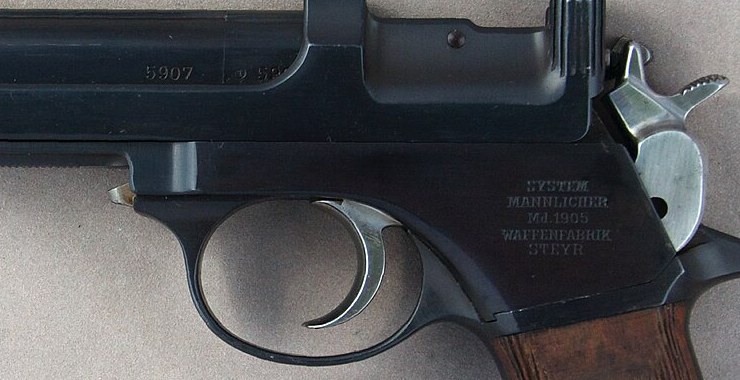
| M1905, commercial | Left frame “Md.1905/WAFFENFABRIK/STEYR” (three lines) and right “SYSTEM MANNLICHER”; or, late, all five lines on the left | 6¼ in barrel; serial along the bottom of the side plate late in production; Vienna proof numbers under the slide | Thinline2; Julia lot 12935; RIA lot 3126 |
| M1905, Argentine | Left: five lines “SYSTEM / MANNLICHER / Md.1905 / WAFFENFABRIK / STEYR”; right: the Argentine national arms | Arms often ground off and the pistol reblued after sale | Thinline2; Forgotten Weapons7 |
| M1905, Austro-Hungarian officer’s | As commercial; occasionally a privately added eagle on the right | Serials recorded 3422–4322 | Thinline2 |
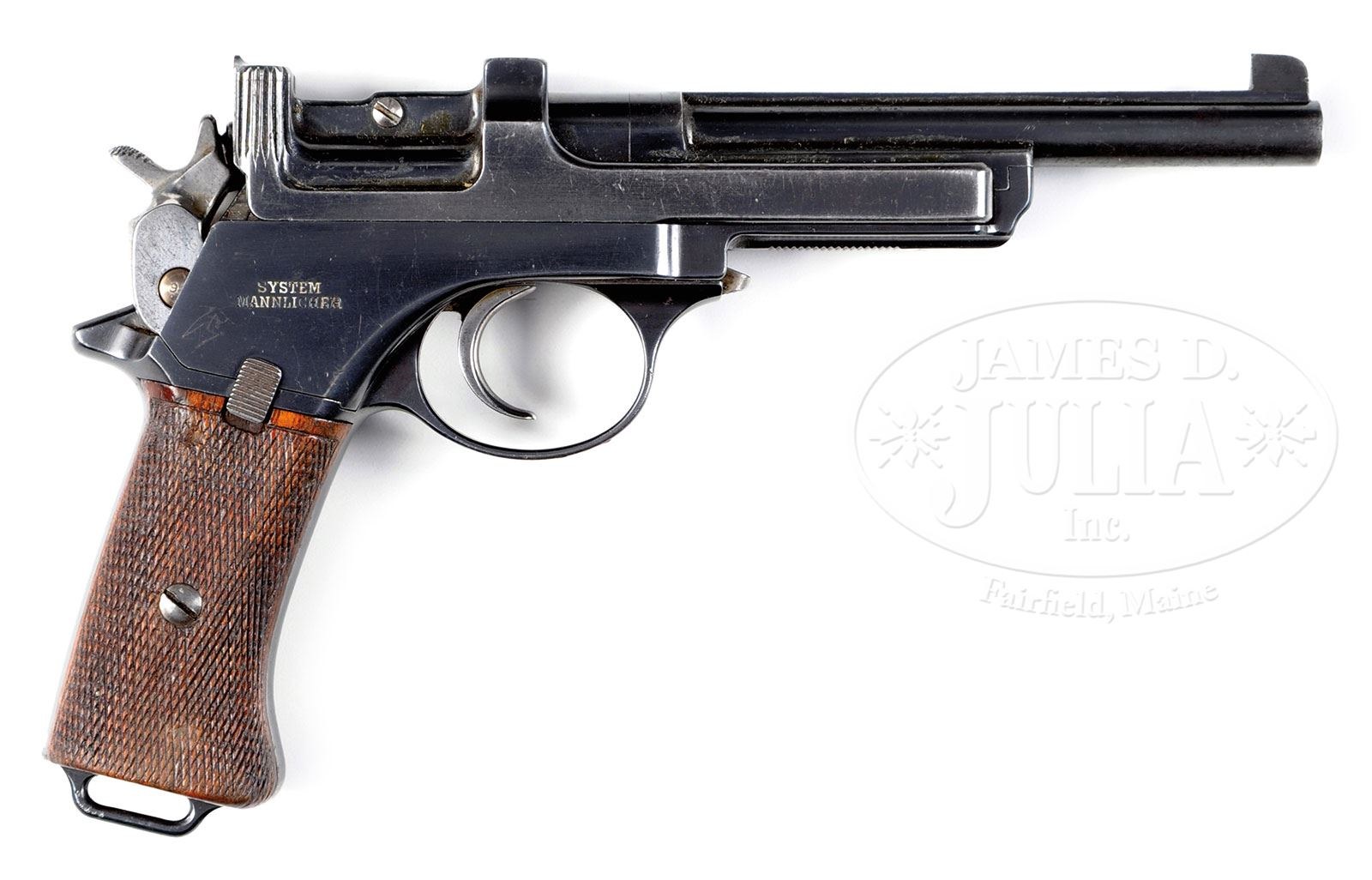
Two cautions come out of the table. First, a five-line left marking does not prove an Argentine contract pistol: Julia sold a late commercial M1905 marked that way.5 Second, a marking of “RA” on the backstrap, which collectors associate with Argentina, appeared on an M1905 that Rock Island Auction said was “not from that contract”.6 The arms on the right, or the ground patch where they were, are the safer test.
5.4 The grip and magazine question
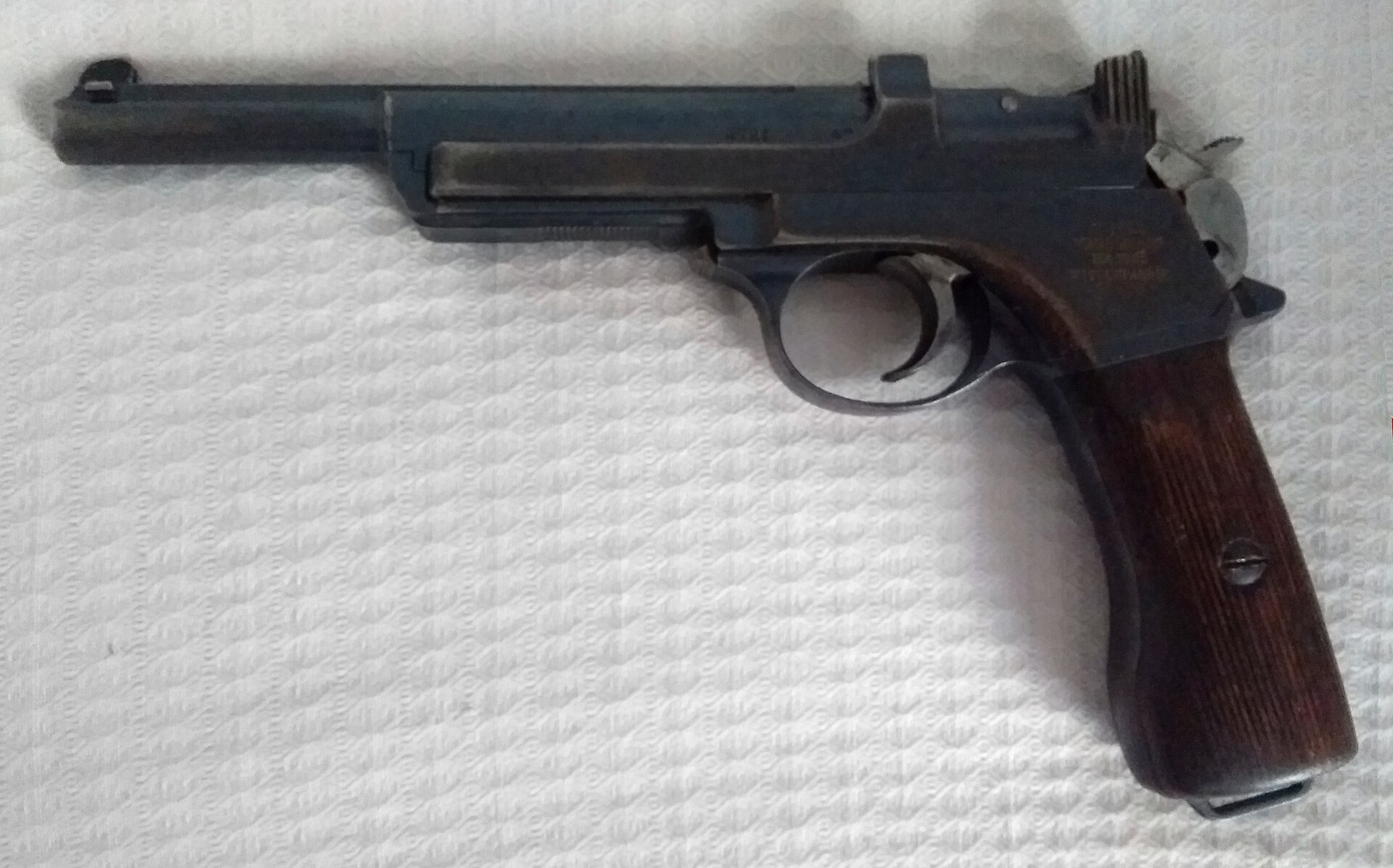
Sources disagree on what separates an M1901 from an M1905. Forgotten Weapons and Rock Island Auction give the M1905 a larger frame and a ten-round magazine against the M1901’s eight; Hogg and Walter give the M1905 eight; Julia describes “short grip M1901/M1905 pistols”, which suggests that a short and a long grip existed side by side.7624
The plate below puts three pistols together, left sides, at a common scale set by the inside height of the trigger-guard ring. The scaling assumes that the trigger guard did not change between models, which was not confirmed, and the measurements were taken by eye from photographs, so the grip lengths can be compared only roughly. The M1901 photographed by Terrell has visibly the shortest grip of the three. The Dutch trial pistol, which Julia calls short-gripped, and the Argentine M1905 are closer to each other than the labels would suggest.
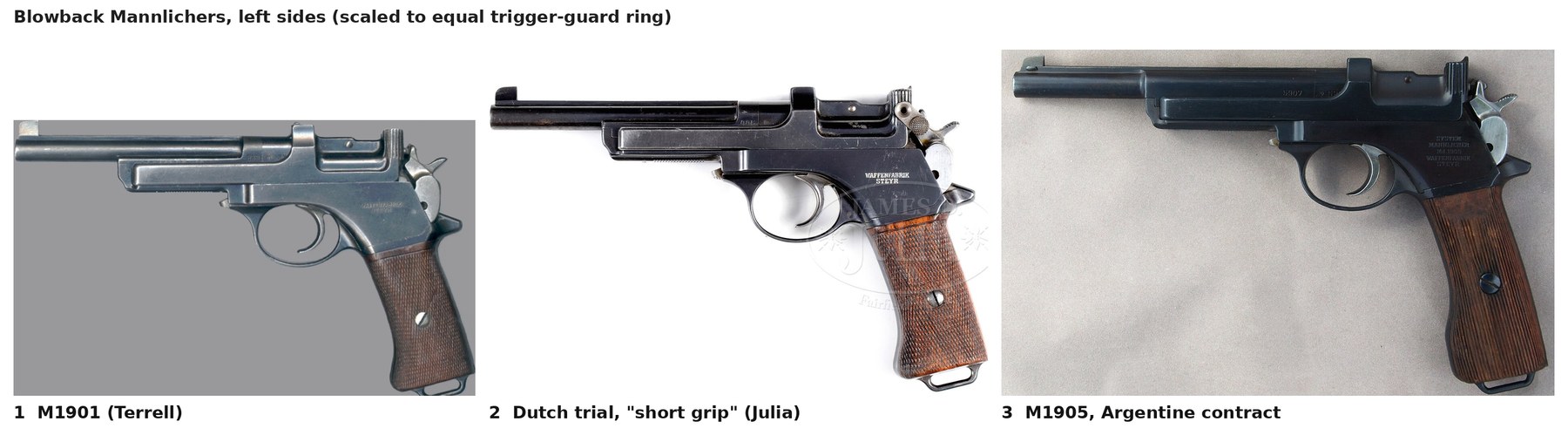
The practical rule for a reader with a pistol in hand: count what the magazine holds, by loading dummy rounds one at a time, and measure the grip. The model marking says when the pistol was made, not necessarily which grip it has.
5.5 Markings, close up
Proof marks. Austrian proof marks appear on the barrel and frame. Julia’s description of a late M1905 says that retracting the slide “shows a series of Vienna proof house marks and numbers; this was the 4795th pistol proofed in 1909”.5 Terrell’s M1901 has a number line under the slide ending in what appears to be ”. 03” (Vol 2). On this evidence the proof-house number gives a pistol’s proof year, which is a better date than the serial number. No published key to the Vienna proof-house registers was consulted, and this reading should be confirmed against one.
Serial numbers. Julia records the full serial “on the left side of bbl and chamber” and, late in production, “longitudinally on the bottom of the sideplate, just forward of the serrations”, with grips “factory matched”.5 A pistol whose barrel, frame, side plate and slide numbers differ is mixed, whatever its condition.
5.6 Argentine pistols, with and without the arms
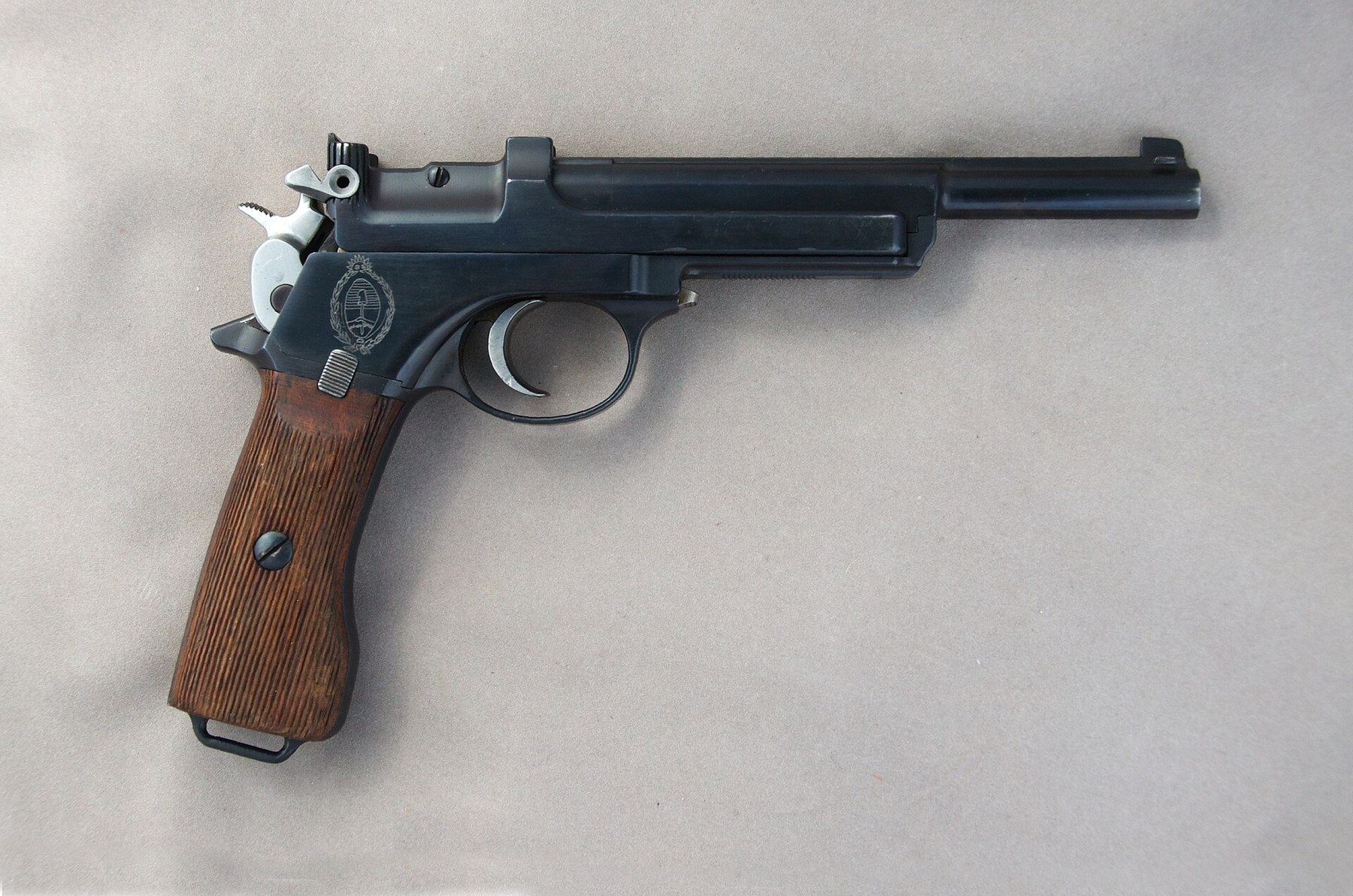
The Argentine M1905 is the commonest Mannlicher in the United States, and most of them have lost their arms. Forgotten Weapons says the surplus pistols that came to the American market in the 1960s are “often identifiable by the spot on the right side where the Argentine crest was ground off”.7 Collector listings add that many were reblued at the same time. A ground and reblued Argentine pistol shows:
- a flattened or dished area on the right of the frame, between the slide and the grip, where the arms were;
- the five-line marking on the left, which survived;
- a serial in the Argentine ranges thinline records (for example 3374–5975), though the ranges interleave with commercial numbers and prove nothing alone;2
- a uniform post-war blue over what should be a rust blue with the hammer, safety, trigger and side-plate release left in the white.5
A pistol with its arms intact, like the one photographed by Self Loader, is the exception and is valued as one (Vol 8).
5.7 Within the locked-breech line
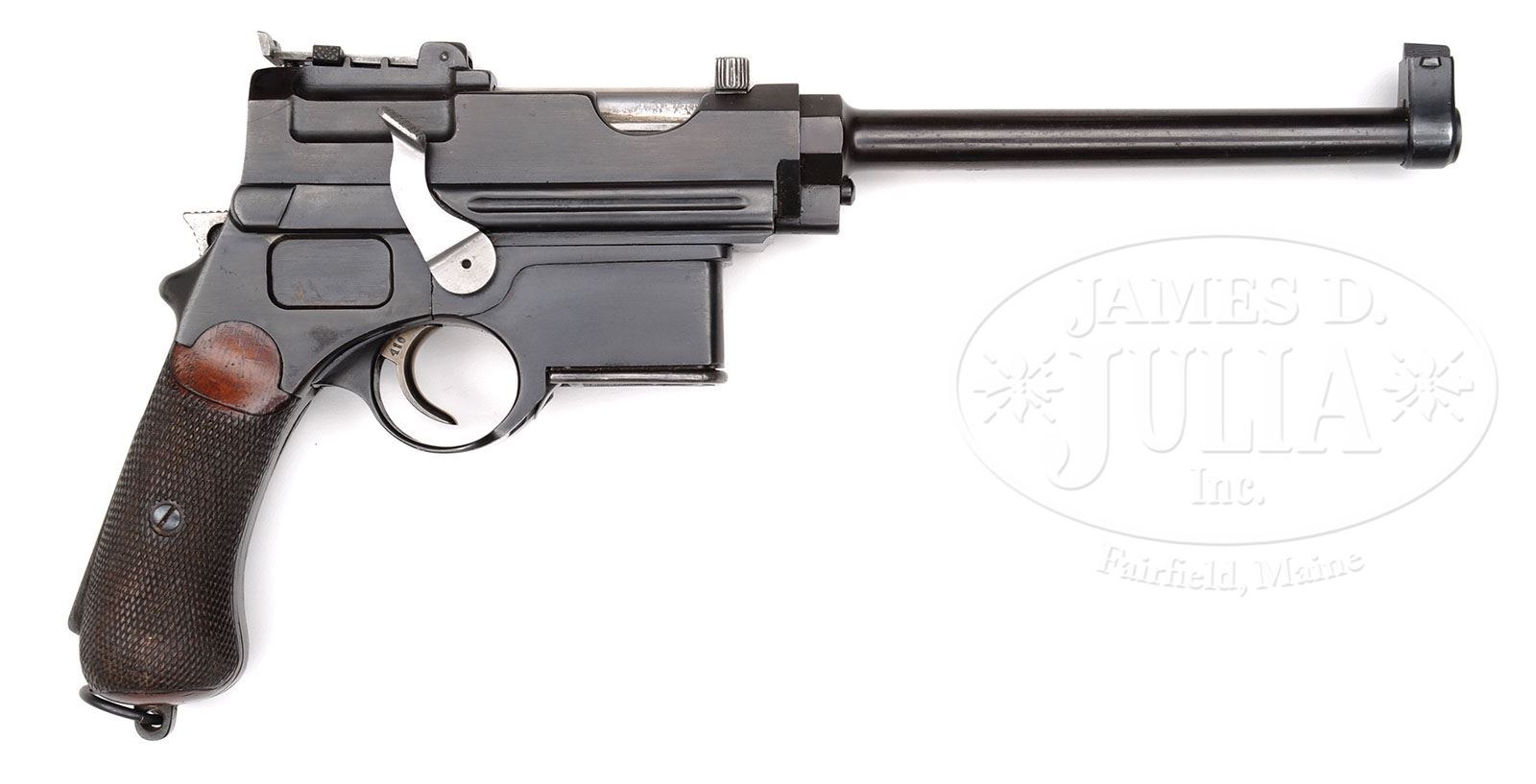
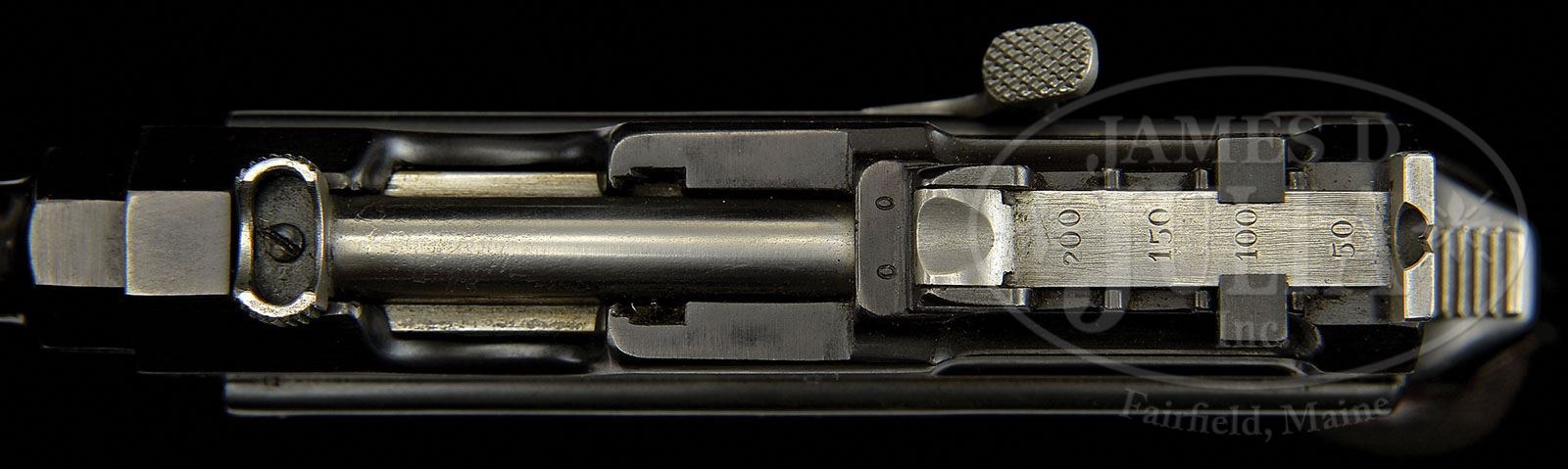
The locked-breech pistols are rare enough that every example is described individually by the auction houses. The distinguishing features, from Wille and the catalogue descriptions:
Table 3 — The locked-breech pistols are rare enough that every example is described individually by the auction houses. The distinguishing features, from Wille and the catalogue descriptions
| Form | Barrel | Sights | Stock | Fore-end | Source |
|---|---|---|---|---|---|
| M1896 | Not recorded | — | Some | — | Wikipedia8 |
| Long pistol (lange Pistole) | 152 mm (Wille); 6 in (Julia SN 410) | Tangent rear, 50–200 (Julia) | Leather holster-stock on a T-rail | None | Wille9; Julia lot 319210 |
| Short pistol (kurze Pistole) | 119 mm | Notch rear | None in Wille | None | Wille9 |
| Carbine (Selbstlade-Karabiner) | 300 mm (Wille); 11½ in (Julia SN 952) | Stepped rear to 500 m (Wille); 400 m (Julia) | Wooden butt, detachable by a knurled bolt through the tangs | Wooden, fixed to the barrel and recoiling with it | Wille9; Julia lot 115611 |
| M1901/04 carbine | 19 in | Short adjustable rear without graduations | Wooden butt | Fixed to the frame; barrel recoils inside it | Julia lots 1289, 371112 |
The quickest single test between the two pistols is the barrel length, then the rear sight. The quickest test between the two carbines is whether the fore-end moves with the barrel. A pistol with a T-slot in the back of its grip strap was made to take the holster-stock, whether or not one is with it; the law in Vol 8 applies when the stock is attached, not when the slot exists.
5.8 Not a Mannlicher
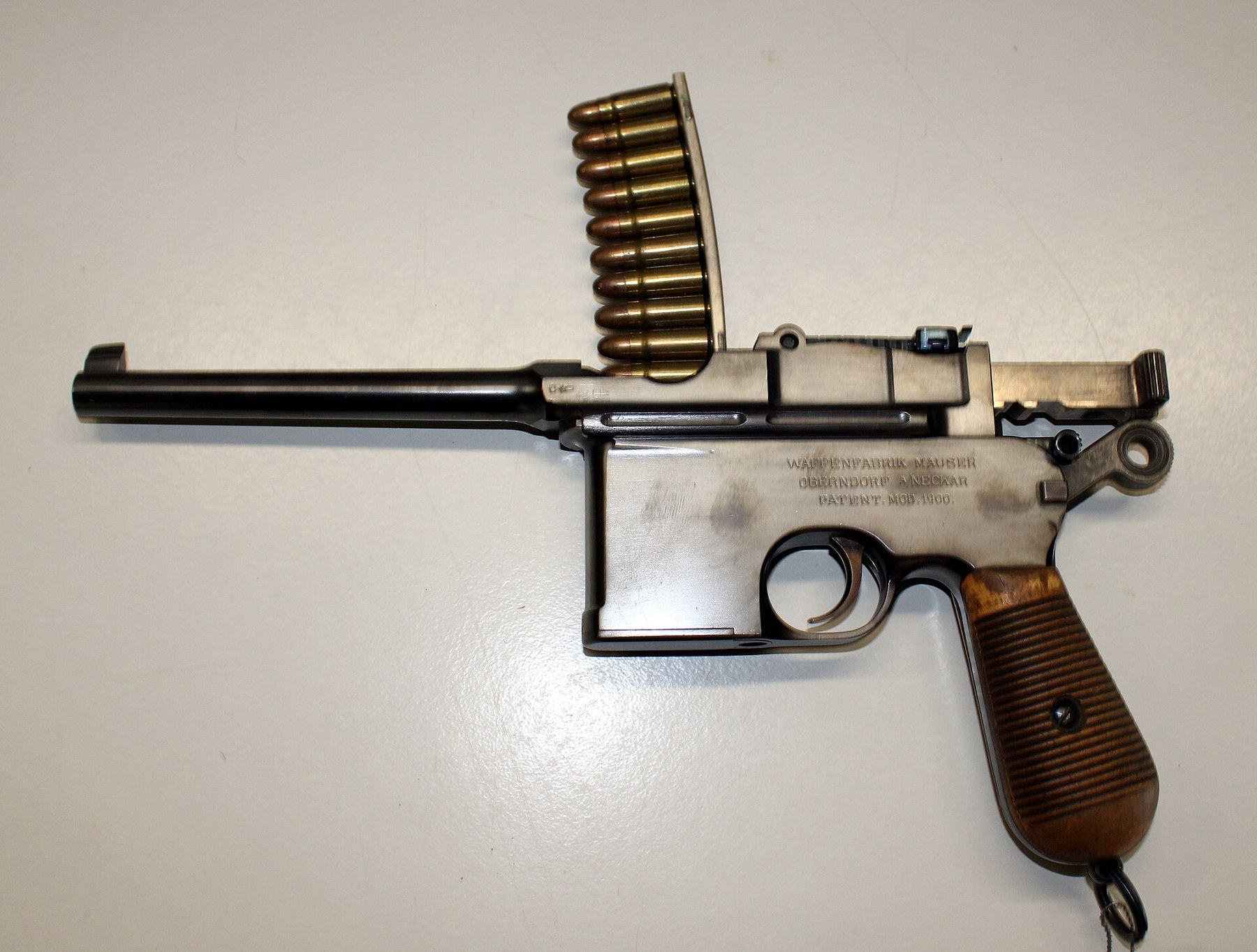
The locked-breech Mannlicher is often mistaken for a Mauser C96, and the confusion runs both ways in descriptions. An early C96 has its box magazine in the same place but has an exposed hammer (the “cone hammer” and “large ring” types), a rectangular receiver with the bolt visible on top, and no cocking lever on the right. The Mauser C96 dive covers C96 variants.
5.9 A checklist
Before buying or describing a Mannlicher pistol:
- Which family? Magazine in the grip or ahead of the trigger.
- Which cartridge? Have the chamber cast or measured. Do not trust a box, a barrel marking or a seller’s word (Vol 7).
- Which maker and model? Read the rib, slide and frame markings against the table above.
- Argentine or not? Look for the arms on the right, or the ground patch where they were.
- When proofed? Look under the slide for a Vienna proof number and year.
- All matching? Compare the serial on barrel, chamber, frame, side plate and grips.
- Original finish? Rust blue with bright small parts, or a later blue over a ground frame.
- For the locked-breech line: barrel length, rear sight, and whether a stock is present or the grip is slotted for one (Vol 8, the law).
5.10 What could not be established
- Whether the M1901 and the M1905 differ in grip length by model or whether both grips existed within each; the standard M1905 magazine capacity.
- The meaning of the “RA” backstrap mark.
- A published key to the Vienna proof-house numbers, and the meaning of the monogram proof on Terrell’s M1901.
- M1900 markings; no M1900 was examined in photographs.
References
Footnotes
-
Ed Buffaloe, “The Steyr-Mannlicher M-1900”, Unblinking Eye, https://unblinkingeye.com/Guns/SM1900/sm1900.html, consulted 2026-10-19. ↩
-
“Argentine Mannlicher Pistol Model 1905”, thinlineweapons.com, https://thinlineweapons.com/Hungariae/Mann05.htm, consulted 2026-10-19. ↩ ↩2 ↩3 ↩4 ↩5 ↩6 ↩7 ↩8
-
Rock Island Auction Company, sale 4093, 7 December 2024, lot 1430, https://www.rockislandauction.com/detail/4093/1430/rare-steyr-mannlicher-patent-model-1901-semiautomatic-pistol, consulted 2026-10-19. ↩
-
James D. Julia, October 2014, lot 1292, https://jamesdjulia.com/?p=522445, consulted 2026-10-19. ↩ ↩2
-
James D. Julia, October 2014, lot 1293, https://jamesdjulia.com/?p=522446, consulted 2026-10-19. ↩ ↩2 ↩3 ↩4 ↩5
-
Rock Island Auction Company, sale 51, 3 December 2010, lot 312, https://www.rockislandauction.com/detail/51/312/steyr-mannlicher-model-1905-semiautomatic-pistol, consulted 2026-10-19. ↩ ↩2 ↩3
-
Ian McCollum, “Mannlicher 1901 & 1905 Pistols (Video)”, Forgotten Weapons, 3 March 2017, https://forgottenweapons.com/mannlicher-1901-1905-pistols-video, consulted 2026-10-19. ↩ ↩2 ↩3
-
“Mannlicher M1901”, English Wikipedia, https://en.wikipedia.org/wiki/Mannlicher_M1901, consulted 2026-10-19. ↩
-
R. Wille, v. Mannlichers Selbstlade-Karabiner und Karabiner-Pistole m/1901 (Berlin 1902), pp. 12, 18–19, 38–40. Scan via Forgotten Weapons, consulted 2026-10-19. ↩ ↩2 ↩3
-
James D. Julia, October 2013, lot 3192, https://jamesdjulia.com/?p=484812, consulted 2026-10-19. ↩
-
James D. Julia, Spring 2009, lot 1156, https://jamesdjulia.com/?p=463137, consulted 2026-10-19. ↩
-
James D. Julia, October 2014, lot 1289, https://jamesdjulia.com/?p=522442, and October 2015, lot 3711, https://jamesdjulia.com/?p=535743, consulted 2026-10-19. ↩
Comments (0)