Mannlicher M1901 & M1903 · Volume 6
Field Strip, Detail Strip, Care and Repair
The locked-breech pistol's disassembly in the order its 1902 description gives, what is and is not known about taking down the blowback pistol, how to keep either working, and what breaks
6.1 Read this first
The two families need different treatment, and the evidence for them is very different.
For the locked-breech pistol (the M1903 family) there is a period description, Wille’s of 1902, that gives the full order of disassembly and reassembly and the cleaning instructions. It is quoted and translated below. Wille wrote it for the carbine; his second section says the pistol differs only in barrel, sights, stocking and weight, with the same breech, lock and magazine, so the same order applies less the wooden fore-end and butt.1
For the blowback pistol (M1901, M1905), no factory or military manual was found. Wille wrote one in 1902, and Rock Island Auction sold an original copy with a pistol in 2024, but no scan of it was located.2 What follows for that pistol is assembled from Smith’s 1947 drawings and captions, Wilson’s 1943 description as summarised on English Wikipedia, and collector descriptions, each cited. It is a set of facts about the pistol, not a tested procedure, and it says so where it matters.
Both pistols are over a century old. Many springs in them are original, the steel is not modern steel, and replacement parts are not made. Disassemble only as far as the job needs.
6.2 Unloading either pistol
Blowback pistol. Draw the slide back by its serrated sides and hold it. Press the serrated lever on the right of the grip down: it withdraws the magazine lip and the spring pushes the cartridges out of the top, “so it is necessary to ensure there is a waiting hand strategically positioned to catch them” (Branch).34 Any round in the chamber is extracted by the slide. Look into the chamber and the magazine. To close the slide on an empty magazine, draw it back slightly to ride it off the cam and let it go forward.4
Locked-breech pistol. Wille’s instruction, translated: proceed as for refilling, that is press the magazine catch at the front of the trigger guard and draw the magazine out; or hold the pistol with the hollow of the left hand under the magazine opening, draw the bolt back by its grip with the right, and the cartridge in the barrel falls out “aus dem Magazinkasten in die linke Handhöhlung”, out of the magazine housing into the left hand.1 To close on an empty magazine, press the follower’s guide rib, which projects into the bolt’s path, down with the left thumb, hold the bolt by its grip and let it run forward slowly under its spring.1 To lower the hammer, use the cocking lever “wie bei jeder andern Schusswaffe”, as with any other firearm, with the chamber empty.1
6.3 The locked-breech pistol: Wille’s order of disassembly
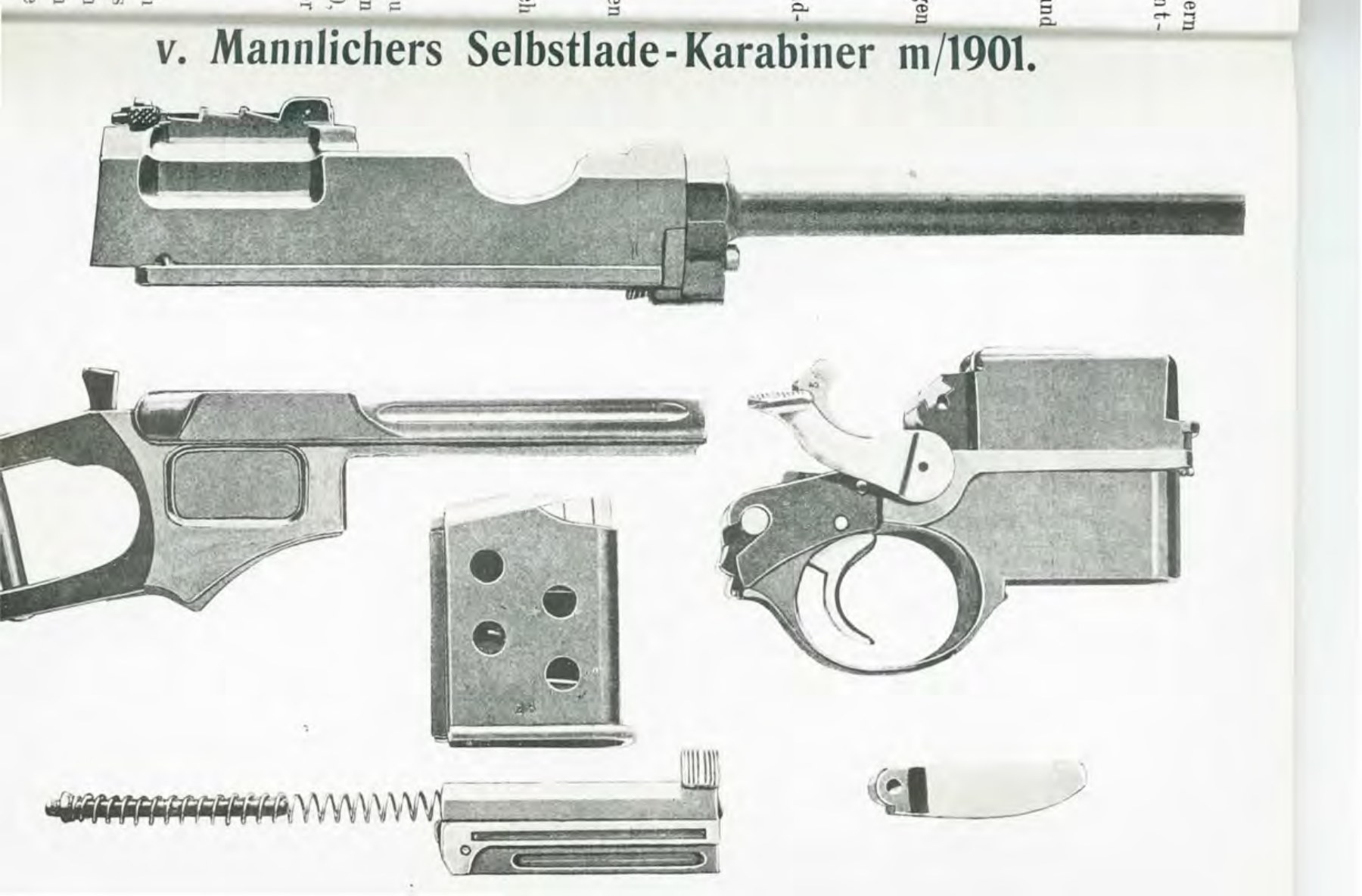
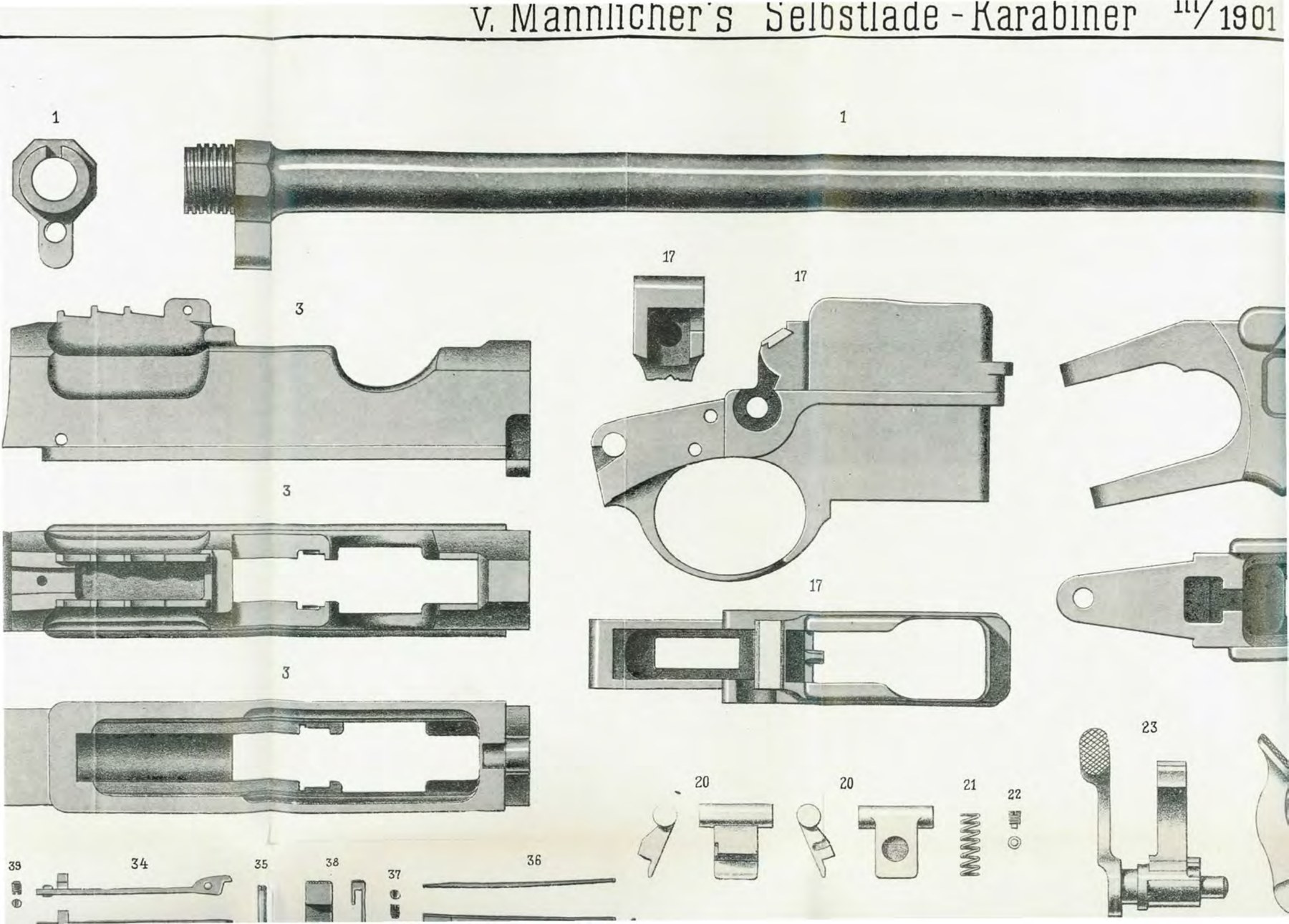
Wille lists the main parts in the order they come off. His text is translated with his part numbers (Vol 4 has the parts table).1
“Das Abnehmen der Hauptteile geschieht in nachstehender Reihenfolge:”
- Lock and magazine housing (17). “herausheben, nachdem der Schnepper, welcher ihn im Rahmen festlegt, mit dem Schraubenzieher oder dergl. niedergedrückt worden ist”: lift it out, after pressing down with a screwdriver or the like the catch (20) that holds it in the frame.
- Barrel with receiver (1, 3). “vom Rahmen nach vorn abschieben”: slide forward off the frame.
- Safety (33). “durch Aufwärtsdrehen aus dem Rahmen entnehmen”: take out of the frame by turning it upward.
- Strut pin (15). “mit einem Stift auf ihre linke Endfläche drücken und sie dann nach rechts herausziehen”: press on its left end with a pin and draw it out to the right.
- Strut (14).
- Bolt (5). “ein wenig zurückziehen und nach unten aus dem Gehäuse entfernen”: draw it back a little and remove it downward out of the receiver.
- Barrel spring (4).
- Guide rod (11).
- Recoil spring with thrust plate (9, 10).
- Retaining pin (7).
- Firing pin (6).
- Firing-pin spring (8).
- Magazine (40). “durch einen Fingerdruck auf den Drückergriff der Haltefeder lösen und aus dem Magazinkasten herausziehen”: release it by pressing the catch’s button and draw it out of the housing.
- Follower spring (43). “den Magazinboden abschieben”: slide the floorplate off.
- Follower (42).
Step 13 can of course come first, and in practice should: an unloaded pistol with its magazine out is the starting point for everything above.
The lock. “Ein Zerlegen des Schlosses wird nur in seltenen Fällen erforderlich”: taking the lock apart is necessary only rarely. With the hammer down, in order:1
- Sear with its pin (31, 32).
- Trigger with its pin (25, 29).
- Trigger spring (30): “fällt heraus”, falls out.
- Hammer (23): “nach rechts herausschieben”, push out to the right.
- Mainspring (24): falls out.
The trigger, the trailing link, its pin and spring (25–28) “werden auch beim Zerlegen der Waffe nicht voneinander getrennt”: are not separated even when the weapon is taken apart.1
6.4 The locked-breech pistol: reassembly
“Das Zusammensetzen erfolgt in umgekehrter Reihenfolge wie das Zerlegen”: reassembly is in the reverse order. Wille adds the details that matter:1
- Magazine. Follower and follower spring into the magazine; close the floorplate; push the magazine into the housing “so weit …, dass die Haltefeder einschnappt”, until the catch snaps in.
- Lock, if it was taken apart. Mainspring first: “den flachen Schenkel mit dem Schraubenzieher oder dergl. gegen die Rückwand des Gehäuses drücken und gleichzeitig den Hahn von rechts nach links so in den Schlosskasten einschieben, dass das Horn der Feder am Absatz der Hahnwelle anliegt”, press its flat limb against the rear wall of the housing with a screwdriver, and at the same time push the hammer into the lock housing from right to left so that the spring’s horn bears on the shoulder of the hammer axle. Then trigger with pin; trigger spring, “so einlegen, dass der längere Arm auf dem Abzug ruht, während der kürzere nach oben weist”, with the longer arm on the trigger and the shorter pointing up; sear with pin; safety into the frame.
- Bolt. Firing pin with its spring; retaining pin; bolt “mit Verschlussfeder und Führungsspindel von unten in das Gehäuse legen”, laid into the receiver from below with its recoil spring and guide rod; strut with its pin; barrel spring.
- Finally. Receiver with bolt: “von vorn in die Nuten des Rahmens einschieben”, slid from the front into the frame’s grooves. Lock housing: “mit dem vorderen Ansatz voran von unten in den Rahmen einführen und durch eine drehende Bewegung nach rückwärts in eine solche Lage bringen, dass der Schnepper einspringt”, front lug first from below into the frame, then swung rearward until the catch snaps in.
A function check, derived by this dive. Wille gives none. After reassembly, with the pistol empty and pointed safely: the bolt should draw back and return freely; the barrel and receiver should move a few millimetres to the rear by hand against the barrel spring and return; the cocking lever should cock and, with the trigger pulled, fall; with the trigger held back after a dry fall and the bolt cycled, the hammer should stay cocked until the trigger is released and pulled again (Vol 4, the disconnector); the safety, pushed up, should block the hammer cocked and uncocked; an empty magazine should hold the bolt open. This check is inferred from the mechanism Wille describes, not quoted from him.
6.5 The blowback pistol: what the sources say
These are the statements found about taking the blowback pistol apart. They are given as their sources give them.
- No tools. Pollard, 1920: “the whole weapon can be taken apart by hand and without tools”, and later, “the pistol is easily taken apart”.5
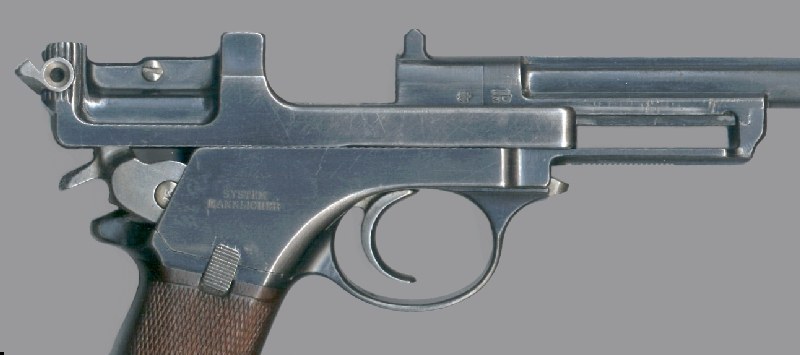
- The side cover. Wilson, as summarised: the lockwork on the left “is covered by a removable side cover housing of unusual design, being wrapped around at the forward end and serving also as a cover of the recoil spring … This cover is installed on the frame from the front, and is retained by a spring catch forward of the trigger-guard.”4 Hogg and Walter: “The plate covering the spring mechanism is joined to the lockwork plate by a forward-sweeping arm. This arm is locked beneath the return spring by a spring catch.”6 English Wikipedia credits the M1901 with “a lever lock for easier disassembly”.4 Julia describes the “sideplate release” as one of the parts left in the white.7
- Early guns used a screw. Buffaloe: on the early Rheinmetall-made guns the side cover is removed by taking out “the screw through the trigger guard bow from the right side”, and “some early Steyr guns may have kept this screw”.8
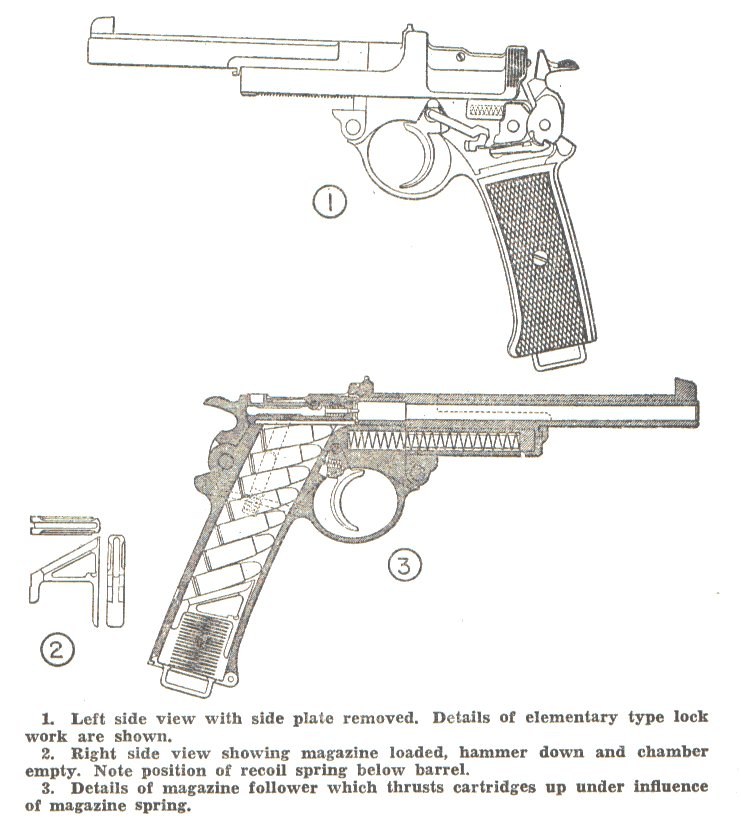
- The slide comes off forward. Smith’s caption to his p. 218 drawing: “Right side view with side plate removed showing slide being pulled back and raised to permit it to be pushed forward over the barrel for removal. The hammer is at full cock and the operation of the mainspring can be seen.”9
- What is under the covers. With the left cover off, the “elementary type lock work”; with the right cover off, the “slide locking cam and mainspring” (Smith).9 Julia: “Removing the sideplate shows all matching small parts.”7
6.6 The blowback pistol: what a correct procedure must account for
No factory sequence was found, and this dive does not invent one. A correct field strip of the blowback pistol must account for the following, all from the sources above:
- Unload first (above), and keep the magazine-unloading lever and chamber checks in that order.
- The cover catch or the screw. On most pistols a spring catch ahead of the trigger guard holds the wrap-around side cover; on early pistols a screw through the trigger-guard bow does. Identify which before forcing anything.
- The cover comes off forward. It was “installed on the frame from the front”; its forward arm locks under the recoil spring.46 The recoil spring’s position therefore affects the cover.
- The cam and mainspring are loaded. The right cover hides a V mainspring whose upper arm presses the cam up and whose lower arm drives the hammer. Both are under load whenever the pistol is assembled. Smith’s drawing shows the slide coming off with the hammer at full cock.9
- The slide comes off over the barrel. It is drawn back, raised at the rear and pushed forward over the barrel.9 It carries the extractor and firing pin; the recoil spring lies under the barrel between its arms.
- Reassembly is the reverse, with the slide fitted over the barrel and drawn back onto the frame before the covers go on, and the cover catch or screw fully engaged before any live round goes near the pistol.
Where a step resists, stop. A gunsmith who has handled the pistol, or a copy of Wille’s 1902 booklet on it, is the remedy.
6.7 Cleaning and lubrication
Wille’s instruction for the locked-breech pistol, which is the only period cleaning instruction found for any Mannlicher pistol: “Nach jedem Schiessen wird die Laufseele in der gewöhnlichen Weise gründlich ausgewischt sowie Verschluss und Riegel gereinigt und leicht gefettet. Den Zubringer wischt man fett ab, und auch das Schloss ist nach seiner oberflächlichen Reinigung ein wenig zu fetten”: after every shooting the bore is thoroughly wiped out in the usual way, and the bolt and strut cleaned and lightly greased; the follower is wiped free of grease, and the lock too, after a superficial cleaning, is lightly greased.1
Read for a modern owner, that is:
- Bore cleaned after every session; with surplus ammunition, assume corrosive priming (below) and clean the same day with a water-based solvent before oiling.
- Bolt and strut, the locking surfaces, cleaned and lightly lubricated. On the blowback pistol the equivalent surfaces are the breechblock’s underside slot and the cam tip, and the slide arms’ guides.
- Magazine follower dry. Grease there collects dirt in the magazine.
- Lock work lightly lubricated, not flooded; on the blowback pistol it lies under the side covers and can be reached once they are off.
Corrosive ammunition. The only factory ammunition commonly found is Argentine surplus of the 1940s, “which is noted to have pretty hard primers”.10 Whether it is corrosive was not established from any source. Treat any surplus as corrosive until it is known not to be.
Finish. Original Steyr pistols were rust blued with the hammer, safety, trigger and side-plate release left bright.7 Rust blue is thin; abrasive cleaning removes it. Oil on a soft cloth, not wire brushes, on the outside. A holster-stock is leather; Julia describes “considerable crazing of the body” on an original one.11 Leather that has dried out should be dressed by a conservator, not with household products.
6.8 Inspection and the parts that wear
No maker published service intervals for these pistols, and none are invented here. What the mechanism and the record suggest:
- The V mainspring of the blowback pistol does two jobs, driving the hammer and pressing the cam that retards the slide. A weak mainspring means light strikes and also less resistance to the slide’s opening. Inspect it for cracks at the bend whenever the right cover is off.
- The strut, its pin and the step block of the locked-breech pistol carry the firing load. Inspect the strut’s front bevel, the bolt’s rear bevel and both steps of the block for peening, cracks or rounding. Wille thought the pistol’s chamber had a safety margin of “mindestens 45 %” over its own cartridge’s pressure; he says nothing about the strut’s margin, and nothing about the Mauser round (Vol 7).1
- The barrel spring of the locked-breech pistol returns barrel and receiver. If it is weak, the barrel group may not return fully and the strut may not climb onto its upper step: the pistol may then fire with the breech not fully locked, which the mechanism (Vol 4) makes a serious fault.
- Firing-pin springs on both pistols retract the pin. A broken one can leave the pin forward.
- Small springs break with age. Julia’s 2009 catalogue notes a broken rear-sight leaf spring on the carbine it sold, “a simple repair by a competent gunsmith”.12
- Bore. Surplus pistols often have eroded bores; Julia describes a “dark bore with easily discernible rifling” even on a high-condition commercial M1905.7
6.9 Malfunctions and their causes
The record of malfunctions in these pistols is thin. What it contains:
Table 1 — The record of malfunctions in these pistols is thin. What it contains
| Symptom | Possible cause | Source or basis |
|---|---|---|
| Misfires with surplus ammunition | Hard primers in 1940s Argentine ammunition; weak mainspring or firing-pin spring | Forgotten Weapons post10; mechanism |
| Locked-breech pistol: barrel and receiver stay back after a shot | Normal until the bolt returns; a fault only if they stay back after the bolt has closed (weak barrel spring, dirt in the frame grooves) | Wille1 |
| Locked-breech carbine: action starts to open when the shooter pulls the gun into the shoulder | Gripping the recoiling fore-end pulls the barrel back and begins to unlock | Julia, “as was noted by contemporary writers”; Wille’s instruction to hold the magazine housing131 |
| Blowback pistol: violent cycling, battered slide or frame | Ammunition loaded above the pistol’s design; “not being positively locked, it should not be used with overloaded cartridges” | Smith9 |
| Locked-breech pistol: damage after firing 7.63 Mauser | The Mauser round chambers, and is loaded to higher velocity; Hogg and Walter say the pistol “was not strong enough to stand up to firing the Mauser round” | Thinline after Hogg and Walter14; Vol 7 |
| Blowback pistol: will not chamber | Wrong cartridge (7.65 mm Mannlicher M1903, 7.65 Parabellum, 7.65 Browning); Vol 7 | Vol 7 |
| Hammer bite, pistol twisting in the hand | Grip high under a high bore line | One shooter’s comment10 |
6.10 Repair: bench, gunsmith, or leave it alone
At the bench, for a competent owner: unloading, the field strip of the locked-breech pistol by Wille’s order, cleaning and lubrication, and refitting magazines and covers.
For a gunsmith who knows early automatics: any spring replacement, which means making the spring (below); lock work on either pistol; the blowback pistol’s cam and mainspring; the locked-breech pistol’s strut, step block and barrel spring; and any work on a pistol whose matching numbers or original finish make it worth more than the repair. A competent gunsmith making a flat spring will want the broken one as a pattern.
Leave alone: refinishing. The auction record values original finish and ground Argentine arms are themselves part of a pistol’s history; Julia’s catalogue says of the expertly refinished M1896/03 that “the numbering is somewhat shallow and the proofing weak”.11 Re-engraving Argentine arms on a ground pistol would be the creation of a misleading object, and is not discussed further.
6.11 Parts
No commercial source of new or used parts for either pistol was found on 19 October 2026. A search for Mannlicher 1905 parts and reproductions returned only dealer and auction listings of whole pistols, and the large American parts houses did not appear.15 Parts therefore come from other pistols, at the price of breaking up an antique, or are made. Vol 9 sets out what a lab can make, and the springs are the hard part.
6.12 What could not be established
- A factory or military disassembly instruction for the blowback pistol (Wille’s 1902 booklet on it was not found).
- Whether 1940s Argentine 7.65 mm Mannlicher ammunition is corrosive.
- Any maker’s service interval or spring specification for either pistol.
- Any documented failure of a locked-breech pistol from 7.63 Mauser ammunition; Hogg and Walter’s statement is uncited.
References
Footnotes
-
R. Wille, v. Mannlichers Selbstlade-Karabiner und Karabiner-Pistole m/1901 (Berlin 1902), pp. 27–30, 37–39. Scan via Forgotten Weapons, http://www.forgottenweapons.com/wp-content/uploads/manuals/Mannlicher%201901.pdf, consulted 2026-10-19. Translations are this dive’s. ↩ ↩2 ↩3 ↩4 ↩5 ↩6 ↩7 ↩8 ↩9 ↩10 ↩11 ↩12
-
Rock Island Auction Company, sale 4093, 7 December 2024, lot 1430, https://www.rockislandauction.com/detail/4093/1430/rare-steyr-mannlicher-patent-model-1901-semiautomatic-pistol, consulted 2026-10-19. ↩
-
Jon C. Branch, “Mannlicher Model 1901 and 1905”, Revivaler, 4 August 2016, https://revivaler.com/mannlicher-model-1901-1905/, consulted 2026-10-19. ↩
-
“Mannlicher M1901”, English Wikipedia, https://en.wikipedia.org/wiki/Mannlicher_M1901, consulted 2026-10-19 (summarising Wilson 1943, pp. 134–137). ↩ ↩2 ↩3 ↩4 ↩5
-
Hugh B. C. Pollard, Automatic Pistols (1920), pp. 14, 24. Internet Archive, https://archive.org/details/automaticpistolspollard1920, consulted 2026-10-19. ↩
-
“Argentine Mannlicher Pistol Model 1905”, thinlineweapons.com, https://thinlineweapons.com/Hungariae/Mann05.htm, consulted 2026-10-19. ↩ ↩2
-
James D. Julia, October 2014, lot 1293, https://jamesdjulia.com/?p=522446, consulted 2026-10-19. ↩ ↩2 ↩3 ↩4
-
Ed Buffaloe, “The Steyr-Mannlicher M-1900”, Unblinking Eye, https://unblinkingeye.com/Guns/SM1900/sm1900.html, consulted 2026-10-19. ↩
-
W. H. B. Smith, Mannlicher Rifles and Pistols (1947), pp. 216, 218, as reproduced on Wikimedia Commons, consulted 2026-10-19. ↩ ↩2 ↩3 ↩4 ↩5
-
“Looking for Some 7.65mm Mannlicher Ammo…”, Forgotten Weapons, with reader comments, https://www.forgottenweapons.com/looking-for-some-7-65mm-mannlicher-ammo/, consulted 2026-10-19. ↩ ↩2 ↩3
-
James D. Julia, October 2013, lot 3192, https://jamesdjulia.com/?p=484812, consulted 2026-10-19. ↩ ↩2
-
James D. Julia, Spring 2009, lot 1156, https://jamesdjulia.com/?p=463137, consulted 2026-10-19. ↩
-
James D. Julia, October 2015, lot 3711, https://jamesdjulia.com/?p=535743, consulted 2026-10-19. ↩
-
“Austro-Hungarian Mannlicher M1903 Pistol”, thinlineweapons.com, https://thinlineweapons.com/Hungariae/Mann03P.htm, consulted 2026-10-19. ↩
-
Web search “Mannlicher 1905 pistol parts Numrich OR Gun Parts Corp OR replica OR reproduction”, 2026-10-19: results were dealer and auction listings of complete pistols only. ↩
Comments (0)