Mannlicher M1901 & M1903 · Volume 2
The Blowback Pistol: M1900, M1901 and M1905, and Argentina
How the commercial Mannlicher evolved, what it measured by each source, how many were made by each count, and the one army that bought it
2.1 The pistol in one paragraph
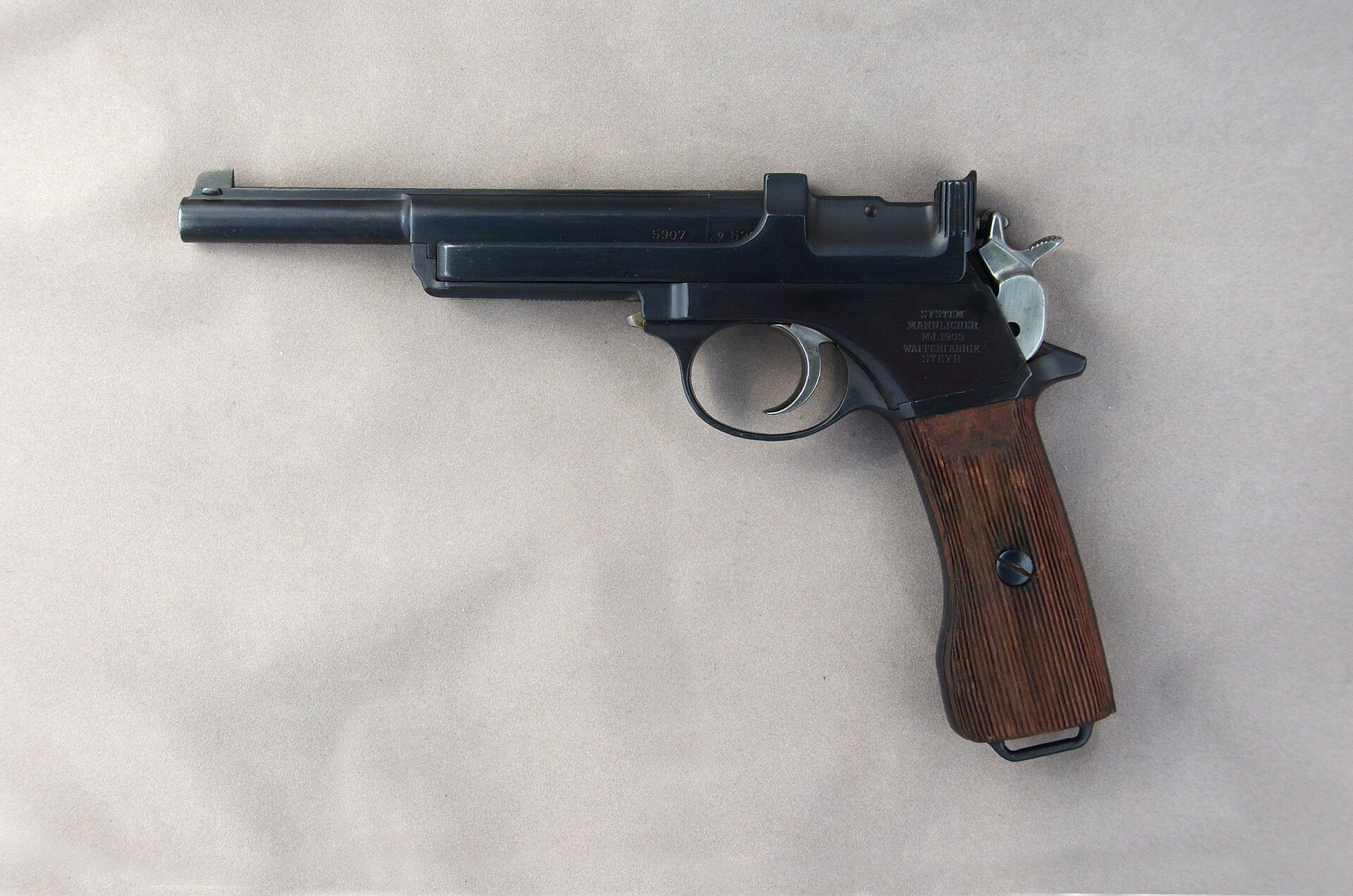
The blowback Mannlicher is a slim, long-barrelled pistol with an open-topped slide. A fixed barrel is screwed into a frame forged with the chamber. The slide is a short breechblock behind the chamber with two arms running forward under the barrel to a cross-beam, and the recoil spring lies under the barrel between them. An external hammer sits behind the breechblock. The trigger lockwork lies under a plate on the left of the frame and the mainspring under a plate on the right, the two plates joined by a forward arm that locks under the recoil spring. A fixed magazine in the grip is filled from the top with a stripper clip, and a lever on the right of the grip empties it. The breech is not locked. It is held shut by the mass of the slide, the recoil spring and a spring-loaded cam that the breechblock must push down before it can open.123 How that cam works, and how far it delays anything, is in Vol 4.
2.2 From M1900 to M1905
The models differ in calibre, markings, safety, grip length and maker. The sequence below is the consensus of the sources consulted; where they disagree, it says so.
M1900. The first production version, made from 1900 in an 8 mm rimmed cartridge. Buffaloe: “Only about 300 of the original M-1900 in 8mm were manufactured”, the first of them by Rheinmetall at Sömmerda, “a few hundred”, and some early guns had a safety lever on the left above the grip plate, “or no safety at all”.4 The factory name, from Smith, was Automatische Repetier-Pistole mit fixem Lauf und Packetladung M. 1900.3
M1901. The same pistol reintroduced in 1901 in the straight-cased 7.63 mm Mannlicher cartridge, and the first version sold in quantity. English Wikipedia credits it with the slide-mounted hammer-blocking safety and “a lever lock for easier disassembly”.2 Rock Island Auction describes an early example marked on the rib for Sömmerda and on the left of the slide “PATENT MANNLICHER.”, with a “fixed 8 round magazine” and a 5½-inch barrel.5 Thinlineweapons.com says pistols “made in 1900-1901 displayed ‘PATENT MANNLICHER’ on the front of the left slide arm”, and that “subsequently ‘WAFFENFABRIK STEYR’ appeared on the lock cover on the left side of the gun.”1
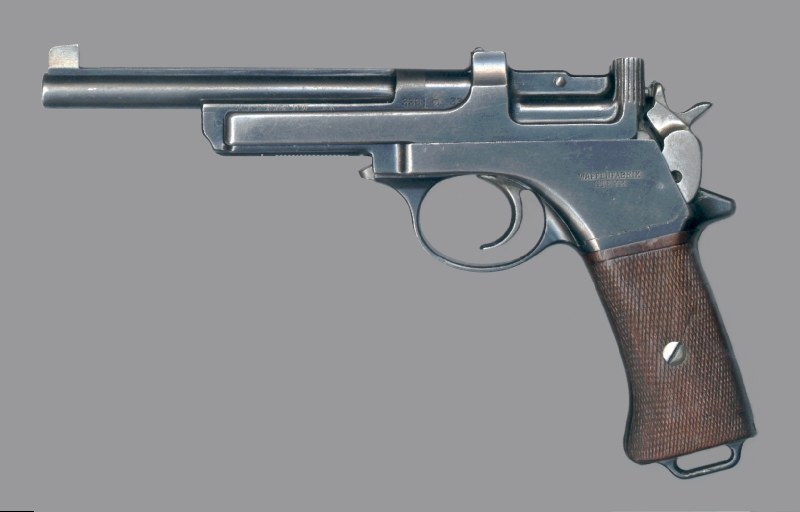
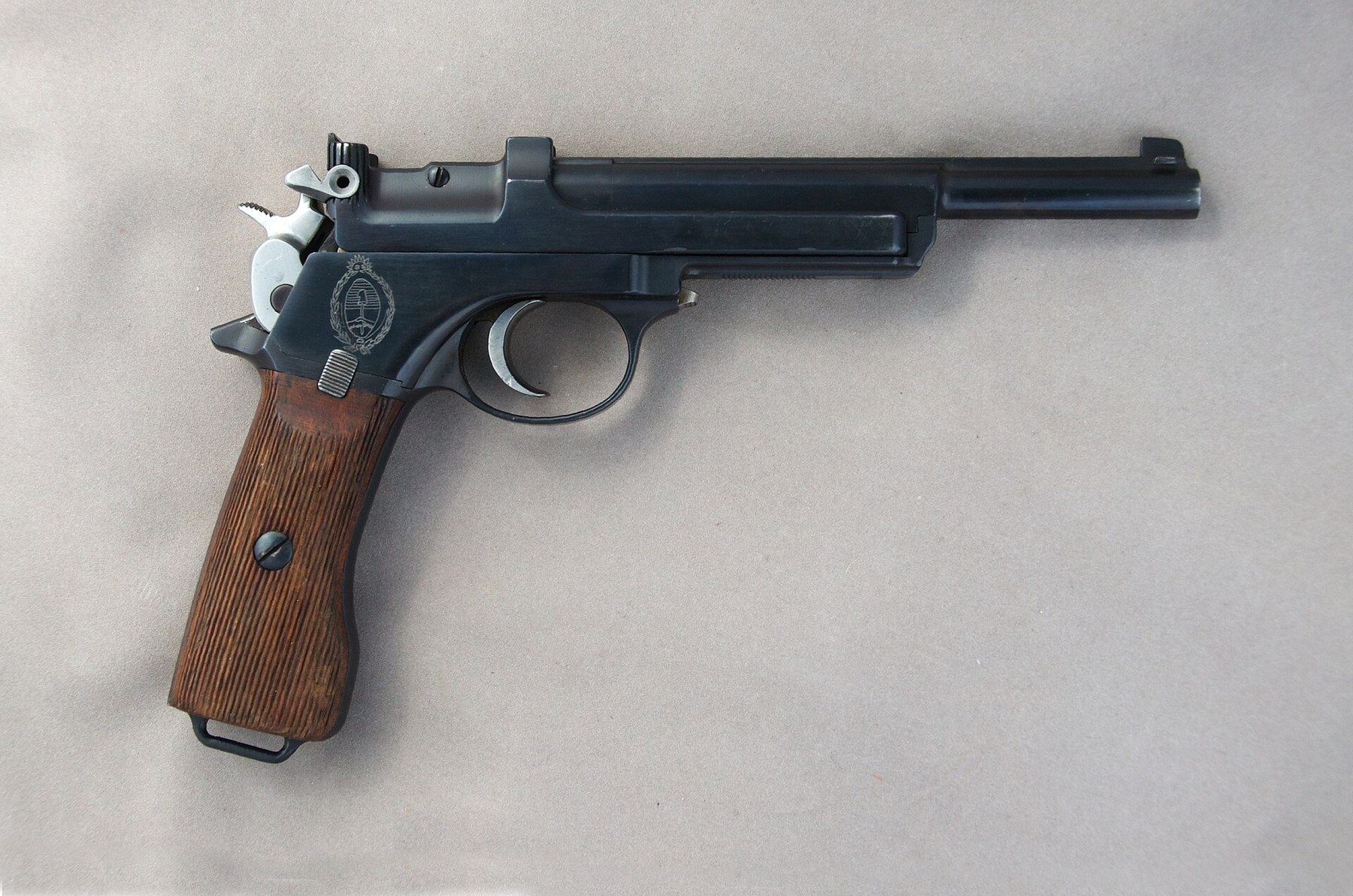
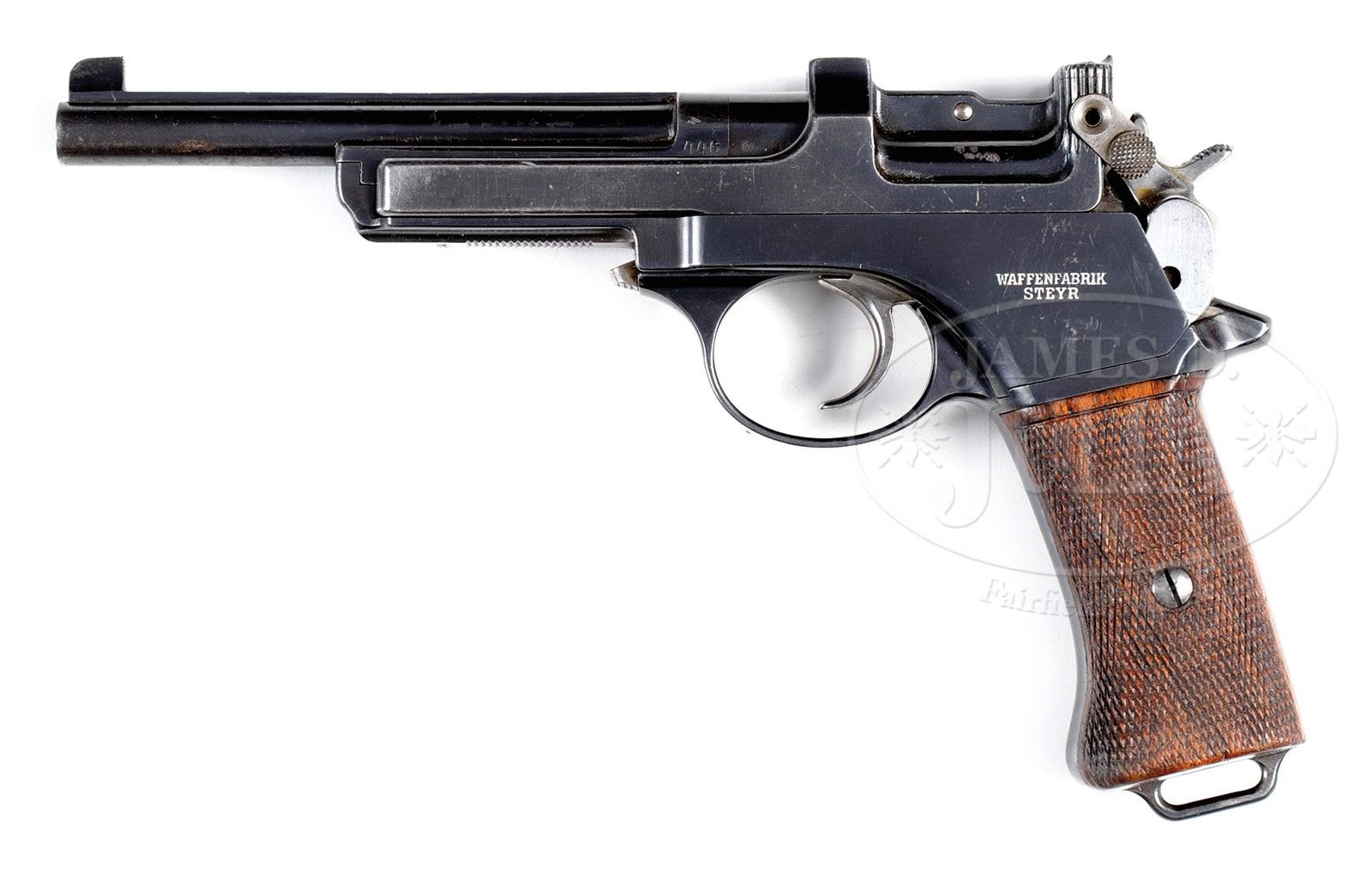
M1905. The final version, marked “Md.1905”. Thinlineweapons.com: excepting Argentine contract guns, “the M1905 is marked ‘Md.1905/WAFFENFABRIK/STEYR’ in three lines on the left frame panel and ‘SYSTEM MANNLICHER’ on the right”, while “the Argentine guns had all five lines on the left side to accommodate the national coat of arms on the right”; production ran to “about 1910”.1 A late commercial M1905 sold by James D. Julia in 2014, however, carried the five-line marking on the left too.6 So the five-line marking alone does not prove Argentine origin; the arms on the right do, or did before they were ground off (Vol 5).
What separates an M1905 from an M1901 is less settled than the markings. Forgotten Weapons’ Ian McCollum describes the 1901 as the compact version with an eight-round magazine and the 1905 as having a larger frame and a ten-round capacity.7 Rock Island Auction gives an M1905 a “10 round internal magazine”.8 Thinlineweapons.com gives the M1905 an eight-round magazine.1 Julia’s 2014 catalogue calls the Dutch trial pistols “short grip M1901/M1905 pistols”, which implies that grip length, not the model name, is the real division.9 The sources disagree, and the disagreement is reported, not resolved. A reader identifying a pistol should count what its magazine holds and measure the grip, and should not rely on the marking alone (Vol 5).
2.3 Specifications, source by source
No factory specification table for the blowback pistol was found; Wille’s 1902 booklet on it would have one, and it was not located. The figures below come from secondary sources and from auction descriptions of particular pistols, and they disagree. They are given side by side.
Table 1 — Specifications, source by source
| Item | Figure | Source |
|---|---|---|
| Barrel, M1901 | 5½ in (140 mm) | RIA, early Sömmerda M19015; Julia, Dutch trial M19019 |
| Barrel, M1905 | 6¼ in (159 mm) | RIA8; Julia6 |
| Barrel, M1905 | 160 mm | English Wikipedia, M190510 |
| Barrel, M1905 | 140–160 mm | Thinlineweapons.com1 |
| Overall length, M1905 | 246 mm | English Wikipedia10 |
| Overall length, M1905 | 226–246 mm | Thinlineweapons.com1 |
| Weight, M1905, empty | 910 g | Thinlineweapons.com; English Wikipedia110 |
| Rifling, M1905 | 4 grooves, right hand | Thinlineweapons.com1 |
| Magazine, M1901 | 8 | RIA5; Forgotten Weapons7 |
| Magazine, M1905 | 10 | RIA8; Forgotten Weapons7; English Wikipedia10 |
| Magazine, M1905 | 8 | Thinlineweapons.com1 |
| Muzzle velocity | 326 m/s (1,070 ft/s) | Wilson 1943 as cited by English Wikipedia2 |
| Muzzle velocity | 1,000 ft/s (305 m/s) | Buffaloe4 |
| Muzzle velocity | 300 m/s | Pollard 192011 |
The barrel lengths are not necessarily in conflict: the M1901 and the M1905 may simply have had different barrels, and thinline’s range may span both. The magazine figures are in conflict for the M1905, and two of the three velocities are attributed to no test.
2.4 How many were made
Four figures circulate. They are not reconcilable without the factory’s records, and they are not averaged.
Table 2 — How many were made
| Figure | Covers | Source |
|---|---|---|
| About 300 | M1900, 8 mm | Buffaloe4 |
| 4,000 | M1901, 1901–1903 | English Wikipedia infobox, citing Wilson2 |
| About 10,600 | All 1901-pattern Steyr guns to the end of M1905 production, about 1910 | Thinlineweapons.com1 |
| About 12,000 | ”Models 1901-1905” | Buffaloe4 |
| ”Approximately 11,000 or more” | M1905 (infobox) | English Wikipedia, M190510 |
The highest serial seen in this research, 10,564, is on an Argentine contract gun recorded by thinlineweapons.com, and a commercial M1905 numbered 10,196 was proofed in 1909.16 Both support a single production run reaching past 10,000.
2.5 Serial numbers and proof dates
Two accounts of the numbering conflict.
- Continuous. Thinlineweapons.com: “Numbering of the 1900 series was separate. The 1901-pattern Steyr-made guns began again at 1 and continued to the end of M1905 production about 1910.”1
- Restarting by year. Buffaloe: serials “start at 1 in 1901 and restart each production year (1901, 1902, 1903, 1905)”.4
The auction record favours the first for the M1905 at least. Julia’s catalogue for a late commercial M1905, serial 10196, says that “retracting the slide shows a series of Vienna proof house marks and numbers; this was the 4795th pistol proofed in 1909”, and that “as was true near the end of production, the full SN was applied longitudinally on the bottom of the sideplate”.6 A pistol proofed in 1909 with a five-digit number cannot belong to a yearly series restarting at 1 unless that year’s output was over 10,000, which no source suggests. Whether the 1901 to 1903 pistols were numbered by year, as Buffaloe says, the record consulted does not show.
The Vienna proof number is the more useful date. Under the slide of a pistol photographed by Wesley Terrell is a stamped line ending in what appears to be ”. 03”; read with Julia’s description, it is a proof-house entry, and on that reading his pistol was proofed in 1903.12 That reading is this dive’s inference from two sources, not a published key to the marks.
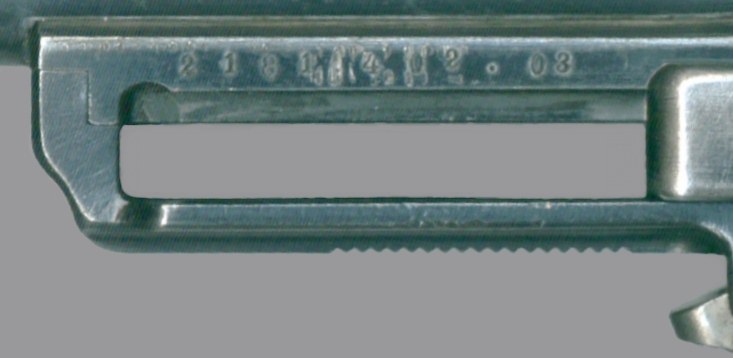
Thinlineweapons.com also publishes the serial ranges it has recorded: commercial 1803–1865, 5579–5869, 7879–8053, 8405–8642 and 9263–10405; Austro-Hungarian military-marked guns 3422–4322; Argentine contract guns 95, 3374–5975, 8404, 9239 and 10564 with their crests ground, and 3361 with the crest intact.1 The interleaving of the Argentine numbers with commercial and military ones is itself evidence of one continuous run drawn on for all three markets.
2.6 Austria-Hungary: the officers’ private pistol
Austria-Hungary never adopted the Mannlicher, but its officers bought it. English Wikipedia says the M1901 “was not officially adopted following military trials in 1904–1905” and was “privately purchased by some officers”.2 Revivaler’s Jon Branch writes that “a significant number of the Mannlicher Model 1901 pistols were privately purchased by officers in the Austro-Hungarian Army”.13 Thinlineweapons.com records a block of “Austro-Hungarian military” serials between 3422 and 4322, and illustrates an M1905 with “a neat Austrian Eagle on the right side of this pistol, probably added by an Austrian officer”.1 No Austrian regulation authorising the private Mannlicher as an officer’s arm was found.
The service pistols Austria-Hungary did adopt, the Roth-Steyr M1907 and the Steyr M1912, came from the same factory. They are outside this dive.
2.7 Argentina: the Modelo 1905
Argentina is the only state found to have adopted the Mannlicher pistol as a service arm, and the reason the M1905 is the commonest Mannlicher in collections today.
English Wikipedia’s M1905 article gives the contract history in some detail: “On 15 March 1905, the Argentine Republic bought 1,020 Modelo 1905 pistols along with the necessary accessories (Holsters and stripper clips) and 1,019,700 rounds of ammunition. Almost three years later, they purchased 5,000 more Modelo 1905 pistols, and 3,000,000 rounds of ammunition. Ultimately, a total of around 10,000 of these pistols were acquired by the Argentine armed forces.”10 None of those sentences carries a citation, and no Argentine primary source for them was found. Revivaler repeats the same figures, also without a source.13 Forgotten Weapons gives “about 6,000”; thinlineweapons.com gives “approx. 6000 was sold to Argentina”.71 The 1,020 and 5,000 of the two contracts sum to 6,020, which agrees with the 6,000 figure and not with the 10,000. The two totals are given separately.
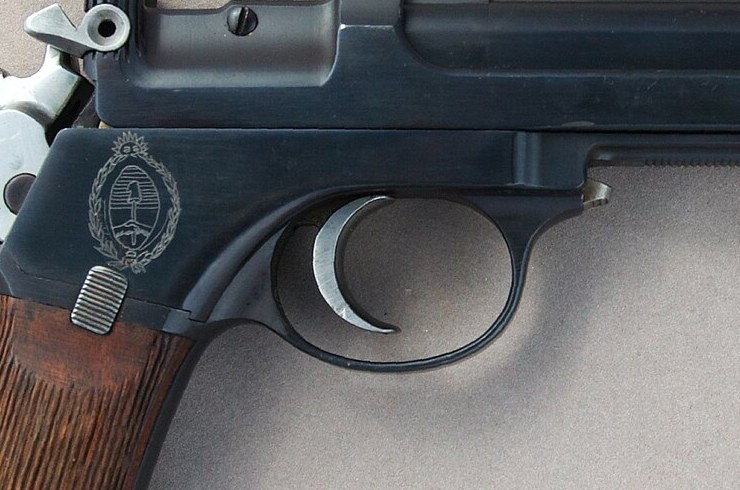
The Argentine pistols carried the national arms on the right side of the frame, between the slide and the grip, and the five-line Steyr marking on the left.1 Collector listings also describe an “RA” mark; Rock Island Auction noted “RA” on the backstrap of an M1905 that it said was “not from that contract”, which leaves open whether the mark was Argentine at all.8 Argentina’s own factories made the cartridge: boxes of the Fábrica Militar de Munición de Armas Portátiles “Borghi” labelled “50 Cartuchos Cal. 7,65 mm. Para pistola MANNLICHER” are illustrated in Vol 7, and Buffaloe says Fabricaciones Militares at San Lorenzo made it “until at least 1958”.4
2.8 Paraguay, and the pistols’ later lives
English Wikipedia says “the M1905 was also sold to Paraguay, which used it during the Chaco War”, citing Jean Huon’s article on the Chaco War in Small Arms Review of September 2013.10 The article was not read for this dive. The claim is reported as Wikipedia’s.
Forgotten Weapons says Argentina’s surplus pistols “reached the US commercial market in the 1960s, often identifiable by the spot on the right side where the Argentine crest was ground off”.7 Collector listings add that many were reblued when the crest was removed. That surplus is why an M1905 is a pistol a collector can buy for a few thousand dollars (Vol 8), while every locked-breech Mannlicher is a five-figure rarity.
2.9 Why it lost
No government report explaining a rejection of the blowback pistol was found. The pieces in the sources point the same way.
- Its cartridge was weak for a service pistol. The 7.63 mm Mannlicher threw an 85-grain bullet at about 1,000 to 1,070 ft/s (Vol 7). American Rifleman’s summary of the 1898 American board, quoted in the Borchardt C-93 dive, says the European pistols “seemed clumsy, awkward and chambered for inadequate cartridges”.
- It loaded slowly. A fixed magazine filled by clip meant the pistol could not be reloaded with a single motion, as a detachable magazine could. Revivaler argues it was “slower than dropping and changing a detachable magazine but arguably faster than having to take out and re-fill a magazine if you’ve only got one”.13
- The competition moved on. The Swiss adopted the Borchardt-Luger in 1900 and Germany the Luger in 1908, and the FN and Colt Browning pistols set the pattern of the slide-and-detachable-magazine pistol that followed.
What every source agrees on is its handling. McCollum calls both models comfortable and elegant to handle and fire; Branch calls them “made like a Swiss watch” and “one of the prettiest automatic pistols ever created”.713 One reader’s comment on a Forgotten Weapons post adds the counterpoint, from his own shooting: the low grip under a high bore makes it twist in the hand, and the hammer bites the web of the hand of a shooter who grips high.14 It is one anecdote and is reported as one.
2.10 What could not be established
- Wille’s booklet on the blowback pistol, v. Mannlichers Selbstlade-Pistole m/1901 (Berlin 1902), which would give factory figures. Not found online.
- Any Argentine primary record of the contracts: the 15 March 1905 date, the 1,020 and 5,000 quantities and the 10,000 total are uncited in their only source.
- The M1905’s standard magazine capacity (8 or 10) and whether a long and a short grip existed within one model designation.
- Whether serials restarted by year in 1901 to 1903; the meaning of the “RA” mark.
- The Paraguayan sale and Chaco War use (Huon 2013, not read).
- The total number made, on which the sources give 4,000, 10,600, 11,000 and 12,000 for overlapping spans.
References
Footnotes
-
“Argentine Mannlicher Pistol Model 1905 (Modelo 1905)”, Austro-Hungarian Weapons, thinlineweapons.com, https://thinlineweapons.com/Hungariae/Mann05.htm, consulted 2026-10-19. Its descriptive text follows Hogg and Walter, Pistols of the World; its serial observations are the site’s own. ↩ ↩2 ↩3 ↩4 ↩5 ↩6 ↩7 ↩8 ↩9 ↩10 ↩11 ↩12 ↩13 ↩14 ↩15 ↩16
-
“Mannlicher M1901”, English Wikipedia, https://en.wikipedia.org/wiki/Mannlicher_M1901, consulted 2026-10-19; it cites R. K. Wilson, Textbook of Automatic Pistols (1943), pp. 134–137. ↩ ↩2 ↩3 ↩4 ↩5
-
W. H. B. Smith, Mannlicher Rifles and Pistols (1947), pp. 214, 216, 218, as reproduced on Wikimedia Commons, consulted 2026-10-19. ↩ ↩2
-
Ed Buffaloe, “The Steyr-Mannlicher M-1900”, Unblinking Eye, https://unblinkingeye.com/Guns/SM1900/sm1900.html, consulted 2026-10-19. ↩ ↩2 ↩3 ↩4 ↩5 ↩6
-
Rock Island Auction Company, sale 4093, 7 December 2024, lot 1430, https://www.rockislandauction.com/detail/4093/1430/rare-steyr-mannlicher-patent-model-1901-semiautomatic-pistol, consulted 2026-10-19. ↩ ↩2 ↩3
-
James D. Julia, October 2014 firearms auction, lot 1293, “High condition M1905 Mannlicher, commercial”, https://jamesdjulia.com/?p=522446, consulted 2026-10-19. ↩ ↩2 ↩3 ↩4
-
Ian McCollum, “Mannlicher 1901 & 1905 Pistols (Video)”, Forgotten Weapons, 3 March 2017, https://forgottenweapons.com/mannlicher-1901-1905-pistols-video, consulted 2026-10-19. ↩ ↩2 ↩3 ↩4 ↩5 ↩6
-
Rock Island Auction Company, sale 51, 3 December 2010, lot 312, “Steyr Mannlicher Model 1905 Semi-Automatic Pistol”, https://www.rockislandauction.com/detail/51/312/steyr-mannlicher-model-1905-semiautomatic-pistol, consulted 2026-10-19. ↩ ↩2 ↩3 ↩4
-
James D. Julia, October 2014 firearms auction, lot 1292, https://jamesdjulia.com/?p=522445, consulted 2026-10-19. ↩ ↩2
-
“Mannlicher M1905”, English Wikipedia, https://en.wikipedia.org/wiki/Mannlicher_M1905, consulted 2026-10-19. ↩ ↩2 ↩3 ↩4 ↩5 ↩6 ↩7
-
Hugh B. C. Pollard, Automatic Pistols (1920), p. 15. Internet Archive, https://archive.org/details/automaticpistolspollard1920, consulted 2026-10-19. ↩
-
Wesley Terrell, File:1901MannlicherNumbers.jpg, Wikimedia Commons, CC BY-SA 3.0, https://commons.wikimedia.org/wiki/File:1901MannlicherNumbers.jpg, consulted 2026-10-19. ↩
-
Jon C. Branch, “Mannlicher Model 1901 and 1905”, Revivaler, 4 August 2016, https://revivaler.com/mannlicher-model-1901-1905/, consulted 2026-10-19. ↩ ↩2 ↩3 ↩4
-
“Looking for Some 7.65mm Mannlicher Ammo…”, Forgotten Weapons, with reader comments, https://www.forgottenweapons.com/looking-for-some-7-65mm-mannlicher-ammo/, consulted 2026-10-19. ↩

Comments (0)