Mannlicher M1901 & M1903 · Volume 3
The Locked-Breech Line: the 'M1903' Pistol, the Carbine-Pistol and the Carbine
Mannlicher's strut-locked pistol family from the 1902 German description of it: the long and short pistols, the leather holster-stock, the carbine, their measured performance, and the fore-end that moved
3.1 The source: Wille, 1902
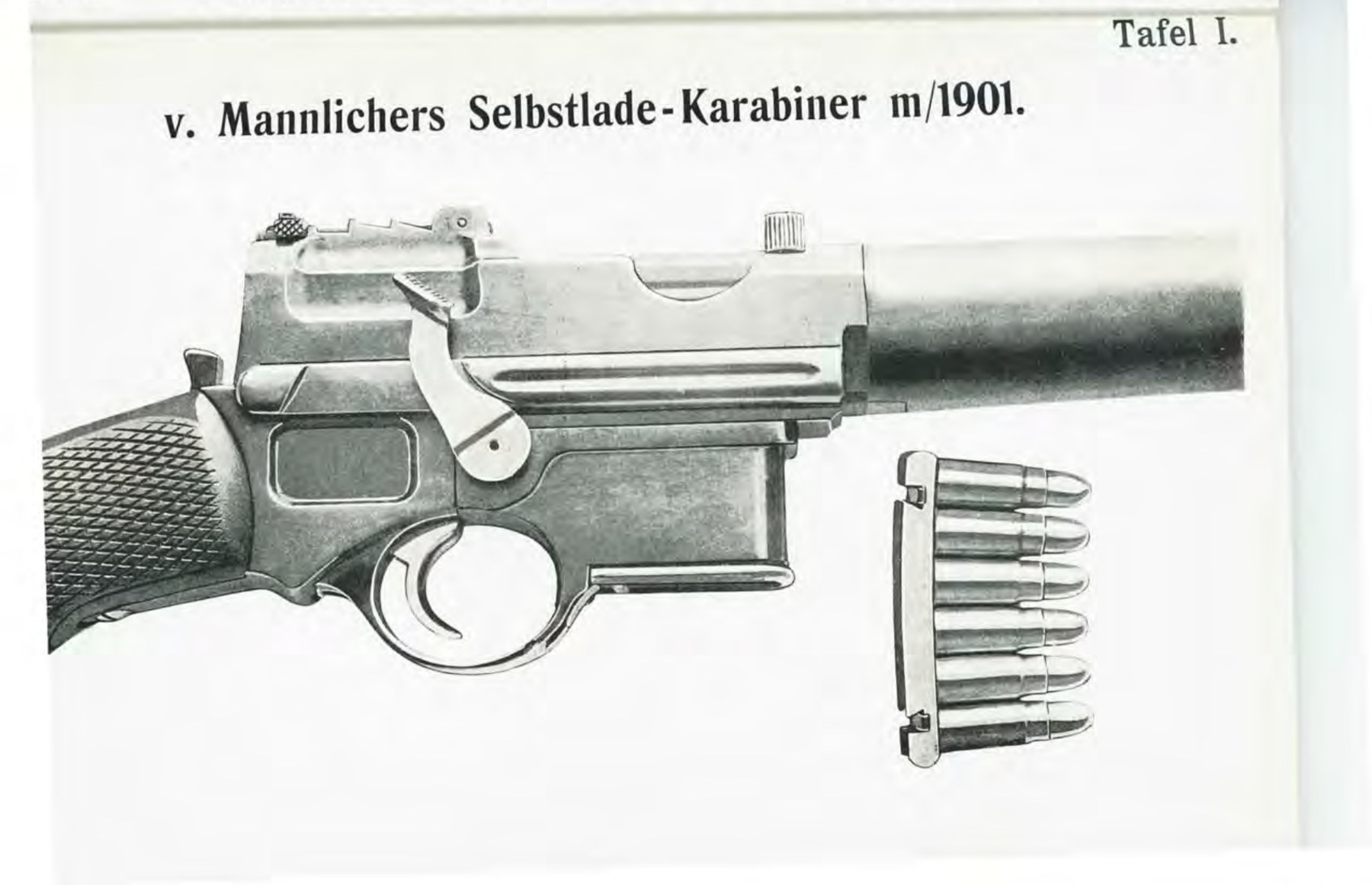
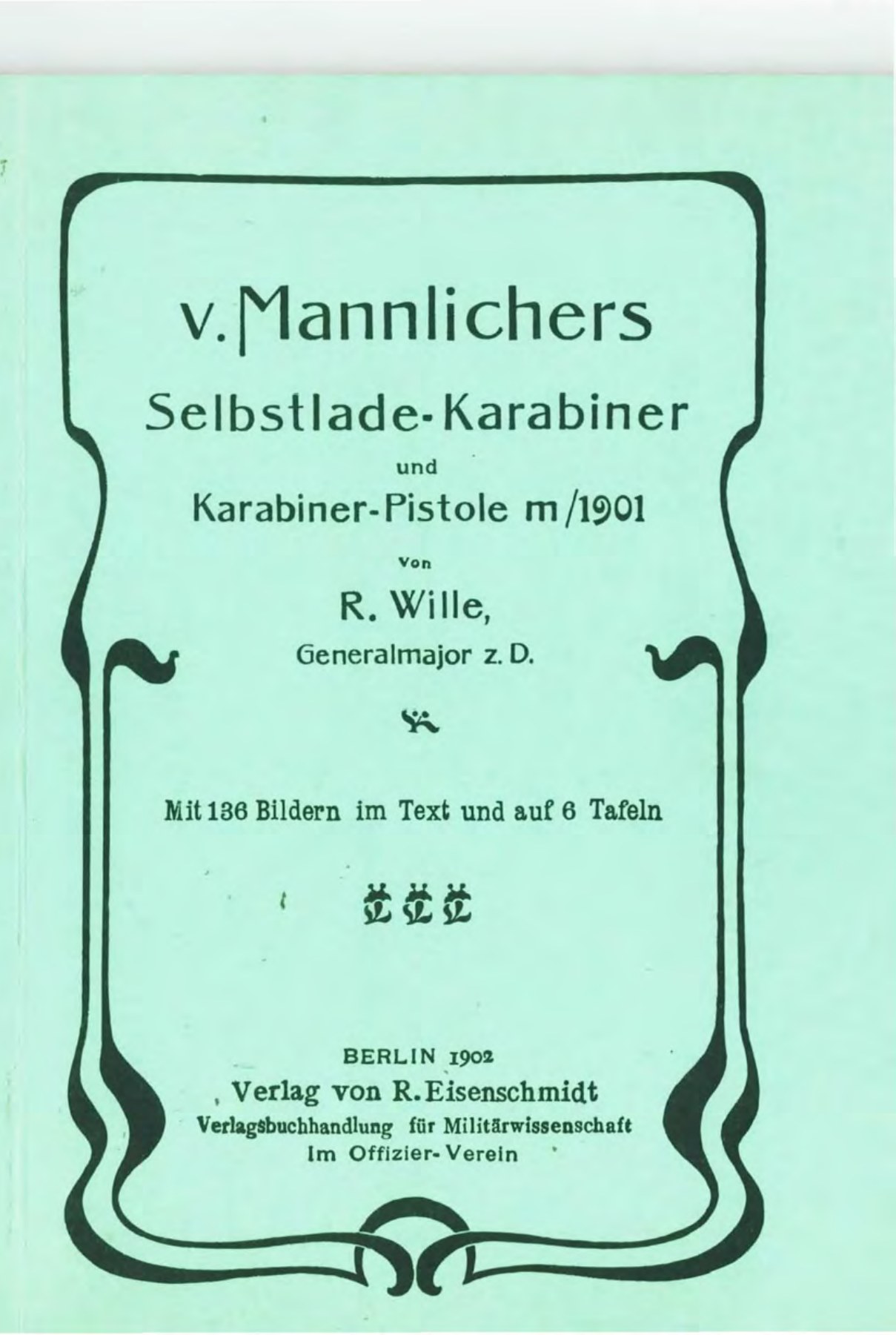
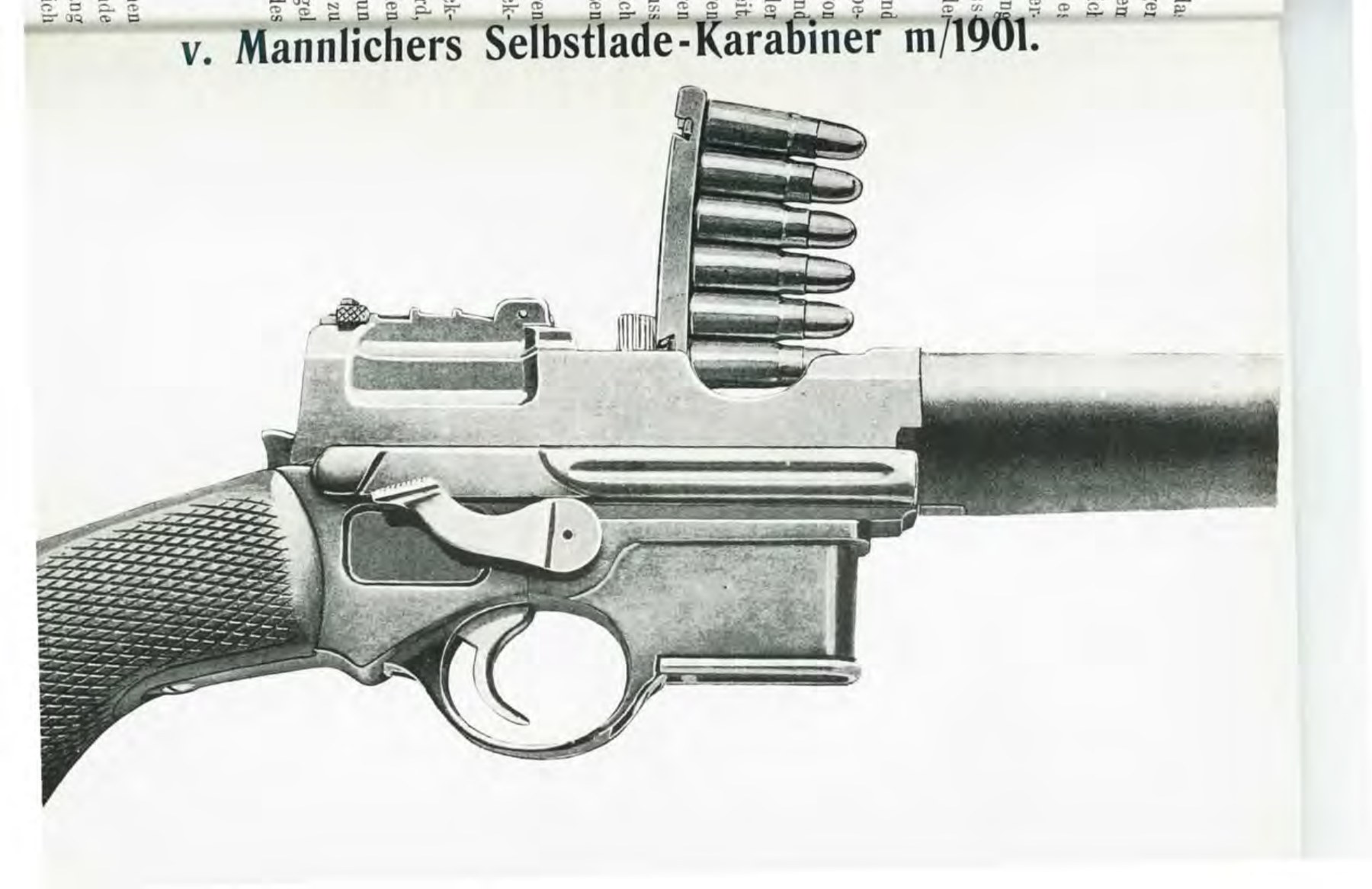
The locked-breech Mannlicher is documented far better than its rarity suggests, because a German officer described it in detail while it was being offered for sale. v. Mannlichers Selbstlade-Karabiner und Karabiner-Pistole m/1901, by R. Wille, Generalmajor z. D., was published in Berlin by R. Eisenschmidt, a military publisher, with a foreword dated 16 February 1902. It has 136 illustrations in the text and six plates.1 Forgotten Weapons hosts a scan, which this dive used.2 The scan lacks Tafel IV, which the contents list gives as the longitudinal sections and the cartridge drawing; the other five plates are present.
Wille was not a neutral reporter. His booklets of the period describe one system at a time (Mauser-Selbstlader, 1897; a Parabellum manual, 1902), and this one praises its subject throughout.3 But he gives numbers: dimensions, weights, velocities, pressures, dispersion, penetration, the order of disassembly. No other source found gives any of them for this weapon, and they are used here as the period’s best evidence, labelled as his.
3.2 The family
The locked-breech line went through at least four forms between 1896 and 1904. Collectors call most of them “M1903”; the names below are those used by the sources cited for each.
Table 1 — The family
| Form | Magazine | Notes | Source |
|---|---|---|---|
| M1896 | Fixed, ahead of the trigger, 6 or 7 | Resembles the Mauser C96 | English Wikipedia, after Wilson4 |
| M1897/01, M1896/03 | Detachable box ahead of the trigger, 6 | Pistol, stocked pistol, carbine; Swiss trial model | English Wikipedia4; Julia (SN 410)5 |
| Karabiner-Pistole m/1901, long and short; Selbstlade-Karabiner m/1901 | Detachable box, 6 (carbine also 7) | The forms described in 1902 | Wille1 |
| M1901/04 carbine | Detachable box | Fixed, non-recoiling fore-end; “long 7.63x45mm Mannlicher M904 cartridge”; reportedly made at Neuhausen | Julia, 2014 and 2015 (consignor’s report)6 |
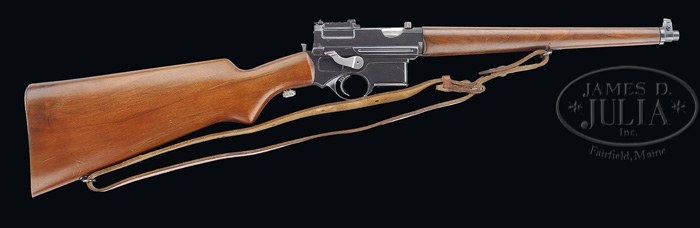
ATF’s curios and relics list, which classifies what it has been asked to classify rather than describing a family, names an M1896 pistol-carbine with an 11¾-inch barrel among pre-1898 guns, and “m/01, m/02, and m/06 pistol-carbines with factory-produced, fixed rifle-type shoulder stock and forearm and 11 ¾ long barrels, cal.’s 7.65mm Mannlicher, 9mm Parabellum, and 7.63mm Mauser” among guns removed from the NFA.7 Wille’s carbine barrel is 300 mm, which is 11.8 inches, so the m/01 of ATF’s list is almost certainly his carbine. The 9 mm Parabellum and 7.63 Mauser calibres in the same entry appear in no other source found, and are reported as ATF wrote them.
3.3 What the 1902 book describes
Wille’s first section is the carbine, his second the carbine-pistol, which he says differs from the carbine only where a pistol must differ from a shoulder arm:
“Sie beschränken sich daher fast ausschliesslich auf die naturgemässen Abweichungen der Lauflänge, des Visiers, der Schäftung und der Gewichtsverhältnisse. Dagegen sind Laufweite, Patrone, Ladestreifen, Verschluss, Schloss und Magazin bei beiden Waffen gleich.”1
That is, the differences are “almost exclusively” barrel length, sights, stocking and weight; bore, cartridge, clip, breech, lock and magazine “are the same in both weapons”. On the pistol the front sight sits directly on the barrel and the rear sight “consists only of the sight bar with its notch”; the grip is a steel strap stiffened by a central rib, with checkered walnut panels hollowed inside to save weight and held by one cross screw, and a riveted lug carries a lanyard ring.1
The general arrangement, in Wille’s opening words:
“Der Karabiner gehört zur Klasse der mit beweglichem Lauf und starrer Verriegelung des Verschlusses versehenen Selbstlader.”
“The carbine belongs to the class of self-loaders with a moving barrel and rigid locking of the breech.” On firing, barrel, bolt and the receiver that carries them recoil together in a straight line; after a short distance the receiver strikes a stop in the frame, the coupling between bolt and barrel releases itself, and the bolt runs on alone far enough to uncover the magazine, ejecting the case and cocking the lock as it goes.1 Vol 4 follows the mechanism part by part.
Three features Wille singles out:
- A concealed hammer with a cocking lever. “Das Hahnschloss ist längs der Mittellinie … so untergebracht, dass seine sämtlichen Teile, auch der Hahn, von aussen unsichtbar bleiben; nur die Hahnwelle ragt durch die rechte Wand des Schlosskastens hindurch und trägt an ihrem äusseren Ende einen Spannhebel” — every part of the lock, the hammer included, is invisible from outside, except the hammer axle, which passes through the right wall of the lock housing and carries a cocking lever on its outer end. The lever shows at a glance whether the hammer is cocked and lets the shooter cock and lower it by hand.1 Julia’s description of a pistol of the family agrees: “a large cocking lever on the right side of the frame”, which “rotate[s] forward” when the pistol is fired.5
- A closed rear. The bolt never leaves the receiver, whose rear wall is solid: “beim Arbeiten des Mechanismus im Feuer kein einziger Verschluss- oder Schlossteil aus der widerstandsfähigen Rückwand des hinten vollständig abgeschlossenen Gehäuses heraustritt” — no breech or lock part emerges from the strong, fully closed rear wall of the receiver during firing.1 Wille argues it both protects the shooter if a part breaks and keeps the arm short.
- A last-shot hold-open. When the last cartridge is fired the follower, driven by a zigzag spring, rises into the bolt’s path and holds it open, so that the shooter is told “with unmistakable clarity” that the magazine is empty.1
The magazine was loaded from the top through the open action, from a clip, or could be removed and refilled: Wille’s procedure is to press the magazine catch, withdraw the magazine, tip the cartridges into the hand and refill the clip.1 The clip was Mannlicher’s own design with Pieper, the “System Mannlicher-Pieper”, whose spring claws gripped the cartridges at their ends so firmly that, Wille says, it was easier to break the clip than to pull a cartridge out of it by force, yet released them at the lightest touch once it was seated in the receiver’s guide, where ramps pressed the claws back.1
3.4 Wille’s figures for the three weapons
Wille gives three weapons the same cartridge and the same barrel bore and rifling, and different lengths and weights. His figures, with conversions added by this dive:1
Table 2 — Wille's figures for the three weapons
| Item | Carbine | Long pistol | Short pistol |
|---|---|---|---|
| Bore between lands | 7.65 mm (+0.03/−0.02) | same | same |
| Rifling | 4 grooves, 0.12 mm deep, groove 2.93 mm, land 3.08 mm; right-hand, one turn in 250 mm (32.68 calibres), 5° 30′ | same | same |
| Overall length | 735 mm | 300 mm (11.8 in) | 266 mm (10.5 in) |
| Barrel length | 300 mm (11.8 in) | 152 mm (6.0 in) | 119 mm (4.7 in) |
| Rifled length | 266 mm | 121 mm | 88 mm |
| Sight radius | 385 mm | 247 mm | 212 mm |
| Height | 77 mm (receiver to magazine housing) | 139 mm | 139 mm |
| Width | 31 mm | 31 mm | 31 mm |
| Chamber outside diameter | 20 mm (octagonal), 15 mm in front | same | same |
| Weight, magazine empty | 1,775 g (62.6 oz) | 1,045 g (36.9 oz) | 980 g (34.6 oz) |
| Weight, magazine full | 1,837.4 g | 1,108 g | 1,043 g |
| Number of parts | 56 | 45 | 41 |
| Magazine | 6 (or 7, see below) | 6 | 6 |
A seven-round carbine was also made: “Der Karabiner wird auch für eine Magazinfüllung von sieben Patronen eingerichtet; der Ladestreifen ist dann um einen Patronendurchmesser länger und das Magazin 7 mm tiefer.”1 The long pistol’s leather holster-stock weighed 500 g.
The cartridge (Vol 7 compares it with the Mauser): loaded length 35.00 mm and weight 10.40 g; bottlenecked brass case 25.00 mm long, weighing 4.45 g with its primer; bullet 7.82 mm in diameter, 14.00 mm long, 5.53 g (85.3 gr); powder charge 0.45 g (6.9 gr).1
3.5 Performance as measured in 1902
Wille’s performance tables are the only measured figures found for any Mannlicher pistol.1
Table 3 — Performance as measured in 1902
| Item | Carbine | Long pistol | Short pistol |
|---|---|---|---|
| Muzzle velocity | 450 m/s (1,476 ft/s) | 375 m/s (1,230 ft/s) | 360 m/s (1,181 ft/s) |
| Muzzle energy | 57.1 mkg | 39.6 mkg | 36.6 mkg |
| Mass of recoiling parts (barrel, receiver, strut, bolt; carbine also fore-end) | 635 g | 496 g | 448 g |
| Recoil of those parts before unlocking | 4.00 mm | 4.00 mm | 4.00 mm |
| Highest gas pressure | 1,395 at (+25/−17) | same | same |
| Mean gas pressure | 495 at | 730 at | 900 at |
| Penetration at 10 m, 0.95 mm mild-steel plates spaced 10 mm | 14 | 12 | 11 |
| Penetration at 10 m, 30 mm pine boards spaced 30 mm | 9 | 8 | 7 |
| Shots in 30 seconds, aimed / “mechanical”, including reloading | 18 / 42 | 24 / 42 | 24 / 42 |
The pistol velocities are “Mittel aus 10 Messungen”, the mean of ten, with a largest spread of 20 m/s for the long pistol and 22 m/s for the short; the pressure is the mean of seven measurements.1 The unit “at” is the technical atmosphere, about 0.981 bar, so 1,395 at is about 1,368 bar, or about 19,800 psi; the method of measurement is not stated, and is almost certainly a crusher gauge of the period, whose figures are not directly comparable with a modern transducer reading. That matters in Vol 7.
Dispersion, as Wille gives it in millimetres of height and width of the group:
Table 4 — Dispersion, as Wille gives it in millimetres of height and width of the group
| Weapon and condition | Height | Width |
|---|---|---|
| Carbine, 100 m, rested | 280 | 300 |
| Carbine, 200 m, rested | 710 | 580 |
| Carbine, 300 m, rested | 800 | 910 |
| Carbine, 100 m, freehand | 630 | 600 |
| Long pistol, 50 m, freehand | 350 | 290 |
| Long pistol with holster-stock, 50 m | 230 | 300 |
| Long pistol with holster-stock, 100 m | 360 | 370 |
| Long pistol with holster-stock, 200 m | 850 | 630 |
| Short pistol, 50 m, freehand | 410 | 360 |
The long-pistol figures are from 49 shots from four pistols at 50 m freehand and 36 or 42 shots from one pistol with the stock; the short-pistol figure from 63 shots from five pistols.1 These are extreme spreads of the whole group, not the mean radii a modern test reports. Wille himself draws one conclusion from them: fitting the holster-stock cut the long pistol’s vertical spread at 50 m from 35 cm to 23 cm, 34 per cent.1
Wille also argues, with arithmetic, that the barrel need not unlock earlier than it does. The 5.53 g bullet leaves the 280 mm bore of the carbine in about 0.00124 seconds; in that time the 635 g of recoiling parts, by conservation of the centre of gravity, move back by x in the ratio x : 280 = 5.53 : 635, so x = 2.44 mm. Since unlocking happens only after 4 mm, the bullet is already out of the muzzle when the breech opens, and “kein nennenswerter Gasdruck mehr in der Seele” — no pressure worth mentioning remains in the bore.1 The argument ignores the gas’s own momentum and the friction he mentions in the next sentence, which delay the barrel further. It is his, and is given as his.
3.6 The holster-stock
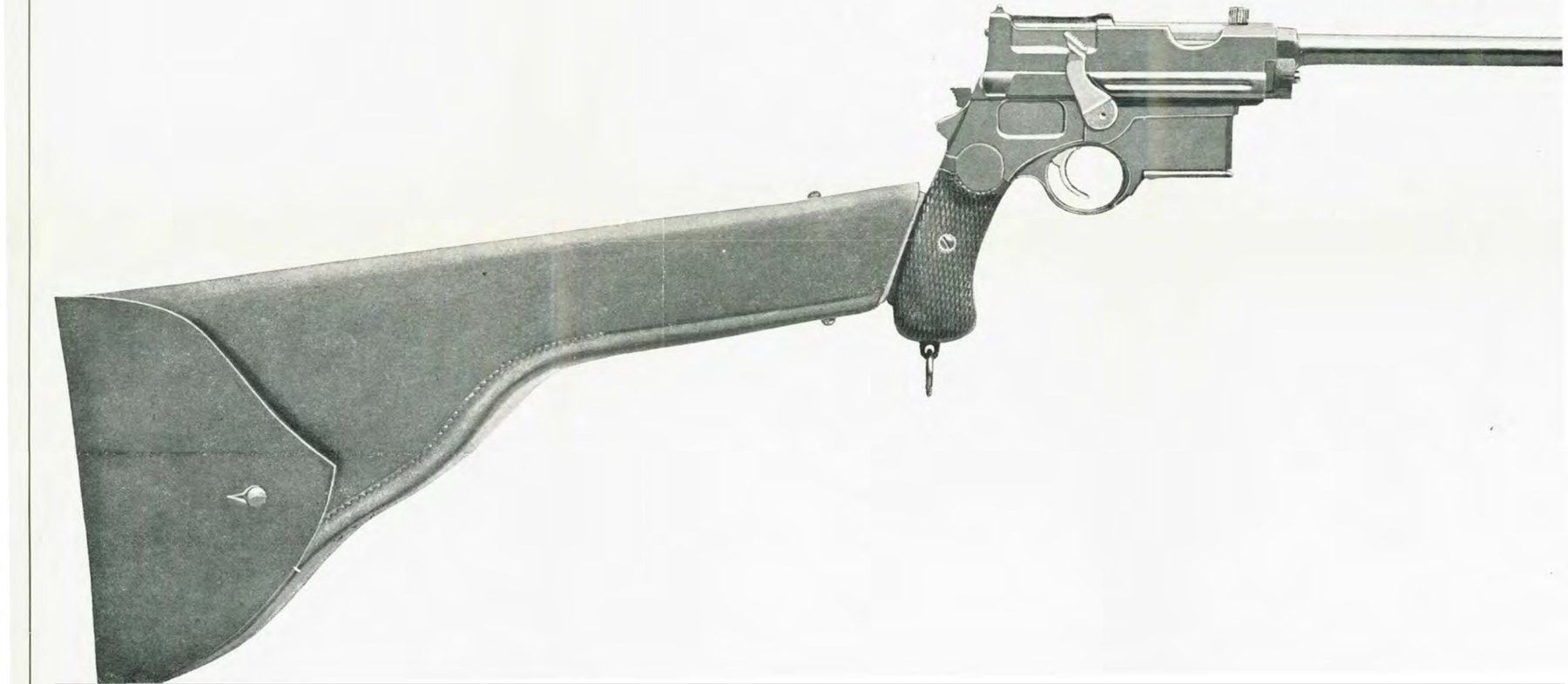
The long pistol was meant to be usable as a carbine. Its holster was made “von steifem Kernleder”, stiff leather, closed at the back by a flap with a brass stud, with a sling loop on the left and a sliding strap inside to help draw the pistol. A wooden block glued and screwed into its front end was cut out to receive the barrel and front sight, and carried on its outer face a steel box with a T-shaped rail. A T-slot milled into the back of the pistol’s grip strap took the rail from below until a spring-loaded locking pin, with a roughened grip, snapped into a recess; a press on the grip released it.1 Wille notes that shoulder stocks for pistols were nothing new, citing the Baden cavalry pistol m/53, the Swiss revolver m/82, the Garcia Reynoso, and the Borchardt and Mauser self-loaders.1
James D. Julia sold a pistol of the family in October 2013 with “an original black leather shoulder stock whose body is matched to the pistol with a ‘410’ marked in the leather along the lower spine, just behind the stock lug screw”. That pistol had a 6-inch barrel and a tangent rear sight graduated in four steps from 50 to 200, which is the long pistol of Wille’s book.5 Its stock is the real thing, and it is the clearest photograph of one found.
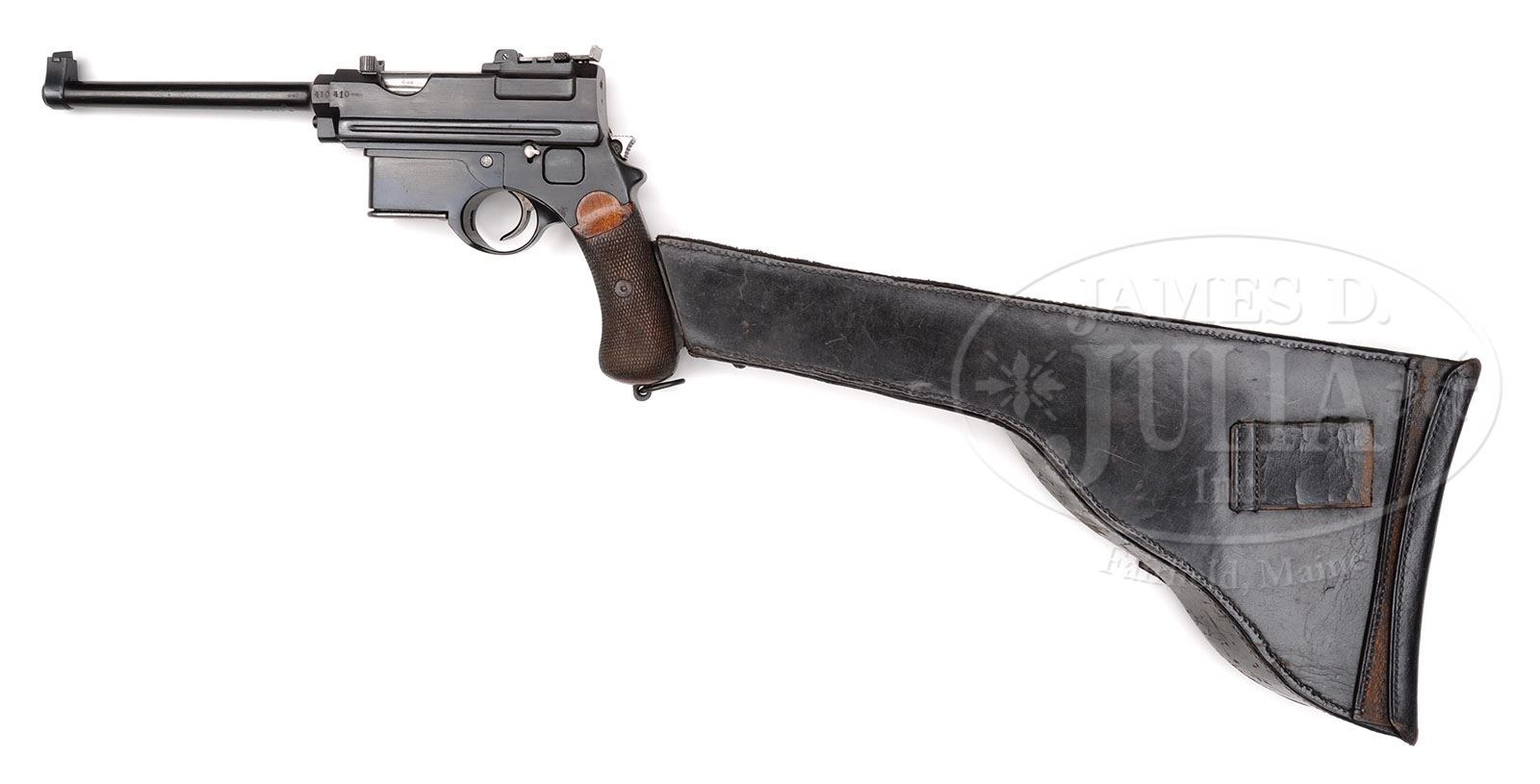
The stock matters for the law more than for the shooting. A post-1898 pistol with a barrel under 16 inches and a shoulder stock attached is, on the text of federal law, a short-barrelled rifle unless ATF has listed it as a collector’s item. The holster-stocked long pistol is not on ATF’s list. Vol 8 sets that out.
3.7 The carbine, and the fore-end that moved
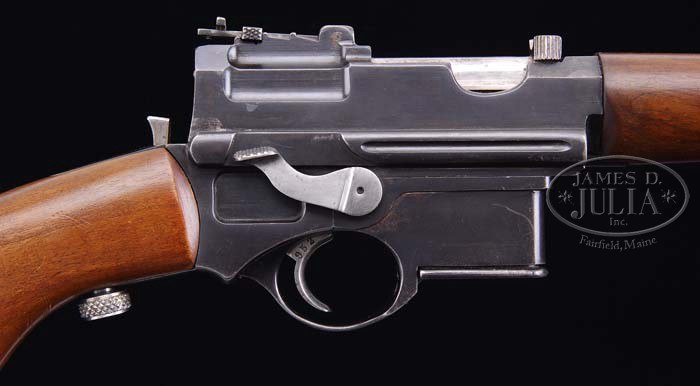
The carbine’s fore-end was fixed to the barrel and recoiled with it. Wille acknowledges the objection directly:
“Als ein Mangel in der Ausgestaltung der Waffe hinsichtlich der durch die Beweglichkeit des Laufs bedingten Einrichtungen könnte es vielleicht — scheinbar nicht ohne triftigen Grund — bezeichnet werden, dass der Vorderschaft mit dem Lauf — und nur mit diesem — starr verbunden ist und daher auch an dessen durch die Rückwirkung des Schusses hervorgerufenen Bewegungen teilnimmt, so dass die linke Hand des Schützen nicht ihn, sondern den Magazinkasten ergreifen muss.”1
“It might perhaps be called a defect — apparently not without good reason — that the fore-end is rigidly joined to the barrel, and to it alone, and so takes part in its movement under recoil, so that the shooter’s left hand must grip not the fore-end but the magazine housing.” His instructions say the same: in the aim, the left hand holds the magazine housing, “nicht den Vorderschaft”, because holding the fore-end would hinder the barrel’s movement.1 He then argues the objection away, on the grounds that the magazine housing is placed for exactly that grip.
Julia’s catalogue of 2014, describing a later carbine with a fixed fore-end, is harsher about the same feature: the common carbine’s fore-end “recoils with the barrel to the detriment of handling, or, a more serious fault, the barrel is easily pulled back before firing to the point of unlocking the bolt if the fore-end is gripped to pull the gun into the shoulder, rendering this weapon unsafe, as was noted by contemporary writers”. It says “Mannlicher’s last patents of 1904 addressed this problem”, by letting the barrel recoil inside a fixed fore-end.6 The contemporary writers are not named and the 1904 patents were not seen. The safety point is sound on the mechanism described in Vol 4: the lock is released by the barrel’s rearward travel, so anything that pulls the barrel back starts to unlock it. No incident was found in the record.
3.8 Other figures in print
Thinlineweapons.com, following Hogg and Walter, gives the M1903 pistol as 280 mm long, 1,020 g, with a 115 mm barrel and a six-round detachable box.8 None of those matches Wille’s long or short pistol exactly; the barrel and weight lie close to his short pistol (119 mm, 980 g) and the length between his two. Either a third form existed or the figures are approximations. They are given separately. Julia gives the carbine’s barrel as 11½ inches (292 mm), against Wille’s 300 mm.9
The same source says the M1903 “chambered yet another special cartridge, a 7.65mm bottle-necked rimless round offering the same dimensions as the 7.63mm Mauser but less velocity. This was a grave mistake, as the Mannlicher pistol was not strong enough to stand up to firing the Mauser round”, that “though the breech-lock design was strong enough to withstand the Mauser round, the rest of the pistol was not”, and that “a strengthened model was produced experimentally in the early 1900s but was never exploited”.8 No test or failure is cited for any of those statements. Vol 7 takes up the question of what the Mauser round does in this pistol.
3.9 How many, and how many survive
The production figures are all estimates. Hogg and Walter: “it is doubtful if more than a thousand 1903-type pistols and pistol-carbines were made, work having stopped well before the outbreak of WW1.”8 English Wikipedia: fewer than 1,000 of the M1896 and M1897/01 together.4 The handgun collector James Rankin, quoted in Julia’s 2009 catalogue from a private letter, estimated “only an estimated 150 of these pieces still in existence”.9
The auction record supports rarity. In 2009 to 2015 James D. Julia sold an M1903 pistol-carbine for $10,925, an M1896/03 long pistol with its matching stock for $17,250, and a fixed-fore-end carbine prototype for $11,500 (Vol 8).956
3.10 What could not be established
- Tafel IV of Wille’s booklet (sections and the cartridge drawing), missing from the scan used.
- Whether thinline’s 280 mm, 115 mm, 1,020 g pistol is a third form or an approximation of one of Wille’s two.
- The 1904 Mannlicher patents for a fixed fore-end, and the “contemporary writers” who called the recoiling fore-end unsafe.
- ATF’s basis for listing 9 mm Parabellum and 7.63 Mauser pistol-carbines among the m/01, m/02 and m/06.
- The “long 7.63x45mm Mannlicher M904 cartridge” of the carbine prototypes, reported by Julia’s consignor and not confirmed.
- Production numbers and dates for the locked-breech line.
References
Footnotes
-
R. Wille, v. Mannlichers Selbstlade-Karabiner und Karabiner-Pistole m/1901 (Berlin: R. Eisenschmidt, 1902), pp. 1–3, 6–9, 12, 17–21, 27–42 and Tafeln I–III, V, VI. Scan via Forgotten Weapons, http://www.forgottenweapons.com/wp-content/uploads/manuals/Mannlicher%201901.pdf, consulted 2026-10-19. Translations are this dive’s. ↩ ↩2 ↩3 ↩4 ↩5 ↩6 ↩7 ↩8 ↩9 ↩10 ↩11 ↩12 ↩13 ↩14 ↩15 ↩16 ↩17 ↩18 ↩19 ↩20 ↩21 ↩22
-
Ian McCollum, “Mannlicher m/1901 manual”, Forgotten Weapons, 6 July 2011, https://www.forgottenweapons.com/mannlicher-m1901-manual/, consulted 2026-10-19. ↩
-
Hugh B. C. Pollard, Automatic Pistols (1920), p. 98, “Works consulted”, which lists Wille’s Mauser Selbstlader (1897), Parabellum Manual (1902) and Ritter von Mannlichers Selbstlade Pistole (1902). Internet Archive, https://archive.org/details/automaticpistolspollard1920, consulted 2026-10-19. ↩
-
“Mannlicher M1901”, English Wikipedia, https://en.wikipedia.org/wiki/Mannlicher_M1901, consulted 2026-10-19. ↩ ↩2 ↩3
-
James D. Julia, October 2013 firearms auction, lot 3192, “Highly desirable Mannlicher M1896/03 with matching shoulder stock”, https://jamesdjulia.com/?p=484812, consulted 2026-10-19. ↩ ↩2 ↩3 ↩4
-
James D. Julia, October 2015 firearms auction, lot 3711, “Extremely rare Mannlicher M1901/04 self-loading carbine prototype”, https://jamesdjulia.com/?p=535743, and October 2014, lot 1289, https://jamesdjulia.com/?p=522442, both consulted 2026-10-19. ↩ ↩2 ↩3
-
ATF, Firearms Curios or Relics List — January 1972 through April 2025 (ATF P 5300.11), Sections III and IIIA. Internet Archive copy https://web.archive.org/web/20260426215034if_/https://www.atf.gov/media/19856/download, consulted 2026-10-19. ↩
-
“Austro-Hungarian Mannlicher M1903 Pistol”, thinlineweapons.com, https://thinlineweapons.com/Hungariae/Mann03P.htm, consulted 2026-10-19. ↩ ↩2 ↩3
-
James D. Julia, Spring 2009 firearms auction, lot 1156, https://jamesdjulia.com/?p=463137, consulted 2026-10-19. ↩ ↩2 ↩3
Comments (0)