Mannlicher M1901 & M1903 · Volume 4
How They Work: the Cam-Delayed Blowback and the Strut Lock
The M1901 and M1905 cycle part by part, what the 'delay' actually amounts to by each source, and the locked-breech pistol's strut, step block and barrel catch in the words of its 1902 description
4.1 Two answers to one problem
A self-loading pistol must keep the breech shut until the bullet has left the barrel and the pressure has fallen, and then use the recoil to work the action. Mannlicher’s production pistols answer that in two ways (Vol 1). The blowback pistol does not lock at all: the breechblock is held by its own mass, its spring and a spring-loaded cam, and the cartridge is weak enough for that to suffice. The locked-breech pistol couples the bolt to a recoiling barrel with a pivoting strut and releases it after a few millimetres of travel, which suits a cartridge nearly half as fast again. This volume takes each in turn.
The blowback account rests on W.H.B. Smith’s 1947 drawings and captions, on R.K. Wilson’s 1943 description as summarised on English Wikipedia, and on Hogg and Walter’s text as reproduced by thinlineweapons.com. No factory description of the blowback pistol was found. The locked-breech account rests on R. Wille’s 1902 description, which is close to a factory document.
4.2 The blowback pistol: the parts
Frame and barrel. The chamber is part of the frame, and the barrel is screwed into it; “the barrel is screwed into the chamber section of the receiver and has a front sight top rib which is part of the barrel forging” (Wilson, as summarised).1 Hogg and Walter: “A fixed barrel is screwed into the standing breech, forged as part of the frame.”2
Slide. “The slide consists of a short breech-block section behind the barrel, carrying the extractor and firing pin. Two arms run forward from this block, one on each side, to join transversely beneath the barrel.”2 Thinlineweapons.com adds that this pistol “introduced the open-topped slide to the automatic pistol world”, a claim of priority this dive has not tested.
Recoil spring. “The return spring sits in a hole beneath the breech, extending forward to anchor on a stud in the front of the slide arms. Any rearward movement of the slide compresses the spring.”2 Wilson’s account, as summarised, puts it the other way round, with the cross-beam at the front of the slide compressing the spring against the frame as the slide recoils.1 Both agree that the spring lies under the barrel, between the slide arms, and is compressed as the slide goes back.
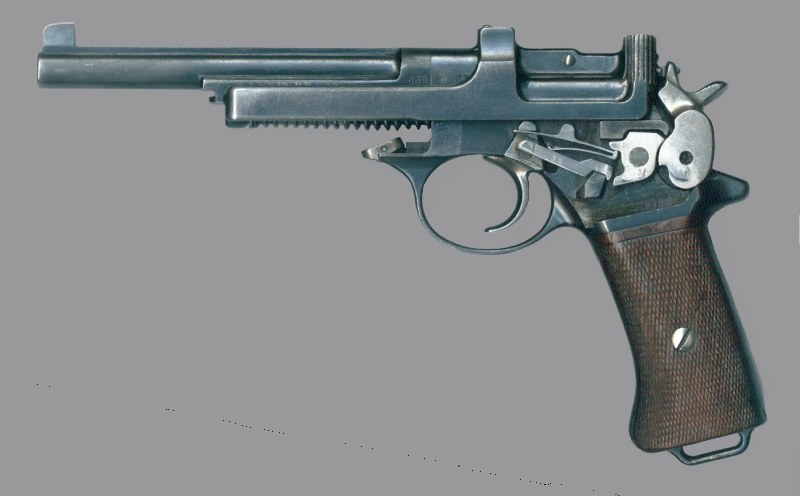
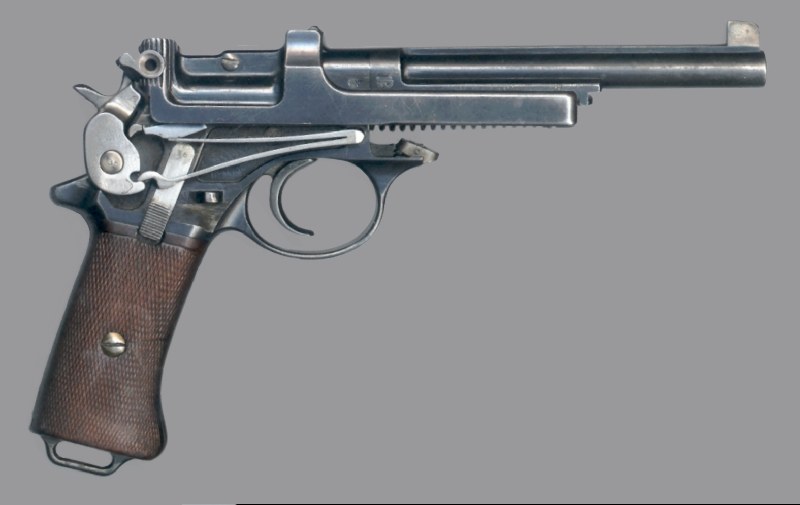
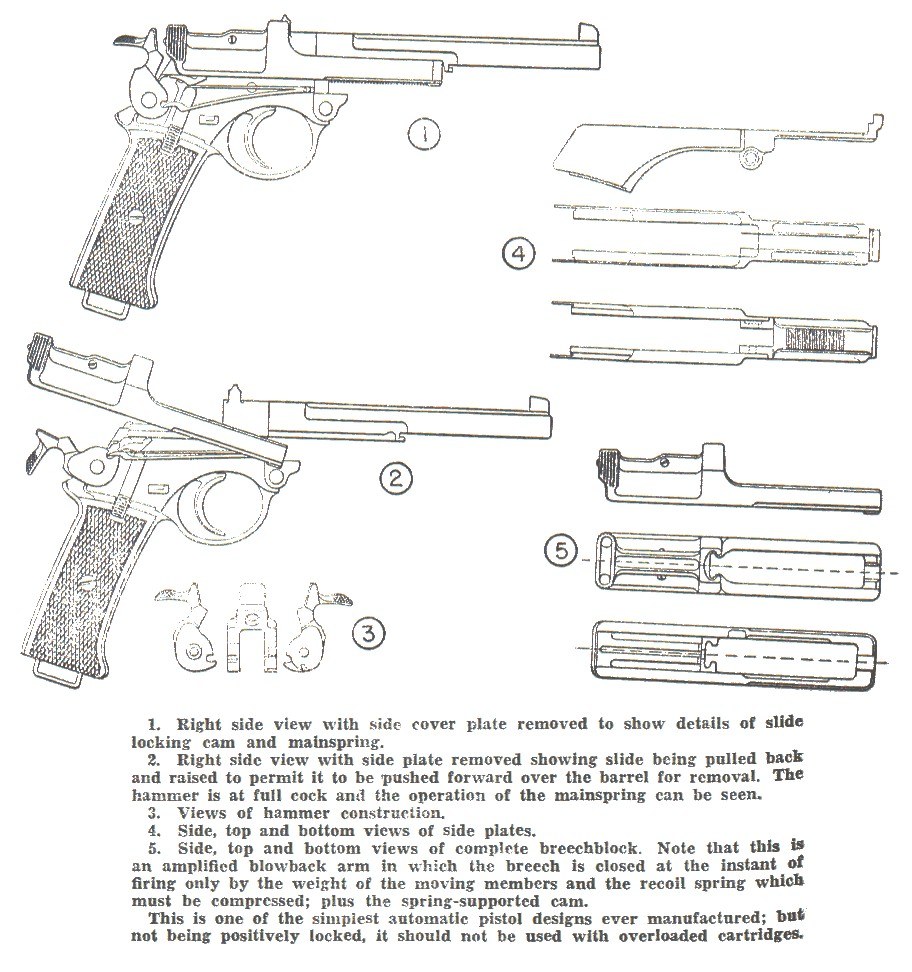
Lockwork on the left. The trigger works a trigger bar on the left of the frame, which pushes the tail of the sear; a V-spring serves as both trigger and sear spring, and the sear nose engages a notch “in the left fork of the hammer (which is external) to provide a smooth trigger pull that is very unusual in an automatic pistol”.1 Smith’s drawing shows this “elementary type lock work” with the left plate off.3
Mainspring and cam on the right. Under the right-hand cover is a heavy V mainspring. “Its greater arm (lower) engages a notch in the right fork of the hammer to drive it forward when released by the sear. Its lesser arm (upper) continuously presses a cam upward that engages a slot in the under-surface of the breechblock slide when the action is closed.”1 Hogg and Walter: “The main spring lies in the right side of the frame, the lower arm pressing on the hammer and the upper arm on a small lever whose tip engages a notch in the underside of the slide.”2
The side covers. “The plate covering the spring mechanism is joined to the lockwork plate by a forward-sweeping arm. This arm is locked beneath the return spring by a spring catch.”2 Wilson, as summarised: the cover “is installed on the frame from the front, and is retained by a spring catch forward of the trigger-guard”.1
Magazine. Fixed in the grip, with a follower and spring and “a spring lip at the top” holding the cartridges; an ejector bar at the back of the magazine.1
4.3 The blowback pistol: one cycle
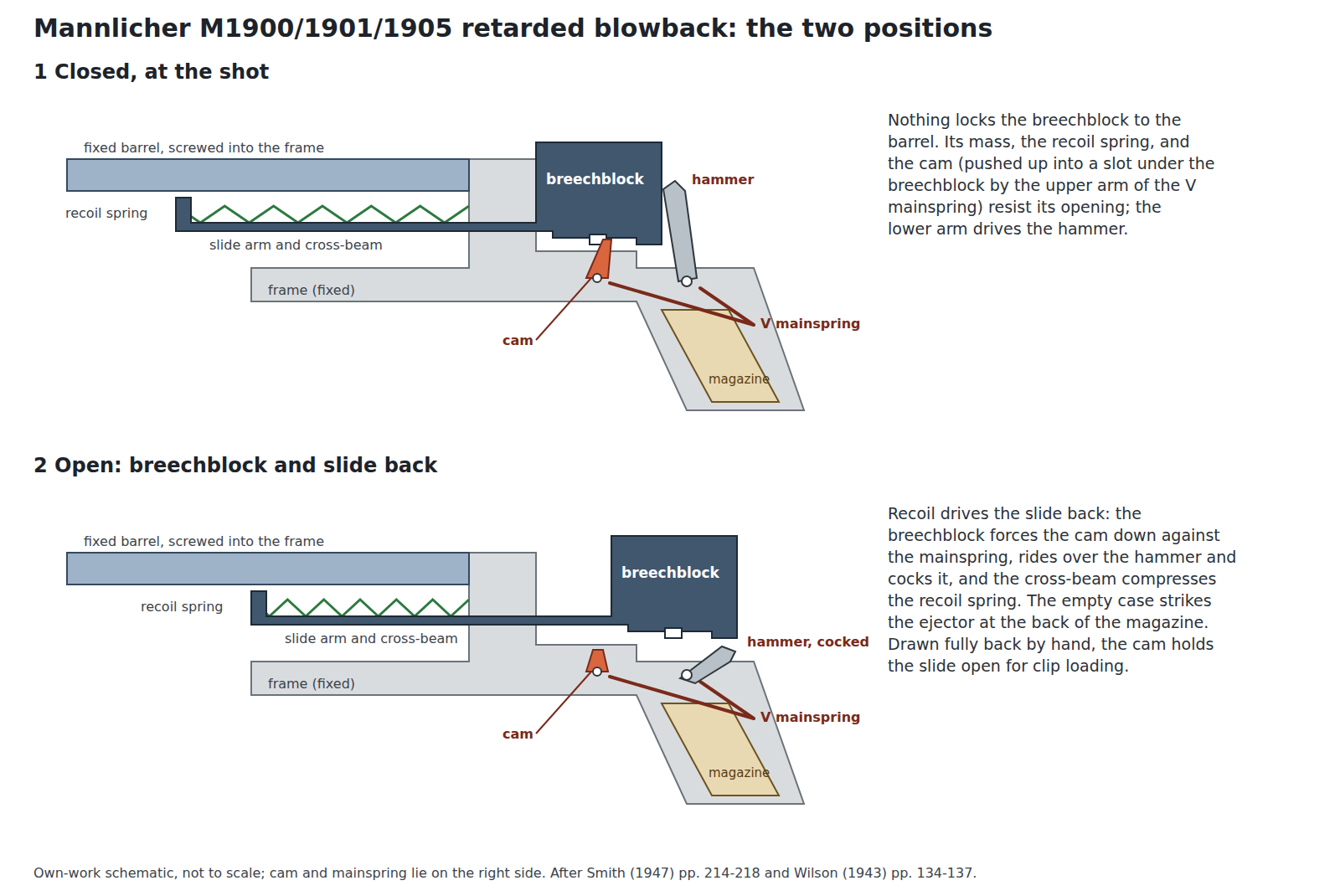
The cycle, assembled from the sources above, with the schematic below.
- Closed, cocked, a round chambered. The breechblock sits against the chamber. The cam, pressed up by the mainspring’s upper arm, is in the slot under the breechblock. The hammer is held at full cock by the sear.
- The shot. Pressing the trigger moves the trigger bar back against the sear’s tail; the sear leaves the hammer’s notch and the mainspring’s lower arm drives the hammer onto the firing pin.1
- Recoil. “The breechblock starts back at the instant of discharge, carrying the empty cartridge case with the assistance of the extractor.”1 To move, it must force the cam down out of its slot against the mainspring and compress the recoil spring.
- Ejection and cocking. “The empty cartridge case is brought sharply against the ejector, which is a bar at the back of the magazine. The underside of the breechblock is slotted to travel over the ejector.” “The recoiling slide riding over the hammer causes the hammer to rotate on its axis, locking the sear in the notch of the left hammer fork.”1
- Feed and return. The magazine spring lifts the next cartridge; the recoil spring returns the slide, the breechblock strips and chambers the round, the extractor snaps over its rim, and the cam rises into its slot again.1 “Until trigger pressure is released, another discharge is not possible.”1 How the pistol disconnects is not described in any source consulted.
4.4 How much delay is there?
Every source agrees the breech is not locked. They disagree about whether the cam does anything worth calling a delay. Their words, side by side:
- Wilson (1943), as summarised on English Wikipedia: “While technically listed as a ‘hesitation’ lock because of a delaying cam which has some theoretical tendency to slow down the opening of the breech, in actual practice it functions as an unlocked pistol.”1
- Smith (1947): “Note that this is an amplified blowback arm in which the breech is closed at the instant of firing only by the weight of the moving members and the recoil spring which must be compressed; plus the spring-supported cam. This is one of the simplest automatic pistol designs ever manufactured; but not being positively locked, it should not be used with overloaded cartridges.”3
- Wille (1902): the m/1901 pistol has “einen festgelagerten Lauf mit gefedertem Verschluss ohne starre Verriegelung”, a fixed barrel with a spring-held breech and no rigid lock, made acceptable “zumal im Hinblick auf die vom Erfinder so wesentlich verbesserte Ausgestaltung der Bremsvorrichtungen”, especially in view of the inventor’s much improved braking devices.4
- Branch (2016): “Although the hammer assists in delaying the movement of the slide when the pistol is discharged this is really a straight blowback design.”5
- McCollum (2017), as summarised: a delayed blowback in which the slide had to overcome a spring-loaded wedge before it could open.6
There are two retarding elements: the cam, which must be pushed down against the mainspring’s upper arm, and the hammer, which must be cocked against the mainspring’s lower arm. Both load the same spring. Neither source quantifies either. What can be said from the physics is that a spring-loaded cam adds resistance at the start of the stroke, when the case is most heavily loaded against the chamber wall, and that the 7.63 mm Mannlicher cartridge, at about 1,070 ft/s with an 85-grain bullet (Vol 7), is in the class that plain blowback pistols handle. Smith’s warning against “overloaded cartridges” is the practical conclusion: the design depends on the cartridge staying weak.
4.5 Loading, unloading and the safety
Loading. The slide is drawn straight back by its serrated sides; “the magazine follower rises to hold the action open, while the cross beam at the forward end of the slide compresses the recoil spring. A loaded stripper clip is inserted into the clip guide in the face of the breech block, and then the cartridges are stripped into the magazine.”1 The same summary then says the cam, pressed up by the mainspring, enters the slot in the underside of the slide and holds the action open, so that “the pistol does not close when the clip is removed. However, drawing back slightly on the breechblock will ride it over the cam, and releasing it will permit the recoil spring to close the action.”1 Buffaloe agrees that “the cam also locks the breech open at the rear for cleaning or loading”.7 The summary credits both the follower and the cam with holding the slide open at different points of its account, and the original was not seen; this dive does not decide between them. Whether the pistol holds open by itself after the last round is fired is not stated by any source consulted.
Unloading. “While the breechblock is held open, pulling down on the serrated lever on the right side at the top of the grip panel will withdraw the lip which is holding the cartridges in the magazine, enabling the magazine spring to move the platform up, forcing all the cartridges out of the magazine.”1 Branch’s practical note: the cartridges “will spring out so it is necessary to ensure there is a waiting hand strategically positioned to catch them”.5 The chambered round is extracted by working the slide.
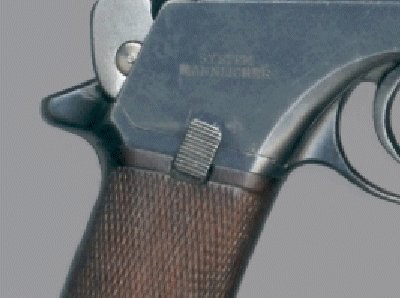
Safety. English Wikipedia credits the M1901 with “a slide-mounted, hammer-blocking safety”; its M1905 article describes “a manual safety catch lever on the right side of the slide that stands in the way of the hammer hitting the firing pin”.18 Buffaloe says early guns had a left-side lever above the grip plate, or none.7 The Dutch trial pistols had the lever moved to the left of the slide at Dutch request.9 Being on the slide, the safety moves with it; it blocks the hammer from the firing pin rather than locking the sear.
Uncocking. With an external hammer, the hammer can be lowered by hand on a loaded chamber. No source consulted gives a half-cock notch for the blowback pistol beyond Smith’s drawing caption showing the action “closed but hammer at half cock”.3 Lowering a hammer by hand on a live round is a known accident route on any pistol of this type and is not recommended here.
4.6 The locked-breech pistol: the parts
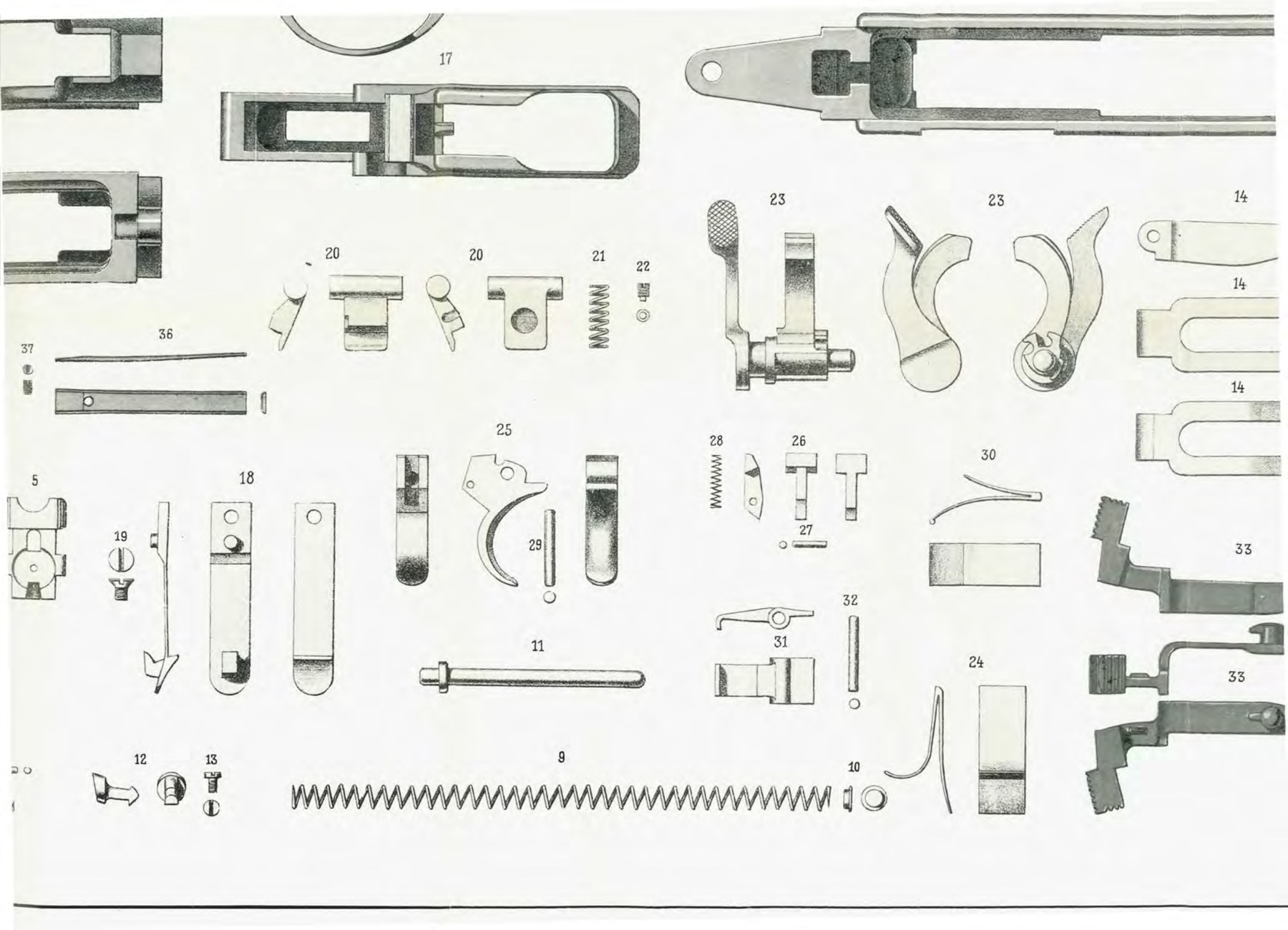
Wille numbers every part of the carbine; the pistol’s parts are the same less the stock, fore-end and sling fittings (45 for the long pistol, 41 for the short, against the carbine’s 56).4 The load-bearing ones:
Table 1 — Wille numbers every part of the carbine; the pistol's parts are the same less the stock, fore-end and sling fittings (45 for the long pistol, 41 for the short, against the carbine's 56).[^wille] The load-bearing ones
| No. | Wille’s name | English | Function |
|---|---|---|---|
| 1 | Lauf | Barrel | Screwed into the receiver; moves with it |
| 3 | Gehäuse | Receiver | Box carrying the bolt; recoils with the barrel; solid rear wall |
| 4 | Lauffeder | Barrel spring | Returns barrel and receiver forward |
| 5 | Verschlusskolben | Bolt | Breechblock; bored for its own spring; rear-bottom bevel bears on the strut |
| 6–8 | Schlagstift, Haltestift, Schlagstiftfeder | Firing pin, retaining pin, firing-pin spring | Rebounding pin struck through the open rear of the bolt |
| 9–11 | Verschlussfeder, Druckplatte, Führungsspindel | Recoil spring, thrust plate, guide rod | Returns the bolt; also loads the extractor |
| 12 | Auszieher | Extractor | On top of the bolt, sprung by the recoil spring through the thrust plate |
| 14–15 | Riegel, Riegelwelle | Strut, strut pin | The lock: pivots at the bottom of the receiver’s rear wall |
| 16 | Rahmen | Frame | Guides the receiver in grooves; stops its recoil |
| 17 | Schloss- und Magazinkasten | Lock and magazine housing | Holds the whole lock; its front is the magazine well; carries the stepped Schwelle and the ejector |
| 18 | Magazin-Haltefeder | Magazine catch | Its button projects at the front of the trigger guard |
| 20 | Schnepper | Housing catch | Holds the lock housing in the frame |
| 23–24 | Hahn, Schlagfeder | Hammer (with cocking lever), mainspring | Concealed hammer; lever on the outer end of its axle |
| 33 | Sicherung | Safety | Locks the hammer in either position |
| 40–43 | Magazin, Magazinboden, Zubringer, Zubringerfeder | Magazine, floorplate, follower, follower spring | Detachable box; zigzag spring |
4.7 The locked-breech pistol: one cycle
Wille describes the strut’s work in one long passage, given here in full in translation because nothing else describes it:4
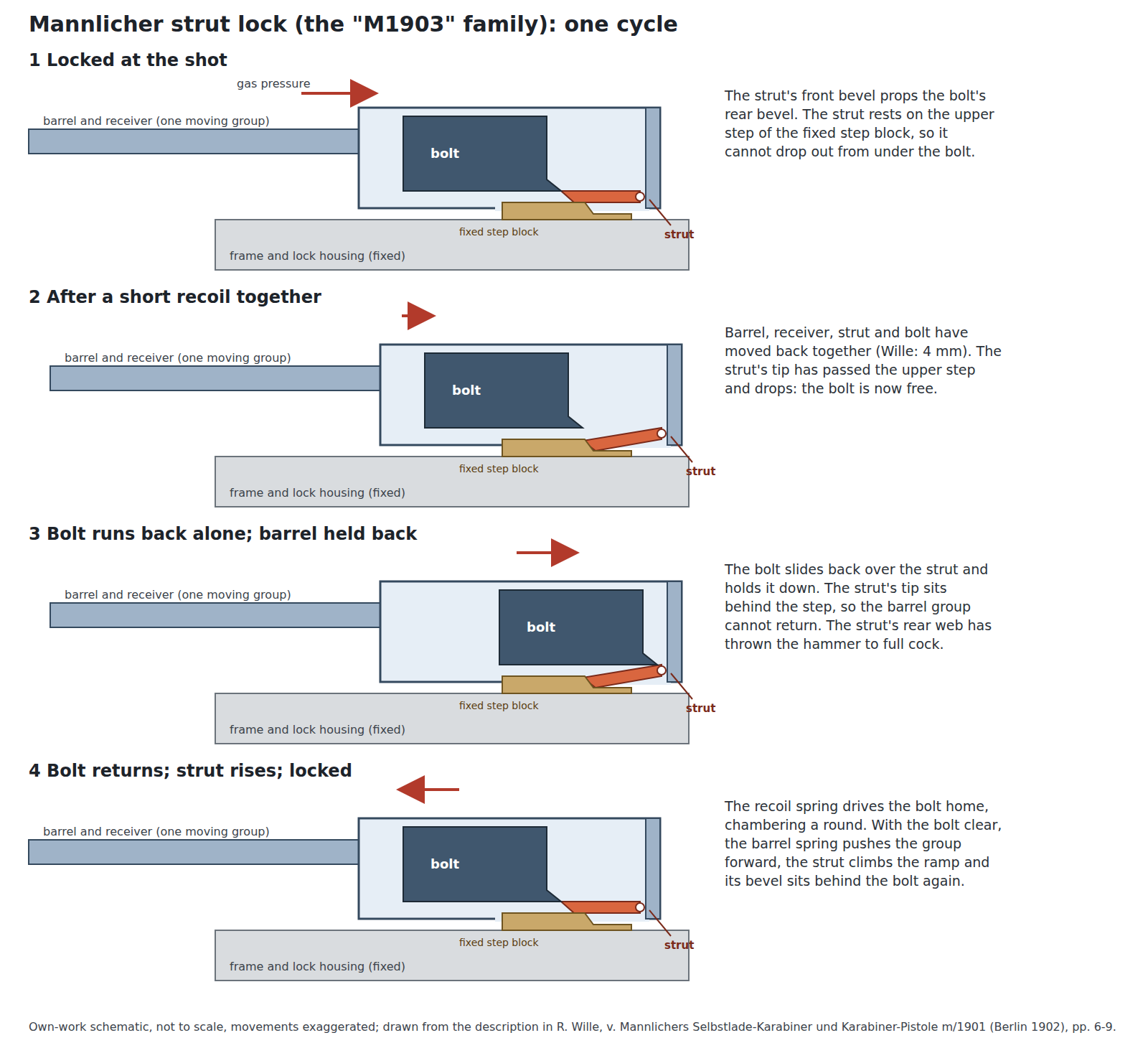
The strut “is mounted between the walls of the receiver so that it can swing a few millimetres up and down about its joint and pin. A slot in its middle lets the hammer pass freely. With the breech closed, its front bevel lies against the sloping support face of the bolt and so locks the breech, that is, couples it to the barrel. In this position the strut rests on the front upper step of the step block (Schwelle) pushed into the lock housing, and so cannot slide off the bolt’s support face.
“When the gas pressure drives barrel, receiver and bolt back, the locking is at first undisturbed, until the strut, travelling back with the receiver, slides down from the upper to the rear lower step and so releases the bolt. The bolt continues alone, on the energy the shot has given it; the barrel, on the other hand, is held for the time being in its rearward position, because the strut, resting on the lower step and held down by the bolt sliding back over it, cannot move forward again, and so prevents the receiver and barrel from sliding forward under the pressure of the compressed barrel spring.
“At the same time the blow of the strut’s rear web has thrown the hammer back into full cock.
“As soon as the bolt is driven forward again by its recoil spring, compressed by its rearward travel, it gives the strut, by sliding over it, room enough to swing upward. The barrel spring can then push barrel, receiver and strut forward, and the strut, sliding up onto the upper step, lays its bevel behind the bolt’s support face again: the breech is locked.”
Four things follow from that passage that most short accounts of this pistol miss.
- The strut is pivoted on the moving receiver, and released by a fixed step. It is not cammed out by a ramp on the barrel, as in a Browning, nor broken by a toggle. The fixed part is the Schwelle, a stepped block dovetailed into the top rear of the magazine housing (which is part of the lock housing, which is fixed in the frame).4 The receiver’s 4 mm of travel carries the strut’s tip off the upper step.
- The barrel is caught at the rear until the bolt comes home. Barrel and receiver do not return with the bolt; they wait, held back by the strut, until the bolt has passed over the strut. A pistol whose barrel and receiver stay back after firing is not necessarily broken; that is the design.
- The strut, not the bolt, cocks the hammer. The strut’s rear web strikes the hammer back into full cock as it drops.4 The hammer’s head reaches up through the slot in the strut, and the firing pin’s rounded rear end protrudes from the bolt for it to strike.4
- The rear is closed. Since the bolt rides inside the receiver, which has a solid rear wall, nothing comes back towards the face.4
The thinlineweapons.com description, after Hogg and Walter, puts the same mechanism differently: “A steel strut attached to the barrel extension was forced up by a ramp in the frame to lock the bolt. The barrel and barrel extension moved backward on recoil, forcing the strut off its ramp and allowing the bolt to reciprocate independently.”10 That agrees with Wille in substance, with “barrel extension” for his receiver and “ramp” for his step block.
4.8 The lock work and the safety
Hammer and cocking lever. All lock parts are inside the lock housing; the hammer axle passes through its right wall and carries the external cocking lever, which shows whether the hammer is cocked and lets the shooter cock or lower it by hand.4 Julia’s description of a pistol of the family: “Pulling the trigger will fire the pistol and allow the cocking lever to rotate forward.”11 The bolt can also be cycled by its knurled grip without cocking by hand.
Firing pin. The firing pin is limited by a retaining pin and kept back by its own coil spring, so that “seine Spitze nur im Augenblick der Bethätigung durch den Hahn aus dem Verschluss nach vorn heraustreten kann”: its point can project from the bolt face only at the moment the hammer strikes.4 It is, in modern terms, a rebounding (inertia-retracted) firing pin.
Hammer, sear and mainspring. The hammer’s head has a flat striking face and reaches through the slot in the strut; head, axle and cocking lever are one piece. A collar on the axle carries a shoulder for the mainspring, the full-cock notch for the sear and cuts for the safety. The two-limbed mainspring lies with its front limb flat against the front wall of the lock housing, and the lower part of its rear limb is bent back into a curved “horn” that bears on the shoulder of the axle collar.4
Disconnection. “Der Natur des Selbstladers entsprechend, ist das Schloss derart eingerichtet, dass unter keinen Umständen zwei oder mehrere Schüsse durch einmaliges Zurückziehen der Abzugzunge in unmittelbarer Folge abgegeben werden können”: the lock is arranged so that under no circumstances can two or more shots be fired by one pull of the trigger.4 The parts are a sear (Stange, 31) pivoting in the lock housing on its pin (32), whose front arm the upper limb of the trigger spring presses up against the full-cock notch on the hammer axle, and a trailing link (Schleppglied, 26) pinned to the trigger and pushed back by its own spring, which bears on the sear’s rear arm. Wille’s account of the sequence:
“Wird der Hahn beim Schuss durch den Stoss des Riegels zurückgeworfen, so fällt die Stange sogleich in die Spannrast ein, wenn auch der Druck des Zeigefingers auf die Abzugzunge noch andauert; denn das Schleppglied, welches die Stange beim Abziehen aus der Spannrast gehoben hat, weicht im Augenblick des Schusses nach vorn aus und giebt daher die Stange wieder frei. Lässt der Fingerdruck auf den Abzug dann nach, so geht letzterer wieder vor, während das Schleppglied durch die Schleppgliedfeder zurückgedrückt wird und erst bei erneutem Abziehen abermals auf den hinteren Arm der Stange zu wirken vermag.”4
When the strut throws the hammer back at the shot, the sear drops into the full-cock notch at once, even though the finger is still on the trigger, because the trailing link, which lifted the sear out of the notch on the pull, gives way forward at the moment of the shot and frees it. When the finger eases, the trigger goes forward, the link’s spring pushes it back into place, and only a fresh pull can bring it to bear on the sear again. “Sonach wird der Hahn auch dann in gespanntem Zustand erhalten, wenn der Zeigefinger des Schützen die zurückgezogene Abzugzunge nicht sofort loslässt”: the hammer therefore stays cocked even if the shooter does not release the trigger at once.4 Wille does not say what pushes the link forward at the shot; the strut’s or the receiver’s rearward movement is the obvious candidate, but that is this dive’s inference.
Safety. A two-armed lever pivoted on a stud in the left wall of the frame; its rear arm, bent to the right, projects from the back of the frame as a ribbed button, and its front arm engages the cuts in the hammer-axle collar.4 “Um zu sichern, wird der Knopf aufwärts, zum Entsichern abwärts gedrückt. Es kann sowohl bei gespanntem wie bei entspanntem Hahn gesichert werden”: to make safe, the button is pushed up, to make ready, down; it can be applied with the hammer cocked or down.4 Julia: “The small serrated projection over the tang is the safety. Moving the safety up blocks the cocking lever to prevent firing.”11
Magazine and hold-open. The detachable magazine is a sheet-steel box with perforated sides, inserted from below and held by a catch whose button projects at the front of the trigger guard. Its follower rises into the bolt’s path after the last shot and holds the bolt open. Wille notes as a merit that the magazine can be emptied downward without first removing follower and spring.4
4.9 The two compared, and their neighbours
Table 2 — The two compared, and their neighbours
| Feature | Blowback (M1901, M1905) | Locked breech (M1903 family) |
|---|---|---|
| Barrel | Fixed, screwed into the frame | Recoils about 4 mm with the receiver |
| Breech | Unlocked; cam- and spring-retarded | Locked by a strut until the barrel has recoiled |
| Hammer | External, cocked by the slide | Concealed, cocked by the strut; external lever |
| Magazine | Fixed in the grip, clip-loaded, emptied by a lever | Detachable box ahead of the trigger, clip-loaded or changed |
| Hold-open | Cam at full rearward travel (sources differ) | Follower after the last shot |
| Cartridge | 7.63 mm Mannlicher, straight | 7.65 mm Mannlicher, bottlenecked |
| Muzzle velocity | about 300–326 m/s (sources differ) | 360–375 m/s pistol, 450 m/s carbine (Wille) |
The locked-breech pistol invites comparison with its two great contemporaries. Like the Mauser C96 it has a magazine ahead of the trigger, a short-recoiling barrel and receiver, a bolt inside a closed receiver and a clip-loading top; unlike the C96 its lock is a single pivoting strut released by a fixed step rather than a rising and falling block, and its hammer is hidden. The Borchardt C-93 uses a toggle that breaks upward. All three keep the bolt inside the receiver and fire the same length of bottlenecked cartridge; the Mannlicher’s is loaded to the lowest velocity of the three (Vol 7).
4.10 What could not be established
- A factory description of the blowback pistol: Wille’s booklet on it was not found.
- How the blowback pistol disconnects, and whether it holds open by itself after the last shot.
- How much the cam actually retards the slide; no measurement exists in the sources consulted.
- What moves the locked-breech pistol’s trailing link forward at the shot; Wille says only that it gives way.
References
Footnotes
-
“Mannlicher M1901”, English Wikipedia, https://en.wikipedia.org/wiki/Mannlicher_M1901, consulted 2026-10-19; it summarises R. K. Wilson, Textbook of Automatic Pistols (1943), pp. 134–137, and Smith (1947), pp. 214–218. ↩ ↩2 ↩3 ↩4 ↩5 ↩6 ↩7 ↩8 ↩9 ↩10 ↩11 ↩12 ↩13 ↩14 ↩15 ↩16
-
“Argentine Mannlicher Pistol Model 1905”, thinlineweapons.com, https://thinlineweapons.com/Hungariae/Mann05.htm, consulted 2026-10-19 (text after Hogg and Walter, Pistols of the World). ↩ ↩2 ↩3 ↩4 ↩5
-
W. H. B. Smith, Mannlicher Rifles and Pistols (1947), pp. 214, 216, 218, as reproduced on Wikimedia Commons, consulted 2026-10-19. ↩ ↩2 ↩3
-
R. Wille, v. Mannlichers Selbstlade-Karabiner und Karabiner-Pistole m/1901 (Berlin 1902), pp. 1–3, 6–12, 27–28, 31–32, 37. Scan via Forgotten Weapons, http://www.forgottenweapons.com/wp-content/uploads/manuals/Mannlicher%201901.pdf, consulted 2026-10-19. Translations are this dive’s. ↩ ↩2 ↩3 ↩4 ↩5 ↩6 ↩7 ↩8 ↩9 ↩10 ↩11 ↩12 ↩13 ↩14 ↩15 ↩16
-
Jon C. Branch, “Mannlicher Model 1901 and 1905”, Revivaler, 4 August 2016, https://revivaler.com/mannlicher-model-1901-1905/, consulted 2026-10-19. ↩ ↩2
-
Ian McCollum, “Mannlicher 1901 & 1905 Pistols (Video)”, Forgotten Weapons, 3 March 2017, https://forgottenweapons.com/mannlicher-1901-1905-pistols-video, consulted 2026-10-19. ↩
-
Ed Buffaloe, “The Steyr-Mannlicher M-1900”, Unblinking Eye, https://unblinkingeye.com/Guns/SM1900/sm1900.html, consulted 2026-10-19. ↩ ↩2
-
“Mannlicher M1905”, English Wikipedia, https://en.wikipedia.org/wiki/Mannlicher_M1905, consulted 2026-10-19. ↩
-
James D. Julia, October 2014, lot 1292, https://jamesdjulia.com/?p=522445, consulted 2026-10-19. ↩
-
“Austro-Hungarian Mannlicher M1903 Pistol”, thinlineweapons.com, https://thinlineweapons.com/Hungariae/Mann03P.htm, consulted 2026-10-19. ↩
-
James D. Julia, October 2013, lot 3192, https://jamesdjulia.com/?p=484812, consulted 2026-10-19. ↩ ↩2
Comments (0)