LeMat Revolver · Volume 9
The Law — Antique, Replica, Cartridge Gun and Michigan
The federal antique definition quoted in full, what it means for an original, a Pietta, a pinfire or centerfire LeMat and a home-built gun, why a cartridge LeMat's centre barrel is an NFA problem, and what Michigan's own statutes say
9.1 Not legal advice
This volume reads the statutes and one published federal agency position as they stood when read on 18 October 2026. It is not legal advice and was not written by a lawyer. The analysis of how the statutes apply to particular LeMats is this work’s reading and is labelled as such. For anything that matters — a purchase, a carry, a build, a prohibited-person question — consult a lawyer who practises firearms law in Michigan, or ask ATF for a classification in writing, as the Hand Mortars dive’s law volume also advises.
9.2 The federal definitions, quoted
“Firearm”, 18 U.S.C. § 921(a)(3):
“The term “firearm” means (A) any weapon (including a starter gun) which will or is designed to or may readily be converted to expel a projectile by the action of an explosive; (B) the frame or receiver of any such weapon; (C) any firearm muffler or firearm silencer; or (D) any destructive device. Such term does not include an antique firearm.”1
“Antique firearm”, 18 U.S.C. § 921(a)(16), in full:
“The term “antique firearm” means— (A) any firearm (including any firearm with a matchlock, flintlock, percussion cap, or similar type of ignition system) manufactured in or before 1898; or (B) any replica of any firearm described in subparagraph (A) if such replica— (i) is not designed or redesigned for using rimfire or conventional centerfire fixed ammunition, or (ii) uses rimfire or conventional centerfire fixed ammunition which is no longer manufactured in the United States and which is not readily available in the ordinary channels of commercial trade; or (C) any muzzle loading rifle, muzzle loading shotgun, or muzzle loading pistol, which is designed to use black powder, or a black powder substitute, and which cannot use fixed ammunition. For purposes of this subparagraph, the term “antique firearm” shall not include any weapon which incorporates a firearm frame or receiver, any firearm which is converted into a muzzle loading weapon, or any muzzle loading weapon which can be readily converted to fire fixed ammunition by replacing the barrel, bolt, breechblock, or any combination thereof.”1
Subparagraph (C) was added in 1998; before then the definition had only (A) and (B).1
The National Firearms Act’s own definitions, 26 U.S.C. § 5845, matter for the centre barrel (§9.5):
(a) ”… The term “firearm” shall not include an antique firearm or any device (other than a machinegun or destructive device) which, although designed as a weapon, the Secretary finds by reason of the date of its manufacture, value, design, and other characteristics is primarily a collector’s item and is not likely to be used as a weapon.”2
(e) “The term “any other weapon” means any weapon or device capable of being concealed on the person from which a shot can be discharged through the energy of an explosive, a pistol or revolver having a barrel with a smooth bore designed or redesigned to fire a fixed shotgun shell, … Such term shall not include a pistol or a revolver having a rifled bore, or rifled bores, or weapons designed, made, or intended to be fired from the shoulder and not capable of firing fixed ammunition.”2
(g) “The term “antique firearm” means any firearm not designed or redesigned for using rim fire or conventional center fire ignition with fixed ammunition and manufactured in or before 1898 (including any matchlock, flintlock, percussion cap, or similar type of ignition system or replica thereof, whether actually manufactured before or after the year 1898) and also any firearm using fixed ammunition manufactured in or before 1898, for which ammunition is no longer manufactured in the United States and is not readily available in the ordinary channels of commercial trade.”2
Note the difference. Under the GCA, any gun made in or before 1898 is an antique, whatever it fires. Under the NFA, a pre-1898 gun that uses fixed ammunition is an antique only if that ammunition is no longer made in the United States and not readily available.
9.3 What ATF has said about replicas
ATF’s Industry Circular 98-02, on in-line muzzleloaders, sets out the agency’s reading of the definitions in two sentences that apply directly to a reproduction LeMat:
“The cited definitions make it clear that weapons actually manufactured in or before 1898 are not subject to regulation as firearms. Further, modern replicas of antique firearms using an antique form of ignition such as matchlock, flintlock, or percussion cap are also not subject to regulation as firearms.”3
The same circular draws the line at modern primers: muzzleloaders “designed or redesigned to use modern conventional firearm primers do not meet the definition of antique firearms and are subject to regulation as a firearm. Primers are not an antique ignition system.”3 The circular dates from 1998 and is hosted in the archive of the Alcohol and Tobacco Tax and Trade Bureau, ATF’s former parent; it was read there because ATF’s own site refuses automated requests. Whether ATF has since changed its view was not checked.
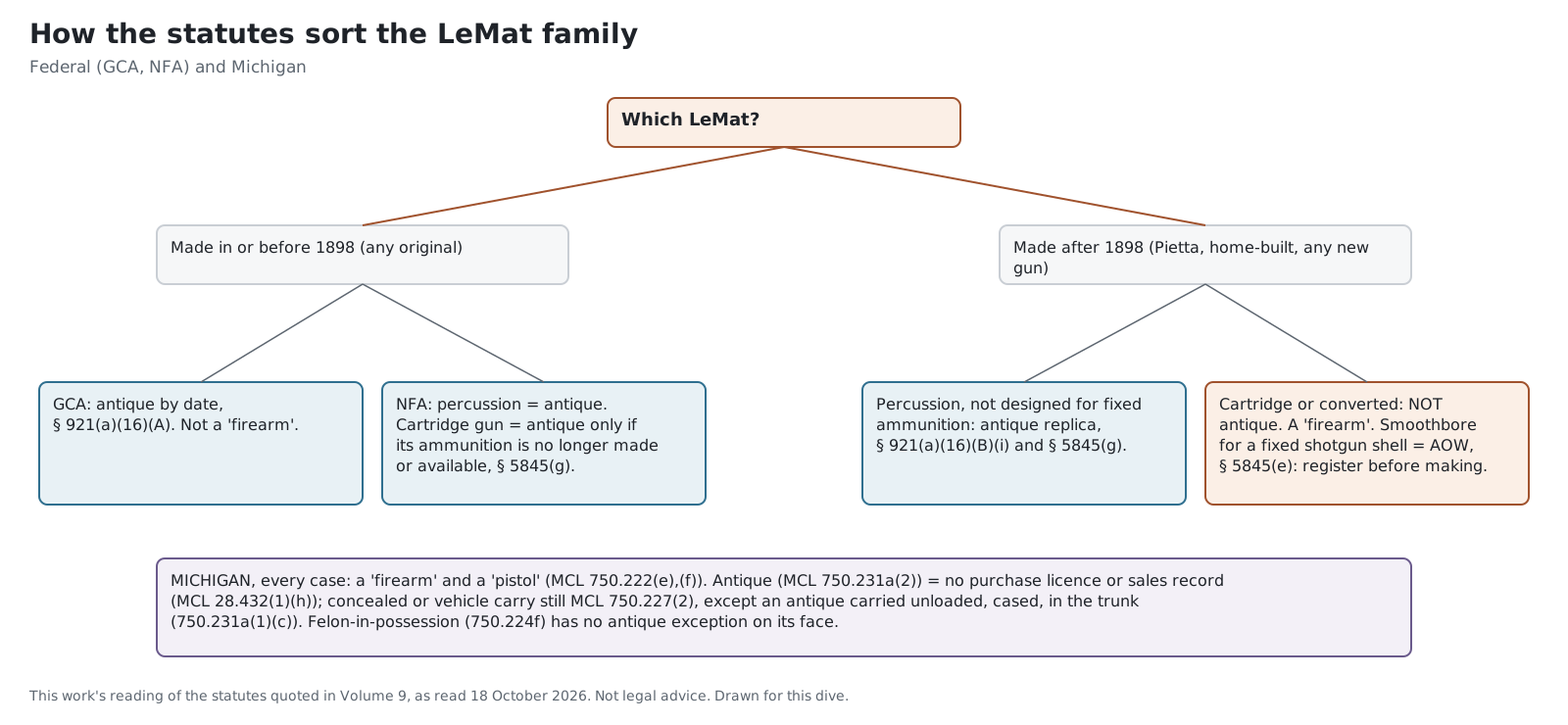
9.4 Applying it: six kinds of LeMat
This section is this work’s reading of the statutes quoted above.
- An original percussion LeMat (1856–1865). Made before 1899 and percussion. An antique under § 921(a)(16)(A) and under § 5845(g). Not a “firearm” under either act.
- An original pinfire LeMat. Made in or before 1898. An antique under § 921(a)(16)(A) by date. Under the NFA, its cylinder uses fixed ammunition (12 mm pinfire); its centre barrel is a percussion smoothbore (Volume 3), which does not fire a “fixed shotgun shell.” The NFA question does not arise on the centre barrel; on the cylinder it turns on the availability of 12 mm pinfire ammunition, which was not researched here.
- An original centerfire LeMat or carbine (1866–1880s). Made in or before 1898. An antique under the GCA by date. Under the NFA, the cartridge revolver’s centre barrel is chambered for a shot cartridge (Volume 3); whether it is an antique under § 5845(g) turns on whether its ammunition “is no longer manufactured in the United States and is not readily available.” If it were not an antique, a revolver with a smooth bore made to fire a fixed shotgun shell would meet § 5845(e). The ammunition question was not researched for this work, and an owner should not assume the answer.
- A Pietta reproduction. A replica of a pre-1898 percussion revolver that is “not designed or redesigned for using rimfire or conventional centerfire fixed ammunition.” An antique under § 921(a)(16)(B)(i) and, as a percussion “replica thereof,” under § 5845(g). ATF’s circular says such replicas “are also not subject to regulation as firearms.”3 Its 20-gauge centre barrel is loaded loose from the muzzle and does not fire a fixed shotgun shell.
- A home-built percussion LeMat. The same analysis as the Pietta, provided it is a percussion replica not designed for fixed ammunition (Volume 8). Its maker’s skill is not a legal question; its ignition and its design are.
- A new-made cartridge LeMat (a reproduction of the 1869 gun, or any percussion LeMat converted to cartridges). Not an antique: not made before 1899, and designed for fixed ammunition. A “firearm” under the GCA. If its smoothbore centre barrel is designed to fire a fixed shotgun shell, it is a pistol or revolver “having a barrel with a smooth bore designed or redesigned to fire a fixed shotgun shell” — an “any other weapon” under § 5845(e), which must be registered and approved before it is made. The tax treatment of “any other weapons” changed under Public Law 119-21; the Suppressor Law dive covers the change and is the place to check it, but registration before making is still required.
9.5 The NFA and the centre barrel
The LeMat is unusual among antique revolvers because its centre barrel is a smoothbore. A smoothbore muzzleloading barrel loaded with loose powder and shot is not a barrel “designed or redesigned to fire a fixed shotgun shell”; the AOW definition reaches the cartridge form only.2
The centre barrel’s bore also exceeds half an inch — about 0.63 in on originals, 20-gauge on the Pietta (Volume 3). The NFA’s destructive-device definition, § 5845(f)(2), covers “any type of weapon … the barrel or barrels of which have a bore of more than one-half inch in diameter,” subject to exceptions; but § 5845(a) excludes antique firearms from the NFA’s “firearm” altogether.2 For an antique LeMat, original or percussion replica, the bore size therefore does not bring it into the NFA. For a non-antique cartridge LeMat, the centre barrel’s bore is a second NFA question on top of the AOW one, and is another reason Volume 8 builds only percussion guns.
9.6 Conversion cylinders and home builds
Conversion cylinders. No cartridge-conversion cylinder for the Pietta LeMat was found (Volume 7). The statutory point is general: § 921(a)(16)(B)(i) protects a replica only if it “is not designed or redesigned for using rimfire or conventional centerfire fixed ammunition,” and subparagraph (C) excludes “any muzzle loading weapon which can be readily converted to fire fixed ammunition by replacing the barrel, bolt, breechblock.”1 A percussion revolver fitted to fire cartridges has been redesigned for fixed ammunition. No ATF classification on conversion cylinders was read for this work, and the conclusion that a converted LeMat would lose antique status is this work’s reading of the text. For a LeMat, the centre barrel would raise the further NFA question in §9.5 if it too were converted.
Home builds. A federal licence is required to engage in the business of manufacturing firearms, but a percussion replica that is an antique is not a “firearm” under § 921(a)(3).1 On the statutes quoted, an individual making a percussion LeMat for his own use is making an antique replica. Michigan law (§9.8) still treats it as a firearm and a pistol for most purposes.
9.7 Black powder itself
ATF’s position on black powder for antique firearms — commercially manufactured black powder in quantities up to 50 pounds, for sporting, recreational or cultural purposes in antique firearms, is exempt from the explosives regulations — is set out in the Hand Mortars dive, Volume 15, and is not repeated here. Pietta’s manual adds the practical rule: store black powder and percussion caps in separate places, in their original containers where possible.4
9.8 Michigan: an antique is still a “firearm” and a “pistol”
Michigan’s penal code defines its terms in MCL 750.222. The relevant definitions, as read on 18 October 2026 (the Legislature’s site states it is “complete through PA 91 of 2026”):
“(e) “Firearm” means any weapon which will, is designed to, or may readily be converted to expel a projectile by action of an explosive.”
“(f) “Pistol” means a loaded or unloaded firearm that is 26 inches or less in length, or a loaded or unloaded firearm that by its construction and appearance conceals itself as a firearm.”5
The Firearms Act, MCL 28.421, uses the same definitions of “firearm” and “pistol.”6
Neither definition excludes antiques. Black powder is an explosive; a LeMat expels a projectile by its action; a LeMat is about 14 inches long. On the text, every LeMat — original, Pietta or home-built — is a “firearm” and a “pistol” in Michigan. Where Michigan exempts antiques, it does so section by section, and only where a section says so.
9.9 Michigan: what antique status does change
Licensing and the sales record. MCL 28.422 requires a licence to “purchase, carry, possess, or transport a pistol.”7 MCL 28.432(1)(h) exempts antiques:
“Section 2 does not apply to any of the following: … (h) Purchasing, owning, carrying, possessing, using, or transporting an antique firearm. As used in this subdivision, “antique firearm” means that term as defined in section 231a of the Michigan penal code, 1931 PA 328, MCL 750.231a.”8
The amendment that added it “may be known as the ‘Janet Kukuk act’” (2004 PA 99).8
Michigan’s antique definition. MCL 750.231a(2):
""antique firearm” means either of the following: (i) A firearm not designed or redesigned for using rimfire or conventional center fire ignition with fixed ammunition and manufactured in or before 1898, including a matchlock, flintlock, percussion cap, or similar type of ignition system or replica of such a firearm, whether actually manufactured before or after 1898. (ii) A firearm using fixed ammunition manufactured in or before 1898, for which ammunition is no longer manufactured in the United States and is not readily available in the ordinary channels of commercial trade.”9
This follows the NFA’s wording, not the GCA’s. On this work’s reading:
- an original percussion LeMat and a Pietta (a “replica of such a firearm, whether actually manufactured before or after 1898”) are antiques in Michigan;
- a home-built percussion LeMat is also a “replica of such a firearm”;
- an original pinfire or centerfire LeMat is an antique in Michigan only under (ii) — if its ammunition is no longer manufactured in the United States and not readily available. Michigan has no “made before 1899” rule for cartridge guns; the GCA does.
- a new cartridge LeMat is not an antique in Michigan.
So a Michigan resident buying an original percussion LeMat or a Pietta needs no purchase licence and creates no pistol sales record under § 28.422, because § 28.432(1)(h) takes antiques out of that section entirely.
9.10 Michigan: carrying and transporting a LeMat
Antique status does not remove a LeMat from Michigan’s concealed-carry statute. MCL 750.227(2):
“A person shall not carry a pistol concealed on or about his or her person, or, whether concealed or otherwise, in a vehicle operated or occupied by the person, except in his or her dwelling house, place of business, or on other land possessed by the person, without a license to carry the pistol as provided by law…”10
Violation is a felony punishable by up to five years or a $2,500 fine.10 The antique exception in MCL 750.231a is narrow:
“(1) Subsection (2) of section 227 does not apply to any of the following: … (c) To a person carrying an antique firearm, completely unloaded in a closed case or container designed for the storage of firearms in the trunk of a vehicle.”9
On this work’s reading, then: a LeMat carried concealed, or carried in a vehicle other than unloaded, cased and in the trunk, falls under § 227(2) unless the person holds a concealed pistol licence and carries consistently with it. The narrow trunk exception is the antique’s only special treatment under § 227. Whether a black-powder pistol counts as “loaded” with powder and ball but no caps was not researched and should not be assumed either way.
9.11 Michigan: who may possess one
Federally, the prohibited-person provisions of the Gun Control Act apply to “firearms,” and an antique is not a “firearm” under § 921(a)(3).1
In Michigan, the felon-in-possession statute, MCL 750.224f, prohibits a person convicted of a felony from possessing “a firearm in this state” until the conditions in the section are met.11 The section contains no antique exception, and the penal code’s definition of “firearm” (§9.8) does not exclude antiques. On this work’s reading, a black-powder LeMat is a “firearm” for § 224f. This is precisely the kind of question that must go to a Michigan lawyer, and it is flagged here so that no reader assumes that federal antique status settles it.
9.12 A summary table
This work’s reading of the statutes quoted; not legal advice.
Table 1 — A summary table
| LeMat | GCA “firearm”? | NFA item? | Michigan “firearm”/“pistol”? | Michigan purchase licence (§ 28.422)? | Michigan concealed/vehicle carry (§ 227) |
|---|---|---|---|---|---|
| Original percussion | No (antique by date) | No | Yes | No (antique, § 28.432(1)(h)) | Applies, except unloaded, cased, in trunk |
| Original pinfire | No (antique by date) | Centre barrel percussion: no AOW question; cylinder depends on ammunition | Yes | No if antique under § 231a(2)(ii) (ammunition) | as above |
| Original centerfire / carbine | No (antique by date) | Depends on whether its ammunition is still made or available | Yes | Depends on § 231a(2)(ii) | as above |
| Pietta percussion | No (replica, § 921(a)(16)(B)(i)) | No | Yes | No | as above |
| Home-built percussion | No, if a percussion replica not designed for fixed ammunition | No | Yes | No | as above |
| New cartridge LeMat | Yes | Smoothbore barrel for a fixed shotgun shell is an AOW; register before making | Yes | Yes | Applies fully |
9.13 What could not be verified
- Whether 12 mm pinfire, 12 mm centerfire and the LeMat shot cartridges are “no longer manufactured in the United States and … not readily available” — the fact on which an original cartridge LeMat’s NFA status and its Michigan antique status turn.
- Any ATF classification of a LeMat, of a conversion cylinder, or of a home-built percussion revolver.
- Whether ATF Industry Circular 98-02 remains the agency’s current position.
- Whether a black-powder pistol with powder and ball but no caps is “loaded” for Michigan law.
- Michigan hunting rules for muzzleloading pistols (not researched).
- The application of MCL 750.224f to black-powder antiques (stated as this work’s reading of the text only).
Sources
Footnotes
-
18 U.S.C. § 921(a)(3) and (a)(16), with the amendment note for Pub. L. 105-277, Legal Information Institute, Cornell Law School, https://www.law.cornell.edu/uscode/text/18/921, read 2026-10-18. ↩ ↩2 ↩3 ↩4 ↩5 ↩6
-
26 U.S.C. § 5845(a), (e), (f) and (g), Legal Information Institute, https://www.law.cornell.edu/uscode/text/26/5845, read 2026-10-18. ↩ ↩2 ↩3 ↩4 ↩5
-
Bureau of Alcohol, Tobacco and Firearms, Industry Circular 98-02, “Classification of muzzle loading weapons that use modern primers for ignition” (1998), TTB archive, https://www.ttb.gov/public-information/industry-circulars/archives/1998/98-02, read 2026-10-18. ↩ ↩2 ↩3
-
F.lli Pietta, instruction manual for muzzleloading percussion firearms, English edition, p. 16, read 2026-10-18. ↩
-
Michigan Compiled Laws § 750.222, Michigan Legislature, https://www.legislature.mi.gov/Laws/MCL?objectName=mcl-750-222, read 2026-10-18 (“complete through PA 91 of 2026”). ↩
-
MCL § 28.421, Michigan Legislature, read 2026-10-18. ↩
-
MCL § 28.422, Michigan Legislature, read 2026-10-18. ↩
-
MCL § 28.432, Michigan Legislature, read 2026-10-18 (history: 1927 PA 372; am. 2004 PA 99). ↩ ↩2
-
MCL § 750.231a, Michigan Legislature, read 2026-10-18 (history ends am. 2012 PA 427). ↩ ↩2
-
MCL § 750.224f, Michigan Legislature, read 2026-10-18 (added 1992 PA 217). ↩
Comments (0)