LeMat Revolver · Volume 5
Loading and Shooting Both Barrels — Charges, Ball, Shot, Caps and What Accuracy to Expect
Every charge figure attributed to the document that gives it: the 1859 board, the maker's current manual and the 2014 recommendation, set side by side; the loading sequence for the cylinder and the shot barrel; and the cap that must not sit high
This volume is about putting powder, ball, shot and caps into a LeMat and firing them. It applies to the reproductions, which are the only LeMats anyone should shoot; an original is a museum object worth tens of thousands of dollars with a hand-fitted lock and, often, replaced parts (Volume 7).
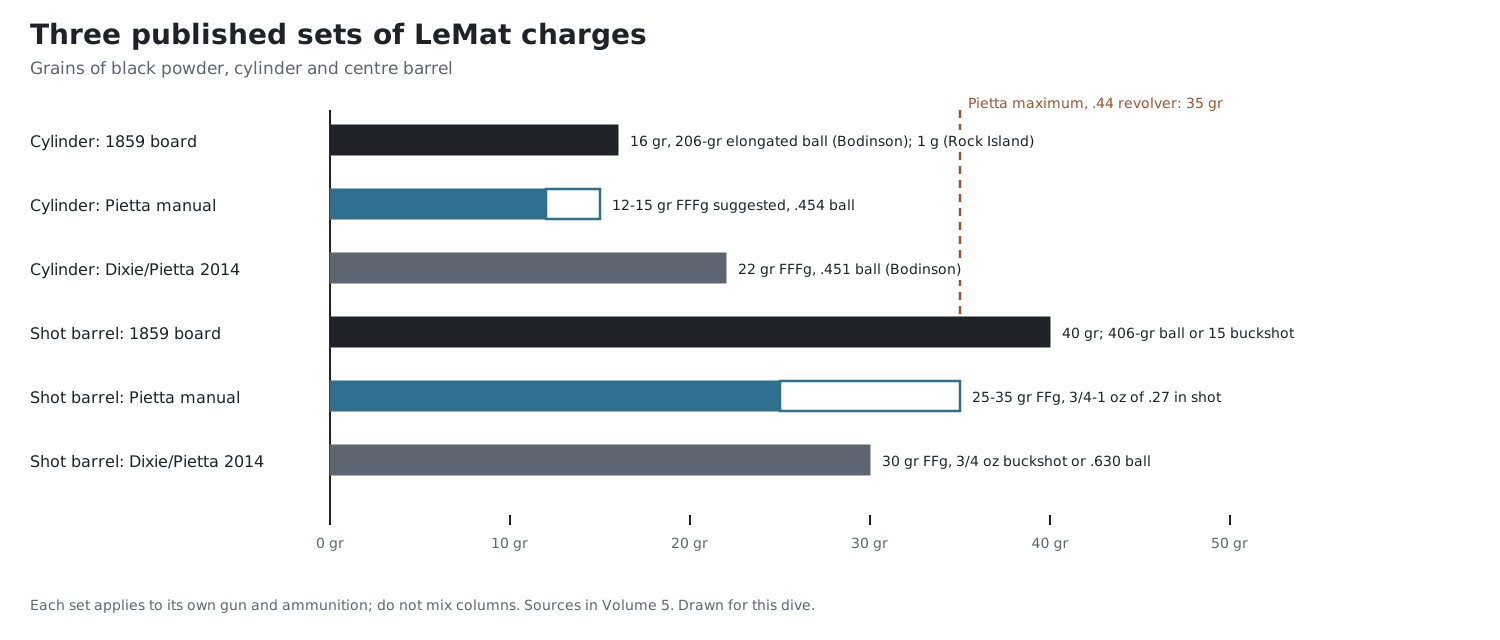
No charge figure in this volume is invented or adapted. Each comes from a named document: the 1859 Washington board’s report as read by two later authors, the instruction manual of F.lli Pietta, the gun’s maker, and a 2014 article that gives the recommendation of Pietta and the importer Dixie Gun Works at that time. The figures differ, and they are given separately. Where they disagree, the maker’s current manual governs a Pietta gun.
The general black-powder material — what black powder is, how its granulations are graded, why smokeless powder must never be used, how to store it — is covered in the muzzleloader dives in this collection and is linked rather than repeated: powder and granulation in Traditions Blunderbuss Kits, Volume 9, the loading and same-day cleaning routine in Volume 10, the percussion cap’s history in History of Muzzleloaders, Volume 11, and the ATF’s 50-pound black-powder exemption in Hand Mortars, Volume 15.
5.1 The rule before any number
Pietta’s manual opens its loading section with a warning that must stand at the head of this one too:
“NEVER LOAD YOUR GUN WITH ANY TYPE OF SMOKELESS POWDER OR OTHER PROPELLANT! … all muzzleloading firearms are intended for use with BLACK POWDER ONLY. … NEVER under any circumstances attempt to use smokeless powder or a mixture of black powder and smokeless powder.”1
Its reason: “black powder generates a relatively low breech pressure. Replica firearms, even with their modern steel barrels, are not designed to withstand the high pressure produced by modern smokeless powder.”1 The manual does list maximum charges of the substitute Pyrodex (§5.2), so a black-powder substitute of that kind is within the maker’s instructions; smokeless powder never is.
5.2 Three sets of figures, side by side
Table 1 — Three sets of figures, side by side
| 1859 Washington board | Pietta manual (current English edition) | Dixie and Pietta, as reported in 2014 | |
|---|---|---|---|
| Cylinder powder | 16 gr (Bodinson); 1 g = 15.4 gr (Rock Island) | FFFg, 12–15 gr (0.8–1 g) suggested; 35 gr maximum; Pyrodex maximum 28 gr | 22 gr FFFg |
| Cylinder projectile | 206-gr “elongated ball” | Round ball .454 in (11.55 mm) | Round ball .451 in |
| Shot-barrel powder | 40 gr (Bodinson); 2.5 g = 38.6 gr (Rock Island) | FFg, 25–35 gr (1.6–2.2 g) | 30 gr FFg |
| Shot-barrel load | 406-gr ball, or 15 buckshot | Round “grapeshot” balls .27 in (6.85 mm), about ¾ to 1 oz | ¾ oz buckshot, or a .630 in patched round ball |
| Wads | Not stated | Not stated for the LeMat | 17-gauge over-powder and over-shot wads |
| Applies to | The original .42/18-bore gun | Pietta .44 / 20-gauge reproduction | Pietta .44 / 20-gauge reproduction |
How to read the table.
- The 1859 figures describe the original gun and its original ammunition; they are historical evidence, not a load for a reproduction. Their consistency between two independent readings (16 gr against 15.4 gr, 40 gr against 38.6 gr) suggests they are accurate transcriptions.
- The Pietta manual’s figures are generic rows of its load table — “.44 REVOLVER” and “.20 ga REVOLVER” — which its LeMat section then applies by recommending, for the LeMat, “.44 cal.: .454″ (mm 11,55)” ball and “.20 ga.: round grapeshot balls .27 cal. (mm 6,85) approx 3/4 ounce to 1 ounce.”1 The manual does not give a separate LeMat-specific powder charge. The .44 revolver row’s maximum of 35 grains is the maker’s ceiling for its .44 revolvers in general.
- The 2014 figures are what Bodinson reported as the Dixie and Pietta recommendation then, and they differ from the current manual both in powder (22 grains against 12–15 suggested) and in ball (.451 in against .454 in).2 Twenty-two grains is within the manual’s 35-grain maximum but above its suggested range. The manual’s suggested range is conservative.
- Do not mix the columns. A shot-barrel charge from 1859 with a cylinder charge from 2014 is a combination nobody has published.
5.3 Powder
Granulation. Pietta’s manual specifies “3f or FFFg — standard granulosity, recommended for .31, .36 and .44 cal. revolvers” and “2f or FFg — to be used with .50 cal. firearms and .10, .12, .16 and .20 ga. side by side.”1 Its table follows that: FFFg for the LeMat’s cylinder and FFg for its 20-gauge barrel.1 Bodinson’s 2014 recommendation is the same: FFFg for the cylinder and FFg for the shot barrel.2 So a LeMat shooter needs two powders at the bench — a fine one for the chambers and a coarser one for the centre barrel — with two separate measures. Confusing them is the obvious bench error.
Measuring. Pietta’s rules: “ONLY handle Black Powder in very small quantities”; “NEVER charge a muzzleloader directly from the powder flask”; “ALWAYS use individual charges from a powder measure.”1 A flask spout charger poured straight into a chamber leaves the flask in contact with a chamber that may hold a smouldering residue.
Substitutes. The manual’s maximum-load table includes “THE MAXIMUM GRAINS OF PYRODEX DATA,” giving 28 grains for a .44 revolver.1 Edmunds shot his Navy Arms reproduction with “a modern non-corrosive black powder.”4 Substitutes are discussed further in the Traditions dive linked above.
5.4 Ball for the cylinder
Pietta’s current recommendation is a .454 in (11.55 mm) round ball of pure lead; the manual identifies it with “part no. 8,” which in its parts list is the barrel — that is, the ball for the rifled barrel’s chambers.1 Its rule: “Use soft lead ball only. Other materials or alloys will not travel freely through the barrel.”1
Fit. The ball is meant to be oversize for the chamber, so that seating it shaves a ring of lead: “A thin ring of lead will be shaved off the ball at the opening of the chamber. This occurrence illustrates that the ball is properly fitted to the chamber and will not move off the powder during the firing of the other chambers.”1 The ball is seated “smooth and uninterrupted” by the loading lever until it lies “.040″ (1mm) below the cylinder edge,” without crushing the powder.1
Bullets. The originals were loaded with conical bullets — the 1859 board’s “206-grain … elongated ball,” and the Confederate paper cartridges Edmunds describes.24 Rock Island describes an original mould casting “a .40 caliber conical bullet” together with buckshot (§5.11).3 Bodinson notes that “the Civil War LeMat was loaded with a conical bullet.”2 Pietta’s manual gives only round ball. No published conical-bullet load for the Pietta LeMat was found.
5.5 Shot, ball and wads for the centre barrel
Shot. Pietta: “round grapeshot balls .27 cal. (mm 6,85) approx 3/4 ounce to 1 ounce,” with 25–35 grains of FFg.1 Bodinson: “30 grains of FFg and 0.75 ounces of buckshot.”2 The 1859 board fired “15 buckshot.”23 Bodinson’s own target load was “15 No. 4 buckshot.”2
Ball. The 1859 board also fired a single 406-grain ball, and Bodinson reports a 2014 recommendation of “a 0.630-inch patched roundball.” He did not see the point: “Why they would recommend a ball loading in the shotgun barrel eludes me … It defeats the whole purpose of the LeMat Grape Shot Revolver!”2 Note the size: a .630 in ball is near the original 18-bore and is not a nominal 20-gauge size (Volume 3). It is reported here as Bodinson gives it.
Wads. The centre barrel must hold its load against the recoil of the cylinder shots, which hammer it nine times while it waits. Bodinson: the shot side “requires the use of 17-gauge over-powder and over-shot wads to keep the load in place when shooting the revolver.”2 A 17-gauge wad in a 20-gauge barrel is a deliberately oversized, tight fit. Pietta’s manual does not specify wads for the LeMat; its shotgun section describes an over-powder wad (it prefers cork) and an over-shot card for its muzzleloading shotguns, seated firmly and checked by a mark on the rammer.1 Edmunds and his correspondents loaded the centre barrel with “patch, grapeshot and ball” using a wooden rod, because the gun’s own rammer was too short.4
The 1869 shot cartridge. For interest, LeMat’s 1869 patent describes a cartridge for the centre barrel with a conical ball at its mouth and three slugs “each constituting one-third of the cylindrical section of the cartridge” behind it, and a cased pinfire gun sold by Rock Island came with a mould “for round balls and three-piece segmented slugs.”56 The Illustrated London News engraving of 1861 shows a three-ball cluster beside the gun (Volume 1). These are historical loads and are not published for the reproduction.
5.6 Caps, and the shot-barrel cap problem
The LeMat takes ten caps. Edmunds: “The last step in loading would be to place a percussion cap on each nipple: a total of ten, including the shotgun nipple. This requires half-cocking the gun and rotating the cylinder to it’s nine-stop capping locations, then full-cocking the gun and placing the last cap on the shotgun nipple.”4
Size. No cap size was found in Pietta’s manual for the LeMat. A retailer recommendation reported in search results (#11 caps) was not read on its source page and is not relied on. Fit the cap to the nipple: a cap that has to be forced may split, and one that falls off will not fire.
The shot-barrel cap. Two observations by experienced shooters point at the same problem:
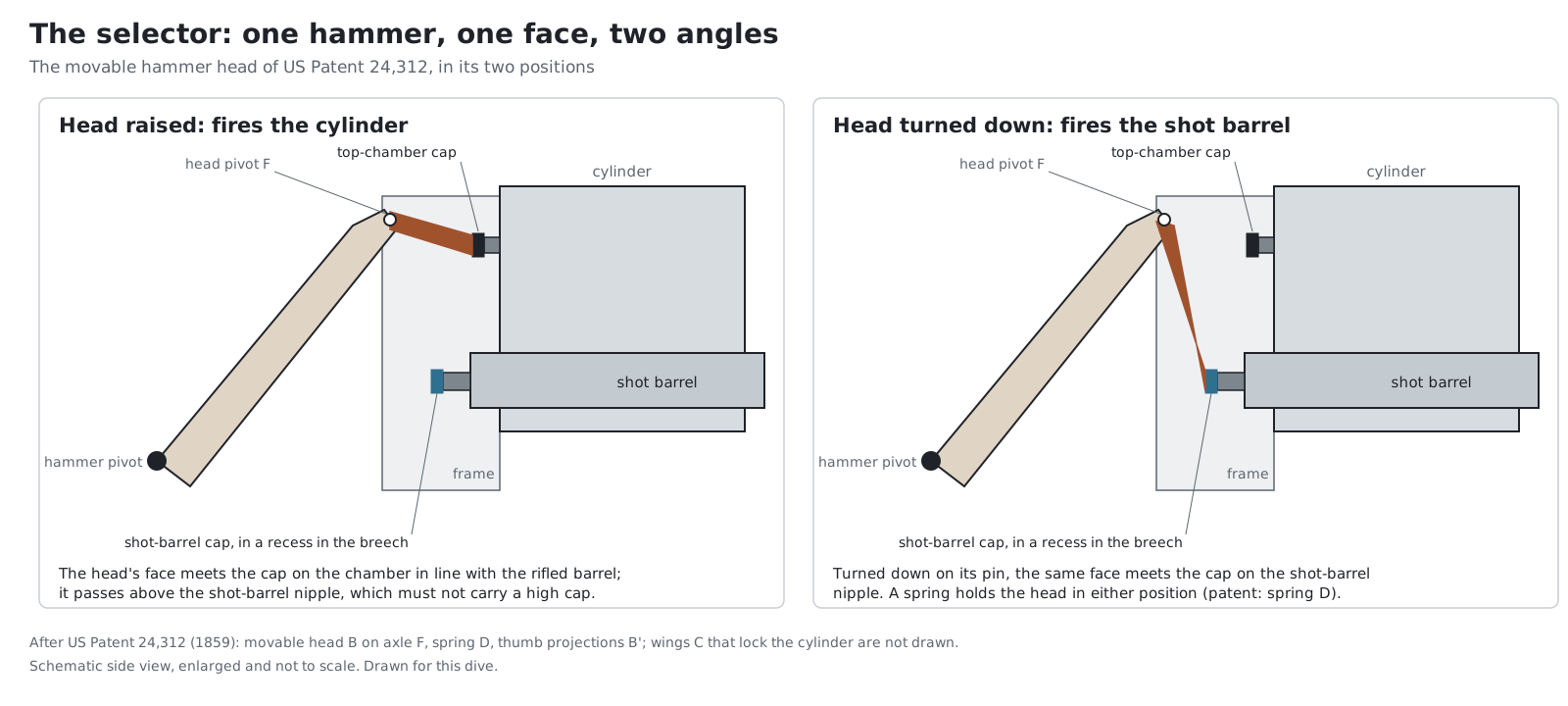
- Cumpston: “The shot barrel is difficult to shoot with modern percussion caps due to the oblique angle of the shot barrel hammer extension and its short throw.”7
- Pietta: “After loading the cylinder and the center barrel, NEVER place any cap on the nipple under the hammer, for the .20 ga. The cap could be misplaced (too high) causing a double percussion which would fire 2 shots simultaneously.”1
The hammer head reaches the shot-barrel nipple at an angle and with little travel. A cap that is not fully seated may be struck by the head in the revolver position, so that one fall of the hammer fires both the top chamber and the centre barrel; a cap that is fully seated may be hard for the turned-down head to fire reliably. The manual’s wording, read literally, would forbid capping the centre barrel at all, which cannot be its intent; the safe practice that follows from both statements is: cap the shot-barrel nipple only when you are about to fire the shot barrel, seat the cap fully, and never leave it capped while firing the cylinder. This is this work’s reading; the quotation is Pietta’s.
5.7 The loading sequence
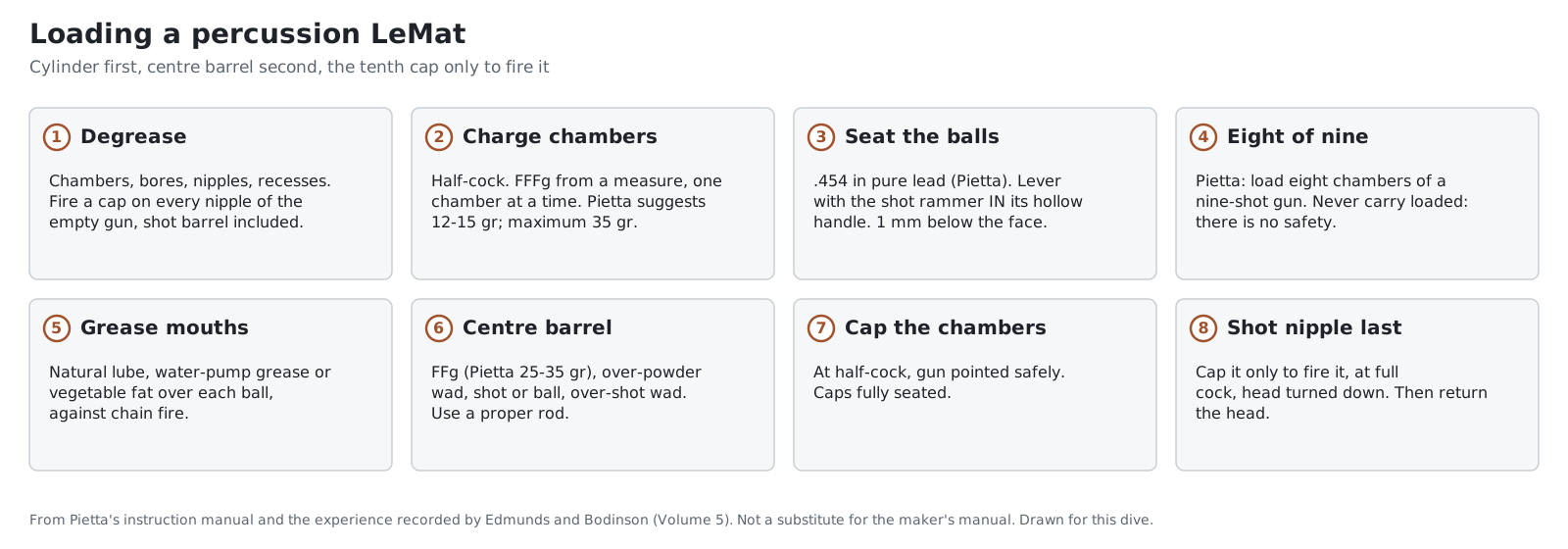
Combining Pietta’s general percussion-revolver instructions with its LeMat notes and the experience recorded by Edmunds and Bodinson:142
- Degrease. “Wipe away any grease and oil from the cylinder chambers, the inside of the barrel, the nipples and pockets around the nipples,” using a degreaser. Check that each nipple is firmly seated.
- Fire caps on the empty gun. At half-cock, cap every nipple; at full cock, fire each “to dry out the base of the chamber and nipple.” Remove the spent caps and check that none remains unfired. For the LeMat, do this for the centre barrel’s nipple too, by turning the hammer head down.
- Charge the chambers. At half-cock, muzzle up, pour a measured charge of FFFg into each chamber. Pietta notes that a “pre-cut patch or a dose of semolina” may be laid over the powder.
- Seat the balls. Place a ball on each chamber mouth, rotate it under the rammer, and seat it with the loading lever “smooth and uninterrupted” to about 1 mm below the cylinder face. Keep the shot-barrel rammer inside the lever’s hollow handle while doing this; Bodinson’s advice, and the lesson of the broken levers in Edmunds’s account.
- Load only eight chambers. Pietta: “TO AVOID AN ACCIDENTAL DISCHARGE, ALWAYS LOAD ONLY … EIGHT CHAMBERS OF A NINE-SHOTS GUN,” with the hammer to rest on “the uncapped nipple of the unloaded chamber” — and see §5.8 on the limits of that.
- Grease the chamber mouths. “Fill the remaining portion of each loaded chamber with grease. Suitable products are natural lube, water pump grease or vegetable fat like crisco. This not only helps form a gas seal when the ball enters the barrel, but also prevents chain firing of all chambers at once, and aids in cleaning.”
- Load the centre barrel. FFg charge; an over-powder wad (Bodinson: 17-gauge); the shot or ball; an over-shot wad. Use a proper rod — Edmunds and his correspondents found the gun’s own short rammer inadequate — and keep the gun’s rammer back in the lever afterwards.
- Cap the chambers at half-cock, gun pointed safely.
- Do not cap the centre barrel until the shot barrel is to be fired (§5.6).
- To fire the shot barrel: cock, turn the head down, cap the shot nipple fully home, fire, then return the head to the revolver position.
Pietta’s instructions also say to remove a ball seated without powder by taking the cylinder off and using a worm, or by removing the nipple and pushing the ball out, and never to fire a gun in which a ball has lodged part way down the barrel.1
5.8 Carrying, decocking and the missing safety
No safety. “LEMAT MODEL — For this model there are no safety devices or safety positions. ALWAYS carry this gun unloaded.”1 Colt and Remington percussion revolvers have safety notches or pins between the chambers; the LeMat has none.
Eight of nine. Pietta’s general instruction to load eight chambers and rest the hammer on the uncapped nipple of the empty one is a range-handling instruction, not permission to carry the gun loaded; the LeMat-specific instruction overrides it for carry.1 Pietta also warns: “NEVER CARRY A CYLINDER THAT IS CAPPED! A Capped Cylinder loaded with powder and ball is the equivalent of a small firearm.”1
Decocking. Pietta gives a decocking sequence for its single-action revolvers: thumb holding the hammer fully back, trigger pressed, hammer lowered slowly past half-cock onto the cap; then to half-cock, rotate the empty chamber under the hammer, and lower it again. It warns that the decocked live charge “will rotate with each cocking. DO NOT FORGET ABOUT THIS CHARGE.”1 Practise it unloaded.
5.9 Shooting: recoil, the lever, the cylinder that stops turning
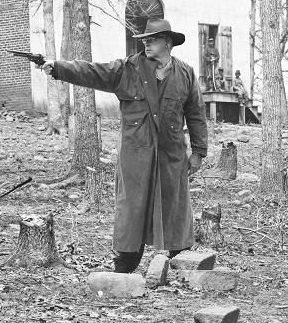
Recoil of the centre barrel. Garbers repeats a period complaint from “a young private demonstrating the revolver for LeMat” that “the recoil from the grapeshot barrel was unbearable.”8 A charge of up to 35 grains and an ounce of shot from a 1.6 kg handgun (Pietta’s weights) recoils far harder than the 15 or 20 grains behind a .454 ball. Hold the gun firmly with both hands for the shot barrel.
The lever drops. Bodinson: “when shooting the shotgun barrel, the loading lever will consistently flip up and out of its spring clip and leave the shotgun ramrod on the ground at your feet.”2 Check the lever after every shot from the centre barrel.
The cylinder stops turning. Edmunds’s reproduction needed hand turning after four or five shots because the cylinder-stop pins would not engage through fouling.4 Bodinson’s Pietta worked “fine as long as the pin and its corresponding holes are kept clean.”2 Have a cleaning patch and a pick for the pin holes on the bench, and wipe the breech face between cylinders. A chamber out of line with the bore shaves lead and throws it sideways — a real hazard to anyone beside the shooter.
Cap fragments. Pietta’s troubleshooting note applies with extra force to a gun with two nipples under one hammer: if a cap fails to fire, “cock the hammer and flick out the cap fragments from the previous shot which sometimes get caught under the hammer.”1
5.10 Accuracy and velocity: what is published, and what is not
Velocity. Wikipedia gives a muzzle velocity of 620 ft/s, an effective range of 40 yards and a maximum of 100 yards, without a source.9 No chronograph figure for an original or a reproduction was found in a maker’s publication or a test report. The 620 ft/s figure is therefore recorded here as uncited and is not used.
Accuracy evidence. What exists is anecdotal and should be read that way:
- Rock Island: the LeMat “was bulky, had less accuracy, and required more reload time” than the Colt 1851 Navy and the Starr.3 No figures.
- Wikipedia’s article describes the original as “not very accurate but deadly at close range.”9
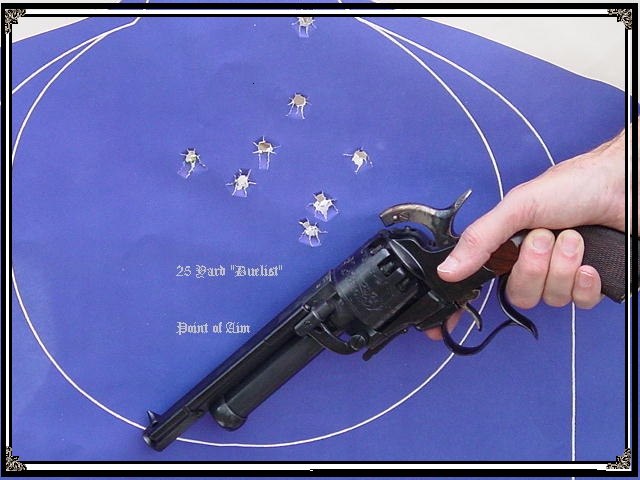
- Cumpston’s photograph shows a Pietta replica above a group on a target annotated “25 Yard ‘Duelist,’” with the shots clustered above the point of aim; he calls the gun “accurate.”7 The number of shots and the group size are not stated and are not measured here.
- Bodinson shot a B-27 silhouette target “at 30 feet with a full load of 9 .44-caliber balls and a load of 15 No. 4 buckshot.”2 No group size is given.
Why it might not shoot well. Three features of the design work against accuracy, and they are the honest way to frame expectations:
- Sights. A hammer-groove rear sight and a thick pyramidal front post — “good for combat, bad for target shooting” (Bodinson).2
- Barrel attachment. The rifled barrel is screwed onto the shot barrel and pinned, not fixed to a top strap; its alignment with the chamber depends on threads and a pin (Volume 4).
- Cylinder lock. A pin lock that fouls can leave a chamber slightly out of line.
Point of impact. Fixed sights on a revolver are regulated for one load. The Pietta’s front sight is drifted for windage; elevation is set by the sight’s height. Expect to choose a charge that puts the group where the sights look, within the maker’s limits.
The shot barrel. No pattern data was found. Bodinson’s 30-foot target is the only illustrated result.
5.11 Moulds and cast projectiles
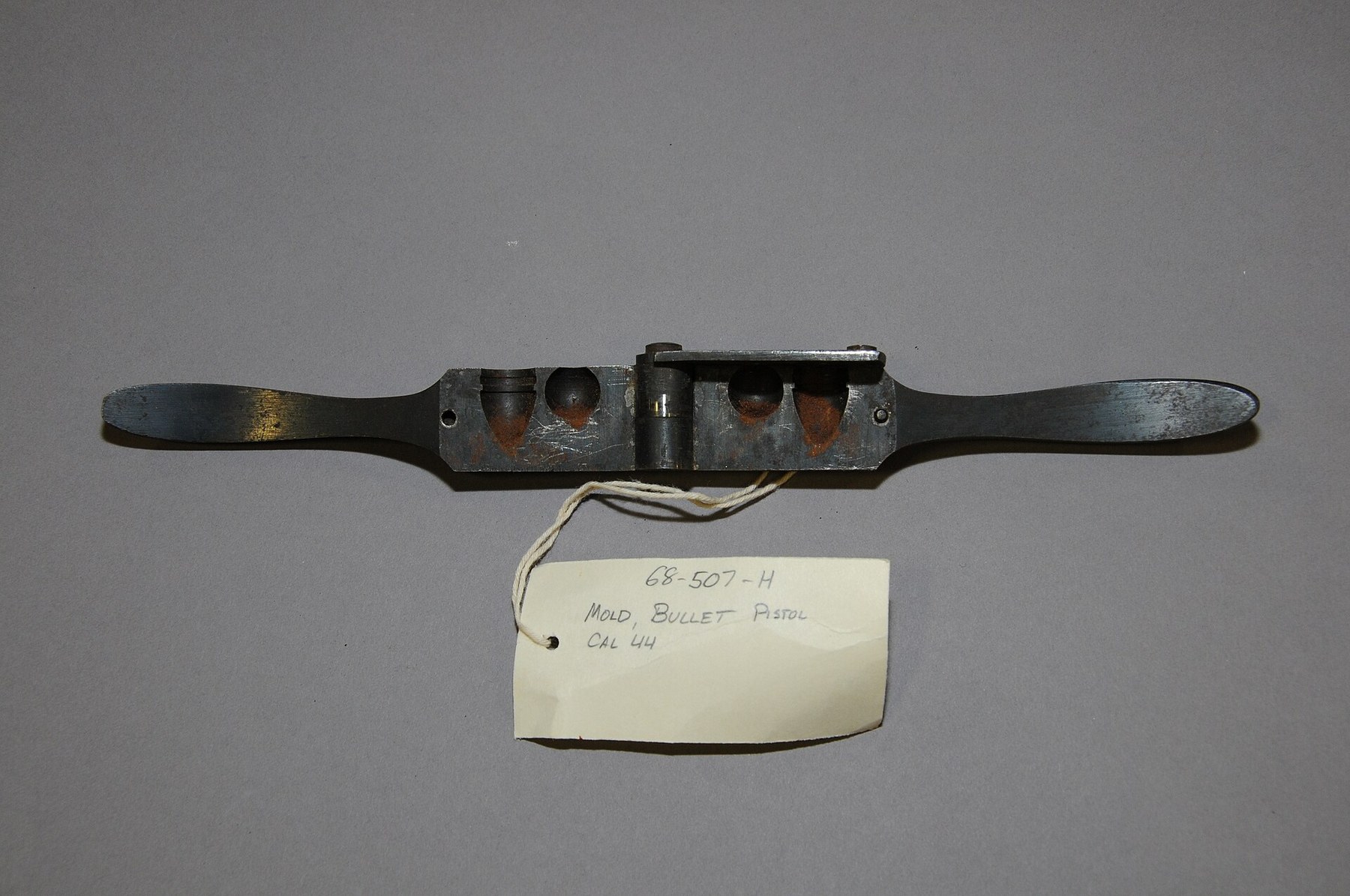
Original moulds. Rock Island describes an original LeMat mould that casts “two small .28 caliber buckshot balls (approximately #2 buckshot) and a .40 caliber conical bullet,” a pattern “discussed in depth on page 105 of ‘The Confederate LeMat Revolver’ by Doug Adams.”3 It also describes two long gang moulds, “approximately 18 1/2 inches in length,” with “twenty-three small round cavities for casting lead buckshot balls measuring at approximately .28 caliber,” attributed as Confederate-made.3 Edmunds refers to the soldier’s “issued brass-mold” for bullets and grapeshot.4 The cased pinfire gun had “a brass double cavity bullet mold for round balls and three-piece segmented slugs.”6
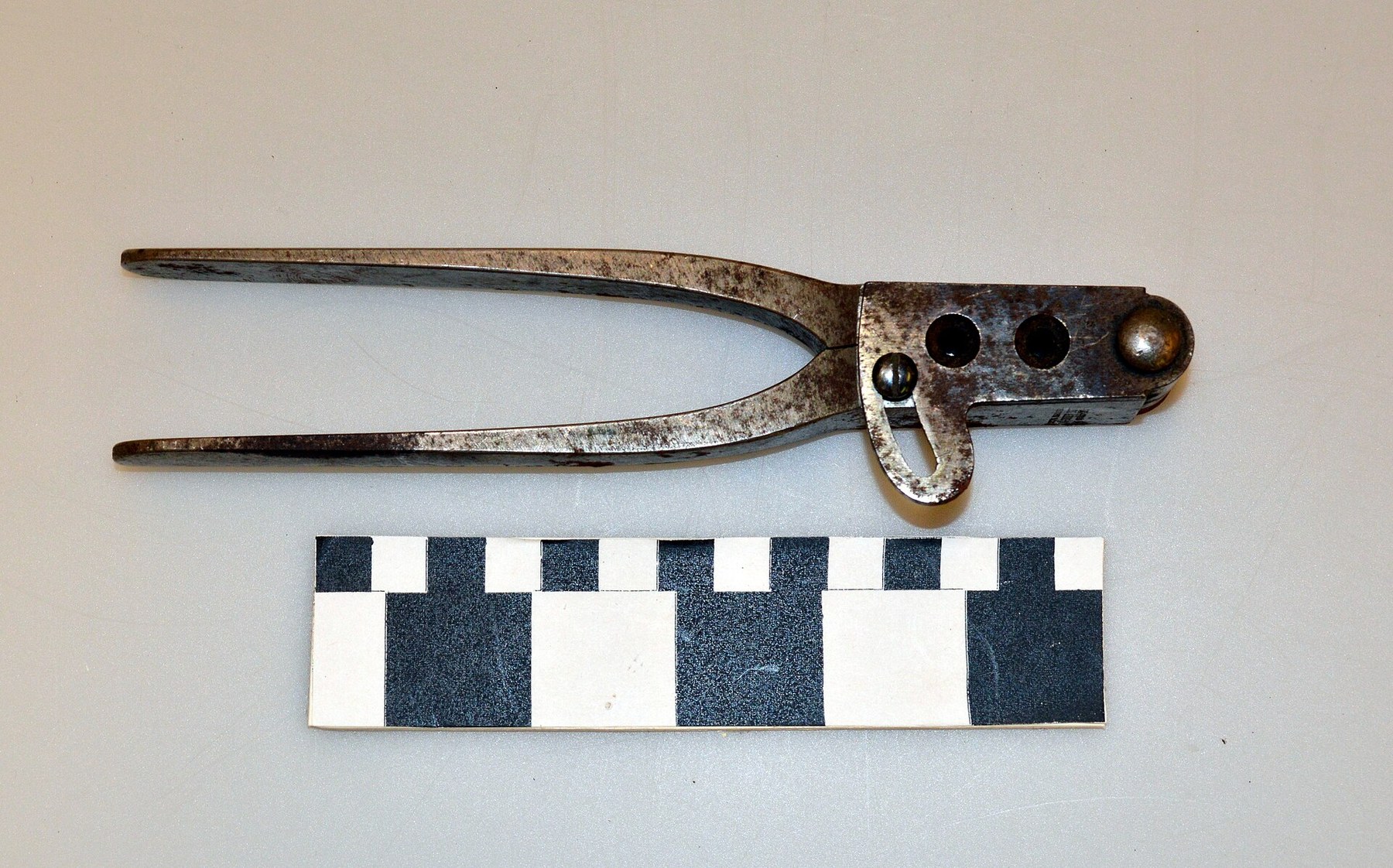
Moulds for the reproduction. The Pietta takes a .454 in round ball and .27 in buckshot (Pietta’s figures), both standard sizes cast in ordinary round-ball moulds. No LeMat-specific modern mould was found in the sources consulted, and none is named here. Pietta’s manual carries the usual lead warning: casting “will expose you and others in the area to lead”; work with strong ventilation and wash afterwards.1
5.12 Malfunctions at the bench
Table 2 — Malfunctions at the bench
| Symptom | Likely cause | What to do | Source |
|---|---|---|---|
| Cylinder will not turn to the next chamber | Fouling in the stop-pin holes or on the shot barrel’s bearing surface | Clean pin, holes and breech face; hand-turn only with the gun pointed safely | Edmunds; Bodinson42 |
| Cap fires, chamber does not | Clogged nipple; oil in the nipple; powder not down to the nipple | Pick the nipple; fire caps on a clean empty gun before loading next time | Pietta1 |
| Cap does not fire | Hammer blow weak, defective cap, or cap fragments under the hammer | Cock and flick fragments out with a blade or small screwdriver | Pietta1 |
| Shot barrel will not fire | Cap not reached by the head’s short oblique throw; head not fully down | Seat the cap; check the head’s spring holds it down | Cumpston; this work’s reading7 |
| Two shots at once | Shot-barrel cap high enough to be struck in the revolver position | Never leave the shot nipple capped except to fire it | Pietta1 |
| Ball lodged in barrel | Firing with no or little powder | Stop. Disassemble and remove; never fire another shot behind it | Pietta1 |
| Loading lever bent | Seating balls with the shot rammer out of the handle | Keep the rammer in; replace lever | Bodinson; Edmunds24 |
| Lever drops when firing the shot barrel | Weak retaining spring | Check after each shot; replace spring | Bodinson; College Hill210 |
| Chain fire (several chambers at once) | Loose balls, no grease at chamber mouths, missing caps | Correct ball size, grease mouths, caps on all loaded chambers | Pietta1 |
5.13 What could not be verified
- A LeMat-specific powder charge from the maker. Pietta’s manual applies its generic .44 and .20-gauge rows.
- The reason the 2014 recommendation (22 grains, .451 ball) differs from the current manual (12–15 grains, .454 ball).
- Any chronograph velocity, original or reproduction; Wikipedia’s 620 ft/s is uncited.
- Any measured group or pattern.
- The correct cap size for the Pietta’s nipples.
- What Pietta’s double-percussion warning means exactly. It is quoted; the reading is this work’s.
- A modern LeMat-specific mould (none found).
Sources
Footnotes
-
F.lli Pietta, instruction manual for muzzleloading percussion firearms, English edition (file “avancarica_Ing.pdf”), pp. 15–28 and 30–33, https://pietta.it/wp-content/uploads/2024/05/avancarica_Ing.pdf, read 2026-10-18. ↩ ↩2 ↩3 ↩4 ↩5 ↩6 ↩7 ↩8 ↩9 ↩10 ↩11 ↩12 ↩13 ↩14 ↩15 ↩16 ↩17 ↩18 ↩19 ↩20 ↩21 ↩22 ↩23 ↩24 ↩25 ↩26 ↩27 ↩28
-
Holt Bodinson, “The Awesome LeMat,” GUNS Magazine, 7 February 2014, https://gunsmagazine.com/guns/handguns/the-awesome-lemat/, read 2026-10-18. Source of the 1859 board’s loads in grains and of the Dixie/Pietta recommendation of that date. ↩ ↩2 ↩3 ↩4 ↩5 ↩6 ↩7 ↩8 ↩9 ↩10 ↩11 ↩12 ↩13 ↩14 ↩15 ↩16 ↩17 ↩18
-
Joe Engesser, “The LeMat Revolver,” Rock Island Auction Company, read 2026-10-18. Source of the 1859 loads in grams and of the original moulds. ↩ ↩2 ↩3 ↩4 ↩5 ↩6
-
Frederick R. Edmunds, “Some Thoughts on the Confederate LeMat Revolver,” ASAC Bulletin 100:24–28 (2009), read 2026-10-18. ↩ ↩2 ↩3 ↩4 ↩5 ↩6 ↩7 ↩8 ↩9
-
F. A. Le Mat, US Patent 97,780, 14 December 1869, read 2026-10-18. ↩
-
Rock Island Auction Company, auction 64, lot 265, cased pinfire LeMat, read 2026-10-18. ↩ ↩2
-
Mike Cumpston, description of File:Lemat25targ.JPG (uploaded 3 July 2007), Wikimedia Commons, read 2026-10-18. ↩ ↩2 ↩3
-
Alan Garbers, “The LeMat’s Grapeshot Revolver,” GUNS Magazine, 15 September 2021, read 2026-10-18. ↩
-
College Hill Arsenal, Second Model serial 1784, read 2026-10-18. ↩
Comments (0)