LeMat Revolver · Volume 3
Variants and Identification — First Model, Second Model, London, Baby, Pinfire, Centerfire and Carbine
How to tell one LeMat from another by the trigger guard, the lanyard ring, the loading lever, the barrel address and the proof marks, and why an original's shot barrel is 18-bore and not 20-gauge
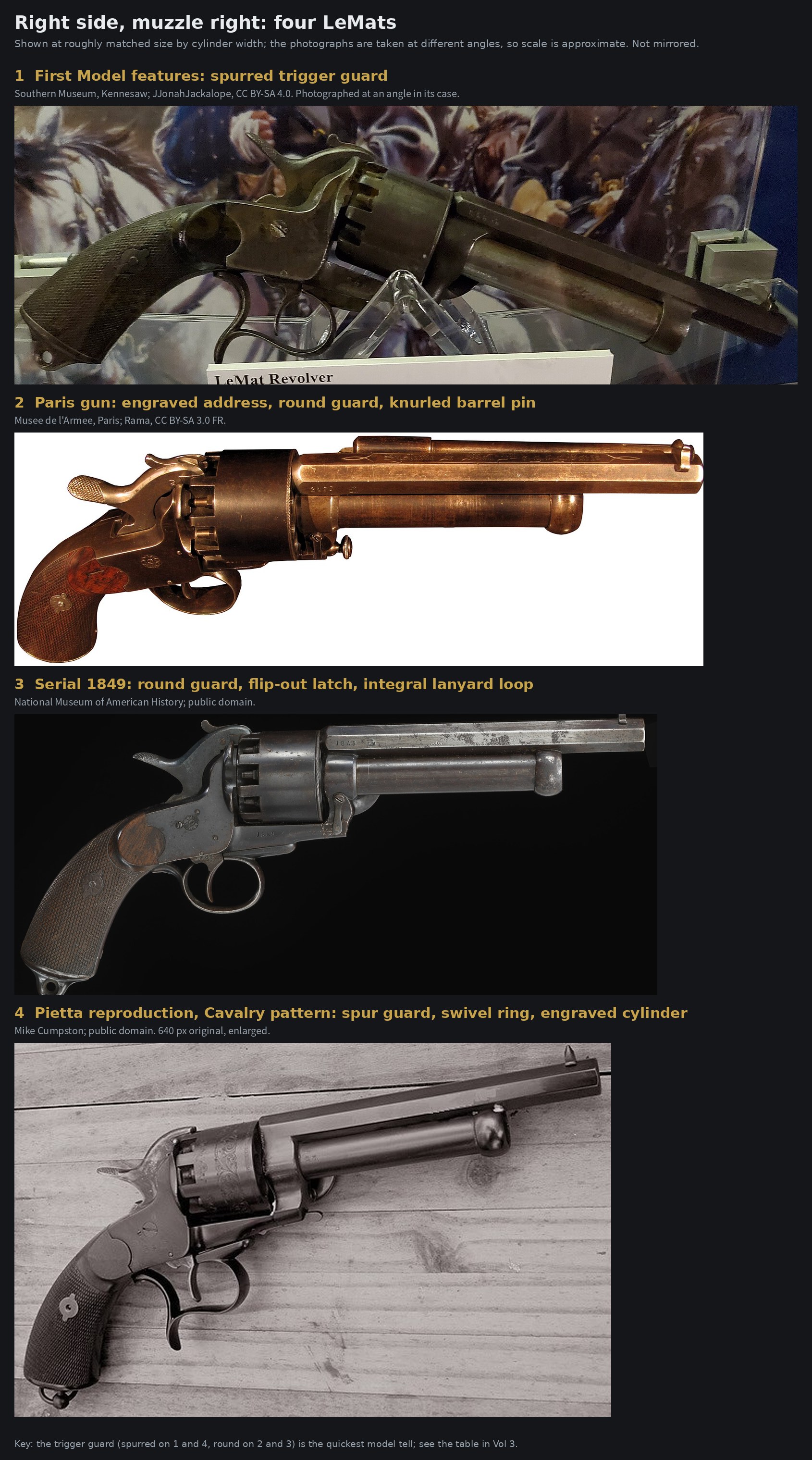
Volume 2 followed the LeMat through the war. This volume is about the guns themselves: how to tell what an example is, and which features carry real information about where and when it was made. It also covers the four families that came after or beside the Civil War percussion revolver — the Baby LeMat, the pinfire gun, the centerfire gun and the carbines — and the modern reproductions, whose model names describe no original model.
3.1 The families at a glance
Table 1 — The families at a glance
| Family | Ignition | Cylinder | Centre barrel | Made | Approximate numbers |
|---|---|---|---|---|---|
| Krider prototypes | Percussion | 9 shot, “.40” | Smoothbore, “16” | Philadelphia, 1859 | 2 known (Adams)1 |
| Francotte guns | Percussion | 9 shot | Smoothbore | Liège, 1859 | 6 known, highest serial 20 (Adams)1 |
| First Model | Percussion | 9 shot, about .42 | Smoothbore, about .63 | Liège 1861–62 (most sources); Paris-marked examples exist | About 45023 |
| Transitional | Percussion | as above | as above | Paris | Not counted |
| Second Model | Percussion | as above | as above | Paris, 1864–65 | Bulk of the roughly 2,9003 |
| London | Percussion | 60-bore | 18-bore at proof | England, c. 1864–65 | Serials 8000–9000 (Adams, via Julia)4 |
| Baby LeMat | Percussion | 9 shot, .32 | Rifled, .41 | Paris, 1864–65 | ”About 100” delivered; 10–14 known56 |
| Pinfire | 12 mm pinfire cylinder; percussion shot barrel | 9 shot | Smoothbore, about 20 ga | Liège, 1863–65 and later | ”About 1,000” (one cataloguer)78 |
| Centerfire | Centerfire | 9 shot, 12 mm and others | Chambered for a shot cartridge | Paris, Liège, Birmingham, 1866–1880s | ”In the hundreds”29 |
| Carbine | Pinfire with percussion lower barrel; later centerfire | 9 shot, 11–12 mm | 13.6 mm, rifled or smooth | Liège and others | Rare; no count found1011 |
3.2 Why the models blur
Every collector source warns that LeMats do not divide neatly into models. Three facts explain why.
The guns were assembled from parts made in different shops. Rock Island: “Numerous variations are found in the standard models since LeMat revolver components were manufactured by smaller shops and later shipped to a main factory for final assembly.”2 A part design changed when the subcontractor changed, not when the factory announced a new model.
Design changes were introduced one at a time. Garbers describes the run as “two distinct models, with a transitional period between the two,” and lists the changes as they arrived: a spring-loaded barrel latch replaced by a cheaper flip-out lever; engraved barrel markings replaced by roll stamps; the spur dropped from the trigger guard “during the Transition period”; the right-side loading lever moved to the left.12 College Hill Arsenal: “It is not uncommon to find mixture of 1st Model and 2nd Model features on many of the earlier, Paris made, 2nd Model production range pistols, which collectors refer to as ‘Transitional’ LeMats.”3
Serial numbers were duplicated and parts replaced. Simmons, captioning a photograph of serial number one: “There were duplications of serial numbers in the early models.”13 And because some parts — the loading lever, its catch spring, the barrel pin and its spring, the hammer nose — broke or were discarded in service, surviving guns often carry replacements that confuse the picture (Volume 6).314
The practical rule follows from all three: identify a LeMat by its features, not by its serial number alone, and read every feature against the others. A single anomalous feature is more likely a replacement or a transitional mixture than a new model.
3.3 The prototypes: Krider and Francotte
Volume 1 covers these in detail. For identification:
- Krider guns. Two are known, serial numbers 1 and 2, made in Philadelphia; serial 1 is in Liège and serial 2 is calibre “40/16” with silver-plated brass trigger guard and backstrap and a barrel address with “COL.” added.1 Simmons notes that the grips of serial 1 “were never checkered.”13
- Francotte guns. Six are known, “closely emulating the Krider pistols,” with the highest known serial 20.1 The older books (Serpette; Forgett and Serpette) catalogued them as Krider guns; Adams separated them.1
A gun offered as an American-made prototype should be expected to match one of the two Krider guns’ documented features, and a buyer should know that Adams’s count of two has been challenged, at least nominally, by Rock Island’s sale of a “Krider” serial number 4 in May 2026.2
3.4 The First Model
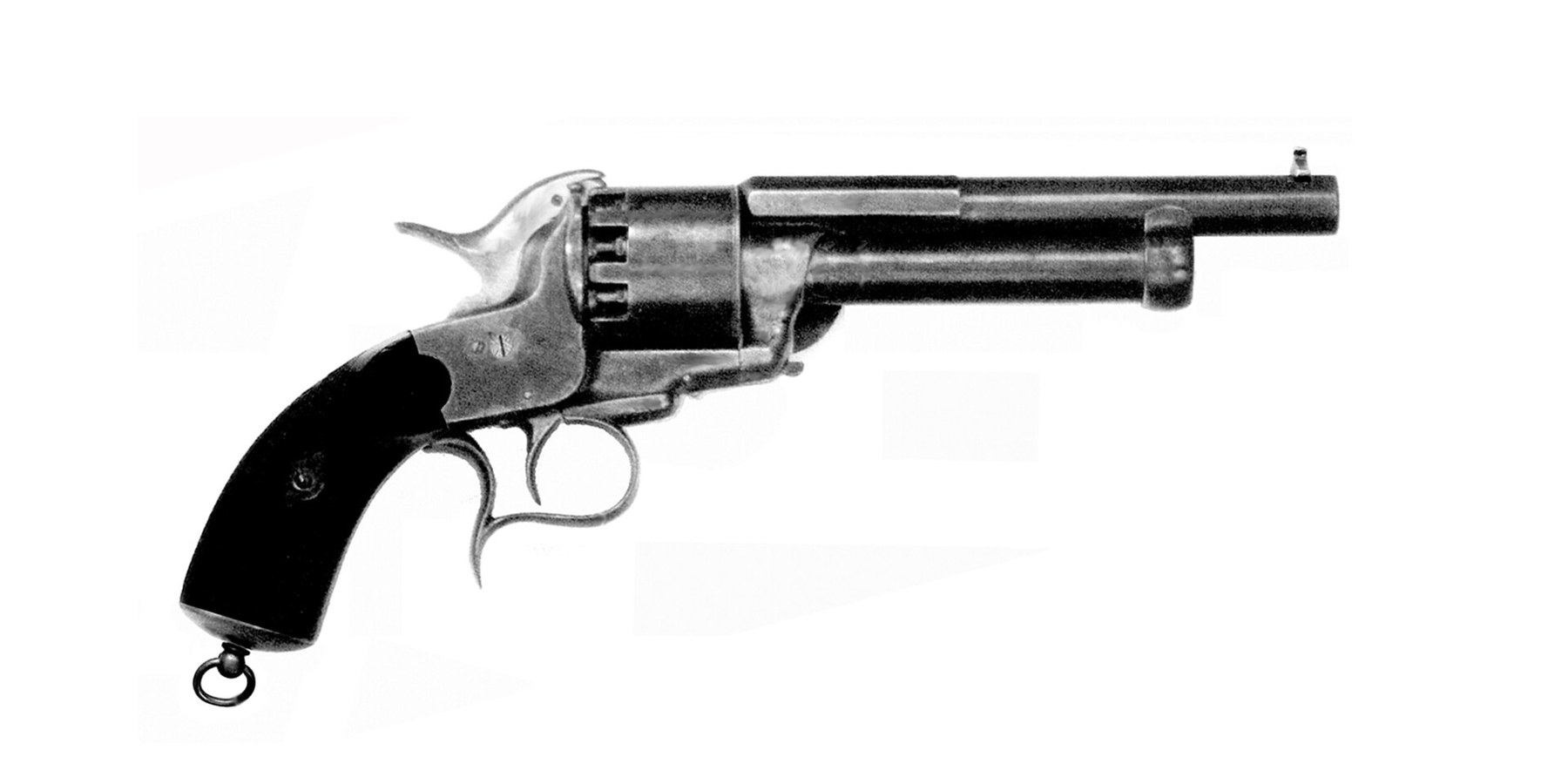
The First Model is the early production gun, about 450 of them, which Rock Island and College Hill place in Liège in 1861–62 in the serial range of roughly 1 to 450.23 Garbers puts the last known First Model at about serial 458, from his description of number 451 as “seven guns before the last known.”12 Edmunds identifies the first 450 as the Navy-contract shipment that Gorgas diverted to the cavalry (Volume 2).14
Where they were made is not as settled as the summary suggests. Rock Island’s own catalogue for a different lot describes a “Paris Marked First Model” with “SYSTME LEMAT BTE S.C.D.G. PARIS” on the top flat, and says in that entry that early production was in Paris with later production in Liège and Birmingham — the reverse of the order in Rock Island’s own article.152 The Julia catalogue for First Model serial 28 calls it “Belgian” and records no proof marks at all.16 The safe reading is that First Model features are found on guns marked both for Liège and for Paris, and that the address on the barrel, not the model, tells you where a given gun was finished.
First Model features, assembled from the descriptions of serials 28, 282, 286 and 451:16212
- Spurred trigger guard — a finger spur at the rear of the guard, “much like the Smith & Wesson Model 3 Russian” (Garbers).
- Loading lever on the right side of the barrel, housing the removable rammer for the shot barrel.
- Swivelling lanyard ring through the butt, with “solid integral butt cap” (Julia, serial 28); College Hill calls it a “large rotating lanyard ring.”3
- Rifled barrel octagonal at the breech, round forward — “7″ oct to rnd” on serial 28.
- Engraved barrel address, for example “COL. LeMat Patent” in an engraved panel with a fleur-de-lis at each end (serial 28).
- Barrel latch: early guns have a “spring loaded, spoon handle latch” (serial 28) that had to be pressed before the barrel could be unscrewed; by serial 451 it had become “a cheaper flip-out lever” (Garbers).
- Reciprocating-pin cylinder lock: a pin moving in and out of the standing breech to engage holes in the rear of the cylinder, described by Garbers as “an extremely complicated and expensive system” that grit could defeat (Volume 4).
- Hammer nose “with small ears on each side” for the thumb (serial 28) — the “lateral projections” of the 1859 patent.17
- Interrupted take-down threads at the muzzle end of the shot barrel (serial 28).
3.5 The transitional guns
“Transitional” is a collectors’ term, not a factory one. It describes Paris guns in the early Second Model serial range that carry a mixture of features. Simmons recorded serial 309 as “the lowest serial number Le Mat revolver with second model” features in his files, “at least 150 numbers less than any other second model or transition model.”13 Garbers’s serial 451 shows the mixture from the other side: it has the First Model right-side lever and spurred guard, but the later flip-out barrel latch.12 The overlap of serial 309 with the “1 to 450” First Model range is itself a reminder that the model boundaries are not serial boundaries.
3.6 The Second Model
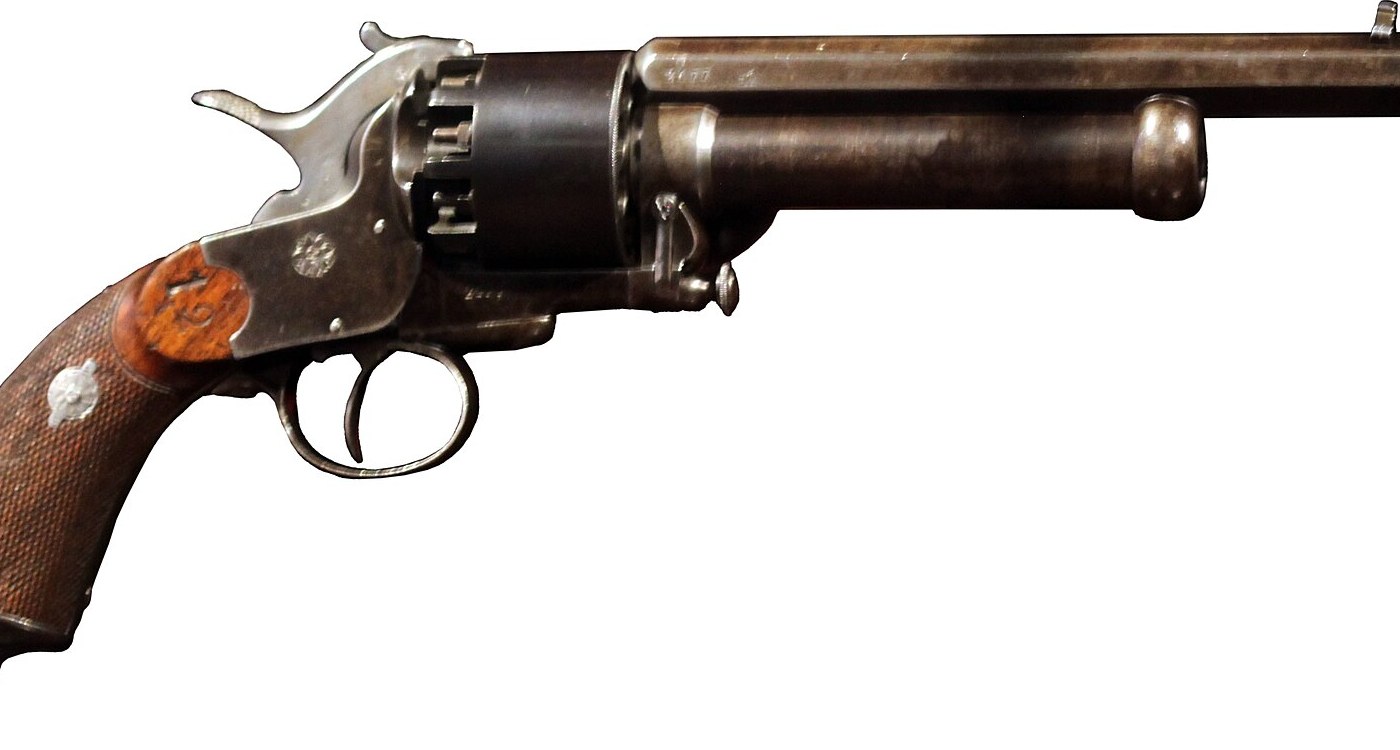
The Second Model is the Paris production gun of 1864–65, roughly serials 451 to 2500.23 Its features, in Rock Island’s list: “a round trigger guard, an integral lanyard ring on the butt, an octagon barrel, a pull-out assembly latch, a center-mounted hammer pivot, and a loading lever mounted on the left side of the barrel.”2 College Hill describes the lanyard fitting as “a small, and a fixed lanyard ring.”3
Representative examples from catalogues:
- Serial 1784 (College Hill): engraved Gothic address between intertwined brackets with flourishes; ”* / LM” proof on the left side of the barrel ahead of the serial; serial repeated on cylinder, frame, take-down pin face, loading-lever pivot, shot-barrel rammer and trigger; assembly number 19 inside the frame and written in ink inside both grips; five-groove rifling; dovetailed front sight that originally carried a “barley corn.”3
- Serial 1576 (Julia): “6-13/16″ full oct bbl with ‘PARIS’ markings on top flat and rammer mounted on left side”; 10.63 mm/16 ga.18
- Serial 1475 (Julia): no address on the top flat and no star/LM mark, but Birmingham proofs on the cylinder, barrel and shot barrel; serial on the inside of the side plate; 6½ in upper and 5 in lower barrels; casehardened frame.19
- A Rock Island Second Model with the barrel signed “Col Le Mat Bte s.g.d.g. Paris” with lined borders and “the distinct ‘/LM’ mark on the right side ahead of the serial number.”2
Note the disagreement over the side of the “LM” proof mark — left on serial 1784 (College Hill), right on Rock Island’s example. Both may be correct for the guns described; it is not a reliable model feature.
3.7 The London guns
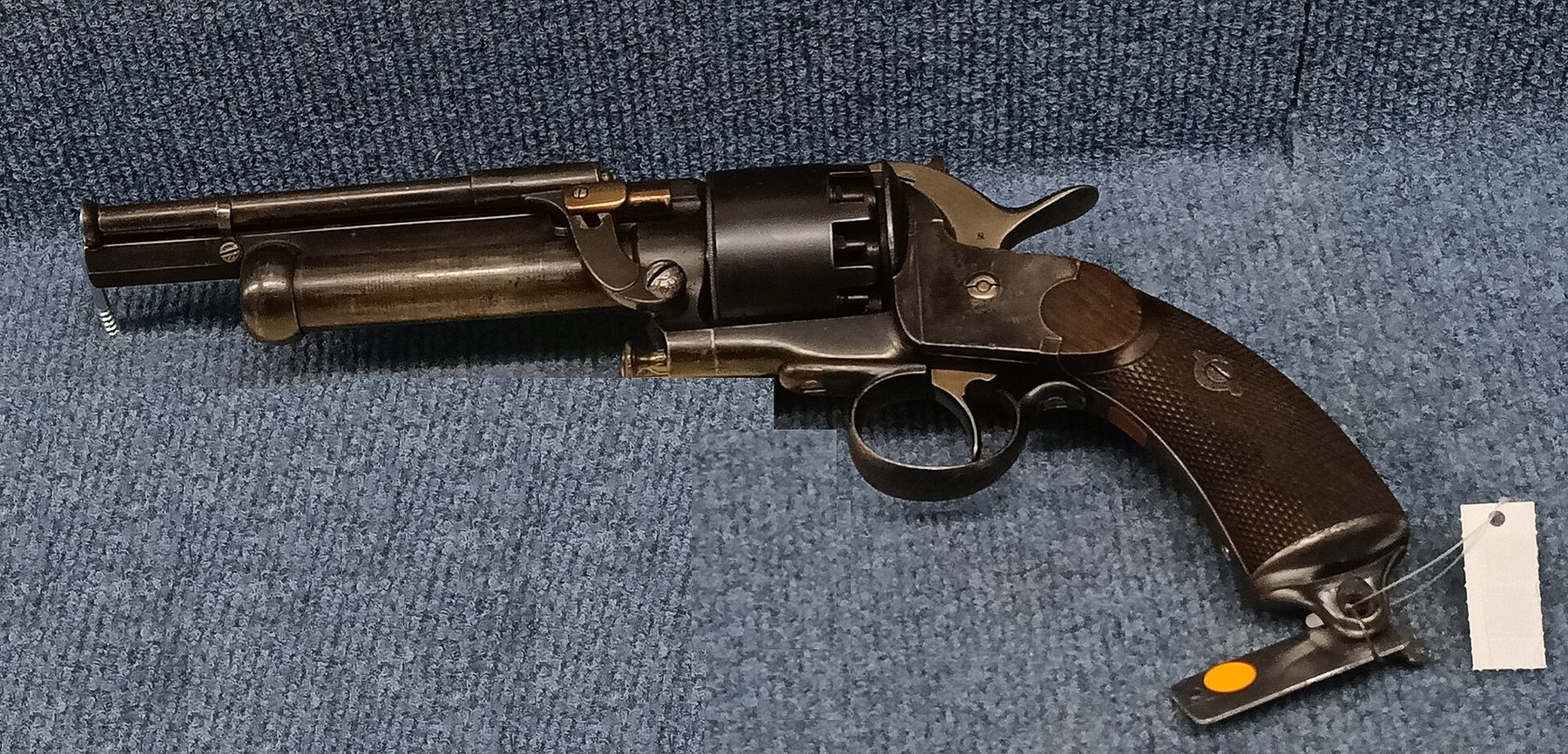
Volume 2 lists the surviving London guns. For identification: “LEMAT & GIRARD’S PATENT LONDON” in block letters on the top flat; Birmingham proof marks on the barrel and between the chambers; a bore number “18” stamped with two proofs under the shot barrel; serials in the 8000–9000 range, which Adams identified as a Confederate Navy contract; left-side lever in a channel between barrel and rear boss; a single knurled-head barrel pin; “integral solid butt cap & lanyard loop without ring”; and a tall front sight.420 Simmons also records a London gun with a low serial, number 3, with provisional proof marks of crossed sceptres and bore number 18, and London number 9 among a group photograph of eight guns.13 The London series evidently had its own numbering, as College Hill says (“somewhat eccentric”).3
3.8 Tell them apart: the percussion guns
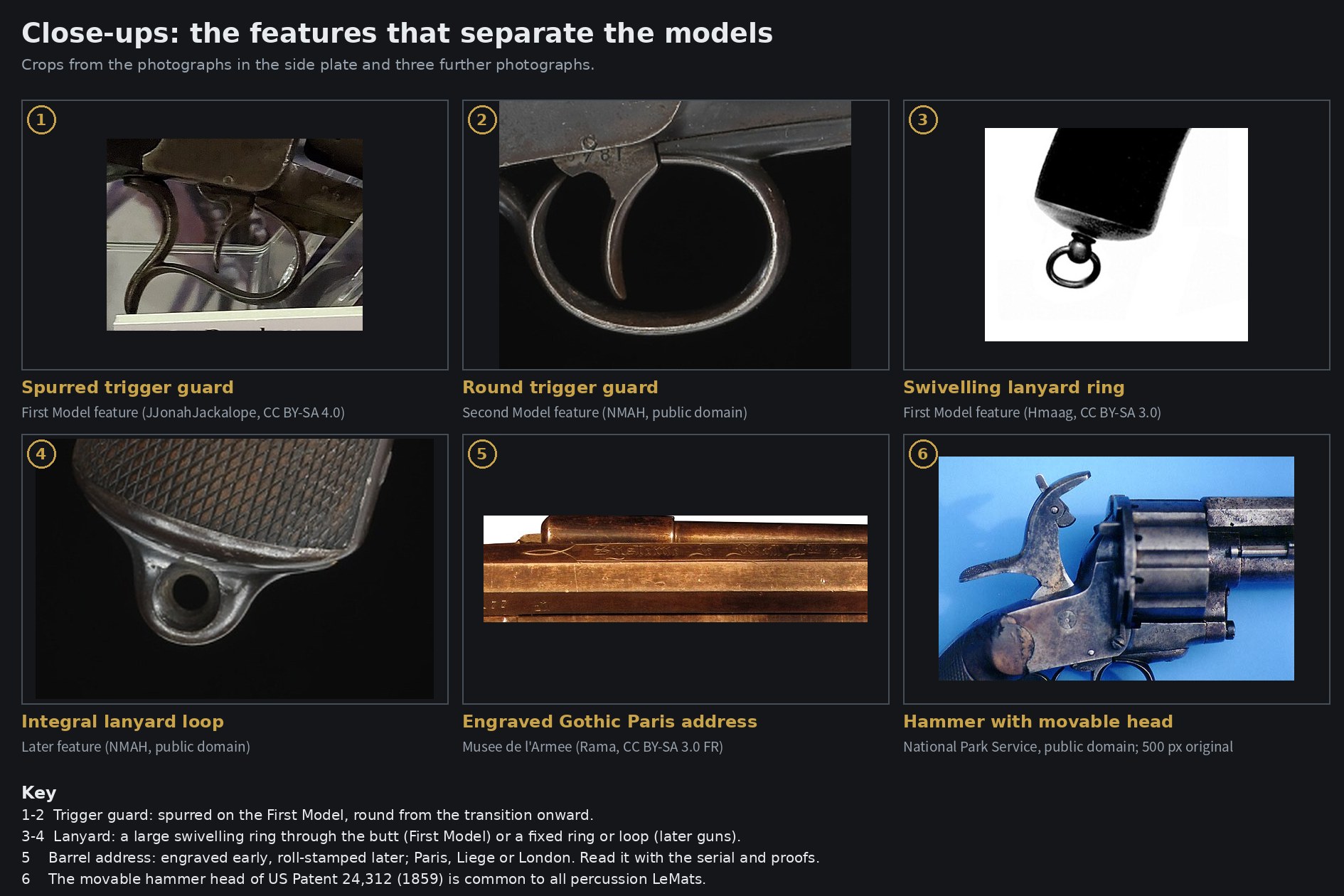
Table 2 — Tell them apart: the percussion guns
| Feature | First Model | Transitional | Second Model (Paris) | London | Where to look |
|---|---|---|---|---|---|
| Trigger guard | Spurred | Spur dropped during the transition | Round, no spur | Round, no spur | Rear of the guard |
| Lanyard fitting | Large swivelling ring through the butt | Either | Small fixed ring, integral with butt | Loop without ring, integral butt cap | Bottom of the butt |
| Loading lever | Right side | Right or left | Left side | Left side, in a channel | Under the rifled barrel |
| Rifled barrel | Octagonal to round | Either | Full octagon | Full octagon, 6-9/16 in on serial 8074 | Barrel profile |
| Barrel address | Engraved; e.g. “COL. LeMat Patent” with fleurs-de-lis | Engraved or stamped | Engraved Gothic “Col. Le Mat Bte s.g.d.g. Paris”; later roll-stamped | ”LEMAT & GIRARD’S PATENT LONDON” block letters | Top flat |
| Barrel latch | Spring-loaded spoon-handle latch, later flip-out lever | Flip-out lever | Pull-out pin with knurled head | Single knurled-head pin | Right front of frame |
| Cylinder lock | Reciprocating pin | Pin | Pin, later replaced by a bolt (Bodinson) | as Second Model | Standing breech face; rear of cylinder |
| Proofs | Often none (serial 28) | Varies | Paris star/LM; late guns Birmingham | Birmingham, bore number 18 | Barrel flats, cylinder, under shot barrel |
| Serial range | About 1–458 | About 309 upward | About 451–2500 | 8000–9000 and a separate low series | Barrel, frame, cylinder |
The table is an aid, not a test. A First Model with a replacement left-side lever, or a Second Model with a replaced plain guard, is far more likely than an unrecorded model. Where features conflict, read the barrel address, the serial number and the proof marks together.
3.9 Calibre, bore numbers and the 18-bore correction
The LeMat’s calibres are quoted in four systems — inches, millimetres, the gauge or bore number, and the proof stamp — and the conversions are where the most widespread error in LeMat writing comes from.
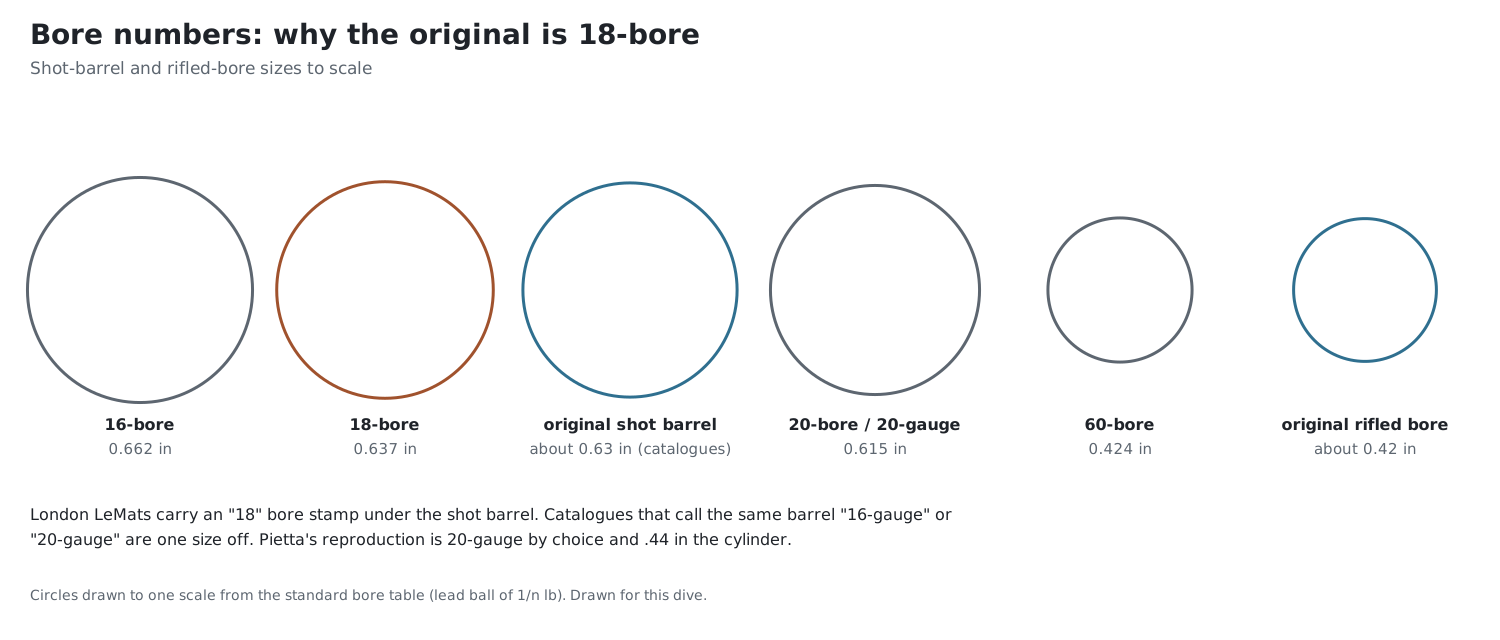
The rifled barrel is usually given as .42 calibre.321 Rock Island adds .40 and .41 as “non-standard calibers,” the Smithsonian’s gun is .40, Krider serial 2 is “40,” and catalogues in millimetres give 10.6, 10.63 and 10.66 mm, which are .417 to .420 in.2221161823 Christie’s describes the London gun’s barrel as “60-bore.”24 In the old British bore system, 60-bore is a lead ball of one-sixtieth of a pound, about 0.42 in. All of these are the same nominal size measured or named differently.
The shot barrel is the problem. Its bore is usually given as .63 in.319 The catalogues then name its gauge three different ways:
- “approximately 20 gauge” — College Hill Arsenal;3
- “16 gauge” or “16-bore” — the Smithsonian, Rock Island, Julia and Christie’s;2220424
- “18 gauge” — Wikipedia, Rock Island’s article (“its 18 gauge shot barrel”) and Garbers.25212
The standard bore sizes are: 16-bore, 0.662 in; 18-bore, 0.637 in; 20-bore, 0.615 in. A .63 in barrel is 18-bore. The London guns settle it physically: the proof stamp under the shot barrel is “18” (serials 8074, 8948 and 8604) and London serial 3 carries “bore number of 18.”4232013 The Julia cataloguer read the stamp correctly — “‘18’ which probably refers to bore diameter” — while still calling the barrel “16 ga.” in the heading.4
So the original shot barrel is 18-bore, about 0.63 in. “16-gauge” overstates it by one size and “20 gauge” understates it by one. Pietta’s catalogue makes the matching error the other way, describing the original as “9 shots plus 1 in .65” — a calibre nearer 16-bore — and explaining that “the .65 central barrel is produced, for market requirements, in .20 for muzzleloaders.”26 The reproduction’s 20-gauge barrel is therefore a deliberate modern change, and it is smaller than the original’s, not larger.
3.10 Serial numbers and markings
- Serial locations, Second Model: barrel (right side ahead of the cylinder), cylinder, frame, take-down pin face, loading-lever pivot, rammer, trigger; plus an assembly number inside the frame and in ink inside the grips (College Hill, serial 1784).3 On the Baby LeMat serial 31, the number was found on sixteen parts including the oiler in the butt.27
- The star over “LM” is LeMat’s own mark, called his “oval proof” by one cataloguer, and is found next to the barrel serial.1615
- Birmingham proofs appear on late Paris guns and on all London guns; Julia notes them on Baby serial 5 as “found only on the very late Paris models that were shipped to England in 1864.”5
- Inspector marks. Some Baby LeMats carry an “M” cartouche, attributed in the older literature (Simmons and Albaugh) to the Confederate naval inspector Lieutenant William H. Murdaugh; serial 31 carries a “B.”527
- Liège proofs on pinfire and carbine guns: the oval “ELG” with star, “crown over EL,” “crown over V,” “crown over G” and others.8710
Because duplicated serials are recorded among early guns, and because the London guns used their own sequences, a serial number alone does not identify a LeMat. The barrel address and proof marks have to agree with it.
3.11 The Baby LeMat
The Baby LeMat is a reduced percussion gun, and it is consistently misdescribed. The most common description — Wikipedia’s “revolver in .32 caliber, shotgun in .41 bore,” with a 4¾ in barrel — gets the centre barrel wrong.25
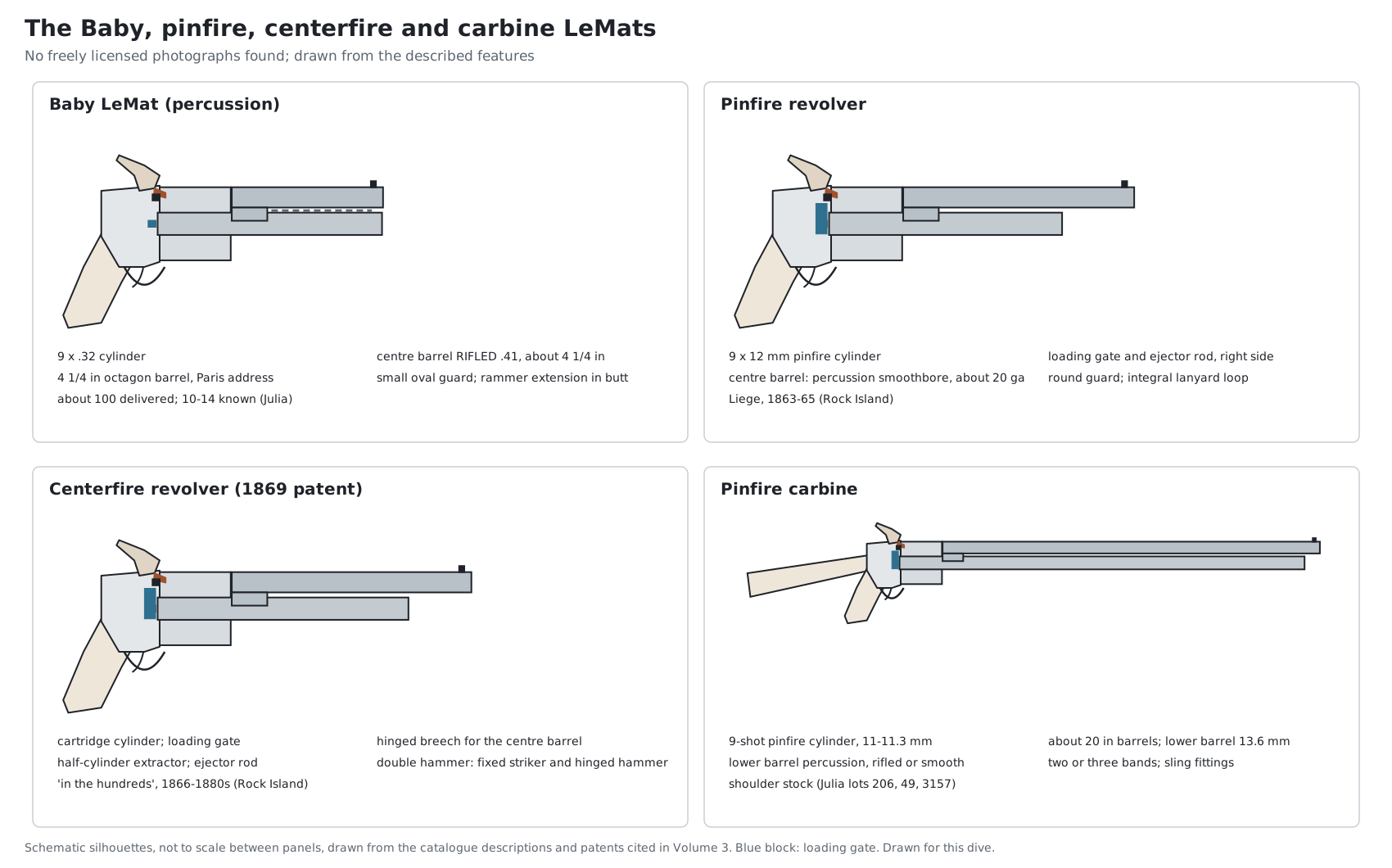
From the catalogue descriptions of serials 5 and 31:5627
- Cylinder: nine shots, .32.
- Centre barrel: rifled, .41 calibre, about 4¼ in, serving as the cylinder pin — “a rifled 41 cal secondary bbl in place of the 18 ga. shotgun bbl,” “rifled in caliber 41 vs. the smoothbore configuration on full size Le Mats.” The Baby is a two-barrel rifle-and-revolver, not a revolver-and-shotgun.
- Rifled barrel: 4¼ in octagonal, marked with the last style of Paris address, “Systeme Le Mat Bte s.g.d.g. Paris.” McNab gives 4.5 in and Wikipedia 4¾ in; the catalogues, which measured guns, give 4¼.2825
- Lockwork: the earlier reciprocating-pin cylinder lock; long-spur hammer with articulated nose.
- Loading: a rammer on the left of the barrel lug with a removable handle which, joined to a tube screwed into the butt cap, serves as the rammer for the centre barrel. Serpette believed the butt tube had “some type of loading use.”
- Frame: small oval trigger guard; one-piece grip frame with integral butt cap; checkered walnut grips.
- Finish: blued, with straw-coloured trigger, hammer and rammer extension on serial 31.
How many. One Julia catalogue: “only about 100 ever delivered of the 2,000 ordered by the Confederacy in 1865,” delivered to Lieutenant William Murdaugh, “Confederate Arms Inspector & Agent in England,” and “only 10–12 of them are known today.”6 Later Julia catalogues say “only 14 specimens known,” with serial 5 the lowest known and serial 83, inspected by Murdaugh, the highest, now in the Powerhouse Museum, Sydney.527 McNab’s “2,000 ordered … about 100 made” agrees with the first.28 Bodinson mentions a Baby “in pinfire as well as percussion”; a centerfire Baby is described in §3.13.21
Values are set out in Volume 7; Baby serial 31 was estimated by Julia at $75,000–125,000 in one sale and $60,000–80,000 in a later one.627
3.12 The pinfire LeMat
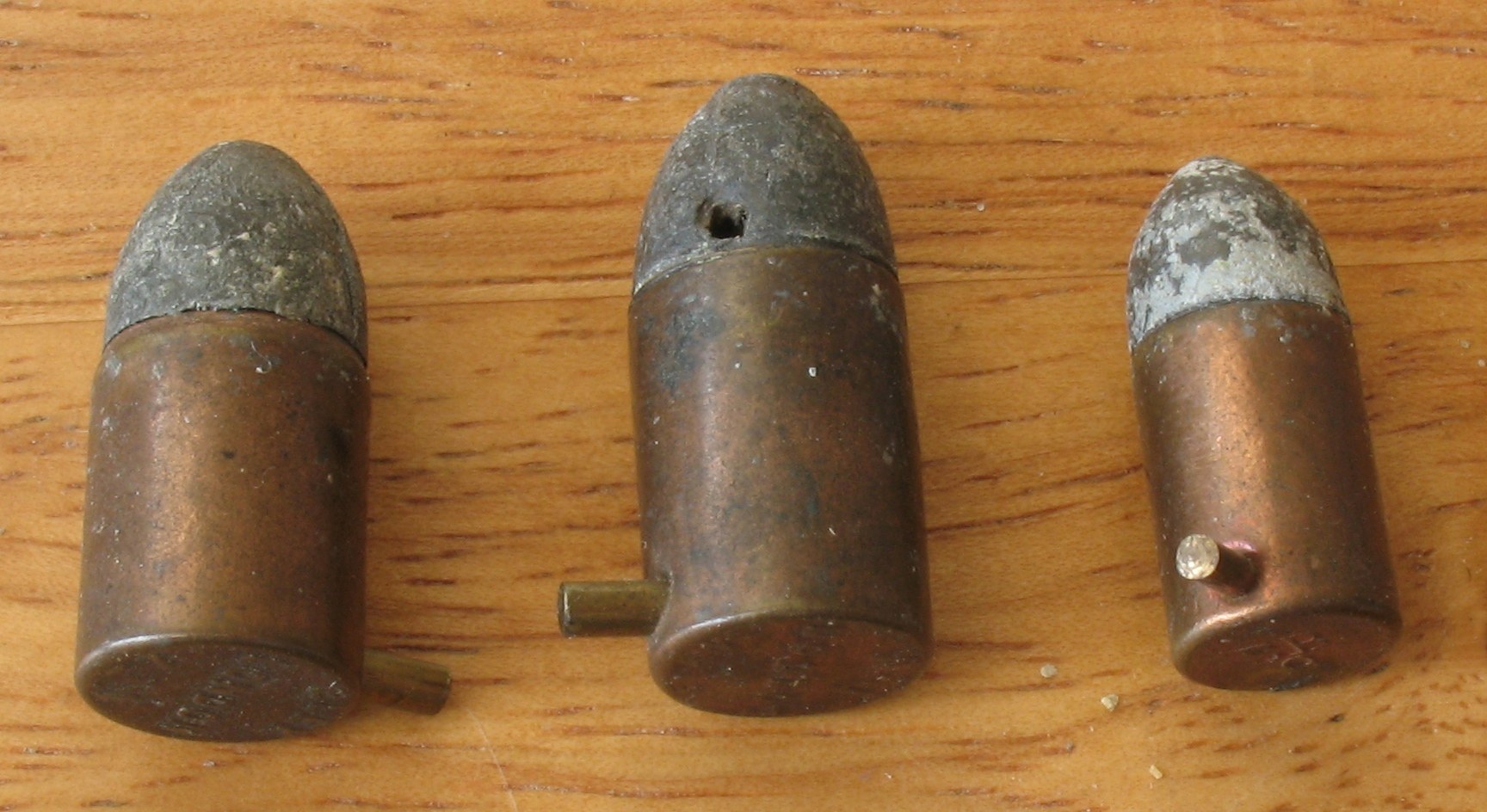
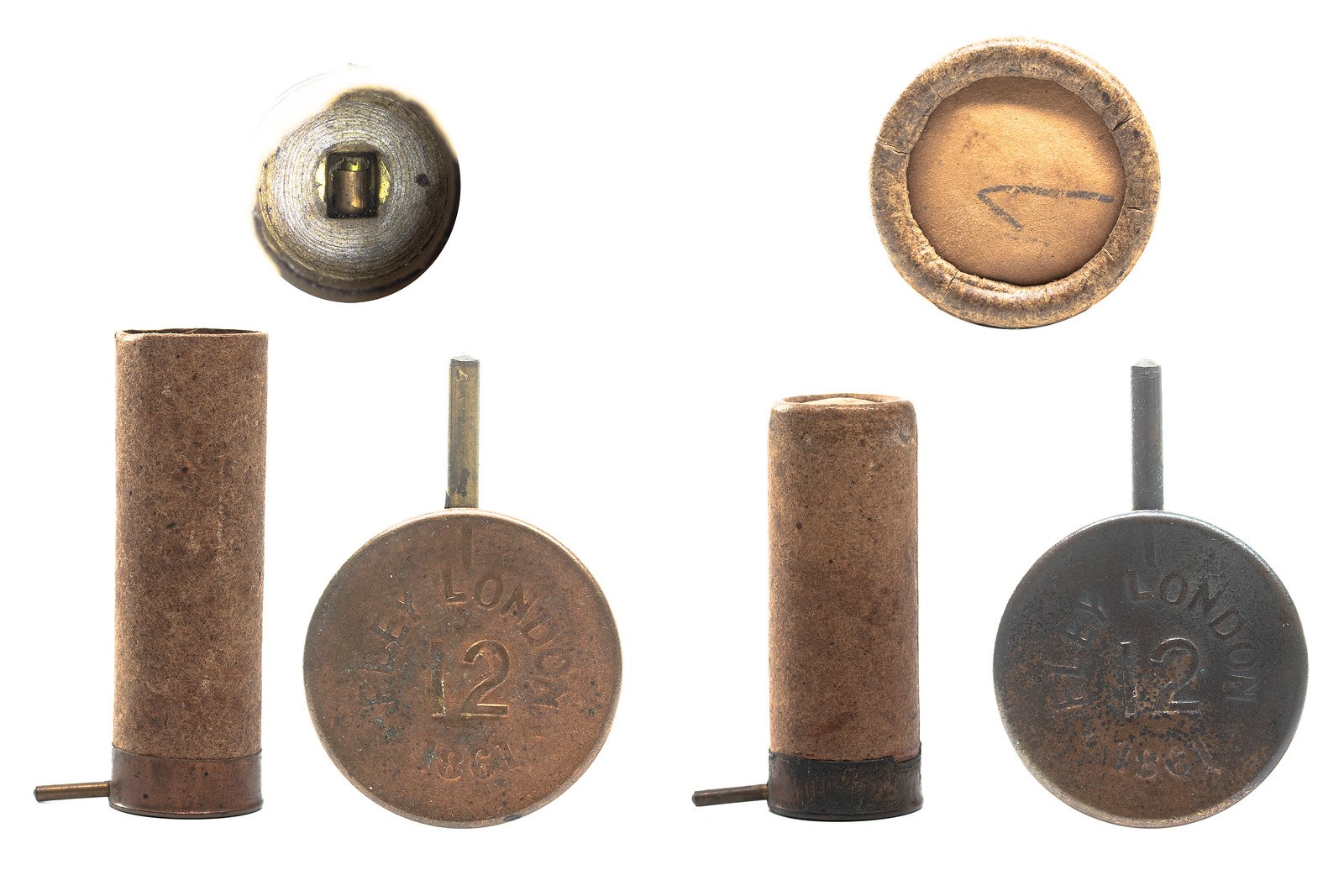
The pinfire LeMat is a hybrid that most summaries misdescribe as a cartridge gun throughout. Rock Island’s description of two examples:
- a “nine-shot pinfire cylinder and a muzzle loading percussion shot barrel”;29
- a cased gun “manufactured in Liege, Belgium, between 1863 and 1865,” with a 6½ in octagonal barrel, a fluted nine-shot cylinder “chambered for the 12 M/M Lefaucheux pinfire cartridge,” and “the distinctive LeMat 4 1/2-inch 20 gauge smoothbore ‘grapeshot’ barrel,” the latter “fired by a pivoting firing pin on the hammer.”8
So the cylinder takes pinfire cartridges loaded through a side-swinging loading gate on the right and punched out by an ejector rod on the right of the frame, while the centre barrel stays a percussion muzzleloader.8 The trigger guard is round, the butt has an integral lanyard loop, and the barrels carry addresses such as “COL A. LEMAT BTE.” or “COLONEL A. LEMAT BREVETE” with Liège proofs.87 Julia records that on one pinfire gun the grip screw enters from the right “vs. left side as found on percussion revolvers,” and that it has a “dbl detent assembly pin.”7
The cased Rock Island gun came with “a brass double cavity bullet mold for round balls and three-piece segmented slugs,” and cast examples of both.8 The three-piece segmented slug corresponds to the shot cartridge described in LeMat’s 1869 patent (Volume 2), which places three slugs, “each constituting one-third of the cylindrical section,” inside the case.30
Numbers. The Julia cataloguer for serial 3023 calls it “one of only about 1,000 of these rare revolvers”; Rock Island says only that the pinfire guns were made “in lower numbers than the percussion revolvers.”729 The figure of 1,000 is one cataloguer’s.
3.13 The centerfire LeMat
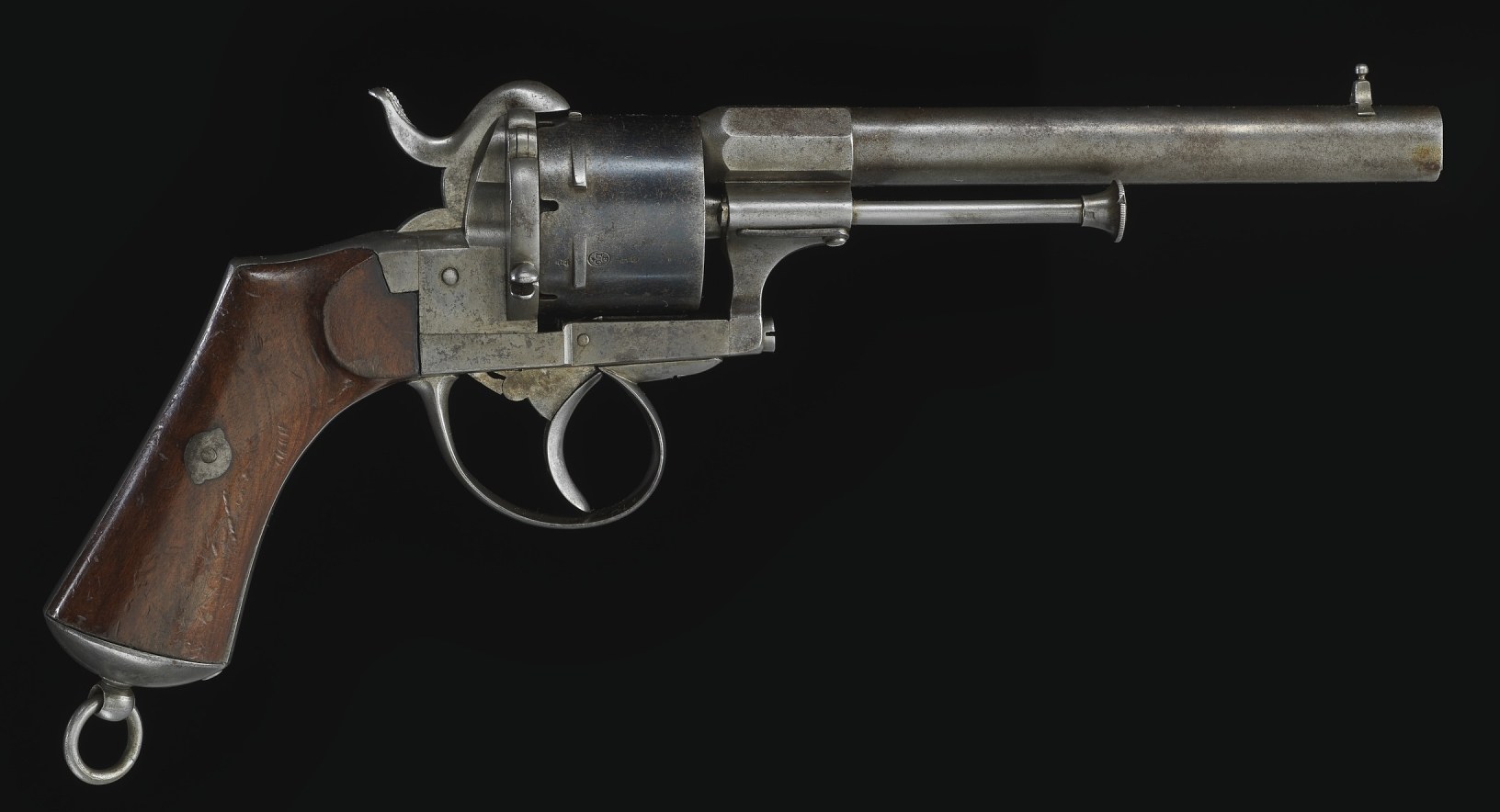
LeMat’s centerfire revolvers follow the 1868 British and 1869 US patents. Rock Island’s catalogue for a centerfire Baby gives the chronology as it understands it: percussion production ended in 1865, “to be replaced by rimfire and pinfire versions and finally centerfire versions. The first known centerfire example of a LeMat revolver was manufactured in 1866. LeMat’s first centerfire revolver patent appeared in France in early 1868,” and “in all, LeMat secured 11 patents for his centerfire revolver,” in France, England, Belgium and the United States.31
From the 1869 patent and the catalogues:302931
- a loading gate for the cylinder and a separate hinged breech for the centre barrel — Rock Island: “A loading gate on the upper right of the gun allows for loading the revolving cylinders and a larger loading gate with a firing pin on the back of the recoil plate is used to load the shotgun barrel”;
- a double hammer with a permanent striker for the cylinder and a hinged auxiliary hammer for the centre barrel’s firing pin;
- a half-cylinder extractor for the centre barrel and an ejector rod for the chambers.
Calibres. Wikipedia gives “12 mm Perrin or 11 mm Chamelot-Delvigne, with a 24 gauge shot barrel,” uncited.25 The Rock Island centerfire Baby is a 9 mm nine-shot cylinder with a centre barrel “rifled and chambered for a single 12 mm centerfire cartridge,” Liège proofed, with a black lacquer finish.31 The calibre list in Wikipedia could not be confirmed and is not repeated as fact.
Numbers and dates. “From 1869 to the 1880s only numbers in the hundreds” (Rock Island’s article); “from the late 1860s until the early 1880s,” “possibly only a few hundred” (Rock Island’s catalogue).29 Wikipedia attributes the centerfire guns’ “little commercial success” partly to “the double-action system”; no catalogue consulted describes a double-action LeMat, and the claim is left unconfirmed.25
3.14 The carbines
The LeMat revolving carbine is a nine-shot revolver action with long barrels and a shoulder stock. The catalogue examples are pinfire-and-percussion guns:
- Serials 206 and 49 (Julia): 11 mm top barrel and 13.6 mm bottom barrel — “marked ‘136’ which is the caliber”; top barrel 19-13/16 in octagonal-to-round, with a tall front sight and two-leaf rear sight; bottom barrel 19-7/8 in or 20¼ in, rifled, percussion; nine-shot pinfire cylinder; two or three barrel bands with sling fittings; tulip-head or knurled-head ramrod on the right; uncheckered French walnut stock. Serial 206 is “virtually identical to serial #208 as pictured on p. 124 of LeMat The Man, The Gun, … with the exception of the bayonet with #208.”1032
- Serial 3157 (Julia, “early Belgian”): 11.3 mm over 13.6 mm; 20 in top barrel; a 19¼ in smoothbore percussion bottom barrel “which is also the cylinder pivot”; deep rounded flutes on the cylinder; and “a pin detent cylinder stop that makes contact with dimples on front of cylinder,” tensioned by a small flat spring.11
Rock Island describes the centerfire carbines as “chambered for 12mm cartridges and 15.2mm shot shells (approximately .44 caliber and 20 gauge),” with a spur at the front of the trigger guard so that the shooter could hold the gun by the guard rather than putting a hand in front of the cylinder — a response to the reputation of revolving rifles for spraying lead at the forward hand.2 Bodinson mentions a “.42/.48-caliber LeMat carbine” of the war years; Wikipedia gives the carbine as “20 inches total length,” which is plainly wrong for guns with 20-inch barrels.2125
3.15 Reproductions and replicas
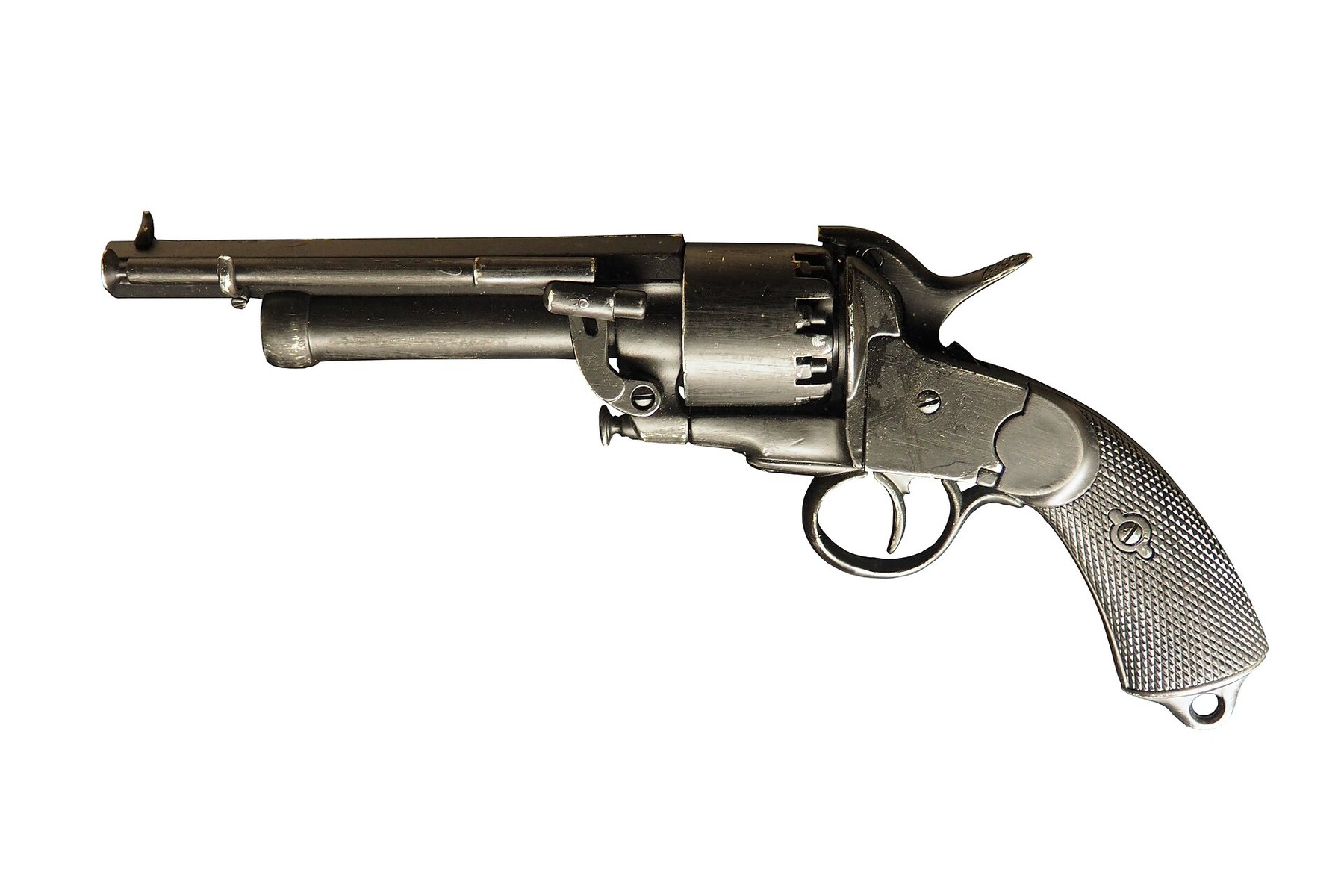
Pietta. The only current maker of a firing LeMat is F.lli Pietta of Gussago, Italy. Its 2025 catalogue lists four standard items — LeMat Cavalry (code LMC44), LeMat Navy (LMN44), LeMat Army Old West (LMAOW44) and LeMat Cavalry Super Deluxe (LCE44) — plus a hand-engraved Cavalry commemorative (LMC44COM). All are .44 with a 20-gauge centre barrel, 1:30 in twist, a 6¾ in octagonal barrel, steel frame, walnut grips, 13⅖ in overall and 1.6 kg.26 Pietta describes the three patterns: “CAVALRY, with spur triggerguard, lever type barrel release, cross pin barrel selector and a lanyard ring, NAVY with knurled pin barrel release and spur barrel selector, ARMY similar to the Navy Model with cross pin barrel selector.”26 The same catalogue mentions “SHERIFF’S and CARBINE versions,” but neither appears in its item tables; they should not be assumed to be in production. Volume 7 gives current prices.
Pietta’s own history places the LeMat early in its reproduction business: an American order in the 1970s, after the firm’s 1972 collaboration with the agent Oreste Puzzo, for seven thousand pieces including “the Le Mat model.”26 Wikipedia dates Pietta’s LeMat to 1985.25 Pietta’s account is undated within the decade, and the two are not reconciled here.
Navy Arms. The first modern reproduction was imported by Navy Arms under Val Forgett, who co-wrote LeMat: The Man, The Gun. Bodinson describes a Navy Arms-imported Pietta Cavalry and states that “Navy Arms … no longer imports or sells LeMats” (2014).21 Edmunds and his correspondents shot Navy Arms reproductions in the 2000s.14
Denix makes the non-firing replica shown above.
How a reproduction differs from an original — for identification, and against fakery:
- Calibre: .44 cylinder and 20-gauge centre barrel, against the original’s .42 and 18-bore.26
- Markings: Pietta guns carry Italian proof marks and the maker’s name in addition to any “Col. LeMat” legend; Bodinson’s gun is “marked ‘Col. LeMat’” on the barrel.21 Italian proofs and a modern serial are conclusive.
- Mixed features: the Pietta “Cavalry” combines the First Model guard and lever-type latch with a hammer selector that Pietta calls a “cross pin,” a combination that does not correspond to any single original.
- The cylinder lock: Pietta “uses the early reciprocating pin lock-up system,” as the First Model did.21
3.16 “Cavalry,” “Navy” and “Army”: names that do not fit the originals
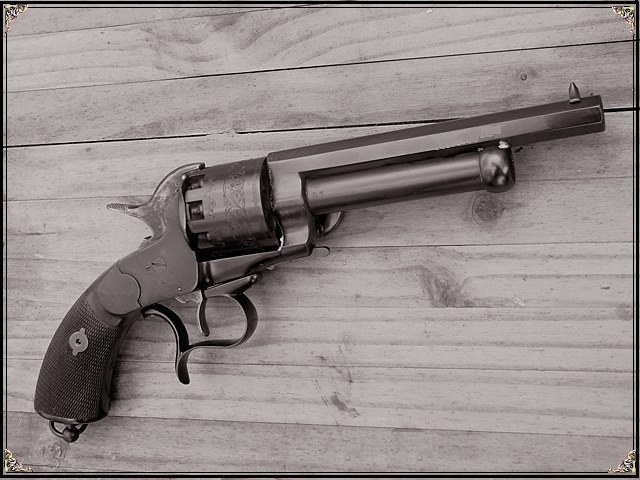
Bodinson is blunt about the reproduction names: “Dixie currently catalogs three LeMat models: a Cavalry model, Navy model and Army model. The variations among the models are slight, while the model designations themselves do not conform to any historical examples.”21
The names are not entirely arbitrary. The spurred guard and swivel ring of the “Cavalry” correspond to the First Model, and Edmunds’s account of the First Models’ diversion to the cavalry gives the name a historical hook.14 But there was no original “Cavalry Model,” “Navy Model” or “Army Model” in the factory’s own terms. A seller describing an original as a “Navy model” may be referring to the London Navy-contract guns or simply borrowing reproduction vocabulary; ask which features are meant.
3.17 What could not be verified
- Where the First Models were made. “Liège 1861–62” is the majority view, but Paris-marked First Models are catalogued, and Rock Island’s own texts disagree.
- The count of Baby LeMats: 10–12 known or 14 known (both Julia); about 100 delivered of 2,000 ordered.
- The pinfire count of “about 1,000” (one cataloguer).
- Centerfire calibres “12 mm Perrin or 11 mm Chamelot-Delvigne” and a “24 gauge” shot barrel (Wikipedia, uncited).
- A double-action centerfire LeMat (Wikipedia).
- The date Pietta began making the LeMat (1970s order in Pietta’s own history; 1985 in Wikipedia).
- The side of the star/LM proof on Second Models (left, College Hill; right, Rock Island).
- Krider serial number 4 against Adams’s two known Krider guns.
Sources
Footnotes
-
James D. Julia, Inc., lot 4378, Krider LeMat serial 2, read 2026-10-18; quotes Doug Adams, The Confederate LeMat Revolver (2005). ↩ ↩2 ↩3 ↩4 ↩5 ↩6
-
Joe Engesser, “The LeMat Revolver,” Rock Island Auction Company, 25 July 2023, updated, read 2026-10-18. ↩ ↩2 ↩3 ↩4 ↩5 ↩6 ↩7 ↩8 ↩9 ↩10 ↩11 ↩12 ↩13 ↩14 ↩15 ↩16
-
College Hill Arsenal, Second Model serial 1784, dealer listing, read 2026-10-18. ↩ ↩2 ↩3 ↩4 ↩5 ↩6 ↩7 ↩8 ↩9 ↩10 ↩11 ↩12 ↩13 ↩14 ↩15
-
James D. Julia, Inc., London LeMat serial 8074, https://jamesdjulia.com/?p=457413, read 2026-10-18. ↩ ↩2 ↩3 ↩4 ↩5 ↩6
-
James D. Julia, Inc., lot 1442, Baby LeMat serial 5, https://jamesdjulia.com/?p=480737, read 2026-10-18. ↩ ↩2 ↩3 ↩4 ↩5
-
James D. Julia, Inc., lot 2383, Baby LeMat serial 31, https://jamesdjulia.com/?p=468584, read 2026-10-18. ↩ ↩2 ↩3 ↩4
-
James D. Julia, Inc., “Rare Belgian Pinfire & Percussion LeMat Grapeshot Revolver,” serial 3023, https://jamesdjulia.com/?p=442554, read 2026-10-18. ↩ ↩2 ↩3 ↩4 ↩5
-
Rock Island Auction Company, “Rare Cased Pinfire LeMat Grapeshot Revolver,” auction 64, lot 265, read 2026-10-18. ↩ ↩2 ↩3 ↩4 ↩5 ↩6
-
Rock Island Auction Company, “Belgian LeMat Patent Centerfire ‘Grapeshot’ Revolver,” auction 89, lot 3095, read 2026-10-18. ↩ ↩2 ↩3
-
James D. Julia, Inc., “Rare LeMat Pinfire & Percussion Carbine,” serial 206, https://jamesdjulia.com/?p=442536, read 2026-10-18. ↩ ↩2 ↩3
-
James D. Julia, Inc., lot 137, “Early Belgian Pinfire LeMat Carbine,” serial 3157, read 2026-10-18. ↩ ↩2
-
Alan Garbers, “The LeMat’s Grapeshot Revolver,” GUNS Magazine, 15 September 2021, read 2026-10-18. ↩ ↩2 ↩3 ↩4 ↩5 ↩6
-
Edward N. Simmons, “Dr. Jean Alexander Francoise Le Mat and the New Orleans Affair,” ASAC Bulletin 22:33–41 (1970), read 2026-10-18. ↩ ↩2 ↩3 ↩4 ↩5 ↩6
-
Frederick R. Edmunds, “Some Thoughts on the Confederate LeMat Revolver,” ASAC Bulletin 100:24–28 (2009), read 2026-10-18. ↩ ↩2 ↩3 ↩4
-
Rock Island Auction Company, “Civil War Era Paris Marked First Model Le Mat Grapeshot Revolver,” auction 74, lot 3304, read 2026-10-18. ↩ ↩2
-
James D. Julia, Inc., lot 148, “First Model Belgian LeMat Grapeshot Percussion Revolver,” serial 28, read 2026-10-18. ↩ ↩2 ↩3 ↩4 ↩5
-
A. Le Mat, US Patent 24,312, 7 June 1859, read 2026-10-18. ↩
-
James D. Julia, Inc., lot 252, “Scarce Le Mat Second Model Percussion Grapeshot Revolver,” serial 1576, read 2026-10-18. ↩ ↩2
-
James D. Julia, Inc., “Superb and Rare Confederate 2nd Model LeMat,” serial 1475, https://jamesdjulia.com/?p=435831, read 2026-10-18. ↩ ↩2
-
Rock Island Auction Company, catalogue 4090, book 1, p. 250, London LeMat serial 8604, read 2026-10-18. ↩ ↩2 ↩3
-
Holt Bodinson, “The Awesome LeMat,” GUNS Magazine, 7 February 2014, read 2026-10-18. ↩ ↩2 ↩3 ↩4 ↩5 ↩6 ↩7 ↩8
-
National Museum of American History, NMAH-ET2012-13983, description via Wikimedia Commons, read 2026-10-18. ↩ ↩2
-
James D. Julia, Inc., London LeMat serial 8948, https://jamesdjulia.com/?p=442543, read 2026-10-18. ↩ ↩2
-
Christie’s, Le Mat & Girard’s Patent London no. 8510, read 2026-10-18. ↩ ↩2
-
“LeMat revolver,” English Wikipedia, read 2026-10-18. ↩ ↩2 ↩3 ↩4 ↩5 ↩6 ↩7
-
F.lli Pietta, revolver catalogue (file “Catalogo_Revolver_2026.pdf,” pages headed “Catalog 2025”), pp. 43–49 (LeMat) and company history, https://pietta.it/wp-content/uploads/2026/03/Catalogo_Revolver_2026.pdf, read 2026-10-18. ↩ ↩2 ↩3 ↩4 ↩5
-
James D. Julia, Inc., lot 4377, Baby LeMat serial 31, https://jamesdjulia.com/?p=545224, read 2026-10-18. ↩ ↩2 ↩3 ↩4 ↩5
-
Chris McNab, “LeMat Revolver,” HistoryNet, 8 March 2022, read 2026-10-18. ↩ ↩2
-
Rock Island Auction Company, “Belgian LeMat Pinfire Grapeshot Revolver,” auction 80, lot 249, read 2026-10-18. ↩ ↩2
-
F. A. Le Mat, US Patent 97,780, 14 December 1869, read 2026-10-18. ↩ ↩2
-
Rock Island Auction Company, “Baby LeMat Centerfire Cartridge Revolver,” auction 69, lot 1202, read 2026-10-18. ↩ ↩2 ↩3
-
James D. Julia, Inc., “Rare LeMat Pinfire & Percussion Carbine,” serial 49, https://jamesdjulia.com/?p=442537, read 2026-10-18. ↩
Comments (0)