LeMat Revolver · Volume 2
Paris, Liège, London and the Blockade — The LeMat in Confederate Service
Eight thousand ordered and about fifteen hundred documented, a factory run by a naturalist, a purchasing agent who fought it, nine boxes of money in a consulate, and the officers who carried the guns that got through
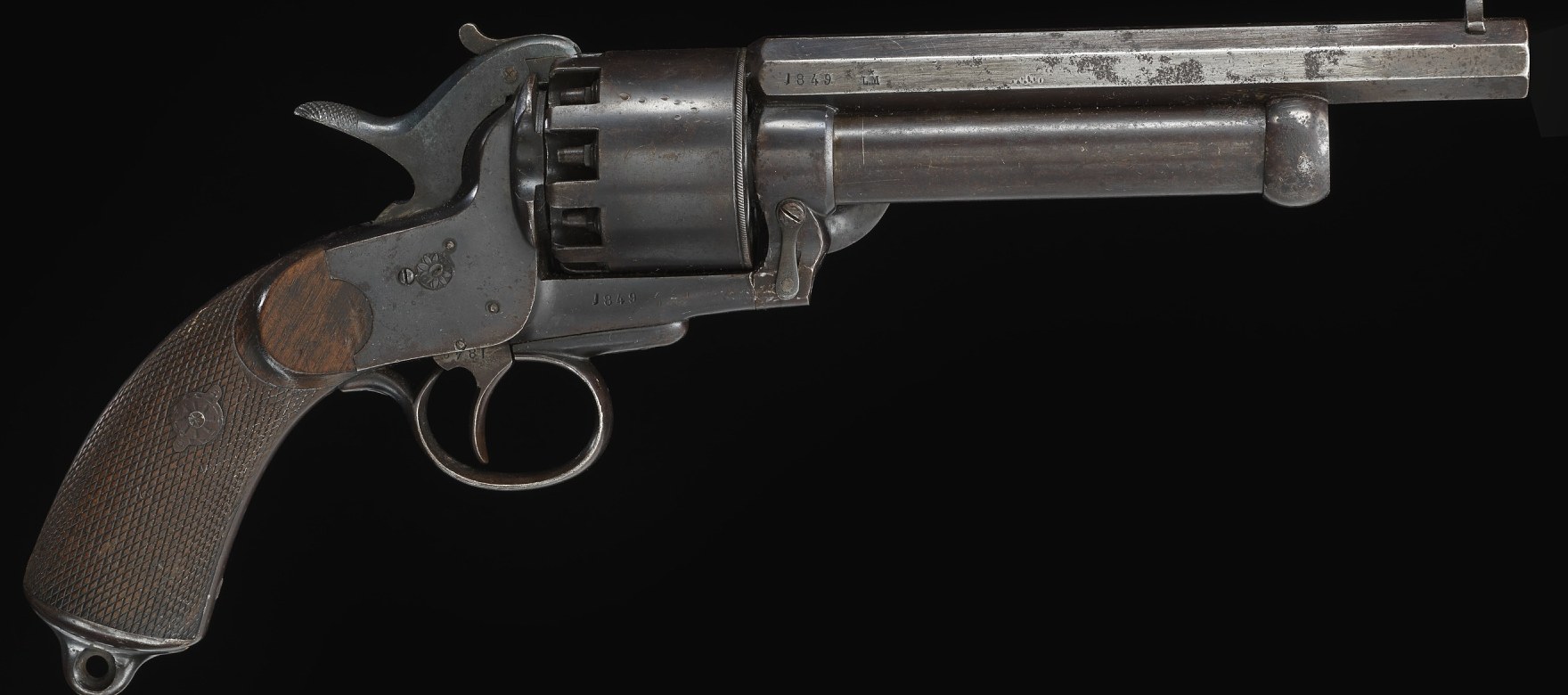
Volume 1 left the LeMat as a patented, tested and recommended revolver that no American maker would build and the United States Army would not buy. Within two years it had become the only revolver the Confederate government had under contract. This volume follows the gun through the war: who ordered it and how many, where and by whom it was made, how it crossed the Atlantic and the blockade, the quarrel over its quality, and the officers whose guns can still be identified by serial number.
The figures are the most contested part of the story and the section that follows sets them out before anything else, so that every later number can be read against them.
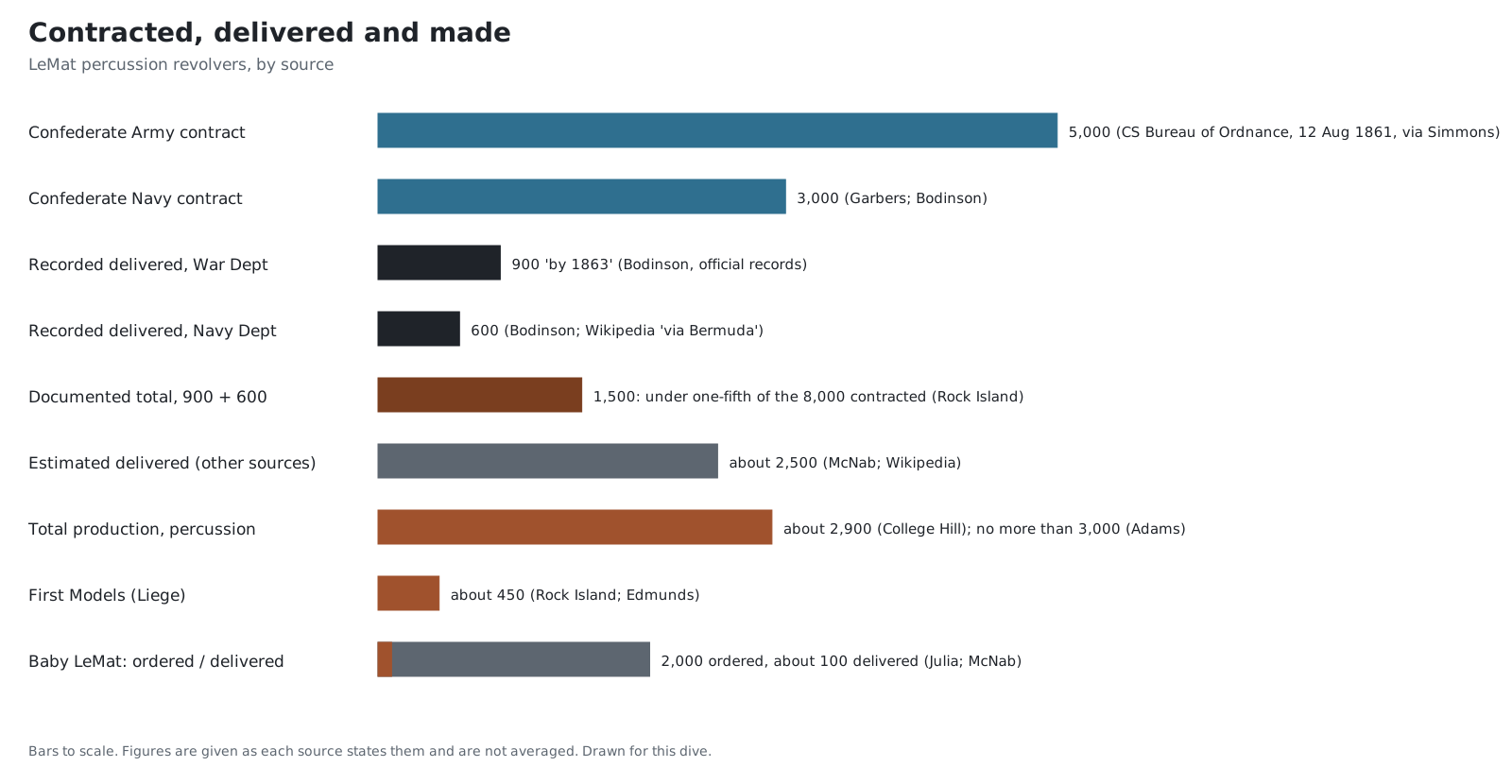
2.1 The numbers, side by side
Table 1 — The numbers, side by side
| What | Figure | Source |
|---|---|---|
| Louisiana militia order, November 1860 | 400 | Garbers1 |
| Confederate War Department contract | 5,000 | Bureau of Ordnance reply of 12 August 1861, quoted by Simmons2 |
| Confederate Navy contract | 3,000 | Garbers; Bodinson13 |
| Delivered to the War Department “by 1863” | 900 | Bodinson, citing “official records”3 |
| Delivered to the Navy Department “by 1863” | 600 | Bodinson3; Wikipedia adds “via Bermuda”4 |
| Estimated delivered to the Confederacy | ”an estimated 1,500,” “less than one-fifth” of the contracts | Rock Island5 |
| Estimated delivered | ”about 2,500” | McNab (HistoryNet 2022); Wikipedia64 |
| Estimated “reached the Confederacy" | "nearly 3,000” | Largen (1996)7 |
| Total production, all percussion models | ”approximately 2,900” (excluding the Baby) | College Hill Arsenal8 |
| Total production | ”no more than 3,000 … in France and England combined” | Adams, via Bodinson3 |
| Total production | ”fewer than 2,900” | Rock Island catalogue 40909 |
| First Model guns, made in Liège | 450 | Rock Island; Edmunds510 |
The figures do not reconcile, and they should not be averaged. Two observations make them easier to read. First, the 900 and 600 are delivery records and sum to 1,500, which is what Rock Island and Adams treat as the documented Confederate total; “2,500” and “nearly 3,000” are much closer to total production than to recorded deliveries, and the likeliest explanation is that a production estimate was later read as a delivery estimate. Second, Adams’s “no more than 3,000” and the dealer’s “approximately 2,900” are compatible ceilings on production, and most of what was made after 1863 cannot be shown to have reached the South. Bodinson’s summary of Adams states it carefully: “how many of those, beyond the previously documented 1,500, arrived on Confederate shores is unknown at this time.”3
2.2 Secession and the first orders
LeMat’s revolver had a customer before it had a country. Garbers reports that “within a week of Lincoln winning the presidential election, LeMat received an order of 400 revolvers from the Louisiana Militia.”1 Garbers does not give a document, and no other source consulted mentions this order; it is recorded here as his.
The first documented Confederate interest is local manufacture. The Daily Delta in June 1861 reported that “The firm of Cook and Brother contemplate the manufacture of Dr. Le Mat’s grapeshot revolver.” Simmons found no evidence that it went further: “So far as the records show the manufacture by Cook and Brother never got beyond the contemplation stage.”2 Largen adds that LeMat searched the Confederacy for a maker with adequate facilities and that negotiations with Cook and Bros. “fell through.”7 The South’s arms industry in 1861 was too small for a revolver as complicated as this, and from mid-1861 the LeMat was a European project.
2.3 The War Department contract of 1861
The single most useful document about the LeMat’s place in Confederate procurement is the Bureau of Ordnance’s answer to Congress. On 27 July 1861 the Confederate Congress asked the bureau what arms it held and what steps it had taken to obtain more. The reply, dated 12 August 1861, records — in Simmons’s account — that the Confederacy had only one contract for the manufacture of revolvers:2
“Mr. LeMat of Louisiana has an order to deliver 5,000 of his revolvers.”
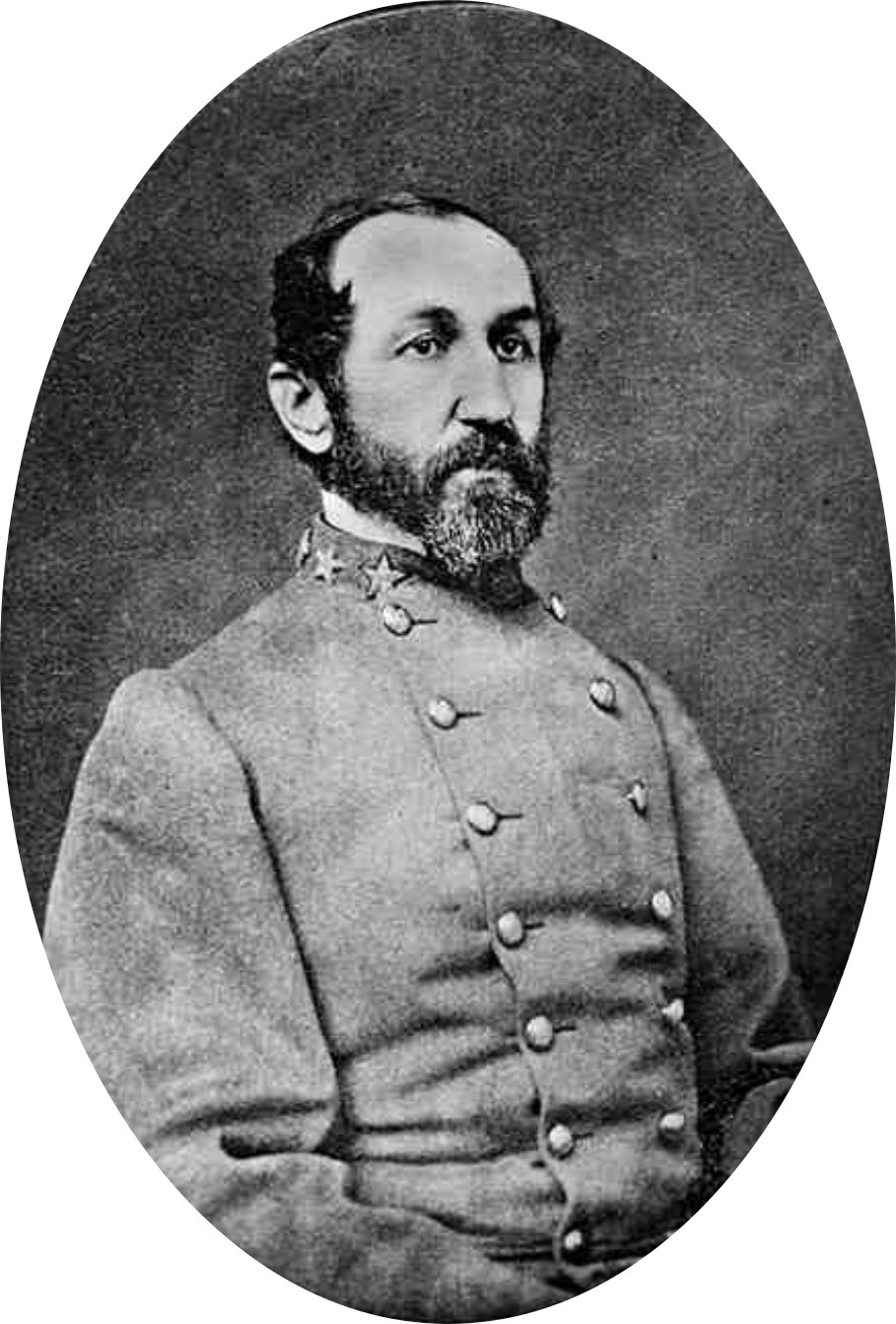
The Bureau’s chief, Josiah Gorgas, had accepted the post of Chief of Ordnance with the rank of major on 8 April 1861; Simmons states that the offer came “through Beauregard.”2 Garbers dates the War Department order to August 1861; Bodinson places it simply “with the formation of the Confederate Government in early 1861.”13
The Ordnance field manual. The Confederate Ordnance Department’s Field Manual for the Use of the Officers on Ordnance Duty, prepared in the autumn of 1861, included a short entry that Simmons quotes:2
“Grapeshot pistol — This pistol is manufactured by M. LeMat of Paris. It has a cylinder which revolves, containing nine chambers, a rifled barrel and a smooth bore barrel. The latter receives a charge of buckshot, and is fired by a slight change in the hammer. Some are in our service.”
“Some are in our service” in the autumn of 1861 means that a few guns — almost certainly from the small pre-war European batch described in Volume 1 — were already in Confederate hands before the contract guns existed.
The price. Rock Island gives the contract price as “approximately $35.00 dollars each, nearly twice the cost of the Colt Model 1860.”5 Garbers gives the same $35 and adds that “inflation and blockade-running costs drove the price to $80,” and that the LeMat was “roughly three times as expensive as other revolvers manufactured for the Confederacy.”1 Neither cites the source of the $80. The $35 contract price is consistent across both and is the figure used here.
2.4 To Europe on the Trent
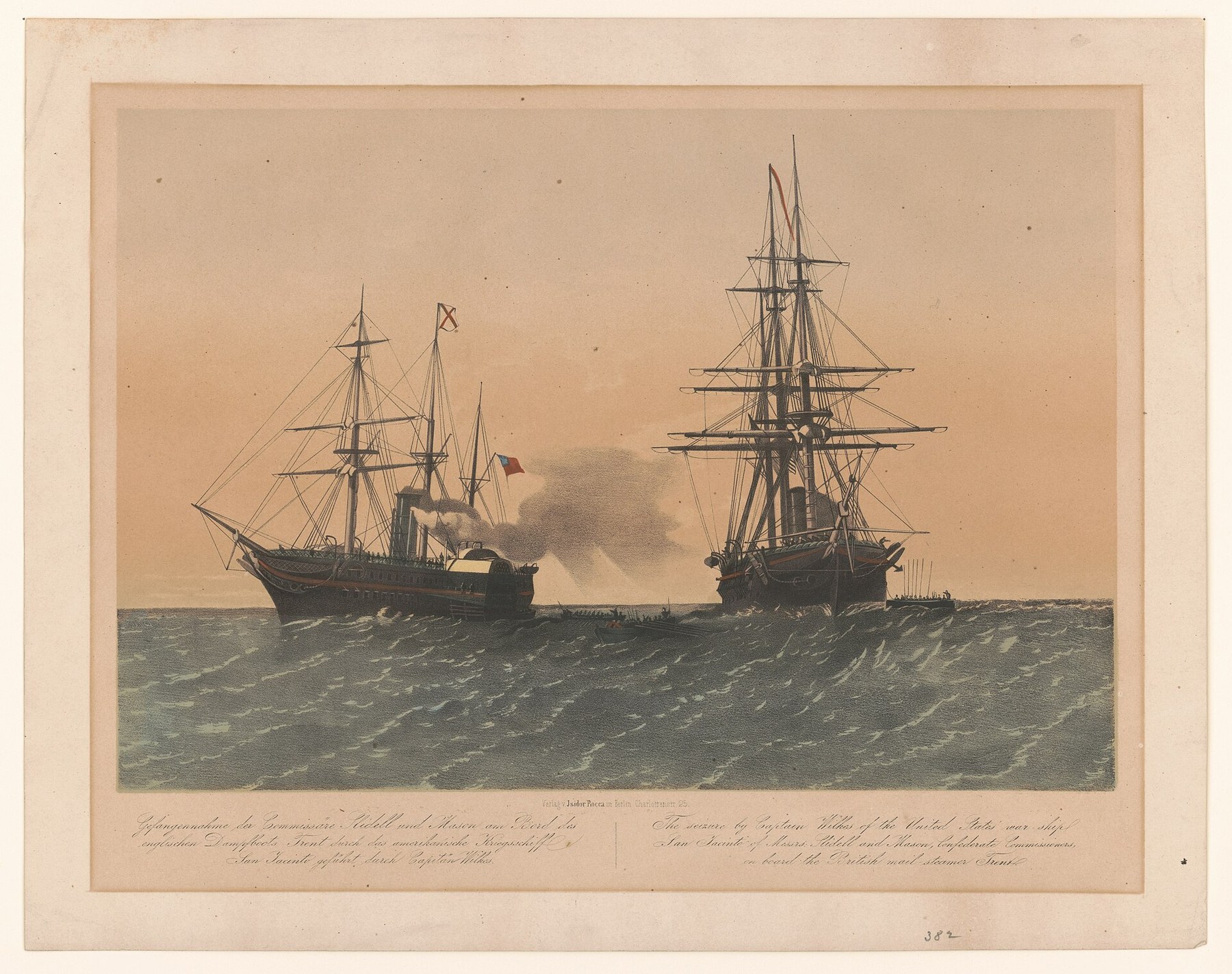
With a contract in hand and no maker, LeMat went to Europe. He travelled with the Confederate commissioners to Britain and France, James Mason and John Slidell. The Charleston Mercury’s account of their sailing, quoted by Simmons, said they were accompanied by “Colonel LeMat, the inventor of the grape shot revolver.” They ran out through the blockade on the night of 12 October 1861 and went to Havana to wait for the British mail steamer Trent.2 On 8 November 1861, as Largen recounts, Trent was stopped by USS San Jacinto; Mason and Slidell were taken off and held at Fort Warren in Boston, and LeMat, though travelling with them, was not detained.7
On the way out, Simmons records, LeMat stopped at Milledgeville, then the capital of Georgia, and took a commission from that state to buy 2,000 English Enfield rifles at $35 each.2 He was, in other words, travelling as a general Confederate purchasing agent as well as an inventor.
How long he stayed in Europe is not known. Simmons concludes that it was probably only long enough to hand the contracts to Girard and confirm that the Paris works could fill them, because early in 1862 LeMat was back in New Orleans, where he stayed until the city fell in April.2
2.5 The Paris factory
The guns were made by the partnership of LeMat and Girard in Paris, and the address on many of them is “Col. LeMat Bté s.g.d.g. Paris” — breveté sans garantie du gouvernement, the standard French patent formula.5 Largen gives the firm as “Charles Frederic Girard and Son, of 9 Passage Joinville, Paris.”7
How the guns were made. French arms making in the 1860s was not organised on the New England pattern of interchangeable parts made by special-purpose machinery. Garbers puts it this way: “firearm production in France was a cottage industry. Components were machined by small shops and then pieced together in the main factory. Each LeMat was custom made and parts were not easily fitted on another LeMat.”1 Rock Island says the same: “Numerous variations are found in the standard models since LeMat revolver components were manufactured by smaller shops and later shipped to a main factory for final assembly.”5 The evidence on the guns supports it. Serial numbers appear on the barrel, cylinder, frame, take-down pin, loading lever pivot, shot-barrel rammer and trigger, and an additional assembly number is stamped inside the frame and written in ink inside the grips — practices that only make sense where parts are fitted to one gun and must not be mixed.8
Liège and Paris. Where each model was made is not consistently reported.
- Rock Island: most were made in Paris, “with a smaller number manufactured in Liege, Belgium from 1861 to 1862, including 450 Belgium First Model LeMat revolvers.” The Second Model was made “in Paris, France from 1864 to 1865.”5
- College Hill Arsenal: the First Model was made “in Belgium circa 1862” in the serial range of about 1 to 450, and the Second Model “in Paris circa 1864–65” in about 451 to 2500.8
- Garbers: “LeMat settled on a factory in Paris, France to produce his revolvers,” without distinguishing models.1
- Largen: Girard’s first guns “were so abysmally made” that production moved to the Birmingham Small Arms Company in England.7 Wikipedia contradicts this, stating that production at BSA was considered and “never set up.”4 No source consulted names any BSA-made LeMat, and Largen’s claim is not followed here.
The consensus of the collector sources is therefore: First Model, about 450 guns, Liège, 1861–62; Second Model, Paris, 1864–65; a transitional group between. Volume 3 sets out the features.
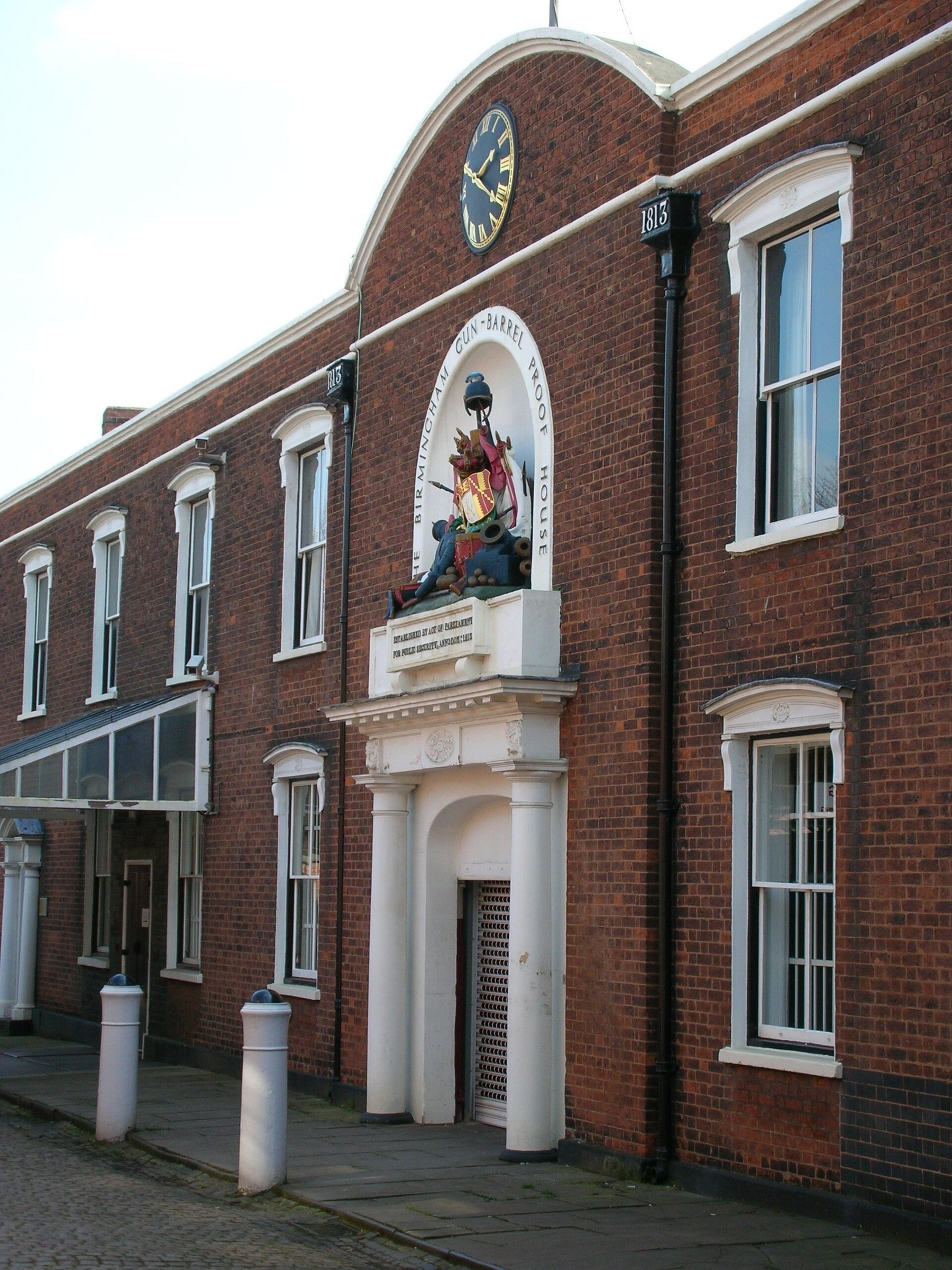
Proof marks and the “English” LeMat. Wikipedia states that guns shipped from France went through Britain, where British law required proof, so that Birmingham proof marks on blockade-run guns “led to a mistaken belief they were made in Britain.”4 College Hill Arsenal describes “later production Paris LeMat revolvers” as bearing English — “usually London” — commercial proofs, and states that its serial number 1784 predates that practice.8 Wikipedia says Birmingham; the dealer says London. Surviving guns described in auction catalogues carry Birmingham proof marks (§2.9), so the Birmingham version has the physical evidence on its side; whether some Paris guns were also proved in London is not settled here.
2.6 Caleb Huse, James Bulloch and the quality dispute
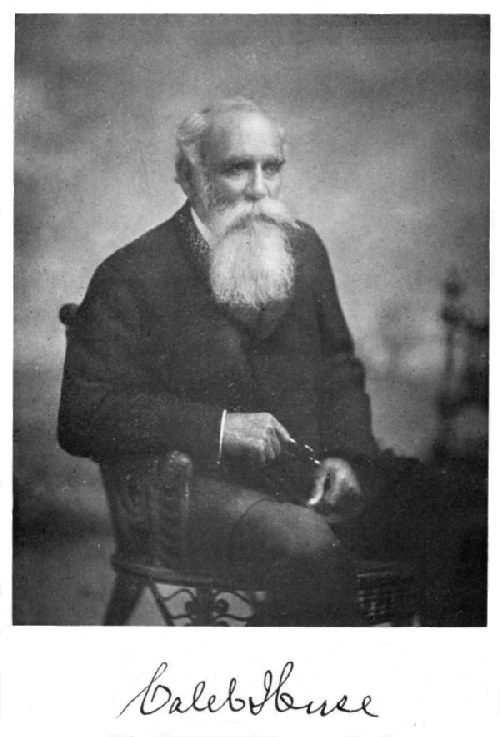
The War Department’s purchasing agent in Europe was Caleb Huse, based in London. How he dealt with Girard is the most heated question in LeMat literature.
The hostile account. Bodinson, citing Wiley Sword’s Firepower from Abroad, states that Huse “was receiving kickbacks from the London Armory Company, which was producing the Kerr revolver and the Enfield rifle for the CSA, and Huse did everything possible to sabotage the LeMat contracts, accusing Girard of using cast iron rather than cast steel, refusing to inspect finished revolvers, even refusing to pay Girard for LeMats that had been delivered.” He adds that after the war Huse “went to work for the London Armory Company!”3
The measured account. Frederick Edmunds, writing from fifty years of collecting Confederate arms, agreed that Huse “laid every stone in Girard’s path concerning the delivery and payment for LeMat pistols,” and that Huse claimed the frames were cast iron “when in fact they were made of malleable iron (claimed by Girard to be of cast steel) and quite suitable for their intended purpose.” But he then wrote: “there’s little doubt that he was unfair in his treatment of Girard concerning the LeMat pistols, nevertheless, it is noteworthy that subsequent inspections concluded that many were defective and were thus rejected. It is a known fact that CS Naval Commander James Bulloch inspected many LeMat pistols and found them to be generally unacceptable.”10 College Hill Arsenal similarly notes that “due to issues with production quality, LeMat was constantly having problems getting the revolvers that he delivered approved by the Confederate Ordnance department.”8
What Huse himself wrote. Huse published a memoir, The Supplies for the Confederate Army: How They Were Obtained in Europe and How Paid For (1904). A search of its full text for “Le Mat,” “Girard,” “revolver” and “pistol” found no mention of either man or the gun.11 The silence proves nothing either way, but it means that no account of Huse’s motives rests on his own words.
The kickback charge is Bodinson’s summary of a secondary book and is not documented in anything seen for this work. What both accounts agree on is the outline: Huse obstructed delivery and payment; at least some of the guns were rejected; and Bulloch, the Navy’s agent, also found many unacceptable. Edmunds’s description of the finish of surviving guns is consistent with uneven quality: some show “imperfections [that] had not been polished out before the bluing process,” while “other pieces were meticulously polished and finished, approaching the quality of the Colt.”10
2.7 The Navy contract and the guns diverted to the cavalry
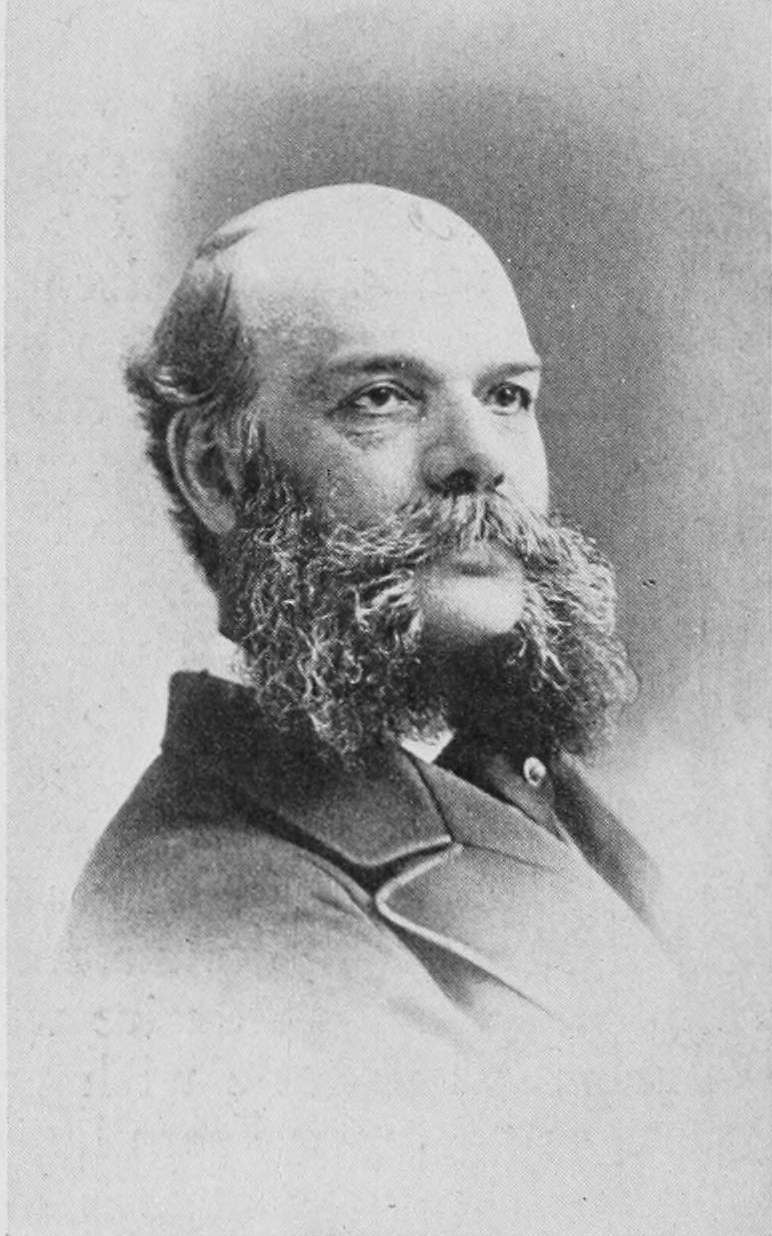
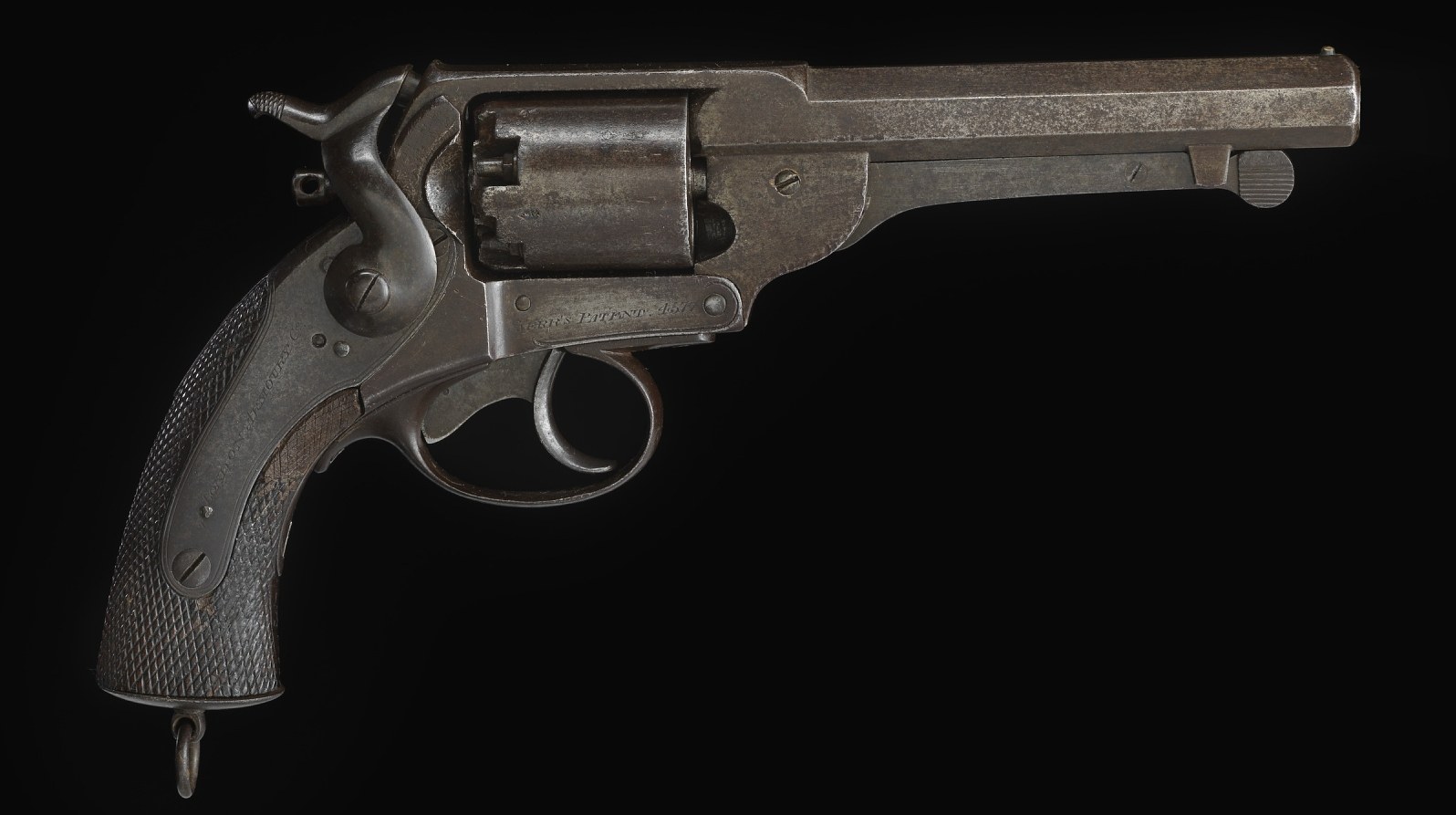
The Navy contract is less well documented than the Army’s. Simmons could not find its date: “the exact date is unknown, and first mention of same does not appear until July, 1862.”2 Garbers and Bodinson give its size as 3,000 revolvers.13
The diversion. Edmunds opens his article with a striking claim: “After the first shipment of 450 First Models went to the Confederate Navy under their contract, Col. Gorgas, Chief of Ordnance of the Confederacy, ordered them diverted to the cavalry (only a few were sent to the navy).”10 If correct, the First Models — the 450 Liège guns — were a Navy contract delivery that the Army took. This would explain both the Navy’s interest in the gun, which the 1856 patent and the New Orleans board had both stressed, and the strong association of First Model guns with cavalry officers. Edmunds does not cite a document for it, and no second source was found. It is given as his.
The smaller Navy pistol. Two articles say the Navy also contracted for a smaller revolver. Largen describes a “lighter .35-caliber pistol equipped with a 28-gauge (.50 caliber) shotgun barrel,” of which “only a few” were made before the Navy cancelled.7 McNab states that the Navy “also ordered 2,000 smaller ‘Baby LeMats’, with a shorter 4.5-inch revolver barrel in .32-caliber, though only about 100 of these were made.”6 Wikipedia’s “.35 caliber with .55 caliber (28 gauge)” model appears to derive from Largen.4 The descriptions are mutually inconsistent in calibre, and none is documented; they may all be versions of the Baby LeMat described in Volume 3. They are not presented as an established Navy model here.
The London Navy guns. The clearest Navy link is the late London guns (§2.9), which Adams identified as a Navy contract.12
2.8 Through the blockade
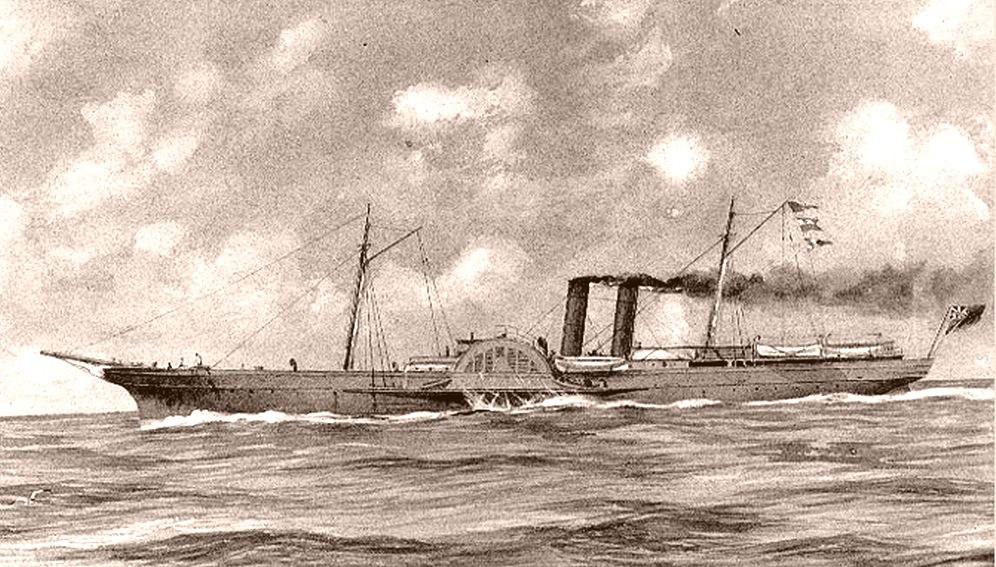
Every LeMat delivered to the Confederacy came through the Union blockade. The sources describe the route only in general terms:
- the guns were “handed over to Confederate officials in Britain and France, who then had them slipped through the Union naval blockade” (Largen);7
- the Navy’s 600 went “via Bermuda to avoid the blockade” (Wikipedia);4
- they were shipped “in 25-revolver crates,” and Beauregard’s second LeMat, number 427, and General Patton Anderson’s, number 475, would have travelled in the same shipments as the First Model number 451 that Garbers examined (Garbers).1
No document naming the ship that carried any LeMat was located for this work. The blockade-running trade in general is well documented — the Bermuda and Nassau entrepôts, fast paddle steamers built on the Clyde, cargoes landed at Wilmington and Charleston — but the LeMat-specific evidence stops at “through Bermuda.”
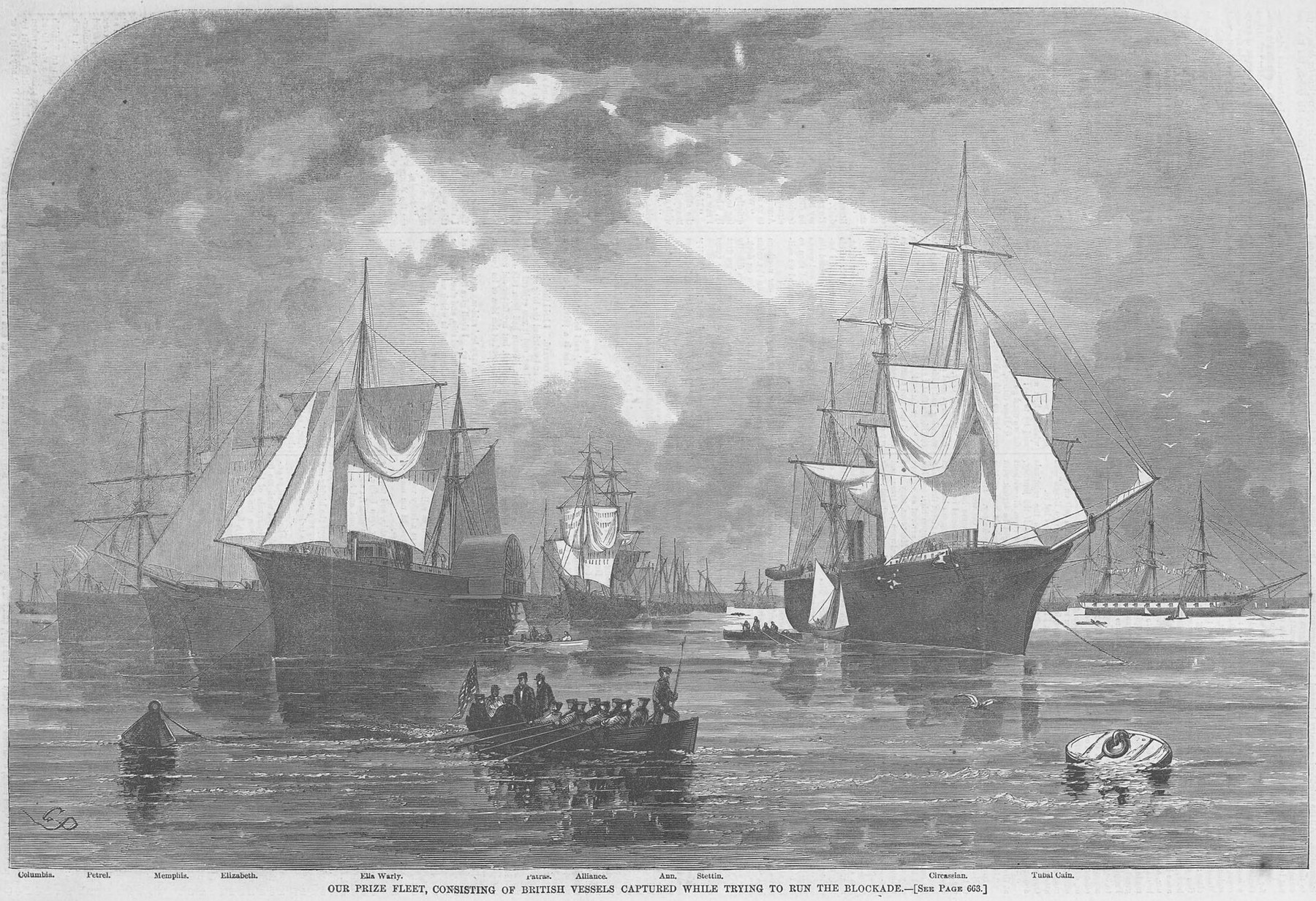
Garbers adds that “some LeMat revolvers were stolen from shipments and a rare few made it to the Confederate civilian market.”1 That is his statement and is not sourced.
2.9 The London guns
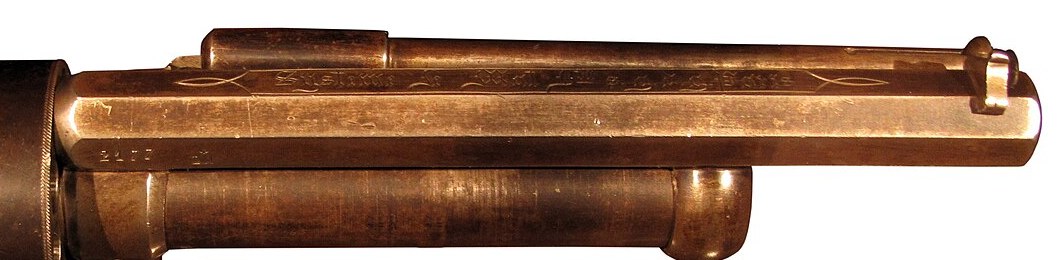
At the end of the war production moved to England. College Hill Arsenal describes the move as “an attempt to improve the overall quality of the guns,” done “so close to the end of the war that most of the English produced guns almost certainly never got into Southern hands,” with “their own, somewhat eccentric, serial number ranges.”8
The surviving London guns are well described in catalogues:
- Serial 8604 (Rock Island): .42 cylinder, 16-gauge shot barrel; “LEMAT & GIRARD’S PATENT LONDON” on the top flat; Birmingham proof marks on the upper left barrel flat and on the cylinder between each chamber; “18” stamped under the shot barrel between two proof marks; a fleur-de-lis on the left grip. Rock Island notes that London serial 8584, twenty numbers lower, “belonged to Lt. Simeon Cummings of the Confederate Steamship C.S.S. Alabama,” citing page 189 of Forgett and Serpette.9
- Serial 8074 (Julia): 6-9/16 in octagonal barrel; tall front sight; left-side loading lever working in a channel between barrel and rear boss; a single knurled-head barrel assembly pin; centre-mounted hammer nose; “integral solid butt cap & lanyard loop without ring.” The catalogue quotes Adams: “the London LeMats serial numbered 8000–9000 were a Confederate Navy contract made by Tipping & Co. in England,” and the previous owner’s notes call it “the final version of the percussion LeMat revolvers, made by C. Girard & Co. under contract with the Confederate Navy Department.”12
- Serial 8948 (Julia): the same pattern, described as “Cal. 10.6 mm rifled bbl & 16 ga. smoothbore.”13
- Serial 8510 (Christie’s): “60-bore octagonal sighted barrel … round 16-bore grapeshot barrel,” Birmingham proofs, integral lanyard ring, “circa 1864.”14
- Serial 3 (Simmons): a “LeMat and Girard’s Patent — London” gun “showing provisional proof marks of crossed sceptres and bore number of 18.”2
Who made them. Adams’s attribution to “Tipping & Co.” comes to this work only through the Julia catalogue’s paraphrase.12 Wikipedia instead says that “a few were illegitimately made in the UK, believed to be by” the London Armoury Company, of which only two survive.4 These are not necessarily the same guns: Wikipedia’s are unauthorised copies, Adams’s an authorised Navy contract. Rock Island also describes a Second Model with Birmingham proofs and no maker’s marking at all, which it interprets as “an English made LeMat revolver completed by an English gunmaker utilizing LeMat components left over from Confederate pistol contracts terminated at the end of the Civil War.”15
What the bore number says. The “18” at proof matters for identification. British proof houses stamp the bore size in the old gauge system, where 18-bore means a lead ball of 1/18 lb, about 0.637 in. The catalogues that call these barrels “16-gauge” (0.662 in) or “16-bore” are one size off from their own proof stamp. Volume 3 sets out the arithmetic.
2.10 The New Orleans affair
The best-documented episode of LeMat’s war has nothing to do with revolvers, and it is the source of the story that he “snuck $400,000 in gold out of New Orleans right under the noses of the Union occupiers.”1
Simmons reconstructed it from the papers of General Benjamin Butler’s investigation. Back in New Orleans early in 1862, LeMat associated himself with Edward Gautherin & Co. of 28 Carondelet Street, formerly tobacco merchants, which on 29 July 1861 had contracted with the Confederate Quartermaster’s Department to supply 375,000 yards of cadet-grey cloth.2 The cloth came from France by way of Havana and was run through to Brownsville, Texas. A receipt of 17 April 1862 records payment for 609 bales, 189,368⅞ yards, of $405,483.08, of which $405,000 was paid in by the Bank of New Orleans — days before the city fell.2
The money was still hidden in New Orleans in August 1862, under Union occupation. The firm’s books, as Simmons transcribes them, show that on 10 August LeMat paid out $2,500 “as a bribe for the affair to start”; that a clerk at the French consulate was paid $528.25 “for keeping nine boxes in the French Consulate”; that a douceur was given to Madame Méjan, wife of the French consul, Count Méjan, “for carrying out the affair well”; and that insurance was paid on nine boxes shipped aboard the Spanish ship Blasco de Garay, which sailed for Europe early in September.2
Butler learned of it from a letter of the US minister at Brussels, Henry Sanford, dated 26 September 1862, and investigated in November. Two of the partners, the LeMore brothers, refused to answer and were confined at Fort Pickens and Fort Jackson; the bookkeeper, Étienne Montardier, made a statement on 13 November in which he said: “Colonel Le Mat I have not seen for some time and don’t know whether he is here or in Europe.” The French consul wrote to Butler on 14 November that the box he demanded “is no more in my possession,” having been withdrawn on the morning of the 12th.2 The documentary trail ends there, with Butler, in Simmons’s words, “empty handed and raging.”
What the documents support, then, is about $405,000 of Confederate contract money, in nine boxes, sheltered in the French consulate and shipped out on a Spanish vessel with LeMat’s involvement — not, as such, $400,000 in gold. The popular version is a fair compression of it.
2.11 Who carried them
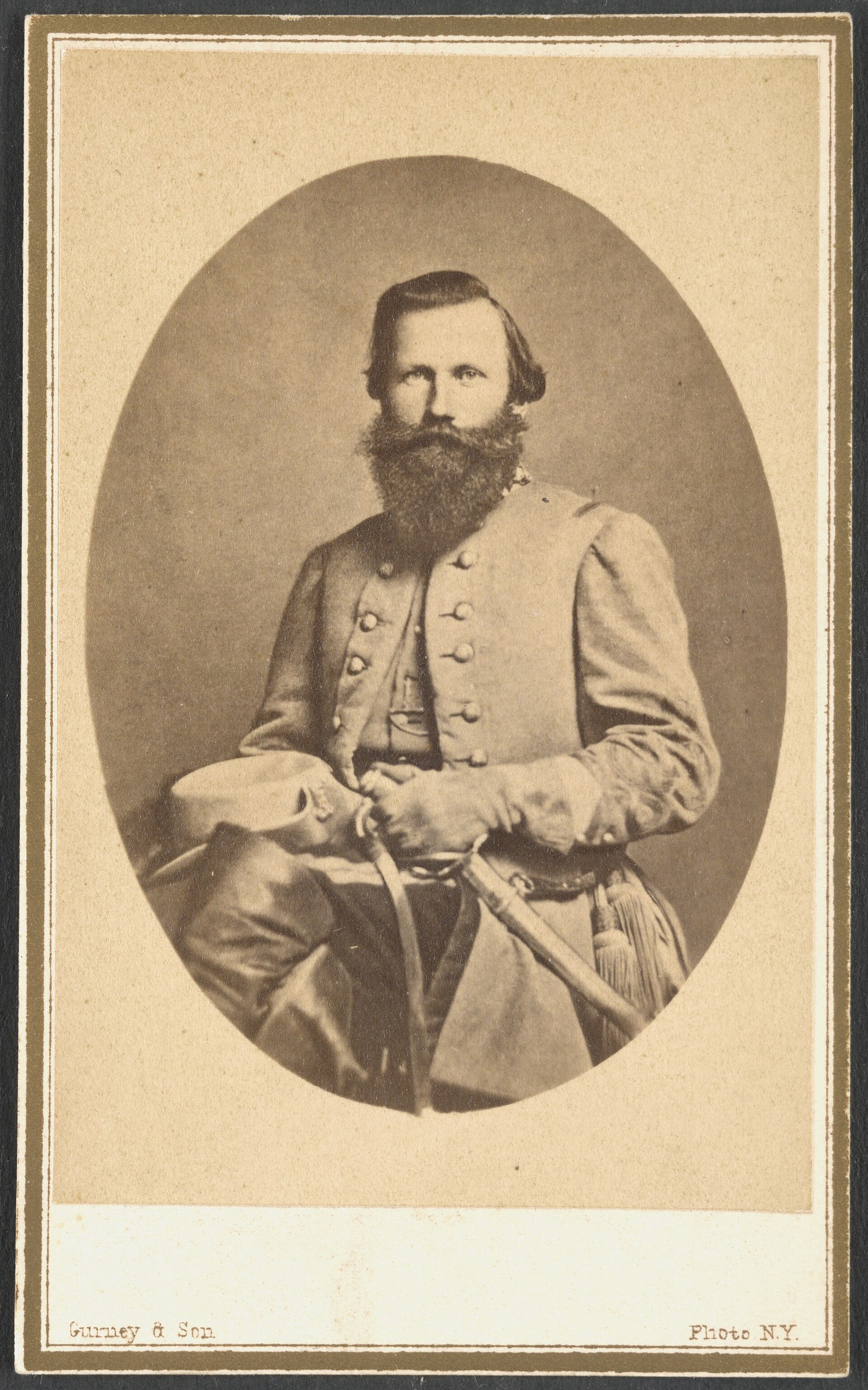
The LeMat’s fame rests heavily on the officers known to have carried one. Bodinson quotes the list from Doug Adams’s monograph of guns with “known high-profile Confederate association”:3
Table 2 — Who carried them
| Serial | Associated with | Source |
|---|---|---|
| 8 | Thomas Henderson | Adams, via Bodinson |
| 88 | Major General John Lawson Lewis | Adams, via Bodinson |
| 115 | Major General J.E.B. Stuart | Adams, via Bodinson |
| 189 | Major Henry Wirz, commandant of Andersonville prison | Adams, via Bodinson |
| 427 | General P.G.T. Beauregard (his second LeMat) | Adams, via Bodinson; Garbers |
| 475 | General J. Patton Anderson | Garbers |
| unknown | Lieutenant General Thomas J. “Stonewall” Jackson | Adams, via Bodinson; Garbers notes that “proof of this has disappeared over the years” |
| 8584 | Lieutenant Simeon Cummings, CSS Alabama | Forgett and Serpette, via Rock Island |
| — | General Braxton Bragg | Rock Island sale, December 2021 |
| — | Brigadier General Lucius J. Gartrell (a First Model, by family descent) | Rock Island |
Beauregard received two, according to Garbers: “One was accidentally left at a friend’s home, so he gifted it to them and procured another.”1 Wikipedia says that his engraved LeMat is in the Museum of the Confederacy, Richmond.4
Stuart is the name most attached to the gun. Rock Island states that he “was firing his LeMat revolver at Union troops when he was mortally wounded at the Battle of Yellow Tavern in 1864,” and its London-gun catalogue that he “carried a LeMat revolver when he was mortally wounded.”59 Garbers says the same.1 None of these cites a contemporary account, and the claim that he was firing a LeMat specifically, rather than simply carrying one, was not traced to a primary source for this work.
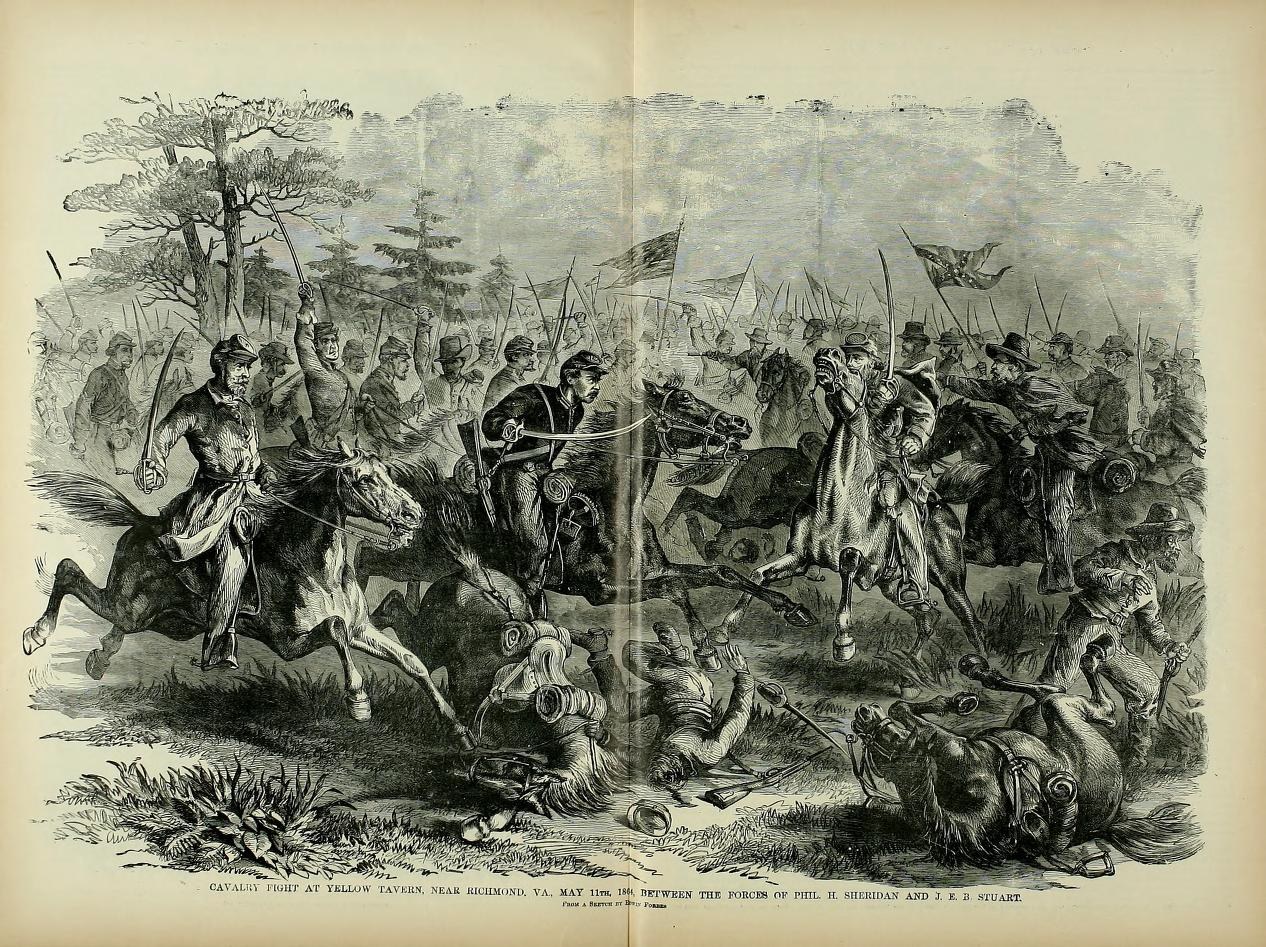
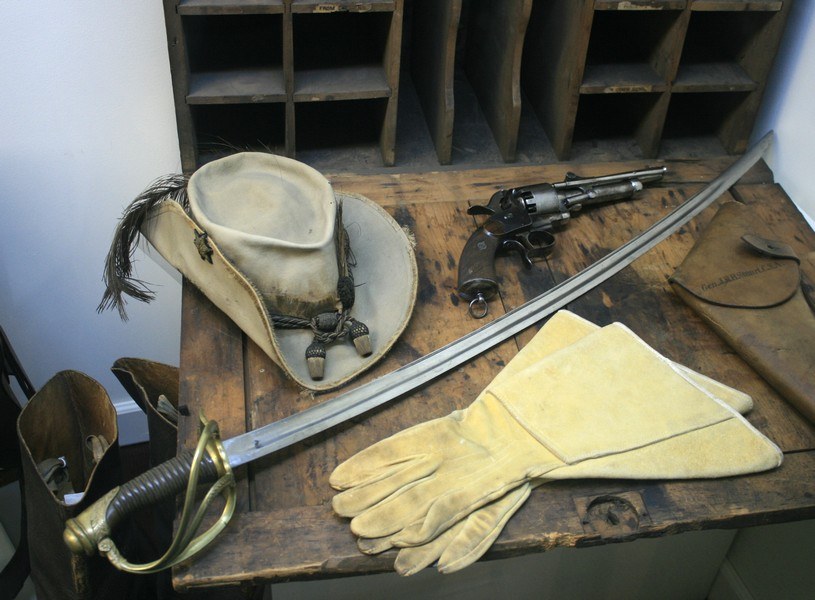
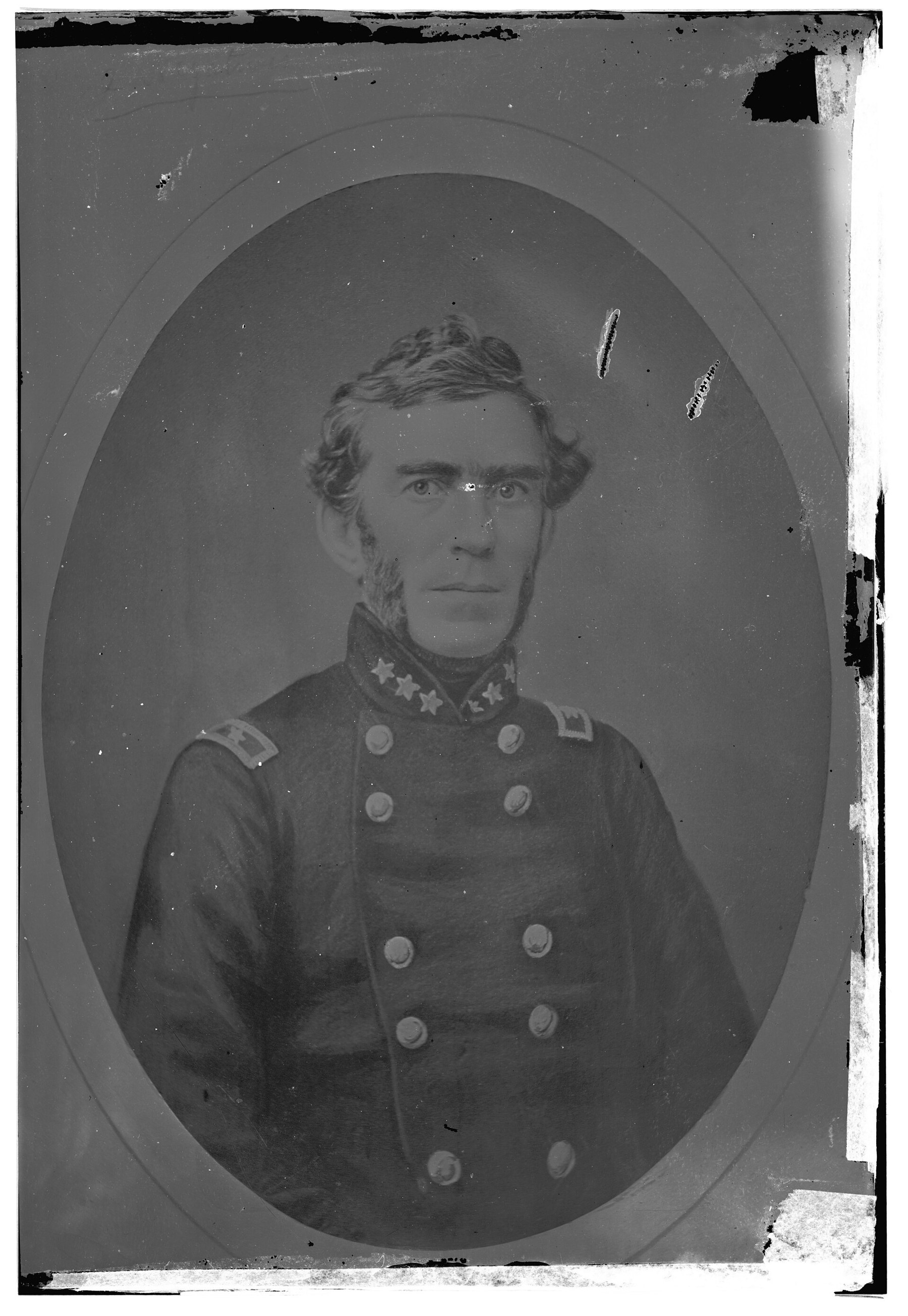
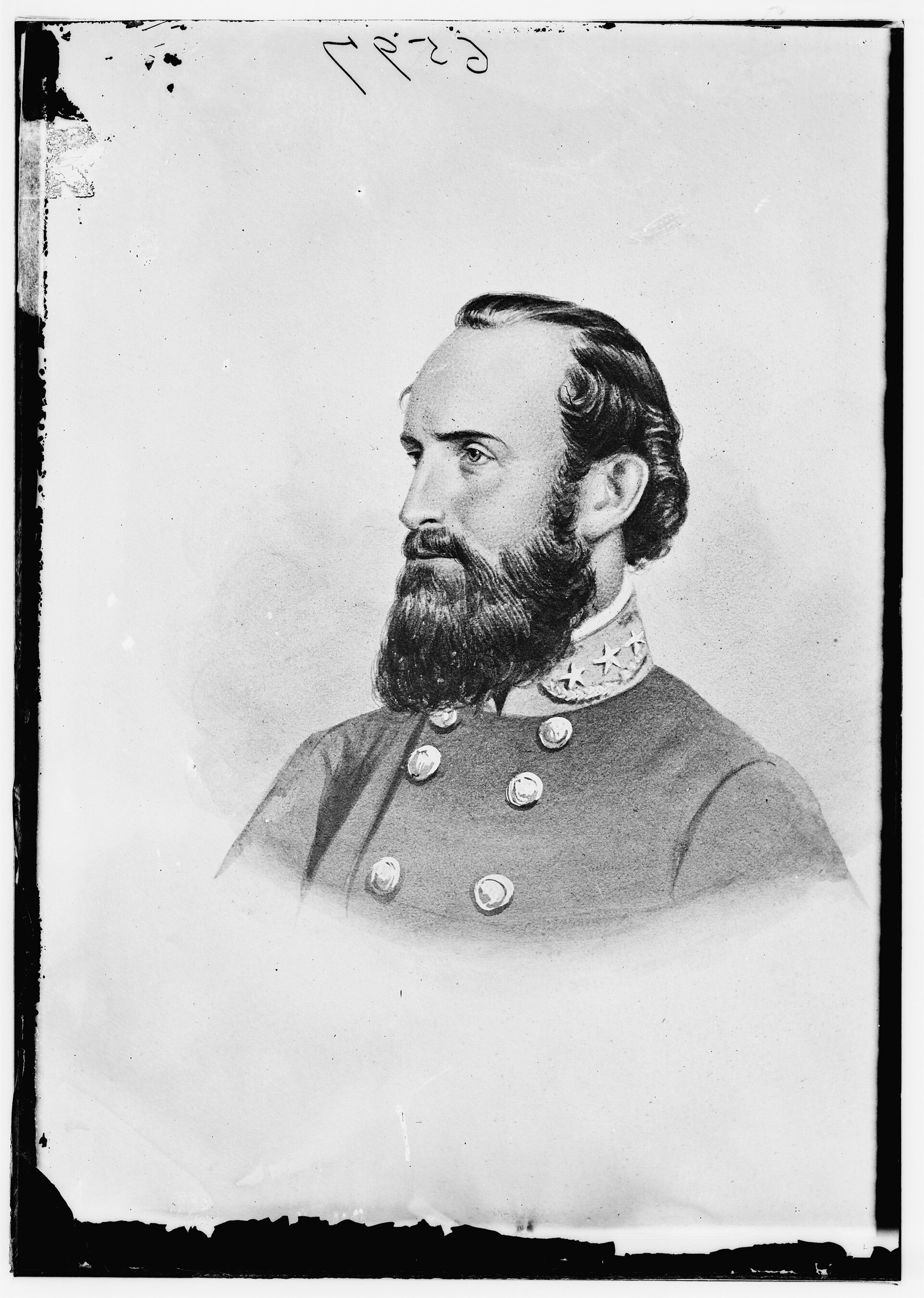
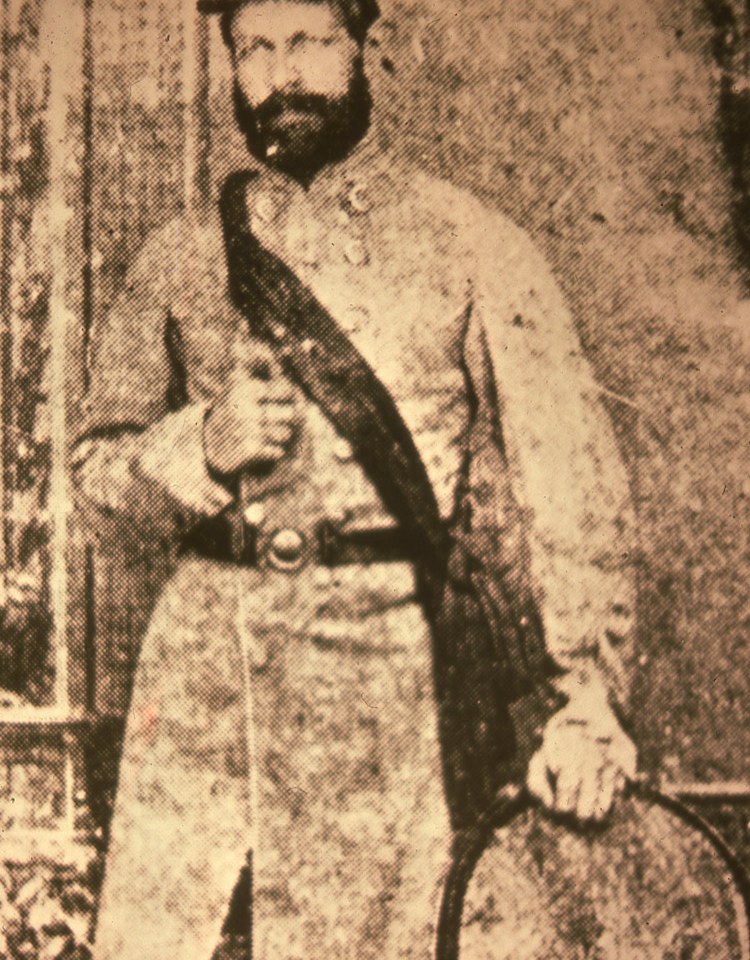
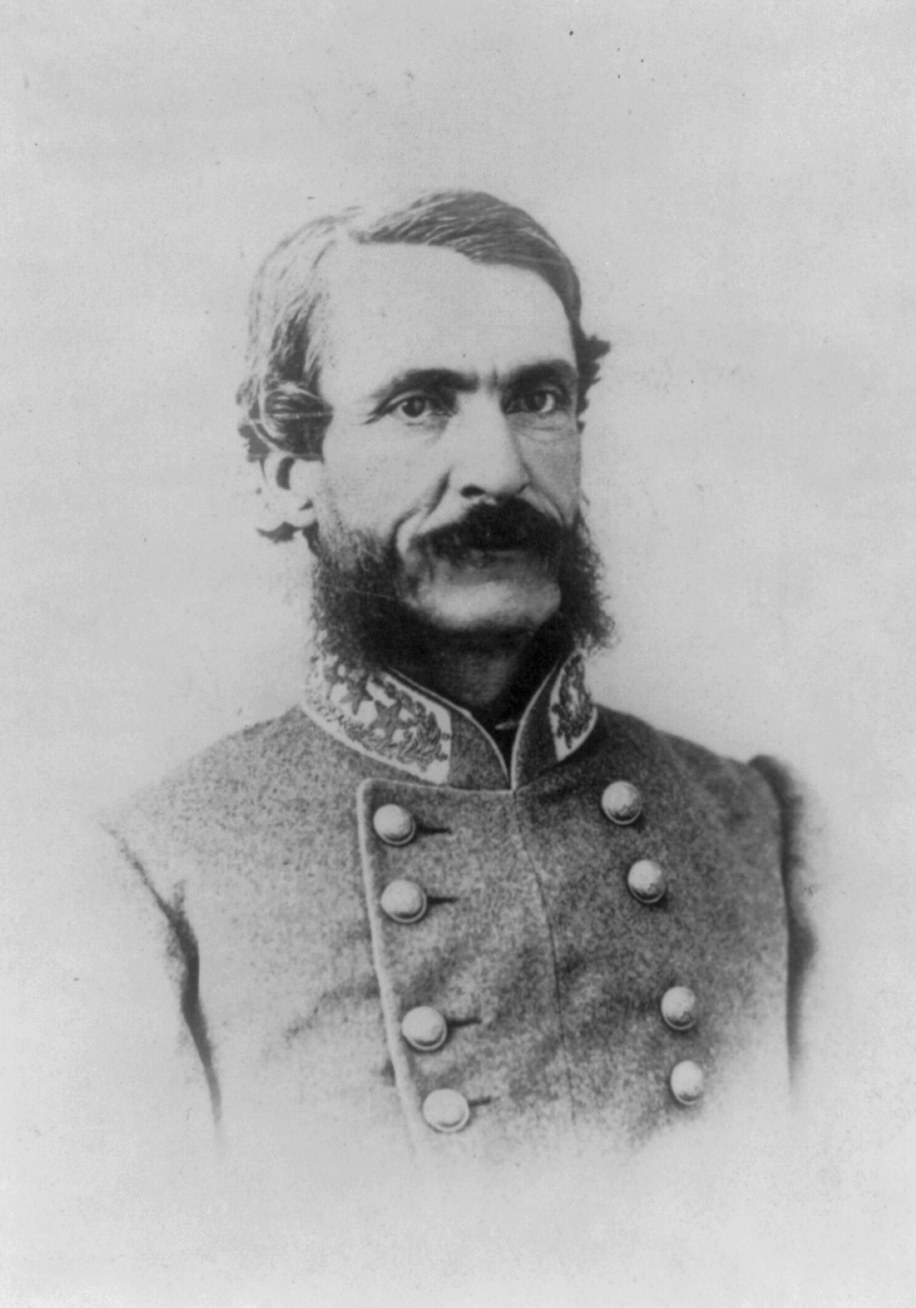
The pattern of the list is the point. These are generals and staff officers, and the cost and scarcity of the gun explain why. Garbers: “The odds are great it went to a high-ranking officer … Issuing such an expensive weapon to a rank and file soldier would have not been cost-effective for a country struggling to sell cotton and fund a war.”1 Rock Island describes it as popular with “Confederate generals and high-ranking cavalry officers fortunate enough to be issued a grapeshot pistol or acquire one through private purchase.”5 Garbers also observes that LeMat made sure prominent officers who might endorse a government contract received one.1
Wikipedia’s list of users adds Stonewall Jackson, J.E.B. Stuart, Richard H. Anderson and Henry Wirz, and Largen adds a “Colonel George S. Patton.”47 Neither gives evidence for those additions beyond the names.
2.12 What the gun was like in the field
There is no first-hand Civil War account of using a LeMat in the sources consulted. The nearest evidence is from collectors who have examined large numbers of surviving guns and from shooters of reproductions, and it is consistent:
- It was loaded in camp, not in the saddle. Edmunds: each chamber had to be charged and rammed individually, nine times; the shot barrel needed a separate short rammer drawn out of the hollow loading lever; ten caps were needed, and the shot barrel could only be capped at full cock. “For these reasons, it is my belief that troops loaded their LeMats in camp — certainly not while on horseback.”10
- Ammunition was a problem. The Confederacy made a self-contained .42 paper cartridge for the gun, but in Edmunds’s assessment “manufactured paper cartridges for the LeMat were in limited supply as compared to those for other more standard .36 and .44 caliber handguns”; without them, the soldier “had to secure a supply of lead, melt it, cast his own bullets and grapeshot in his issued brass mold.”10 Garbers notes the same calibre problem.1
- The loading lever was often thrown away. “Many LeMat pistols are seen without their loading levers,” Edmunds writes; Don Bryan, who had owned more than a hundred, found at least half of his missing the lever; and the dealer Red Jackson claimed that “over 90% of the LeMats when found will be without a loading lever.”10 Garbers mentions the same and the inference that a missing lever indicates field use.1 Volume 4 explains why the lever was weak.
- The shot barrel kicked. Garbers reports that “a young private demonstrating the revolver for LeMat complained the recoil from the grapeshot barrel was unbearable.”1
- Surviving guns show little use. Of more than a hundred LeMats Edmunds examined, “relatively few showed heavy corrosion around the hammer nose area … or around the percussion nipple cutouts,” and he concluded either that they were well cared for or that “many of these pieces saw very little use.”10
Edmunds’s own verdict, from loading and firing a reproduction: “in view of the above considerations, the Colt was the superior military weapon.”10
2.13 After the war: pinfire, centerfire and the carbine
The Confederacy’s collapse ended the percussion LeMat. Bodinson writes that Girard tried to sell the patents to Colt, failed, and closed the French factory in 1866 to settle the firm’s debts; LeMat settled in Paris and went on patenting.3
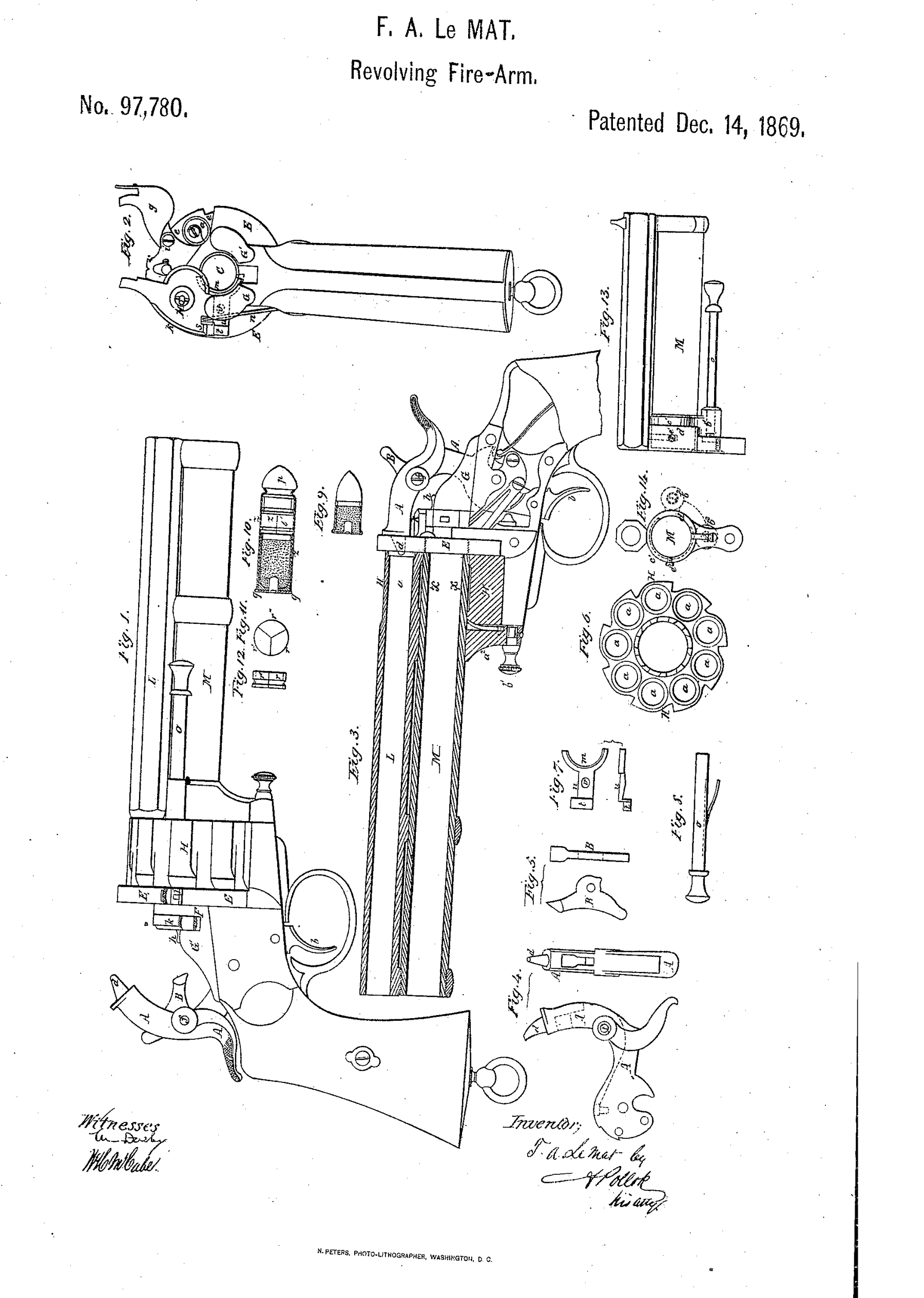
The cartridge LeMat. LeMat’s British patent No. 3131 of 13 October 1868, sealed 1 April 1869, covers “Improvements in the construction of revolving and repeating fire-arms,” and his US Patent 97,780 of 14 December 1869 is a breech-loading revolver of the same layout.16 Its claims are the hinged breech-block of the central barrel with its own firing pin; the combination of that breech-block with a half-cylinder cartridge extractor; and a double hammer “with a permanent beak or pin for exploding the cartridge of the revolver, and a hinged auxiliary hammer” to strike the shot barrel’s pin.16 The shot cartridge it describes contains a conical ball and, between the ball and the case, three slugs “each constituting one-third of the cylindrical section of the cartridge.”16 Rock Island also mentions an 1871 French patent extension.5
The British number comes from a revolver-patent timeline compiled by C&R Arsenal and was not seen in the original; the US patent was read in full.
Production. Rock Island: “The production numbers for all centerfire LeMat revolver variants manufactured from 1869 to the 1880s only numbers in the hundreds.”5 Its catalogue entry for a Belgian centerfire gun says production totals “are not known,” were “likely very low, possibly only a few hundred,” and that centerfire LeMats were made “from the late 1860s until the early 1880s.”17 Largen says post-war LeMats were “manufactured primarily in Belgium and Britain” and “widely used in French penal colonies”; the second claim was not supported by any other source.7 Pinfire LeMats, Rock Island writes, “were sold primarily to the European market but met with little success.”5
Military use abroad. Wikipedia lists the Government of National Defence in the Franco-Prussian War and the Sultanate of Aceh as users, illustrated by a Tropenmuseum photograph from Aceh.4 LeMat himself, according to Rock Island’s catalogue, “led an American volunteer legion during Franco-Prussian War, was a negotiator during the French Insurrection in 1871, and developed early airships.”17 None of these was traced to a primary source.
Volume 3 describes the cartridge models and the carbine.
2.14 What could not be verified
- The Louisiana militia order of 400 (Garbers only).
- The diversion of the 450 First Models from the Navy to the cavalry (Edmunds only, no document cited).
- Any Navy “light” model in .35 or .32 (Largen and McNab, mutually inconsistent).
- Huse’s alleged kickbacks from the London Armoury Company (Bodinson, citing Sword; not seen).
- The maker of the London guns: “Tipping & Co.” (Adams, via Julia) or the London Armoury Company (Wikipedia, for unauthorised copies).
- Whether Stuart was firing his LeMat when he was shot, as against carrying it.
- The $80 inflated price (Garbers only).
- Any named ship carrying LeMats through the blockade.
- The British patent number 3131 (secondary timeline only).
Sources
Footnotes
-
Alan Garbers, “The LeMat’s Grapeshot Revolver,” GUNS Magazine, 15 September 2021, read 2026-10-18. ↩ ↩2 ↩3 ↩4 ↩5 ↩6 ↩7 ↩8 ↩9 ↩10 ↩11 ↩12 ↩13 ↩14 ↩15 ↩16 ↩17 ↩18 ↩19
-
Edward N. Simmons, “Dr. Jean Alexander Francoise Le Mat and the New Orleans Affair,” American Society of Arms Collectors Bulletin 22:33–41 (1970), reprint PDF read 2026-10-18. Source of the Cook & Brother notice, the Bureau of Ordnance reply of 12 August 1861, Gorgas’s appointment, the Ordnance field-manual entry, the Navy contract’s first mention, the Georgia Enfield commission, the Charleston Mercury account and blockade departure, the Gautherin & Co. papers and Butler investigation, and London serial number 3. ↩ ↩2 ↩3 ↩4 ↩5 ↩6 ↩7 ↩8 ↩9 ↩10 ↩11 ↩12 ↩13 ↩14
-
Holt Bodinson, “The Awesome LeMat,” GUNS Magazine, 7 February 2014, read 2026-10-18. Quotes Doug Adams, The Confederate LeMat Revolver (2005), and cites Wiley Sword, Firepower from Abroad. ↩ ↩2 ↩3 ↩4 ↩5 ↩6 ↩7 ↩8 ↩9 ↩10 ↩11
-
“LeMat revolver,” English Wikipedia, read 2026-10-18. ↩ ↩2 ↩3 ↩4 ↩5 ↩6 ↩7 ↩8 ↩9 ↩10
-
Joe Engesser, “The LeMat Revolver,” Rock Island Auction Company, 25 July 2023, updated, https://www.rockislandauction.com/riac-blog/lemat-revolvers, read 2026-10-18. ↩ ↩2 ↩3 ↩4 ↩5 ↩6 ↩7 ↩8 ↩9 ↩10 ↩11 ↩12
-
Chris McNab, “LeMat Revolver: The Innovative, Single-Handed, Close-Quarters Weapon,” HistoryNet, 8 March 2022, https://historynet.com/the-lemat-revolver/, read 2026-10-18. ↩ ↩2
-
Floyd Largen, “Weaponry: Le Mat,” Military History, October 1996, via HistoryNet, read 2026-10-18. ↩ ↩2 ↩3 ↩4 ↩5 ↩6 ↩7 ↩8 ↩9
-
College Hill Arsenal, dealer listing for Second Model serial no. 1784, read 2026-10-18. ↩ ↩2 ↩3 ↩4 ↩5 ↩6
-
Rock Island Auction Company, catalogue 4090, book 1, p. 250, London LeMat serial no. 8604, https://cdn.rockislandauction.com/flipbooks/4090/BOOK1/files/basic-html/page250.html, read 2026-10-18. ↩ ↩2 ↩3 ↩4
-
Frederick R. Edmunds, “Some Thoughts on the Confederate LeMat Revolver,” American Society of Arms Collectors Bulletin 100:24–28 (2009), with notes from Gerald Bennett, Don Bryan, Bruce Kusrow and Hayes Otoupalik; reprint PDF read 2026-10-18. ↩ ↩2 ↩3 ↩4 ↩5 ↩6 ↩7 ↩8 ↩9
-
Caleb Huse, The Supplies for the Confederate Army: How They Were Obtained in Europe and How Paid For (Boston, 1904), Internet Archive full text (item suppliesforconfe00huse), searched 2026-10-18. ↩
-
James D. Julia, Inc., London LeMat serial no. 8074 (estimate $19,000–23,000), https://jamesdjulia.com/?p=457413, read 2026-10-18. ↩ ↩2 ↩3
-
James D. Julia, Inc., London LeMat serial no. 8948 (estimate $10,000–15,000), https://jamesdjulia.com/?p=442543, read 2026-10-18. ↩
-
Christie’s, Le Mat & Girard’s Patent London no. 8510, https://www.christies.com.cn/lot/lot-1633501, read 2026-10-18. ↩
-
Rock Island Auction Company, “British Proofed LeMat Second Model Grapeshot Revolver,” auction 69, lot 1166, read 2026-10-18. ↩
-
F. A. Le Mat, US Patent 97,780, 14 December 1869 (Google Patents, read 2026-10-18). British patent 3131 of 1868 per the C&R Arsenal revolver-patent timeline (revolvers.candrsenal.com), not seen in the original. ↩ ↩2 ↩3
-
Rock Island Auction Company, “Belgian LeMat Patent Centerfire ‘Grapeshot’ Revolver,” auction 89, lot 3095, read 2026-10-18. ↩ ↩2
Comments (0)