LeMat Revolver · Volume 1
The Doctor, the Major and Two Patents — LeMat's Grapeshot Revolver from New Orleans to the 1859 Trials
Who Jean Alexandre LeMat was, what his 1856 and 1859 patents actually claim, how Beauregard bought a quarter of the idea, and what two boards of officers said about it
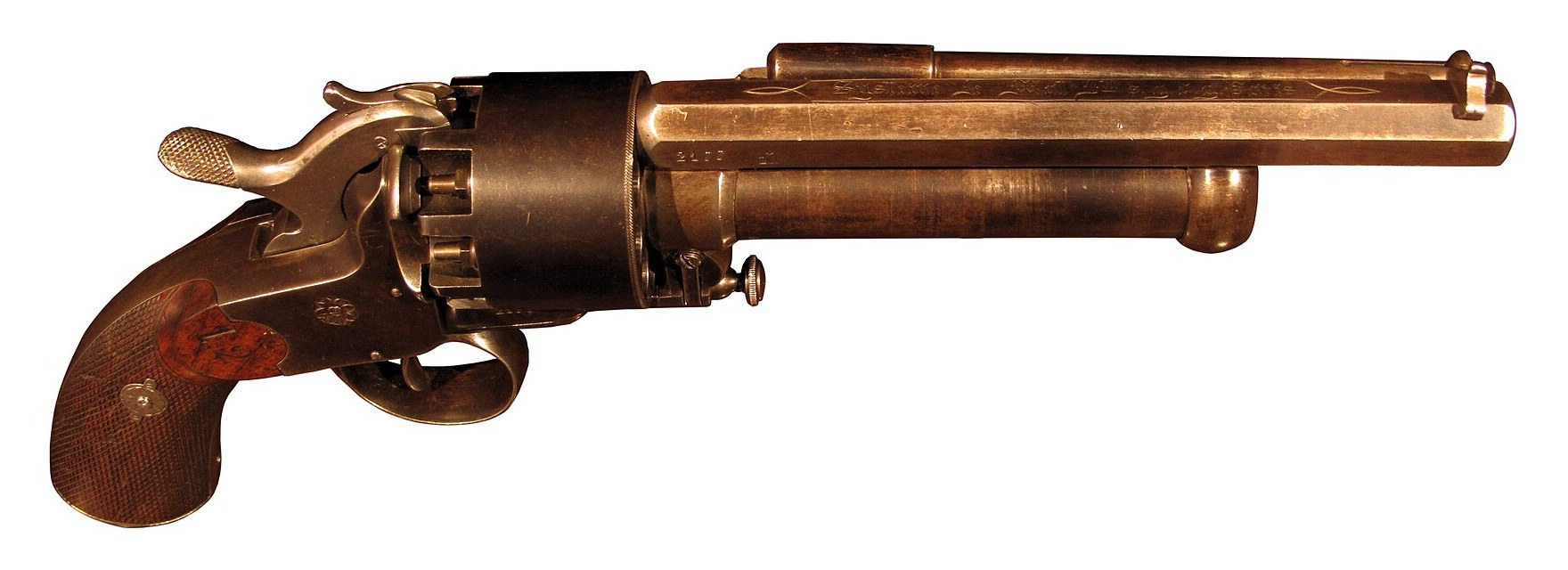
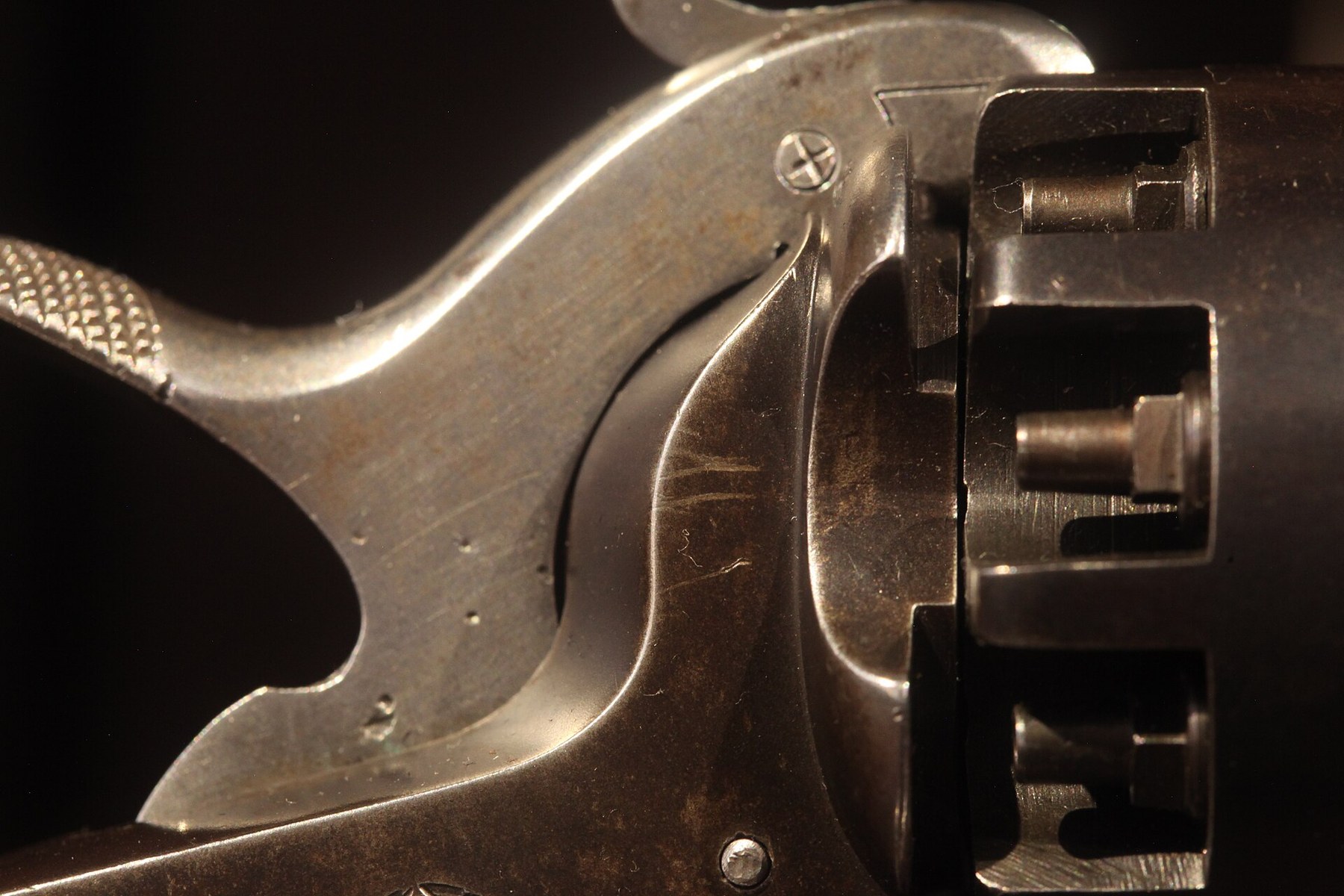
The LeMat is the revolver everyone recognises and almost nobody has handled. It has nine chambers where its contemporaries had five or six, and it carries a second barrel — a short smoothbore of shotgun bore — that runs down the middle of the cylinder and serves as the pin the cylinder turns on. The shooter flips a small lever on the nose of the hammer and the next blow goes to the shot barrel instead of the cylinder. Contemporaries called it the grapeshot revolver, and the name has stuck for a hundred and seventy years.
It is also one of the most consistently garbled guns in American collecting. Its inventor is given two different birth years and two different death years, its prototypes are counted as two or as two hundred and fifty, the selector that made it famous is credited to the wrong patent, and its production figures are quoted in at least four incompatible forms. These volumes work from the patents themselves, from documentary research published by the American Society of Arms Collectors, from the instruction manual and catalogue of the gun’s only current maker, and from auction catalogue descriptions that record measurements and markings of specific serial-numbered guns. Where a figure is contested, each version is given with its source.
1.1 The revolver in one table
For the standard Civil War percussion revolver. Variation between individual guns is considerable, because, as Volume 2 explains, the guns were hand-fitted from parts made in small shops; Volume 3 sets out the model differences.
Table 1 — The revolver in one table
| Type | Single-action percussion revolver, nine-shot, with a single-shot central smoothbore barrel |
| Inventor | Jean Alexandre François LeMat, physician, of New Orleans |
| Patents | US 15,925 (21 October 1856), the central shot barrel; US 24,312 (7 June 1859), the movable hammer head that selects between barrels12 |
| Rifled barrel | 6¾ in, usually octagonal; nominally .42 calibre (60-bore), with .40 and .41 also recorded345 |
| Shot barrel | About 5 in; nominally .63 (18-bore); recorded on surviving guns as “16-gauge” by several catalogues and marked “18” at proof on London guns467 |
| Overall length | 13¼ to 14 in; the Smithsonian’s example measures 14 in8 |
| Weight | About 3½ lb (dealer’s figure for a Second Model)4 |
| Makers | Two prototypes by John Krider, Philadelphia; a few early guns by Auguste Francotte, Liège; production by LeMat & Girard in Paris and Liège; a late run marked “LeMat & Girard’s Patent London”937 |
| Production | ”Approximately 2,900” (College Hill Arsenal, Wikipedia); “no more than 3,000” (Adams via Bodinson); “fewer than 2,900” (Rock Island)4106 |
| Confederate contracts | 5,000 for the Army; 3,000 for the Navy (Garbers, Bodinson)1110 |
| Recorded deliveries | 900 to the War Department and 600 to the Navy Department “by 1863” (Bodinson, citing official records)10 |
1.2 What these volumes argue, and how they are arranged
There are nine volumes. This one covers the man, the patents and the trials of 1859. Volume 2 follows the gun into Confederate service: the contracts, the Paris factory, the blockade, the dispute with the Confederacy’s purchasing agent, the guns that reached named officers, and the post-war cartridge guns. Volume 3 is identification — First Model, transitional, Second Model, London, Baby, pinfire, centerfire and carbine — with comparison plates and a table. Volume 4 is the mechanism part by part. Volume 5 is loading and shooting both barrels, with every charge figure attributed to the document that gives it. Volume 6 is the strip, cleaning, wear and repair. Volume 7 is buying: originals at auction and the current Pietta reproductions, with dated prices. Volume 8 is finishing a reproduction and making a percussion LeMat from scratch in a machine shop. Volume 9 is the law, federal and Michigan.
Four findings run through the series and are worth stating at the start, because each corrects something widely repeated:
- The barrel selector is not in the 1856 patent. The famous hammer with its flip-down nose is the subject of a separate patent, No. 24,312 of June 1859. The 1856 patent claims the shot barrel as cylinder pin and a quite different two-hammer cock (§1.5, §1.9).
- Only two American-made prototypes are known, not the “250” that circulates; the early “Krider” guns of the older literature are Belgian, by Francotte (§1.6, §1.11).
- The shot barrel of an original is not 20-gauge. The original nominal bore, about .63 in, is 18-bore, and London guns carry an “18” at proof. The reproduction’s 20-gauge barrel is a modern choice (Volume 3).
- The documentary trail shows what the Confederacy actually ordered and received, and it is far smaller than the gun’s reputation: 8,000 contracted, about 1,500 documented as delivered (Volume 2).
1.3 Jean Alexandre LeMat: the dates that disagree
The inventor’s name appears as LeMat, Le Mat and Lemat; his given names as Jean Alexandre, Jean Alexandre François and François Alexandre. The 1859 hammer patent is signed “A. Le Mat”; the 1869 cartridge patent is in the name of “François Alexandre Le Mat”.212 This volume uses LeMat, the form most collectors’ literature has settled on, except in quotation.
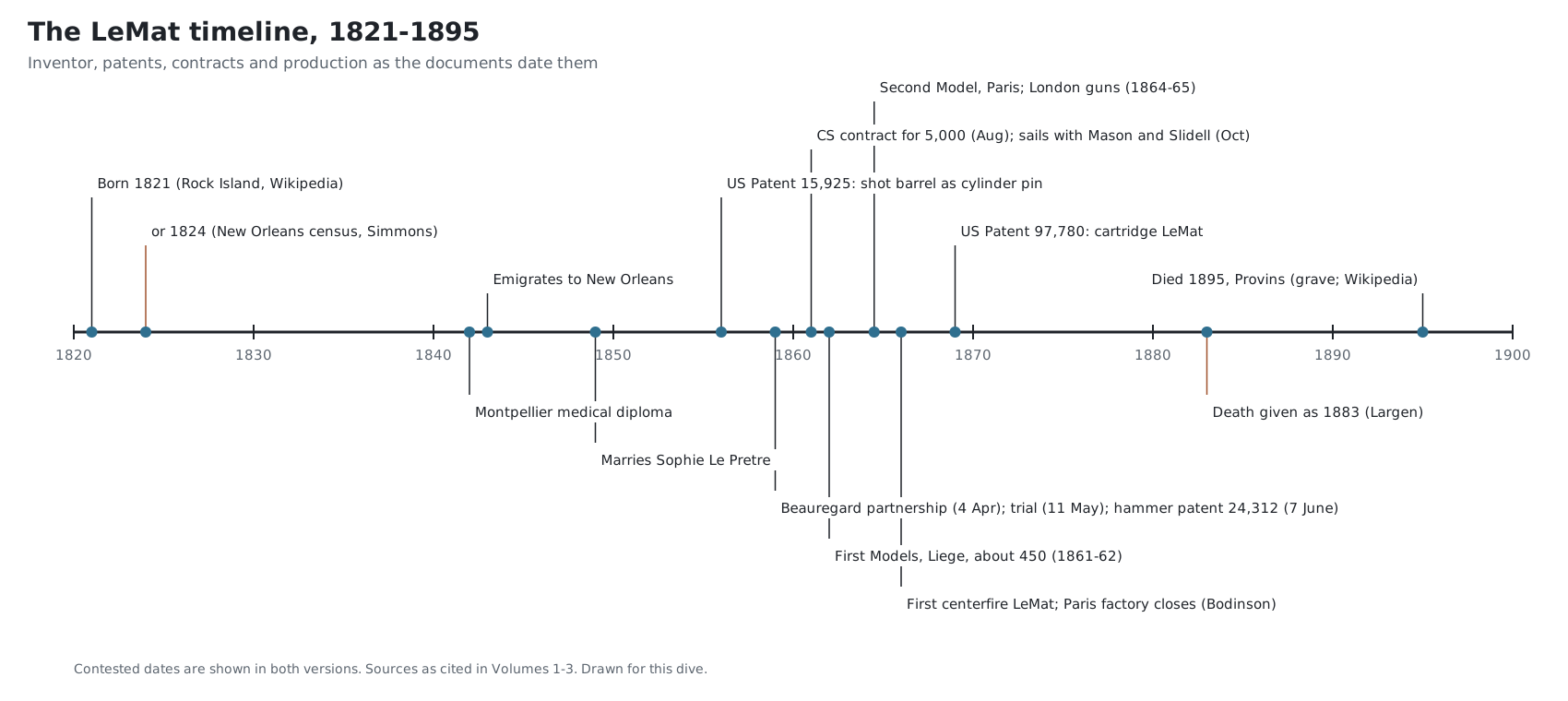
His birth year is given two ways.
- 1821. Rock Island Auction gives “born in France in 1821” and Wikipedia gives 15 April 1821 at Bordeaux.313
- 1824. Edward N. Simmons, writing from primary records for the American Society of Arms Collectors in 1970, states that “The Census records of New Orleans reveal that Dr. Jean Francois Le Mat was born in France during the year of 1824,” and reproduces a photograph made in Paris in 1879 “at the age of 55 years,” which is consistent with 1824.14 Floyd Largen’s 1996 article makes him 32 years old when the patent was granted in October 1856, which also implies 1824.15
Census ages were self-reported and are not proof; nor is a Wikipedia infobox. The two years are given here side by side and neither is preferred.
His death year is given two ways too. Largen gives 1883.15 Holt Bodinson, writing in 2014, gives 1895, and Wikipedia gives 28 July 1895 at Provins, noting that “many sources” say 1883 but that his grave in Paris indicates 1895; it cites the Forgett and Serpette monograph LeMat: The Man, The Gun (1996) for that.1013 The grave evidence makes 1895 the better-supported date, and it is the one used here.
What is documented with more confidence:
- Medical training at Montpellier. The New Orleans Medical Register shows a diploma from the University of Montpellier dated 15 July 1842 entitling him to practise.14
- Emigration around 1843. Rock Island gives 1843; some accounts say 1844.3
- Marriage into the Le Prêtre family. He married Sophie (given as Justine Sophie, or Sophie Justine) Le Prêtre, daughter of the New Orleans planter and merchant Jean-Baptiste Le Prêtre. The 1850 city directory places the couple at the Le Prêtre house, 188 Dauphine Street.14 Rock Island dates the marriage to April 1849 and notes that it made LeMat a cousin by marriage of Pierre Gustave Toutant Beauregard.3
- A son lost to yellow fever. The New Orleans Bee of 13 July 1854 carried, in French, the death notice of “F.A.R. LeMat, son of Dr. LeMat and Sophie Lepretre,” aged thirteen months, during that summer’s epidemic.14
- A run of addresses: 184 St. Peter Street in 1856, 215 Bourbon Street in 1858, 203 Rampart Street in 1861.14
“Colonel.” LeMat used the title of colonel from about 1859; it is engraved on the barrels of his production guns. Largen states that he served on the staff of the governor of Louisiana and was given the rank in that capacity; the Washington letter of introduction of April 1859 already calls him “Col. LeMat.”1514 No commission document was located for this work, and the title is treated here as an honorary state-staff rank, which is how the literature describes it.
The inventor. Bodinson credits him with “more than 35 patents” over his lifetime, ranging from surgical instruments and alloys to a flotation device for disabled ships and a helically driven airship.10 Two non-firearm patents are confirmed by date in Simmons: on 7 June 1859, the same day as the hammer patent, he patented an “improvement in automatic fingers for closing the vents of cannon.”14 The overall count of 35 could not be checked and is Bodinson’s.
1.4 New Orleans in the 1850s
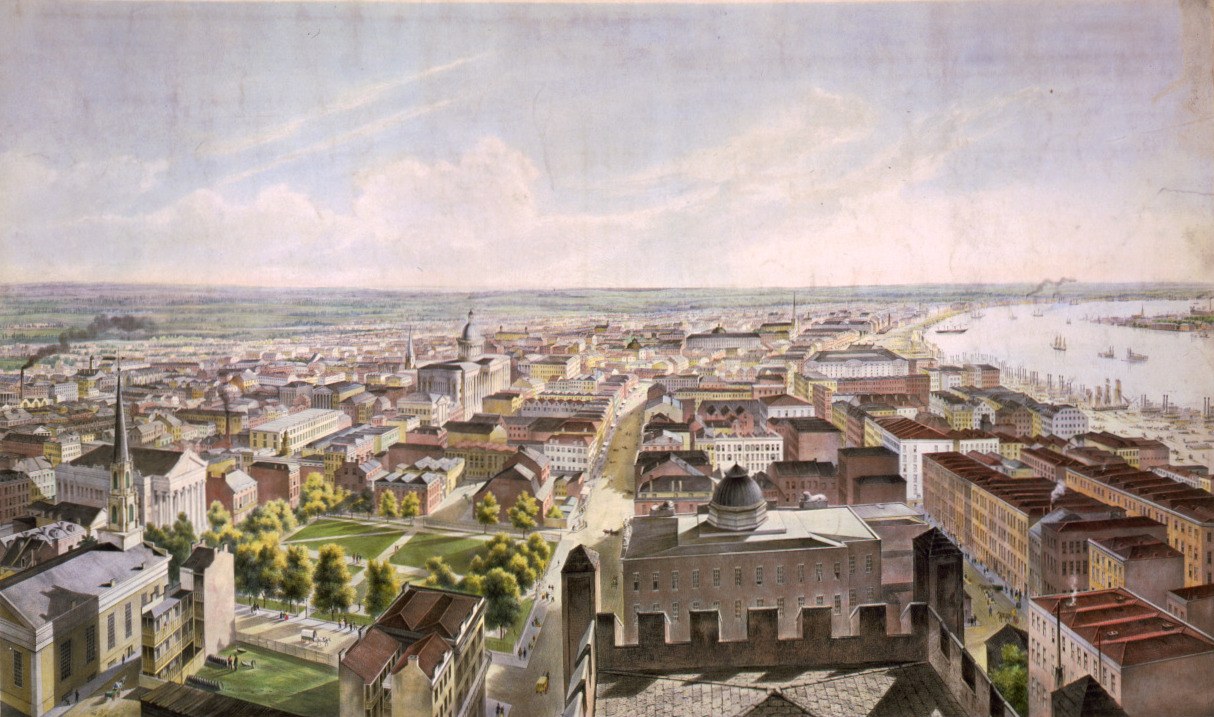
New Orleans is the reason a French doctor designed an American revolver. The city was still strongly French in language and society, it was enormously rich on the river trade, and it was a medical market: Alan Garbers, writing in GUNS Magazine in 2021, describes it as a city of about 167,000 people with only 75 doctors at the time LeMat arrived.11 Garbers does not cite the figure and it is given as his. What is not in doubt is the setting in which the revolver was conceived: a Francophone professional community with close family ties to the Louisiana officer class, and a port through which European goods and European capital flowed directly.
That combination explains three things about the gun’s later history. It explains why LeMat could reach a senior Army engineer through his wife’s family. It explains why, when no American maker would take the gun on, production went to Paris and Liège rather than to New England. And it explains why, when Louisiana seceded, the revolver’s backers were Confederate from the start.
1.5 The patent of 21 October 1856
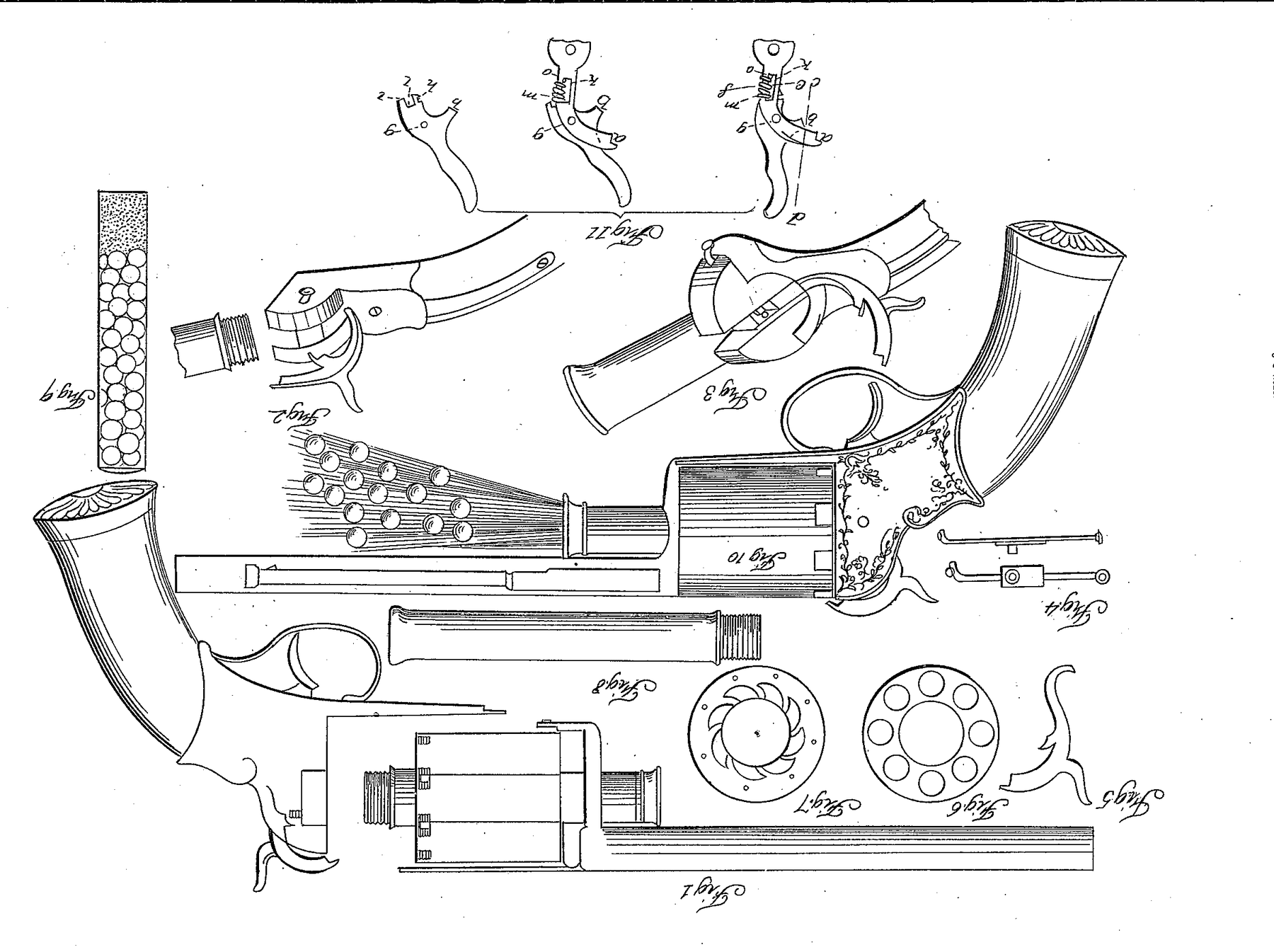
The 1856 patent is short and its text is worth reading in the original, because most descriptions of it are wrong about what it claims. It is titled “Improved Fire-Arm” and describes “a new and Improved Center-Barreled Revolver.” The nature of the invention, in LeMat’s words:
“The nature of my invention consists in using a shot-barrel instead of the solid central cylinder, upon which the cartridge-cylinder of revolvers, constructed upon Colt’s and other similar systems revolve, and in adapting to such revolver a cock of such construction as to explode therewith, at pleasure, either the caps of the cartridge-cylinder or of the central shot-barrel.”1
So the basic idea is stated plainly. A Colt-type revolver turns its cylinder on a solid steel arbor; LeMat makes the arbor hollow and makes it a barrel. The shot barrel “may either be screwed to the breech … or wrought of one piece with the same,” and its nipple — the patent’s word is “chimney” — sits in a recess in the breech face “at a slight distance back from the revolver cartridge-cylinder.”1
How the 1856 patent proposed to select the barrel. This is where the commonly repeated description goes wrong. The patent offers two arrangements, and neither is the pivoting hammer nose of the production guns.
- A sliding plate. A spring-held slide lies over the shot barrel’s nipple. Pressing a button on its outside moves a cap, carried on the slide, over the nipple, where a second, lower hammer on the cock can strike it.
- The preferred arrangement: a cock with two hammers. Hammer a is long enough to strike the caps on the cylinder; hammer b, dovetailed into a slit in the cock and pivoted on a nut, strikes the cap of the central barrel. A ring m, sliding in a transverse slit and pushed up by a spring o, embraces hammer b and holds it either in its “regular form” (out of the way) or in the set position. To fire the shot barrel, the shooter pushes the ring down “with the index finger of the hand holding the pistol,” sets hammer b “with the other hand,” and lets the ring snap back to lock it; then the trigger fires the centre barrel. “If there be any bullet-charges still left, the cock is again brought to its regular form.”1
The patent’s two claims are exactly these two ideas:
“1. The substitution of a shot barrel to the solid cylinder or pin upon which the revolving cartridge-cylinder of revolvers constructed upon Colt’s or similar systems of revolver, in the manner and for the purposes as described. 2. The gun-cock No. 11, with a double hammer, a and b, constructed and operating substantially as described…”1
Why it mattered to LeMat. The patent ends with the purpose, and it is a naval one: “A means of close defense and attack is thus given, heretofore not known or used, which in naval combats is especially invaluable.”1 The marketing of 1859, and the Confederate Navy contract of the war, both follow from that sentence.
The witnesses. The patent is attested by John S. Hollingshead and “C. Girard, M.D.” — Charles Frédéric Girard, the Smithsonian naturalist who would become LeMat’s partner and run the Paris factory (§1.10).1 Girard was therefore involved from the very first document, three years before he became a partner, which is consistent with the James D. Julia catalogue’s statement that Girard “witnessed the patent documents 3 years earlier.”9
A share already given away. Simmons found that one-eighth of the 1856 patent was ceded to a Dr. H. Daret of 117 Philip Street, New Orleans; his name appears nowhere else in the record.14
1.6 The 1858 drawing and the Krider prototypes
Simmons reproduces a drawing of a LeMat revolver “dated New Orleans, March 11, 1858,” held in the archives of Louisiana State University.14 It is the earliest dated depiction of the design found for this work. The drawing itself is not reproduced here because its copyright status is not known.
The prototypes were made in Philadelphia by John Krider, a prominent gunmaker there. How many he made is the first of the gun’s contested numbers:
- Two. The James D. Julia catalogue for Krider serial number 2, drawing on Doug Adams’s 2005 monograph The Confederate LeMat Revolver, states that “there are only 2 Krider made LeMat’s known”: serial number 1, in the Liège arms museum, which “obtained [it] directly from Francotte in 1891,” and serial number 2, “the only known American made LeMat in private hands.”9
- “The first 250 prototypes” — Wikipedia’s LeMat article, uncited.16
The documentary position is Adams’s: two Krider guns are known. Wikipedia’s 250 is not supported by any source consulted and should not be repeated.
Krider serial number 2 is calibre “40/16” in the Julia description, carries silver-plated brass trigger guard and backstrap, and has “COL.” added to the barrel address — an addition not on serial number 1. Adams argued, and the Julia catalogue quotes, that this “could indicate ownership of the pistol by LeMat, himself,” and notes that the gun came out of northern France in the mid-twentieth century, the region where LeMat retired.9 Julia’s estimate for it was $60,000–80,000.9 Rock Island separately sold, in May 2026, an “experimental prototype serial number 4 Krider LeMat revolver” for $105,750.3 The two attributions are in tension — if only Krider serial numbers 1 and 2 are known, a “Krider” serial number 4 would need explaining — and nothing consulted for this work resolves it. Both are reported as the auction houses describe them.
Krider also made, the Julia catalogue records, “a cased engraved ‘patent pistol’ October 24, 1859 for Charles Girard.”9
1.7 Beauregard buys a quarter
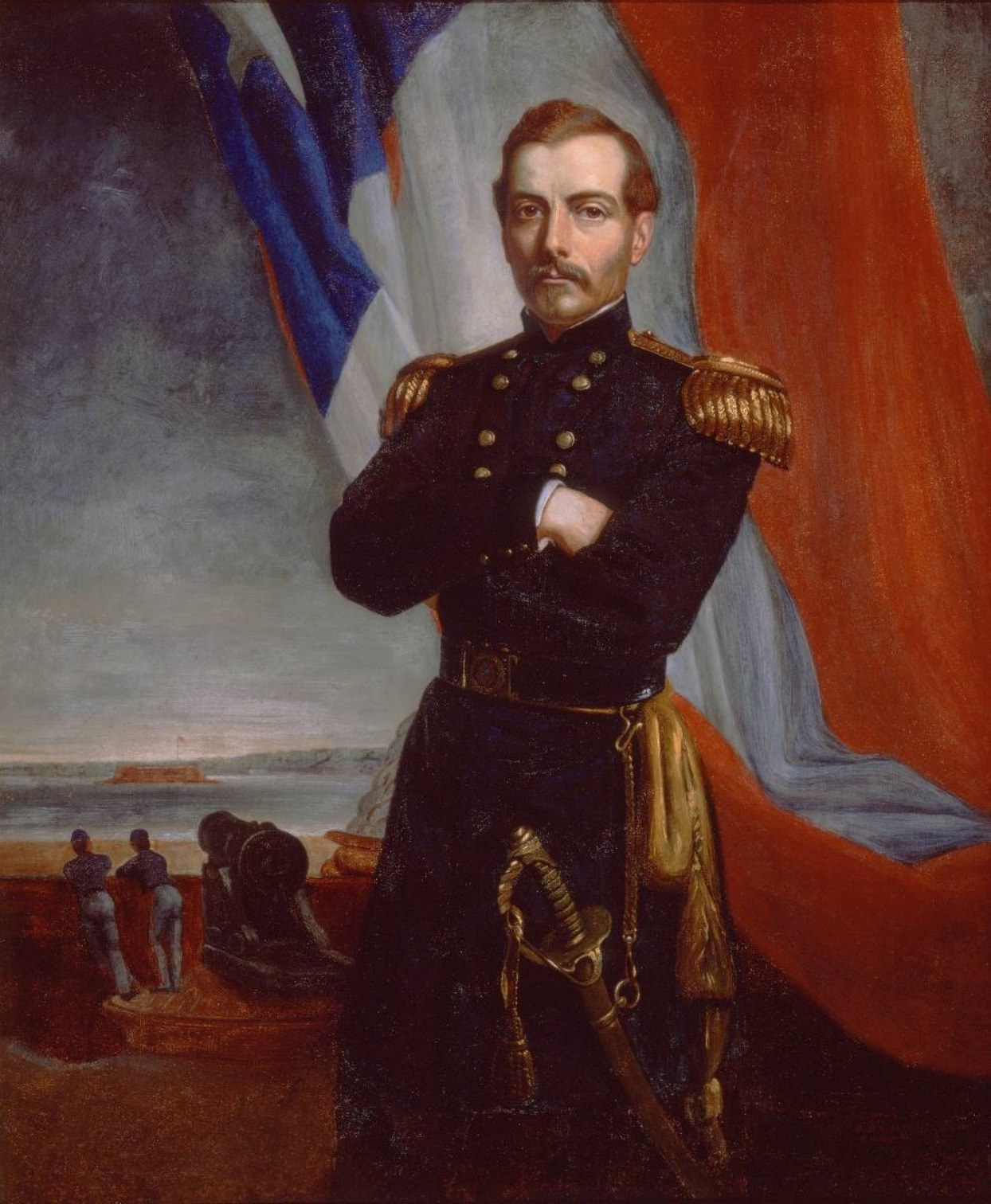
On 4 April 1859 LeMat and Beauregard signed a partnership. Simmons, who saw the contract, summarises it:
“The contract between LeMat and Beauregard plainly indicates that the two fully intended to first protect themselves from imitations by securing patents in all major countries and after this was done, to manufacture and sell the revolver. It provided that one quarter of Le Mat’s patent rights be ceded to Beauregard in exchange for certain favors which Beauregard as Major, United States Army would be in a position to bring about, plus certain financial commitments.”14
Rock Island’s version is that Beauregard “purchased 25% of the LeMat Company.”3 Bodinson’s is that he “obtained 1/4 of the patent rights (which he later sold back to LeMat for $10,000).”10 Simmons, however, says that “upon the approach of the Civil War Beauregard sold his interest in the grapeshot revolver to Charles F. Girard.”14 Whether Beauregard’s quarter went back to LeMat or on to Girard is therefore contested between Bodinson and Simmons. Simmons cites documents; Bodinson does not. The question is left open here.
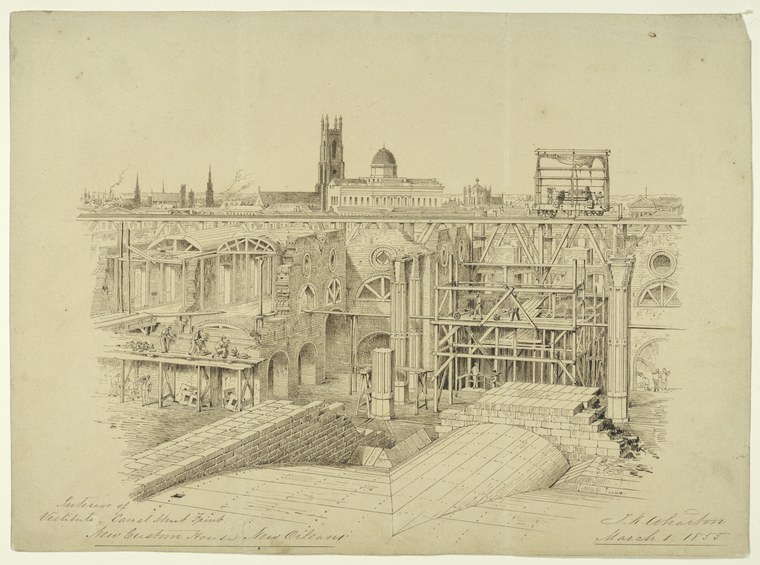
Beauregard’s usefulness is easy to see. He was a West Point engineer and a Mexican War veteran, and in 1859 he was in charge of building the New Orleans custom house.14 He was also family. The patents abroad that the contract anticipated were filed: Garbers lists Belgium, France, England, Saxony and Russia; Bodinson lists France, Belgium, England, Saxony and Prussia.1110 The difference (Russia against Prussia) is not resolved here. The British patents are dated 1859 by Largen.15
1.8 Two boards: New Orleans and the Washington Arsenal
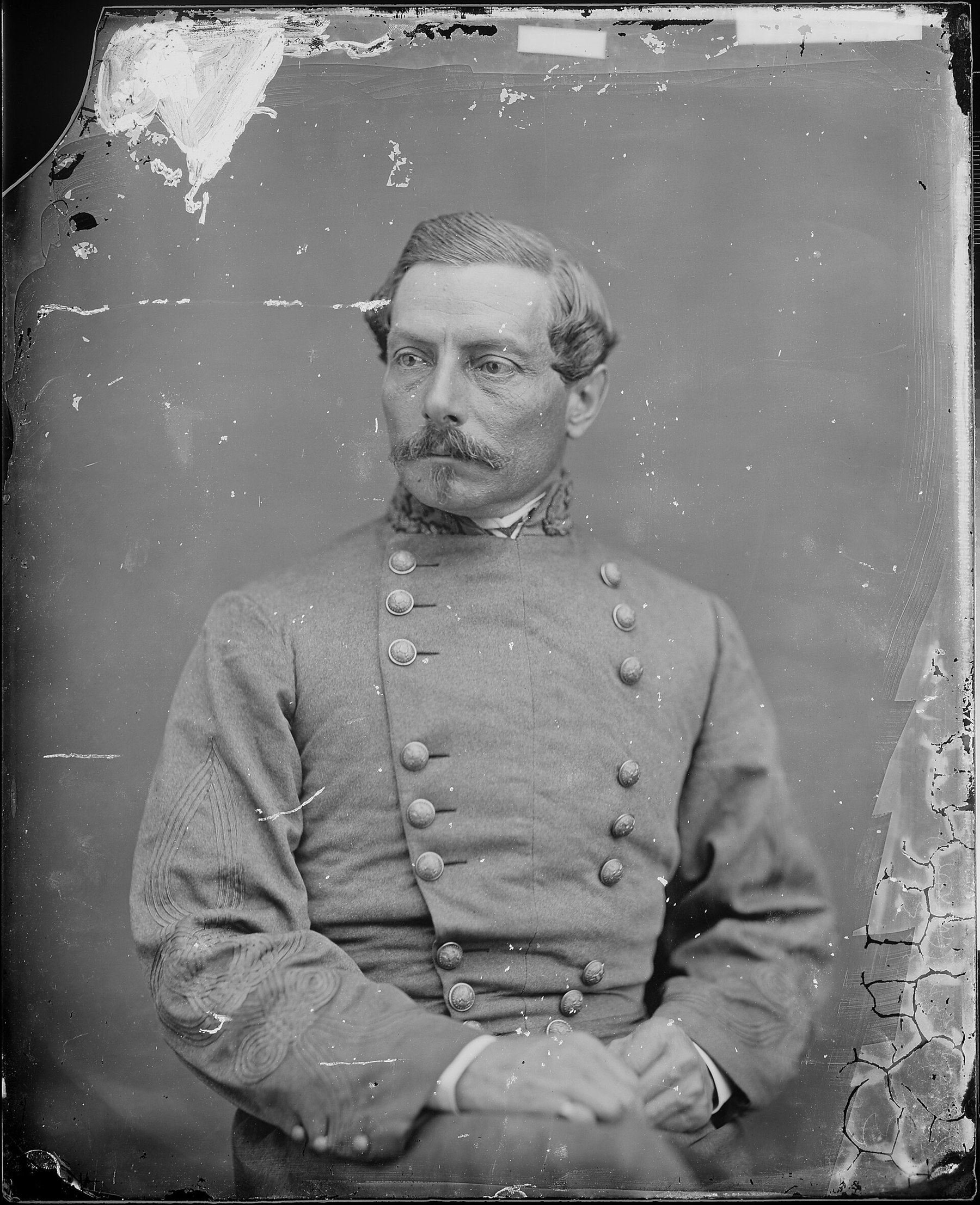
The New Orleans board, March 1859. Beauregard arranged what Simmons calls “a semi-official local board composed of prominent military and political figures” to put the revolver through a public trial.14 Its report is the source of every enthusiastic sentence about the LeMat in print, and it deserves to be quoted at length, from the extracts published by Bodinson and in the Julia catalogue:
“We consider the arm far superior to any we have seen for the use of cavalry acting against Indians or when charging on a square of infantry or a battery of field pieces. It is also indispensable for artillerists in defending their pieces against such a charge, and for infantry defending a breach… Its advantages in the naval service in boarding or repelling boarders is too obvious to require anything but passing notice…”10
“It is more than probable that the introduction and use of this pistol in the cavalry service would give to the latter the preponderance over the infantry, if not armed in like manner, for what would become of a line or square of infantry after its fire should have been drawn by the cavalry when the latter coming up to within a few paces would pour 10 shots into their very faces.”10
“We earnestly recommend that his arm be introduced in our military and naval services, as soon as the Government will find it practicable to do so…”10
The Julia catalogue’s extract adds the comparison that LeMat’s backers prized: “after a close examination of said arm, we consider it a great and important improvement on Colt’s revolver.”9
Beauregard used the report as publicity. Notices of the trial appeared on 21 May 1859 in three New Orleans papers — the True Delta, the Bee and the Crescent — and Simmons reproduces Beauregard’s receipt for one of the advertisements.14 The Julia catalogue describes these as advertisements for guns already in hand.9
The Washington board, May 1859. LeMat went to Washington with a letter of introduction to the Secretary of War, John B. Floyd, dated New Orleans, 25 April 1859, which reads in part: “I take great pleasure in introducing Col. LeMat of New Orleans who is about to visit Washington for the purpose of exhibiting to the War & Navy Departments a weapon of his invention.”14 He was received by the Adjutant General, Colonel Samuel Cooper, and a board of officers was convened under Colonel Joseph E. Johnston with Brevet Major George D. Ramsey (Simmons’s spelling) and an Ordnance officer whose name Simmons’s text renders as “Theo T. J. Lardley” (very probably Theodore T. S. Laidley of the Ordnance Department; the reading is this work’s, from an imperfect scan). It tested the gun at the Washington Arsenal on 11 May 1859.14
The dates are not quite settled. Rock Island gives “a trial in Washington on March 2, 1859.”3 Simmons’s documentary account, which the Julia catalogue follows (“at the Washington Arsenal in May of 1859”), places the Washington trial in May and the informal New Orleans trial in March.149 The sequence Simmons gives — partnership 4 April, letter of introduction 25 April, Washington trial 11 May, newspaper notices 21 May — is internally consistent and is followed here. The 2 March date may be a conflation with the New Orleans trial.
What was fired. Bodinson read the Washington board’s report for its loading data: “The pistol load was 16 grains of powder and a 206-grain bullet, not a ball. The report reads, ‘elongated ball.’ The shotgun barrel load was 40 grains of powder with either a 406-grain ball or 15 buckshot.”10 Rock Island gives the same trial’s charges in metric — “1 gram of black powder” per chamber and “2.5 grams of powder and 15 pellets of buckshot” in the shot barrel.3 One gram is 15.4 grains and 2.5 grams is 38.6 grains, so the two accounts agree within rounding and are very probably two readings of the same document. Volume 5 sets these figures beside the modern maker’s.
What the board recommended. It was impressed, suggested minor changes, and recommended — in the phrase Simmons quotes — “that this arm be subjected to trial in the hands of troops, in actual service in the field.”14 Garbers reports one of the changes: the First Model’s loading lever was on the right, “a feature the military testers recommended be changed to the left side.”11 That is exactly the change seen on the later guns (Volume 3).
1.9 The hammer patent of 7 June 1859
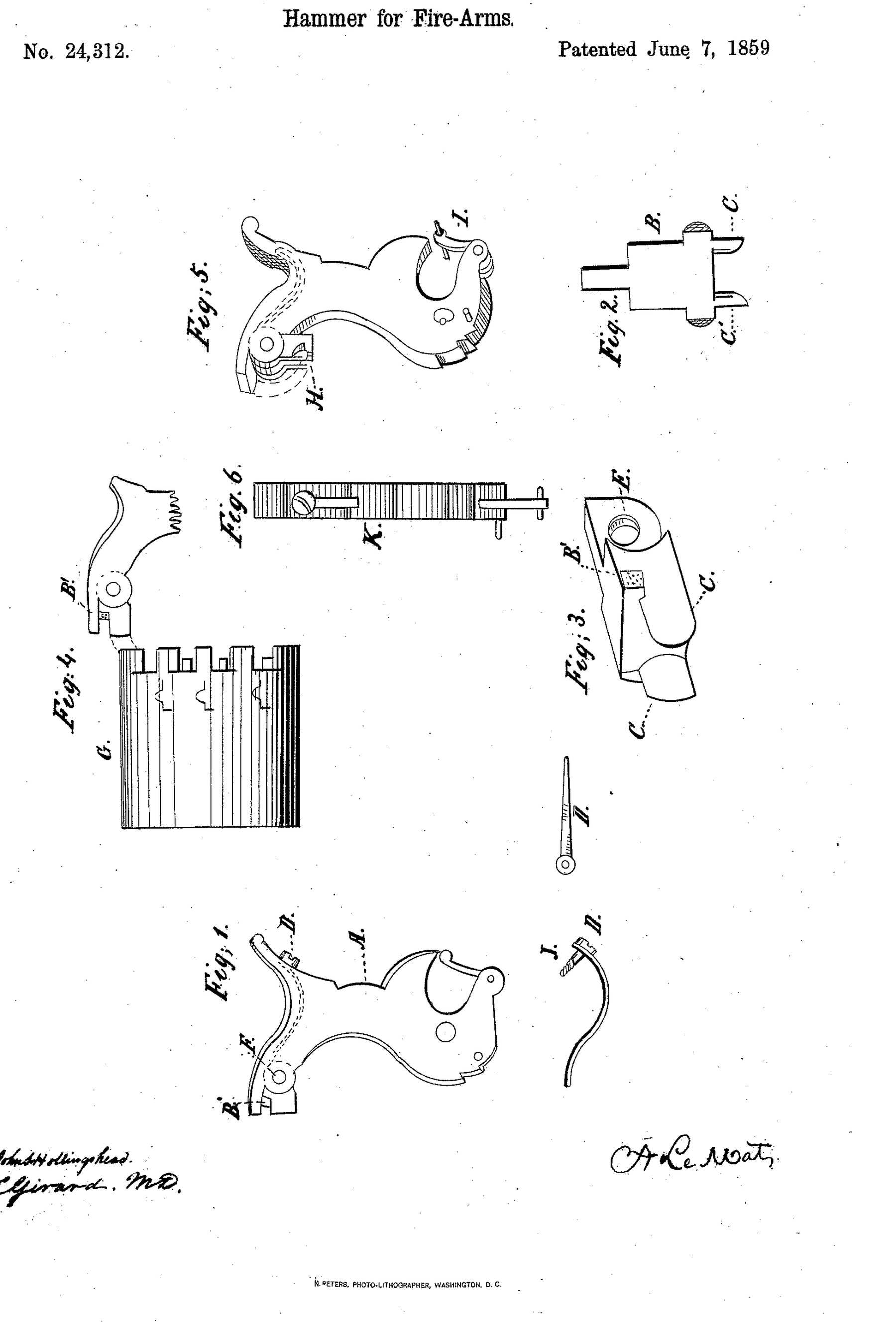
While he was in Washington, LeMat applied for a second patent, and it is the one that describes the gun as it was built. US Patent 24,312, dated 7 June 1859, is titled “Adjustable Hammer for Revolving Firearms”:2
“The nature of my invention consists in providing, 1st, a movable head for the purpose hereinafter specified; and, 2d, two lateral wings to hold the revolving cylinder in place.”
The movable head B is pivoted to the hammer on an axle F and held by a spring D, fastened with a screw J, “for retaining the movable head in either of the positions required by the operator.” Lateral projections B′ give “a ‘point d’appui’ to the thumb in lowering or lifting up the movable head.” Turned one way it strikes the cylinder’s caps; turned down (Figure 5) it fires “the central barrel of my grape shot revolver.” On revolvers without a shot barrel, the same hammer would carry a head “simple and immovable.”2
The second half of the patent is usually forgotten. The hammer head carries “small wings C and C … for the purpose of holding the revolving cylinder fast, and thus preventing it from any displacement.”2 At the moment of firing, in other words, the falling hammer itself locks the cylinder by engaging it with two small lugs. Volume 4 returns to this, because it is part of the answer to how the gun keeps its chambers aligned.
What LeMat did not claim. The patent disclaims “the hammer having a hinged head merely, such as is shown in the patent of F. Beerstecher, of Sept. 25th 1855.”2 Hinged hammer heads were therefore not new; what LeMat claimed was a hinged head arranged to present the same striking face in two directions to fire different barrels, together with the cylinder-locking wings. The witnesses are again John S. Hollingshead and C. Girard.2
The correction. Popular accounts, including the summaries of the 1856 patent found online, describe “a pivoting striker” or “hammer nose” as the 1856 invention. The 1856 patent’s preferred mechanism is a two-hammer cock with a locking ring; the movable head that every surviving LeMat carries is the 1859 patent.12 The 1856 patent is the shot barrel as arbor; the 1859 patent is the selector. The production gun combines them.
1.10 Charles Frédéric Girard, naturalist and arms partner
The man who ran the factory is the least-known figure in the story and the most surprising. Simmons quotes the biography in the Smithsonian’s Bulletin 42:14
- born 9 March 1822 and educated at Neuchâtel under Louis Agassiz, who brought him to the United States;
- at Cambridge with Agassiz until 1850, then at the Smithsonian in Washington under Spencer F. Baird as his assistant, and associated with the foundation of the United States National Museum;
- author of more than 170 papers in the decade before the war, chiefly on fishes and reptiles, including the reports on the specimens collected by the western boundary and railroad surveys;
- naturalised in 1854, graduated in medicine from Georgetown in 1856 — the “M.D.” on LeMat’s patent;
- left for France in 1860, where during the war he supplied the Confederacy with drugs and surgical instruments under the firm of Gautherin & Girard, won the Cuvier prize of the Institut de France in 1861, toured the Confederacy in 1863, and wrote Les États Confédérés d’Amérique visités en 1863.14
Girard joined LeMat in Paris early in 1860 and became a full partner, rather than a “special agent,” in July of that year.14 Bodinson calls him “a prominent doctor and financier who became the major stockholder.”10 After the war, Bodinson writes, Girard tried to sell the patents to Colt, closed the LeMat factory in France in 1866 to settle the firm’s debts, spent a brief time in debtors’ prison, and returned to medicine.10 Those post-war details are Bodinson’s and were not checked against a second source.
1.11 The Francotte guns and the first European production
Between Krider’s two prototypes and the Paris factory sits a small group of Belgian guns. The Julia catalogue, following Adams, states that LeMat, Beauregard and Girard “early in 1859 must have contracted with Auguste Francotte to manufacture a small quantity of revolvers based on the Krider prototypes,” that “there are six known Francotte made pistols closely emulating the Krider pistols, with highest SN known 20,” and that the finest of them, serial number 16, was sold by Julia as lot 2218 in March 2016.9 One of these Francotte guns is inscribed as a Christmas gift in 1863 to an officer of the 16th Maine — a Union regiment — and the cataloguer infers that it was captured.9
The importance of this group is a correction to the older literature. Alain Serpette and Val Forgett, the catalogue notes, believed these early guns were Krider’s work; Adams pointed out that they are Belgian and that only two Krider LeMats are known.9 The Francotte guns are also very probably the guns Beauregard was advertising in New Orleans in May 1859, “two weeks after testing at the Washington Arsenal.”9
That the first Krider prototype found its way to Liège, and was given to the city’s arms museum by Francotte in 1891, fits the same picture: the American prototypes were sent to the European maker as patterns.9
1.12 Why the United States Army said no
The Washington board recommended field trials; none followed. “No further records of the revolvers having been used by the United States Army has been found,” Simmons writes.14 Frederick Edmunds, writing in the same Bulletin in 2009 from fifty years of collecting Confederate arms, noted the same silence — “it appears that the matter was dropped” — and asked whether the Ordnance Board had seen what later users found: an inadequate loading mechanism, fouling of the action after a few shots, a slow and awkward loading procedure, and the prospect of a cartridge in no service calibre.17 Rock Island adds that the Army “may have been skeptical of ordering a gun that lacked a domestic manufacturing facility”; Garbers that it “had no interest in investing in yet another weapon system.”311
These are explanations offered after the fact, and no document from the Ordnance Department explaining the decision was located. What is documented is the commercial consequence. Beauregard, in Bodinson’s words, “approached every arms company in America with a proposal to manufacture the LeMat. None bit.”10 The only domestic maker known to have even contemplated it was Cook & Brother of New Orleans, and that only in June 1861, after secession (Volume 2).14 So the LeMat became, from the start, a European-made gun for an American market — and, when the market split in 1861, a European-made gun for the Confederacy.
1.13 What could not be verified
- LeMat’s birth year (1821 against 1824) and death year (1883 against 1895). The grave evidence favours 1895; nothing consulted settles the birth year.
- Whether Beauregard’s quarter share went back to LeMat (Bodinson) or on to Girard (Simmons).
- The date of the Washington trial: 11 May 1859 (Simmons, followed here) against 2 March 1859 (Rock Island).
- The country list of LeMat’s foreign patents: Russia (Garbers) or Prussia (Bodinson). No foreign patent number other than the 1868 British patent cited in Volume 2 was confirmed.
- The number of LeMat’s patents (“more than 35,” Bodinson).
- The “Krider” serial number 4 sold by Rock Island in May 2026, set against Adams’s statement that only Krider serial numbers 1 and 2 are known.
- The full text of the New Orleans and Washington board reports. The quotations above are the extracts published by Bodinson, Simmons and the Julia catalogue; the reports themselves were not seen.
Sources
Footnotes
-
A. Le Mat, US Patent 15,925, “Improved Fire-Arm,” 21 October 1856, specification and drawing sheet (Google Patents, PDF read 2026-10-18). Witnesses John S. Hollingshead and C. Girard, M.D. ↩ ↩2 ↩3 ↩4 ↩5 ↩6 ↩7 ↩8
-
A. Le Mat, US Patent 24,312, “Adjustable Hammer for Revolving Firearms,” 7 June 1859, specification and drawing sheet (Google Patents, PDF read 2026-10-18). ↩ ↩2 ↩3 ↩4 ↩5 ↩6 ↩7 ↩8
-
Joe Engesser, “The LeMat Revolver,” Rock Island Auction Company, published 25 July 2023 and updated to include a May 2026 sale, https://www.rockislandauction.com/riac-blog/lemat-revolvers, read 2026-10-18. ↩ ↩2 ↩3 ↩4 ↩5 ↩6 ↩7 ↩8 ↩9 ↩10
-
College Hill Arsenal, “2nd Model LeMat — Lovely Untouched Example,” dealer listing for serial no. 1784, https://collegehillarsenal.com/2nd-Model-LeMat-Lovely-Untouched-Example, read 2026-10-18. ↩ ↩2 ↩3 ↩4
-
Christie’s, “A Rare Le Mat and Girard’s Patent Dual-System Ten-Shot Percussion Revolver, signed Le Mat & Girard’s Patent, London, No. 8510, circa 1864,” https://www.christies.com.cn/lot/lot-1633501, read 2026-10-18. ↩
-
Rock Island Auction Company, catalogue 4090, book 1, p. 250, Second Model London LeMat serial no. 8604, read 2026-10-18. ↩ ↩2
-
James D. Julia, Inc., “Scarce and Rare Confederate Navy Contract LeMat and Girard’s Patent London Two Barrel Revolver, SN 8074,” https://jamesdjulia.com/?p=457413, read 2026-10-18. ↩ ↩2
-
National Museum of American History, “LeMat Revolver,” photograph NMAH-ET2012-13983 and its description (“nine-shot .40 caliber LeMat, with a 16-gauge shotgun barrel”; overall 6 × 14 × 1¾ in), via Wikimedia Commons, read 2026-10-18. ↩
-
James D. Julia, Inc., lot 4378, “Krider LeMat Patent Revolver Serial Number 2, the Personal Revolver of Col. Alexander LeMat Himself,” https://jamesdjulia.com/item/4378-394/, read 2026-10-18. Quotes Doug Adams, The Confederate LeMat Revolver (Mowbray, 2005). ↩ ↩2 ↩3 ↩4 ↩5 ↩6 ↩7 ↩8 ↩9 ↩10 ↩11 ↩12 ↩13 ↩14
-
Holt Bodinson, “The Awesome LeMat,” GUNS Magazine, 7 February 2014, https://gunsmagazine.com/guns/handguns/the-awesome-lemat/, read 2026-10-18. ↩ ↩2 ↩3 ↩4 ↩5 ↩6 ↩7 ↩8 ↩9 ↩10 ↩11 ↩12 ↩13 ↩14
-
Alan Garbers, “The LeMat’s Grapeshot Revolver,” GUNS Magazine, 15 September 2021, https://gunsmagazine.com/guns/the-lemats-grapeshot-revolver/, read 2026-10-18. ↩ ↩2 ↩3 ↩4 ↩5
-
F. A. Le Mat, US Patent 97,780, “Improvement in Breech-Loading Revolving Fire-Arms,” 14 December 1869, assignor to Charles Pietroni of London (Google Patents, PDF read 2026-10-18). ↩
-
“Jean Alexandre LeMat,” English Wikipedia, read 2026-10-18; cites Valamore J. Forgett, Alain F. and Marie Antoinette Serpette, LeMat: The Man, The Gun (1996), and Find a Grave memorial 40865752. ↩ ↩2
-
Edward N. Simmons, “Dr. Jean Alexander Francoise Le Mat and the New Orleans Affair,” American Society of Arms Collectors Bulletin 22:33–41 (1970), reprint PDF at americansocietyofarmscollectors.org, read 2026-10-18. Source of the census birth year, the Montpellier diploma, the family and addresses, the one-eighth share to Dr. Daret, the partnership of 4 April 1859 and its terms, the newspaper notices of 21 May 1859, the letter of introduction of 25 April 1859, the Washington board of 11 May 1859 and its recommendation, the 1859 hammer and cannon-vent patents, Beauregard’s sale to Girard, Girard’s biography from Smithsonian Bulletin 42, the 1858 drawing in the LSU archives, and the 1879 photograph. ↩ ↩2 ↩3 ↩4 ↩5 ↩6 ↩7 ↩8 ↩9 ↩10 ↩11 ↩12 ↩13 ↩14 ↩15 ↩16 ↩17 ↩18 ↩19 ↩20 ↩21 ↩22 ↩23
-
Floyd Largen, “Weaponry: Le Mat,” Military History, October 1996, republished at https://historynet.com/weaponry-le-mat/, read 2026-10-18. ↩ ↩2 ↩3 ↩4
-
“LeMat revolver,” English Wikipedia, read 2026-10-18. ↩
-
Frederick R. Edmunds, “Some Thoughts on the Confederate LeMat Revolver,” American Society of Arms Collectors Bulletin 100:24–28 (2009), reprint PDF read 2026-10-18. ↩
Comments (0)