H&K Mk 23 · Volume 8
Buying, Owning and Working On One
What H&K sells, what it costs new and used, what to check before buying, which parts can still be had, what an owner with a full shop can sensibly make or change, and the federal and Michigan law that applies, linked to where this hub already sets it out
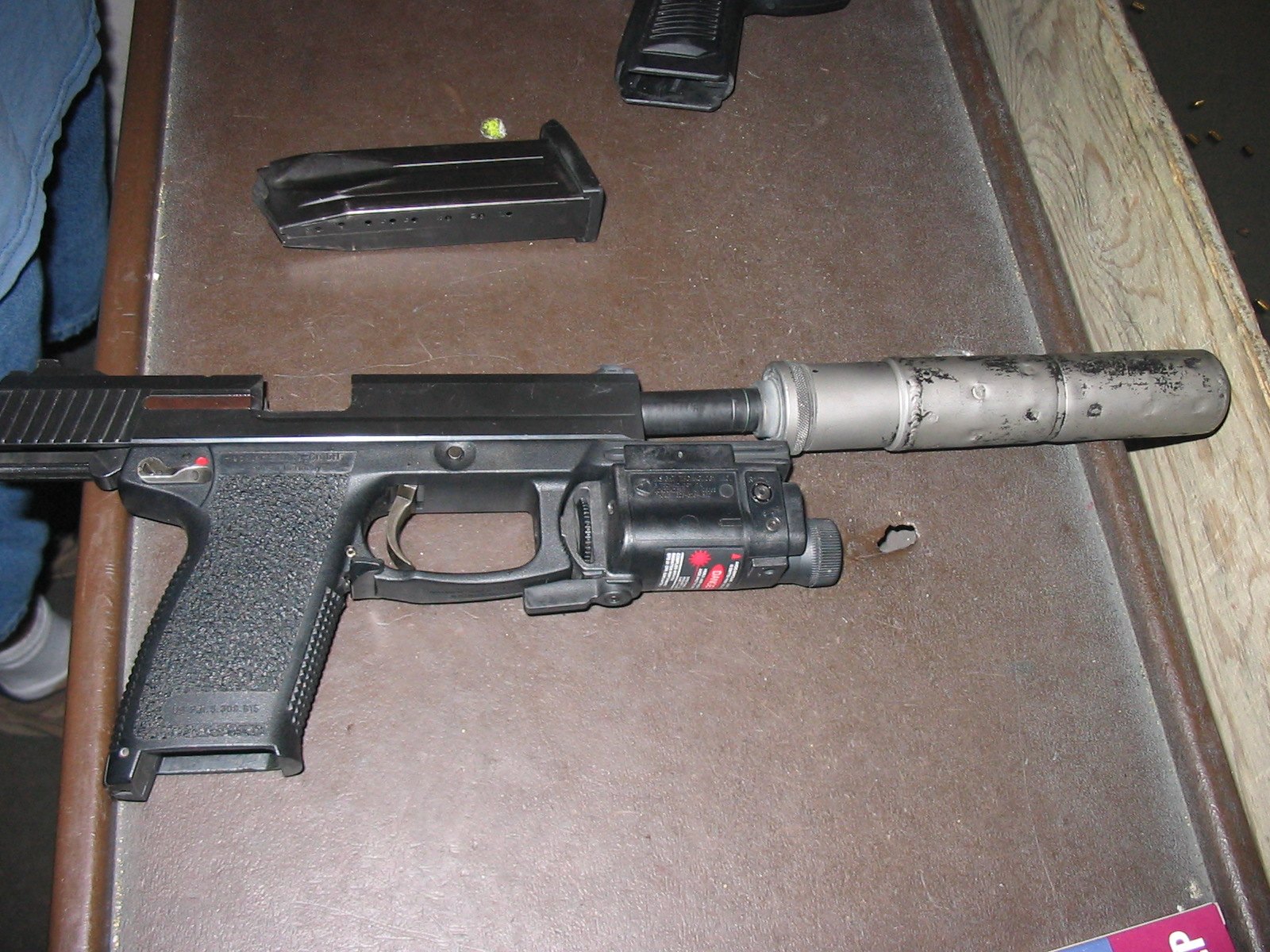
8.1 What can be bought
The pistol a private buyer in the United States can buy is the commercial Mark 23. The issued Mk 23 Mod 0 is government property, no legitimate surplus sale of it was found, and a pistol offered as a “Mod 0” should be assumed to be a commercial pistol until proved otherwise (Volume 4).
H&K USA’s product page, in its last archived form (28 December 2024), lists two configurations:1
Table 1 — What can be bought
| H&K model no. | UPC | Configuration | MSRP, December 2024 |
|---|---|---|---|
| 81000078 | 642230261587 | Mark 23 .45 ACP, DA/SA, two 12-round magazines | $2,639 |
| 81000080 | 642230261228 | Mark 23 .45 ACP, DA/SA, two 10-round magazines | $2,639 |
The live page could not be read for this dive: hk-usa.com refused automated requests in October 2026, and no later archived copy exists. Whether H&K’s current price or configurations have changed since December 2024 is therefore not established here; the 2024 figures are dated and sourced, not current.
US retailers also list a Mark 23 with a black Cerakote slide and an OD green frame under model number 81001074, from about November 2025, at prices around $2,834.2 No H&K page describing it was found, and it is reported here as a retailer listing (Volume 2).
New pistols come from Oberndorf. The Firearm Blog’s reviewer said in 2021 that his “took about six months to immigrate to the U.S. from Germany”, and Gun Tests said in 2026, without a source, that “HK builds only a few hundred new each year”.34 Neither is an H&K statement, but both describe a pistol that is made in small batches and is not always in stock.
8.2 Prices, new and used
Table 2 — Prices, new and used
| Date | Price | What | Source |
|---|---|---|---|
| May 2021 | $2,499 | MSRP | The Firearm Blog |
| April 2022 | $2,639 | MSRP | American Rifleman |
| December 2024 | $2,639 | MSRP, either configuration | H&K USA product page (archived) |
| July 2026 | $2,190 start, $2,329 buy-it-now | Factory-new, online auction listing | Gun Tests |
| July 2026 | $2,250 start, $2,350 buy-it-now | New in box, online auction listing | Gun Tests |
| July 2026 | $2,050 start | Used, online auction listing | Gun Tests |
| July 2026 | $1,900 | New in box, completed auction sale | Gun Tests |
| July 2026 | $1,700 | Used, completed auction sale | Gun Tests |
| 18 October 2026 | $2,301.99 | 81000078, in stock | KYGUNCO |
| About November 2025 | $2,833.95 | 81001074 black/OD green, after rebate | Blackstone Shooting Sports |
Sources: TFB, American Rifleman, H&K, Gun Tests, KYGUNCO, Blackstone.351462
Three things stand out. Retail price in late 2026 was below H&K’s 2024 MSRP. Several retailers’ listings display an “MSRP” above H&K’s own ($3,098.20 and $3,005.25 appeared in search results); those figures could not be traced to H&K and are not used. And the two completed sales Gun Tests reports, $1,900 new in box and $1,700 used, are the only realised prices found; a single month’s auction results are a snapshot, not a market.
What none of these prices includes is the rest of the system. A Knight’s suppressor was $1,300 to $1,500 in 2021 by TFB’s account, a B&T was $750 in 2023 by another TFB review, and both need the NFA transfer described in Volume 7.37
8.3 Buying a used Mark 23: what to check
H&K’s operator’s manual gives, in effect, a used-pistol inspection, because its safety and function check and its inspection list are written for a pistol of unknown history (Volume 5). The checks below are H&K’s, ordered for a buyer, with the reason each matters.
- Run the full safety and function check in Volume 5 on the cleared pistol, with the seller’s permission. Every failure in it has the same consequence in H&K’s manual: return to H&K. The ones that matter most are the safety that must not engage with the hammer down, the decocker that must not work with the safety on, the two hammer-rebound tests and the disconnector test.8
- Field strip it (Volume 5) and look at the O-ring. It is the one part H&K says governs accuracy after long use, and it is cheap; a cracked, flattened or missing ring explains poor groups and is no reason to reject the pistol.8
- Check the buffer spring retainer roll pin. H&K’s troubleshooting table lists “buffer spring retainer roll pin drift” under three malfunctions and says that if the pin is “not firmly seated and centered in the guide rod”, the pistol goes back to H&K.8 A drifted pin is the single most specific warning sign in the manual.
- Look at the rubber hammer spur. “If the rubber hammer spur is badly cracked or chipped, drop safety could be degraded.” The fix is a new hammer, fitted by H&K in the manual’s terms.8 A dropped pistol is the other hammer-related risk: H&K wants the sear axle inspected after any drop on the hammer.
- Check the red and white dots on the frame. Ultrasonic cleaning removes them, the manual warns; their absence says something about how the pistol was cleaned.8
- Look at the slide marks. The serial and proof marks are “etched on the permanent protective coating”, and H&K warns they can corrode in salt water.8 Corrosion around the etched marks is a sign of wet use.
- Check the thread at the muzzle for damage, and confirm it is right-hand with a known cap (Volume 7).
- Read the slide marking and the two-letter code (Volume 4). A “MARK 23” marking is the commercial pistol. “MK23 USSOCOM” on a pistol offered to a civilian calls for documentation.
- Count the magazines and check their type (below).
- Ask whether a suppressor or aiming module is included, and if so, which (Volume 7). Neither comes with the pistol from H&K.
Parts that the manual reserves to H&K (the springs and pins of the recoil assembly, everything in the frame) are not a reason to walk away if the pistol passes its checks. They are a reason to know where service will come from (below).
8.4 Magazines
The Mark 23 takes its own magazines, in two versions with different bodies, floorplates and springs (Volume 5). H&K’s 2024 page lists spare 12-round magazines as 215668S and 10-round magazines as 215670S, at $59 each.1 Whether USP45 magazines fit or function in a Mark 23 was not established, and nothing here should be read as saying they do.
The 10-round magazine exists because of the 1994 federal law (Volume 2). It is not merely a blocked 12-round magazine but a separate design, and H&K still offers it, which matters to a buyer in a state that limits magazine capacity.
8.5 Parts
H&K’s 2024 product page sells only the magazines and the thread cap.1 Genuine H&K Mark 23 parts are, however, listed by at least one large US parts dealer under H&K’s own part numbers. Midwest Gun Works, checked on 18 October 2026, listed among others:9
Table 3 — Parts
| H&K part no. | Part (dealer’s title) |
|---|---|
| 215671 | Mark 23 .45 ACP threaded barrel, 5.87 in |
| 986429 | ”Mark 23 / HK45 Barrel O-Ring, .45 Caliber” |
| 215724 | Recoil spring guide rod |
| 215729 | Recoil spring |
| 215726 | Buffer spring |
| 986433 | Buffer spring retaining pin |
| 215707 | Extractor |
| 215705 | Firing pin |
| 215772 | Hammer |
| 215744 | Safety lever, right |
| 970174 | ”Mark23 Thread Cap, M16x1 RH” |
Prices and stock could not be read reliably from the pages and are not quoted; anyone relying on a part should check the listing on the day. The O-ring’s title is worth noting: the dealer lists the Mark 23’s barrel O-ring as shared with the HK45. The exchangeable rear sights in H&K’s parts list were not found at that dealer.
No aftermarket recoil springs, sights or barrels made specifically for the Mark 23 were found on any maker’s own page for this dive. The Mark 23 is a low-volume pistol, and its parts appear to come from H&K or not at all.
The terms of H&K USA’s service department in 2026 (turnaround, cost, whether it still services the Mark 23 under the “lifetime warranty” its 2004 page advertised) were not established.10 A buyer should ask H&K before buying a pistol that needs service.
8.6 Owner-level work: the rules first
The Mark 23 is a pistol whose maker draws the line for owners very conservatively: field strip, clean, lubricate, inspect, replace the O-ring and exchange the rear sight; everything else to H&K (Volume 5).8 An owner with a machine shop and a gunsmith’s bench can do more, and the sections below say what, but three limits apply whatever the shop.
- Nothing that touches the serial number or the markings. Altering or obscuring a serial is a federal crime under 18 U.S.C. § 922(k), as the hub’s MBA Gyrojet dive, Volume 8 sets out, and Michigan makes it a felony to “wilfully alter, remove, or obliterate” a firearm’s maker’s name, model or number (MCL 750.230), quoted in the Steyr AUG dive, Volume 6.
- Nothing that makes it a different kind of firearm. Anything that would make the pistol fire more than once per pull, or that adds a stock, is outside the scope of this dive and of the law as it applies to an ordinary owner.
- H&K’s warranty and its service department are the practical fallback for a pistol whose detail strip is not published (Volume 5). Work that H&K would regard as unauthorised may end that fallback.
8.7 Springs and the recoil assembly
H&K publishes no replacement interval for the recoil spring, the buffer spring or any other spring.8 The manual’s regime is condition-based: inspect, function check, and replace or return when something fails. The parts are available as genuine H&K parts (above).
For a shop owner, the practical choices are:
- Replace the captured assembly as a unit, or the guide rod, buffer spring, recoil spring and roll pin as separate H&K parts. The parts list and the drawing in Volume 3 show what is in it; H&K’s own figure of the assembly, in the manual, is the authority on its order.
- Keep to H&K’s springs. The recoil system is tuned as a pair of springs (the long recoil spring and the short, stiff buffer spring) acting on a guide rod that is also the barrel’s cam (Volume 3). No aftermarket spring weights or rates were found, and none are published by H&K. A lighter recoil spring on a buffered system changes how both the barrel and the slide are stopped, not just how hard the slide returns.
- Treat the roll pin with respect. The buffer spring retainer’s dual roll pin is the item H&K’s troubleshooting table singles out. Replacing it means driving a roll pin through a guide rod that is also a cam surface; supporting the rod properly so it does not bend, and checking that the new pin sits centred, is the whole job. H&K says to return a pistol with a drifted pin “for replacement”, which tells an owner that H&K regards the job as theirs.
A sensible way to judge spring condition without a published interval is to compare against a new set: the slide force H&K publishes (8.5 kg, 18.74 lb, to retract the slide) is a reference figure that a spring scale on the slide can check, and a pistol that needs markedly less than that has weak springs.8 That is a comparison method suggested here, not an H&K procedure.
8.8 The O-ring
The O-ring (H&K 986429) is the owner’s part. H&K: it “lasts beyond 20,000 rounds and can be replaced by the operator without tools in seconds”, and “accuracy degradation” from a “damaged or missing O-ring” is cured by replacing it.8
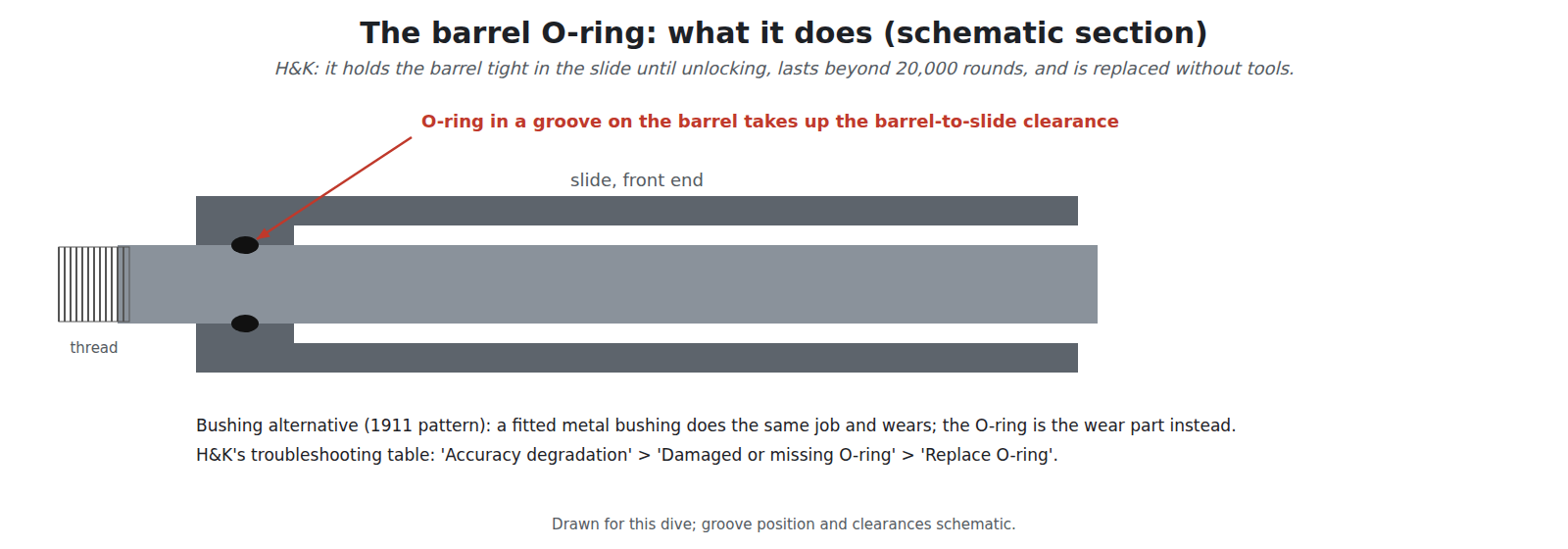
The genuine part is listed by a dealer at H&K’s part number (above), and H&K’s manual gives no dimensions for it. An owner who wants spares on hand should buy H&K’s part rather than match a generic ring by eye. PEW Science’s advice for the Knight’s suppressor’s piston O-ring, to use Viton or a similar heat-resistant compound, is a reminder that the barrel’s ring also lives next to hot gas; H&K does not state its ring’s material.11
8.9 Sights
The Mk 23’s sights are in dovetails. “Both front and rear sights are held in place on the slide within a standard dovetail groove. The rear sight is also secured with a retaining screw.” The manual covers windage (drift the rear sight; left moves the point of impact left) and elevation (exchange the rear sight for one of six heights in 0.4 mm steps, each 2 inches at 25 metres; Volume 6).8 The 3-dot sights could be had with “white circles (or cylindrical tritium capsules)”.8
What an owner with a mill can do:
- Make an intermediate-height rear sight. H&K’s heights are 5.5 to 7.5 mm in 0.4 mm steps. A rear sight 0.2 mm taller than the one fitted moves the point of impact about 1 inch up at 25 metres, by the same arithmetic (0.2 mm over the 197 mm sight radius, projected 25,000 mm). The dovetail’s dimensions are not published by H&K and must be measured from the slide and an H&K sight; the “standard dovetail” phrase in the manual does not say which standard.
- Fit tritium. The manual’s optional tritium sights are H&K parts not found on sale. Fitting tritium vials into a machined sight is specialist work involving a radioactive source and is not covered here beyond noting that the original option existed.
- Make a taller sight for a larger suppressor. The Mk 23 was designed to sight over a 1.37-inch can (Volume 7). A modern can of larger diameter may block the standard sights, and taller sights are the usual answer on other pistols. For the Mk 23, they would have to be made, and the zero re-established with the elevation arithmetic above.
8.10 The threaded barrel and thread caps
Every Mark 23 barrel is threaded at the factory, M16×1 right-hand by the published accounts and the dealer’s title for H&K’s own thread cap (Volume 7).3119 H&K sells the cap (970174) at $19 in its 2024 listing.1
The thread is a simple lathe job for a shop owner, and caps and thread protectors are the obvious things to make: M16×1 right-hand, with a face that seats squarely on the barrel’s shoulder without touching the O-ring behind it. Two points matter.
- Concentricity. A cap does not care, but anything a bullet passes through does. A muzzle device or a thread adapter made at home must be concentric with the bore, which means indicating the bore, not the thread, when setting it up, and checking with a bore rod and alignment rod before firing.
- Mass and the buffered action. Anything screwed onto the barrel adds mass that the barrel has to tilt, and the Mk 23’s barrel is caught by a buffered guide rod rather than a hard stop (Volume 3). A suppressor needs a booster for this reason (Volume 7). A heavy muzzle device without one can cause the short-recoil symptom H&K’s troubleshooting table lists under “slide does not unlock”.
Re-threading the barrel to another thread, or cutting it, turns a $19 cap problem into a barrel replacement. A new barrel (215671) is listed as a part.9
8.11 The accessory grooves
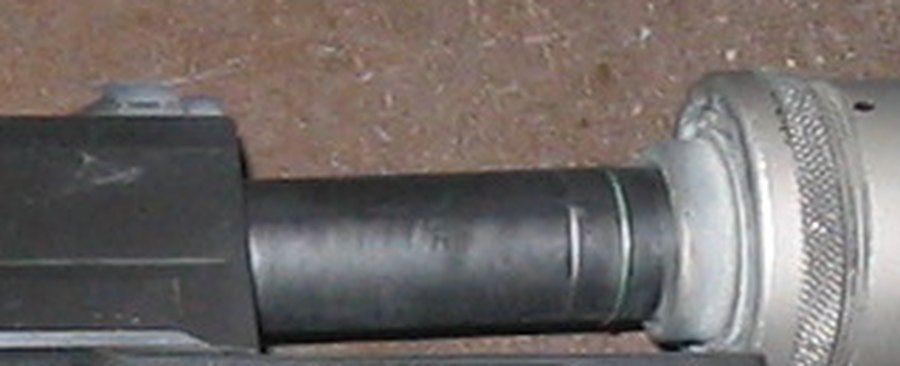
The Mark 23’s frame has its own accessory interface: a pair of grooves forward of the trigger guard and a threaded insert in the trigger guard’s front face. H&K says USP accessories do not fit it and that “improperly designed or installed accessories may result in damage to the Mark 23 mounting grooves and/or the Mark 23. Such damage is not covered under warranty.”8 No current maker’s adapter or light for it was found (Volume 7).
This is the place where an owner with a 3D printer and a CNC mill can genuinely add something, carefully:
- Measure the interface. H&K publishes neither the groove profile nor the insert’s thread. Both have to be measured from the pistol: the groove section with gauge pins or a profile taken from a cast, and the insert’s thread with thread gauges. The insert is moulded into polymer, so any screw into it should be finger-tight in the way the original module’s knurled screw is.
- Prototype in plastic. A printed adapter can prove the fit of the grooves and the insert before any metal is cut.
- Make the working part in aluminium on the mill, with a short 1913 rail section for a modern light. The weight and lever arm of the light are what the grooves will carry; H&K’s warning about damage applies to the adapter as much as to a bought accessory.
The original aiming modules turn up on the used market. They contain lasers, often including an infrared laser; laser classes and the federal rules on laser products were not researched for this dive, and an infrared laser that cannot be seen is a real eye hazard to anyone downrange.
8.12 Holsters from the shop
H&K’s four holster requirements are in Volume 7: no contact with the controls, especially the ambidextrous safety and the trigger; no unlocking of the slide on reholstering; room for accessories; and a holster made for the Mark 23.8 With no current maker’s page confirming a Mark 23 fit, a thermoformed holster made in the shop is a realistic option. The pistol itself, cleared, is the usual mould; a printed or machined dummy of it (from measurements of the pistol, not from H&K’s drawings, which are copyright) keeps the real pistol out of the press. The safety levers are what to relieve: a holster mouth that rides on them can push the safety off on the draw, which is the specific risk H&K’s manual warns of.
8.13 Refinishing and marking
The slide and barrel. The metal finish H&K applied is a corrosion-resistant surface treatment, maritime on early pistols and the USP finish later (Volume 2). The serial and proof marks are etched through it to the steel.8 Any refinish (Cerakote over the existing finish is the obvious one; the black-slide variant in retailers’ listings is described as Cerakote) must leave the markings legible; masking them, or filling them, is the line not to cross (above). Refinishing also changes clearances on the slide rails and the barrel’s locking block, which are medium-lubricated wear surfaces in H&K’s chart; they are the surfaces to mask.
The frame. It is polymer, with the red and white dots that H&K warns ultrasonic cleaning removes.8 A CO2 laser marks polymer by charring or foaming it, and a glass-filled polymer reacts differently from an unfilled one: anything done with a laser on a frame should be tried first on a scrap of similar material, and nowhere near the frame’s own markings. Stippling, the other common frame modification, removes material from a part that cannot be replaced except as a whole frame (215976, not found on sale).
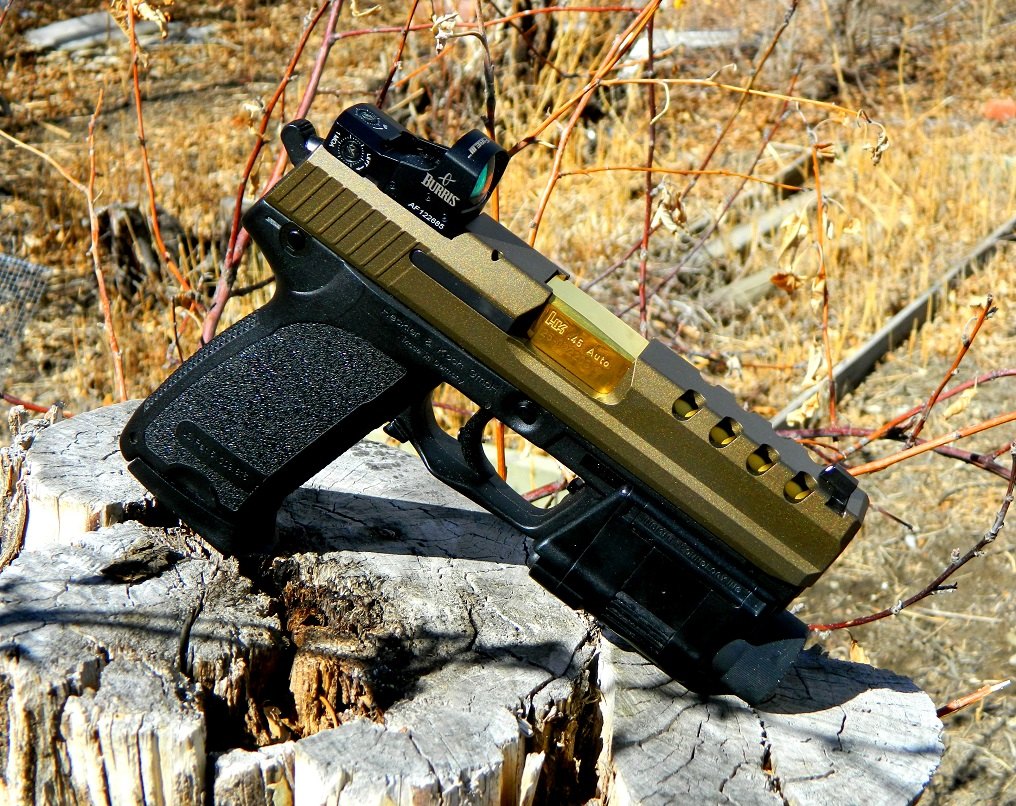
A CO2 laser does not mark bare steel without a marking compound, and is not the tool for anything on the slide’s markings in any case.
8.14 The law
This dive does not restate law that the hub’s other dives already set out.
Federal. The Mark 23 is an ordinary semi-automatic pistol under federal law. A licensed dealer may not sell a handgun to anyone under 21 (18 U.S.C. § 922(b)(1)). The 1994 federal ban, which shaped the pistol’s 10-round magazine, lapsed in 2004 (Volume 2).12 A suppressor is a National Firearms Act item; the federal law, including the $0 transfer tax on suppressors from 1 January 2026, is in the Suppressor Law dive, Volume 3.
Michigan. Buying a pistol in Michigan, including the licence-to-purchase or concealed-pistol-licence route and the state’s pistol records (MCL 28.422 and 28.422a), is set out in the Remington XP-100 dive, Volume 5, section 5.8. The Michigan position on suppressors is in the Suppressor Law dive, Volume 7. The state’s marks-of-identity law (MCL 750.230) is quoted in the Steyr AUG dive, Volume 6.
+P ammunition is ordinary commercial ammunition, and the Mark 23 is rated for it (Volume 6). Handloading for it is against H&K’s instruction, not against any law.
8.15 What a buyer should take away
- The pistol on the market is the commercial Mark 23, at about $2,300 new from a retailer and $1,700 to $1,900 in the only completed sales found (all dated 2026).
- Run H&K’s own function check, look at the O-ring, the buffer roll pin and the hammer spur, and read the slide.
- Genuine parts, including the barrel, springs and O-ring, are sold by at least one large dealer under H&K’s numbers; no aftermarket springs, sights or barrels were found.
- The muzzle is right-hand threaded, which matters for every cap, can and booster.
- The accessory grooves are the Mark 23’s own, and the one place where a shop can make what the market does not offer.
- Detail work beyond H&K’s field strip has no published procedure (Volume 5); work to the function check, and keep H&K’s service in reserve.
References
Footnotes
-
Heckler & Koch USA, “MARK 23” product page, Wayback capture of 28 December 2024, https://web.archive.org/web/20241228154506/https://hk-usa.com/hk-models/mark-23/, consulted 2026-10-18. ↩ ↩2 ↩3 ↩4 ↩5
-
Blackstone Shooting Sports, listing for Heckler & Koch 81001074 Mark 23, black Cerakote slide, OD green polymer frame, UPC 642230269972, consulted 2026-10-18 (retailer listing). ↩ ↩2
-
Pete, “Silencer Saturday #178: H&K and KAC MK23 – The Most Famous Suppressor Combo?”, The Firearm Blog, 29 May 2021, https://www.thefirearmblog.com/blog/2021/05/29/hk-kac-mk23, consulted 2026-10-18. ↩ ↩2 ↩3 ↩4
-
Todd Woodard, “Heckler & Koch Mark 23 45 ACP M723001-A5”, Gun Tests, 30 July 2026, https://www.gun-tests.com/handguns/pistols45/heckler-koch-mark-23-45-acp-m723001-a5-45-acp/, consulted 2026-10-18. ↩ ↩2
-
Guy J. Sagi, “Heckler & Koch Mark 23: A Special Operator’s .45”, American Rifleman, 30 April 2022, https://americanrifleman.org/content/heckler-koch-mark-23-a-special-operator-s-45, consulted 2026-10-18. ↩
-
KYGUNCO, “Heckler and Koch HK USA 81000078 Mark 23 45 ACP DA/SA 12rd”, https://www.kygunco.com/product/heckler-and-koch-hk-usa-81000078-mark-23-45-acp-da-sa-12rd, consulted 2026-10-18. ↩
-
Austin R., “Silencer Saturday #296” (B&T MK23 suppressor), The Firearm Blog, 16 September 2023, https://www.thefirearmblog.com/blog/2023/09/16/bt-mk23-suppressor/, consulted 2026-10-18. ↩
-
Heckler & Koch, Inc., Mark 23 Pistol .45 ACP operator’s manual (“Revised March 2007”; PDF dated 22 August 2008), Sections 1, 2, 4, 6, 8 to 11, parts list p. 34. Wayback capture of 11 August 2011, https://web.archive.org/web/20110811030250/http://www.hk-usa.com/-images/shared/Mark%2023_Ops_Manual_2008.pdf, consulted 2026-10-18. ↩ ↩2 ↩3 ↩4 ↩5 ↩6 ↩7 ↩8 ↩9 ↩10 ↩11 ↩12 ↩13 ↩14 ↩15 ↩16
-
Midwest Gun Works, Heckler & Koch Mark 23 part listings by H&K part number (215671, 986429, 215724, 215729, 215726, 986433, 215707, 215705, 215772, 215744, 970174), https://www.midwestgunworks.com/page/mgwi/prod/215671 and adjacent part numbers, page titles read 2026-10-18. ↩ ↩2 ↩3
-
Heckler & Koch, Inc., “MARK 23” page, Wayback capture of 16 October 2004, http://web.archive.org/web/20041016095828/http://www.hecklerkoch-usa.com:80/handguns/mk23.html, consulted 2026-10-18. ↩
-
Jay (PEW Science), “SSS.6.214 – Suppressed .45 ACP Historical Case Study: HK MK23 and USP45 Silencers – KAC vs. B&T” (free version), PEW Science, 18 February 2026, https://pewscience.com/sound-signature-reviews-free/sss-6-214-kac-b-t-mk23-usp45, consulted 2026-10-18. ↩ ↩2
-
18 U.S.C. § 922(b)(1) (handgun sales by licensees to persons under 21), https://www.law.cornell.edu/uscode/text/18/922, consulted 2026-10-18; and the former 18 U.S.C. § 921(a)(30)-(31) (2000 edition), https://www.govinfo.gov/content/pkg/USCODE-2000-title18/html/USCODE-2000-title18-partI-chap44-sec921.htm, consulted 2026-10-18. ↩
Comments (0)