H&K Mk 23 · Volume 1
SOCOM's Offensive Handgun: The OHWS Programme, 1989 to 1996
Why a new special operations command wanted a pistol to attack with, what it asked for, how Colt and Heckler & Koch competed for it at Crane, and how much of the story the public record actually supports
1.1 What this volume can and cannot establish
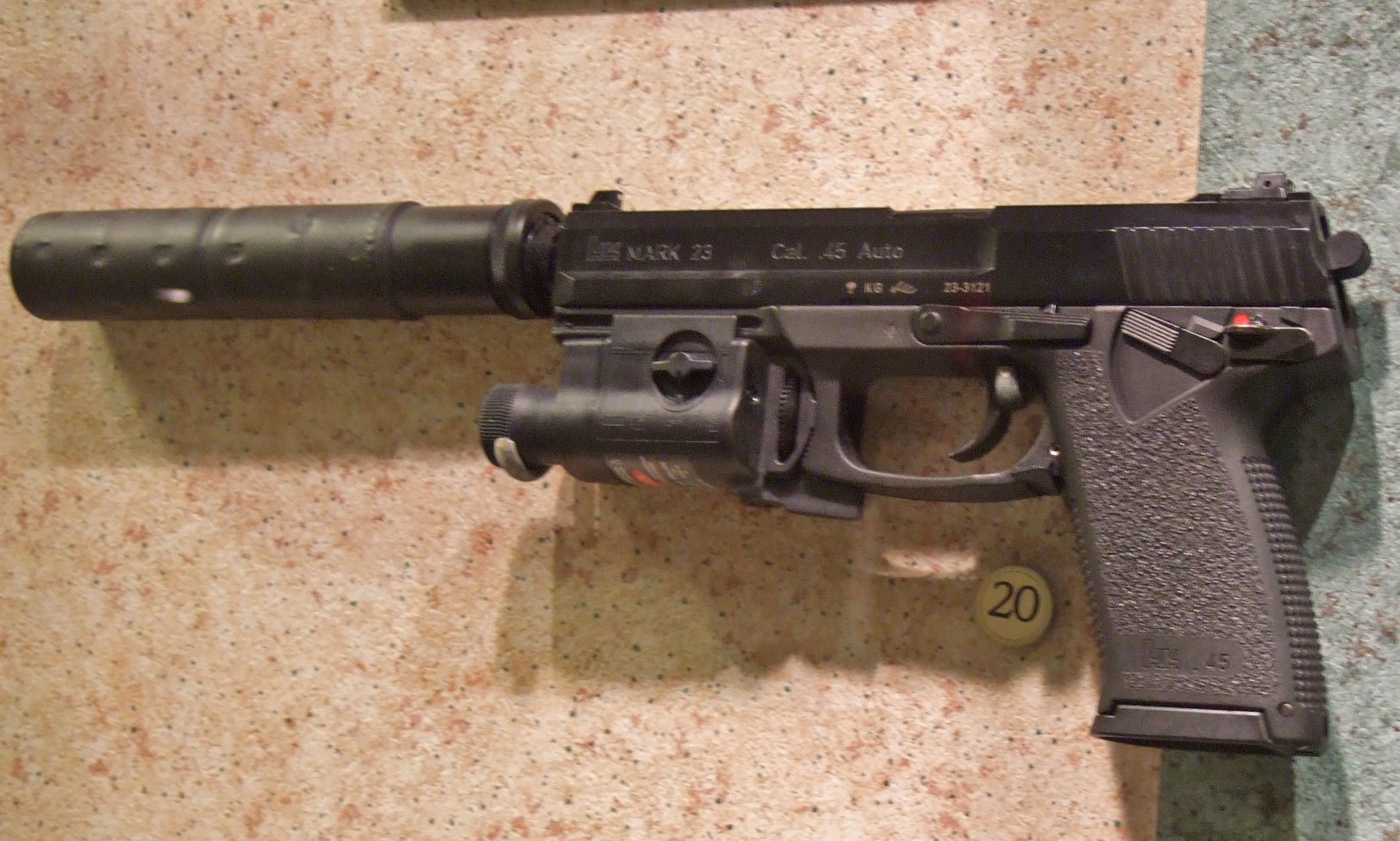
The Heckler & Koch Mk 23 has one of the most repeated origin stories of any modern pistol, and one of the thinnest public paper trails behind it. Almost every account online traces back to three sources: Heckler & Koch’s own marketing text, first written in the 1990s and still on its product page in 2024; two articles by Christopher R. Bartocci in Small Arms Review (2006) and Small Arms Defense Journal (republished online in 2023); and an unsourced GlobalSecurity.org page last revised in 2005.12345
The programme was run by the US Navy for United States Special Operations Command (USSOCOM), and its records would be expected in the Defense Technical Information Center, in SOCOM’s own published histories and posture statements, and in Navy contracting files. For this volume, DTIC’s servers returned a maintenance page to every request on 18 October 2026; the Internet Archive’s mirror of DTIC reports was searched for “offensive handgun”, “OHWS” and “Mk23” and returned nothing relevant; and no SOCOM or Congressional document describing the programme in detail was found. One primary scrap did survive in the secondary literature: the contract number of the Colt entry’s suppressor, which carries the office code of the Naval Surface Warfare Center at Crane, Indiana (see below).36
So this volume does three things. It sets out what the manufacturer says, attributed to the manufacturer. It sets out what the trade-press historians say, attributed to them. And where the sources disagree, which they do on the requirement, the dates and the quantities, it tables the disagreement rather than choosing. A reader who needs the answer to “how many Mk 23 pistols did SOCOM buy?” should know at the outset that no primary source located for this dive answers it.
1.2 A new command and too many guns
USSOCOM was created in the mid-1980s to bring the special operations units of the Army, Navy and Air Force under one unified command. Bartocci gives its formation as 1986, the year of the legislation that created it.4 Its forces arrived with the weapons their parent services had issued or bought, and the handgun picture in particular was mixed. The Army had adopted the Beretta-designed M9 in January 1985 as the replacement for the M1911A1. The Navy, Bartocci writes, bought 1,500 SIG P226 pistols in 1987 for its special warfare units.4 The later replacement of the M9 by the SIG P320 family, and the trial that chose it, are told in this hub’s SIG P320 / M17 dive, Volume 1.
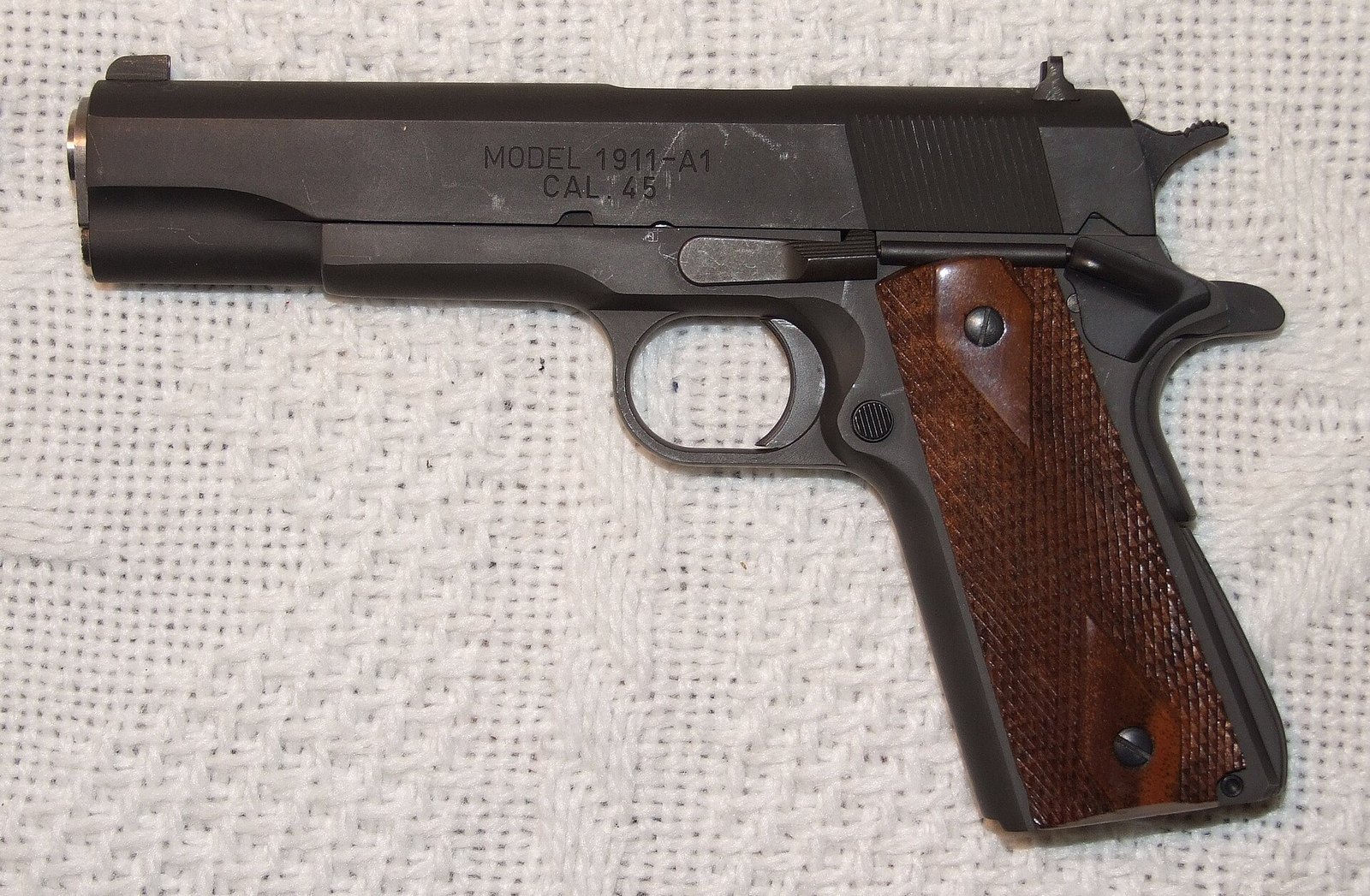
The new command looked at what its units were carrying. Bartocci reports a 1989 study by a Major Gus Taylor that counted 120 different small-arms types in use across SOCOM’s units; the American Rifleman, writing in 2022, gives “more than 100 different close-quarters small arms configurations”.47 The two counts are of different things (types against configurations) and neither cites the study itself, which was not found. What both describe is the same problem: a command whose armourers had to support too many different weapons, and whose operators had no common pistol.
1.3 The idea of an offensive handgun
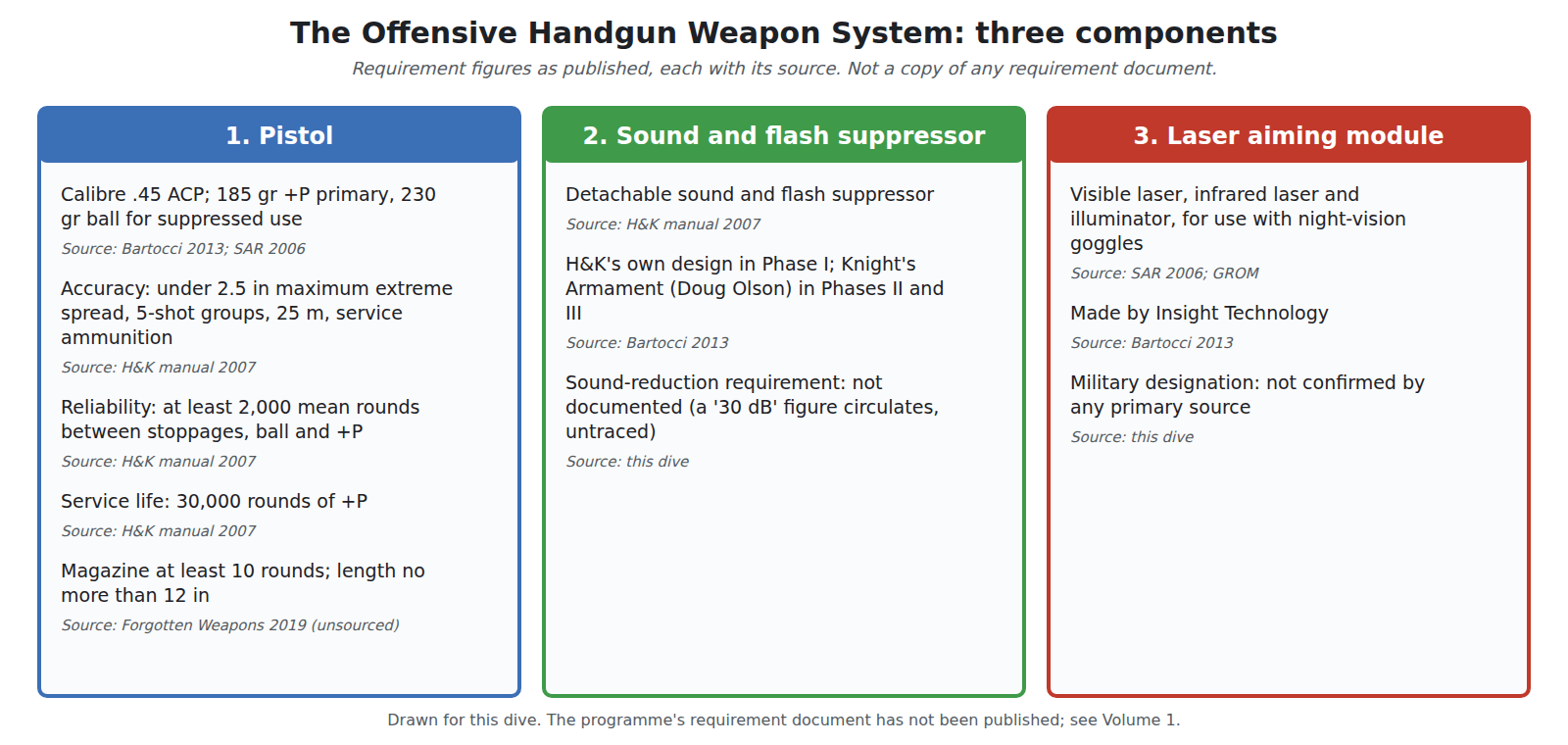
What made the programme unusual was not the wish to standardise, which every service has, but the role it gave the pistol. A military handgun is ordinarily a defensive arm: the weapon an officer, a pilot or a crew member carries because a rifle is impractical, and which is drawn when something has already gone wrong. The Offensive Handgun Weapon System (OHWS) was to be a primary weapon for close-quarters battle and for the quiet removal of a sentry, carried as part of a system with a suppressor and an aiming module.43
Bartocci’s phrase for it, and the title of his 2013 article, is “the crew-served pistol”, a joke about its size that became its nickname. Small Arms Review’s 2006 account of the Colt entry states the purpose plainly: a system of handgun, silencer and laser aiming module, with sentry incapacitation enabled by the silencer.3
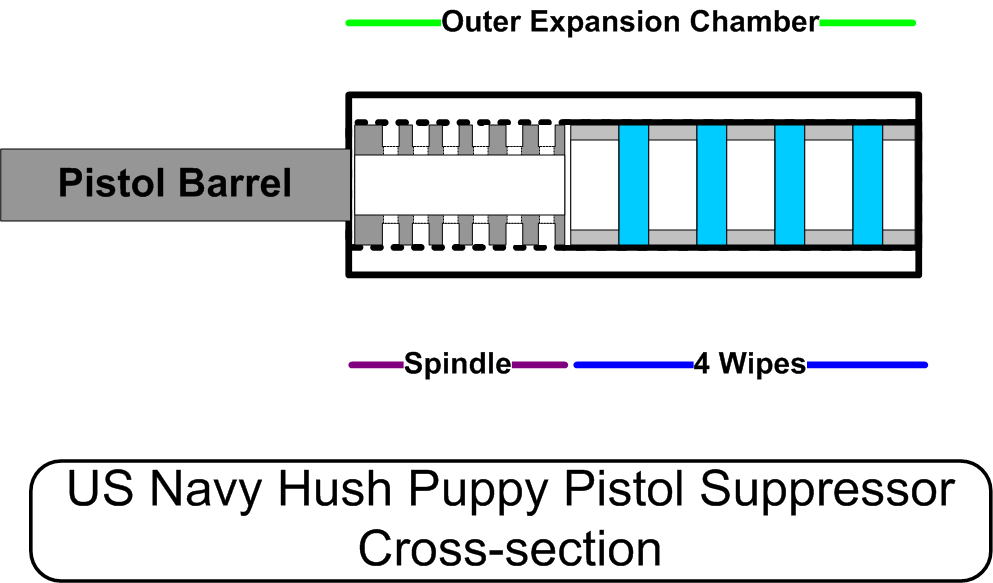
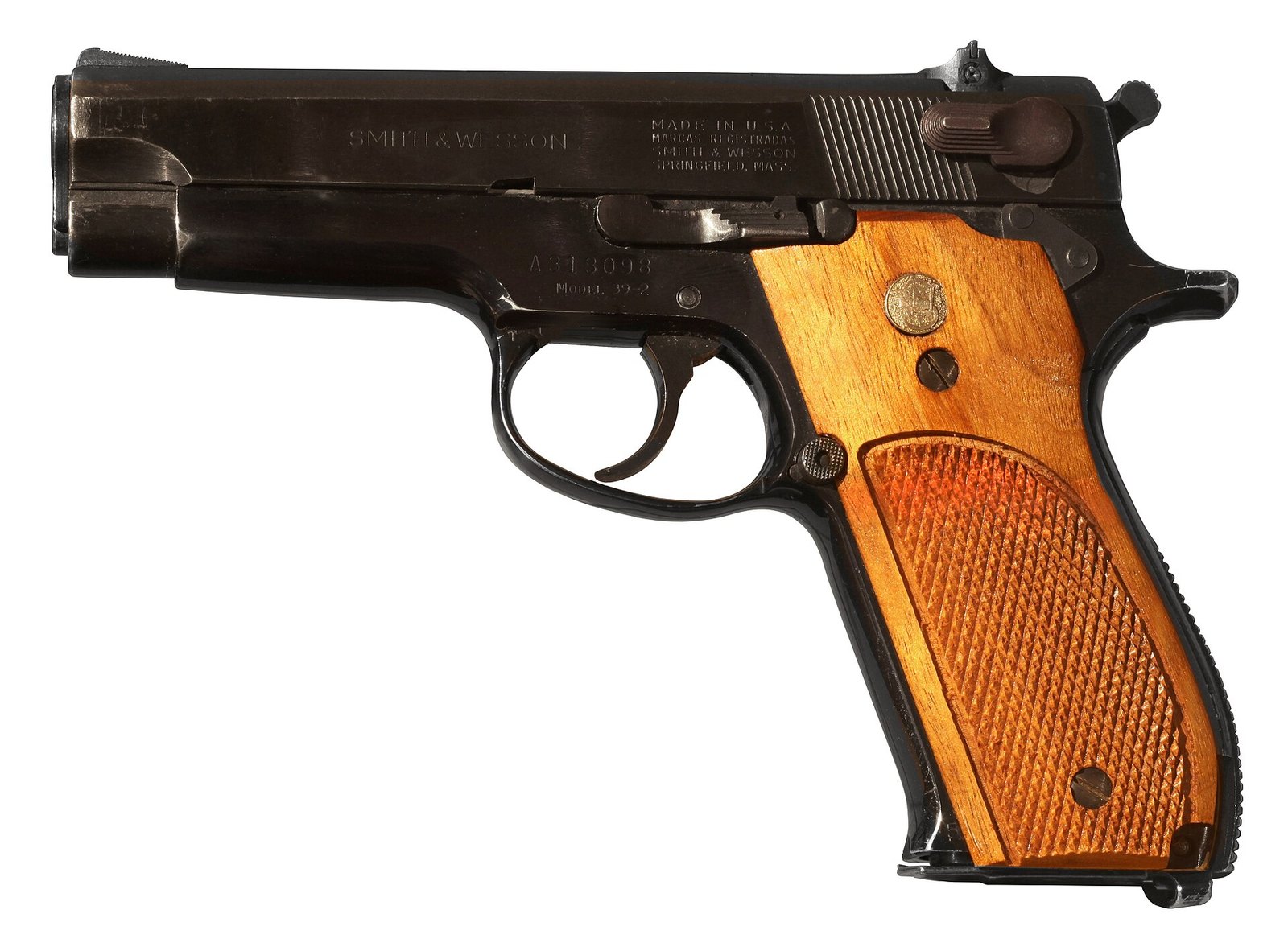
The Navy had fielded a purpose-built suppressed pistol before. The Smith & Wesson Mk 22 Mod 0, the “Hush Puppy”, was a modified Model 39 with a suppressor, used by Navy special warfare units in Vietnam. Its lineage matters here only as precedent: a Navy-designated, suppressed, special-purpose pistol, given a Navy “Mark” number. The OHWS added two things the Hush Puppy did not have: a heavy cartridge loaded above standard pressure, and an aiming module with visible and infrared lasers and lights for use with night-vision goggles.
1.4 Crane takes the job
The programme was managed by the Navy at Crane, Indiana. Bartocci names the Navy’s expeditionary warfare small-arms department there as the lead agency, says it began soliciting industry in December 1989, and names its programme manager as Chuck Zeller.4
None of that could be checked against a Navy document. One detail elsewhere does corroborate Crane as the buying office. Small Arms Review’s account of the Colt entry gives the suppressor development contract as N00164-91-C0215.3 In federal contracting records, the office code N00164 belongs to the Naval Surface Warfare Center, Crane Division: current contract records list the awarding office as “N00164 NSWC CRANE”, and Crane’s present-day contracts carry numbers of the form N00164-25-D-1016.6 Read by the standard Navy pattern, N00164-91-C0215 is a definitive (C-type) contract placed by Crane in fiscal 1991. That is an inference from the format, not a document, but it is consistent with every secondary account.
1.5 The requirement, as far as it has been published
No copy of the OHWS requirement document, or of the request for quotation that Bartocci says shaped the H&K design, was found.8 What can be assembled are the figures that various sources say were in it. They agree on the shape and disagree on several of the numbers.
Table 1 — The requirement, as far as it has been published
| Requirement | Figure | Who says so |
|---|---|---|
| System | Pistol, detachable sound and flash suppressor, laser aiming module | H&K manual (1991 development contract “consisting of” these three) |
| Calibre | .45 ACP; a 185-grain +P load as the primary round, ball for suppressed and maritime use | Bartocci 2013 and 2006 |
| Accuracy | ”less than a 2.5-inch maximum extreme spread in 5-round shot groups at 25 meters with service ammunition” | H&K operator’s manual, 2007 (quoted) |
| Accuracy (variant) | “2.5 MOA at 25 yards” | Bartocci 2013 |
| Accuracy (variant) | “2.5 inches at 25 yards” | Sandboxx News, 2025 |
| Reliability | ”a minimum of 2,000 mean rounds between stoppages (MRBS) with both M1911 ball and +P ammunition” | H&K manual (quoted) |
| Service life | 30,000 rounds of +P (H&K: “the specified service life of the pistol”) | H&K manual |
| Service life (framing) | About three times the life of any pistol Colt had produced | Small Arms Review 2006, on the Colt team’s view |
| Environment | Function tested hot and cold, immersed in salt water, surf, salt fog, sand and dust, mud, unlubricated | H&K manual |
| Length | No more than 12 inches | Forgotten Weapons, 2019 (unsourced) |
| Magazine | At least 10 rounds | Forgotten Weapons, 2019 (unsourced) |
| Aiming module | Visible and infrared aiming lasers and illumination | Forgotten Weapons; Small Arms Review 2006 |
Sources: H&K, Bartocci, Small Arms Review, Forgotten Weapons, Sandboxx.143910
Three things in the table need comment.
The accuracy figure is not one number. H&K’s manual, the nearest thing to a primary statement, gives a 2.5-inch maximum extreme spread for five shots at 25 metres. Bartocci’s 2013 article gives “2.5 MOA at 25 yards”; a 2025 article gives 2.5 inches at 25 yards. At 25 m, 2.5 inches is about 8.7 minutes of angle; 2.5 MOA at 25 yards is about 0.65 inches. Those are not variants of one requirement but statements an order of magnitude apart, and the MOA version is almost certainly a slip. This dive uses H&K’s wording, because H&K is the only source that quotes the requirement as a sentence. Volume 6 takes the accuracy claims apart in detail.
The environmental range is misprinted at its source. H&K’s 2007 manual says the pistol was function tested “at +140 and -250 F”. Minus 250 °F is within about 50 degrees of the boiling point of liquid oxygen (about −297 °F), far below anything a service weapon is function tested at. Bartocci gives the range as −25 °F to 140 °F.8 The manual’s figure is evidently a typesetting error for −25 °F; it is reported here as printed and not repeated as a fact.
The suppressor’s performance requirement is not documented. Secondary accounts give a sound-reduction target of about 30 dB; none quotes a document, and the search summaries that carry the claim could not be traced to an original. It is left out of the table. What the suppressors actually achieved, by various accounts, is in Volume 7.
1.6 Why .45, why +P, and why not the 1911
Bartocci reports that 9×19 mm and 10 mm were considered and rejected, and that the programme chose .45 ACP for its stopping power, with a 185-grain +P load as the primary round.4 Small Arms Review adds that standard ball was retained for suppressed and maritime use, and that subsonic ammunition was needed for the suppressor.3 A standard 230-grain .45 ACP bullet is already subsonic from a pistol barrel, which is why the cartridge needed no special load for suppressed fire; that argument is made in full in this hub’s Suppressors by Caliber, Volume 7.
The +P requirement is the hinge of the whole design. SAAMI sets the maximum average pressure of standard .45 Automatic at 21,000 psi and of .45 Automatic +P at 23,000 psi, an increase of a little under 10 percent (Volume 6 has the figures and their source).11 That does not sound like much, but the requirement was for a 30,000-round service life on +P, with no parts breakage. Bartocci reports that the M1911 design was rejected because its frame could not take sustained +P and because it was not suited to suppressed semi-automatic fire; English Wikipedia says the Colt entry, though built on a 1911 frame, was not designed for +P either.412 Whether the 1911’s frame “could not” take +P is Bartocci’s characterisation, not a published test result; what is documented is that the winning pistol was designed, from the frame inwards, around a buffered recoil system (Volume 3).
1.7 Two contractors: Colt and H&K, August 1991
In August 1991 development contracts went to two firms: Colt’s Manufacturing Company and Heckler & Koch. H&K’s own manual says the project “originated in 1991 when HKI was awarded a development contract for the Special Operations Forces Offensive Handgun Weapon System”; the German trade magazine VISIER dates the American subsidiary’s contract to the end of August 1991.113 GlobalSecurity’s page, by contrast, says “In August, 1991 a request was made … for an ‘offensive’ handgun”, placing the request rather than the contracts in that month.5 Bartocci’s account, in which Crane solicited from December 1989 and awarded in August 1991, fits the other two sources better.
Each contractor was to deliver 30 prototype pistols, with suppressors and laser aiming modules, for the first phase of testing.4 English Wikipedia’s article on the Colt entry, citing Jane’s Infantry Weapons 1994–95, says the prototypes were delivered to Crane in August 1992 and that testing ran to the spring of 1993; Jane’s was not seen for this dive, and those dates are reported as secondary.12
1.8 The Colt entry and why it went out in Phase I
Small Arms Review’s 2006 account of the Colt OHWS is the fullest description in print and the only one that names the Colt team: programme manager Mike Marciano, director of product development Mike Gamache, senior product engineer Bill Shine, senior design engineer Paul Hochstrate and designer Scott Ladd, with SOCOM’s Troy Smith making quarterly visits.3 Colt had a one-year development contract and, by that account, took about three months to build the first prototype.
The pistol was a hybrid. It was built on a 1911-type frame but locked with the rotating barrel Eugene Stoner had designed for Colt’s All American 2000, here with five locking lugs. The slide and frame were stainless steel with a matte black finish. It had a Series 80-type firing-pin block, a 1911-style ambidextrous thumb safety, a double-action trigger with a SIG-type decocker and a Commander-type hammer, a single-column 10-round magazine modified from a commercial one, an oversized trigger guard and magazine release, a lanyard ring, black plastic grips and a fixed Trijicon tritium sight. Instead of a threaded barrel, it carried a detachable muzzle-brake and silencer mount attached to the frame, with a rail and toggle switches for the aiming module. A mechanical slide lock, to stop the slide cycling and so keep a suppressed shot quiet, was fitted.3
Colt’s own position, as Small Arms Review reports it, was that the pistol went through more than 20,000 rounds of ball and +P in its endurance testing with no reliability problems and with accuracy better than required, and that its materials and coatings passed corrosion and salt-spray testing.3 It was nonetheless eliminated at the end of Phase I. The same article gives the reasons:
- The barrel cracked. An undercut ahead of the locking lugs had been cut too deep, leaving a sharp corner where a fillet radius should have been. During SOCOM’s endurance testing the barrel cracked there and eventually broke in two, although the halves stayed aligned well enough that the pistol kept firing.
- Height. The single-column magazine, to hold the required rounds, made the pistol too tall.
- Weight. The pistol was judged too heavy.
- The laser aiming module gave problems.
- Colt’s finances. The company’s financial condition, and the risk that it might go bankrupt during procurement, counted against it.
- Time. Colt had a year to design a new handgun; H&K’s USP was already well advanced.
English Wikipedia’s article on the Colt entry gives a shorter list (too bulky, less durable than expected, accessories too finicky) and adds that a 10 mm version was tried and abandoned; that article’s sources are secondary and the 10 mm detail was not traced.12 A photograph of the Colt pistol that could be published was not found. The only Commons file under that name is a contributor’s digital drawing, not a photograph, and is not reproduced (the rejection is recorded in the credits file).
1.9 The H&K entry: a pistol grown alongside the USP
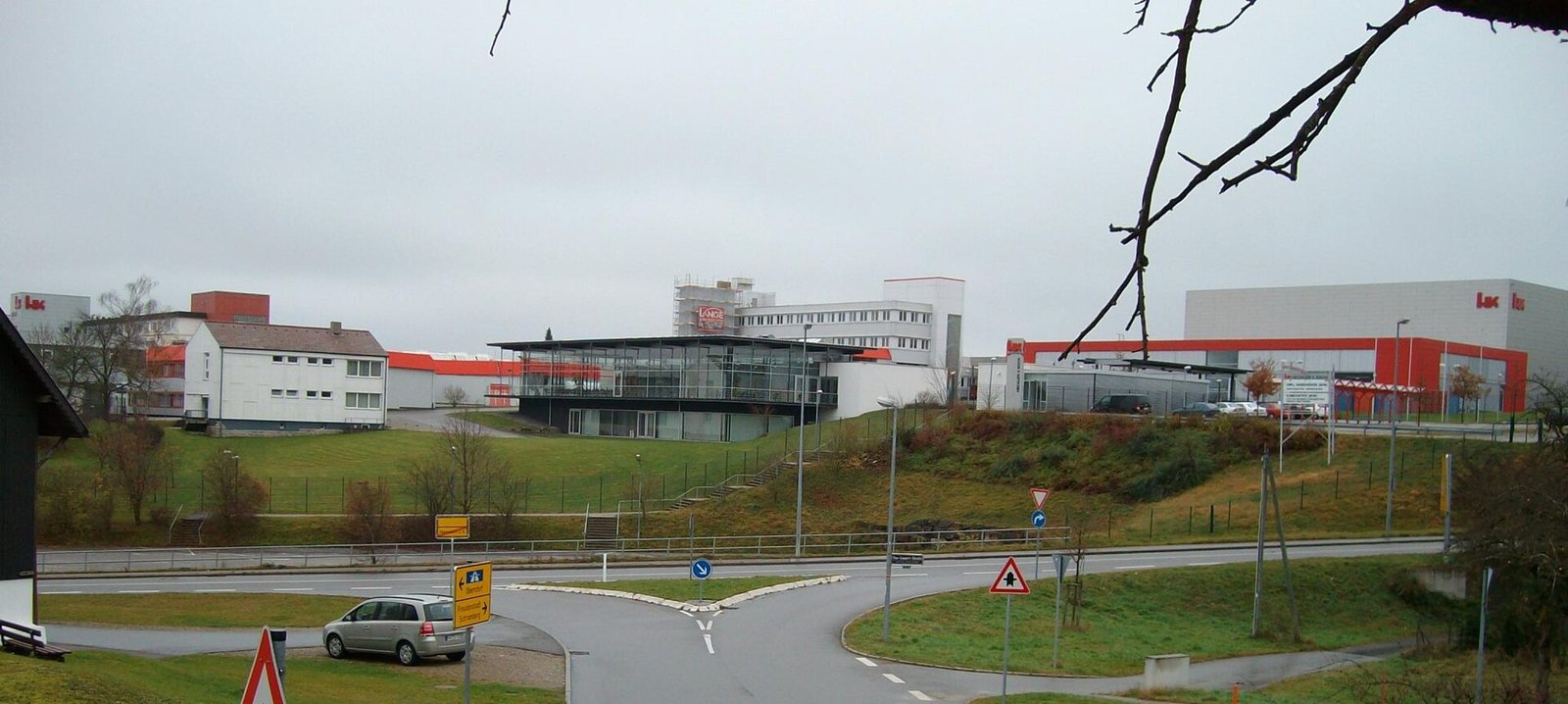
H&K came to the competition with a pistol already in development. VISIER’s 2013 history of the USP says the Oberndorf team was working in 1989 on what it called a “close-range gun for security tasks”, the project that became the Universal Self-loading Pistol; the first USP, in .40 S&W, was shown at the SHOT Show in 1993, with 9 mm following shortly after.13 The same article says the SOCOM pistol was developed alongside the USP and that both used what H&K calls a buffered Browning lock. Poland’s GROM, writing on its own equipment page, put it more simply: the Mk 23 “was created by developing the H&K USP pistol”.14
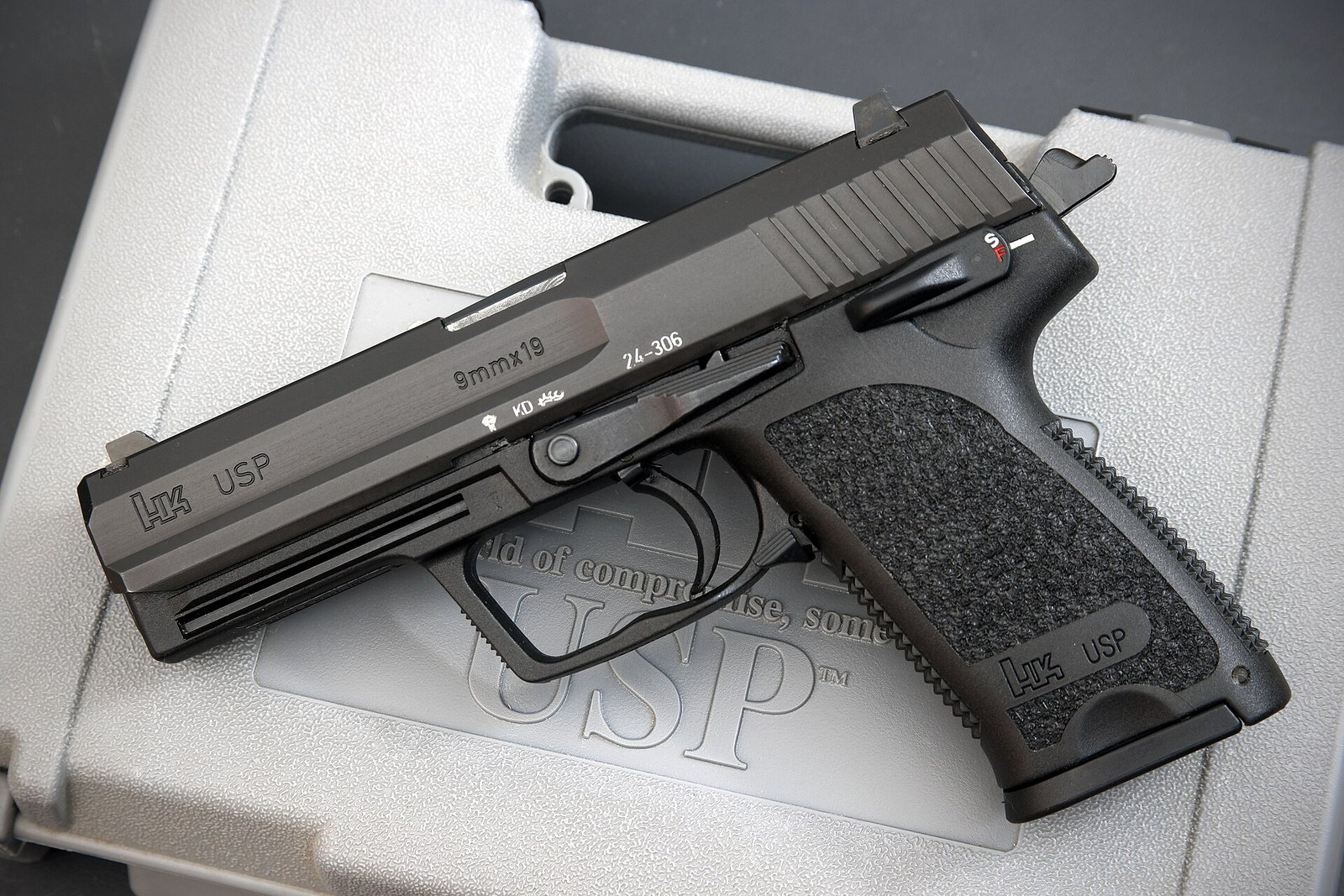
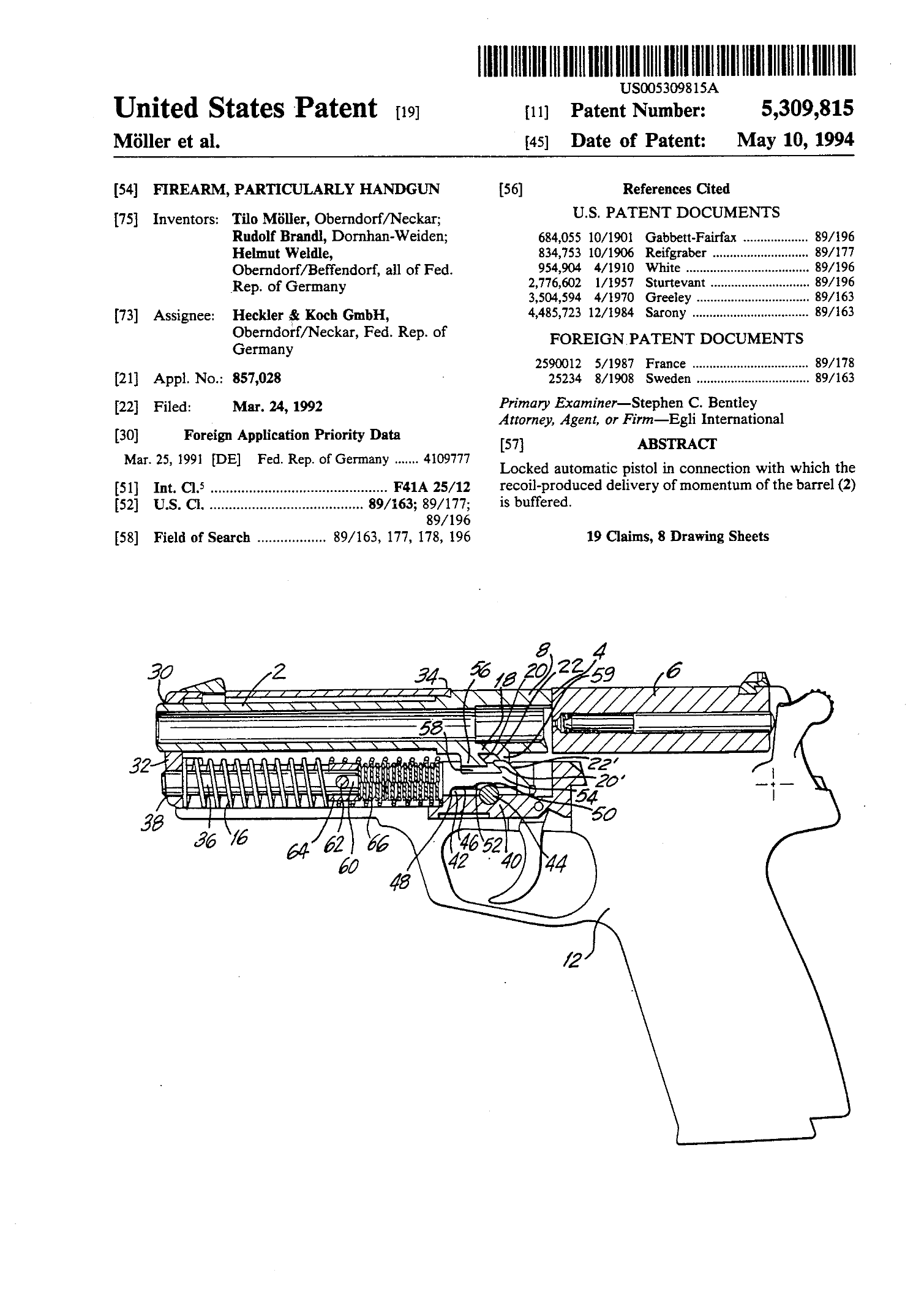
The most concrete evidence of H&K’s head start is a patent. US Patent 5,309,815, “Firearm, particularly handgun”, by Tilo Möller, Rudolf Brandl and Helmut Weldle for Heckler und Koch GmbH, claims a German priority date of 25 March 1991, five months before the OHWS development contracts. It describes a locked, tilting-barrel pistol in which the recoil spring’s guide rod is itself movable against a second, inner buffer spring, so that the barrel’s “unlocking blow” and the slide’s arrival at the end of its travel are both taken up softly.15 The patent does not mention SOCOM or any product, and H&K has never said in print which patent its “patented recoil reduction system” refers to. But the parts list in H&K’s Mark 23 manual, with its guide rod, buffer spring, buffer-spring retainer and the roll pin that holds it, describes exactly the arrangement the patent draws. Volume 3 sets the two side by side.
H&K’s American subsidiary, Heckler & Koch Inc., held the development contract.113 Manufacture, then and later, was in Oberndorf am Neckar; Bartocci states that all the military pistols were made in Germany.8
1.10 Phase II: endurance, accuracy and a change of suppressor
With Colt out, H&K continued alone. In Phase II, by Bartocci’s account, the H&K design underwent durability, reliability and accuracy testing, and H&K delivered another 30 pistols with suppressors; work on the laser aiming module was put on hold.4
Three Phase II changes to the pistol are reported: the mechanical slide lock (the feature Colt’s entry had, to keep the slide shut on a suppressed shot) was dropped; the frame and backstrap were checkered; and the magazine well was bevelled. Later still, in Bartocci’s words, “the front gripping grooves were also removed” (he does not say whether he means the slide’s or the frame’s), and the slide was marked “MK23 USSOCOM Cal. .45”.4 None of these changes is documented by H&K, and no photograph of a Phase I or Phase II H&K prototype that could be published was found.
The suppressor changed hands. H&K’s Phase I suppressor was its own; for Phases II and III the suppressor was by Knight’s Armament Company, designed by Doug Olson.83 Small Arms Review puts it the other way round, from Colt’s side: Knight’s had designed the Colt entry’s suppressor too, and H&K “first tried to design its own silencer, then went with Knight’s design”.3 The Knight’s suppressor, and the uncertainty over what it achieved, are in Volume 7.
The results H&K publishes for the testing are striking, and they are H&K’s: an average of 1.44 inches over more than 450 accuracy firings from a fixture, with 65 groups under one inch; reliability far above the 2,000-round requirement; and three pistols that still met the new-pistol accuracy standard after 30,000 rounds. H&K’s own documents do not agree on the reliability figure: the 2007 manual gives the minimum mean rounds between stoppages achieved as 6,027 and the maximum as 15,122, while H&K’s product page, in 2014 and still in 2024, says “All pistols exceeded the 2000 MRBS with an average of 6000 MRBS”.1162 A minimum of 6,027 and an average of 6,000 cannot both be true. Volume 6 deals with these figures.
1.11 Phase III: the production contract
The production award came in June 1995. Small Arms Review gives the date as 28 June 1995, on which “the Heckler & Koch OHWS would be adopted by SOCOM as their Mk23 Mod0”; Bartocci’s 2013 article gives 28 June on its first page and 8 June on its second.348 The contract, by Bartocci’s account, was for 1,950 systems at $1,186 each.4
How many pistols that meant is a separate question. GlobalSecurity’s 2005 page says that “Production requirements call for 7,500 pistols, 1,950 of which would include the laser aiming module and sound and flash suppressor”, and that “Under a January 1994 contract, the Army continued development of the offensive handgun weapon system”.5 Both sentences read like lines copied from a government budget or programme document, but GlobalSecurity cites nothing and the original was not found. A 2025 article says SOCOM acquired 1,950 pistols.10
Table 2 — Phase III: the production contract
| Claim | Figure | Source | Status |
|---|---|---|---|
| Production contract | 1,950 systems at $1,186 each | Bartocci, SADJ | Secondary; no contract seen |
| Production requirement | 7,500 pistols, 1,950 with aiming module and suppressor | GlobalSecurity, 2005 | Unsourced |
| Development contract, 1994 | ”Under a January 1994 contract, the Army continued development” | GlobalSecurity, 2005 | Unsourced; the Army’s role is not otherwise reported |
| Quantity acquired | 1,950 pistols | Sandboxx, 2025 | Unsourced |
| Quantity announced | ”about 8,000 to 10,000 pistols” accepted by the US Navy | VISIER, 2013 | Unsourced |
The figures are given separately because they are not compatible. 1,950 appears in three versions, but as systems in one, as the kit-equipped share of 7,500 in another, and as the total in a third; the German magazine VISIER gives a fourth, “about 8,000 to 10,000 pistols”, without a source.13 The total number of Mk 23 MOD 0 pistols SOCOM bought is not established by any source found for this dive. Military production ended in July 2010 according to English Wikipedia, which cites nothing for it; the date is reported as unconfirmed.
1.12 May 1996, and the name MK 23 MOD 0
On 1 May 1996, H&K says, “the first MK 23 pistols were delivered to the U.S. Special Operations Command for operational deployment”.1 The date is given identically in H&K’s manual, on its product pages from 2014 to 2024 and in every secondary account, and it is the one date in the story that no source contradicts.
H&K adds that the MK 23 was “the first .45 ACP caliber pistol to enter U.S. military service since the venerable Government Model 1911A1”.1 That is H&K’s claim and it is repeated here as H&K’s. Whether it holds depends on what “enter service” means, since various .45 pistols had been bought in small numbers by units in the interval; no audit of that question was attempted.
The designation follows the Navy’s system for ordnance, in which equipment is designated by “Mark” and “Mod” (modification) numbers rather than the Army’s “M” model numbers: MK 23 MOD 0 is the first version of Mark 23. H&K’s manual writes it “MK 23, MOD 0”; the issued pistol’s slide, by Bartocci’s account, reads “MK23 USSOCOM Cal. .45”; the commercial pistol, a different thing in law and on the slide, is the “Mark 23” (Volume 4).14 The system’s other parts carried their own designations, which are in Volume 7.
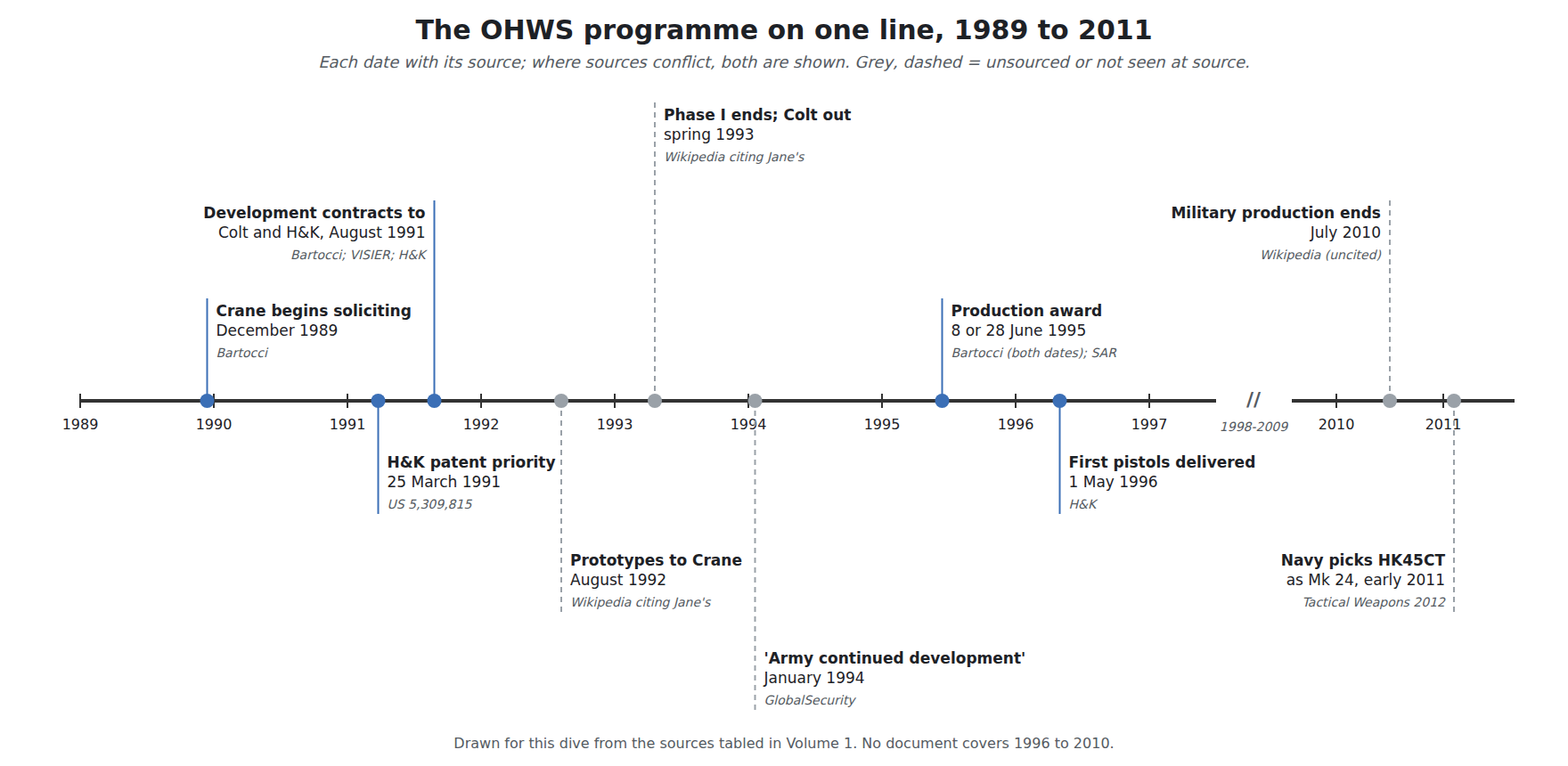
1.13 The dates, side by side
Table 3 — The dates, side by side
| Event | Date | Source |
|---|---|---|
| USSOCOM formed | 1986 | Bartocci |
| H&K’s “close-range gun for security tasks” in development | 1989 | VISIER 2013 |
| Small-arms study (120 types) | 1989 | Bartocci |
| Crane begins soliciting | December 1989 | Bartocci |
| H&K buffered-recoil patent, German priority | 25 March 1991 | US 5,309,815 |
| Request for an offensive handgun | August 1991 | GlobalSecurity (unsourced) |
| Development contracts to Colt and H&K | August 1991 (“end of August”, VISIER) | Bartocci; VISIER; H&K (“1991”) |
| Colt suppressor contract N00164-91-C0215 | Fiscal 1991 | Small Arms Review (number); year read from the number |
| Prototypes delivered to Crane | August 1992 | English Wikipedia, citing Jane’s (not seen) |
| Phase I testing ends | Spring 1993 | English Wikipedia (not seen at source) |
| First USP shown, SHOT Show | 1993 | VISIER 2013 |
| ”Army continued development” contract | January 1994 | GlobalSecurity (unsourced) |
| Production award | 28 June 1995 | Small Arms Review; Bartocci p. 1 |
| Production award (variant) | 8 June 1995 | Bartocci p. 2 |
| First pistols delivered | 1 May 1996 | H&K |
| Military production ends | July 2010 | English Wikipedia (uncited) |
1.14 What the record does not contain
These are the questions a reader is most likely to have that no source found for this dive answers. They are listed so that they are not filled in later from memory or from a search summary.
- The requirement document itself, or the request for quotation, and therefore the exact accuracy, reliability, sound-reduction and environmental clauses.
- The test reports from Crane, for either contractor, and therefore any independent check of H&K’s published results.
- The total number of pistols bought, as distinct from “systems”, and the number of suppressors and aiming modules.
- The end of military production.
- The 1989 small-arms study that both Bartocci and the American Rifleman describe.
- Any photograph of a Phase I or Phase II prototype, from either firm, that could be published.
- What “the Army continued development” under a January 1994 contract meant, if it happened.
The pistol’s service life after 1996, its foreign users and the commercial Mark 23 are the subject of Volume 2.
References
Footnotes
-
Heckler & Koch, Inc., Mark 23 Pistol .45 ACP operator’s manual (“Revised March 2007”; PDF dated 22 August 2008), Section 1, Introduction, p. 5; Section 2, p. 7. Wayback capture of 11 August 2011, https://web.archive.org/web/20110811030250/http://www.hk-usa.com/-images/shared/Mark%2023_Ops_Manual_2008.pdf, consulted 2026-10-18. ↩ ↩2 ↩3 ↩4 ↩5 ↩6 ↩7 ↩8
-
Heckler & Koch USA, “MARK 23” product page, Wayback capture of 28 December 2024, https://web.archive.org/web/20241228154506/https://hk-usa.com/hk-models/mark-23/, consulted 2026-10-18. ↩ ↩2
-
Christopher R. Bartocci, “Colt Offensive Hand Gun”, Small Arms Review vol. 10 no. 3 (December 2006); web edition credited to “SAR Staff”, https://smallarmsreview.com/colt-offensive-hand-gun/, consulted 2026-10-18. ↩ ↩2 ↩3 ↩4 ↩5 ↩6 ↩7 ↩8 ↩9 ↩10 ↩11 ↩12 ↩13
-
Christopher R. Bartocci, “MK23 Mod 0: The Crew-Served Pistol”, Small Arms Defense Journal vol. 5 no. 2 (2013); web edition of 11 August 2023, page 1, https://sadefensejournal.com/mk23-mod-0-the-crew-served-pistol/, consulted 2026-10-18. ↩ ↩2 ↩3 ↩4 ↩5 ↩6 ↩7 ↩8 ↩9 ↩10 ↩11 ↩12 ↩13 ↩14 ↩15
-
GlobalSecurity.org, “SOCOM Pistol Mk 23 Mod 0”, page last modified 29 November 2005, Wayback capture of 1 December 2005, https://web.archive.org/web/20051201045129/http://www.globalsecurity.org/military/systems/ground/mk23.htm, consulted 2026-10-18. ↩ ↩2 ↩3
-
HigherGov, indefinite-delivery contract N0016425D1016, awarding office “N00164 NSWC CRANE”, https://www.highergov.com/idv/N0016425D1016, consulted 2026-10-18. ↩ ↩2
-
Guy J. Sagi, “Heckler & Koch Mark 23: A Special Operator’s .45”, American Rifleman, 30 April 2022, https://americanrifleman.org/content/heckler-koch-mark-23-a-special-operator-s-45, consulted 2026-10-18. ↩
-
Bartocci, “MK23 Mod 0: The Crew-Served Pistol”, web edition, page 2, https://sadefensejournal.com/mk23-mod-0-the-crew-served-pistol/2/, consulted 2026-10-18. ↩ ↩2 ↩3 ↩4 ↩5
-
Ian McCollum, “H&K Mk23 SOCOM Development”, Forgotten Weapons, 28 June 2019, https://www.forgottenweapons.com/hk-mk23-socom-development/, consulted 2026-10-18. ↩
-
Travis Pike, “The HK MK23 built for SOCOM was the first and last offensive handgun”, Sandboxx News, 5 March 2025, https://www.sandboxx.us/news/socoms-hk-mk23-was-the-first-and-last-offensive-handgun/, consulted 2026-10-18. ↩ ↩2
-
Sporting Arms and Ammunition Manufacturers’ Institute, ANSI/SAAMI Z299.3-2022, Voluntary Industry Performance Standards for Pressure and Velocity of Centerfire Pistol and Revolver Ammunition, approved 13 December 2022, velocity and pressure table, https://saami.org/wp-content/uploads/2025/05/SAAMI-Z299.3-2022-Centerfire-Pistol-Revolver-Approved-12-13-2022.pdf, consulted 2026-10-18. ↩
-
“Colt OHWS”, English Wikipedia, https://en.wikipedia.org/wiki/Colt_OHWS, consulted 2026-10-18 (cites Jane’s Infantry Weapons 1994–95, p. 674, not seen for this dive). ↩ ↩2 ↩3
-
VISIER, “Portrait: 20 years of Heckler & Koch USP”, all4shooters.com, 17 June 2013, https://www.all4shooters.com/en/shooting/pistols/heckler-koch-semiautomatic-pistol/, consulted 2026-10-18. ↩ ↩2 ↩3 ↩4
-
Jednostka Wojskowa GROM, “Uzbrojenie i wyposażenie” (weapons and equipment), Wayback capture of 8 January 2018, https://web.archive.org/web/20180108080940/http://www.grom.mil.pl/uzbrojenie_pliki/UZBROJENIE.HTM, consulted 2026-10-18 (Polish; translated for this dive). ↩
-
US Patent 5,309,815, T. Möller, R. Brandl and H. Weldle, assignors to Heckler und Koch GmbH, “Firearm, particularly handgun”, filed 24 March 1992, German priority 25 March 1991, issued 10 May 1994, https://patents.google.com/patent/US5309815A/en, consulted 2026-10-18. ↩
-
Heckler & Koch USA, “mark 23 :: general”, Wayback capture of 9 March 2014, https://web.archive.org/web/20140309124324/http://www.hk-usa.com/civilian_products/mark23_general.asp, consulted 2026-10-18. ↩
Comments (0)