H&K Mk 23 · Volume 2
In Service and on Sale: 1996 to Today
What became of SOCOM's offensive handgun once it was issued, who else adopted it, the successor that replaced it in Navy service, and the commercial Mark 23: how it differs, how the 1994 ban shaped it, and how H&K has described and priced it since
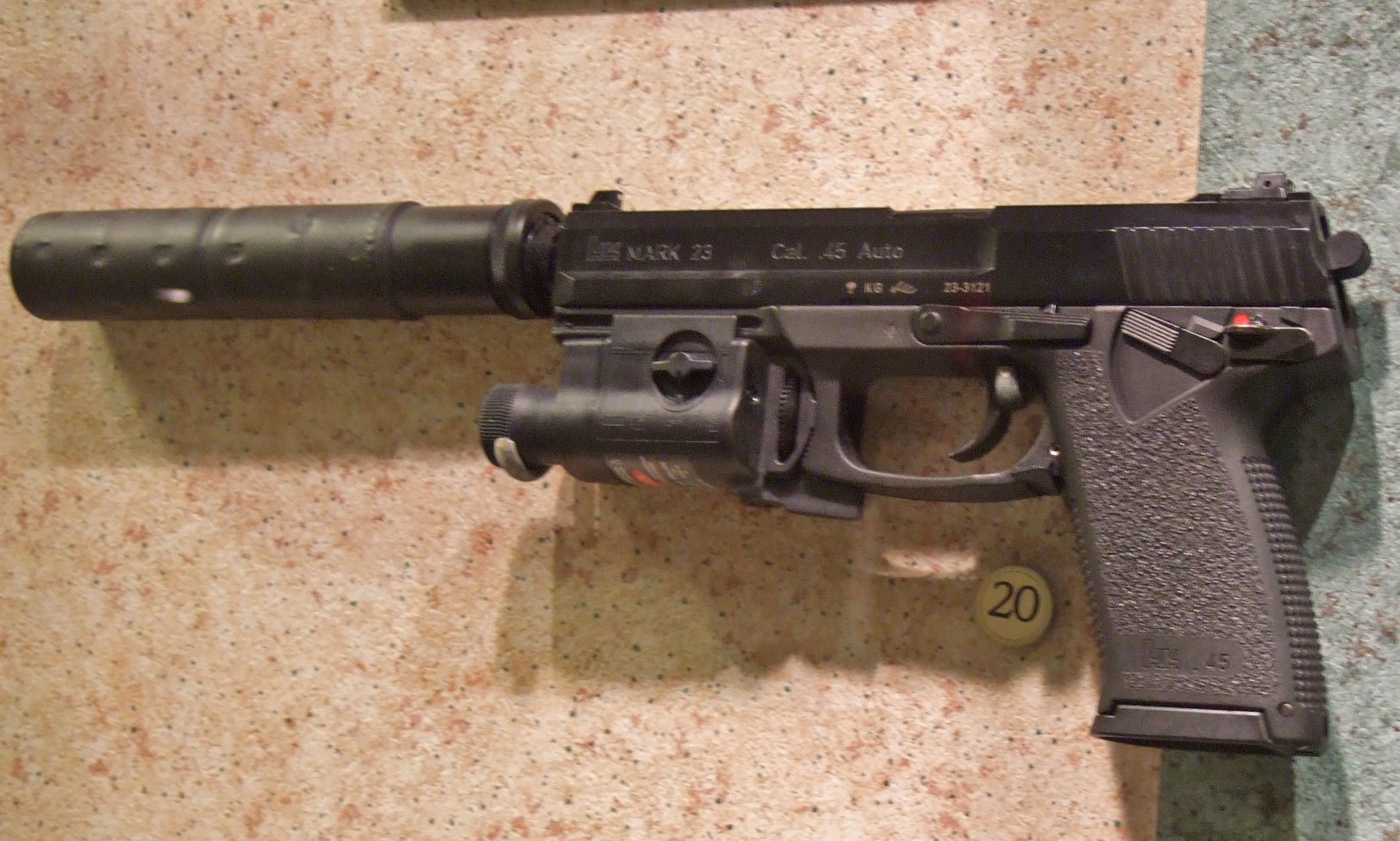
2.1 The public record after 1996
Volume 1 ended on 1 May 1996, the date H&K gives for the first deliveries to SOCOM. The record after that date is thinner still. No SOCOM, Navy or Congressional document describing how the pistol was issued, used or retired was found for this dive, and DTIC’s report servers were unavailable when it was researched (Volume 1). What follows rests on a small number of secondary sources, mainly Christopher Bartocci’s 2013 article in Small Arms Defense Journal, an unsourced GlobalSecurity page of 2005, two articles by Sandboxx News, a 2012 article in Tactical Weapons (Athlon), and one primary source outside the United States, the Polish special forces unit GROM’s own equipment page. Each is attributed as it is used.
2.2 Fielding: a pistol for every unit, and a pistol nobody wanted to carry
Bartocci’s caption to a photograph of the pistol says it “is available to any unit that falls under the umbrella of SOCOM”.1 That is the closest thing in print to a statement of how it was distributed: not as a standard sidearm to every operator, but as an item available to the command’s units, presumably drawn for missions that called for it.
On how it was received, the sources agree, and they are unflattering. GlobalSecurity, in 2005: “The SOCOM pistol reportedly met with less than complete enthusiasm on the part of operators, due to its massive size.”2 Bartocci, more pointedly: “Many operators could not wrap their heads around the size and the fact this was an offensive weapon and not a sidearm.” He adds that most of the operators of the late 1990s “had little to no combat experience”, that “strong political pressure inside the services at the time worked against the fielding of the MK23”, and that “these factors greatly contributed to the lack of production of both the pistol and the new +P ammunition”.1 None of these statements cites a document, and the “political pressure” is not explained.
The difficulty is easy to see from the requirement. The OHWS was specified as a primary weapon for close-quarters battle and for killing sentries quietly (Volume 1). By the late 1990s the suppressed submachine gun and, increasingly, the suppressed short carbine did that job, and a pistol carried as a sidearm was expected to be small enough to carry all day. The Mk 23 was too large to be a convenient sidearm and, as a pistol, too limited to be a primary weapon. Sandboxx’s 2022 survey of Navy pistols makes a related point: “These days that job might be done with the MP7”.3
2.3 How big is “crew-served”?
The nickname that gave Bartocci his title, “the crew-served pistol”, is about size and weight. The figures, all from H&K or its trade press:
Table 1 — The nickname that gave Bartocci his title, "the crew-served pistol", is about size and weight. The figures, all from H&K or its trade press
| Configuration | Length | Weight | Source |
|---|---|---|---|
| Pistol, empty 12-round magazine | 9.65 in (245 mm) | 2.66 lb (1.21 kg) | H&K manual, 2007 |
| Pistol, “with magazine” | 9.65 in | 2.42 lb | H&K web page, 2000 and 2004 |
| Pistol with suppressor and LAM, loaded | not given | 2,280 g (5.0 lb) | VISIER, 2013 |
| Pistol with Knight’s suppressor | 16.6 in | not given | Tactical Weapons, 2012 |
| Pistol with Knight’s suppressor, unloaded | not given | 3.5 lb | The Firearm Blog, 2021 |
Sources: H&K, VISIER, Massimilian, TFB.45678
Five pounds for a loaded pistol with its suppressor and aiming module is the weight behind the “crew-served” joke.
2.4 Afghanistan and Iraq
The pistol’s second life, by Bartocci’s account, came with the wars of the 2000s. “In the nearly decade wars in both Afghanistan and Iraq,” he writes, “the younger generation operators saw firsthand the superiority of the .45 Auto caliber handgun over the 9x19mm one”, and “Special Forces had pulled the MK23 out of storage as well as bought more USP 45s, Glock 21s as well as M1911-type pistols.”1
The claim is that the Mk 23 was in storage before 2001, and that it was drawn again for use as a .45 sidearm, alongside other .45s bought for the same reason. That fits the reception described above: a pistol bought as an offensive system, shelved as too big, and brought back by units that wanted a .45. No document records how many were drawn, by which units or in what role, and no photograph of a Mk 23 in Afghanistan or Iraq that could be published was found.
2.5 The end of production, and the Mk 24
English Wikipedia gives the end of military production as July 2010. It cites nothing for it, and no other source found gives a date (Volume 1).
What replaced the Mk 23 in Navy service, by the trade press’s account, was another H&K .45. Tactical Weapons, in February 2012: “According to news reports, the Navy chose the HK45CT as the replacement for the MK23 early in 2011”, and “the HK45CT was recently adopted by the U.S. Naval Special Warfare Group as MK24 MOD 0 Combat Assault Pistol”.7 The article illustrates it with an Advanced Armament Corp. suppressor and a Crimson Trace infrared laser on the frame’s 1913 rail. The “news reports” are not named. Sandboxx’s 2022 survey also says the HK45 Compact Tactical became the Mk 24, and that “The Mk 24 descends from the Mk 23”; it gives no dates.3
The designation fits the Navy’s Mark sequence: Mk 22 for the Vietnam-era Hush Puppy (Volume 1), Mk 23 for the OHWS pistol, Mk 24 for the HK45CT, and, by Sandboxx’s account, Mk 25 for the SIG P226 in Navy service and Mk 27 for a Glock 19 derivative.3 The choice of the HK45 Compact Tactical says much about what the Mk 23 had become. It kept the .45, the threaded barrel and the suppressor; it dropped the size, the separate decocker and the proprietary accessory grooves in favour of a smaller pistol with a standard rail. That was the pistol many operators had wanted in 1996.
2.6 Is the Mk 23 still in service?
Sandboxx, in 2022: “apparently, the Mk 23 is still kicking around”; in 2025 the same writer says the pistol “may still be in service”.39 Neither cites anything. No source found establishes whether SOCOM still holds Mk 23s, in what numbers, or with which units.
2.7 Users outside the United States
Only one foreign user is documented by its own published material.
Poland: GROM. The equipment page of Jednostka Wojskowa GROM, Poland’s counter-terrorist and special operations unit, as archived in January 2018, lists among the pistols its commandos use “the HK USP family … USP Expert and Mk 23 SOCOM Model 0, calibre 11.43 mm”, and describes the Mk 23: “The Mk 23 SOCOM Model 0 is a large weapon, so it cannot be used as a typical backup weapon. It was made specifically for use with a suppressor and an aiming module (a visible laser, a laser visible only through night-vision goggles, and a light). The weapon was created by developing the H&K USP pistol.”10 (Translated for this dive. 11.43 mm is .45 in.) The page does not say how many GROM holds or when they were bought, and whether GROM’s pistols are Mod 0 pistols bought through the United States or commercial pistols is not stated; the unit calls them “Mk 23 SOCOM Model 0”.
Other countries. English Wikipedia lists Indonesia and Malaysia as users, citing a 2007 issue of the Croatian magazine Hrvatski vojnik and Leroy Thompson’s 2008 book on special weapons.11 Neither source was seen for this dive, and neither user is confirmed by an official source. They are reported here as Wikipedia’s claims.
Table 2 — Users outside the United States
| Country | User | Evidence | Status |
|---|---|---|---|
| United States | USSOCOM | H&K; Bartocci; NSN for the suppressor (Volume 7) | Confirmed |
| Poland | GROM | Unit’s own equipment page (archived 2018) | Confirmed (no quantities) |
| Indonesia | Kopassus / Kopaska (per Wikipedia) | Hrvatski vojnik, 2007, via Wikipedia | Not seen |
| Malaysia | Not specified | Thompson 2008, via Wikipedia | Not seen |
2.8 The commercial Mark 23
H&K’s own statement of what the commercial pistol is: “The Mark 23 is almost identical to the MK 23, MOD 0 pistol used by the Special Operations Command, right down to its threaded barrel. The main differences are slide markings (Mark 23 as opposed to MK 23) and a barrel manufactured to SAMMI [sic] headspace specifications.”4
Two differences, then, by the maker’s account: the name on the slide, and the chamber. Bartocci adds a third, over time: “The first models offered were the exact same pistol with the only change being its SAAMI spec chamber”, and “later commercial pistols would use the same finish as the USP”.1 The military pistol’s finish was what H&K’s manual calls a “special maritime surface coating”; Bartocci describes it as “a proprietary maritime finish intended to protect the pistol from salt water emersion”, “tested in salt/fog spray chamber lab testing up to 96 hours”.41 H&K’s own web pages for the commercial pistol, from 2004 onward, describe a “corrosion resistant blued finish” (Volume 3). The identification of the variants, and what can and cannot be seen from outside, is the subject of Volume 4.
When the commercial pistol first went on sale is not established. The earliest H&K document found that offers it is H&K Inc.’s American web page captured on 28 January 2000; it may well have been sold earlier.5 (American Rifleman’s 2022 article says “first models leaving the factory in 1991”, which is the date the development contract was awarded, not the date of any commercial sale.)12
All of them were made in Germany. Bartocci: “All pistols were manufactured in Germany.”1 The Firearm Blog’s reviewer in 2021 reported that his pistol “took about six months to immigrate to the U.S. from Germany”, and Gun Tests reported in 2026 that “HK builds only a few hundred new each year”, without a source.813 H&K has never published a production figure for the commercial pistol.
2.9 Ten rounds: the 1994 law and the civilian magazine
The commercial Mark 23 arrived in the United States at the time of the Violent Crime Control and Law Enforcement Act of 1994, which for ten years shaped what could be sold with it.
The Act’s definition of a “semiautomatic assault weapon” included a semi-automatic pistol “that has an ability to accept a detachable magazine and has at least 2 of” five features, one of which was “a threaded barrel capable of accepting a barrel extender, flash suppressor, forward handgrip, or silencer” and another “a manufactured weight of 50 ounces or more when the pistol is unloaded”.14 The Mark 23 has the threaded barrel. It does not have the weight: 2.66 lb with an empty magazine in H&K’s manual is 42.6 ounces, and its magazine sits in the grip. With one feature of the five, the commercial Mark 23 was not a “semiautomatic assault weapon” under the 1994 definition, and could be made and sold through the ban years as it stood, threaded barrel and all. (That is an analysis of the statute’s text for this dive; no ATF ruling on the Mark 23 was found.)
The magazines were another matter. The same Act defined a “large capacity ammunition feeding device” as a magazine “manufactured after the date of enactment … that has a capacity of … more than 10 rounds”.14 New 12-round magazines could not be sold to private buyers, and the commercial pistol was sold with 10-round magazines. H&K’s January 2000 page lists the Mark 23’s capacity as 10 and notes “US Civilian magazine capacity is 10 rounds”; its October 2004 page, a month after the law lapsed on 13 September 2004, still gave 10.515 That is why the Mark 23 has a 10-round magazine at all: a separate design with its own housing, floorplate and locking insert (Volume 5), which H&K still lists alongside the 12-round magazine.16
The hub’s Steyr AUG dive, Volume 3 covers the 1994 law’s effect on rifles named in it.
2.10 The Mark 23 among H&K’s .45s
H&K’s American catalogue of January 2000 sold the Mark 23 alongside three USP .45s, and described them in terms of the Mark 23.5
- USP45 Tactical: “An enhanced version of the USP45, the Tactical is designed for users who need the features found on the Mark 23, but in a smaller and more affordable pistol. The USP45 Tactical pistol approaches the precision found on the Mark 23 by adding an extended threaded barrel with rubber O-ring, adjustable trigger, and adjustable target-type sights to the USP45.”
- USP45 Match: it “approches [sic] the precision found on the Mark 23 by adding a special barrel weight system, extended target barrel, adjustable trigger, and target sights”.
- USP Expert: “combining features of the Match, Tactical, and Mark 23 pistols with a new slide design”, with an O-ring barrel.
H&K’s own table on the same page:
Table 3 — H&K's own table on the same page
| USP45 Expert | USP45 Match | USP45 Tactical | Mark 23 | |
|---|---|---|---|---|
| Capacity (US civilian) | 10 | 10 | 10 | 10 |
| Sights | Adjustable target | Adjustable target | Adjustable target | 3-dot |
| Width | 1.26 in | 1.26 in | 1.26 in | 1.53 in |
| Height | 5.90 in | 5.90 in | 5.90 in | 5.90 in |
| Sight radius | 7.50 in | 6.34 in | 6.34 in | 7.76 in |
| Weight | 1.87 lb | 2.38 lb | 2.24 lb | 2.42 lb |
| Barrel | 5.20 in | 6.02 in | 4.92 in | 5.87 in |
Source: H&K Inc. web page, January 2000.5
The table makes the Mark 23’s position plain. It was H&K’s reference point for accuracy and robustness among its .45s, and H&K marketed the others as bringing parts of it to a smaller pistol. The USP45 Tactical, the closest of them, is the pistol most often confused with it; Volume 4 tells them apart.
2.11 How H&K has described it since
H&K’s description of the commercial pistol has changed less than its specifications. The opening paragraph on the January 2000 page (“match grade accuracy equal to that of the finest custom made handguns”, “One of the most thoroughly tested handguns in history”) is the same, nearly word for word, on the October 2004 page and on the product page captured in December 2024.51516 The 2004 page added the feature list that the 2007 manual later contradicted (no loaded-chamber indicator, no lock) and the “average of 6000 MRBS” that conflicts with the manual’s minimum (Volumes 3 and 6). Those web texts are the source of most of what is repeated about the Mark 23 online, including in retailers’ descriptions.
H&K’s account of the origin also shifted slightly. The 2007 manual says the project “originated in 1991 when HKI was awarded a development contract”; the web pages from 2000 to 2024 say it “originated in 1991 when HK began development”.4516 Volume 1 shows that the H&K design work began earlier.
2.12 Model numbers and finishes
H&K’s model numbers for the commercial pistol have changed with its numbering system. The ones found, with their sources:
Table 4 — H&K's model numbers for the commercial pistol have changed with its numbering system. The ones found, with their sources
| Model number | Description | Source | Status |
|---|---|---|---|
| 723001 | Mark 23 | US retailer listings (EuroOptic product URLs) | Retail only |
| M723001-A5 | Mark 23 | Gun Tests, 2026 (title of its test) | Trade press |
| 81000078 | Mark 23 .45 ACP DA/SA, two 12-round magazines | H&K USA product page, December 2024 | Maker |
| 81000080 | Mark 23 .45 ACP DA/SA, two 10-round magazines | H&K USA product page, December 2024 | Maker |
| 81001074 | Mark 23, 12-round, “Black Cerakote” slide, “OD Green Polymer Frame” | US retailer listings, about November 2025 | Not on any H&K page seen |
Sources: H&K, Gun Tests, retailers.16131718
The last line needs care. Several retailers list a Mark 23 with a black Cerakote slide and an OD green frame under 81001074. No H&K page describing it was found (hk-usa.com refused automated access when checked, and the last archived product page, December 2024, does not show it). It is recorded here as a retailer listing; whether it is a catalogue model, a distributor exclusive or a limited run was not established.
2.13 Prices, 2021 to 2026
Table 5 — Prices, 2021 to 2026
| Date | Price | What | Source |
|---|---|---|---|
| May 2021 | $2,499 | MSRP | The Firearm Blog |
| April 2022 | $2,639 | MSRP | American Rifleman |
| December 2024 | $2,639 | MSRP, either configuration | H&K USA product page |
| July 2026 | $1,900 (new in box), $1,700 (used) | Completed auction sales | Gun Tests |
| October 2026 | $2,301.99 | Retail, 81000078, in stock | KYGUNCO |
Sources: TFB, American Rifleman, H&K, Gun Tests, KYGUNCO.812161319 The market in 2026, and what to look for in a used pistol, is in Volume 8.
2.14 What the record does not contain
- How the Mk 23 was issued: numbers per unit, holdings over time, the units that used it.
- Any documented use in Afghanistan or Iraq.
- The end of military production (July 2010 is uncited) and whether SOCOM still holds the pistol.
- The Navy’s own document adopting the Mk 24 Mod 0.
- Foreign users other than GROM, and GROM’s quantities.
- When the commercial pistol went on sale, how many have been made, and whether it was ever imported with the military maritime finish under a commercial marking (Bartocci says the first ones were).
- H&K’s own page for the black and OD green version.
References
Footnotes
-
Christopher R. Bartocci, “MK23 Mod 0: The Crew-Served Pistol”, Small Arms Defense Journal vol. 5 no. 2 (2013); web edition of 11 August 2023, page 2, https://sadefensejournal.com/mk23-mod-0-the-crew-served-pistol/2/, consulted 2026-10-18. ↩ ↩2 ↩3 ↩4 ↩5 ↩6
-
GlobalSecurity.org, “SOCOM Pistol Mk 23 Mod 0”, page last modified 29 November 2005, Wayback capture of 1 December 2005, https://web.archive.org/web/20051201045129/http://www.globalsecurity.org/military/systems/ground/mk23.htm, consulted 2026-10-18. ↩
-
Travis Pike, “These are the Navy’s top 6 Mk handguns”, Sandboxx News, 28 November 2022, https://www.sandboxx.us/news/hitting-your-mark-the-navys-mk-handguns/, consulted 2026-10-18. ↩ ↩2 ↩3 ↩4
-
Heckler & Koch, Inc., Mark 23 Pistol .45 ACP operator’s manual (“Revised March 2007”; PDF dated 22 August 2008), Sections 1 and 2. Wayback capture of 11 August 2011, https://web.archive.org/web/20110811030250/http://www.hk-usa.com/-images/shared/Mark%2023_Ops_Manual_2008.pdf, consulted 2026-10-18. ↩ ↩2 ↩3 ↩4
-
Heckler & Koch, Inc., “Mark 23, USP Tactical and Match” page, Wayback capture of 28 January 2000, http://web.archive.org/web/20000128213444/http://www.hecklerkoch-usa.com:80/Pages/mk23.html, consulted 2026-10-18. ↩ ↩2 ↩3 ↩4 ↩5 ↩6 ↩7
-
VISIER, “Portrait: 20 years of Heckler & Koch USP”, all4shooters.com, 17 June 2013, https://www.all4shooters.com/en/shooting/pistols/heckler-koch-semiautomatic-pistol/, consulted 2026-10-18. ↩
-
Andy Massimilian, “Heckler & Koch 45CT”, Tactical Weapons (Athlon Outdoors), 1 February 2012, https://athlonoutdoors.com/article/heckler-koch-45ct/, consulted 2026-10-18. ↩ ↩2
-
Pete, “Silencer Saturday #178: H&K and KAC MK23 – The Most Famous Suppressor Combo?”, The Firearm Blog, 29 May 2021, https://www.thefirearmblog.com/blog/2021/05/29/hk-kac-mk23, consulted 2026-10-18. ↩ ↩2 ↩3
-
Travis Pike, “The HK MK23 built for SOCOM was the first and last offensive handgun”, Sandboxx News, 5 March 2025, https://www.sandboxx.us/news/socoms-hk-mk23-was-the-first-and-last-offensive-handgun/, consulted 2026-10-18. ↩
-
Jednostka Wojskowa GROM, “Uzbrojenie i wyposażenie” (weapons and equipment), Wayback capture of 8 January 2018, https://web.archive.org/web/20180108080940/http://www.grom.mil.pl/uzbrojenie_pliki/UZBROJENIE.HTM, consulted 2026-10-18 (Polish; translated for this dive). ↩
-
“Heckler & Koch Mark 23”, English Wikipedia, users section, https://en.wikipedia.org/wiki/Heckler_%26_Koch_Mark_23, consulted 2026-10-18 (cites Hrvatski vojnik no. 159, 2007, and L. Thompson, Special Weapons, 2008; neither seen for this dive). ↩
-
Guy J. Sagi, “Heckler & Koch Mark 23: A Special Operator’s .45”, American Rifleman, 30 April 2022, https://americanrifleman.org/content/heckler-koch-mark-23-a-special-operator-s-45, consulted 2026-10-18. ↩ ↩2
-
Todd Woodard, “Heckler & Koch Mark 23 45 ACP M723001-A5”, Gun Tests, 30 July 2026, https://www.gun-tests.com/handguns/pistols45/heckler-koch-mark-23-45-acp-m723001-a5-45-acp/, consulted 2026-10-18. ↩ ↩2 ↩3
-
18 U.S.C. § 921(a)(30)(C) and (a)(31) (2000 edition; the provisions lapsed on 13 September 2004), https://www.govinfo.gov/content/pkg/USCODE-2000-title18/html/USCODE-2000-title18-partI-chap44-sec921.htm, consulted 2026-10-18. ↩ ↩2
-
Heckler & Koch, Inc., “MARK 23” page, Wayback capture of 16 October 2004, http://web.archive.org/web/20041016095828/http://www.hecklerkoch-usa.com:80/handguns/mk23.html, consulted 2026-10-18. ↩ ↩2
-
Heckler & Koch USA, “MARK 23” product page, Wayback capture of 28 December 2024, https://web.archive.org/web/20241228154506/https://hk-usa.com/hk-models/mark-23/, consulted 2026-10-18. ↩ ↩2 ↩3 ↩4 ↩5
-
EuroOptic, product listings “HK Mark 23 .45 ACP Pistol 723001” and “M723001”, https://www.eurooptic.com/hk-mark-23-45-acp-pistol-723001, consulted 2026-10-18 (URL and title only). ↩
-
Blackstone Shooting Sports, listing for Heckler & Koch 81001074 Mark 23, black Cerakote slide, OD green polymer frame, UPC 642230269972, consulted 2026-10-18 (retailer listing). ↩
-
KYGUNCO, “Heckler and Koch HK USA 81000078 Mark 23 45 ACP DA/SA 12rd”, https://www.kygunco.com/product/heckler-and-koch-hk-usa-81000078-mark-23-45-acp-da-sa-12rd, consulted 2026-10-18. ↩
Comments (0)