H&K Mk 23 · Volume 4
Telling Them Apart: Mk 23 Mod 0, Mark 23, USP45 and USP Tactical
How to identify the military pistol, the commercial pistol and the USP .45s they are confused with, feature by feature and marking by marking, with what H&K's own documents say about each and what no published source settles
4.1 Why identification is a problem with this pistol
Three things make the Mk 23 easy to misidentify.
The first is the family resemblance. The Mk 23 was developed alongside H&K’s USP, and the two share a lock, a polymer frame, a stippled grip and H&K’s styling (Volume 1). The USP45 Tactical was designed, in H&K’s words, “for users who need the features found on the Mark 23, but in a smaller and more affordable pistol”, with “an extended threaded barrel with rubber O-ring”.1 A threaded USP45 with a suppressor looks very like a suppressed Mk 23 in a small photograph.
The second is the names. The issued pistol is the MK 23 MOD 0; the commercial pistol is the Mark 23; GROM calls its pistols “Mk 23 SOCOM Model 0”; retailers call the commercial pistol “Mk23”, “MK23 SOCOM” and “Mark 23” interchangeably (Volumes 1 and 2). A listing that says “Mk 23” is almost always the commercial pistol.
The third is the imagery. Licensed photographs of the Mk 23 are scarce: the Commons category held three files when this dive was researched, two of them of commercial pistols and one a Polish display table. Free image libraries are dominated by airsoft replicas: every Flickr result for “SOCOM Mk23” checked for this dive was an airsoft pistol (below). No licensed photograph of an issued Mk 23 Mod 0 was found at all.
4.2 The pistols in question
Table 1 — The pistols in question
| Pistol | What it is | Source |
|---|---|---|
| Mk 23 Mod 0 | SOCOM’s issued pistol, delivered from 1 May 1996 | H&K manual; Volume 1 |
| Mark 23 | The commercial pistol, “almost identical” to the Mod 0; slide marking and a SAAMI-headspace barrel differ | H&K manual |
| USP45 | The full-size USP in .45 ACP | H&K GmbH listing, 2010 |
| USP45 Tactical | USP45 with “an extended threaded barrel with rubber O-ring, adjustable trigger, and adjustable target-type sights” | H&K Inc., 2000 and 2004 |
| USP Expert, Match, Elite | Longer-slide USP target and practical-shooting models | H&K Inc., 2000 |
| HK45 and HK45 Compact Tactical | A later H&K .45 family; the Compact Tactical was adopted by Naval Special Warfare as the Mk 24 Mod 0, by trade-press account | Tactical Weapons, 2012; Volume 2 |
Sources: H&K, Tactical Weapons.21345
4.3 What the photographs can and cannot show
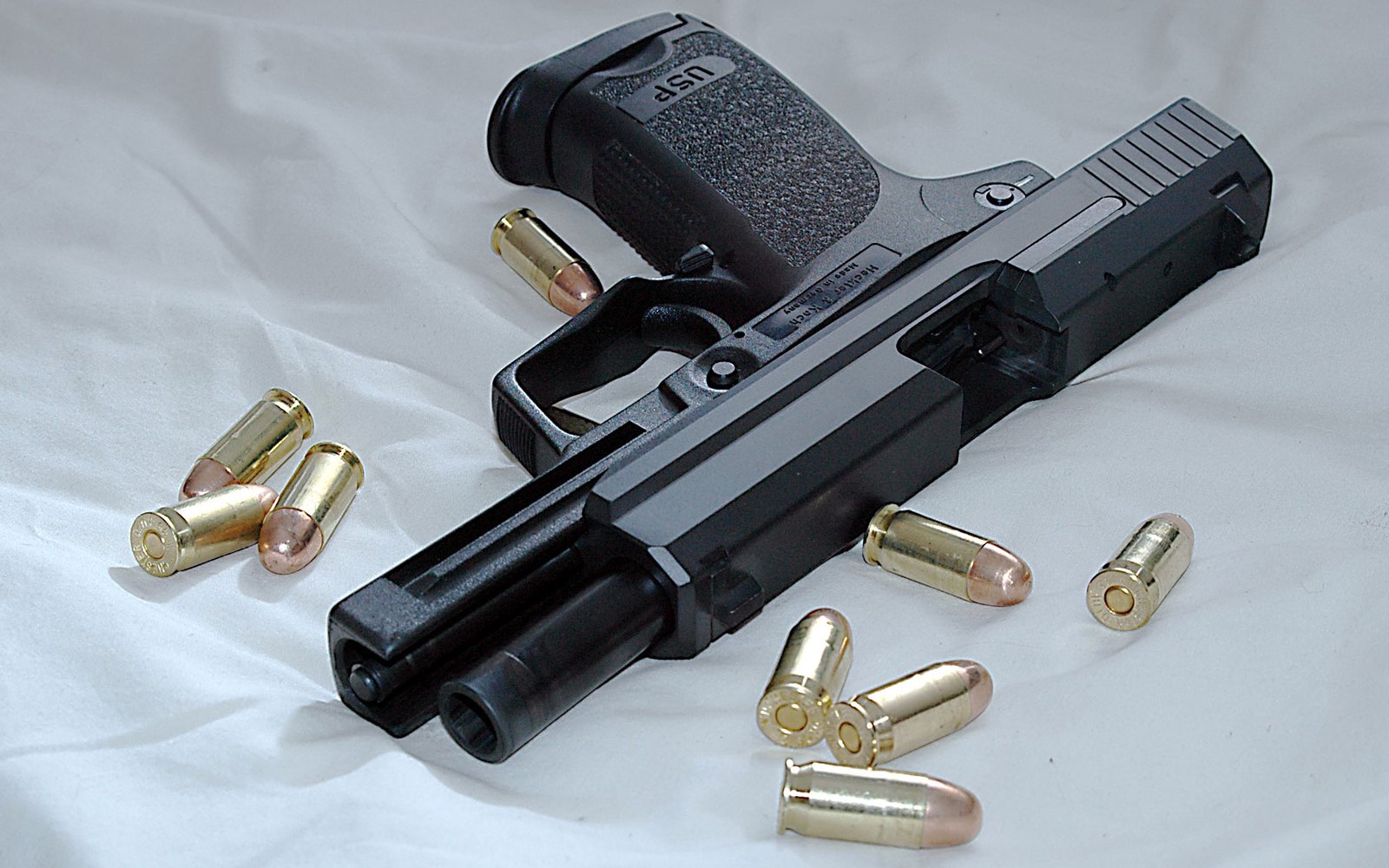
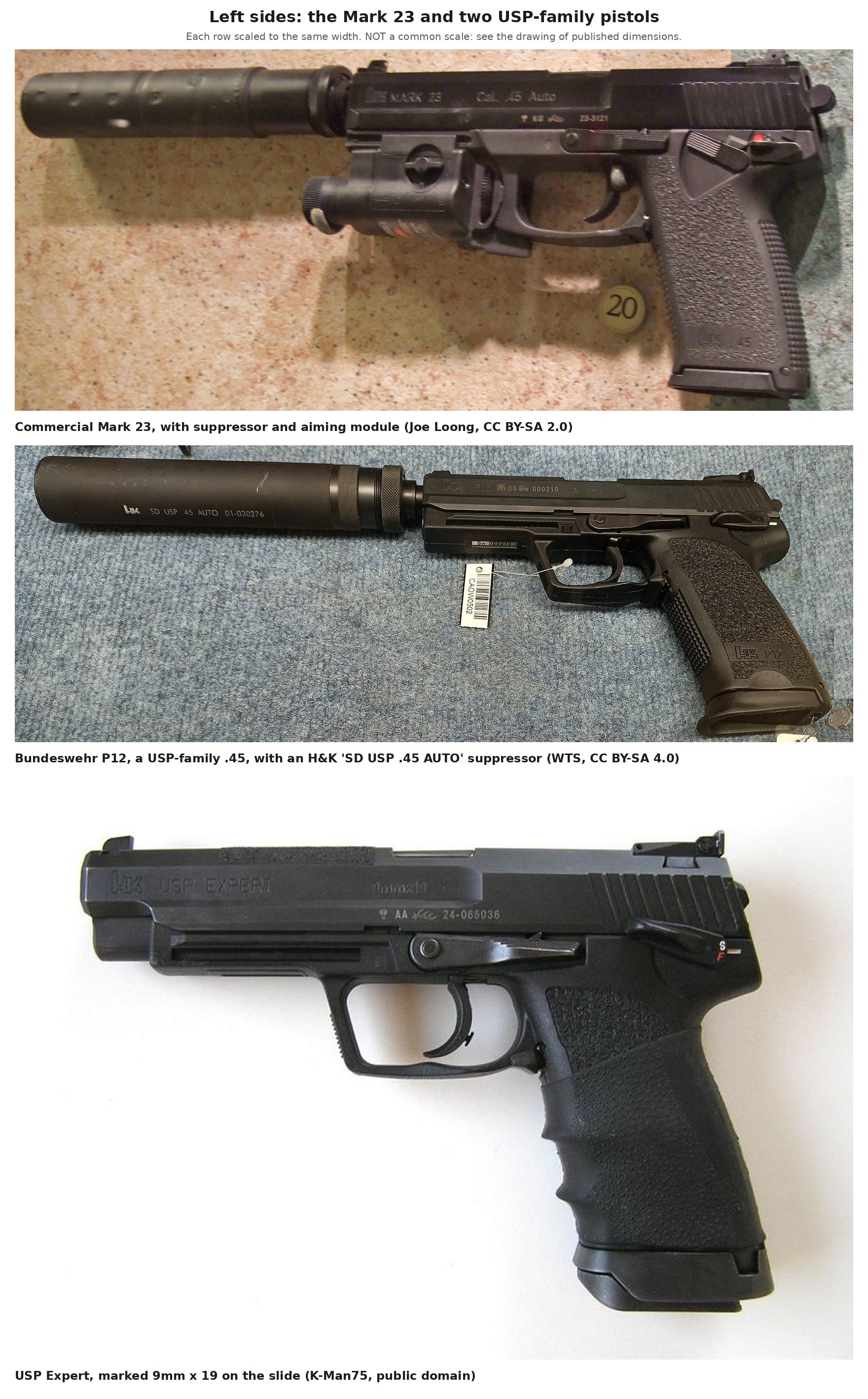
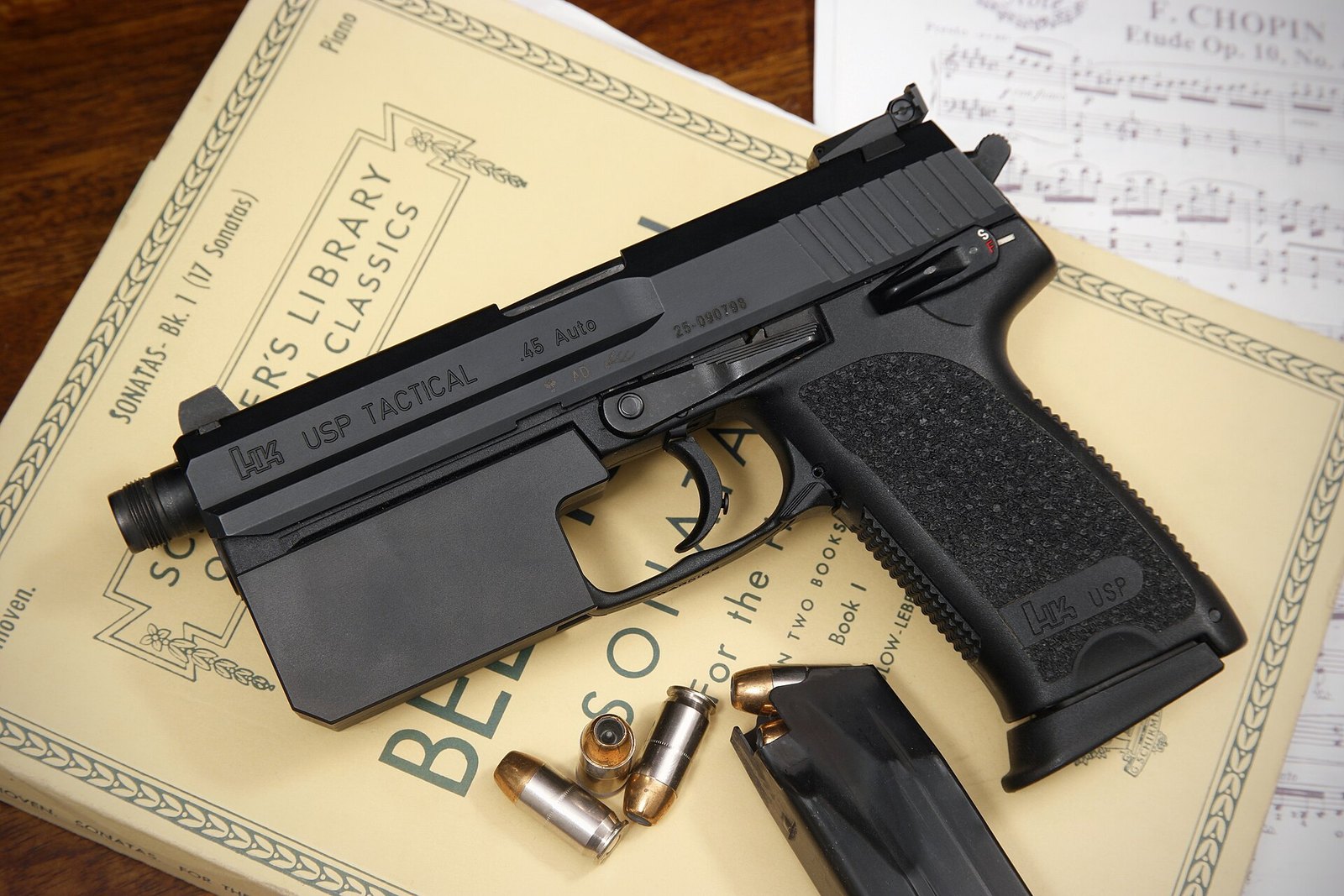
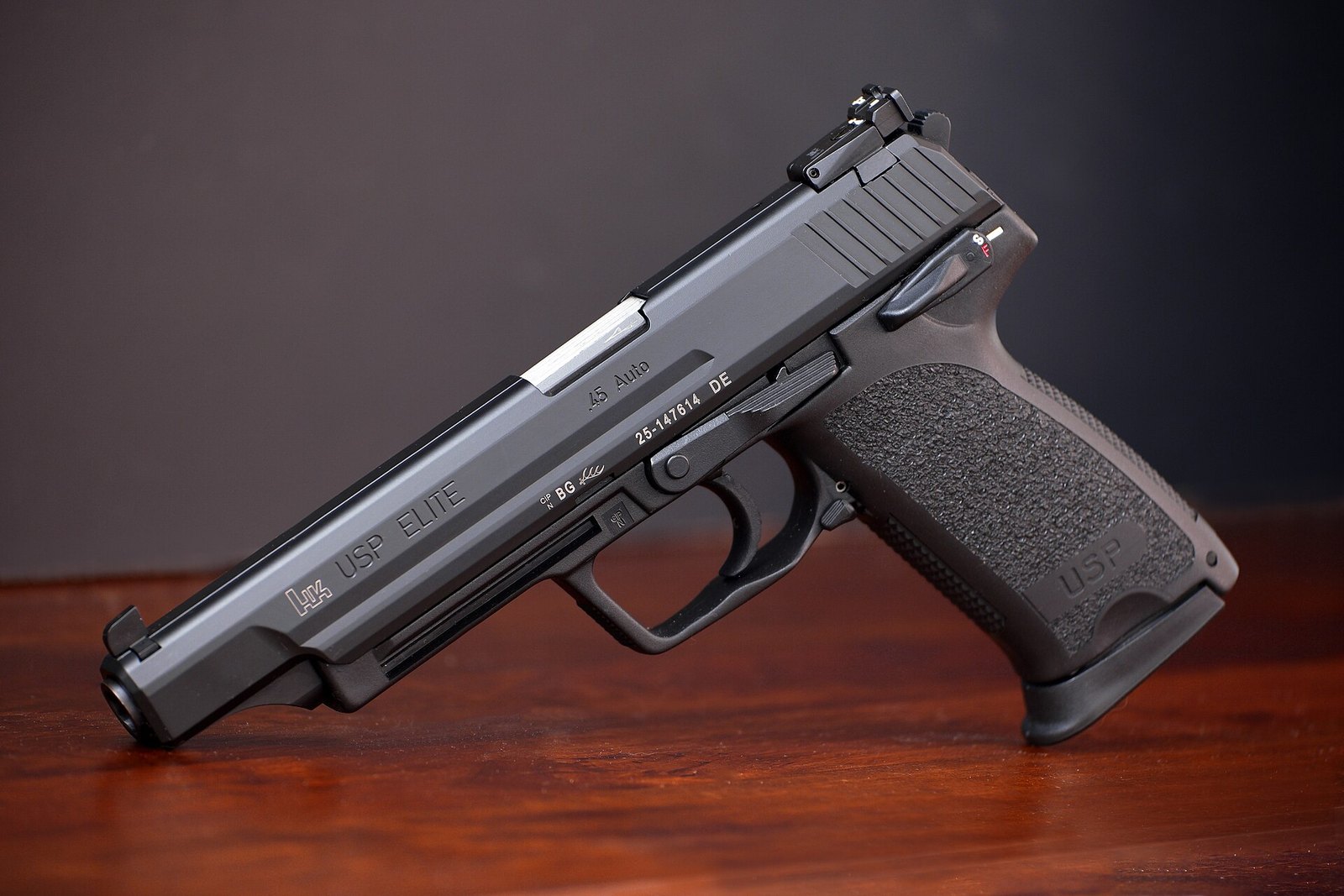
The identification rule applied to every photograph in this volume was: a pistol is called a Mark 23 only if its slide marking reads “MARK 23” in the photograph; a USP is named only from its own slide marking; a photograph whose marking cannot be read is described, not named. Under that rule the Commons photographs used here are two commercial Mark 23s (both marked), a USP Tactical (marked “USP TACTICAL”), a USP45 (described as such by its photographer, slide not legible), a USP Expert (marked, in 9 mm), a USP Elite in .45 and a Bundeswehr P12 (marked “P12” and “.45 Auto”).
Two consequences follow. First, every Mk 23 in this volume is the commercial Mark 23; the Mod 0’s marking is shown in a drawing, from the one published description of it. Second, the comparison plates cannot be built to a common scale, because the photographs were taken at different distances and angles. Scale is carried instead by a drawing of H&K’s published dimensions.
4.4 Size: the first and surest tell
The Mk 23 is bigger than any USP .45 in every published dimension H&K gives. From H&K’s own figures:
Table 2 — The Mk 23 is bigger than any USP .45 in every published dimension H&K gives. From H&K's own figures
| Mark 23 | USP Expert .45 | USP Tactical .45 | USP .45 | |
|---|---|---|---|---|
| Overall length | 245 mm (9.65 in) | 221 mm | 218 mm (8.64 in) | 200 mm |
| Barrel | 149 mm (5.87 in) | 132 mm | 129 mm (5.09 in) | 112 mm |
| Sight radius | 195 mm (GmbH) or 197 mm (manual) | 190 mm | 171 mm | 162 mm |
| Width | 1.58 in (manual); 1.53 to 1.54 in (web pages) | 1.26 in | 1.26 in | not found |
| Height | 5.90 in (150 mm) | 5.90 in | 5.90 in | not found |
Sources: H&K GmbH listing of 2010 (lengths and sight radii in millimetres); H&K Inc. web pages of 2000 and 2004 and the 2007 manual (inch figures).4132
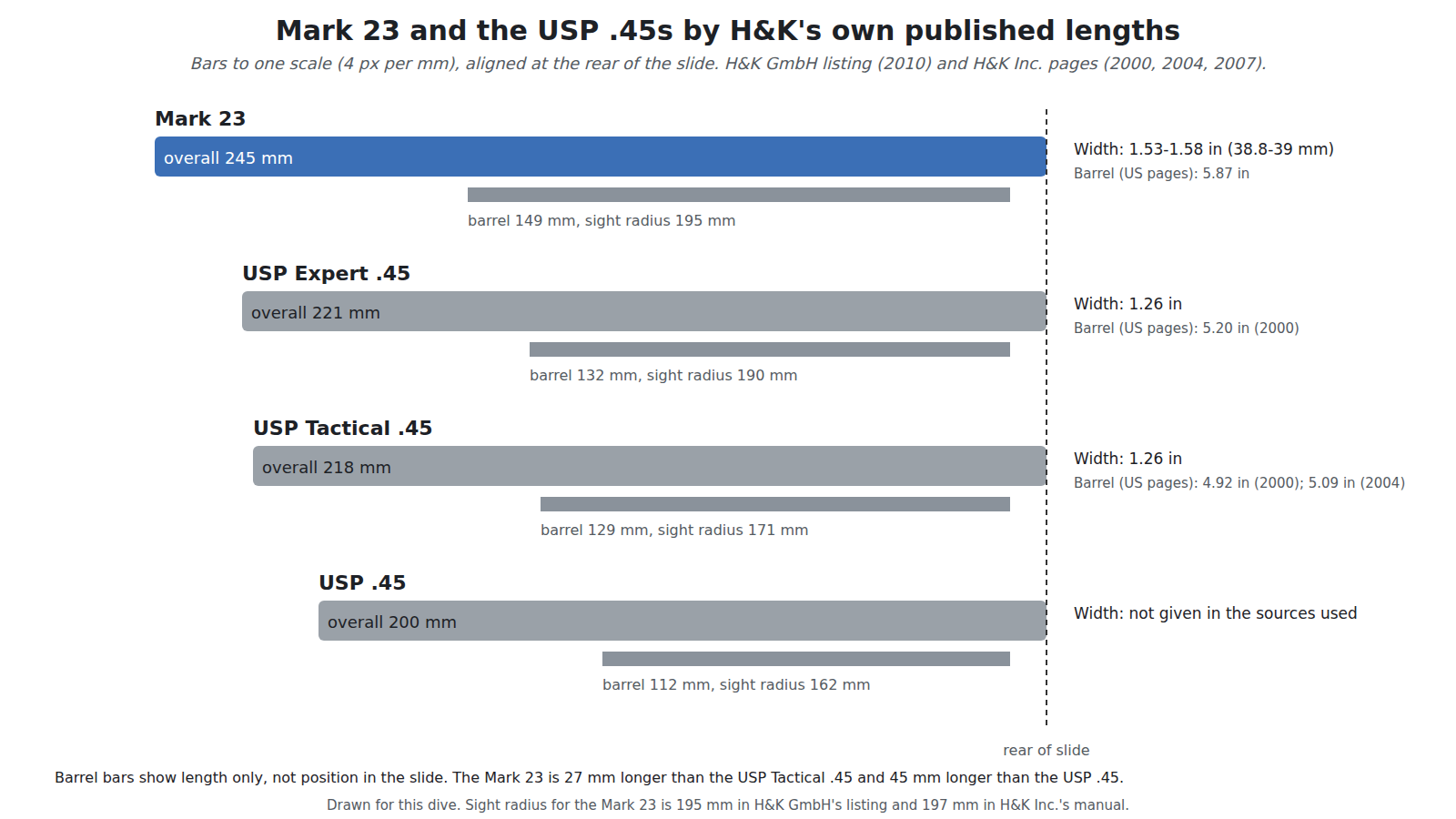
Two figures in the table do the work. A pistol 245 mm long with a 149 mm barrel is a Mk 23 or something built to imitate one; no USP .45 in H&K’s listing exceeds 221 mm. And the Mk 23’s frame is about 1.5 inches across against the USP’s 1.26: the Mk 23’s grip and slide are visibly broader in a top or front view, which the side-on photographs that dominate listings do not show.
The heights are identical in H&K’s own table, at 5.90 inches, so height is not a tell.1
4.5 Controls: two levers or one
The surest feature-level tell, visible in almost any side photograph of the left side, is the controls.
The Mk 23 has two levers at the rear of the frame on the left: a decocking lever forward, and the safety lever behind it at the very rear, with a red dot exposed beside it when the safety is off. The safety is ambidextrous, with a lever on each side; the decocker is on the left only. The slide release, a separate long lever, sits above the trigger.2
The USP has a single control lever at the rear of the frame that, in VISIER’s words, “takes on both functions”; depending on the variant ordered, it is a safety and decocker, a decocker only, or absent, on the left, the right or both sides. VISIER’s caption to a photograph of the two pistols together is the clearest statement in print: “The Mark 23 … has separate catches for safety and release.”6 H&K’s 2004 page for the USP Tactical says it “can be converted to any of nine trigger firing modes”.3
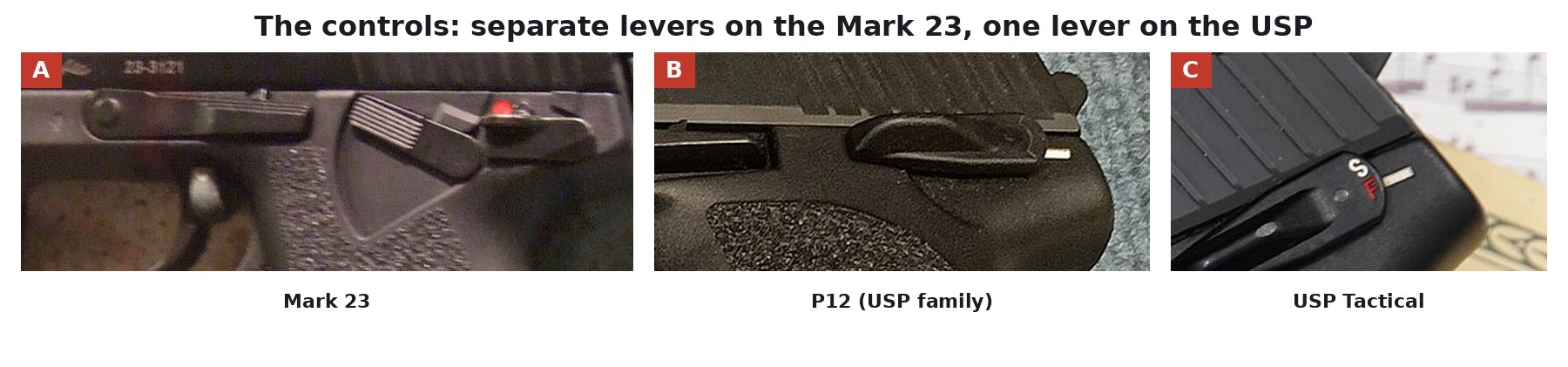
The practical rule: a separate decocking lever forward of a rear safety means a Mk 23 among these pistols; a single lever at the rear means a USP-family pistol.
4.6 The muzzle: thread, length and hand
All the pistols in question can have threaded barrels, so a thread alone identifies nothing. What differs is the hand of the thread and how far the barrel stands out.
- Mark 23: threaded M16×1 right-hand (The Firearm Blog, 2021; PEW Science, 2026), with the O-ring behind the threads.78 Every Mark 23 is threaded; it is the standard barrel (“right down to its threaded barrel”, in H&K’s words).
- USP45 Tactical: threaded M16×1 left-hand, on an extended barrel with an O-ring.783
- USP45: not threaded as standard; the barrel ends at the slide.
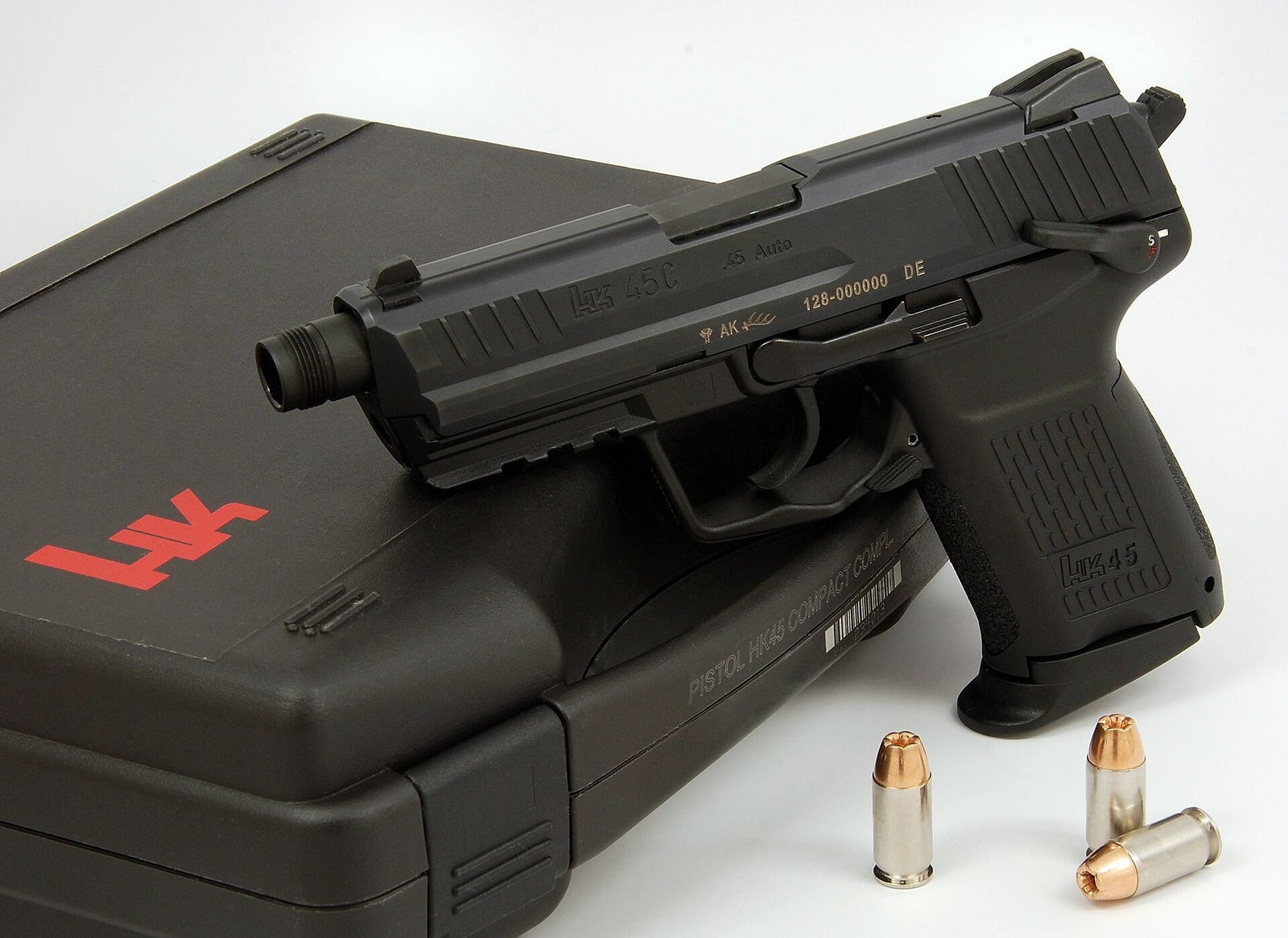
- HK45 Compact Tactical: threaded; the hand was not established for this dive.
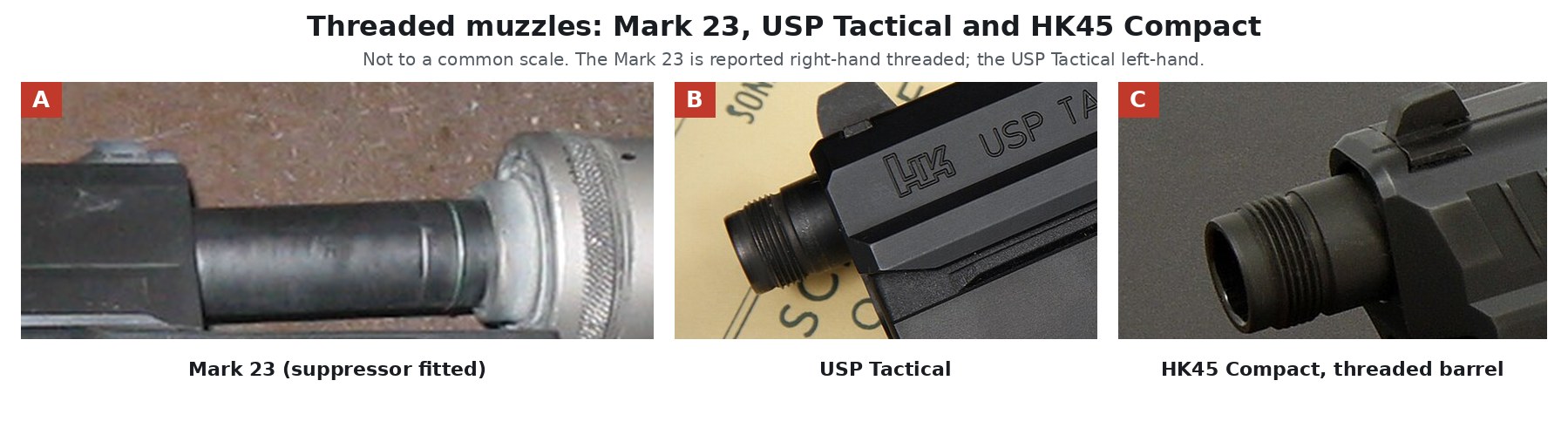
The hand of the thread cannot be read reliably from a photograph. A buyer can read it in the hand: screw on a cap of known hand, or look at the thread end-on. Volume 7 explains why it matters.
4.7 The frame: grooves, trigger guard and the patent panel
Three frame features distinguish the Mk 23 from the USP.
The accessory interface. The Mk 23 has a pair of grooves forward of the trigger guard and “a threaded insert … molded into the front face of the trigger guard” for the aiming module’s retaining screw. The USP has its own grooves. H&K’s manual: “Accessories designed for the Universal Self-loading Pistol (USP) will not work on the Universal Mounting Groves [sic] of the Mark 23.”2 A pistol whose light or laser clamps by a screw into the front of the trigger guard is a Mk 23.
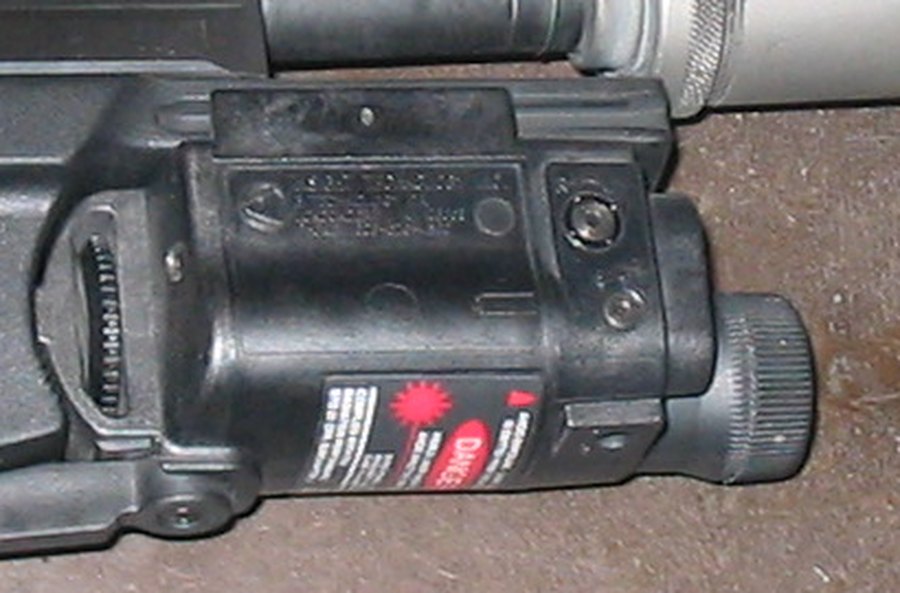
The trigger guard. The Mk 23’s is “extended, recurved and grooved”, and its lower edge is “flared on both sides in front of the magazine release lever”.2 The flare is distinctive in a side view: the guard’s rear bottom corner bulges outward around the magazine release.
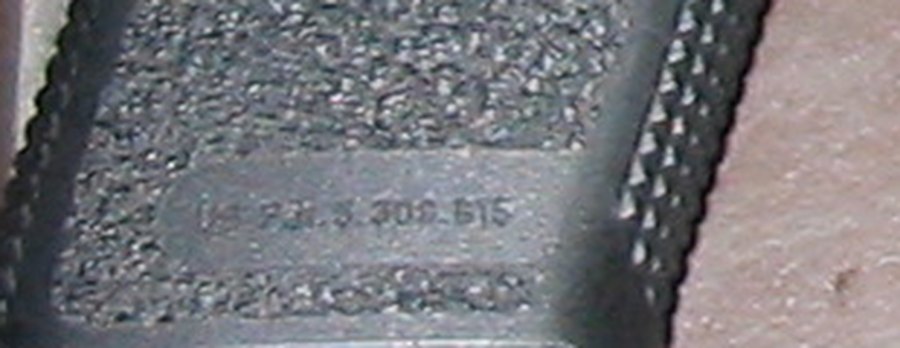
The patent panel. The commercial Mark 23 photographed on Commons carries a moulded panel on the right side of the grip, above the magazine well, reading as a US patent number ending 5 309 815 (Volume 3). Whether the Mod 0 and every commercial pistol carry it, and what the USP’s equivalent panel reads, was not established.
4.8 Sights and trigger
Sights. The Mk 23 has a fixed front post and a rear notch in a dovetail, with three white dots or tritium, adjusted for elevation by exchanging rear sights of different heights (Volume 6).2 The USP Tactical has “adjustable target-type sights”, in H&K’s words, with “micrometer adjustment for windage and elevation”.13 A target rear sight with adjustment screws is not a Mk 23 sight.
Trigger stop. H&K’s USP Tactical feature list includes an “adjustable trigger stop”.3 The Mk 23 manual’s parts list, which names 65 items down to the roll pins, has no trigger stop.2 (That is an absence in a list, not a statement by H&K, but a list that thorough would be expected to include one.)
Hammer. The Mk 23’s hammer has a rubber spur, which the manual lists as an inspection item (Volume 5).2
4.9 Mod 0 or commercial?
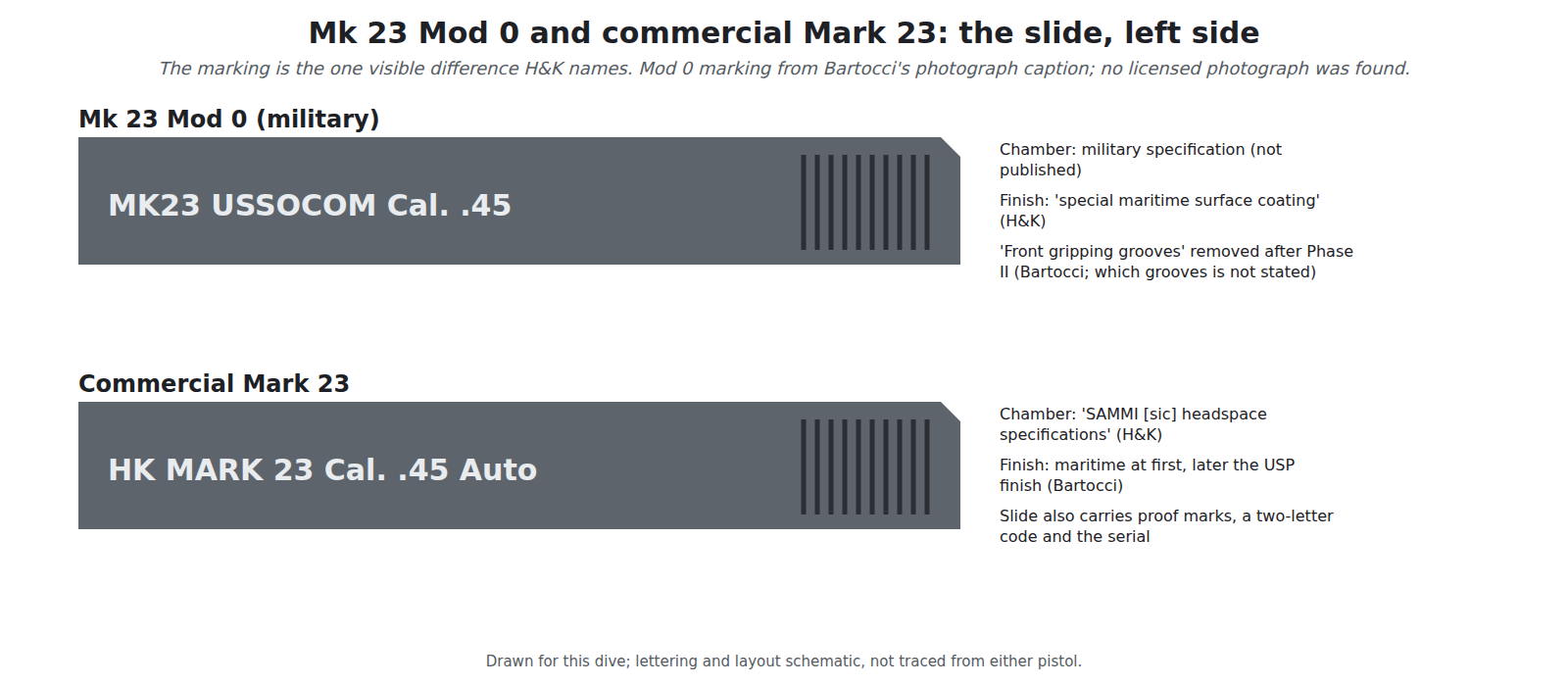
H&K names two differences between the Mk 23 Mod 0 and the commercial Mark 23: “slide markings (Mark 23 as opposed to MK 23) and a barrel manufactured to SAMMI [sic] headspace specifications”. Bartocci adds the finish, the first commercial pistols having the military maritime finish and later ones “the same finish as the USP”.29
So, from the outside:
- The slide marking is the one external difference H&K itself names. “MK23 USSOCOM” (Bartocci) identifies the military pistol; “MARK 23” identifies the commercial one.10
- The barrel’s headspace cannot be checked without gauges, and H&K does not publish the military specification. Whether military barrels are marked differently was not established.
- The finish of an early commercial pistol may be the military finish, by Bartocci’s account; it is not by itself evidence of a military pistol.
A Mk 23 Mod 0 in private hands in the United States would be unusual, because issued pistols are government property. No legitimate civilian sale of surplus Mod 0 pistols was found for this dive. A pistol offered as a “Mod 0” should be expected to be a commercial Mark 23, and a commercial pistol with a re-marked or replaced slide is not a military pistol.
4.10 Reading the slide markings
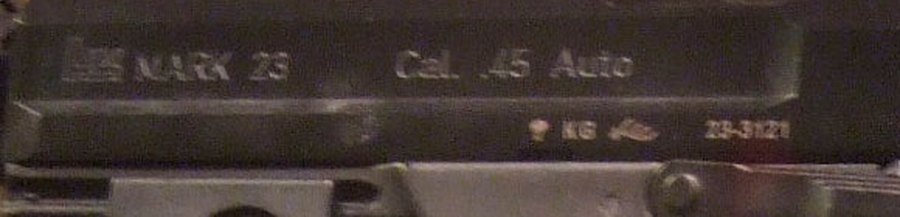
The commercial Mark 23 photographed on Commons is marked on the left of the slide, from front to back: H&K’s logo, MARK 23, and Cal. .45 Auto; and on a lower line, a small proof-house mark, the letters KG, an eagle device, and the serial number, 23-3121.11
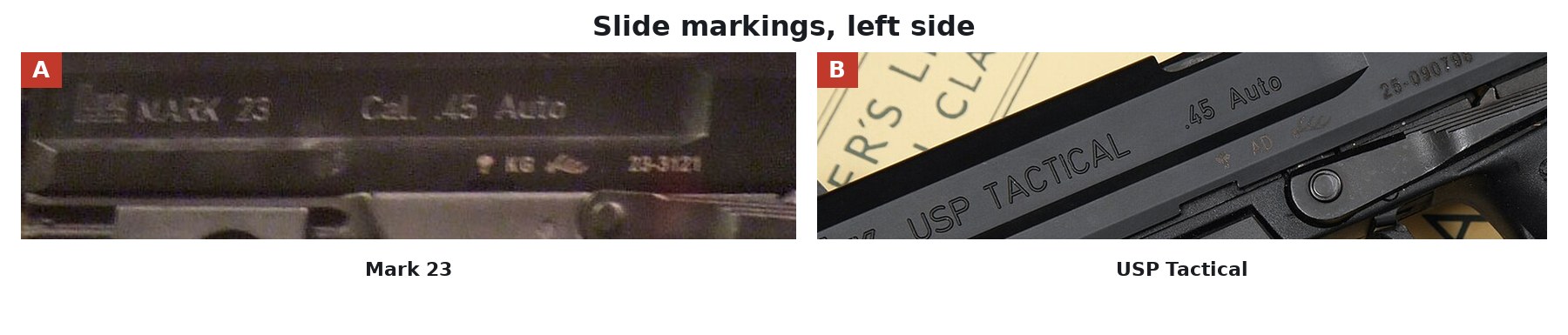
What the parts mean, as far as the sources allow:
- The two-letter code. H&K marks a two-letter code beside the proof marks. The hub’s HK PSG1 dive, Volume 5 records an auction house reading such codes on PSG1 receivers as dates, “IB” as 1981 and “KF” as 1995, and notes that H&K’s key was not found in an H&K document. Read by the same pattern (a letter for the decade’s last digit and a letter for the year’s, with I for 8, K for 9, B for 1, F for 5), KG would be 1996. That is an inference from an auction house’s readings, not from H&K, and it is offered as such.
- The serial. The commercial pistol’s serial begins 23-; the USP Tactical photographed has a serial beginning 25-, and the USP Expert one beginning 24-. H&K’s serial prefixes are evidently model-related, but no H&K table of them was found, and none is asserted here.
- The proof marks. German-made firearms are proofed under German law, and the slide carries proof-house and proof marks. Their exact forms are not legible enough in the photograph to identify, and are not identified here.
The H&K manual’s water-operations section confirms how the marks are applied: the serial number and proof marks on the barrel and slide “are etched on the permanent protective coating”, so they can corrode in prolonged salt-water exposure (Volume 5).2 H&K’s manual mentions marks on the barrel too; the barrel’s markings were not visible in any photograph found.
4.11 The prototypes
Phase I and Phase II pistols differ from production pistols in ways Bartocci describes from photographs in his article.10
Table 3 — The prototypes
| Phase | Features (Bartocci) |
|---|---|
| Phase I | ”original non checkered frame, slide lock for silent suppressed fire”, H&K’s own suppressor |
| Phase II | ”slide lock removed, new frame with checkered front and backstrap and beveled mag well” |
| Production | ”the front gripping grooves were also removed”; slide “marked MK23 USSOCOM Cal. .45” |
No photograph of a prototype that could be published was found, and the whereabouts of the prototypes are not documented. A Mk 23 with a smooth frame, a slide lock or front grip grooves would be of exceptional interest and would need provenance.
4.12 The later H&K .45s: HK45 and the Mk 24
The HK45 family is a separate design, not a Mk 23 variant. Tactical Weapons reported in 2012 that the HK45 Compact Tactical had been adopted by Naval Special Warfare as the Mk 24 Mod 0, and shows it with a 1913 rail on the dust cover; Sandboxx’s 2022 account says “The Mk 24 descends from the Mk 23”.512 In identification terms the HK45s are easy to separate: they have a rail rather than grooves, their own slide markings (“HK45” or “HK45C”), and a shorter overall length. The Mk 24’s own markings were not found.
4.13 Replicas
The Mk 23 is one of the most reproduced pistols in airsoft, and the replicas outnumber the real pistols in photographs. Every Flickr result for “SOCOM Mk23” checked for this dive through Openverse was a Tokyo Marui airsoft pistol, and others were KWA airsoft pistols, one titled by its photographer “KWA USA H&K MK23 USSOCOM Pistol with Trademarks”.13 (None is reproduced: their licences forbid commercial use, and they are not firearms.) Some replicas therefore carry H&K’s markings, and, to judge by that title, the military “USSOCOM” name that the real commercial pistol does not carry.
That last point is the useful one. A pistol marked “MK23 USSOCOM” offered on the civilian market is far more likely to be a replica than a Mod 0. The identification checks for a real Mark 23 are the ones a firearm offers: a serial number and proof marks on the slide (and, by law, on the frame), a steel slide and the weights H&K publishes (2.66 lb with an empty magazine, by the manual).2
4.14 Tell them apart: the table
Table 4 — Tell them apart: the table
| Feature | Mk 23 Mod 0 | Commercial Mark 23 | USP45 | USP45 Tactical | Where to look |
|---|---|---|---|---|---|
| Slide marking | ”MK23 USSOCOM Cal. .45” (Bartocci) | “MARK 23 Cal. .45 Auto" | "USP” and “.45 Auto" | "USP TACTICAL” and “.45 Auto” | Left of slide |
| Overall length | 245 mm | 245 mm | 200 mm | 218 mm | Measure |
| Frame width | about 1.5 in | about 1.5 in | not found | 1.26 in | Top or front view |
| Controls | Decocker forward, ambidextrous safety at rear | Same | Single control lever (variant-dependent) | Single control lever | Rear of frame, left |
| Barrel | Threaded, O-ring | Threaded, O-ring | Not threaded | Extended, threaded, O-ring | Muzzle |
| Thread | M16×1 RH (reported) | M16×1 RH (reported) | none | M16×1 LH (reported) | Try a known cap |
| Accessory mount | Mk 23 grooves, threaded insert in the trigger guard | Same | USP grooves | USP grooves | Front of frame and guard |
| Trigger guard | Extended, recurved, flared at the magazine release | Same | USP | USP | Side view |
| Sights | Fixed 3-dot or tritium, exchangeable rear | Same | USP standard | Adjustable target | Rear sight |
| Trigger stop | none in parts list | none in parts list | — | Adjustable | Behind the trigger |
| Chamber | Military (unpublished) | SAAMI headspace | SAAMI | SAAMI | Gauges |
| Finish | ”Special maritime surface coating” | Maritime at first, later the USP finish (Bartocci) | not checked | ”Hostile Environment” blued (H&K, 2004) | Bartocci; date code |
Sources as cited above. “Reported” means stated by The Firearm Blog and PEW Science but not by H&K.
References
Footnotes
-
Heckler & Koch, Inc., “Mark 23, USP Tactical and Match” page, Wayback capture of 28 January 2000, http://web.archive.org/web/20000128213444/http://www.hecklerkoch-usa.com:80/Pages/mk23.html, consulted 2026-10-18. ↩ ↩2 ↩3 ↩4 ↩5
-
Heckler & Koch, Inc., Mark 23 Pistol .45 ACP operator’s manual (“Revised March 2007”; PDF dated 22 August 2008), Sections 1, 2, 4, 6, 9 and 10, parts list p. 34. Wayback capture of 11 August 2011, https://web.archive.org/web/20110811030250/http://www.hk-usa.com/-images/shared/Mark%2023_Ops_Manual_2008.pdf, consulted 2026-10-18. ↩ ↩2 ↩3 ↩4 ↩5 ↩6 ↩7 ↩8 ↩9 ↩10 ↩11
-
Heckler & Koch, Inc., “The USP Tactical” page, Wayback capture of 18 October 2004, http://web.archive.org/web/20041018000623/http://www.hecklerkoch-usa.com:80/handguns/usptactical.html, consulted 2026-10-18. ↩ ↩2 ↩3 ↩4 ↩5 ↩6
-
Heckler & Koch GmbH, pistol product listing (MK23, USP .45, USP Tactical .45, USP Expert .45, USP Compact .45: length, barrel length, sight radius), Wayback capture of 29 July 2010, http://www.heckler-koch.de/HKWebText/detailProd/1925/104/4/21, consulted 2026-10-18. ↩ ↩2
-
Andy Massimilian, “Heckler & Koch 45CT”, Tactical Weapons (Athlon Outdoors), 1 February 2012, https://athlonoutdoors.com/article/heckler-koch-45ct/, consulted 2026-10-18. ↩ ↩2
-
VISIER, “Portrait: 20 years of Heckler & Koch USP”, all4shooters.com, 17 June 2013, https://www.all4shooters.com/en/shooting/pistols/heckler-koch-semiautomatic-pistol/, consulted 2026-10-18. ↩
-
Pete, “Silencer Saturday #178: H&K and KAC MK23 – The Most Famous Suppressor Combo?”, The Firearm Blog, 29 May 2021, https://www.thefirearmblog.com/blog/2021/05/29/hk-kac-mk23, consulted 2026-10-18. ↩ ↩2
-
Jay (PEW Science), “SSS.6.214 – Suppressed .45 ACP Historical Case Study: HK MK23 and USP45 Silencers – KAC vs. B&T” (free version), PEW Science, 18 February 2026, https://pewscience.com/sound-signature-reviews-free/sss-6-214-kac-b-t-mk23-usp45, consulted 2026-10-18. ↩ ↩2
-
Bartocci, “MK23 Mod 0: The Crew-Served Pistol”, web edition, page 2, https://sadefensejournal.com/mk23-mod-0-the-crew-served-pistol/2/, consulted 2026-10-18. ↩
-
Christopher R. Bartocci, “MK23 Mod 0: The Crew-Served Pistol”, Small Arms Defense Journal vol. 5 no. 2 (2013); web edition of 11 August 2023, page 1 (photograph captions), https://sadefensejournal.com/mk23-mod-0-the-crew-served-pistol/, consulted 2026-10-18. ↩ ↩2
-
Joe Loong, “Mark23SuppressedLeft.jpg”, Wikimedia Commons, CC BY-SA 2.0, https://commons.wikimedia.org/wiki/File:Mark23SuppressedLeft.jpg, consulted 2026-10-18 (markings read from the photograph for this dive). ↩
-
Travis Pike, “These are the Navy’s top 6 Mk handguns”, Sandboxx News, 28 November 2022, https://www.sandboxx.us/news/hitting-your-mark-the-navys-mk-handguns/, consulted 2026-10-18. ↩
-
Openverse image search for “Mk23 pistol” and “SOCOM Mk23”, 18 October 2026 (Flickr results, including a photograph by abcovey titled “KWA USA H&K MK23 USSOCOM Pistol with Trademarks”, CC BY-NC-ND 2.0), https://openverse.org/, consulted 2026-10-18. ↩

Comments (0)