H&K Mk 23 · Volume 7
The Kit: Suppressor, Laser Aiming Module and Holster
The system's other two components: the Knight's Armament suppressor and its booster, the Brügger & Thomet alternative H&K also approved, what each actually achieves by the measures available, the muzzle thread that catches buyers out, the laser aiming module whose designation no primary source confirms, and what the manual asks of a holster
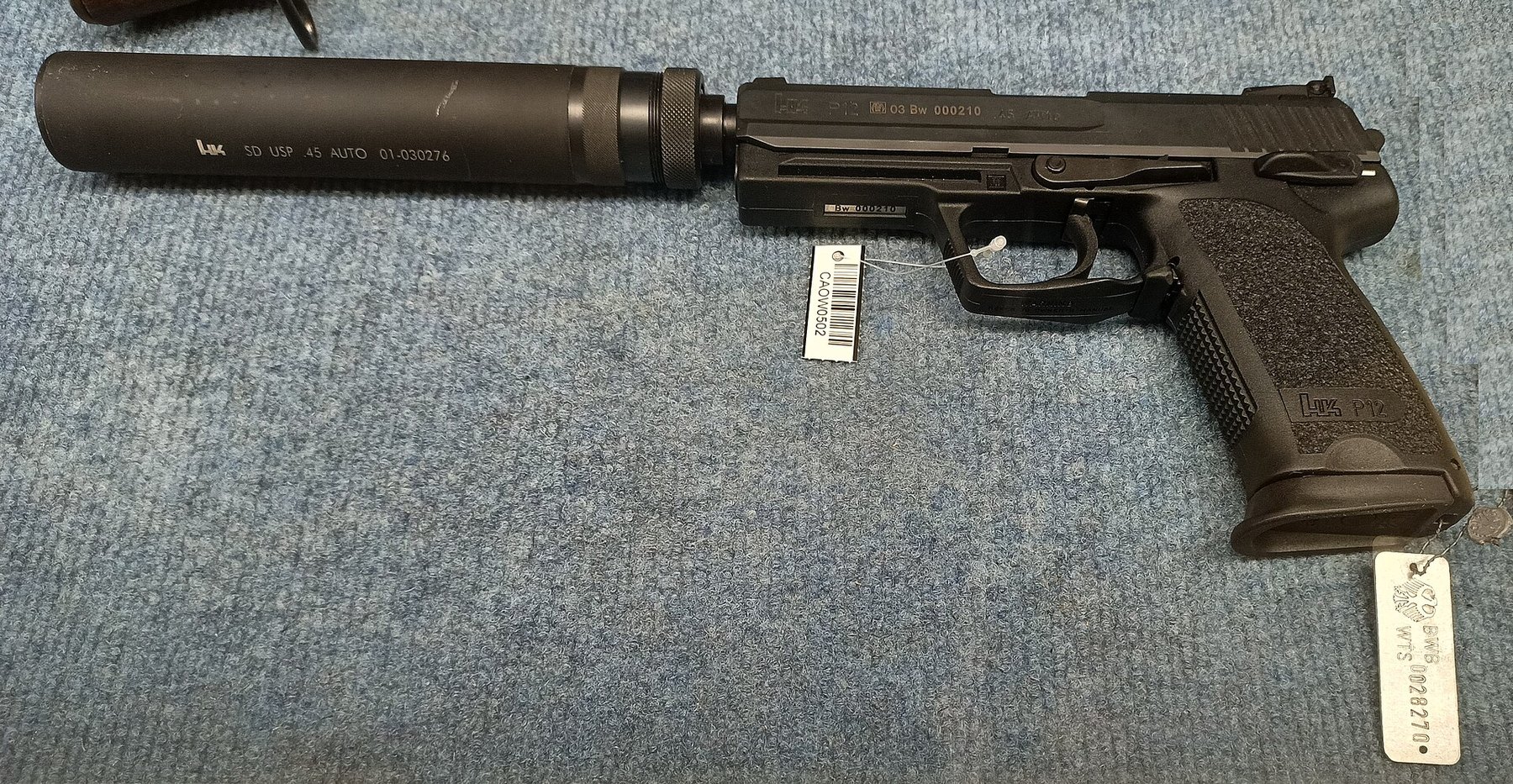
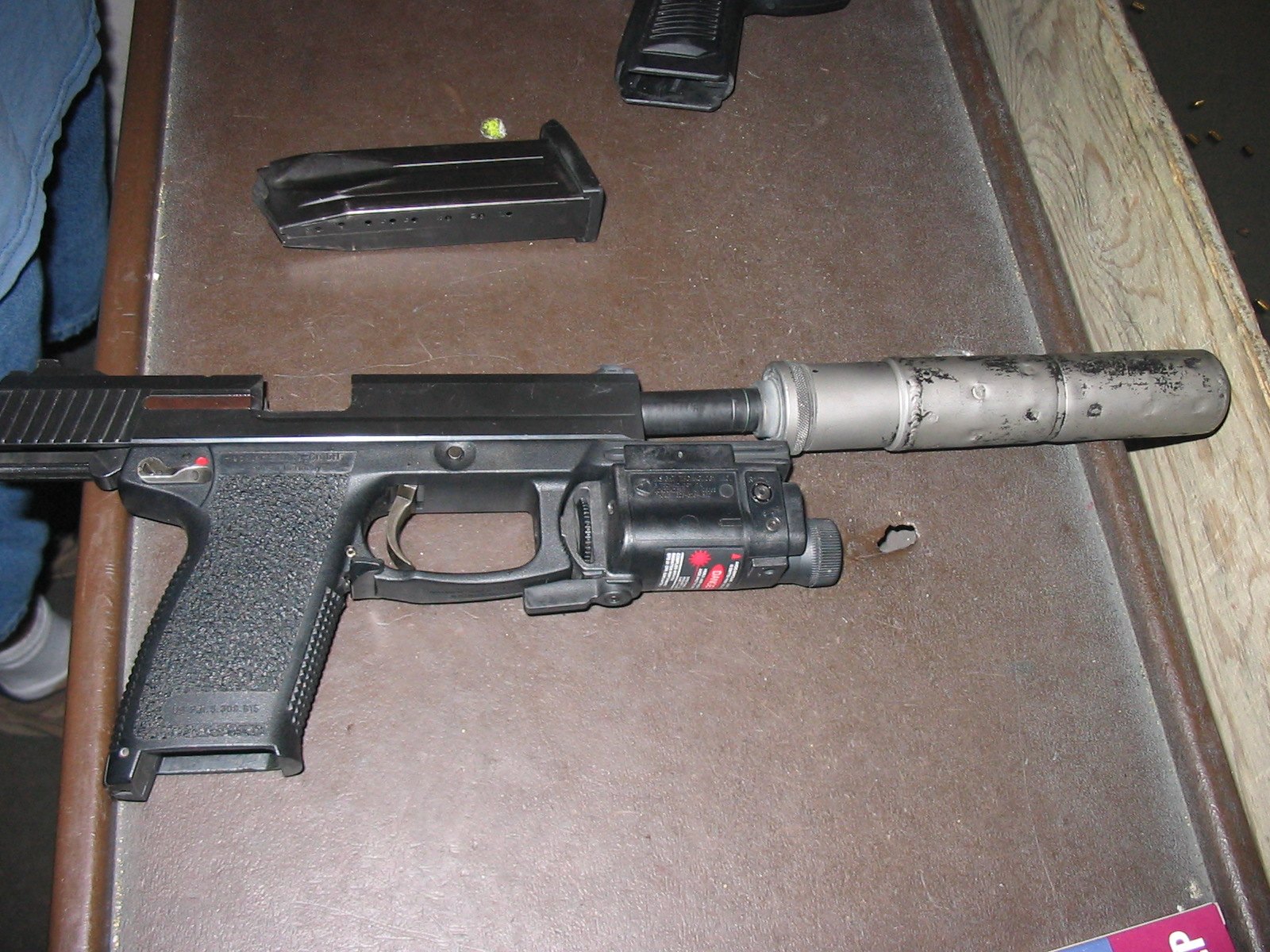
7.1 A system, not a pistol
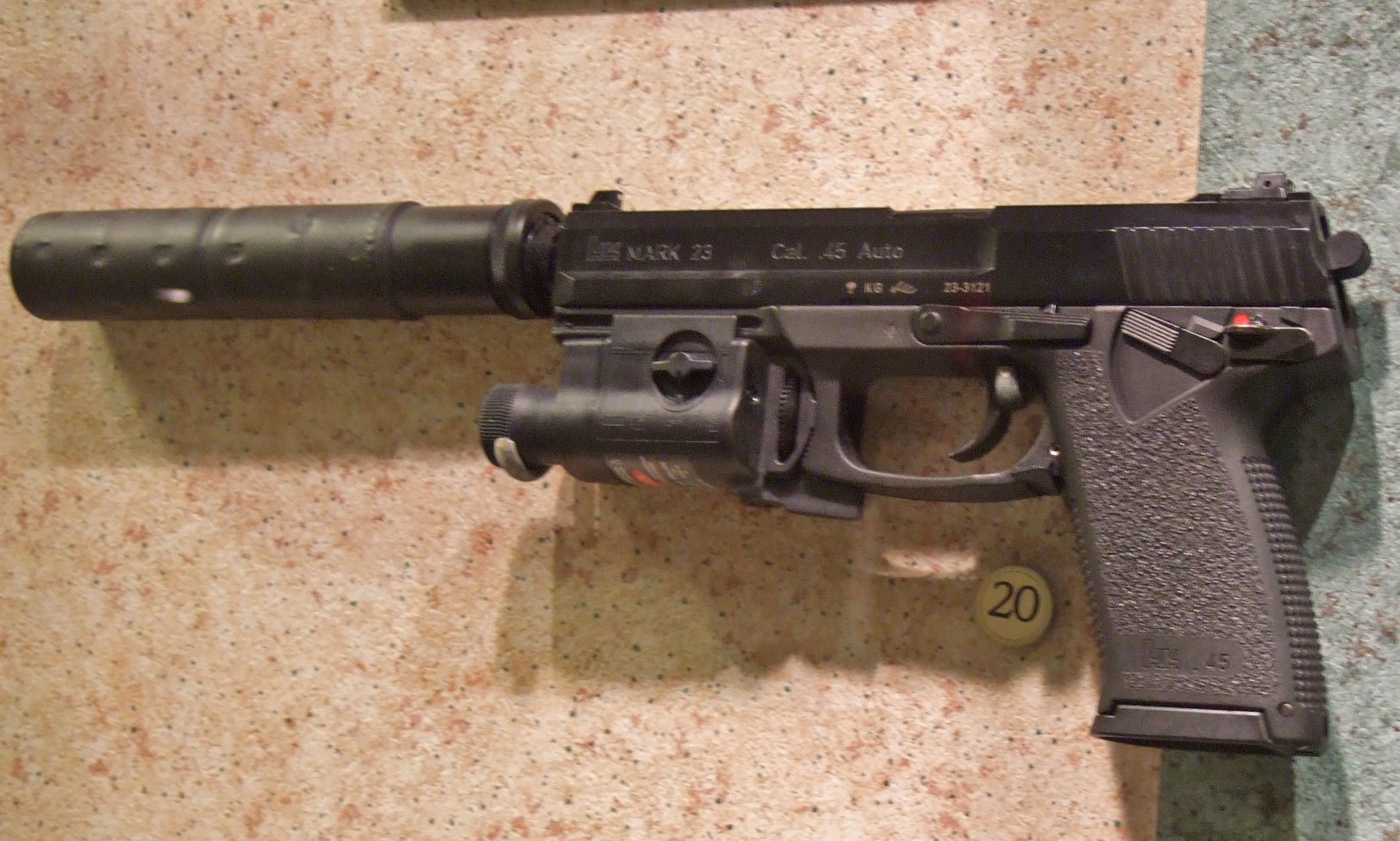
H&K’s manual describes the 1991 development contract as being for a “Special Operations Forces Offensive Handgun Weapon System, consisting of a .45 caliber pistol, detachable sound and flash suppressor, and laser aiming module (LAM)”.1 The pistol is the part sold to the public. The other two were made by other companies, were bought by SOCOM separately, and are much less well documented. Volume 1 has the programme’s history; this volume is about the two components and what replaces them for a civilian owner.
The suppressor law, how suppressors work and the mechanics of the booster are covered in depth by this hub’s Suppressors dives and are linked, not repeated: How Suppressors Work, Suppressors by Caliber, Volume 7 on .45 ACP, and Suppressor Law.
7.2 The suppressor programme: H&K’s can, then Knight’s
Bartocci’s account, the fullest published, is that H&K’s Phase I entry carried an H&K-designed suppressor (a second-generation H&K design appears in his photographs) and that “the Phase II and III suppressors were manufactured by Reed Knight at Knight’s Armament Company”; “the KAC OHWS sound suppressor was designed by Doug Olson”.23 Small Arms Review’s 2006 account of the Colt entry says Knight’s designed Colt’s suppressor too, and that H&K “first tried to design its own silencer, then went with Knight’s design”.4
PEW Science’s 2026 historical study of the two pistol suppressors gives the engineering lineage. It traces the inertial-decoupling idea for pistol suppressors to work at Qual-A-Tec in the 1980s, describes Knight’s “OHG” (Offensive Handgun) suppressor of the early 1990s as “the first perfected production example” of the system, and credits Qual-A-Tec’s people, Rex Stephens, Doug Olson, Charles “Mickey” Finn and others, with the press-crimped cone baffles used in Knight’s suppressors.5 That account is the testing laboratory’s history, not a documented programme history, and it is attributed to PEW Science.
7.3 The Knight’s Armament MK23 suppressor
Knight’s Armament still lists the suppressor. Its own product page, as captured in December 2022, gives:6
Table 1 — The Knight's Armament MK23 suppressor
| Item | Knight’s Armament’s figure |
|---|---|
| Name | MK23 .45 Caliber Suppressor |
| Part number | 94368 |
| Mounting | ”Threaded Connection for Mk23 Pistols” |
| Weight | 15.4 oz |
| Length | 7.5 in |
| NSN | 1005-01-435-1917 |
The page gives no diameter, sound reduction or price. The National Stock Number confirms that the suppressor was catalogued in the US military supply system; the NSN itself does not say which units held it or how many.
Other published descriptions add detail. Bartocci: “manufactured from stainless steel with a Moly resin finish and 1.37 inches in diameter”, with a service life of “15,000 rounds”.3 PEW Science, measuring a current example: 1.37 in diameter, 7.63 in long, 14.7 oz with its piston, a TIG-welded stainless tube and plug-welded crimped-cone baffles, and three host-specific pistons retained by an O-ring (Knight’s part 23015, which PEW gives as 0.674 × 0.544 × 0.065 in and recommends replacing in Viton or a similar heat-resistant material).5 PEW also notes that rotating the piston by the rear retaining cap can be used to adjust the point of impact.5
The Firearm Blog, reviewing one in 2021, describes the baffles as “segmented into sections with raised humps pointing towards the center of the can”, reports that “the only part of the KAC MK23 suppressor that would appear to be user serviceable is an o-ring inside the piston”, that the “current batch of KAC suppressors come dual marked as MK23/USP models”, and that spare booster assemblies run “upwards of $600 alone”. It gave the can’s price as ”~$1300-$1500” and a “9-12 month manufacturing window”.7 Those prices are dated 2021 and are TFB’s.
7.4 How much quieter? Four sets of figures
The OHWS suppressor’s performance is quoted everywhere and documented almost nowhere. Four kinds of figure exist, and they are not the same measurement.
Table 2 — How much quieter? Four sets of figures
| Figure | Conditions | Source |
|---|---|---|
| 26 dB reduction dry, 36 dB with 5 cc of water | Not stated beyond “230 gr ball” (for the Colt entry’s Knight’s can) | Small Arms Review 2006; Bartocci 2013 (Mk 23 can) |
| 28 dB | B&T’s figure for its Impuls IIA .45, with the caveat that “actual suppression may vary due to firearm, barrel length, ammunition and environmental factors” | B&T catalogue 2025 |
| PEW Suppression Rating 32.1 (muzzle), 38.3 (overall) | Knight’s can on a Mk 23, Speer Lawman 230 gr, PEW’s standard method | PEW Science 2026 |
| PEW Suppression Rating 26.5 (muzzle), 29.0 (overall) | B&T Impuls IIA SD Mk23 Rev. 03 on a Mk 23, same conditions | PEW Science 2026 |
Sources: SAR, Bartocci, B&T, PEW Science.4385
The decibel reductions are unqualified figures from secondary sources and a maker. PEW’s numbers are not decibels. They are PEW’s Suppression Rating, a single number computed from the pressure and impulse of the sound signature and mapped to a hearing-damage model, measured at a defined position; the hub’s How Suppressors Work, Volume 2 explains what it is and why it cannot be converted to a decibel figure. They are the only figures in the table measured by a published, repeatable method, and on that method the Knight’s can is the better suppressor on this pistol by a clear margin. PEW’s conclusions, in its staff opinion, are that Knight’s outperforms B&T on both the Mk 23 and the USP45 Tactical, that the Mk 23 can be suppressed better than the USP45 Tactical because of its longer barrel and lock time, and that the B&T’s first-round pop is about twice as severe as its follow-up shots.5
A “30 dB” OHWS requirement is widely repeated. As Volume 1 records, it was not traced to any document, and it is not used here.
7.5 The booster, and why this pistol needs one
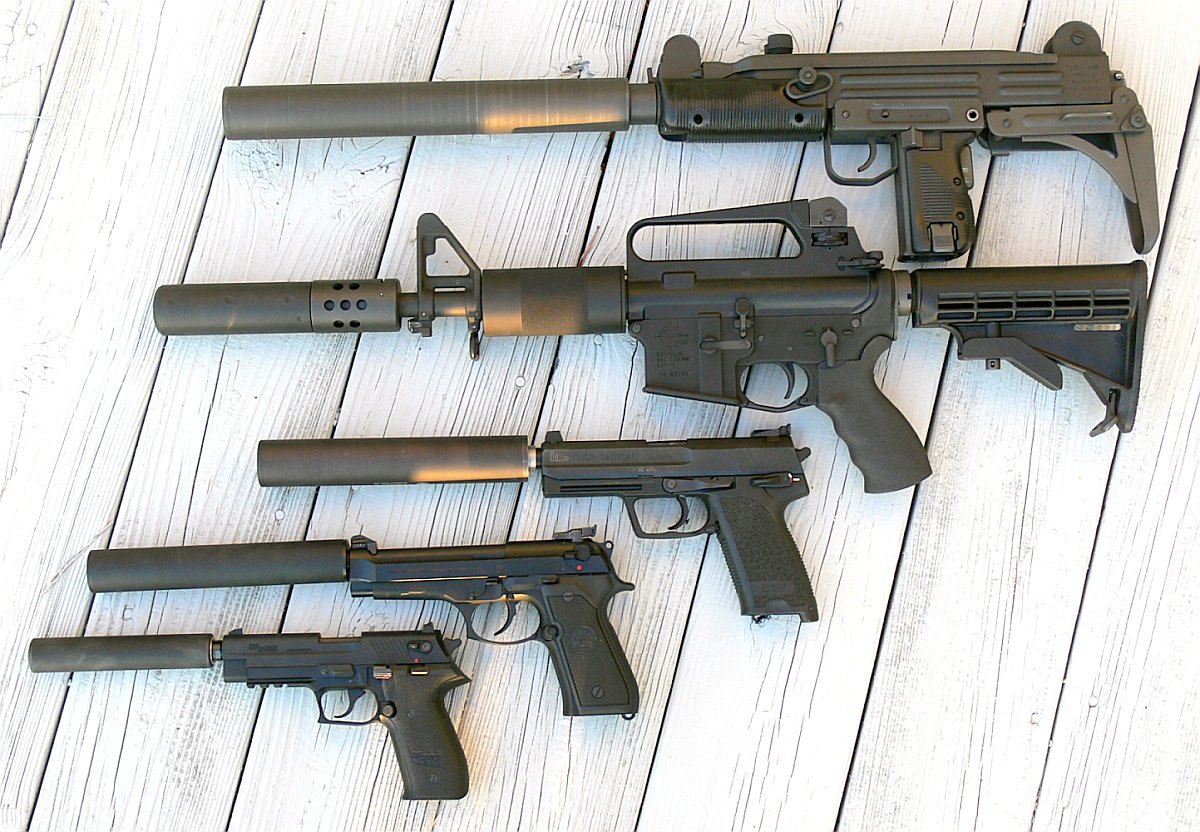
A suppressor screwed to a tilting-barrel pistol adds mass to the end of the barrel that has to tilt. Too much, and the barrel cannot unlock in time; the pistol short-strokes. The fix is a recoil booster, or Nielsen device, in the back of the suppressor: a spring-loaded piston that carries the barrel through its unlocking stroke while the suppressor’s body is briefly decoupled from it. The mechanism, and the general rule that every tilting-barrel pistol needs one, is in this hub’s Suppressors by Caliber, Volume 6 and How Suppressors Work, Volume 7.
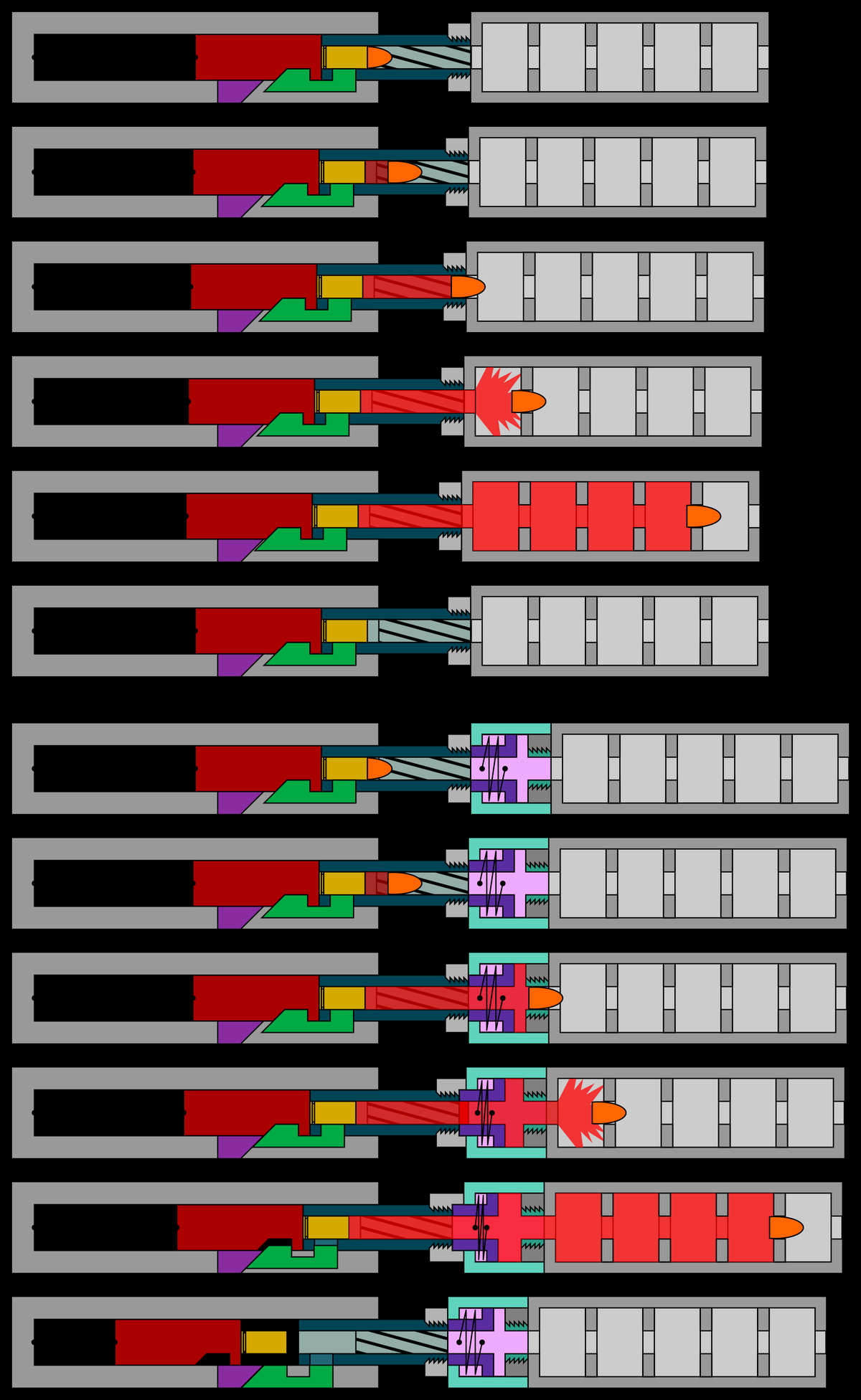
The Mk 23 puts a particular demand on its booster. Its barrel is caught at the end of its rearward travel by the buffered guide rod (Volume 3), not by a hard stop, and it is centred at the muzzle by an O-ring rather than a bushing. Bartocci describes Olson’s solution as “a hollow piston in the rear of the sound suppressor”.3 Both approved suppressors use host-specific pistons, and the pistons are not interchangeable between Knight’s and B&T.5 A suppressor with the wrong piston, or one whose piston is worn or dry, will show the symptom H&K’s troubleshooting table lists under “slide does not unlock”: a short, weak recoil stroke (Volume 5).
7.6 Wet and dry
The “36 dB wet” figure refers to the old practice of putting a small quantity of water (Bartocci’s “5 cc”) into the suppressor before firing. The water absorbs heat from the propellant gas, which reduces its volume and pressure and therefore the sound, for the first few shots until it is blown or boiled out. It is a technique documented for this suppressor in the secondary literature only, and PEW’s 2026 study did not test it (“a subject of future research”).35 Water and the suppressor’s internal finish are the owner’s concern; neither maker’s current page discusses wet use.
7.7 The second approved suppressor: B&T’s Impuls IIA
H&K approved two suppressors, not one. Its American web page of January 2000 told Mark 23 owners: “When using Mark 23 pistols with a suppressor, fire only M1911 ball ammunition and use only Heckler & Koch approved suppressors as currently made by Knight Armament Company or Brügger & Thomet.”9 PEW Science’s 2026 study says the same of the present day, that the Knight’s and B&T suppressors “remain the only two silencers officially accepted by Heckler and Koch for use on the MK23 and USP45 Tactical”.5
B&T, of Thun, Switzerland, lists the suppressor as the Impuls IIA in .45 ACP. B&T’s 2025 suppressor catalogue gives it as follows, and places the Impuls IIA in its company history in the mid-1990s with the line “Used by Police and Militaries to this day”:8
Table 3 — The second approved suppressor: B&T's Impuls IIA
| Item | B&T’s 2025 catalogue |
|---|---|
| Calibre | .45 ACP |
| Interface | M16x1L (other threads “possible upon request”) |
| Length | 199 mm |
| Length past the muzzle | 185 mm |
| Weight | 489 g |
| Suppression | 28 dB (qualified, above) |
B&T’s catalogue gives the .45 Impuls IIA’s standard thread as left-hand, which is the thread of the USP45 Tactical. The Mk 23 version, sold in the United States as the B&T MK23 or “Impulse-IIA SD Mk23”, is the right-hand variant; PEW Science’s test example was “Rev. 03”, threaded 16×1 mm right-hand for the Mk 23 (16×1 left-hand for the USP45 Tactical).5
The B&T suppressor’s weight and length are reported four ways, and they are not reconciled here:
Table 4 — The B&T suppressor's weight and length are reported four ways, and they are not reconciled here
| Weight | Length | Source |
|---|---|---|
| 489 g (17.2 oz) | 199 mm (7.83 in) | B&T catalogue 2025, Impuls IIA .45 |
| 12.1 oz with piston | 7.81 in | PEW Science 2026, measured, Rev. 03 |
| 10.8 oz | 7 7/8 in (200 mm) | The Firearm Blog 2023, measured |
| 12.6 oz | 8.8 in | US retail listing |
Sources: B&T, PEW, TFB, retail.8510 The lengths agree closely except for the retailer’s. The weights do not: PEW describes the current can as an anodised aluminium tube with machined aluminium baffles, and TFB reported in 2023 that the housing had changed material over the years, so B&T’s 489 g may be for an older or different construction. No B&T document reconciling them was found.
7.8 The thread: right-hand M16, and why it matters
The Mk 23’s barrel is threaded M16×1 right-hand, according to every source that states it: The Firearm Blog in 2021 (“the thread pitch on the MK23 is M16x1 RH whereas the USP Tactical barrels are threaded M16X1 LH”) and PEW Science in 2026 (16×1 mm RH for the Mk 23, LH for the USP45 Tactical).75 H&K’s own manual and product pages do not state the thread.
That makes the Mk 23 the odd one out among H&K’s suppressor-ready .45s. A suppressor, booster piston or thread cap made for a USP45 Tactical will not fit a Mk 23, and the reverse; a direct-thread mount for M16×1 left-hand will not even start on the Mk 23’s barrel. Knight’s suppressors are now dual-marked MK23/USP but use host-specific pistons, and the user has to fit the right one.75
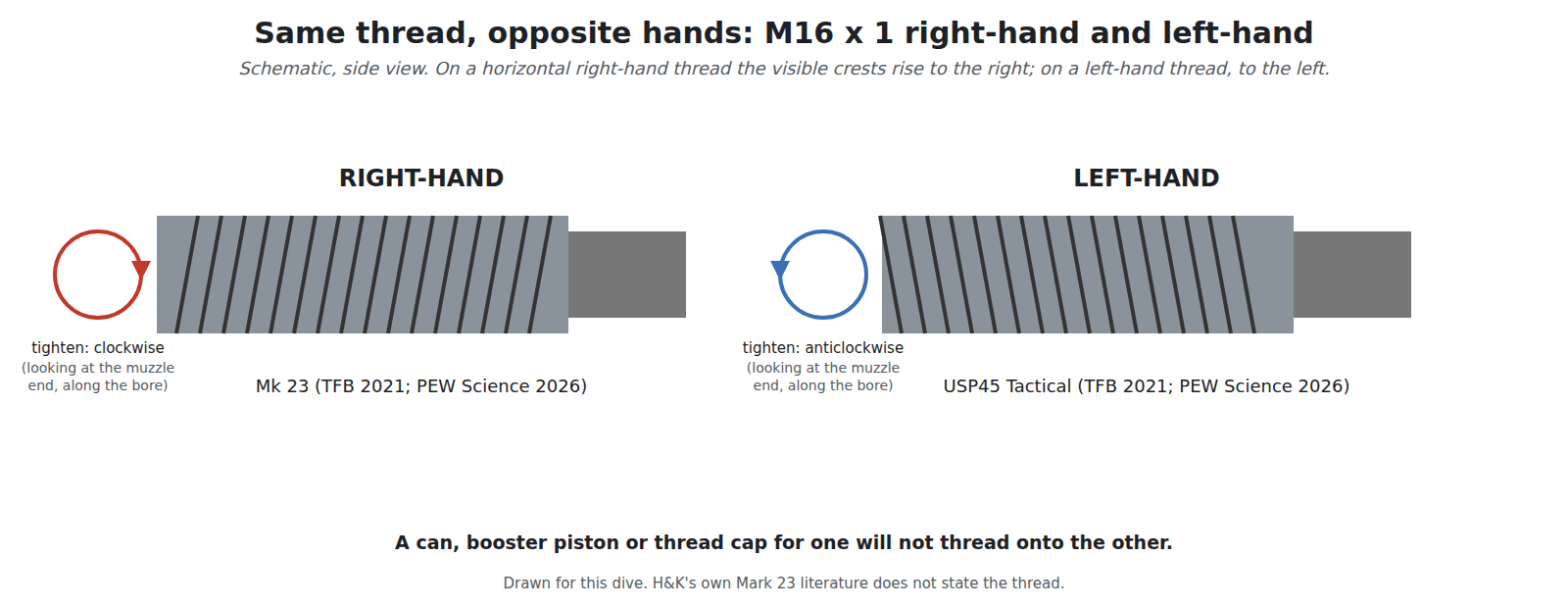
H&K sells a thread cap for the Mark 23, part 970174, listed on its 2024 product page at $19.11 A large US parts dealer lists the same part number as “Mark23 Thread Cap, M16x1 RH”, which is the nearest thing to an H&K-sourced statement of the thread that was found.12
7.9 Using a suppressor on a Mk 23 today
Owning a suppressor in the United States is governed by the National Firearms Act and, for an owner in Michigan, by state law; both are set out in this hub’s Suppressor Law dive, including the reduction of the federal transfer tax on suppressors to $0 from 1 January 2026 (Volume 3) and the Michigan position (Volume 7). Nothing here restates that law.
What is specific to the Mk 23 is short.
- Thread and piston. M16×1 right-hand, and a booster piston made for the Mk 23. A general-purpose .45 suppressor with an M16×1 RH piston can be fitted; TFB’s reviewer used an M16×1 RH piston on a SilencerCo Octane 45HD.7
- Ammunition. H&K’s instruction in 2000 was “fire only M1911 ball ammunition” with a suppressor.9 The reasons are in Volume 6: 230-grain ball is subsonic, and some +P loads are not. PEW warns that +P (or hotter) ammunition “may” damage the B&T can.5
- Sights. The Mk 23 was designed to be fired suppressed with its standard sights; a 1.37-inch can on its 5.87-inch barrel sits below the line of sight. A larger-diameter modern can may not.
- Point of impact. Expect the point of impact to move with the can fitted. Knight’s piston can be rotated to adjust it.5
7.10 The laser aiming module
The third component is the worst documented. What is known:
- The maker. Bartocci says the LAM “is manufactured by Insight Technologies”.3 Insight Technology, of Londonderry, New Hampshire, made a range of weapon-mounted lights and lasers for the US military. No Insight document that names a Mk 23 module was found: its archived federal product pages of 2006 were checked and none mentions the Mk 23 or OHWS.13
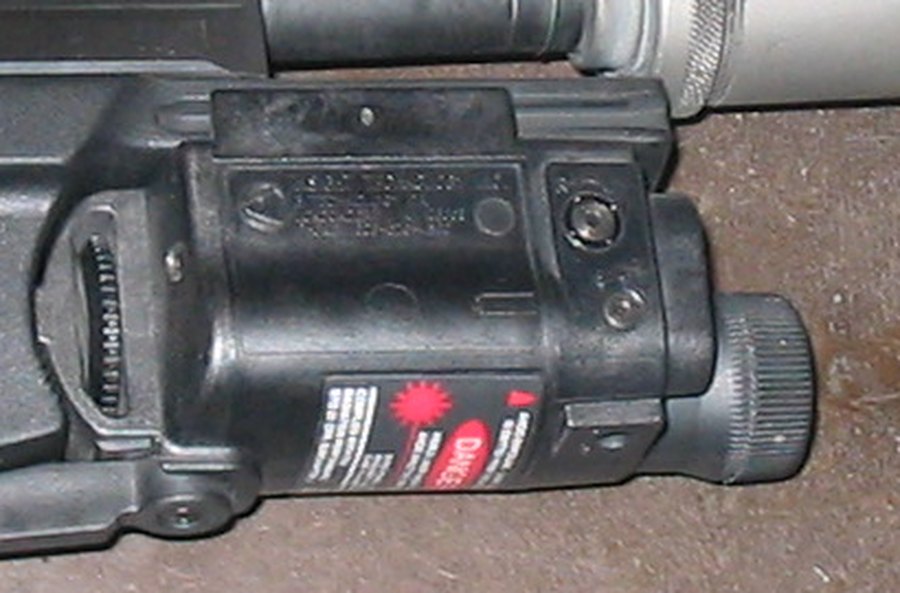
- The specification, by Bartocci’s account. “Weighing only 5 ounces, the LAM features a 620 to 650nm visible laser sight”, “a 70 lumen halogen bulb as a light source”, and “a 810 to 850nm infrared laser”; Bartocci’s account also gives two DL123A lithium batteries.3 A visible laser for daylight and close range, an infrared laser and an illuminator for use with night-vision goggles: that is the combination every account gives, and it matches GROM’s description of the pistol as made for use with “a suppressor and an aiming module (a visible laser, a laser visible only through night-vision goggles, and a light)”.14
- The mounting. The module on the commercial pistols photographed on Commons slides into the frame’s grooves ahead of the trigger guard and is held by a knurled thumbscrew into the threaded insert in the front of the guard, the arrangement H&K’s manual describes for “a laser aiming device or an illuminator”.1
What is not known is the module’s designation. A widely repeated claim is that the Mk 23’s module was Insight’s AN/PEQ-6. Insight’s own 2006 page for its LAM-1000 says it was “Known to the U.S. Military as the ILWLP” and that it “Mounts to any MIL-STD-1913 Rail”.15 A 1913 rail is not what the Mk 23 has, and H&K’s manual warns that even USP accessories will not fit the Mark 23’s grooves.1 Other secondary sources equate the LAM-1000, the AN/PEQ-6 and the ILWLP with one another. None of those identifications was confirmed against a primary document for this dive, and the module’s designation is listed as unverified.
7.11 Lights and lasers on the commercial pistol
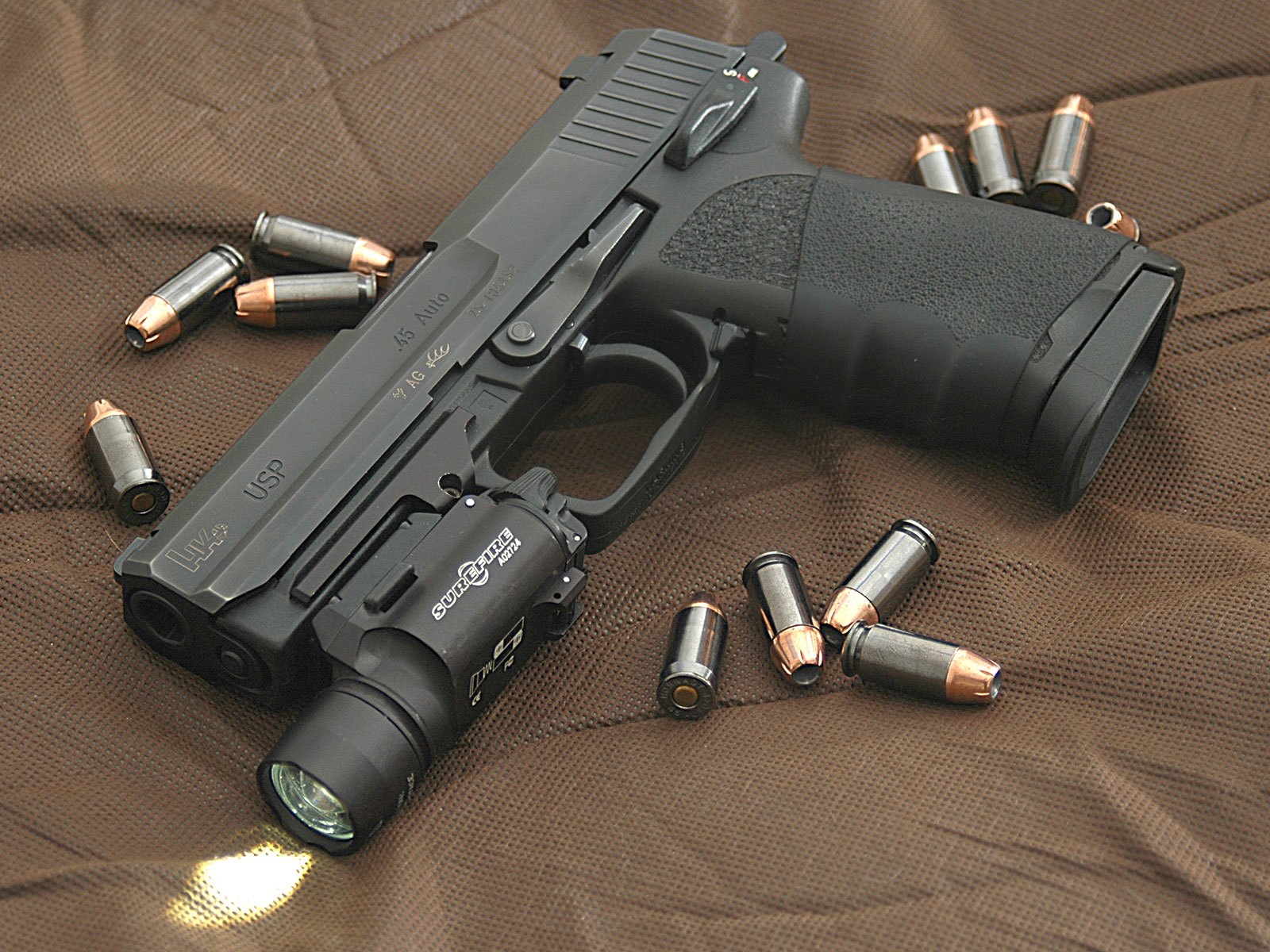
For an owner, the practical point is the one H&K’s manual makes as a caution: “A pair of Universal Mounting Grooves located on the front of the Mark 23 frame allow for a variety of accessories to be used with the pistol. Improperly designed or installed accessories may result in damage to the Mark 23 mounting grooves and/or the Mark 23. Such damage is not covered under warranty. Be certain to use only HKI authorized accessories … Accessories designed for the Universal Self-loading Pistol (USP) will not work on the Universal Mounting Groves [sic] of the Mark 23.”1
H&K’s 2024 product page lists no light, laser or mounting adapter for the Mark 23.11 No current maker’s page for a light or laser designed for the Mark 23’s grooves, or for an adapter from them to a 1913 rail, was found for this dive. Surplus and second-hand modules turn up on the used market; their identification, condition and laser class are the buyer’s problem, and an infrared laser is not a toy (Volume 8). This is a gap in the dive’s research, recorded as such.
7.12 Holsters
H&K’s manual sets four requirements for a holster: it must not touch or work any control (“the hammer, slide release, magazine release lever, and most importantly the safety lever and the trigger”), on the draw, in the holster or on reholstering; it must not push the slide out of battery when the pistol is reholstered; it must have room for any accessory fitted; and it should be “a holster designed for the Mark 23”. The pistol goes into the holster decocked, or cocked with the safety on, and never otherwise.1
The safety-lever requirement is the one that bites. H&K warns that the safety “can be moved to the ‘fire’ position (down) with a minimal amount of force”, including “during removal of the pistol from the holster” (Volume 3).1 A holster whose mouth rides on the ambidextrous safety levers is unsuitable for cocked-and-locked carry.
Which holster SOCOM issued with the pistol, and who made it, was not established. Holsters described as Safariland models for the Mark 23 appear on second-hand listings, but no current maker’s page confirming a Mark 23 fit was found. The pistol is large: 9.65 inches long and 5.9 inches high without the magazine, and 1.58 inches across the frame by H&K’s manual, before a module or suppressor is added (Volume 3). A holster for the pistol with its aiming module is a different holster from one for the bare pistol.
7.13 What the record does not contain
- The suppressor’s requirement (the “30 dB” figure is untraced) and SOCOM’s test results for it.
- How many suppressors and aiming modules were bought, and whether “1,950 systems” (Volume 1) included one of each per pistol.
- The aiming module’s military designation, part number and NSN; any Insight document naming it.
- The issued holster.
- A current maker of lights or lasers for the Mark 23’s grooves.
- B&T’s Mk 23 product page (none was reachable; the catalogue gives the left-hand .45 model).
References
Footnotes
-
Heckler & Koch, Inc., Mark 23 Pistol .45 ACP operator’s manual (“Revised March 2007”; PDF dated 22 August 2008), Sections 1, 4, 8 and 11. Wayback capture of 11 August 2011, https://web.archive.org/web/20110811030250/http://www.hk-usa.com/-images/shared/Mark%2023_Ops_Manual_2008.pdf, consulted 2026-10-18. ↩ ↩2 ↩3 ↩4 ↩5 ↩6
-
Christopher R. Bartocci, “MK23 Mod 0: The Crew-Served Pistol”, Small Arms Defense Journal vol. 5 no. 2 (2013); web edition of 11 August 2023, page 1, https://sadefensejournal.com/mk23-mod-0-the-crew-served-pistol/, consulted 2026-10-18. ↩
-
Bartocci, “MK23 Mod 0: The Crew-Served Pistol”, web edition, page 2, https://sadefensejournal.com/mk23-mod-0-the-crew-served-pistol/2/, consulted 2026-10-18. ↩ ↩2 ↩3 ↩4 ↩5 ↩6 ↩7
-
Christopher R. Bartocci, “Colt Offensive Hand Gun”, Small Arms Review vol. 10 no. 3 (December 2006); web edition credited to “SAR Staff”, https://smallarmsreview.com/colt-offensive-hand-gun/, consulted 2026-10-18. ↩ ↩2
-
Jay (PEW Science), “SSS.6.214 – Suppressed .45 ACP Historical Case Study: HK MK23 and USP45 Silencers – KAC vs. B&T” (free version), PEW Science, 18 February 2026, https://pewscience.com/sound-signature-reviews-free/sss-6-214-kac-b-t-mk23-usp45, consulted 2026-10-18. ↩ ↩2 ↩3 ↩4 ↩5 ↩6 ↩7 ↩8 ↩9 ↩10 ↩11 ↩12 ↩13 ↩14
-
Knight’s Armament Company, “MK23 .45 Caliber Suppressor” product page, Wayback capture of 10 December 2022, https://web.archive.org/web/20221210/https://www.knightarmco.com/13563/shop/signature-reduction/pistol-suppressors/45cal/mk23-45-caliber-suppressor, consulted 2026-10-18. ↩
-
Pete, “Silencer Saturday #178: H&K and KAC MK23 – The Most Famous Suppressor Combo?”, The Firearm Blog, 29 May 2021, https://www.thefirearmblog.com/blog/2021/05/29/hk-kac-mk23, consulted 2026-10-18. ↩ ↩2 ↩3 ↩4
-
B&T AG, Suppressors catalogue 2025 (English), technical specifications table and company history, https://bt-ag.ch/wp-content/uploads/catalog/B&T_Catalogue_Suppressors_2025_EN.pdf, consulted 2026-10-18. ↩ ↩2 ↩3
-
Heckler & Koch, Inc., “Mark 23, USP Tactical and Match” page, Wayback capture of 28 January 2000, http://web.archive.org/web/20000128213444/http://www.hecklerkoch-usa.com:80/Pages/mk23.html, consulted 2026-10-18. ↩ ↩2
-
Austin R., “Silencer Saturday #296” (B&T MK23 suppressor), The Firearm Blog, 16 September 2023, https://www.thefirearmblog.com/blog/2023/09/16/bt-mk23-suppressor/, consulted 2026-10-18. ↩
-
Heckler & Koch USA, “MARK 23” product page, Wayback capture of 28 December 2024, https://web.archive.org/web/20241228154506/https://hk-usa.com/hk-models/mark-23/, consulted 2026-10-18. ↩ ↩2
-
Midwest Gun Works, “Heckler and Koch Mark23 Thread Cap, M16x1 RH”, H&K part 970174, https://www.midwestgunworks.com/page/mgwi/prod/970174, page title read 2026-10-18. ↩
-
Insight Technology, Inc., federal product pages (showProduct.asp?id=17, 21, 22, 24 to 27), Wayback captures of 3 May 2006, http://web.archive.org/web/20060503161833/http://www.insighttechnology.com:80/federal/showProduct.asp?id=17 and adjacent ids, consulted 2026-10-18. ↩
-
Jednostka Wojskowa GROM, “Uzbrojenie i wyposażenie” (weapons and equipment), Wayback capture of 8 January 2018, https://web.archive.org/web/20180108080940/http://www.grom.mil.pl/uzbrojenie_pliki/UZBROJENIE.HTM, consulted 2026-10-18 (Polish; translated for this dive). ↩
-
Insight Technology, Inc., “LAM-1000” federal product page, Wayback capture of 3 May 2006, http://web.archive.org/web/20060503161910/http://www.insighttechnology.com:80/federal/showProduct.asp?id=24, consulted 2026-10-18. ↩
Comments (0)