H&K Mk 23 · Volume 5
Field Strip, Detail Strip, Maintenance and Repair
H&K's own procedures for clearing, field stripping, cleaning, lubricating and checking the Mk 23; what H&K reserves to its own armourers and why no detail-strip procedure is published; the troubleshooting table, the parts that wear and the parts that send the pistol back to the factory
5.1 The source, and its limits
Everything in this volume that is a procedure comes from one document: Heckler & Koch Inc.’s operator’s manual for the commercial Mark 23, revised March 2007.1 It is a good manual, more thorough than most commercial pistol manuals, with a military shape inherited from the issued pistol: clearing procedure, preventive maintenance checks, a lubrication schedule by surface, a safety and function check after every reassembly, and a troubleshooting table.
It stops at the field strip. “Operator disassembly of the Mark 23 pistol is now complete. Only trained HKI personnel may disassemble the weapon further.”1 No armourer’s manual or US military technical manual for the Mk 23 Mod 0 was found in any public collection for this dive; searches for a Navy (NAVSEA) or SOCOM publication returned nothing that could be checked. The detail strip is therefore described here by what the parts list implies, not by a procedure, and no sequence is given. The section on it says why.
The steps below are paraphrased closely, with H&K’s wording quoted where the exact words matter. The step numbering is H&K’s.
5.2 Clearing
H&K defines a clear Mk 23 by four conditions, all of which must hold: the magazine is removed, the slide is locked to the rear, the chamber is free of brass or ammunition, and the safety lever is set on safe.1 The procedure:1
- Fingers outside the trigger guard, muzzle in a safe direction.
- Decock the hammer or engage the safety. Either lever will do here.
- Press the magazine release and remove the magazine.
- Lock the slide open by pulling it back while pushing the slide release up. Watch for an ejected round or case.
- Inspect the chamber: look through the ejection port, and then put a finger into the chamber to feel for a case. Remove anything found.
Step 5’s physical check is a military habit worth keeping on this pistol in particular, because the Mk 23 has no loaded-chamber indicator. H&K’s manual says so twice, and says that the extractor “does not act as a loaded chamber indicator”, contradicting H&K’s own web pages from 2004 onward (Volume 3).1
5.3 Loading, and a warning about slamming magazines
The manual describes loading the magazine one round at a time, rim pressed down on the follower’s front edge and slid back under the lips; the viewing holes in the back of the magazine show the count.1
It gives two administrative loads (from slide locked back: insert, release the slide, then safety on or decock, then top the magazine up by one; from slide forward: insert, rack fully and “do not ride slide forward”, then the same) and two tactical reloads (from slide lock, and with a round still chambered).1
There is one warning that is particular to the design: “Forcefully inserting a loaded magazine into the Mark 23 may cause the pistol’s slide to close, chambering a cartridge and making the Mark 23 ready to fire.”1 A firmly seated magazine can jolt the follower against the slide release and drop the slide. The muzzle and trigger finger rules apply while seating a magazine on a locked-back slide, not only while firing.
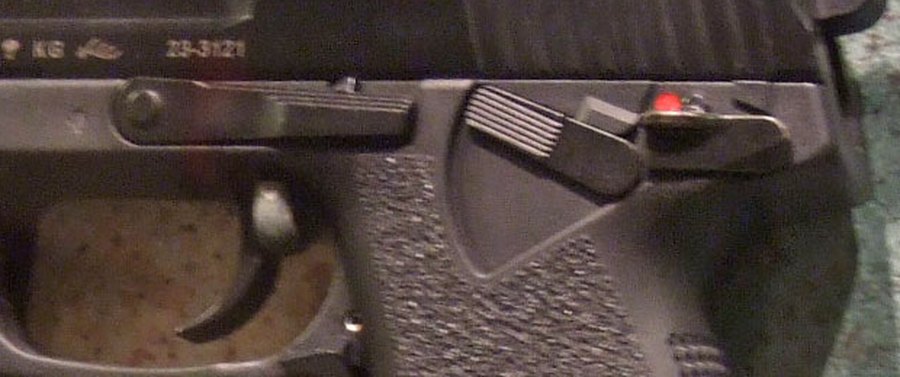
H&K’s ready-to-fire note is that when the safety is pushed down, a “red hazard dot will be visible above safety lever”.1
5.4 Field strip
Before any preventive maintenance, H&K wants the “Firearm Service Record” updated with the round count, a military-style instruction that survives in the commercial manual. The tools listed for maintenance are a cleaning rod with handle and eyelet, a long-handled nylon brush, a .45 bronze bore brush, cotton swabs, solvent or CLP, .45 patches and a rag.1
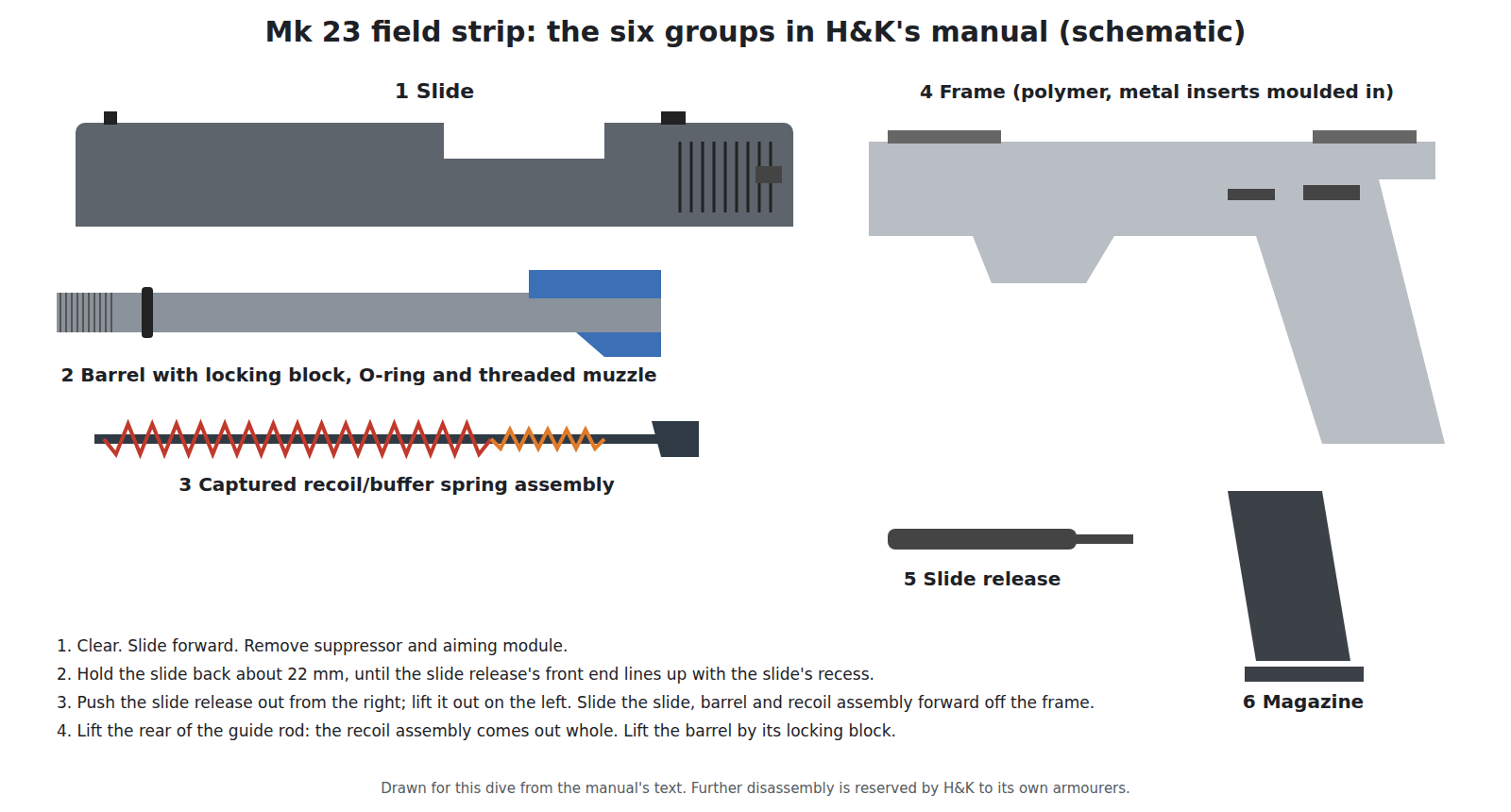
The field strip:1
- Clear the pistol.
- Press the slide release and let the slide go forward.
- Remove any mounted accessories. A suppressor and an aiming module must both come off before the slide can.
- Retract the slide about 22 mm and hold it there with the left hand, until the front end of the slide release is centred on the recess in the left side of the slide.
- Push the slide release from the right side of the frame (its pin end protrudes there), then lift it out from the left.
- Slide the slide forward off the frame, with the barrel and the captured recoil/buffer spring assembly still in it. H&K’s caution: hold the recoil assembly in place while doing so.
- Lift the rear of the guide rod and lift the whole captured recoil/buffer spring assembly out of the slide.
- Lift the barrel by its locking block and withdraw it from the slide.
The recoil assembly is “captured”: its springs, retainers and roll pin stay together on the guide rod, held by a spring clip (the “C-clip” or “spring ring”, part 929191). The field strip does not take it apart, and the manual gives no procedure for doing so (below).
5.5 The magazines: two different floorplates
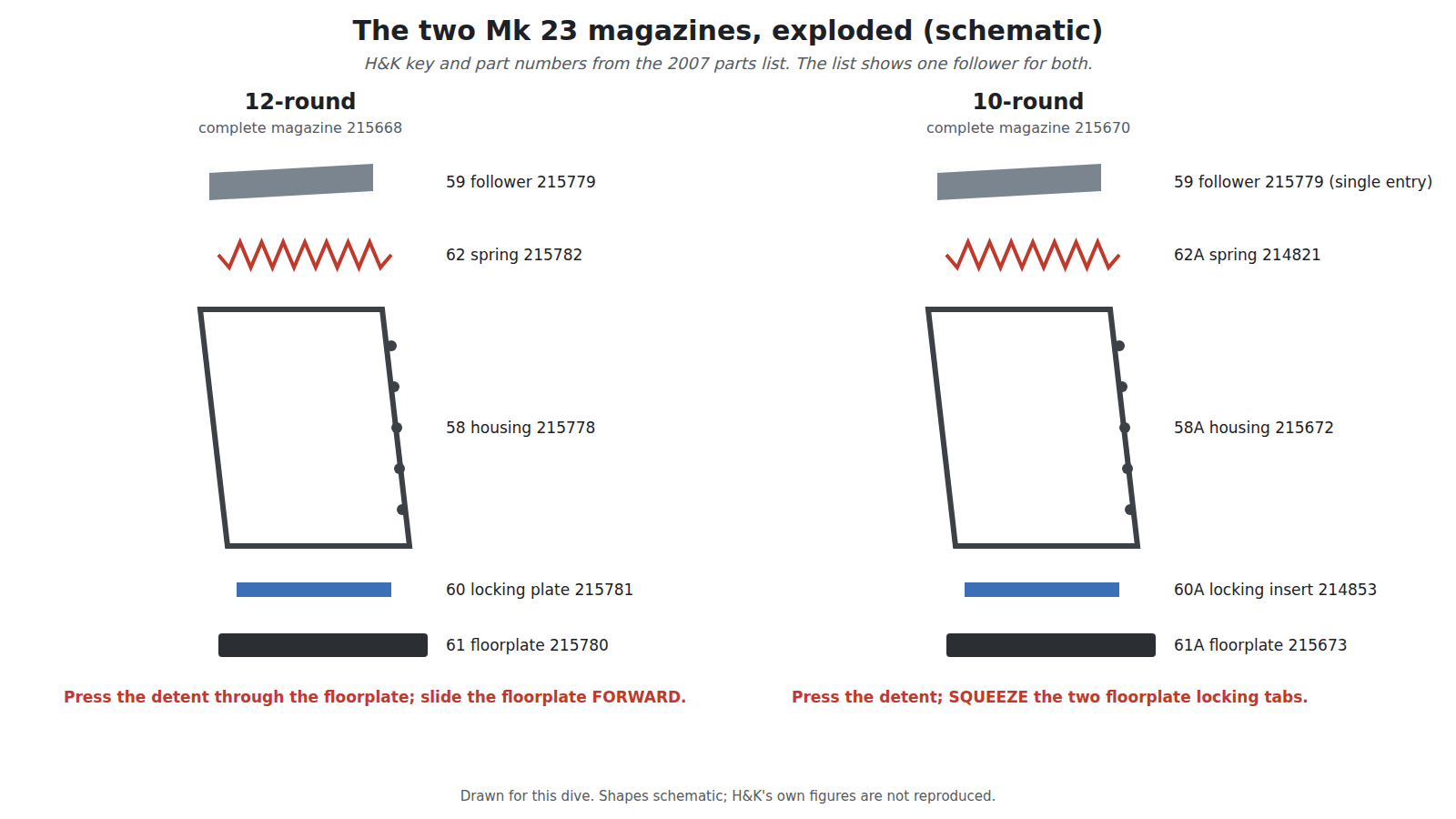
The 12-round and 10-round magazines are different assemblies with different parts, and they come apart differently.1
Table 1 — The magazines: two different floorplates
| Step | 12-round magazine (215668) | 10-round magazine (215670) |
|---|---|---|
| 1 | Depress the locking detent through the hole in the floorplate with a blunt point, and hold it | Depress the “locking insert detente” in the floorplate and hold it |
| 2 | Cover the base with a hand to control the spring | Cover the base with a hand to control the spring |
| 3 | Slide the floorplate forward off the housing | Squeeze the floorplate locking tabs on the right and left sides |
| 4 | Let the locking plate and spring come out slowly | Let the locking insert and spring come out slowly |
| 5 | Remove locking plate, spring and follower | Remove locking insert, spring and follower |
The parts list gives each magazine its own housing (215778 and 215672), locking plate or insert, floorplate and spring, and lists a single follower (215779) with no 10-round alternative, which suggests the two share it.1 The 10-round magazine was the US civilian magazine through most of the commercial pistol’s first decade: H&K’s own page of January 2000 notes that “US Civilian magazine capacity is 10 rounds”, as federal law then required for new manufacture (Volume 2).2
On reassembly, H&K specifies the follower’s orientation on the spring: for the 12-round magazine, “having the loop at the end of the wire on the left side of the follower”; for the 10-round magazine, “the end of the spring positioned on the left of the follower”, with the 10-round locking insert’s “rounded corners face toward the front”. The test of a correct reassembly is the same for both: the follower moves freely under spring tension and rises “nearly flush against the bottom of the magazine lips”.1
5.6 Reassembly, and the step that goes wrong
Reassembly of the pistol reverses the strip, with one step that needs care.1
- Put the muzzle of the barrel through the large hole at the front of the slide.
- Drop the barrel into the slide and push it forward until the O-ring engages the slide, the locking block sits in the ejection port and the locking block’s angled surfaces are visible along the bottom of the slide. “The O-ring will now hold the muzzle tight in the front of the slide.”
- Put the recoil assembly into the slide with the front of the guide rod in the smaller hole at the front of the slide.
- Align the angled locking surfaces on the guide rod with those on the bottom of the barrel’s locking block.
- Push the rear of the recoil assembly forward far enough that the recoil spring retainer engages on the shelf on the front of the barrel locking block. This is the step H&K illustrates separately, under the title “Proper Position for the Captured Recoil/Buffer Spring Assembly on the Barrel Locking Block”.
- Hold the slide in the right hand with the thumb keeping the rear of the recoil assembly in place.
- Hold the frame in the left hand, with the rear of the slide above the front of the frame.
- Draw the slide back onto the frame so that the rails of the locking insert and guiding part run in the slide’s grooves.
- Retract the slide until its left-side recess is centred on the slide release’s hole.
- Insert the slide release from left to right until it is flush and locks.
Step 5 is where the Mk 23’s buffered guide rod (Volume 3) becomes the owner’s business. The guide rod’s rear end is the cam that tilts the barrel; if the recoil spring retainer is not seated on the locking block’s shelf, the cam surfaces are not in register and the slide will not go onto the frame properly, or will not lock. H&K’s step 6, holding the assembly in place with the thumb, exists because the stiff recoil and buffer springs will push it out of position.
H&K’s own note is that operator reassembly “is now complete, but not finished without a safety/function check”.1
5.7 The safety and function check
H&K requires a safety and function check “anytime the pistol is reassembled”, on a cleared pistol.1 It is the most useful single procedure in the manual for anyone buying a used Mk 23, because every failure it can reveal has a defined consequence: return to H&K. It is set out here as a table, in H&K’s order.
Table 2 — The safety and function check
| Test | Do this | It fails if |
|---|---|---|
| Magazine and catch | Insert and release | It is not held securely, or does not drop free |
| Slide | Work it, with and without a magazine | It binds |
| Barrel | Close the slide | The locking block does not lock fully into the ejection port |
| Slide release, hold open | Retract the slide with an empty magazine; then with the release pressed up | It does not hold the slide open |
| Slide release, drop | Press it down; retract the slide with no magazine | The slide does not snap forward; the lever does not rebound under its spring |
| Safety, hammer down | With the hammer down, try to push the safety up | It engages. The safety must not go on with the hammer down |
| Safety, detent | With the hammer cocked, move the safety safe to fire and back several times | There is no pronounced stop in each position |
| Safety, holds hammer | Cock, safety on, pull the trigger three or four times | The hammer falls |
| Decocker, works | Cock, press the decocker | The hammer does not fall, or the lever does not spring back up |
| Decocker, locked out | Cock, safety on, press the decocker three or four times | The hammer falls |
| Hammer rebound (1) | Fire the hammer double action and keep the trigger back; push the hammer forward with a fingertip; release the trigger, then the hammer | The hammer does not spring back to its stop position |
| Hammer rebound (2) | Hammer down, trigger forward: push the hammer with a fingertip | The hammer moves forward to the firing pin |
| Disconnector | Cock, push the slide back about 2 mm, hold it, pull the trigger | The hammer falls |
| Disconnector, slide release | Lock the slide back; pull the trigger and release the slide together | The hammer falls |
| Trigger reset | As above, then release the trigger and pull again | The trigger does not return; or the hammer does not then fall |
| Sear engagement | Trigger forward, thumb pressure on the cocked hammer | The hammer lowers under thumb pressure alone |
Source: H&K manual, Section 9.1 In every failure case H&K’s instruction is the same: return the pistol to the H&K service department.
Two notes on the table. The disconnector test in the manual says “push the slide rearward approximately 3/16 inches (2mm)”. Three-sixteenths of an inch is 4.8 mm, not 2 mm. The description of the disconnector elsewhere in the manual says it engages after 2 mm of slide travel (Volume 3), so the metric figure is the one that tests the stated engagement point; at 4.8 mm the test still holds the slide well past it.1 And after any corrective action H&K requires that “the pistol shall be function fired a full magazine prior to being cleaned and returned to service use”.1
5.8 Cleaning
H&K’s interval: “after each firing, every twelve (12) months, or after any exposure to extreme environmental conditions such as salt, fog, sand, dust, mud, water, etc.”1 The procedure, group by group:1
- Slide. Scrub all internal surfaces with the solvent-moistened nylon brush; remove loose fouling with rag and swabs.
- Recoil/buffer spring assembly. Remove visible fouling with solvent, nylon brush, rag and swabs. It is cleaned assembled.
- Barrel. Scrub the bore with the solvent-moistened bronze brush “from chamber to muzzle at least six passes, back and forth”, and repeat until a patch comes through clean. Scrub the outside of the barrel and locking block, and the threads and O-ring, with the nylon brush.
- Frame. Scrub where carbon is visible, “concentrate on the area normally covered by the slide”, then wipe out.
- Magazine. Disassembled; scrub the follower and feed lips.
The solvent note is generous, and it has one exception that is easy to miss. “All parts of the Mark 23 can be immersed in any cleaning solvent that is safe to put your hands into. Gasoline and other motor fuels are not authorized cleaning solvents. Avoid cleaning the frame in an ultrasonic cleaner, as this can remove the colored ‘safe’ and ‘fire’ dots.”1 The red fire dot is the pistol’s only visual indication of the safety’s state.
5.9 Inspection
During and after cleaning, H&K’s inspection list is: damaged or missing parts; improper assembly or function; absence of free movement or spring tension where it should be present; “unaccustomed looseness”; cracks, burrs, dents or signs of stress; the presence of stops or tactile clicks in the controls; cleanliness; lubrication; corrosion or degradation of the surface finish; and the rubber hammer spur for cracks or chips.1
The last item carries the manual’s starkest warning outside the firing instructions: “If the rubber hammer spur is badly cracked or chipped, drop safety could be degraded. Pistol should be returned to HKI Service Department to replace hammer.”1 The parts list carries the hammer only as “hammer, complete” (215772), so the spur is not a separate part.
The second drop warning is in the firing section: “Whenever the pistol is dropped on a hard surface landing on the hammer (cocked or down), it should be sent to the HKI Customer Service Department as soon as possible to inspect the sear axle. If the sear axle is bent it should be replaced.”1
5.10 Lubrication
The Mk 23’s metal finish, H&K says, “resists all types of corrosion including corrosion resulting from exposure to salt water. However, this surface treatment does not reduce friction between parts; therefore, lubricant must be applied.” Any high-quality medium-weight firearms oil or grease will do; H&K names Break-Free CLP. “Do not use lubricants that boast of their ability to penetrate metal as these substances may deaden primers.”1
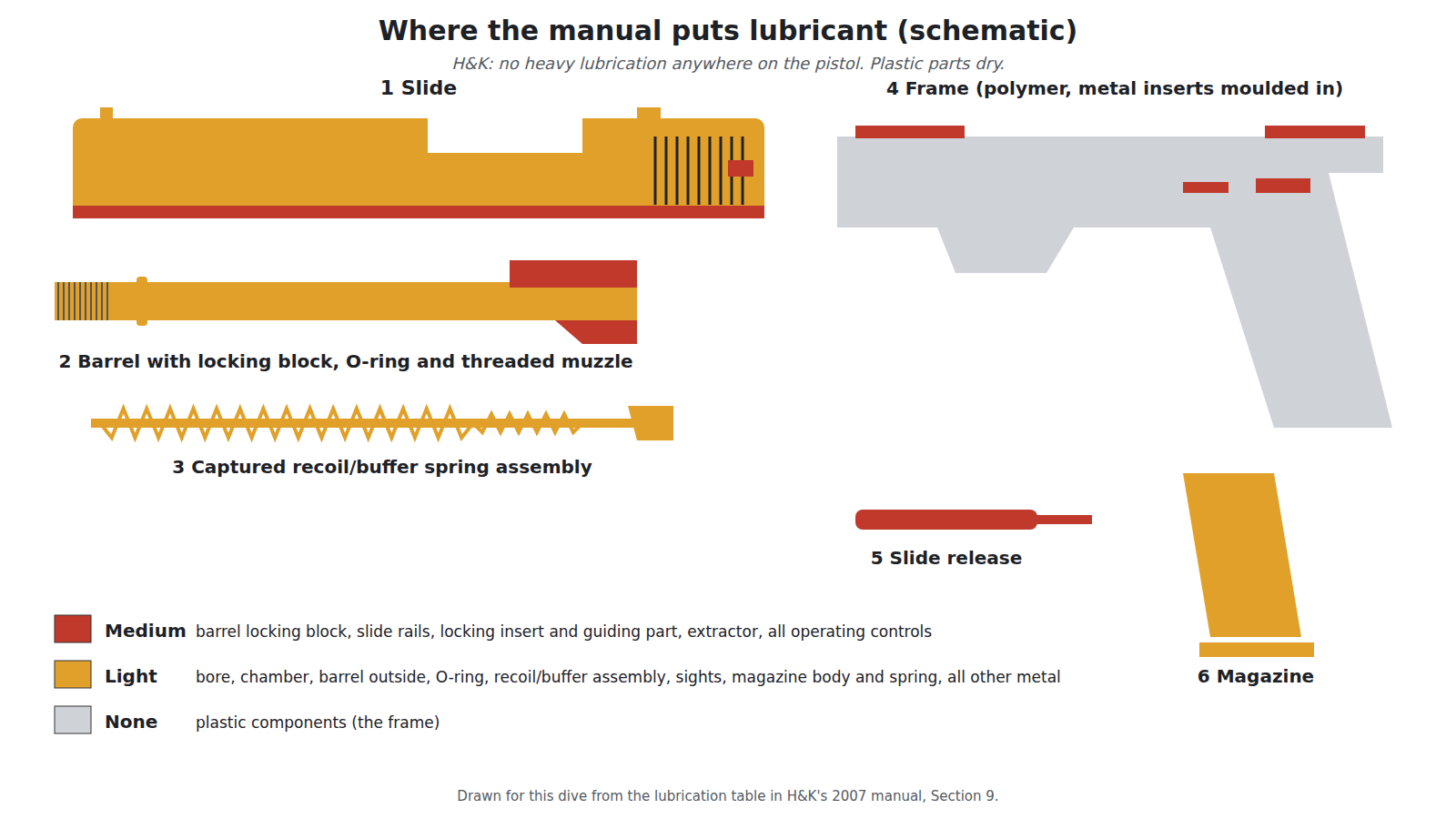
H&K defines three amounts by touch, and assigns every surface to one of them. There is no heavy lubrication anywhere on the pistol.
Table 3 — Lubrication
| Amount | H&K’s test | Where |
|---|---|---|
| None | ”surface is dry and not slippery to the touch” | Plastic components |
| Light | ”finger run across surface yields little or no lube” | Bore, chamber and barrel exterior; all metal parts; all internal parts in slide and frame; magazine housing and spring; recoil/buffer spring assembly; sights; O-ring |
| Medium | ”finger run across surface yields some lube but lube does not run down surface when held in a vertical position” | Barrel locking block; slide rails; all operating controls; locking insert and guiding part; extractor |
| Heavy | ”lube runs down surface when held in a vertical position" | "No heavy lube is required on the Mark 23 pistol” |
Source: H&K manual, Section 9.1
H&K adds that lubricant should be reapplied “periodically during firing as it burns off from the heat”, and suggests a shaving brush, swabs, patches, a rag or a spray bottle with compressed air to spread it.1 For dry, sandy climates the advice reverses (below).
5.11 Unusual conditions: cold, heat, sand and salt water
The manual’s Section 6 is short and practical, and is where the pistol’s maritime origin shows most.1
Table 4 — Unusual conditions: cold, heat, sand and salt water
| Condition | H&K’s instructions, in brief |
|---|---|
| Extreme cold | Clean and lubricate indoors at room temperature if possible; a light coat of LAW (Lubricant, Arctic Weapons) on all functional parts; cover the pistol when moving from warm to cold; keep it dry; never lay a hot pistol in snow; keep snow out of the bore; do not lubricate ammunition |
| Hot, wet | Maintain more often; inspect hidden surfaces for corrosion; wipe off hand prints; dry and lubricate with CLP; check magazines and ammunition for corrosion; keep mud out of the bore |
| Hot, dry | Keep covered; “lightly lubricate internal working surfaces only”; “Do not lubricate external parts”; wipe off excess; do not lubricate magazine internals |
| Heavy rain and water | Keep dry where possible; drain the barrel before firing and dry the bore; lightly lube bore and chamber; “generously lube internal and external surfaces” with CLP |
One instruction under water operations says something about how the pistol is marked: “In extreme or prolonged wet or saltwater conditions, cover serial number and proof mark on barrel and slide with a temporary protective coating. These are etched on the permanent protective coating on the barrel and slide and therefore may corrode under these conditions.”1 The markings are cut through the protective finish to the steel, which is then exposed. Marking methods are in Volume 4.
The manual’s warning for this whole section: “If extensive corrosion is found and cleaning does not solve the problem”, contact H&K.1
5.12 Detail strip: what H&K does not publish
The manual’s parts list names 65 items and gives part numbers for all but the three moulded-in frame inserts.1 It therefore shows what a detail strip would have to deal with, even though H&K publishes no procedure for one and restricts it to “trained HKI personnel”. The following is an account of the parts, grouped as the list groups them. It is not a procedure, and no order of disassembly should be inferred from it.
Slide group. Extractor (215707) and extractor spring (215708); firing pin (215705) and firing pin spring (215706); firing pin block (215709) and its spring (215710); front sight (215721); rear sight and its retaining screw (215711). The rear sight is the one slide part the manual has the owner remove, for elevation changes (Volume 6).
Recoil assembly. Guide rod (215724), recoil spring retainer (215725), buffer spring (215726), dual roll pin (986433), buffer spring retainer (215727), spring ring (929191), washer (215728) and recoil spring (215729). The assembly is captured by the spring ring. The roll pin is the part H&K’s troubleshooting table singles out for inspection, and if it has drifted the instruction is to return the pistol “for replacement”: the manual does not authorise an owner to replace it.
Barrel. Barrel (215671) and O-ring (986429). The O-ring is the one part the manual says an operator can replace, “without tools in seconds”.1
Frame group. Trigger (215735) and trigger pin (215736); trigger bar (215760) and spring (215734); sear (215748), sear spring (215749), sear actuator (215750), disconnector (215751) and sear axle (215753); hammer complete (215772), hammer axle (215738), hammer rebound spring (215739), hammer strut (215740) and hammer strut spring (215741); ejector (215752) and its roll pin (986431); left and right safety levers (215769, 215744) with the right lever’s roll pin (986430), sear block (215754), decocking lockout (215745), safety detent (215746) and detent spring (215747); decocking lever (215766), decocker (215742), decocking spring (214743) and its C-clip (927062); magazine release (215775), spring (215737) and pin (986432); slide release complete (215763) and slide release spring (215733); insert (215731) and locking bolt (215732); and the frame itself (215976).
What this shows is that the frame group is pinned and clipped, not screwed: roll pins for the ejector and right safety lever, a C-clip for the decocker, axles for sear, hammer and trigger. A detail strip needs roll-pin punches of the right diameters, a way of supporting a polymer frame against punch blows without cracking it, and knowledge of the order in which the axles and springs come out and go back, which is exactly what H&K does not publish. The safety and decocker interlock (the decocking lockout and the sear block acting on the sear actuator) is the assembly whose function the safety checks above test, and it is the one that is most consequential to get wrong.
No published detail-strip procedure for the Mk 23 was found, from H&K, from a military armourer’s manual or from a reputable gunsmithing publication. Nor can a USP procedure be borrowed: the Mk 23’s fire control is not the USP’s (it has a separate safety and decocker; Volume 4). For an experienced gunsmith with the parts in hand, the parts list and the safety checks define what a correct reassembly must achieve; the sequence that gets there is not in the public record and is not invented here.
5.13 Troubleshooting
H&K’s troubleshooting table is reproduced here in full, condensed only in wording.1
Table 5 — Troubleshooting
| Problem | Possible cause | H&K’s remedy |
|---|---|---|
| Round does not feed | Fouled magazine or pistol | Clean and lubricate pistol and magazine |
| Improperly assembled | Assemble correctly | |
| Incorrect loading procedure | Load per the manual | |
| Unserviceable magazine | Replace magazine | |
| Round does not chamber | Dirty or damaged magazine | Clean and lubricate, or replace |
| Obstruction in chamber or bore | Remove; clean and lubricate | |
| Bent or damaged recoil spring, buffer spring or guide rod; buffer spring retainer roll pin drift | Return to H&K | |
| Slide does not lock fully forward | Fouled barrel locking block or slide | Clean and lubricate |
| Dry parts | Lubricate per the manual | |
| Damaged or burred slide, locking block or recoil/buffer assembly; roll pin drift | Return to H&K | |
| Pistol does not fire | Faulty ammunition | Replace ammunition |
| Little or no firing-pin indent on the primer | Return to H&K | |
| Slide does not unlock | Faulty ammunition, shown by short recoil | Check the bore for an obstruction; replace ammunition |
| Broken or damaged slide, locking block or recoil/buffer assembly; roll pin drift | Return to H&K | |
| Cartridge does not extract | Fouled chamber | Clean and lubricate |
| Ruptured case in chamber | Remove; clean and lubricate chamber | |
| Fouled or corroded ammunition | Replace ammunition | |
| Pitted or damaged chamber | Return to H&K | |
| Broken or damaged extractor or extractor spring | Return to H&K | |
| Controls do not work as described | Damaged or improperly assembled parts | Return to H&K |
| Accuracy degradation | Damaged or missing O-ring | Replace O-ring |
H&K’s note under the table, printed twice: “Always inspect the buffer spring retainer roll pin for drift. If not firmly seated and centered in the guide rod, return to the HKI Service Department for replacement.”1
Two other warnings belong with the table. The manual’s remedial action for a stoppage is a seven-step drill (clear, lock the slide, remove the magazine, inspect the chamber, insert a fresh magazine, release the slide, attempt to fire), followed by a call to H&K if the pistol still fails to fire. And it warns of the squib: a round without powder can lodge a bullet in the bore, characterised by “a much reduced report and little or no movement of the slide”, and firing another round behind it can damage the pistol and injure the shooter.1 On a suppressed pistol the reduced report is harder to notice, which makes the “little or no movement of the slide” the more reliable sign.
The table’s “slide does not unlock … shown by short recoil” is also the symptom of a suppressor fitted without a working booster (Volume 7); the manual does not list that cause, because the commercial manual does not cover the suppressor.
5.14 What wears, and what an owner can fix
H&K publishes only two wear figures for the Mk 23, both in the manual’s introduction: the O-ring “lasts beyond 20,000 rounds”, and the pistol has “a service life of over 30,000 rounds of +P ammunition with no parts breakage, with an additional 30,000 rounds certified on the slide and frame”.1 No replacement intervals are given for the recoil spring, buffer spring, extractor or firing pin spring. The manual’s preventive-maintenance regime is condition-based: inspect, function-check, and send it back if anything fails.
On the manual’s own terms, an owner may:
- clean, lubricate and inspect as above;
- replace the O-ring (the manual’s sole owner repair);
- replace or drift the rear sight, and choose among the exchangeable rear sights for elevation (Volume 6);
- disassemble and clean the magazines, and replace a magazine judged unserviceable.
Everything else in the troubleshooting table that is not cleaning, lubrication, ammunition or the magazine goes back to H&K. That is a conservative line, and it is drawn for liability as much as for engineering, but on this pistol it has a practical basis. The springs and pins that H&K keeps returning to (the buffer spring retainer roll pin above all) are part of the recoil system on which the pistol’s long service life depends, and the frame’s fire control is pinned into a polymer moulding.
For an owner with a gunsmithing bench, the parts that would plausibly be replaced by a competent gunsmith without H&K’s help are those with a part number and no fitting: the recoil spring assembly as a unit, the extractor and its spring, the firing pin spring and the magazine parts. Whether H&K USA sells those parts to individuals in 2026 is a separate question (below and Volume 8). The work an owner might want to do beyond repair (springs, sights, finish) is in Volume 8.
5.15 Parts and service in 2026
H&K USA’s December 2024 product page lists for the Mark 23 the two pistol configurations, the 12-round and 10-round magazines (spare part numbers 215668S and 215670S, $59 each) and the thread cap (970174, $19).3 No other spare parts were listed on the product page. The O-ring, recoil assembly, rear sights and other parts in the manual’s list were not found on any H&K USA page checked for this dive, and the current terms of H&K USA’s service department (turnaround, cost, whether it still holds Mark 23 parts) were not established. Both questions are among this dive’s unverified items, and are best put to H&K USA directly before a used pistol is bought on the assumption that it can be serviced.
The manual’s service contact in 2007 was H&K Inc.’s civilian sales and customer service in Columbus, Georgia.1 (The manual prints the military and law enforcement office as “Ashburn, VA 31907”, a Georgia ZIP code; the Ashburn office’s ZIP was not checked.)
References
Footnotes
-
Heckler & Koch, Inc., Mark 23 Pistol .45 ACP operator’s manual (“Revised March 2007”; PDF dated 22 August 2008), Sections 1, 5 to 9, 11 and parts list p. 34. Wayback capture of 11 August 2011, https://web.archive.org/web/20110811030250/http://www.hk-usa.com/-images/shared/Mark%2023_Ops_Manual_2008.pdf, consulted 2026-10-18. ↩ ↩2 ↩3 ↩4 ↩5 ↩6 ↩7 ↩8 ↩9 ↩10 ↩11 ↩12 ↩13 ↩14 ↩15 ↩16 ↩17 ↩18 ↩19 ↩20 ↩21 ↩22 ↩23 ↩24 ↩25 ↩26 ↩27 ↩28 ↩29 ↩30 ↩31 ↩32 ↩33 ↩34 ↩35 ↩36 ↩37 ↩38 ↩39
-
Heckler & Koch, Inc., “Mark 23, USP Tactical and Match” page, Wayback capture of 28 January 2000, http://web.archive.org/web/20000128213444/http://www.hecklerkoch-usa.com:80/Pages/mk23.html, consulted 2026-10-18. ↩
-
Heckler & Koch USA, “MARK 23” product page, Wayback capture of 28 December 2024, https://web.archive.org/web/20241228154506/https://hk-usa.com/hk-models/mark-23/, consulted 2026-10-18. ↩
Comments (0)