H&K Mk 23 · Volume 6
Accuracy and Ammunition
The accuracy requirement as H&K quotes it, the results H&K claims, the figures that have been garbled in repetition, the one independent measurement found, and the two cartridges the pistol was built for: SAAMI's .45 Automatic and .45 Automatic +P, with pressures, velocities and the speed of sound
6.1 Requirement, claim and measurement: three different things
The Mk 23’s reputation for accuracy rests on three kinds of number, and most accounts mix them.
- The requirement: what SOCOM asked for. No copy of the requirement has been published. H&K quotes it.
- The claim: what H&K says its pistols achieved in the government’s testing. H&K published these results itself; no test report has been released.
- The measurement: what someone outside H&K has shot with a production pistol and published, with the method stated.
This volume keeps them apart. The history of the requirement is in Volume 1; this volume takes the accuracy and reliability figures in turn and then turns to the ammunition.
6.2 The requirement, in H&K’s words
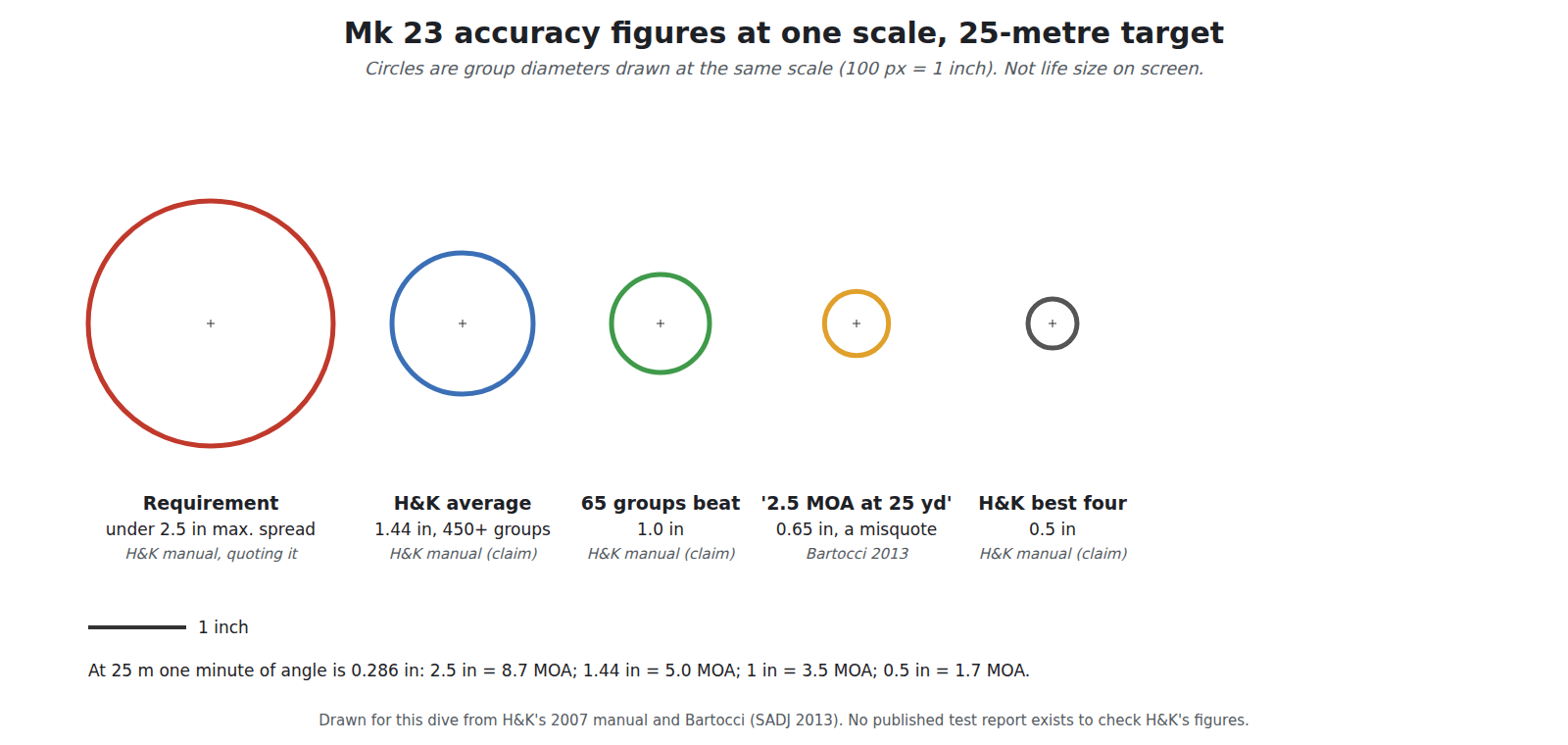
H&K’s 2007 operator’s manual gives the requirement as: “less than a 2.5-inch maximum extreme spread in 5-round shot groups at 25 meters with service ammunition”.1 That is the only statement of the accuracy requirement found that is phrased as a quotation of the requirement, and it is the one used here.
Three terms in it matter.
- Maximum extreme spread is the largest centre-to-centre distance between any two holes in a group. It is the conventional measure, and the strictest of the common ones (mean radius, for example, gives a smaller number for the same group).
- 5-round groups are short groups. Five shots understate the spread a pistol will show over 10 or 20, so a five-shot standard is easier to meet than the same number in a longer string.
- 25 metres is 27.3 yards. American handgun accuracy is normally quoted at 25 yards, and the 2.3-yard difference is about 9 percent of the distance.
The manual does not say whether the requirement was to be met from a fixture or by hand, but its results paragraph says the test firings were “from a precision firing fixture”.1
6.3 What H&K says the pistols did
The manual’s results paragraph, quoted in full: “Out of over 450 accuracy test firings from a precision firing fixture, the MK 23 pistols far exceeded the government requirement averaging 1.44 inches with 65 groups of less than one inch. There were four groups of .5 inches with 5 rounds going through the same hole! This included firing with and without the sound/flash suppressor attached.”1
On endurance: “Three pistols were tested for accuracy after firing over 30,000 rounds, the specified service life of the pistol, and still met the new pistol accuracy requirement.”1 H&K’s web pages from 2004 to 2024 repeat the 1.44-inch average and the 65 sub-inch groups.23
These are H&K’s figures about its own pistol in a competition it won. They are plausible, they have been repeated in every account since, and they have never been checked against a published test report, because none has been published (Volume 1). Several details are not given: whether “over 450 accuracy test firings” means 450 five-shot groups; with what ammunition (the requirement says “service ammunition”, which for this pistol could be ball or +P); and how many pistols were involved.
The claim “with and without the sound/flash suppressor attached” is worth noting for what it implies. A suppressor on a tilting-barrel pistol changes the barrel’s motion and usually shifts the point of impact. That the averages included suppressed groups, if they did, says the barrel returned to the same place against the sights shot after shot with or without the extra mass at the muzzle. Volume 3 sets out the design feature in H&K’s patent intended to do exactly that.
6.4 Inches, metres and minutes of angle
The accuracy figures have been converted, mis-converted and re-quoted so often that the same requirement now circulates in three versions an order of magnitude apart. At 25 metres, one minute of angle (MOA) subtends 0.286 inches; at 25 yards, 0.262 inches.
Table 1 — Inches, metres and minutes of angle
| Statement | Distance | Size | In MOA | Source |
|---|---|---|---|---|
| Requirement, maximum extreme spread | 25 m | 2.5 in | 8.7 | H&K manual (quoted) |
| Requirement, as restated | 25 yd | 2.5 in | 9.5 | Sandboxx, 2025 |
| Requirement, as restated | 25 yd | ”2.5 MOA” = 0.65 in | 2.5 | Bartocci, SADJ 2013 |
| H&K’s average result | 25 m | 1.44 in | 5.0 | H&K manual |
| H&K’s sub-inch groups (65 of them) | 25 m | under 1 in | under 3.5 | H&K manual |
| H&K’s best four groups | 25 m | 0.5 in | 1.7 | H&K manual |
| ”many groups under 1 MOA” | 25 m | under 0.29 in | under 1 | Bartocci, SADJ 2013 |
Sources: H&K, Bartocci, Sandboxx.1456 The MOA column is calculated for this dive.
Two of those lines cannot be right. “2.5 MOA at 25 yards” would require 0.65-inch groups, more than twice as tight as the average H&K claims its pistols achieved, so it cannot have been the requirement the pistols “far exceeded”. And Bartocci’s “many groups under 1 MOA” would mean many groups under 0.29 inches at 25 metres, when H&K’s best four were 0.5 inches. Both look like the same slip, inches written as MOA. H&K’s own wording, in inches at 25 metres, is internally consistent with its own results, and it is the version used throughout this dive.
6.5 Reliability: minimum, average or both?
The reliability requirement, in H&K’s manual: “a minimum of 2,000 mean rounds between stoppages (MRBS) with both M1911 ball and +P ammunition”. The result, in the same paragraph: “The minimum MRBS achieved in testing was 6,027 and the maximum was 15,122!”1
H&K’s web pages from 2004 onward say instead that “All pistols exceeded the 2000 MRBS with an average of 6000 MRBS”.23 Bartocci says the Mk 23 “averaged around 6027 mean rounds between failure and a maximum of 15,122 rounds between failures”.5
Table 2 — Reliability: minimum, average or both?
| Figure | Described as | Source |
|---|---|---|
| 6,027 MRBS | the minimum achieved | H&K manual, 2007 |
| 15,122 MRBS | the maximum achieved | H&K manual, 2007 |
| 6,000 MRBS | an average | H&K web pages, 2004 to 2024 |
| 6,027 | an average | Bartocci, 2013 |
A minimum of 6,027 and an average of 6,000 are incompatible. The likeliest reading is that the manual’s figures are per test lot or per ammunition type (a lowest and a highest MRBS across several groups), that 6,027 was the lowest, and that “an average of 6000” is a rounding of the lowest figure mislabelled as an average. That is a reading, not a fact. What every version supports is that the measured figure was about three times the requirement at its least favourable.
MRBS is a figure for a population of pistols and ammunition over a long test. It is not a prediction for a single pistol, and it says nothing about magazine-related or ammunition-related stoppages in other hands.
6.6 What has been measured independently
One published test of a production Mark 23 with groups, distance, ammunition and method stated was found.
Gun Tests, in a July 2026 test by Todd Woodard of a pistol it identifies as model M723001-A5, fired its accuracy groups suppressed, at 25 yards, in single action. The averages it reports are:7
Table 3 — What has been measured independently
| Ammunition | Average group, 25 yd | In MOA |
|---|---|---|
| Prvi Partizan 185 gr semi-jacketed hollow point | 1.25 in | 4.8 |
| Fiocchi 200 gr JHP | 2.1 in | 8.0 |
| Winchester 230 gr ball | 2.6 in | 9.9 |
The magazine’s own words for the best of them: “a suppressed 1.25 inches at 25 yards with the Prvi Partizan 185-grain semi-jacketed hollowpoints”. It measured the double-action pull at 11 lb.7 The review does not name the suppressor, give unsuppressed groups or report velocities.
These numbers are not comparable with H&K’s. They are from a rest by hand rather than a fixture, at 25 yards rather than metres, suppressed, and with commercial loads rather than service ammunition. They are reported because they are the only measured groups with a method attached that could be found. A single 185-grain load averaging 1.25 inches at 25 yards with a suppressor fitted is in the same territory as H&K’s fixture average of 1.44 inches at 25 metres; the 230-grain ball result is about the size of the requirement.
Bartocci’s article reproduces a target captioned “This target showed a 1 1/4 inch group at 25 meters”; the web edition does not say who fired it, with what, or how.5 A figure that circulates in reference works, that the Mk 23 “is capable of” a 2-inch group at 25 metres, was not found in any primary source, and a dealer’s description of the pistol as “factory-tested to shoot 2-inch groups” was not traced to H&K.
6.7 Is there a factory test target?
Whether the commercial Mark 23 ships with a factory test target, and what such a target shows (distance, group size, ammunition, whether fired from a fixture), could not be established for this dive. H&K’s manual does not mention one, H&K’s product pages do not, and no photograph of a dated Mark 23 factory target with its specifications legible was found. It is listed among the unverified items. What the manual does document is the factory zero: the sights are set “using +P 185 grain JHP ammunition … from a machine rest at a target positioned 25 meters from the pistol”, point of aim equals point of impact.1
6.8 Why the pistol is accurate
The design features that bear on accuracy are each documented, and they compound.
- Barrel and sight radius. A 5.87-inch (149 mm) barrel and a 7.76-inch (197 mm) sight radius in H&K’s manual, against the 5-inch barrel of a full-size 1911.1 The long sight radius makes the sights easier to align precisely.
- Repeatable lock-up. H&K’s patent says that in the locked position a frustum-shaped extension of the barrel is “seated snugly” on the barrel stop at the rear of the guide rod, so that “the barrel 2 always assumes the same position relative to the sighting device seated on the breechblock”.8
- The O-ring. It centres the muzzle in the slide until unlocking, and H&K credits it with the pistols’ accuracy after 30,000 rounds (Volume 3).1
- The trigger. A 4.85 lb single action in the manual (5.17 lb on later pages), with the first shot from a cocked hammer and the safety on if desired.13
- Weight. A heavy pistol (2.66 lb with an empty magazine, in the manual) moves less under the shooter’s pulse and the trigger press, and recoils less for a given cartridge.
The polygonal bore (Volume 3) is often credited with accuracy too. H&K’s own Mark 23 literature does not make that claim, and it is not made here.
6.9 Sights and zero
The sights are a fixed front post and a rear notch in a dovetail, held by a retaining screw, with three white dots or three tritium capsules.1 All adjustment is at the rear.
- Windage is set by drifting the rear sight in its dovetail with a brass or soft punch, striking the sight base and not the blade: drift it left to move the point of impact left, right to move it right, and retighten the screw.
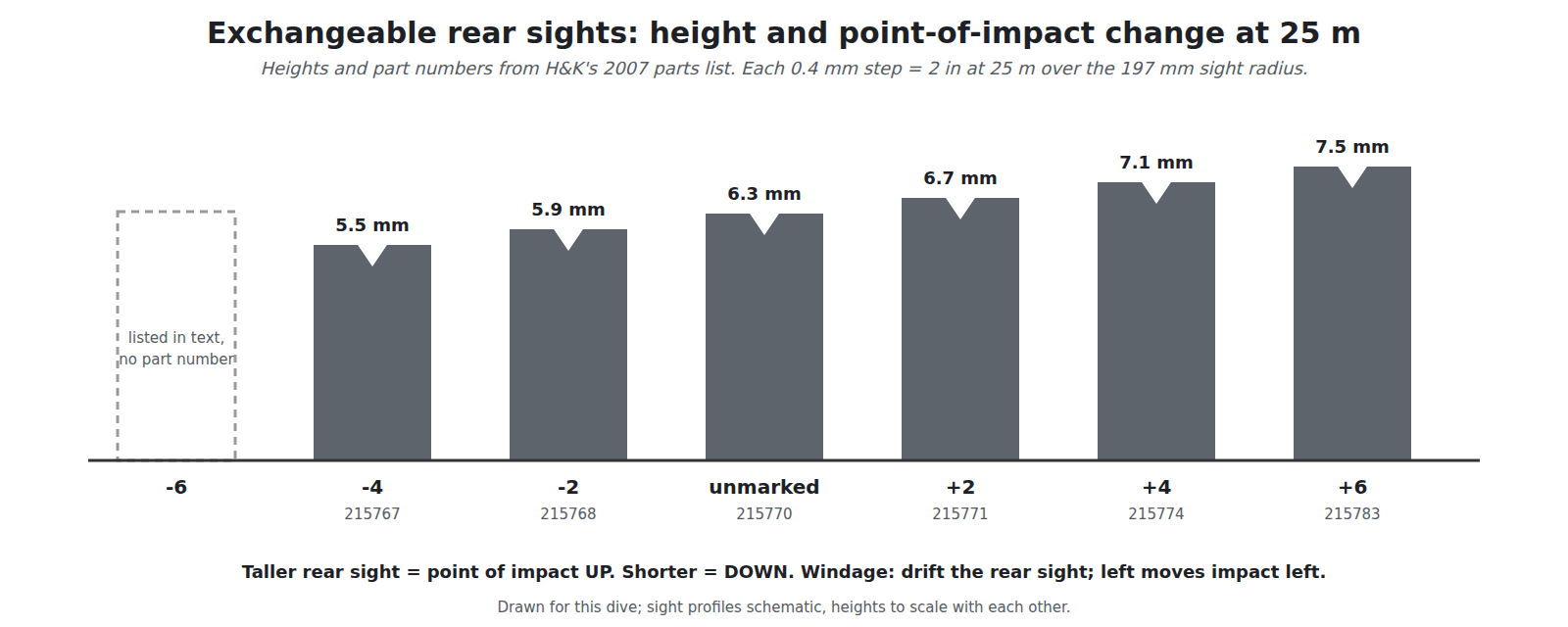
- Elevation is set by exchanging the rear sight for a taller or shorter one. Each rear sight is marked on its underside with the change it gives, in inches at 25 metres, relative to the standard (unmarked) sight: −6, −4, −2, unmarked, +2, +4, +6. “To RAISE the point of impact, install a higher rear sight. To LOWER the point of impact, install a lower sight.”1
The parts list gives the rear sight heights:1
Table 4 — Sights and zero
| Marking | Height | H&K part no. |
|---|---|---|
| −4 | 5.5 mm | 215767 |
| −2 | 5.9 mm | 215768 |
| Unmarked (standard) | 6.3 mm | 215770 |
| +2 | 6.7 mm | 215771 |
| +4 | 7.1 mm | 215774 |
| +6 | 7.5 mm | 215783 |
The text lists a −6 sight; the parts list has no −6 part. The steps are 0.4 mm each, and the arithmetic confirms H&K’s markings: 0.4 mm over the 197 mm sight radius, projected to 25 metres, is 50.8 mm, which is 2.0 inches. (The manual’s worked example refers to “Figure 25” for the sight chart, which is printed as Figure 14.)1
The manual’s zero is with +P 185-grain JHP. A pistol zeroed with +P will put 230-grain ball somewhere else; the direction and size of the shift depend on the individual pistol and are not given by H&K. An owner who shoots mainly ball, and that is what a suppressed Mk 23 shoots (below), should zero with ball.
6.10 The two cartridges it was designed for
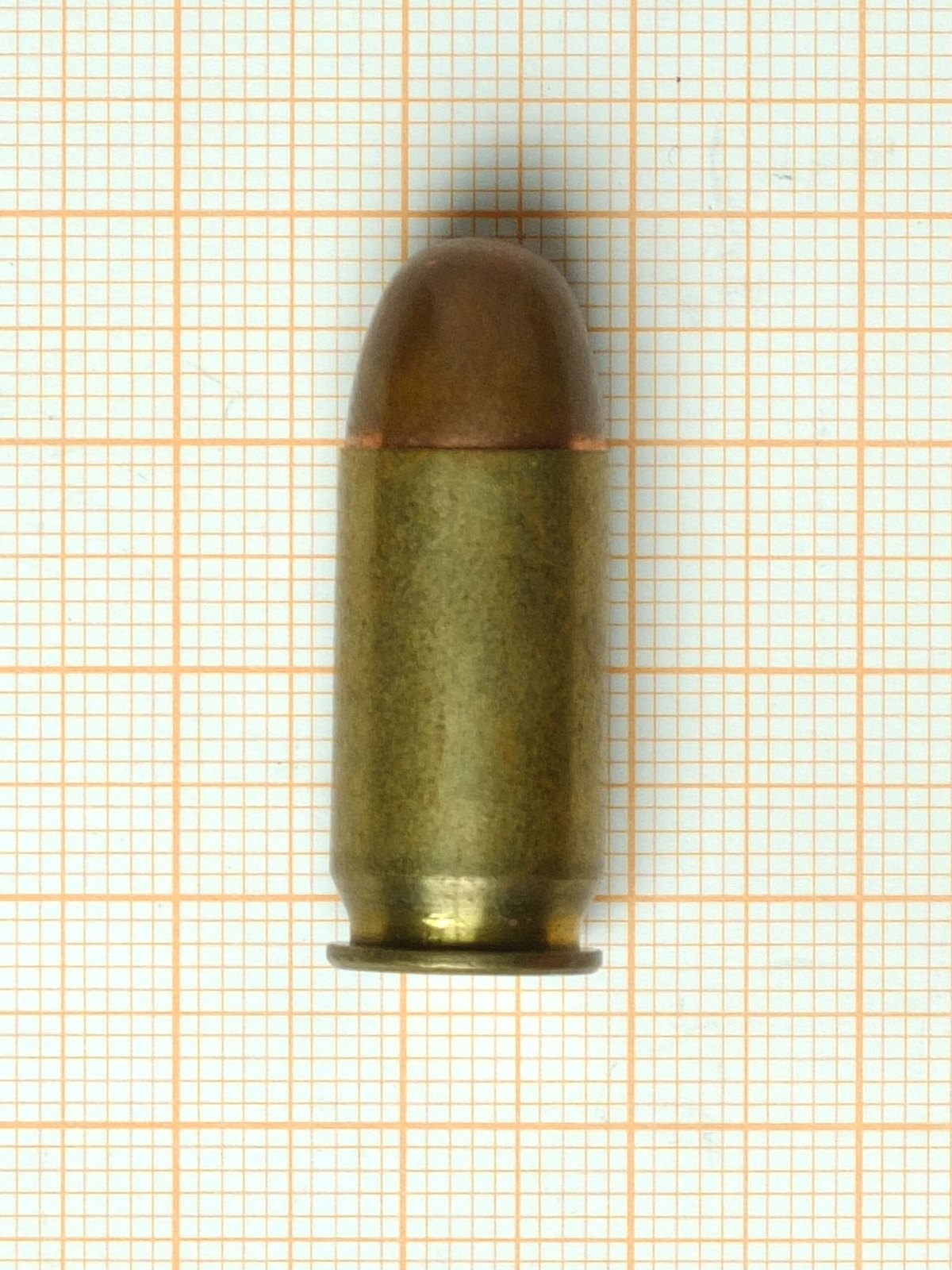
H&K’s manual is specific: “The Mark 23 pistol was designed to operate best using two types of .45 ACP caliber ammunition. They are: A. M1911 230 grain ball B. Commercially manufactured 185 grain +P Jacketed Hollow Point (JHP).”1 Elsewhere it says the pistol is chambered for .45 ACP “up to and including the commercial +P cartridges”.1
Those are the two loads the OHWS requirement named, by every account: a 185-grain +P as the primary combat round and 230-grain ball for suppressed and maritime use (Volume 1).
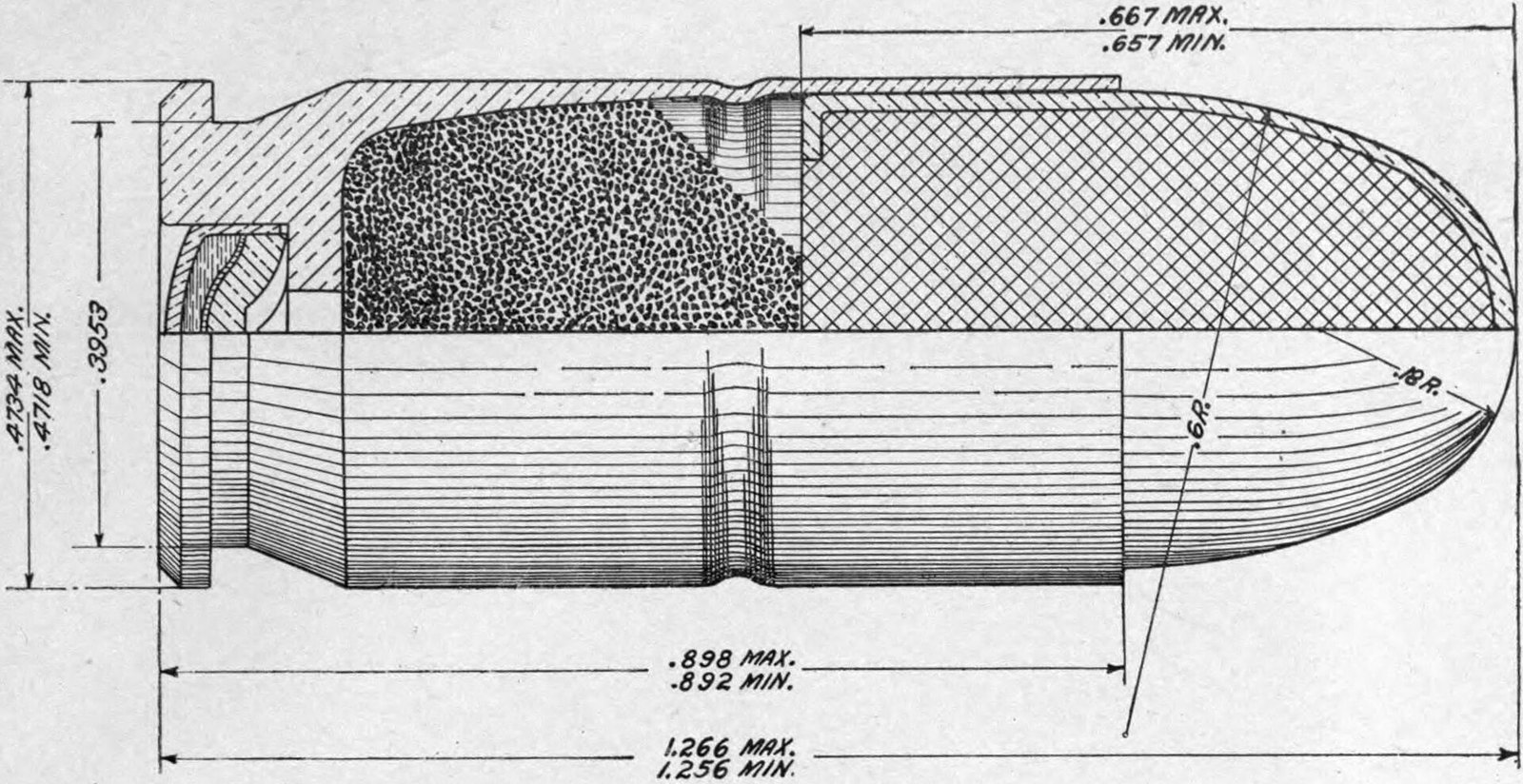
6.11 .45 Automatic and .45 Automatic +P by the SAAMI standard
The American industry standard for both is ANSI/SAAMI Z299.3, the centerfire pistol and revolver standard; the current edition was approved on 13 December 2022.9 Its velocity and pressure table gives these figures. Pressures are by transducer; velocities are nominal mean instrumental velocities 15 feet from the muzzle of SAAMI’s test barrel, which for .45 Automatic and +P is 5.000 inches long.9
Table 5 — .45 Automatic and .45 Automatic +P by the SAAMI standard
| .45 Automatic | .45 Automatic +P | |
|---|---|---|
| Maximum average pressure (MAP) | 21,000 psi | 23,000 psi |
| Maximum probable lot mean | 21,700 psi | 23,700 psi |
| Maximum probable sample mean | 22,700 psi | 24,800 psi |
| Crusher MAP | 18,000 CUP | not established |
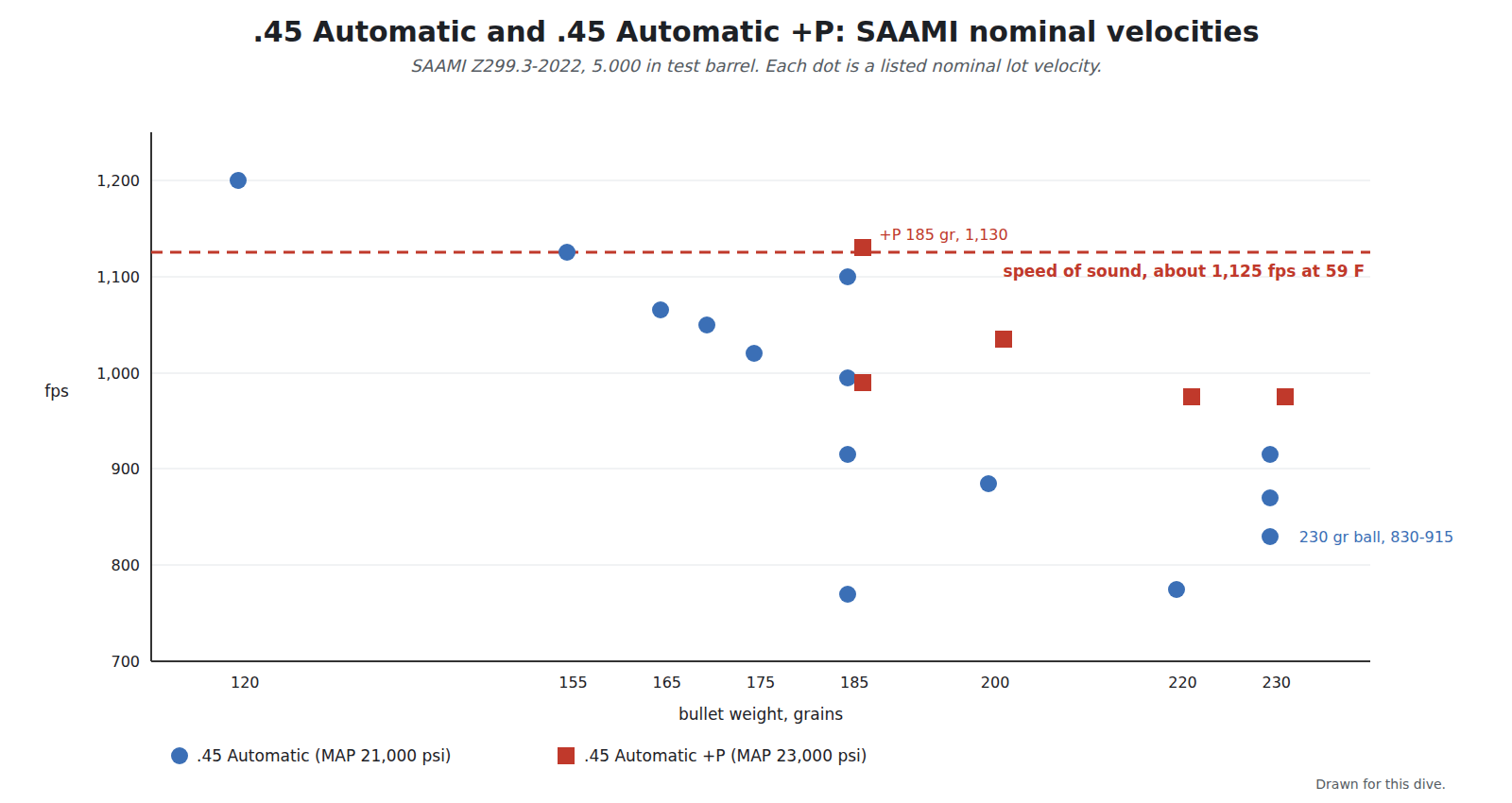
| 185 gr, nominal velocity | 770, 915, 995 and 1,100 fps (four listed lots) | 990 and 1,130 fps (two listed lots) |
| 200 gr | 885 fps | 1,035 fps |
| 220 gr | 775 fps | 975 fps |
| 230 gr | 830, 870 and 915 fps | 975 fps |
| Headspace (gauge, on the case mouth) | 0.8980 to 0.9200 in | same |
Source: SAAMI Z299.3-2022, velocity and pressure table, p. 19, and headspace gauge table.9
Three things in the table are easy to misread.
- +P is 2,000 psi, about 9.5 percent, over standard. That is the whole of the difference in pressure. The 21,000 psi figure for standard .45 is also used in this hub’s Reloading Bench, Volume 15.
- The velocity bands overlap. A standard-pressure 185-grain load may be listed at 1,100 fps and a +P 185-grain load at 990. “+P” says what the pressure may be, not what the velocity is.
- Standard .45 Automatic has no proof load of its own. SAAMI’s proof table says “45 Automatic: Obsolete, use 45 Automatic +P proof loads”, and lists the +P proof load (185 grains) at an average of 31,000 to 33,000 psi.9 Every .45 Automatic firearm proofed to the SAAMI standard is proofed with +P proof loads. That does not make every .45 suitable for a steady diet of +P service ammunition, which is a question of wear, not proof.
The commercial Mark 23 was made with a barrel “manufactured to SAMMI [sic] headspace specifications”, in H&K’s words, which is the main internal difference H&K gives between the commercial pistol and the Mod 0 (Volume 4).1 What the military chamber specification was, and how it differed, H&K does not say.
6.12 +P and the speed of sound
The speed of sound in air at about 59 °F is near 1,125 fps. The hub’s Suppressors by Caliber, Volume 7 explains why standard .45 ACP is subsonic as loaded and therefore needs no special ammunition to be quiet through a suppressor.
The SAAMI table shows what happens with +P. One of the two listed +P 185-grain loads is nominally 1,130 fps from a 5-inch test barrel: at or just over the speed of sound at room temperature, before the extra 0.87 inch of the Mk 23’s barrel adds anything. The other +P 185-grain load (990 fps) and all of the heavier +P loads are subsonic on paper.
H&K’s instruction on this point predates the manual. Its American web page of January 2000 carried this note: “When using Mark 23 pistols with a suppressor, fire only M1911 ball ammunition and use only Heckler & Koch approved suppressors as currently made by Knight Armament Company or Brügger & Thomet.”10 The reasons are not given. Ball is the load that is reliably subsonic, and the suppressors of the period were rated for it; the suppressors themselves are in Volume 7.
6.13 What +P costs the pistol
H&K’s endurance claim is specific to +P: “a service life of over 30,000 rounds of +P ammunition with no parts breakage”.1 The +P requirement drove the frame, slide and recoil system (Volumes 1 and 3).
The arithmetic of the two cartridges shows why the recoil system mattered. Taking SAAMI’s nominal figures, a 230-grain ball bullet at 830 fps carries about 27.3 pound-feet per second of momentum; a 185-grain +P bullet at 1,130 fps carries about 29.9, roughly 10 percent more. The pistol’s recoil momentum is the bullet’s plus the propellant gas’s, so +P adds more than that, but the bullet terms alone show that the +P load is not much harder on the hand: it is faster and lighter. What it is harder on is the gun, because the extra velocity comes with a sharper pressure pulse and a faster slide. Kinetic energy at the muzzle tells the same story from the other side: about 352 foot-pounds for the ball load against about 525 for the fast +P load, a 49 percent increase. These figures are calculated for this dive from SAAMI’s nominal velocities; actual velocities from a 5.87-inch barrel will differ.
6.14 What not to feed it
H&K’s manual lists ammunition not to use in the Mark 23:1
- reloaded, remanufactured or military surplus (foreign or outdated) ammunition;
- ammunition in aluminium cases;
- cracked, split, dirty or corroded cases;
- ammunition with corrosive primers or propellant;
- ammunition whose bullet is damaged or has been pushed into the case past the crimp (set back);
- ammunition exposed to oil, grease, water or direct sunlight, and ammunition heated by the sun, “could raise the chamber pressure of the cartridge above safe limits”.
The manual adds that H&K “specifically disclaims any responsibilities for any damage or injury that should occur because of, or as a result of, the use of faulty, remanufactured or reloaded (hand loaded) ammunition”. Handloading for .45 ACP is covered in this hub’s Reloading Bench dive; whoever loads for a Mk 23 does so against the maker’s instruction and outside its warranty.
The set-back warning matters more than usual with +P. A bullet pushed deeper into the case reduces the volume behind it and raises the pressure; a +P load starts nearer the limit. A round that has been chambered repeatedly, as a carry pistol’s top round is, should be measured or retired.
6.15 The OHWS +P cartridge itself
No source found for this dive names the 185-grain +P load that SOCOM adopted with the pistol, its maker, its military designation or its specified velocity. Bartocci says only that a 185-grain +P load was chosen and that the “lack of production of both the pistol and the new +P ammunition” was one of the programme’s difficulties.5 H&K’s manual refers to “commercially manufactured 185 grain +P” and to “M1911 230 grain ball”, which suggests the military pistol was meant to fire a commercial-pattern +P load, but that is an inference. The cartridge’s identity is among this dive’s unverified items, and nothing here should be read as a statement of what it was.
References
Footnotes
-
Heckler & Koch, Inc., Mark 23 Pistol .45 ACP operator’s manual (“Revised March 2007”; PDF dated 22 August 2008), Sections 1, 2, 4, 10 and 12, parts list p. 34. Wayback capture of 11 August 2011, https://web.archive.org/web/20110811030250/http://www.hk-usa.com/-images/shared/Mark%2023_Ops_Manual_2008.pdf, consulted 2026-10-18. ↩ ↩2 ↩3 ↩4 ↩5 ↩6 ↩7 ↩8 ↩9 ↩10 ↩11 ↩12 ↩13 ↩14 ↩15 ↩16 ↩17 ↩18 ↩19
-
Heckler & Koch, Inc., “MARK 23” page, Wayback capture of 16 October 2004, http://web.archive.org/web/20041016095828/http://www.hecklerkoch-usa.com:80/handguns/mk23.html, consulted 2026-10-18. ↩ ↩2
-
Heckler & Koch USA, “MARK 23” product page, Wayback capture of 28 December 2024, https://web.archive.org/web/20241228154506/https://hk-usa.com/hk-models/mark-23/, consulted 2026-10-18. ↩ ↩2 ↩3
-
Christopher R. Bartocci, “MK23 Mod 0: The Crew-Served Pistol”, Small Arms Defense Journal vol. 5 no. 2 (2013); web edition of 11 August 2023, page 1, https://sadefensejournal.com/mk23-mod-0-the-crew-served-pistol/, consulted 2026-10-18. ↩
-
Bartocci, “MK23 Mod 0: The Crew-Served Pistol”, web edition, page 2, https://sadefensejournal.com/mk23-mod-0-the-crew-served-pistol/2/, consulted 2026-10-18. ↩ ↩2 ↩3 ↩4
-
Travis Pike, “The HK MK23 built for SOCOM was the first and last offensive handgun”, Sandboxx News, 5 March 2025, https://www.sandboxx.us/news/socoms-hk-mk23-was-the-first-and-last-offensive-handgun/, consulted 2026-10-18. ↩
-
Todd Woodard, “Heckler & Koch Mark 23 45 ACP M723001-A5”, Gun Tests, 30 July 2026, https://www.gun-tests.com/handguns/pistols45/heckler-koch-mark-23-45-acp-m723001-a5-45-acp/, consulted 2026-10-18. ↩ ↩2
-
US Patent 5,309,815, T. Möller, R. Brandl, H. Weldle and H. Krieger, assignors to Heckler und Koch GmbH, “Firearm, particularly handgun”, issued 10 May 1994, https://patents.google.com/patent/US5309815A/en, consulted 2026-10-18. ↩
-
Sporting Arms and Ammunition Manufacturers’ Institute, ANSI/SAAMI Z299.3-2022, Voluntary Industry Performance Standards for Pressure and Velocity of Centerfire Pistol and Revolver Ammunition, approved 13 December 2022, velocity and pressure table (p. 19), headspace gauge table, proof load tables and test-barrel specifications, https://saami.org/wp-content/uploads/2025/05/SAAMI-Z299.3-2022-Centerfire-Pistol-Revolver-Approved-12-13-2022.pdf, consulted 2026-10-18. ↩ ↩2 ↩3 ↩4
-
Heckler & Koch, Inc., “Mark 23, USP Tactical and Match” page, Wayback capture of 28 January 2000, http://web.archive.org/web/20000128213444/http://www.hecklerkoch-usa.com:80/Pages/mk23.html, consulted 2026-10-18. ↩
Comments (0)