Borchardt C-93 · Volume 9
Making One: Reproductions, the Law of a New Antique Design, and a From-Scratch Lab Build
What exists and does not, why a newly made C-93 is a modern firearm, and a machinist-level path for an antique-pattern pistol built in a lab with CNC mills, 3D printers, a laser and a full gunsmithing bench
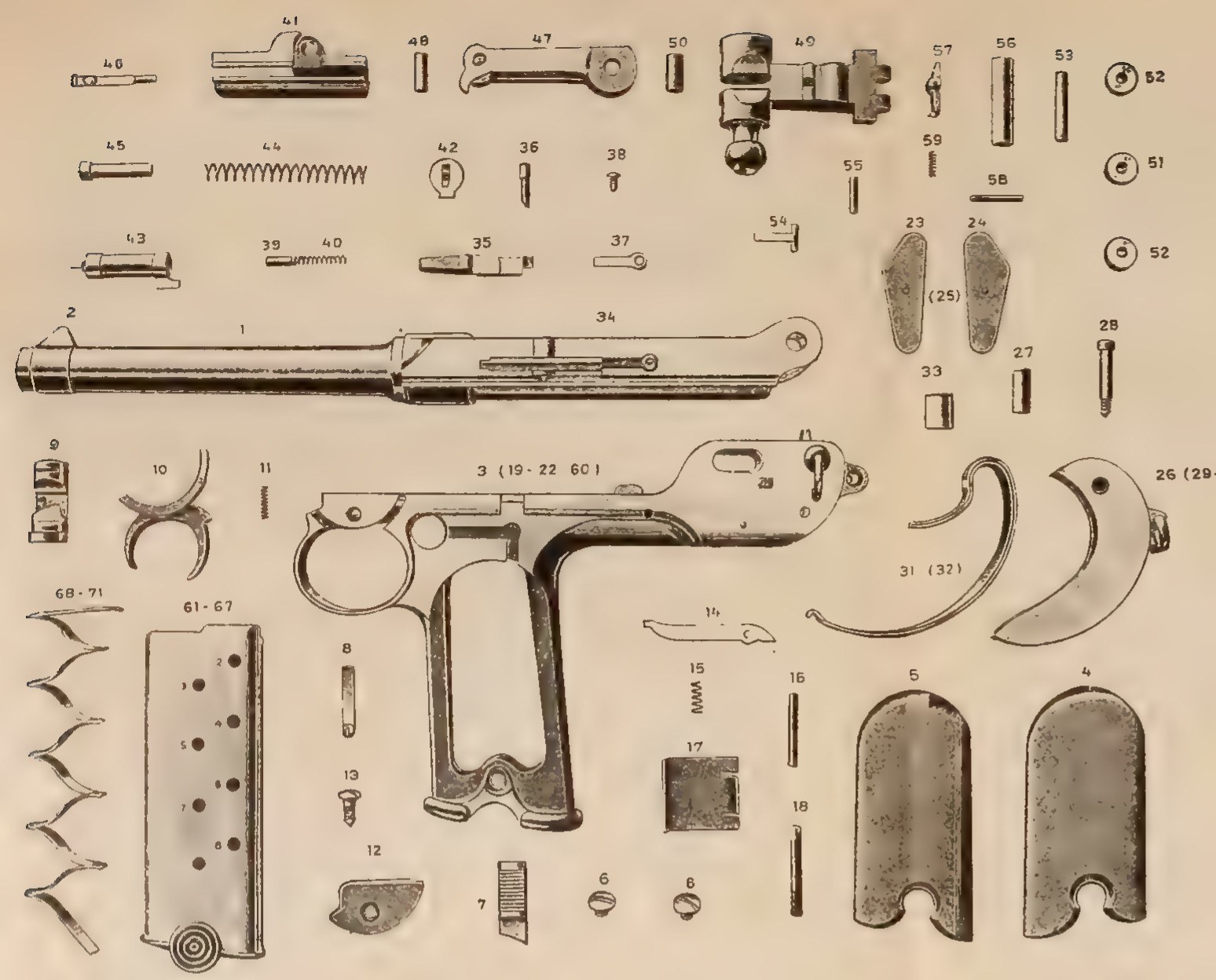
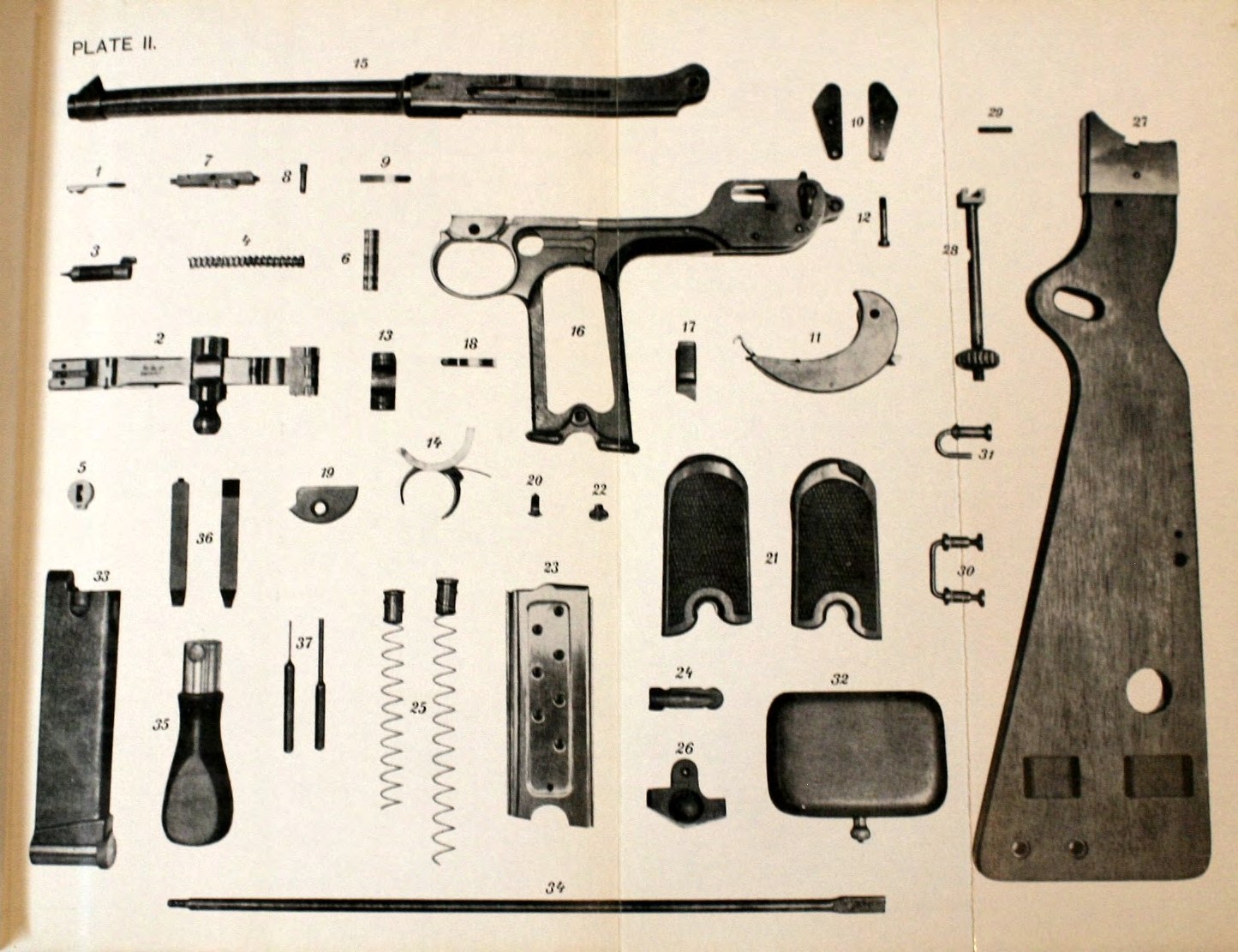
This volume does three things. It establishes what C-93 reproductions actually exist, which is fewer than the internet implies. It sets out the law that governs making a firearm of an antique design, because a newly made C-93 is not an antique and the stock turns it into something else again. And it lays out a full from-scratch path for an antique-pattern pistol at the depth an experienced machinist and gunsmith needs, using the factory parts list in Volume 4 as the inventory.
Everything in the build path below is a proposal for a modern build, written in a reference voice. Where it touches period practice (materials, heat treatment, tolerances) the sources are silent, and it says so.
9.1 What exists: no firing reproduction
No commercially made firing reproduction of the C-93 was found. Searches in English, German (“Nachbau”, “Replik schussfähig”) and Japanese turned up no maker’s page, no report in the gun press, and no Forgotten Weapons piece describing one.1 That is absence of evidence, not proof, but it is a consistent absence across languages, and it means a C-93 built from scratch is not reinventing a catalogue product.
What does exist:
Table 1 — What does exist
| Item | Maker or seller | Fires? | Evidence | Price, dated |
|---|---|---|---|---|
| Model gun, dummy-cartridge type | CAW (Craft Apple Works), Japan | No | LugerForum thread of 18 March 2015: released “about 2 years ago”; a video reportedly shows “his parts interchanging with a real C93”; CAW also sold reproduction manuals at $25. The maker’s own site refused retrieval. | $420 plus shipping, Los Angeles, March 2015 (forum report) |
| Dummy-cartridge prop replica | Sold by MG-Props (UK), labelled HWS | Cycles dummy cartridges only | Seller page: “Functions, Fires, Field strips like the real thing”; ABS heavyweight with metal parts, real wood grips, about 790 g; marked sold | Not stated |
| Full-size printed prop, solid or cutaway | printed3dmodels.com | No; “Solid model (doesn’t have internal parts)”, orange tip required | Seller page | €34.99, 18 October 2026 |
| Miniature with working toggle | Unmarked maker; Morphy, 5–7 September 2023, lot 1283 | Not stated | 7 in long without stock, 13½ in with; holster, dummy magazine, case | $7,800 including premium (estimate $1,200–2,000) |
| Low-poly digital model with STL | AxoGM on itch.io | Game asset | No licence terms on the page | Name your price |
Sources: as listed.23456 No Denix, airsoft, gas-blowback or cap-firing C-93 was found; Denix makes a C96, not a C-93.1 Reproduction stocks, holsters, cases and grips do circulate, without named makers (Volume 5).
The CAW model gun matters to a builder more than any of the others, because if its parts really do interchange with an original’s, it is a source of dimensions that can be bought and measured. That claim rests on one forum report of a video and is not confirmed.2
9.2 The law of making a C-93 today
The analysis below is from the statutes and ATF’s published answers. It is not legal advice.
A newly made C-93 is not an antique. The Gun Control Act’s antique definition, 18 U.S.C. § 921(a)(16), turns in its clause (A) on manufacture “in or before 1898”, which a pistol machined now cannot meet. The only route for a new gun is clause (B), “any replica of any firearm described in subparagraph (A)”, and only if the replica “(i) is not designed or redesigned for using rimfire or conventional centerfire fixed ammunition, or (ii) uses rimfire or conventional centerfire fixed ammunition which is no longer manufactured in the United States and which is not readily available in the ordinary channels of commercial trade”.7 A firing C-93 copy fires conventional centrefire fixed ammunition, so (B)(i) fails. (B)(ii) needs both limbs, and 7.63 Mauser, which chambers in a C-93, is made and sold in the United States market (Volume 7), so (B)(ii) fails too. ATF’s published answer is to the same effect: antique firearms fall outside the Gun Control Act “assuming the antique firearm is not a replica designed or redesigned for using rimfire or conventional centerfire fixed ammunition”.8 The curio-or-relic category excludes replicas expressly: “Firearms which were manufactured at least 50 years prior to the current date, but not including replicas thereof”.9
A new C-93 is therefore a firearm under the Gun Control Act, made by its builder: in ATF’s term, a privately made firearm.
An unlicensed individual may make one for personal use. ATF: “No, a license is not required to make a firearm solely for personal use. However, a license is required to manufacture firearms for sale or distribution. The law prohibits a person from assembling a non–sporting semiautomatic rifle or shotgun from 10 or more imported parts, as well as firearms that cannot be detected by metal detectors or x–ray machines. In addition, the making of an NFA firearm requires a tax payment and advance approval by ATF.”10 The parts-count rule applies to rifles and shotguns, not pistols. Making to sell is manufacturing in the business, which needs a licence; § 921(a)(21)(A) defines a manufacturer engaged in the business as one who manufactures “as a regular course of trade or business with the principal objective of livelihood and profit through the sale or distribution of the firearms manufactured”.7
Detectability is not an issue for an all-steel pistol. 18 U.S.C. § 922(p) prohibits a firearm that, without its grips, stocks and magazines, is not as detectable as the “Security Exemplar” of 3.7 ounces of 17-4 PH stainless, or whose major components do not show their shape on an airport x-ray.11 It would matter only to a builder tempted to print a functional frame in polymer, which this path does not do.
The stock makes it a short-barrelled rifle. A C-93-pattern pistol with a shoulder stock attached is a rifle with a barrel under 16 inches, an NFA firearm under 26 U.S.C. § 5845(a)(3).12 ATF’s collector’s-item listing for the stocked Borchardt covers only pistols made in or before 1898 (Volume 8), so it has no application to a new one. Fitting a stock to a new pistol is “making” an NFA firearm, and 26 U.S.C. § 5822 requires that the maker first file an application, identify himself with fingerprints and photograph, and obtain approval.13 The making tax is $0 for calendar quarters from 1 January 2026 under Public Law 119-21; the approval is not optional.14 Making the stock is not itself the offence; the sequence is approval first, then attachment.
A pistol that doubles is a machine gun. 26 U.S.C. § 5845(b): “The term ‘machinegun’ means any weapon which shoots, is designed to shoot, or can be readily restored to shoot, automatically more than one shot, without manual reloading, by a single function of the trigger.”12 Under 18 U.S.C. § 922(o) an individual may not lawfully make one.11 The C-93’s disconnector is a yielding pin and a small spring in the sear (Volume 4). The Seventh Circuit in United States v. Olofson held that “automatically” describes a self-acting mechanism, and that this “clearly forecloses the argument that a weapon is not a machinegun merely because it stopped firing due to a malfunction”; a defendant can argue that extra rounds resulted from “a mishap rather than from a regular self-acting mechanism”.15 That is a jury argument, not a safe harbour. The disconnector’s geometry and timing are therefore a legal requirement as well as a safety one, and a build that doubles must be stopped and fixed before it is fired again.
The 2022 frame rule and VanDerStok. In Bondi v. VanDerStok, decided on 26 March 2025 by seven votes to two, the Supreme Court held that ATF’s 2022 rule was “not facially inconsistent with the GCA”, upholding its treatment of weapon parts kits and partially complete frames and receivers against a facial challenge.16 It decided nothing about an individual machining a pistol from bar stock, which never involves acquiring a partially complete frame from anyone, and its practical relevance to this build is low.
Marking is a licensee’s duty, not the maker’s. Under 27 CFR 478.92(a)(2), federal licensees “must legibly and conspicuously identify each privately made firearm” they receive, with a serial number prefixed by their licence number; an FFL may adopt a number the maker has already applied.17 A C-93 that ever goes to a gunsmith for overnight work, or is sold through a dealer, will be engraved. A builder who applies his own serial and name first, in a place and at a depth that meets the rule, lets the licensee adopt it rather than add a new number in a visible spot on a period-style receiver. That is practical advice drawn from the regulation, not a requirement on the unlicensed maker.
9.3 Which part is the “frame”?
This question is worth asking before the first cut, because it decides which part of a C-93 is the regulated firearm, and the answer is not the obvious one.
The 2022 rule defines a handgun’s frame by function. 27 CFR 478.12(a)(1): “The term ‘frame’ means the part of a handgun, or variants thereof, that provides housing or a structure for the component (i.e., sear or equivalent) designed to hold back the hammer, striker, bolt, or similar primary energized component prior to initiation of the firing sequence, even if pins or other attachments are required to connect such component (i.e., sear or equivalent) to the housing or structure.”18
Most people would point to the C-93’s grip, the large casting-like part that carries the trigger, magazine and springs, and call it the frame. But the C-93’s sear is not in the grip. The factory: “the nose of the sear 35, which swinging in the left side of the receiver engages the lug of the firing-bolt”. Borchardt’s patent says the sear is “connected to the barrel so as to slide therewith”.1920 On the words of 478.12, the part that “provides housing or a structure for” the sear is the forked receiver, part 34, which is screwed to the barrel and recoils with it. If that reading is right, the regulated frame of a C-93 is the receiver, and the grip is an unregulated part.
That is this dive’s reading of the regulation against the factory’s description of the mechanism. It has not been put to ATF, no ruling on the C-93 was found, and the rule also contains provisions for split and multi-part frames that a classification would weigh. The point for a builder is narrow: the receiver is the part to treat as the firearm for every purpose (serial, record, disposal of scrap and failed attempts), and a builder wanting certainty can ask ATF’s Firearms and Ammunition Technology Division for a classification of a drawing.
9.4 Michigan and the self-made pistol
Michigan’s licence and sales-record machinery is built around a transfer between two people. MCL 28.421 defines a “purchaser” as “a person who receives a firearm from another person by purchase or gift” and a “seller” as “a person who sells or gives a firearm to another person”, and MCL 28.422a(2) puts the record-keeping duty on “the seller”.2122 Making a pistol is not receiving one from another person, and no Michigan statute located creates a registration step for a self-made pistol.
But MCL 28.422(1)(a) forbids anyone to “purchase, carry, possess, or transport a pistol in this state without first having obtained a license for the pistol as prescribed in this section”, on its literal words regardless of how the pistol was acquired, and the statute does not say how a maker with no seller obtains that licence.23 The clean path in the text is a concealed pistol licence: MCL 28.422a(1)(a) says a section 5b licensee “is not required to obtain a license under section 2 to purchase, carry, possess, use, or transport a firearm”.22 A Michigan builder without a CPL should put the question to the Michigan State Police Firearms Records Unit in writing before making a pistol. Practitioner advice circulating online about how to “register” a home-built pistol disagrees with itself and is not repeated here.
A newly made C-93 is not a Michigan antique under any reading of MCL 750.231a (Volume 8), so the antique exemption does not help.
Two Michigan bills would change this. Senate Bill 331 of 2025 would require serial numbers on all firearms and components; it passed the Senate 19 to 17 on 25 June 2025 and was referred to the House Committee on Government Operations the same day, with no later action listed as of 18 October 2026. Its tie-bar, SB 332, took the same path.2425 Neither is law. Both should be checked again before a build starts, because enactment would put a serialisation duty on a Michigan maker. The safe-storage provision of MCL 28.429 applies to any firearm, including a privately made one (Volume 8).26
9.5 Design decisions before any metal is cut
1. Chambering and pressure. The pistol is a 7.65 mm Borchardt, and its chamber will accept 7.63 Mauser and 7.62 Tokarev (Volume 7). Somebody, eventually, will put a modern Mauser round or a Tokarev into it. A modern build should therefore be designed and proved for the C.I.P. 7,63 Mauser maximum pressure of 2,250 bar, not for the lighter original load, even if it is only ever fed handloads to the factory’s 400 m/s.27 That is an engineering decision, and it is the single most important one in this volume.
2. Fidelity or modern materials. The period steels and heat treatments are not documented in any source found; even the Parabellum’s metallurgy is largely undocumented beyond hardness studies.28 A faithful-looking pistol in modern steels, heat treated to known specifications, is the only responsible choice. Nothing below claims to reproduce Loewe’s metallurgy.
3. Rifling. The original was four grooves with one turn in 250 mm.29 The C.I.P. Mauser barrel is six grooves at the same twist, bore 7.62 mm (.300 in) and groove 7.85 mm (.309 in).27 A modern .30 calibre blank in a .300/.308 bore-and-groove specification with a twist near 1 in 10 is a close match to the C.I.P. dimensions; a four-groove barrel is more faithful and harder to source. Either works; the C.I.P. specification is the documented one.
4. Barrel length. The factory’s 190 mm, or the documented short 154 mm.19 Under federal law a pistol has no minimum barrel length. Neither length, nor any length, changes the stock question.
5. Will it ever wear a stock? Decide now. If it will, the Form 1 comes first (above), and the pistol should be designed with the stock lug and spring-box tenon from the start. If it will not, consider omitting the stock-attachment features so that no question arises.
6. Disconnector. Treat it as a designed and tested subsystem, not a copied detail (above, and below).
9.6 Where the dimensions come from
No dimensioned engineering drawings of the C-93 are published. No plan vendor, blueprint set or published dimension sheet was found.1 The usable sources, in order of quality:
- An original pistol, measured. The best source by far, and the hardest to get access to.
- The CAW model gun, if its reported parts interchangeability with an original is true.2
- The collector monographs: Görtz and Sturgess, The Borchardt & Luger Automatic Pistols (2010–11), and Henrotin, The Borchardt Pistol Explained (2011). Whether either carries dimensioned drawings was not checked.
- The patent drawings and the ONI plate, scaled from known dimensions. The factory gives three anchors: barrel 190 mm, sight radius 315 mm, cartridge 35 mm.29 Patent drawings are not guaranteed to scale, and anything taken from them must be treated as an approximation to be corrected by fitting.
- The cartridge and chamber, from the C.I.P. 7,63 Mauser sheet (Volume 7), confirmed against C.I.P.’s own database before use.27
A practical route for a lab without access to an original is to model the pistol in CAD from the scaled drawings, then build a motion study of the barrel, receiver, toggle and rollers against the curved butt piece. The ONI’s barrel recoil figure of 0.118 inch (Volume 4) is the one kinematic constraint published: the toggle should begin to fold only after the barrel-and-lock unit has travelled close to that distance, and the slots for the connecting pin set the travel.30
9.7 The build, group by group
The factory’s own grouping (Volume 4) is the natural work breakdown. The material suggestions are engineering proposals for a modern build, not period specifications, and every heat treatment should follow the steel maker’s published data for the grade and section.
Group 1: barrel and receiver (parts 1, 2, 34).
- Barrel (1). Turned from a .30 calibre rifled blank in a chrome-moly or stainless barrel steel. Contour to the original’s profile; thread the breech end for the receiver. The thread form and pitch of the original were not found; choose a standard fine thread that leaves adequate wall at the chamber, and record it. Chamber with a reamer cut to the 7.65 Borchardt / 7.63 Mauser chamber: no 7.65 Borchardt reamer is catalogued by the rental house checked, but 4D Reamer Rentals lists a “30 Mauser (7.62mm Tokarev)” reamer at $45 (solid pilot) or $49 (floating pilot), with a headspace gauge set at $8 and a measurement report at $15.31 Buy the measurement report and compare it with the C.I.P. chamber before cutting, because a reamer labelled for both Mauser and Tokarev is a compromise. The front sight (2) was soldered on originally;19 silver-solder or a dovetail is a modern choice.
- Receiver (34). The most complex part to machine and, by the frame analysis above, probably the regulated part. It is a fork: two side walls joined at the front by the threaded ring that takes the barrel, with internal grooves for the breechblock’s ribs, external surfaces that slide in the grip’s guides, the transverse bore for the connecting pin 56, and the sear’s pivot and slot on the left. From a prehardened chrome-moly bar on a four-axis mill: rough the outside, bore and thread the barrel ring, cut the internal rib grooves with a slitting saw or a long-reach keyseat cutter from the open rear, and leave finish stock on every sliding surface for fitting to the grip.
Group 2: the lock (parts 41–59).
- Breechblock (41), with ribs to run in the receiver, a counterbored face for the case head, a slot underneath for the ejector, the bore for the striker and its rear thread for the breechblock screw 42, the slot in the left rib for the sear’s nose, and the extractor seat on top. Heat treated after machining.
- Toggle links (47, 49). Profiled on the mill from flat stock, through-hardened and tempered for toughness. The rear link carries the knee pin, the connecting-pin bore, the roller axle at its rear, the stirrup pin, the catch-lever seat on the right and the knob on the left. The geometry of the three pin centres is the heart of the mechanism and should come from the CAD motion study, not from a single drawing.
- Rollers (51, 52) and pins (48, 50, 53, 55, 56, 58). Turned from a bearing or case-hardening steel, hardened, and ground or lapped to fit. The rollers take the impact that opens the action every shot.
- Stirrup (54) and catch lever (57) with its spring (59).
- Striker (43), a hollow cylinder with a lug, its coil spring (44), and the breechblock screw (42). The striker tip protrusion must be checked against a gauge before firing.
- Extractor (46), a spring piece. Made from spring steel and tempered to spring hardness.
Group 3: the grip (parts 3, 4–6, 14–19, 23–25).
- Grip (3). The largest part: lock case, guides for the receiver, the magazine well, the trigger guard, the slots for the connecting pin, the seat for the buffer spring, the ejector’s pivot, the safety’s vertical groove, the magazine catch bore, and at the rear the curved butt piece (19), the cam surface that the rollers strike. The original grip, the butt and several small parts were “firmly fixed” to it as one unit.19 From billet on a mill, in several setups. The cam profile is the critical surface: generate it from the roller’s path in the motion study, machine it with a ball end mill on a 3D toolpath, and polish it.
- Cover plates (23, 24), fire-blued spring steel per a collector’s identification of originals, with their locating studs;32 cheekpieces (4, 5) in walnut, chequered.
- Ejector (14) with its spring and pin.
Group 4: the firing mechanism (parts 7–13, 35–40).
- Trigger (10) with its curved “horn” and wedge, running in its groove on the left of the grip, and its cover (12) and screw (13).
- Sear (35), carried on the receiver, with its screw (36, with the flat that must align with a groove), spring (37) and crosspin (38).
- The yielding pin (39) and its spring (40), inside the sear: the disconnector. See below.
- Safety (7) and the shared spring (8) that also serves the magazine holder (9).
Group 5: the spring box (parts 26–33). The box (26) with its bushing (27), screw (28) and the stock swivel (29, 30); the double closing spring (31) with its rivet (32) and bushing (33). The springs are their own section below.
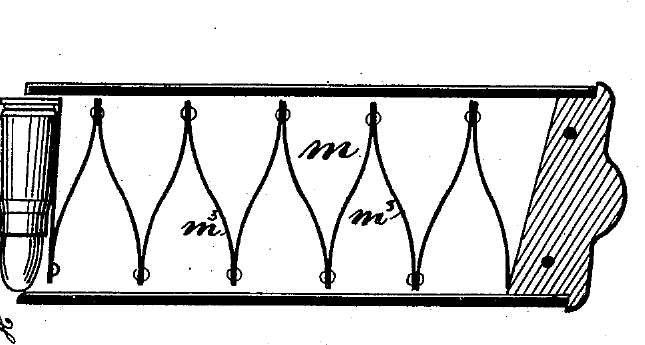
Group 6: the magazine (parts 61–71). Two side plates and front and rear ribs in sheet steel, formed and joined; the wooden bottom piece (65) on its two pins; the follower spring of eight zig-zag leaves on a bottom leaf, riveted, under a top plate. Witness holes in the side plates. The feed lips at the rear must hold the round and release it into the breechblock’s path (Volume 4).
Group 7: the stock and accessories (parts 27–30 of the DWM list). The board stock in walnut with its cheekpiece, ferrule, connecting bolt and nut; the leather holster laced to the stock; the strap; the barring block. Only if the Form 1 decision (above) has been made.
9.8 The springs: the hardest parts
Three springs make the C-93 work, and none can be bought.
The double closing spring (31a, 31b) is two flat leaves riveted together and coiled round a bushing inside the spring box, with a short arm bearing on the lock case and a long arm hooked to the stirrup.19 Making one means forming flat spring-steel strip round a mandrel to the coiled shape, heat treating and tempering it to spring temper, riveting the two leaves, and then tuning its force by trial: too weak and the action will not close and hold the toggle down; too strong and it will not open fully on a factory-level load. There is no published rate for the original, so the rate is found by experiment with chronographed ammunition, starting soft. Plan on making several.
The buffer, the factory’s “double recoil spring” (17a, 17b), is a forked flat spring low in the rear of the lock case.1920 It takes the surplus energy of every stroke. Too weak and the rollers hammer the butt piece; too strong and it throws the parts forward early.
The magazine follower spring (68–71) is a stack of riveted zig-zag leaves.19 Thin spring-steel strip, formed in a fixture, riveted.
The striker spring (44) and the small coil springs of the ejector, sear pin and catch lever can be wound or bought as stock springs and cut to fit.
9.9 What each machine in the lab is for
CNC mills. The grip, the receiver, the breechblock, the toggle links, the trigger, the sear, the spring box, and the cam profile of the curved butt piece. Four-axis capability helps on the receiver and the grip. Fixtures for the second and later setups of the grip and receiver are a job in their own right, and worth making properly, because a failed grip or receiver is a lot of material and time.
Lathe work (on a lathe or a mill-turn setup): the barrel, the barrel thread and chamber, the striker, the breechblock screw, every pin and bushing, and the rollers.
3D printers. Two uses, both before metal.
- A kinematic model, at full scale or larger, of the barrel, receiver, toggle and grip with its cam profile, to prove the motion study: that the rollers meet the curve at the right point, that the knee rises, that the breechblock clears the magazine, and that the closing spring’s path does not foul. This is how the cam profile and the link geometry should be settled.
- Fit-check prototypes of individual parts. A deliberately non-functional plastic model that cannot expel a projectile is not a firearm, but a builder should not print a part dimensionally capable of serving as the frame or receiver of a working pistol, and should keep the models visibly incomplete.
The CO2 laser (60 W, with a 100 W tube on hand). It will cut and engrave wood and leather: templates for the stock and cheekpieces, the holster’s pattern pieces, chequering layout lines on the grip panels, and engraved markings on the wooden parts and the barring block. A CO2 laser does not mark bare steel without a marking compound, and it will not cut the steel parts of the pistol. Updated 2026-10-19: earlier editions said the laser’s type was not recorded.
The gunsmithing bench. Fitting, which on a C-93 is most of the work: the receiver to the grip’s guides, the breechblock to the receiver, the toggle pins, the sear and trigger engagement, the spring tuning, and the final polishing of the cam surface and the sliding surfaces. Then rust blue for the steel and fire blue for the cover plates, if the period look is wanted.
9.10 Assembly, timing and the disconnector
Assembly follows the factory’s own reassembly notes in Volume 6, including the two traps: the sear screw’s flat must align with its groove, and the ejector’s rear end must be lifted through the spring-box opening as the barrel-and-lock unit goes home.29
Before any live round, check by hand, unloaded:
- Lock-up. The toggle closes fully under its spring, the links come straight, and the catch lever engages.
- Barrel travel. The barrel-and-lock unit slides back in the grip to the end of the connecting-pin slots, close to the documented 0.118 inch, before the rollers begin to fold the toggle.30
- Headspace, with gauges, after final fitting.
- Striker protrusion, gauged.
- Safety. Up locks the sear, the trigger and the barrel.
- Disconnector. With the trigger held back, the action is cycled by hand; the striker must not follow the breechblock home; releasing the trigger must let the yielding pin snap forward with a definite reset; the next pull must release the striker. Volume 6 notes the limitation of this check: hand-cycling may not move the receiver through its full firing travel, so a pass is necessary, not sufficient.
The yielding pin (39) and its spring (40) are the parts on which the pistol’s legal status depends (above). Their design deserves the same attention as the toggle’s: the pin’s travel, the strength of its spring, and the shape of the trigger’s wedge together decide whether the sear can trip as the receiver returns with the trigger held. The factory’s own description is the specification: the pin “recedes when it strikes against the trigger, and after the trigger has been released, snaps forward behind the wedgeshaped end of the latter, so that the firing can be repeated.”19
9.11 Proving and first firing
There is no civilian proof house in the United States. The DWM manual records how the factory proved its pistols: “At the official test the finished mechanism is proved with a charge of 5,6 gramm black powder and a soft-lead slug weighing 16,1 gramm. The barrel and parts of the lock bear the official stamp.”29 That is a historical record, not a procedure to copy with modern powders. No commercially loaded proof ammunition for 7.65 Borchardt or 7.63 Mauser was found.
What a builder can do, as general practice rather than a C-93 instruction:
- Fire the first rounds remotely, from a fixture, with the pistol secured and the shooter behind cover.
- Start below the factory figure, with handloads assembled to a published source and worked up toward, not past, the factory’s 400 m/s (Volume 7), chronographing every string.
- Inspect after each stage: headspace, the rollers and the cam surface, the toggle pins, the breechblock face, the extractor, and the case heads and primers for pressure signs.
- Load one round, then two, to confirm the pistol fires once per trigger pull (above), before ever loading a full magazine.
- Crack-test the stressed parts (receiver, breechblock, links) by magnetic particle inspection after the first stages if the means are available.
9.12 Markings: do not make a fake
A newly made C-93 that carried “WAFFENFABRIK LOEWE BERLIN” or the DWM legend would be, in a decade or two, indistinguishable in photographs from an original worth tens of thousands of dollars. Volume 5 records that markings on originals are already “enhanced” and that reproduction stocks and cases are not always identified as such. A modern pistol should be marked plainly as what it is: the builder’s name and town, the year of manufacture, the word “reproduction” or its equivalent, and a serial number, on the receiver. It may carry “SYSTEM BORCHARDT” as a statement of design, which is historically accurate, without a period maker’s name. The same applies to any reproduction stock or case made for it.
That is ethics and good sense rather than a quoted legal rule. It also serves the builder: under 27 CFR 478.92, a licensee who handles the pistol can adopt a serial that is already there.17
9.13 The non-firing alternatives
For anyone who wants the object without the legal and engineering load of a firing pistol, the options are real but few: the CAW model gun if one can be found, the HWS-labelled dummy-cycling model that MG-Props has sold, a printed prop, or a high-quality miniature (above). A lab of the kind this volume assumes could also build a full-size, all-metal, non-firing working model: every part machined as described, but with no chamber, a barrel without a bore, and a breechblock face that cannot hold a cartridge, so that it demonstrates the toggle, rollers and springs without being able to expel a projectile. Such a model is not a firearm under the § 921(a)(3) definition as long as it cannot be readily converted to fire, which means the omissions must be real and not a plug in an otherwise complete barrel. Whether a particular design meets that test is ATF’s to decide, and a builder who wants certainty should ask before making it.
9.14 What could not be established
- Whether any firing reproduction has ever been made commercially. None was found.
- Whether the CAW model gun’s parts really interchange with an original’s.
- Whether ATF would treat the receiver or the grip as the C-93’s frame under 27 CFR 478.12.
- The Michigan State Police position on licensing a self-made pistol without a CPL, and the fate of SB 331.
- The original barrel thread, the period steels and heat treatments, and the spring rates.
- Dimensioned drawings. None are published; Görtz and Sturgess and Henrotin were not checked for them.
References
Footnotes
-
Searches of 18 October 2026 in English, German and Japanese for firing C-93 reproductions, reproduction parts, drawings and blueprints, including Forgotten Weapons, LugerForum, maker sites and gun-press archives. Absence of a result is not proof of absence. ↩ ↩2 ↩3
-
David-NY and others, “CAW Borchardt C93 model gun”, LugerForum, 18 March 2015 and later posts to 21 May 2025, https://forum.lugerforum.com/forum/showthread.php?p=269070, consulted 2026-10-18. Forum posts; the maker’s site, caw.co.jp, refused retrieval. ↩ ↩2 ↩3
-
MG-Props, “Borchardt”, https://www.mg-props.co.uk/borchardt.htm, consulted 2026-10-18. ↩
-
printed3dmodels.com, “Borchardt C93 plastic replica”, https://printed3dmodels.com/?product=borchardt-c93-plastic-replica, consulted 2026-10-18. ↩
-
Morphy Auctions, Firearms and Militaria, 5–7 September 2023, lot 1283, https://auctions.morphyauctions.com/lot-564194.aspx, consulted 2026-10-18. ↩
-
AxoGM, “Low poly Borchardt C-93”, https://axogm.itch.io/low-poly-borchardt-c-93, consulted 2026-10-18. ↩
-
18 U.S.C. § 921(a)(3), (a)(16) and (a)(21), Cornell Legal Information Institute, https://www.law.cornell.edu/uscode/text/18/921, consulted 2026-10-18. ↩ ↩2
-
ATF, “Do antique firearms come within the purview of the GCA?”, https://www.atf.gov/firearms/qa/do-antique-firearms-come-within-purview-gca, read from the Internet Archive copy of 13 December 2025, consulted 2026-10-18. Last reviewed 22 August 2019. ↩
-
27 CFR 478.11, “Curios or relics” and “Privately made firearm”, eCFR, consulted 2026-10-18. ↩
-
ATF, “Does an individual need a license to make a firearm for personal use?”, https://www.atf.gov/firearms/qa/does-individual-need-license-make-firearm-personal-use, read from the Internet Archive copy of 25 January 2026, consulted 2026-10-18. Last reviewed 17 March 2020. ↩
-
18 U.S.C. § 922(o) and (p), Cornell Legal Information Institute, https://www.law.cornell.edu/uscode/text/18/922, consulted 2026-10-18. ↩ ↩2
-
26 U.S.C. § 5845(a), (b) and (c), Cornell Legal Information Institute, https://www.law.cornell.edu/uscode/text/26/5845, consulted 2026-10-18. ↩ ↩2
-
26 U.S.C. § 5822, Cornell Legal Information Institute, https://www.law.cornell.edu/uscode/text/26/5822, consulted 2026-10-18. ↩
-
26 U.S.C. § 5821, as amended by Pub. L. 119–21 § 70436, Cornell Legal Information Institute, https://www.law.cornell.edu/uscode/text/26/5821, consulted 2026-10-18. ↩
-
United States v. Olofson, 563 F.3d 652 (7th Cir. 2009), https://www.courtlistener.com/opinion/1263890/united-states-v-olofson/, consulted 2026-10-18. ↩
-
Bondi v. VanDerStok, No. 23-852, decided 26 March 2025, syllabus, https://www.law.cornell.edu/supremecourt/text/23-852, consulted 2026-10-18. ↩
-
27 CFR 478.92(a)(2), eCFR, https://www.ecfr.gov/current/title-27/chapter-II/subchapter-B/part-478/subpart-D/section-478.92, consulted 2026-10-18. ↩ ↩2
-
27 CFR 478.12(a)(1), eCFR, https://www.ecfr.gov/current/title-27/chapter-II/subchapter-B/part-478/subpart-B/section-478.12, consulted 2026-10-18. ↩
-
Ludw. Loewe & Co., Repeating Pistol (System Borchardt), English edition, pp. 3–14. Page images at https://landofborchardt.com/LoeweManual.html, consulted 2026-10-18. ↩ ↩2 ↩3 ↩4 ↩5 ↩6 ↩7 ↩8
-
Hugo Borchardt, US Patent 571,260, specification and claims, consulted 2026-10-18. ↩ ↩2
-
MCL 28.421, https://legislature.mi.gov/Laws/MCL?objectName=mcl-28-421, consulted 2026-10-18. ↩
-
MCL 28.422a, https://legislature.mi.gov/Laws/MCL?objectName=mcl-28-422a, consulted 2026-10-18. ↩ ↩2
-
MCL 28.422, https://legislature.mi.gov/Laws/MCL?objectName=mcl-28-422, consulted 2026-10-18. ↩
-
Michigan Senate Bill 331 (2025), https://legislature.mi.gov/Bills/Bill?ObjectName=2025-SB-0331, consulted 2026-10-18. ↩
-
Michigan Senate Bill 332 (2025), https://legislature.mi.gov/Bills/Bill?ObjectName=2025-SB-0332, consulted 2026-10-18. ↩
-
MCL 28.429, https://legislature.mi.gov/Laws/MCL?objectName=mcl-28-429, consulted 2026-10-18. ↩
-
C.I.P., Table IV, “7,63 Mauser”, read from a third-party copy at https://www.tiropratico.com/CIP/Commission%20Internationale%20Permanente/763mauser.pdf, consulted 2026-10-18; to be confirmed against C.I.P.’s own database. ↩ ↩2 ↩3
-
LugerForum discussions of Parabellum metallurgy, e.g. https://forum.lugerforum.com/showthread.php?p=256472, seen through search summaries only, 2026-10-18. Cited only for the absence of published period metallurgy. ↩
-
Deutsche Waffen- und Munitionsfabriken, Automatic Repeating Pistol, Borchardt Patent, English edition, pp. 11–13 and Plate II, consulted 2026-10-18. ↩ ↩2 ↩3 ↩4
-
US Office of Naval Intelligence, General Information Series No. XV (July 1896), p. 129, consulted 2026-10-18. ↩ ↩2
-
4D Reamer Rentals, “30 Mauser (7.62mm Tokarev)”, https://4drentals.com/product/reamer-rentals/pistol/30-mauser/, consulted 2026-10-18. ↩
-
Ron Wood, “Borchardt - Luger Predecessor”, LugerForum, 5 April 2011, https://forum.lugerforum.com/forum/showthread.php?p=192957, consulted 2026-10-18. ↩
Comments (0)