Borchardt C-93 · Volume 8
Owning One: The Market, the Prices and the Law
Two dozen dated auction results with their terms, what drives value, the federal antique and NFA position quoted from the statutes and ATF's list, and a Michigan definition that is stricter than the federal one
8.1 Not legal advice
This volume quotes statutes, regulations and ATF publications, and reads them. It is not legal advice and does not replace a lawyer or a written determination from ATF or the Michigan State Police. Where the law’s application to a C-93 is not settled by the text, the volume says so and does not supply a confident answer.
8.2 The market in one paragraph
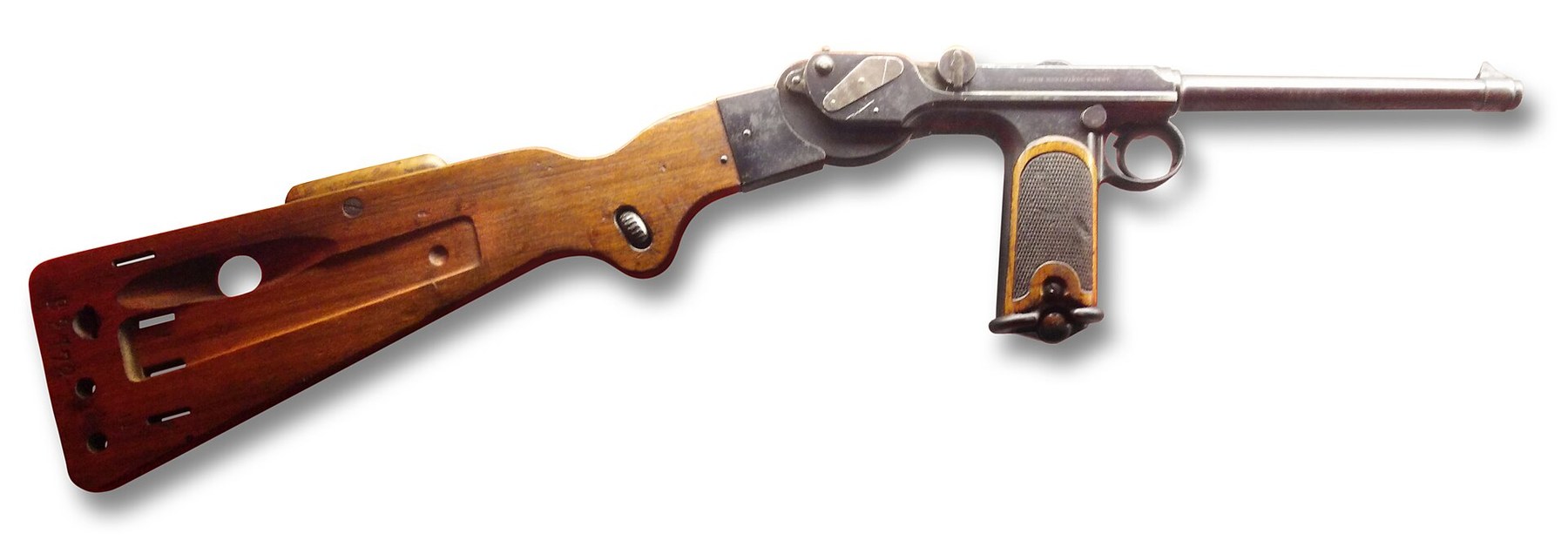
Original C-93s sell at auction in the United States, Britain and Germany for roughly $16,000 to $25,000 when complete and in honest condition, and well beyond that for early, original, fully matching cased outfits: $74,750 for Loewe serial 13 in 2017 and, by the auction house’s own account, $70,500 for a cased Loewe pistol in 2023. German results run lower in the published reports, which appear to quote hammer prices. The stock, holster and case are worth real money on their own: a case and stock without a pistol made $9,000 with premium in 2022. The figures behind those statements follow, with their terms.
8.3 Realised prices, newest first
All figures were read on the auction house’s own page or the named report on 18 October 2026. “Incl. BP” means including buyer’s premium. Rows are not averaged: the currencies, premium treatment and completeness differ.
Table 1 — Realised prices, newest first
| Date | House, sale, lot | Pistol | Configuration and condition, in the house’s words | Result | Premium |
|---|---|---|---|---|---|
| May 2025 | Hermann Historica, auction 104, lot 7570 | DWM serial 2234 | Original finish with wear; non-original case; stock and holster; reprint manual | €18,000 | Not stated; reports normally quote hammer |
| Aug 2023 | Rock Island, lot 409 (identification with the blog’s pistol is this dive’s) | Loewe, cased | ”Excellent, with 90% plus original blue”; matching stock, cheekpiece, three extra matching magazines, full tools | $70,500, per Rock Island’s own blog | Not stated |
| May 2022 | Morphy, lot 1353 | Case only, no pistol | Original case with stock, cheekpiece, barring block, rod, oiler, sling | $9,000 (estimate $2,500–3,500) | Incl. BP |
| Nov 2019 | Bonhams London, sale 25427, lot 42 | Loewe no. 881 | Original leather case, stock-holster, four magazines numbered to the gun; “much blued finish” | £23,812.50 | Incl. BP |
| Nov 2019 | Bonhams London, sale 25427, lot 43 | Loewe no. 664 | Original case, stock-holster, three numbered magazines | £20,062.50 | Incl. BP |
| Nov 2018 | Hermann Historica (Lux collection) | Loewe | ”complete with holster-stock and box with original accessories” | €18,000 | Not stated |
| Nov 2018 | Morphy, lot id 450735 | DWM, cased | ”Stock, Case, Tools, Magazine Insert, Holster, Plaque”; “excellent” | $22,200 | Incl. BP |
| Apr 2017 | James D. Julia, lot 1516 | Loewe serial 13, experimental features | ”an amazing 99+% orig blue”, cased | $74,750 | Incl. BP |
| Apr 2017 | James D. Julia, lot 1520 | DWM serial 1105 | ”approx 75-80% orig rust blue”; original unnumbered stock and cheekpiece | $16,100 | Incl. BP |
| Mar 2016 | James D. Julia, lot 2614 | DWM serial 1962, cased | ”professionally restored finish”; reproduction case, holster and straps | $19,550 | Incl. BP |
| 2014 | Hermann Historica | Loewe | With board stock and holster | €13,500 (called at €12,000) | Not stated |
| Oct 2010 | Hermann Historica | Not stated | ”almost mint condition with all its original brushed bluing”; original linen-covered case | €24,000 (estimate €15,000) | Not stated |
Sources: the houses’ pages and reports.12345678910111213 The 2010 report’s headline converts the result to “£24,000”, which appears to mislabel the currency; the euro figure is from its text.
Offered, result not public or not sold. Rock Island hides realised prices behind a login and this research did not try to get round it, so for its lots only estimates are recorded: Loewe serial 19, the earliest known complete cased rig in the house’s description, estimated $70,000–90,000 in December 2024, after an estimate of $75,000–100,000 in December 2023 (the re-offer a year later at a lower estimate suggests, but does not prove, that it did not sell the first time); Loewe serial 529 at $14,000–22,500 in October 2025; a Loewe with matching stock 522 at $16,000–25,000 in December 2018; and a stock and holster alone at $4,000–7,000 in 2013.1415161718 James D. Julia’s Loewe serial 463, with four matching magazines and a barring block, shows $0.00 on its page at an estimate of $35,000–45,000, which means unsold or not posted, not a sale price.19 Poulin’s Loewe serial 1013 and Siamese DWM serial 2915 do not show results on their pages.2021
8.4 Dealer asking prices and accessories
Asking prices are not sale prices, and the dealers’ pages are undated “previously sold” listings unless shown otherwise.
Table 2 — Dealer asking prices and accessories
| Seller | Item | Asking price |
|---|---|---|
| Collectors Firearms | Serial 1910, “97% of the original blue”, all matching including magazine, original stock and holster | $34,500 |
| Collectors Firearms | Serial 2119, “original gun that has been refinished”, replacement grips, stock and holster | $12,500 |
| Historic Investments | Loewe serial 1013, about 97 percent original rust blue, matching magazine, stock and cheekpiece | $27,950 (“out of stock”) |
| Handguns of the World | Reproduction “Borchardt 1893 Flat Board Shoulder Stock with cheek piece”, walnut, black leather holster attached, new | $1,995, in stock, 18 October 2026 |
Sources: the sellers’ pages.22232425 For a sense of how far values have moved, a reader comment on Forgotten Weapons recalls a stocked, cased pistol at “around $3,500 in the 1970s” against about $1,800 unstocked. It is an anecdote, not a price record.26
8.5 What drives the price
The auction houses explain their own estimates, and the drivers are consistent.
Completeness of the outfit. Rock Island: the pistols “were typically all sold as a complete cased set with walnut board stock and spare magazines. In many instances the cases, stock/holster and accessories were separated from the Borchardt pistol and lost.” And to the owner of a pistol without a stock: “you need to buy this one as it would dramatically increase the value of your pistol.”18 Morphy’s case and stock alone, at $9,000 against a $2,500–3,500 estimate, confirms it.4
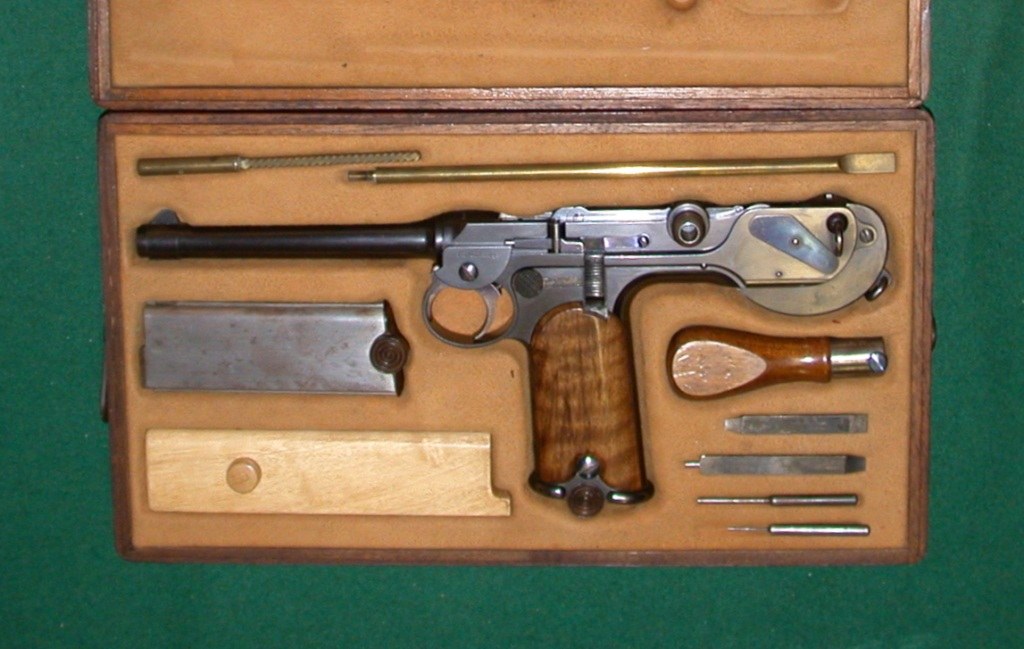
Original finish. Collectors Firearms, on its serial 1910: “Very fine example of an original condition gun and holster. Most examples are restored.”22 The same dealer priced a refinished pistol with replacement accessories at $12,500 against $34,500 for the original.2322
The original case and manual. On Hermann Historica’s €18,000 DWM in 2025, the reporting journalist added: “If it had had the box and the original manual, surely the final price would have been considerably higher.”1
Matching numbers, read correctly. Loewe numbered the stock and magazines to the pistol; DWM did not number its stocks, so an unnumbered stock on a DWM pistol is correct, not a defect (Volume 5).10 Four matching magazines are, in James D. Julia’s word, “unheard of”.19
Maker. The top results are Loewe pistols, and the trade generally treats Loewe as the premium maker. No published rarity count of complete outfits by maker was found.
Early serials, prototypes and experimental features. Serial 13’s experimental sear and stock fitting, and serial 19’s claim to be the earliest complete rig, are the two highest-estimated pistols in the record.914
Special markings and provenance. The Siamese chakra (Volume 5), publication in Görtz and Sturgess or Walter, named collections, and inscriptions all appear in the houses’ copy as reasons for their estimates.21
Mechanical condition. The unserialised prototype whose top assembly would “not return fully to battery” did not sell at $17,500–35,000.27
Legal status. The houses catalogue C-93s variously as antiques and as curios or relics, and Rock Island notes that they are “restricted under various state-level assault weapons bans and cannot be sold or transferred to residents of IL or NY”.162021 A buyer’s legal position follows from the pistol’s date of manufacture, and the market prices it accordingly.
8.6 Where they are sold
In the United States, the major firearms auction houses (Rock Island, Morphy, which absorbed James D. Julia, Poulin) and specialist dealers; in Britain, Bonhams; in Germany, Hermann Historica; in France, sales listed through the Gazette Drouot, where Loewe serial 429 was offered with its stock and case in October 2026, result for subscribers only.28 Cased outfits, stocks and accessories also trade separately.
8.7 Federal law: is it a firearm at all?
The Gun Control Act excludes antique firearms from its definition of a firearm. 18 U.S.C. § 921(a)(3): “The term ‘firearm’ means (A) any weapon (including a starter gun) which will or is designed to or may readily be converted to expel a projectile by the action of an explosive; (B) the frame or receiver of any such weapon; … Such term does not include an antique firearm.”29
§ 921(a)(16) defines the antique:
“(16) The term ‘antique firearm’ means— (A) any firearm (including any firearm with a matchlock, flintlock, percussion cap, or similar type of ignition system) manufactured in or before 1898; or (B) any replica of any firearm described in subparagraph (A) if such replica— (i) is not designed or redesigned for using rimfire or conventional centerfire fixed ammunition, or (ii) uses rimfire or conventional centerfire fixed ammunition which is no longer manufactured in the United States and which is not readily available in the ordinary channels of commercial trade; or (C) any muzzle loading rifle, muzzle loading shotgun, or muzzle loading pistol …”29
For an original C-93 the operative clause is (A), and the test is the date of manufacture alone. A C-93 manufactured in or before 1898 is not a “firearm” under the Gun Control Act: no dealer transfer, no Form 4473, no federal interstate restriction. The regulation, 27 CFR 478.11, repeats the definition.30
A C-93 manufactured in 1899 or later is a firearm. It is more than fifty years old, so it is a curio or relic under 27 CFR 478.11, category (a), “Firearms which were manufactured at least 50 years prior to the current date, but not including replicas thereof”.30 Curio or relic status does not take it out of the Gun Control Act; it allows a holder of a collector’s licence to acquire it across state lines.
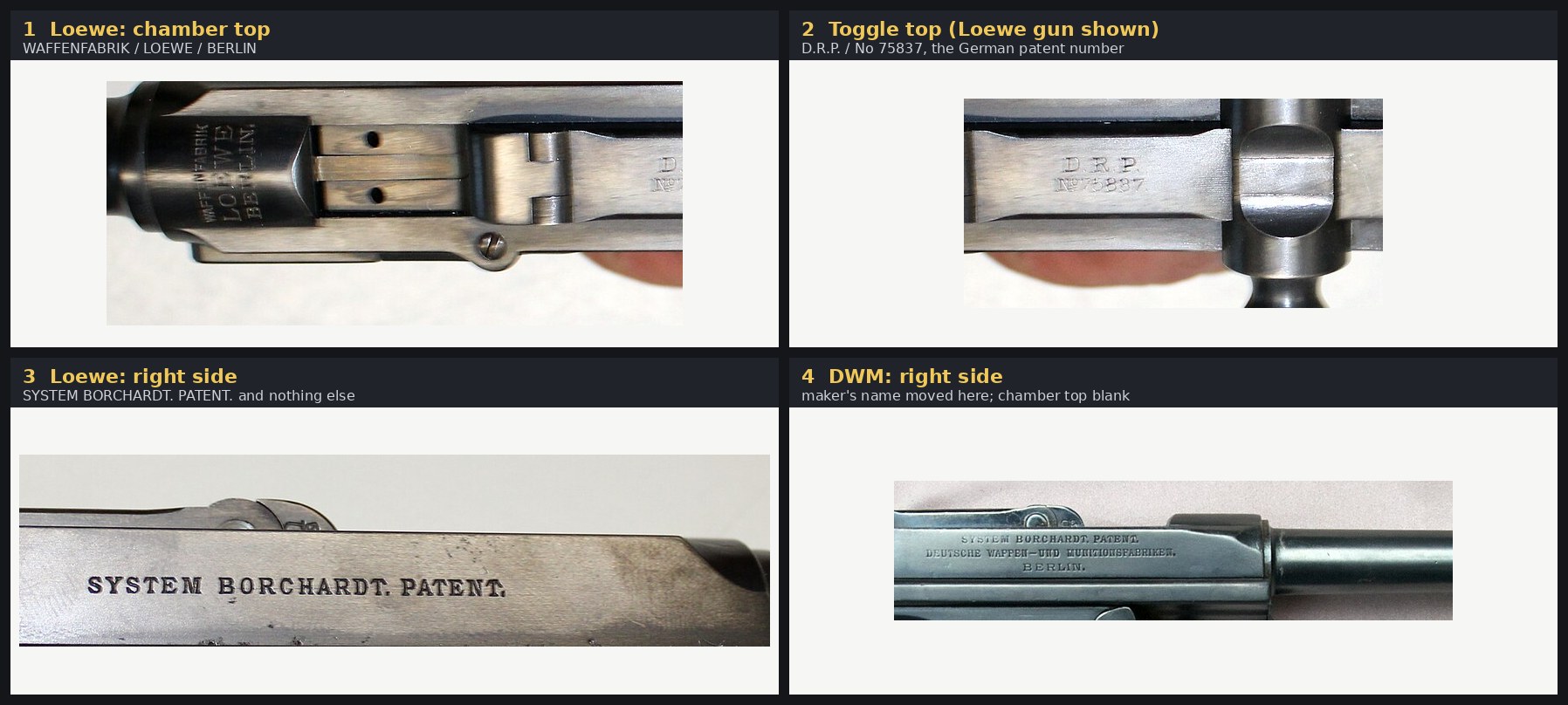
That is why Volume 2’s unanswered question matters. The sources give production end dates of 1898, 1899 and 1902, and Antaris describes Loewe parts being finished as late as 1897. Loewe-marked pistols are generally treated by the trade as antiques; DWM pistols may fall on either side of the line. Antique status belongs to the individual pistol, by its date of manufacture, not to the model, and the sources consulted contain no serial-to-year table.
The Protector palm pistol dive and the DL-44 dive discuss the antique definition for their own subjects; the reading here is from the statute and ATF’s list as quoted.
8.8 Federal law: the stock
Fit the stock and the question changes from the Gun Control Act to the National Firearms Act. A pistol with a shoulder stock and a barrel under 16 inches is on its face a short-barrelled rifle: 26 U.S.C. § 5845(a) makes “a rifle having a barrel or barrels of less than 16 inches in length” an NFA firearm, and § 5845(c) defines a rifle as a weapon “intended to be fired from the shoulder”.31
The NFA’s antique definition is narrower than the Gun Control Act’s, and for a cartridge pistol the difference is decisive. 26 U.S.C. § 5845(g):
“(g) Antique firearm. The term ‘antique firearm’ means any firearm not designed or redesigned for using rim fire or conventional center fire ignition with fixed ammunition and manufactured in or before 1898 (including any matchlock, flintlock, percussion cap, or similar type of ignition system or replica thereof, whether actually manufactured before or after the year 1898) and also any firearm using fixed ammunition manufactured in or before 1898, for which ammunition is no longer manufactured in the United States and is not readily available in the ordinary channels of commercial trade.”31
The 1898 manufacture clause covers only firearms not designed for fixed cartridge ammunition. The C-93 fires centrefire fixed ammunition, so that clause does not reach it at all. It can be an NFA antique only under the second clause, if its ammunition “is no longer manufactured in the United States and is not readily available in the ordinary channels of commercial trade”. 7.65 mm Borchardt as such is not made; but 7.63 mm Mauser, the same case, chambers in it and was on retail shelves on 18 October 2026 (Volume 7). The argument that a C-93 uses obsolete ammunition is therefore weak, and the NFA’s antique exclusion does not clearly protect a stocked C-93.31
What does protect it is a listing. § 5845(a) also excludes “any device (other than a machinegun or destructive device) which, although designed as a weapon, the Secretary finds by reason of the date of its manufacture, value, design, and other characteristics is primarily a collector’s item and is not likely to be used as a weapon.”31 ATF’s Firearms Curios or Relics List (ATF Publication 5300.11, edition covering January 1972 through April 2025) records those findings. Its Section IIIA is headed:
“Section IIIA — Firearms manufactured in or before 1898, removed from the provisions of the National Firearms Act and classified as antique firearms not subject to the provisions of 18 U.S.C. Chapter 44, the Gun Control Act of 1968.”
Its first entry is generic: “Any pistol or revolver, mfd. in or before 1898, originally designed to accept a shoulder stock, and accompanied by an original shoulder stock.” Among the specific entries:
“Borchardt, Model 1893, cal. 7.63mm, pistol with accompanying shoulder stock.”32
The ATF document was read from an Internet Archive copy because atf.gov refuses automated retrieval. “Borchardt” appears only once in the whole list. ATF’s “7.63mm” is loose for the 7.65 mm Borchardt cartridge; the entry identifies the model, not the chambering.
Three things follow from the text. The listing is confined, by its section heading and its generic entry, to pistols manufactured in or before 1898. The generic entry requires an original shoulder stock; the Borchardt entry says “accompanying”, and reading it to require originality is an inference from the section’s structure, flagged as such. And there is no Section III entry for any Borchardt made after 1898, in contrast to the Mauser C96, for which Section III removes from the NFA pistols “as produced by Mauser prior to 1940 accompanied by original German mfd. detachable holster/shoulder stocks”.32
The $0 tax. For anyone who must register a stocked C-93 as a short-barrelled rifle, Public Law 119-21 of 4 July 2025 changed the making tax. 26 U.S.C. § 5821(a) now reads: “There shall be levied, collected, and paid upon the making of a firearm a tax at the rate of— (1) $200 for each firearm made in the case of a machinegun or a destructive device, and (2) $0 for any firearm made which is not described in paragraph (1).”33 The amendment applies to calendar quarters beginning more than 90 days after enactment, which this dive computes as 1 January 2026. Registration was not abolished: 26 U.S.C. § 5822 still requires anyone making an NFA firearm first to file an application, identify himself with fingerprints and a photograph, and obtain approval.34 The hub’s suppressor law dive covers the Public Law 119-21 changes in general.
8.9 Five cases
From the texts above. The analysis is this dive’s and is not legal advice.
- A C-93 made in or before 1898, with its original stock. Listed in Section IIIA: removed from the NFA, and an antique outside the Gun Control Act. Owned and transferred as an antique under federal law.
- A C-93 made in 1899 or later, with its original stock. On no list. With the stock attached it is, on the text, an unregistered short-barrelled rifle unless it is on the National Firearms Registration and Transfer Record or ATF classifies it otherwise on request. No ATF ruling on a post-1898 Borchardt was found. An owner of a late DWM pistol should seek a written classification from ATF’s Firearms and Ammunition Technology Division before the stock is ever fitted.
- A pre-1899 C-93 with a reproduction stock. Under the Gun Control Act the pistol remains an antique, because the test is its date. Under the NFA, the collector’s-item listing contemplates the original stock, and the antique exclusion reaches the combination only if the ammunition is obsolete, which is doubtful (above). The conservative reading is that fitting a reproduction stock makes a short-barrelled rifle.
- Any stock on a modern-made C-93-pattern pistol. Making a short-barrelled rifle: an approved ATF Form 1 is required before the stock is attached. The tax is $0 from 2026; the application and approval are not optional (Volume 9).
- A pistol and a stock owned together but not attached. The Supreme Court held in United States v. Thompson/Center Arms Co. (1992) that a pistol and a conversion kit “when packaged together have not been ‘made’ into a short-barreled rifle for NFA purposes”, resolving the ambiguity by the rule of lenity.35 That case turned on a kit that could also be assembled into lawful configurations, a pistol and a long-barrelled rifle. A C-93 stock has no lawful use except to make a short-barrelled rifle from a short-barrelled pistol, so how far the decision protects someone holding a reproduction stock with a post-1898 or modern pistol is not established.
8.10 Michigan: a stricter definition
Michigan’s definition of an antique firearm is not the Gun Control Act’s. It is the National Firearms Act’s, almost word for word. MCL 750.231a(2):
“(2) As used in this section, ‘antique firearm’ means either of the following: (i) A firearm not designed or redesigned for using rimfire or conventional center fire ignition with fixed ammunition and manufactured in or before 1898, including a matchlock, flintlock, percussion cap, or similar type of ignition system or replica of such a firearm, whether actually manufactured before or after 1898. (ii) A firearm using fixed ammunition manufactured in or before 1898, for which ammunition is no longer manufactured in the United States and is not readily available in the ordinary channels of commercial trade.”36
The licensing exemption for antiques borrows that definition. MCL 28.432(1): “Section 2 does not apply to any of the following: … (h) Purchasing, owning, carrying, possessing, using, or transporting an antique firearm. As used in this subdivision, ‘antique firearm’ means that term as defined in section 231a of the Michigan penal code, 1931 PA 328, MCL 750.231a.”37
The consequence, on the text: a C-93 made in 1895, which is a federal antique, is not clearly a Michigan antique. It is a centrefire fixed-ammunition firearm, so clause (i) does not reach it; it qualifies under clause (ii) only if its ammunition is both no longer made in the United States and not readily available, and 7.63 Mauser, which chambers in it, is sold at retail. No Michigan case or Attorney General’s opinion on cartridge antiques was located.
If it is not an antique in Michigan, it is a pistol like any other. MCL 28.421 defines a pistol as “a loaded or unloaded firearm that is 26 inches or less in length”, and a firearm as “any weapon which will, is designed to, or may readily be converted to expel a projectile by action of an explosive”, with no antique carve-out of its own.38 MCL 28.422(1): “Except as otherwise provided in this act, a person shall not do either of the following: (a) Purchase, carry, possess, or transport a pistol in this state without first having obtained a license for the pistol as prescribed in this section.”39
Holders of a Michigan concealed pistol licence are exempt from that licence requirement: MCL 28.422a(1) says an individual licensed under section 5b “is not required to obtain a license under section 2 to purchase, carry, possess, use, or transport a firearm”, though when such a person acquires a firearm the seller must still complete the state’s sales record, and for a pistol forward a copy to local police within ten days.40
Two further Michigan provisions apply to a C-93 whatever its status. The vehicle transport exception for antiques in MCL 750.231a(1)(c), for “a person carrying an antique firearm, completely unloaded in a closed case or container designed for the storage of firearms in the trunk of a vehicle”, uses the same narrow definition.36 And the safe-storage provision of MCL 28.429, added in 2023, applies to any firearm left unattended where a minor is or is likely to be present: it must be in a locked box or container, or unloaded and locked with a properly engaged locking device.41
How this applies to a particular pistol is deliberately left unresolved here. The text points to a conservative course for a Michigan owner: treat an original C-93 as a pistol subject to the licence and sales-record regime, or hold a concealed pistol licence. Whether the Michigan State Police treat it that way in practice was not found on the state’s own pages, and the question should be put to the MSP Firearms Records Unit in writing.
8.11 Other states
Federal antique status does not carry through every state’s law. Rock Island’s catalogue note that C-93s cannot be sold or transferred to residents of Illinois or New York, because of those states’ assault-weapons laws, is one example the trade itself flags.16 A buyer outside Michigan should check his own state’s definitions, which may follow either federal model or neither.
8.12 A checklist before buying
- Establish the date of manufacture as closely as the evidence allows: maker’s marking, serial, features, provenance (Volumes 2 and 5).
- Decide the federal status from that date: antique if made in or before 1898; curio or relic, and a firearm, if later.
- Treat the stock as the legal question it is. Original stock with a pre-1899 pistol: listed. Anything else: see the five cases, and ask ATF in writing before attaching it.
- In Michigan, assume the pistol is a pistol for licensing purposes unless the State Police say otherwise in writing.
- Check the outfit item by item for originality, and price it accordingly (Volume 5).
- Have it examined mechanically before any thought of firing it (Volume 6).
8.13 What could not be established
- When the last C-93 was made, and so which DWM pistols are federal antiques.
- Any ATF ruling on a post-1898 C-93 with its stock, or on a reproduction stock with an original.
- Whether ATF reads “accompanying shoulder stock” to require an original stock.
- The Michigan State Police position on cartridge firearms made before 1899, and on licensing a self-made pistol (Volume 9).
- Rock Island’s realised prices, which are behind a login.
- A rarity count of complete original outfits.
References
Footnotes
-
Giorgio Brancaglion, “Hermann Historica auction 104: all the results”, all4shooters.com, 13 May 2025, https://www.all4shooters.com/en/shooting/culture/hermann-historica-auction-number-all-results/, consulted 2026-10-18. ↩ ↩2
-
Joe Engesser, “The Borchardt C93 Pistol”, Rock Island Auction Company blog, 14 October 2024, https://www.rockislandauction.com/riac-blog/borchardt-c93-pistol, consulted 2026-10-18. ↩
-
Rock Island Auction Company, lot 89-409, 25 August 2023, https://www.rockislandauction.com/detail/89/409/ludwig-loewe-model-1893-borchardt-semiautomatic-pistol, consulted 2026-10-18. ↩
-
Morphy Auctions, 18 May 2022, lot 1353, https://auctions.morphyauctions.com/ORIGINAL_BORCHARDT_C93_CASE_WITH_ACCESSORIES_-LOT531196.aspx, consulted 2026-10-18. ↩ ↩2
-
Bonhams, sale 25427, 28 November 2019, lot 42, https://www.bonhams.com/auction/25427/lot/42/, consulted 2026-10-18. ↩
-
Bonhams, sale 25427, 28 November 2019, lot 43, https://www.bonhams.com/auction/25427/lot/43/, consulted 2026-10-18. ↩
-
all4shooters.com, “Hermann Historica: the results of the dream auction”, 19 December 2018, https://www.all4shooters.com/en/shooting/culture/hermann-historica-the-results-of-the-dream-auction/, consulted 2026-10-18. ↩
-
Morphy Auctions, Firearms, Militaria and Sporting, 30 October to 2 November 2018, https://auctions.morphyauctions.com/lot-450735.aspx, consulted 2026-10-18. ↩
-
James D. Julia, April 2017, lot 1516, https://jamesdjulia.com/?p=548180, consulted 2026-10-18. ↩ ↩2
-
James D. Julia, April 2017, lot 1520, https://jamesdjulia.com/?p=548184, consulted 2026-10-18. ↩ ↩2
-
James D. Julia, March 2016, lot 2614, https://jamesdjulia.com/?p=539605, consulted 2026-10-18. ↩
-
all4shooters.com (German edition), Hermann Historica autumn auction report, https://www.all4shooters.com/de/shooting/waffenkultur/2018/herbstauktion-der-hermann-historica-ohg/, consulted 2026-10-18. ↩
-
Paul Fraser Collectibles, “Near mint condition Borchardt gun shoots to 24,000 at Hermann Historica”, 12 October 2010, https://www.paulfrasercollectibles.com/blogs/medals-militaria/near-mint-condition-borchardt-gun-shoots-to-24-000-at-hermann-historica, consulted 2026-10-18. ↩
-
Rock Island Auction Company, lot 4093-1368, 7 December 2024, consulted 2026-10-18. ↩ ↩2
-
Rock Island Auction Company, lot 4090-507, 8 December 2023, consulted 2026-10-18. ↩
-
Rock Island Auction Company, lot 1049-542, 3 October 2025, consulted 2026-10-18. ↩ ↩2 ↩3
-
Rock Island Auction Company, lot 75-2694, 1 December 2018, consulted 2026-10-18. ↩
-
Rock Island Auction Company, lot 60-1360, 8 December 2013, consulted 2026-10-18. ↩ ↩2
-
James D. Julia, October 2017, lot 2005, https://jamesdjulia.com/?p=554250, consulted 2026-10-18. ↩ ↩2
-
Poulin Auctions, lot 01-29022, Summer 2026, consulted 2026-10-18. ↩ ↩2
-
Poulin Auctions, lot 25-3438, Fall 2025, consulted 2026-10-18. ↩ ↩2 ↩3
-
Collectors Firearms, serial 1910, https://collectorsfirearms.com/product/borchardt-c93-semi-auto-pistol-7-65x25mm-ah9044/, consulted 2026-10-18. ↩ ↩2 ↩3
-
Collectors Firearms, serial 2119, https://collectorsfirearms.com/product/borchardt-c93-pistol-w-stock-ah9022/, consulted 2026-10-18. ↩ ↩2
-
Historic Investments, “Loewe Borchardt C93 matching mag, stock, cheekpiece, antique 1013”, https://investmentsinarms.com/product/loewe-borchardt-c93-matching-mag-stock-cheekpiece-antique-1013-o-278, consulted 2026-10-18. ↩
-
Handguns of the World, “Borchardt 1893 Stock”, SKU B4271, https://handgunsoftheworld.com/product/borchardt-1893-stock/, consulted 2026-10-18. ↩
-
Forgotten Weapons, 29 November 2015, reader comments, https://www.forgottenweapons.com/c93-borchardt-the-first-successful-self-loading-pistol-at-ria/, consulted 2026-10-18. ↩
-
James D. Julia, April 2017, lot 1518, https://jamesdjulia.com/?p=548182, consulted 2026-10-18. ↩
-
Gazette Drouot, lot 42, Borchardt C-93, https://www.gazette-drouot.com/en/lots/28323457-borchardt-c-93-semi-automatic---, consulted 2026-10-18. ↩
-
18 U.S.C. § 921, Cornell Legal Information Institute, https://www.law.cornell.edu/uscode/text/18/921, consulted 2026-10-18. ↩ ↩2
-
27 CFR 478.11, eCFR, https://www.ecfr.gov/current/title-27/chapter-II/subchapter-B/part-478/subpart-B/section-478.11, consulted 2026-10-18. ↩ ↩2
-
26 U.S.C. § 5845, Cornell Legal Information Institute, https://www.law.cornell.edu/uscode/text/26/5845, consulted 2026-10-18. ↩ ↩2 ↩3 ↩4
-
ATF, Firearms Curios or Relics List, January 1972 through April 2025 (ATF P 5300.11), https://www.atf.gov/media/19856/download, read from the Internet Archive copy of 26 April 2026, https://web.archive.org/web/20260426215034if_/https://www.atf.gov/media/19856/download, consulted 2026-10-18. Section IIIA and Section III. ↩ ↩2
-
26 U.S.C. § 5821, Cornell Legal Information Institute, https://www.law.cornell.edu/uscode/text/26/5821, consulted 2026-10-18; amended by Pub. L. 119–21, title VII, § 70436(b), 4 July 2025. ↩
-
26 U.S.C. § 5822, Cornell Legal Information Institute, https://www.law.cornell.edu/uscode/text/26/5822, consulted 2026-10-18. ↩
-
United States v. Thompson/Center Arms Co., 504 U.S. 505 (1992), https://www.law.cornell.edu/supremecourt/text/504/505, consulted 2026-10-18. ↩
-
MCL 750.231a, https://legislature.mi.gov/Laws/MCL?objectName=mcl-750-231a, consulted 2026-10-18. ↩ ↩2
-
MCL 28.432, https://legislature.mi.gov/Laws/MCL?objectName=mcl-28-432, consulted 2026-10-18. ↩
-
MCL 28.421, https://legislature.mi.gov/Laws/MCL?objectName=mcl-28-421, consulted 2026-10-18. ↩
-
MCL 28.422, https://legislature.mi.gov/Laws/MCL?objectName=mcl-28-422, consulted 2026-10-18. ↩
-
MCL 28.422a, https://legislature.mi.gov/Laws/MCL?objectName=mcl-28-422a, consulted 2026-10-18. ↩
-
MCL 28.429, https://legislature.mi.gov/Laws/MCL?objectName=mcl-28-429, consulted 2026-10-18. ↩
Comments (0)