Borchardt C-93 · Volume 3
Trials, Rejection and the Road to the Luger
The US Navy in 1894, the Swiss commission in 1897, the US Army in 1897 and 1898, why every one said no, and how Georg Luger turned the C-93 into the Parabellum
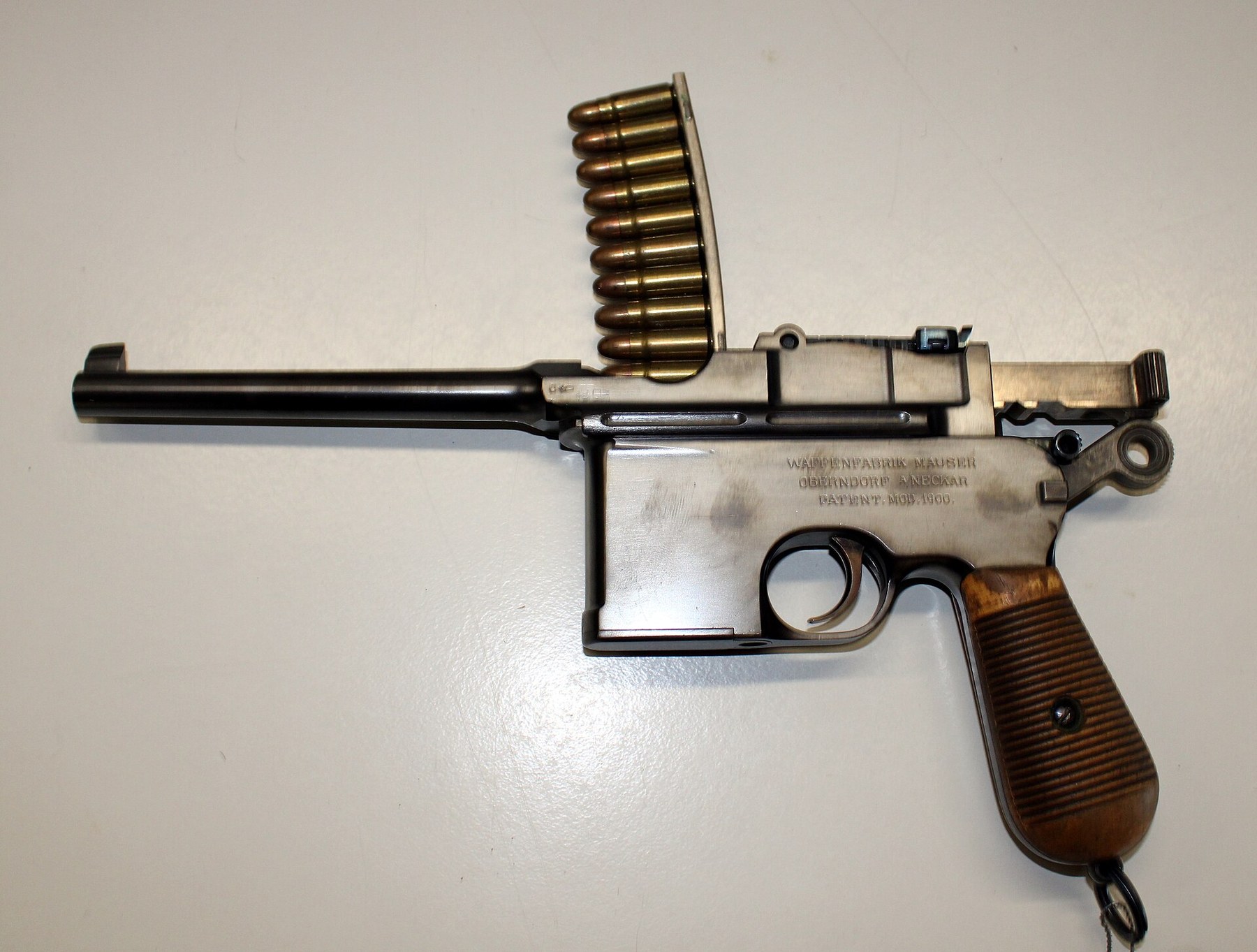
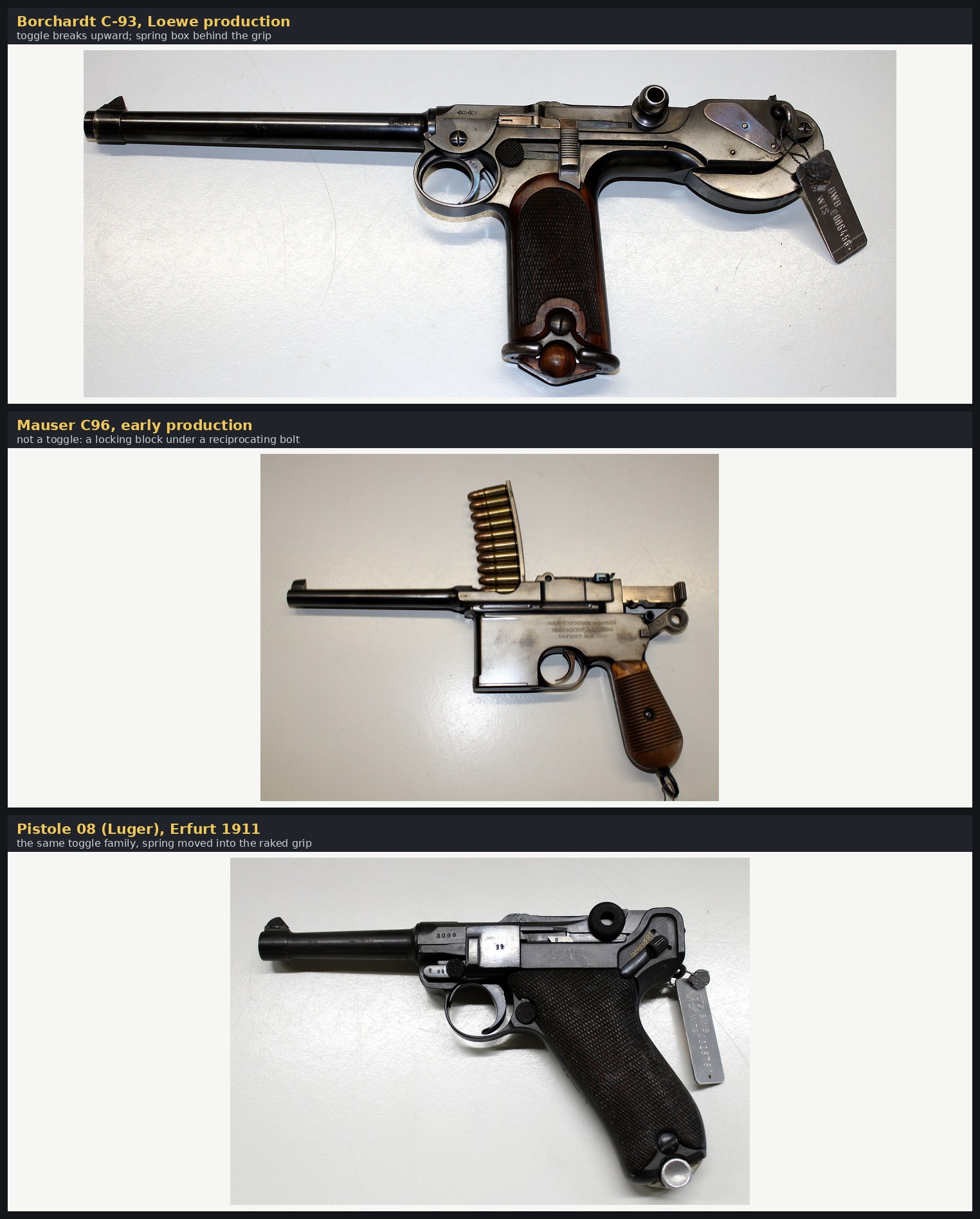
No government adopted the C-93. Every service that looked at it in the 1890s, in the United States, Switzerland and perhaps the Netherlands, found something to admire and more to dislike. The pattern of those verdicts, and its designer’s response to them, is the reason the world remembers the C-93 at all: Hugo Borchardt would not make his pistol smaller, so his employer gave the job to Georg Luger, and the Parabellum that came out of it was adopted by Switzerland in 1900 and Germany in 1908. This volume follows that sequence, keeping to what the documents say and marking where the documents run out.
3.1 The trials in one table
Table 1 — The trials in one table
| Date | Service | Where | Demonstrator | Outcome | Source quality |
|---|---|---|---|---|---|
| 21 November 1894 | US Navy board | Providence, Rhode Island | Georg Luger | Not pursued | Secondary; newspaper report quoted by Datig |
| 1895 | Dutch military | — | — | One stocked pistol reportedly bought | Collector site only |
| June 1897 | Swiss Gewehrkommission | Thun area | Georg Luger | No pistol recommended; C-93 and C96 rated best but too big, heavy and complicated | Swiss federal foundation report |
| 20 October 1897 | US Army board | Springfield Armory | — | Not pursued | Secondary; order quoted by Datig |
| November 1898 | US Army board | — | — | “Not yet” ready to replace the revolver | Board report as quoted |
| November 1898 onward | Swiss commission | Bern or Thun | Georg Luger | Borchardt-Luger, not the C-93 | Swiss foundation report |
3.2 The United States Navy, November 1894
The C-93’s first known trial was American. Fred Datig’s history of the Luger, published in Gun Digest, places a demonstration before a US Navy small-arms board at Providence, Rhode Island, on 21 November 1894, and quotes the Boston Herald of the next day: the “exhibitor fired 24 shots in 43? seconds. range 110 feet, and all were hits”.1 The seconds figure is garbled in the online text of Datig’s article, so the rate of fire is not usable; the range, 110 feet, and the result, all hits, are. Datig adds that the eight-round magazine was loaded with “nickel jacketed bullets”, that it was Luger and not Borchardt who brought the pistol across, and that the Navy did not follow it up.1
The German Wikipedia biography of Luger confirms the outline independently: in November 1894 Luger toured the United States and presented the C-93 to the US Navy.2 The 1896 ONI description of the pistol, discussed in Volume 2, may be the Navy’s documentary residue of that visit; it does not say so. No primary report of the Providence board was located: the Navy’s Bureau of Ordnance annual report for the fiscal year 1895 and the Boston Herald of 22 November 1894 are the places to look, and both are listed as owed.
3.3 The Netherlands, 1895
A collector site states that a “C93 Borchardt pistol with detachable stock” was bought by the Dutch military in 1895, and that the German-language DWM manual in the same collection carries the stamp of Georges & de Watteville of Amsterdam, DWM’s representative in the Netherlands.3 Neither statement was confirmed from a Dutch source; the purchase, if it happened, was a test specimen rather than an adoption.
3.4 Switzerland, June 1897: the decisive test
The best-documented trial is the Swiss one, and it is the one that decided the pistol’s fate. The account here follows a 2021 report by Markus Käser of the Stiftung Historisches Armeematerial in Thun, the Swiss federal foundation that holds the army’s historic materiel, which draws on the Swiss records and on Görtz and Sturgess.4
The Swiss had been looking at self-loading pistols since about 1892, beginning with a Bergmann; a Mannlicher was presented in 1895, and a comparative test of twenty pistols was planned and repeatedly delayed. “Early in 1897”, the report says, “the well-known firm of Mauser presented its newly developed C 96 pistol. Apparently at the same time the Deutsche Waffen- und Munitionsfabriken (DWM) became interested, with its pistol 1893 developed by Hugo Borchardt, in taking part in the Swiss trials.”4
“The rifle commission officially appointed by the Federal Military Department tested the weapons of the four competitors in June 1897”: Bergmann, Mannlicher, Mauser and Borchardt. “The Borchardt was demonstrated by the engineer Georg Luger of DWM.”4
The verdict, in the report’s words: “None of the weapons was recommended for adoption; however, the weapons of Mauser and DWM were judged best.” They were judged best because, as locked-breech designs, they had “markedly higher performance potential”. “Against that, they stood out negatively through their size, weight and complexity” (Grösse, Gewicht und Kompliziertheit). The competitors were told to improve their pistols to the commission’s requirements and submit them again.4
The German Wikipedia article on the C-93 dates the trial to 22 and 23 June 1897 and quotes the trial report’s judgement as “Die Waffe hat schon mehr die Dimensionen eines Karabiners und ein entsprechendes Gewicht”: the weapon already has more the dimensions of a carbine, and a corresponding weight.5 The primary report was not seen and the quotation is attributed to the encyclopaedia. An unsourced French account gives the Swiss requirements as a maximum weight of 1,000 g, a calibre of 7.5 to 7.65 mm and a maximum length of 275 mm.6 If those are correct, the C-93, at 1,275 g by its own factory’s figure, failed the weight limit by more than a quarter before anyone fired it.
The C96’s history, mechanism and cartridge belong to the Mauser C96 dive, which this dive does not repeat.
3.5 The United States Army, 1897 and 1898
Datig also quotes an order of the US Chief of Ordnance convening a board of officers at Springfield Armory on 20 October 1897 “to make a thorough test of, and report upon, a Borchardt Automatic Pistol Carbine”.1 He gives no result and assumes the pistol did not win the board’s approval. The Springfield Armory museum holds a C-93 it catalogues as a “Model 1894”, serial 649; whether it is the board’s pistol is not recorded in the sources consulted, and its catalogue page could not be retrieved.7
A year later a further board, convened chiefly to test revolvers, examined the self-loaders together. Its report, as quoted in a history of the Colt Model 1900, reads: “The Board is of the opinion, based on a careful examination of the Borchardt, the Mannlicher, the Mauser, the Colt, and the Bergmann repeating weapons that the development of this type of pistol has not yet reached such a stage as to justify its adoption in place of the revolver for service use.”8 American Rifleman’s history of the M1911 trials summarises the same episode less kindly: after “a brief examination by an Army board of the Bergmann, Borchardt, Mannlicher and Mauser pistols”, the Colt “created a very favorable impression; the others seemed clumsy, awkward and chambered for inadequate cartridges.”9 The C-93 does not appear in the more thorough American trials of 1899 and after.
A popular article quotes a “Lt. Robert Evans” of the 12th US Infantry calling the pistol “a very accurate, close shooting weapon” that “seems to possess great endurance”.10 No report or date is cited; it is noted as a lead.
3.6 Why everyone said no
The objections recorded across the sources are consistent, and they are given here with their sources rather than merged:
Table 2 — The objections recorded across the sources are consistent, and they are given here with their sources rather than merged
| Objection | Source |
|---|---|
| Size, weight and complexity | Swiss commission, June 1897, via Stiftung HAM |
| ”The dimensions of a carbine and a corresponding weight” | Swiss trial report, as quoted by German Wikipedia |
| ”Clumsy, awkward and chambered for inadequate cartridges” | US Army board, 1898, as summarised by American Rifleman |
| Too large, too heavy, poorly balanced | German Wikipedia, Georg Luger |
| Expensive to produce, unwieldy near-vertical grip, unexpectedly powerful recoil | English Wikipedia, C-93 |
| ”Fragile nature” and “awkward handling” | James D. Julia lot essay, 2013 |
| ”The action was both frail and complicated”; cartridges “badly designed” | Pollard, Automatic Pistols, 1920 |
| ”Failure-prone” (fehleranfällig) | German Wikipedia, DWM |
The first three are contemporary verdicts by services that tested the pistol. The rest are later judgements, and the “fragile” and “failure-prone” charges in particular have no test record behind them in the sources consulted. Pollard’s description of the mechanism, it should be said, is wrong in a way that undermines his authority on it: he says the action recoiled “until a pair of lugs on the frame lifted the toggle-joint”, which is the Luger’s arrangement, not the C-93’s rollers and curved butt.11
What the sources do agree on is that the fundamental objection was not reliability but bulk. A service pistol in the 1890s was expected to replace a revolver on an officer’s belt. The C-93 was more than 30 cm long, over 1.2 kg, and hung its spring housing behind the hand. It was, as the Swiss said, a carbine in pistol’s clothing, and the factory and its American agent sold it exactly that way.
3.7 Borchardt’s refusal
Every account of what happened next says the same thing: Borchardt would not change the design. The Swiss foundation report is the most authoritative statement of it, in a footnote: “The original designer Hugo Borchardt refused to rebuild his weapon to a handy size, whereupon Georg Luger evidently took the matter on.”4 Ian McCollum writes that “Borchardt refused to consider the possibility that his pistol could be improved”, and that “DWM gave the job to a man named Georg Luger”.12 Antaris, in American Rifleman, says Borchardt refused requests for a redesign and “turned the project over” to Luger.13 A James D. Julia lot essay dates DWM’s request for a redesign to 1897.14
None of those accounts cites a letter or a minute from Borchardt himself, and the reasons for his refusal are not recorded. What can be said is that his patent had told the world the near-vertical grip and the balanced springs were the pistol’s great virtues (Volume 2), and that the Swiss had just told him they were its great faults.
3.8 Georg Luger
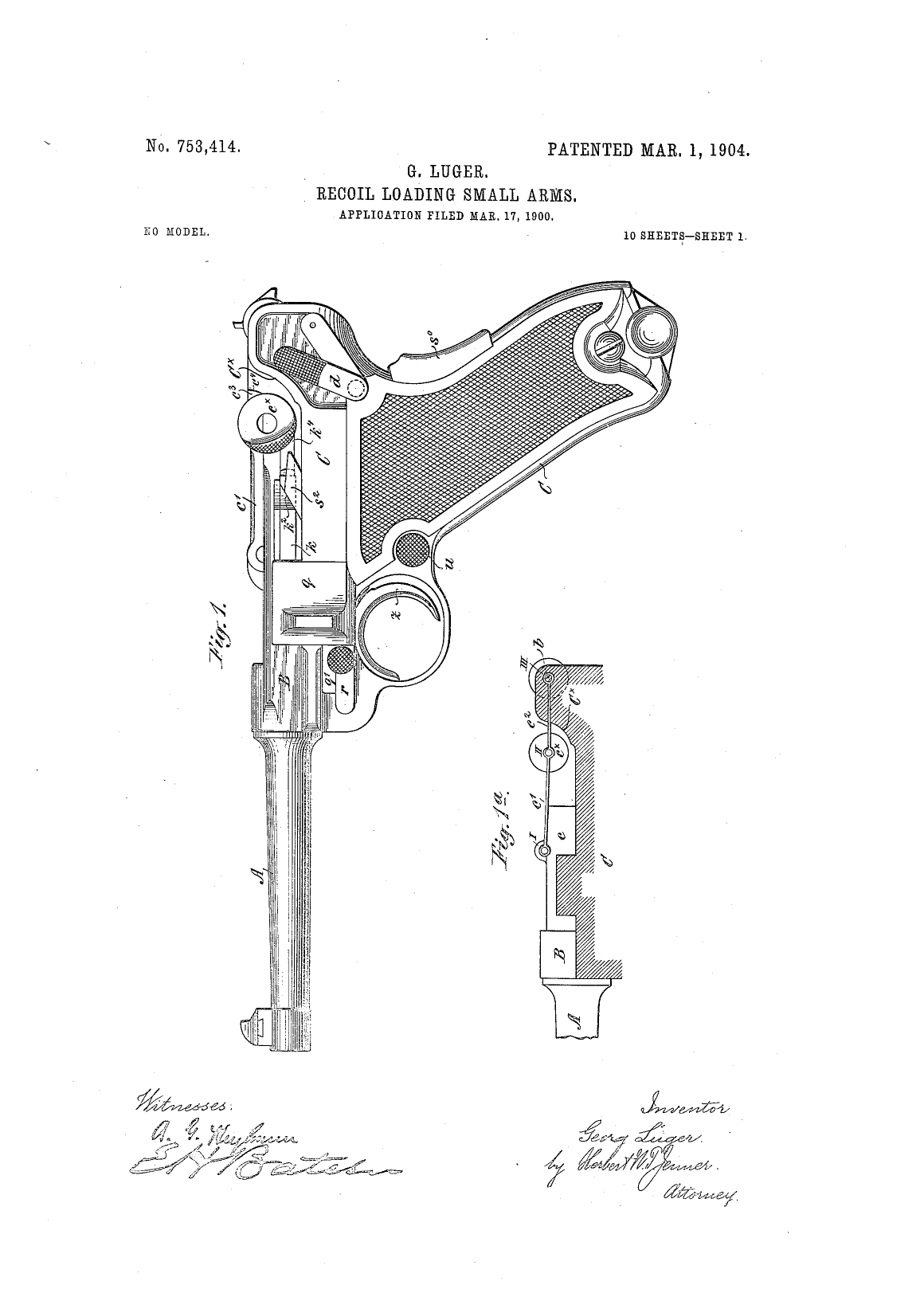
Georg Luger had settled in Berlin-Charlottenburg by 1896 and, according to his entry in the Neue Deutsche Biographie, become an employee of “the leading German arms factory Ludwig Loewe & Co.”, which the same year was sold into the newly founded DWM.15 He held 36 German patents and supplementary patents between 1893 and 1922.15 He was the company’s demonstrator for the C-93 in the United States in 1894 and in Switzerland in 1897, so he knew the pistol’s reception better than its inventor. Datig describes him as a salaried DWM employee on a long contract, able to patent at company cost.1 The German Wikipedia biography records that DWM dismissed him in 1919 and that the ensuing litigation was decided in his favour in 1922.2
The Neue Deutsche Biographie is careful on the question of credit. It says that “Borchardt was granted the German Reich patent fundamental to the later Parabellum pistol, effective from 9.9.1893”, the C-93’s DRP 75,837.15 The Parabellum is Luger’s redesign of a Borchardt patent, and the period sources and the Swiss called it the Borchardt-Luger.
3.9 The Borchardt-Luger, 1898
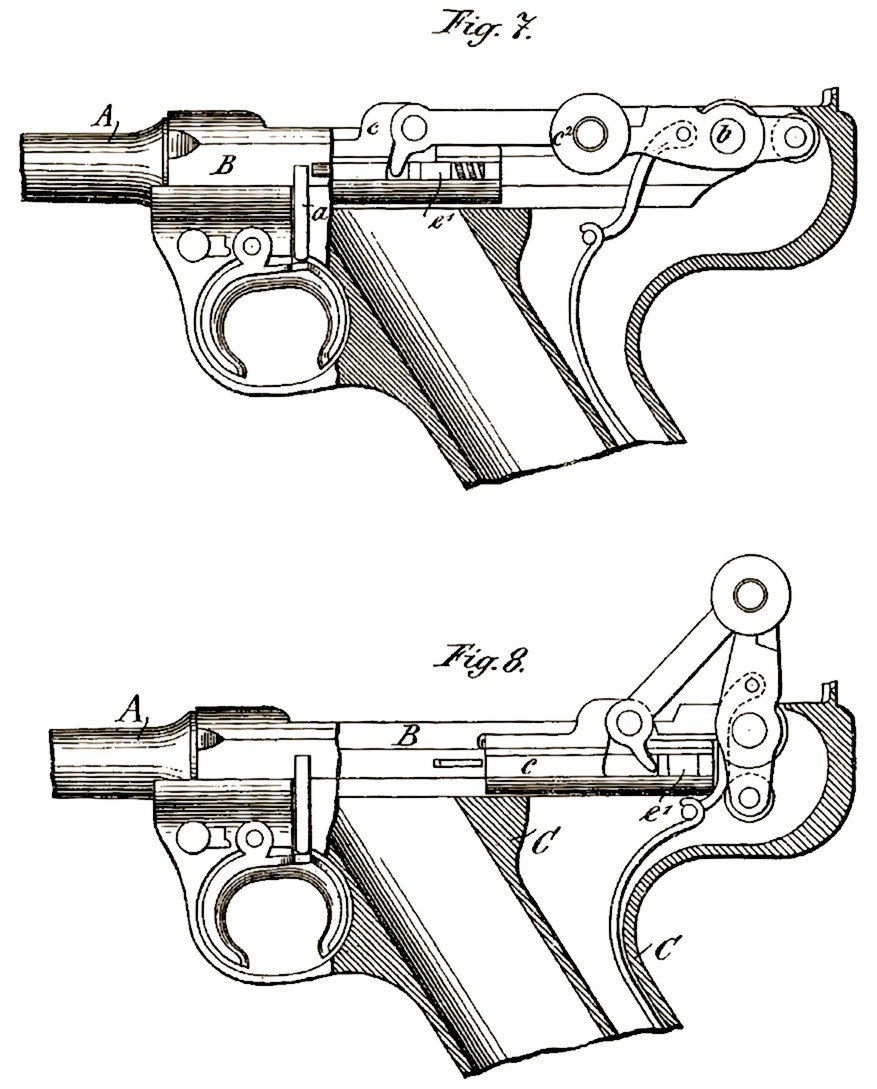
The transition from C-93 to Parabellum took about two years and several intermediate pistols. A collector history of Borchardt-Luger serial 5, drawing on Kenyon, on Görtz and Sturgess, on Stucki’s study of the Thun pistol trials and on Heer, gives this outline:16
- The first transitional models, numbers 1 and 2, kept C-93-style toggle links, with rollers on the rear link, and an extended rear frame, and “probably” twin ribbon recoil springs.
- Number 5 is the first “true” Luger by its rear toggle link and recoil spring, with a much shorter rear frame extension and a grip safety on the frame.
- Luger took numbers 5 and 6 to the Swiss trial at Thun in November 1898.
- The design was protected by Swiss patent 17977 of 3 October 1898 and German patent 109,481.
The Swiss report confirms that number 5 survives and is “the oldest still existing pistol of the Borchardt-Luger”, now in the collection the foundation holds.4 The same collector history records that it was stolen in the 1990s, recovered in the United States around 2002 and returned to Switzerland.16
3.10 Switzerland adopts, 1899 to 1900
The Swiss report carries the story to its end.4 In November 1898 the redesigned Borchardt-Luger emerged “as the clear winner”, though the commission still wanted improvements in safety and weight. A Roth pistol also took part. The date and place are given differently elsewhere: an unsourced French account has the makers recalled to Thun on 23 November 1898 for three days, and Datig has a trial at Bern from 24 November to 8 December 1898, in which the Borchardt-Luger was “the only weapon in the endurance test to perform satisfactorily”.61 Both are given because neither was checked against the Swiss record.
In May 1899 Luger presented further improved pistols, the Mannlicher was finally eliminated, and twenty pistols were ordered for a troop trial over the winter of 1899–1900, believed to be numbers 10 to 29.4 On 3 April 1900 the commission recommended the Borchardt-Luger, and on 4 May 1900 the Federal Council adopted it as the Pistole 1900 for officers; it was declared regulation issue only on 19 February 1904.4 Trial pistol number 21 sold at auction in 2009 for CHF 280,000.4
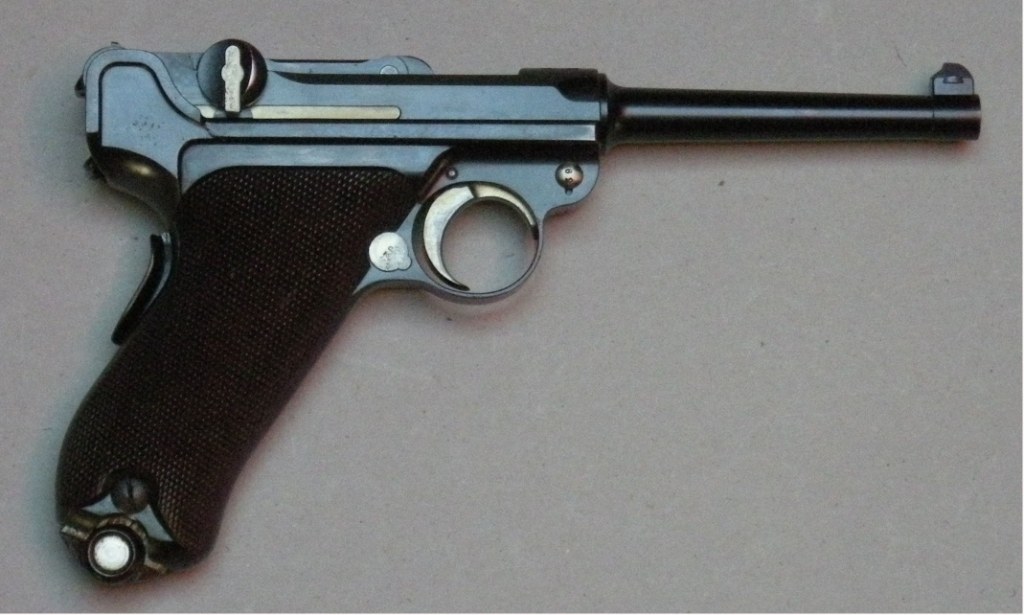
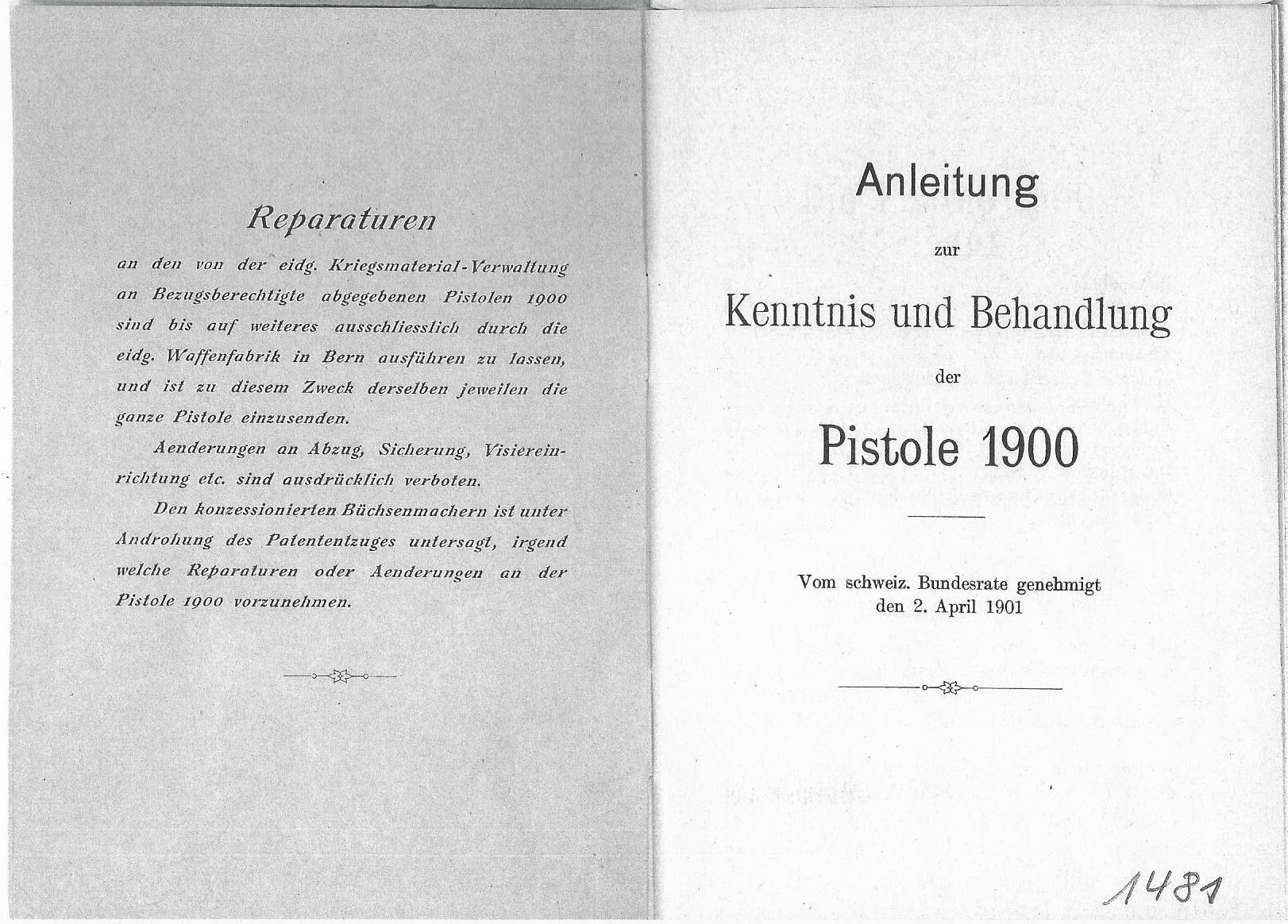
The connection to the C-93 is easy to lose in the Luger’s later fame, so it is worth putting plainly. The pistol the Swiss adopted in 1900 was DWM’s product, built on Borchardt’s German patent, demonstrated by the same man who had shown them the C-93 three years earlier, and redesigned to answer precisely the three objections they had made to it: size, weight and complexity.
3.11 What Luger changed, from his own patent
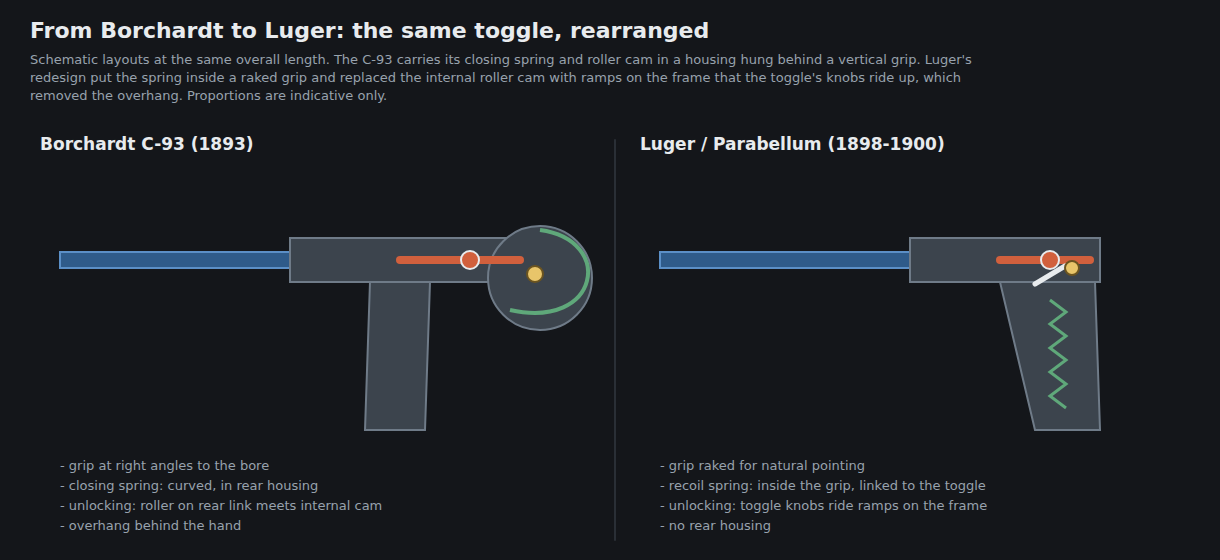
The production arrangement is described in Luger’s US patent 753,414 of 1904, and the differences from Borchardt’s are set out here from the two patents rather than from the collector literature.1718
Table 3 — What Luger changed, from his own patent
| Feature | Borchardt C-93 | Luger, US 753,414 |
|---|---|---|
| Closing spring | Double flat spring coiled in a spring box behind the grip, hooked to the rear link by a stirrup | ”a plate-spring lying in the neck of the butt … parallel to the magazine and having, preferably, an S shape”, connected to the rear link by “a swinging arm” |
| What breaks the toggle | Three rollers on an arm behind the rear pivot strike a curved thrust-piece at the back of the frame | ”suitably-curved guide surfaces … on both sides of the handle-piece, which when the barrel recedes are impinged upon by the … studs” on the rear link |
| Closed position | Not stated in Borchardt’s patent; held by a spring catch-lever on the toggle (Loewe manual) | “its central hinge comes to be situated a little below the end points of the joint”, “on the ‘knee-press’ principle” |
| Hold-open | None; a wooden block is supplied to hold the breech open | ”a novel automatic arresting arrangement for keeping the breech open after the contents of the magazine have been exhausted” |
| Grip | ”at about right angles to the direction of the barrel” | Raked |
| Common architecture | Barrel with a fork-shaped receiver, breechblock, and frame | ”three parts, namely, the barrel A, with the fork-shaped extension B …, the breech-block c, and the case C” |
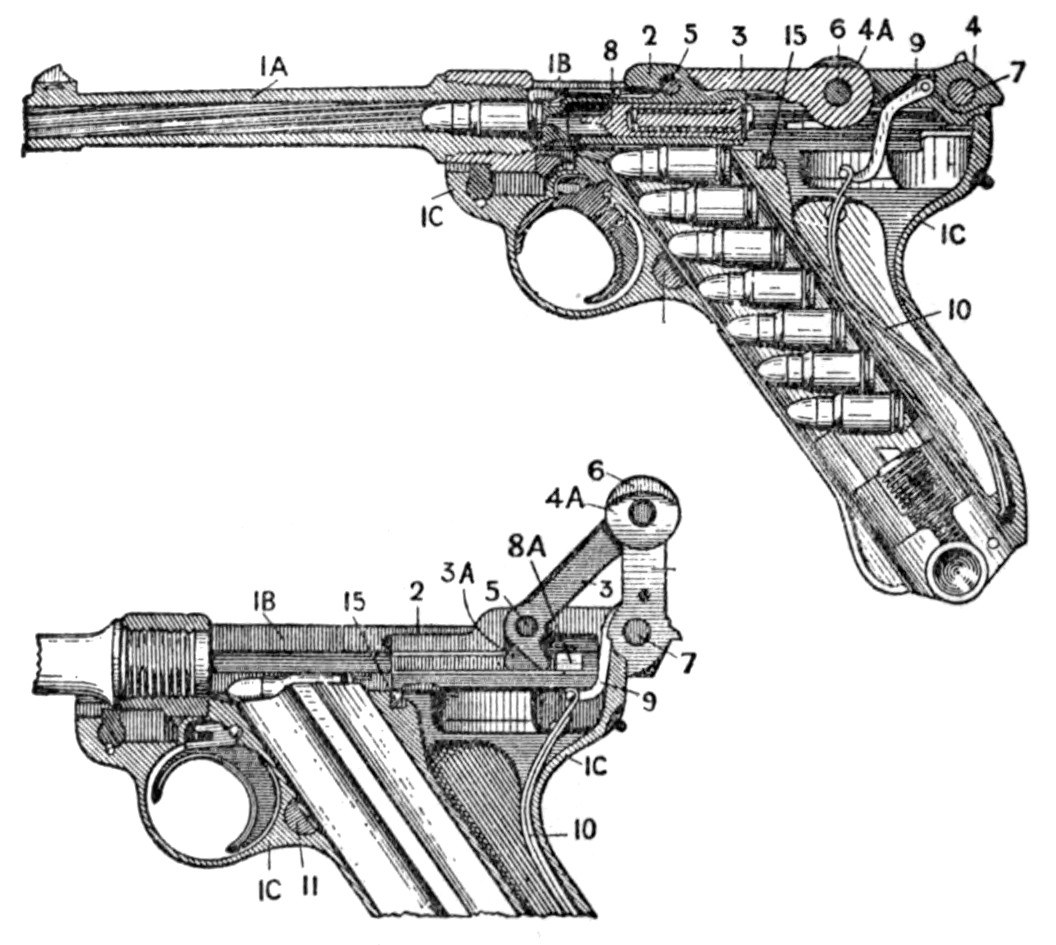
Luger also shortened the cartridge. His 7.65 mm Parabellum round, 21 mm long against the Borchardt’s 25 mm, allowed a shorter toggle stroke and a narrower grip.7 The cartridge history is the Mauser C96 dive’s for the Borchardt line; the Parabellum cartridges are outside this dive.
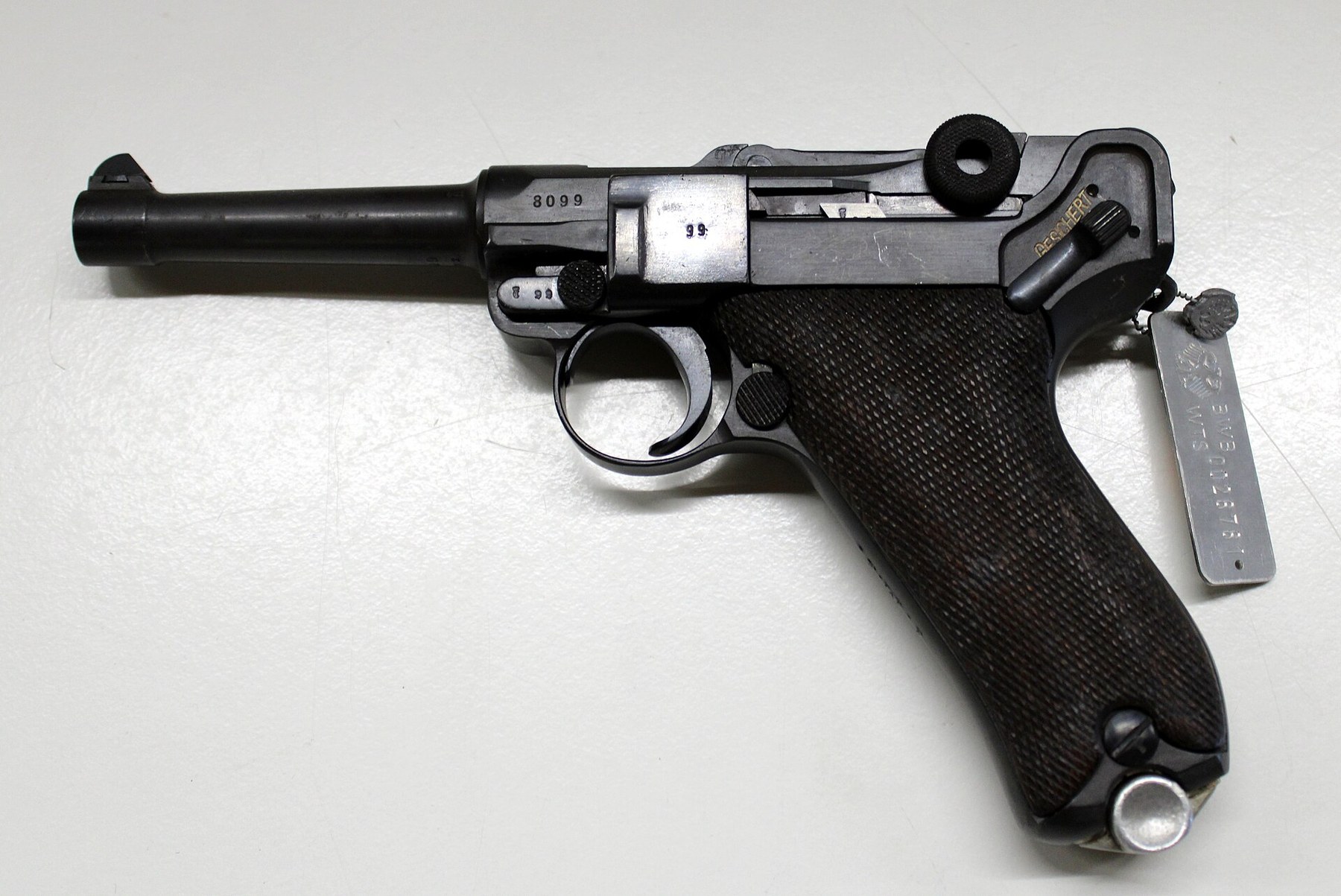
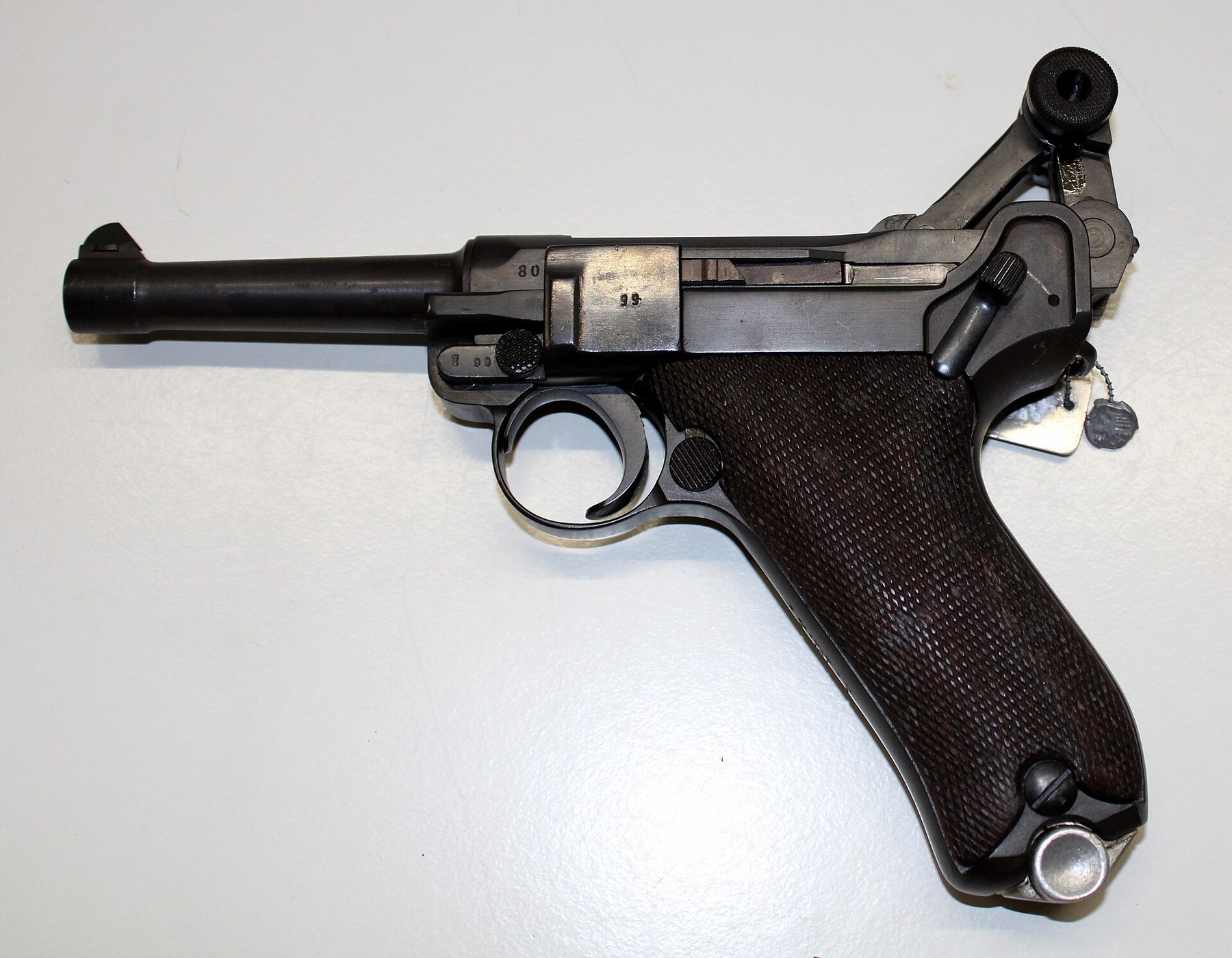
The same toggle family runs on to the German service pistol of 1908. The two photographs below, from the same study collection as the C-93 shown in Volume 1, show the Pistole 08 closed and with the toggle broken upward.
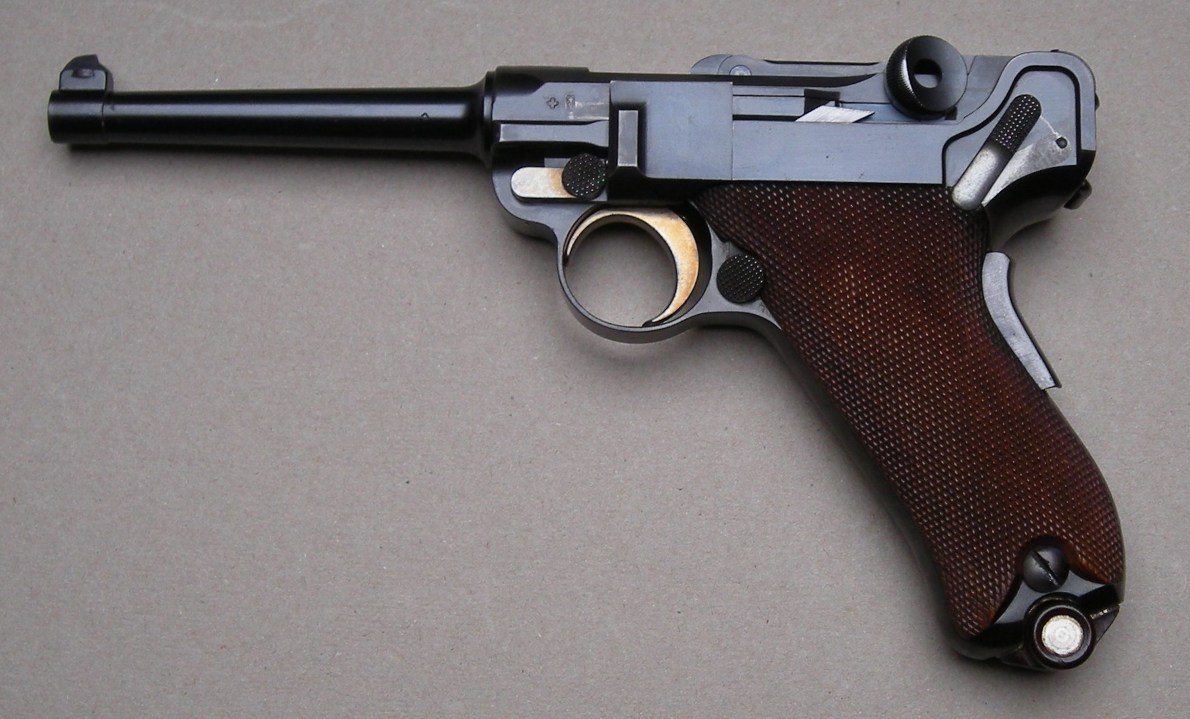
That change, from the old “flat laminated main spring” to “a more reliable coil design” in the 1906 New Model, is recorded in the English encyclopaedia’s Luger article; it shows that even Luger’s flat spring, the direct successor of Borchardt’s double leaf, was eventually judged the weak point.19
3.12 Maxim’s toggle “turned upside down”
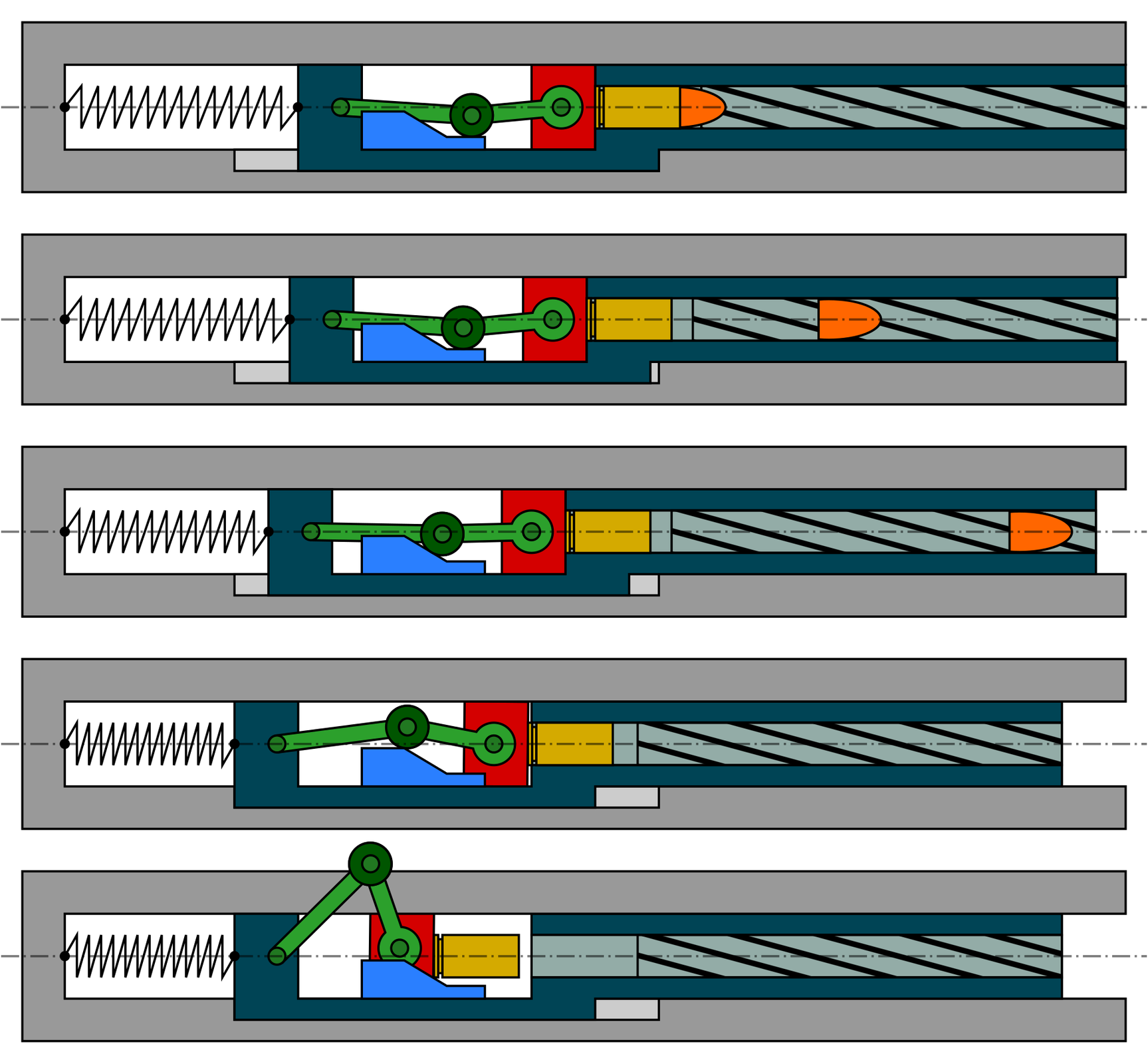
A last claim needs examining because it is in almost every account of the pistol: that Borchardt took Maxim’s toggle and reversed it, so that where Maxim’s breaks downward his breaks upward.
The half of that which concerns Borchardt is documented beyond doubt. His US patent says the rollers “are forced downward, thereby bending the toggle-joint, throwing its central portion upward”; his German patent says “hebt sich das Froschgelenk um sein Mittelgelenk nach oben”, the toggle rises about its centre joint; and both factory manuals say “the middle joint of the toggles is raised”.182021
The half that concerns Maxim was not documented for this dive. The 1917 edition of the US Army’s Handbook of the Maxim Automatic Machine Gun, Model of 1904 was searched without finding a statement of the direction; the English Wikipedia article on the Vickers says only that Vickers improved the Maxim by “inverting the mechanism”, without saying which way either broke; and the claim that Borchardt “reversed the toggle” appears on a collector page without a primary source.5 The answer is in Maxim’s patent drawings and in sectional drawings of the gun, and reading one off a drawing rather than off a text is the method the hub’s lessons require. Until that is done, the dive says that the C-93’s toggle breaks upward, which is certain, and that it derives from Maxim’s, which is universally stated, and leaves the direction of Maxim’s to a later pass.
3.13 What this volume could not settle
- The US Navy board report of November 1894 and the Boston Herald account, including the number of seconds in which 24 shots were fired.
- The US Army board of October 1897: its result, and whether the Springfield Armory museum’s serial 649 was its pistol.
- The Swiss trial report of June 1897 itself, and the exact requirements the commission set.
- The place and dates of the November 1898 Swiss trial.
- The Dutch purchase of 1895.
- Borchardt’s own reasons for refusing to redesign, and any contemporary record of his dispute with Luger.
- Which way Maxim’s toggle breaks, to be read from Maxim’s patent drawings.
References
Footnotes
-
Fred A. Datig, “The Luger: Was It The ‘World’s Best’ Pistol?”, Gun Digest, posted 20 April 2009, https://gundigest.com/article/thelugerpistol, consulted 2026-10-18. The Providence demonstration, the Boston Herald quotation, the October 1897 Springfield board order, and the November 1898 Bern trial. ↩ ↩2 ↩3 ↩4 ↩5
-
“Georg Luger”, German Wikipedia, https://de.wikipedia.org/wiki/Georg_Luger, consulted 2026-10-18. ↩ ↩2
-
Land of Borchardt, “1893 C93 Borchardt German Language Manual”, https://landofborchardt.com/c93manual-article.html, consulted 2026-10-18. ↩
-
Markus Käser, “Fundobjekt in der Sammlung Stiftung HAM: Chronologie zur Einführung der Selbstladepistole 1900 und der Versuchspistole mit der Waffennummer 19 in der Schweizer Armee”, Stiftung Historisches Armeematerial, Thun, January 2021, https://test.stiftung-ham.ch/wp-content/uploads/2021/01/Fundobjekt-in-der-Sammlung-Stiftung-HAM.pdf, consulted 2026-10-18. Quotations translated for this dive. ↩ ↩2 ↩3 ↩4 ↩5 ↩6 ↩7 ↩8 ↩9 ↩10
-
“Borchardt C93”, German Wikipedia, https://de.wikipedia.org/wiki/Borchardt_C93, consulted 2026-10-18. ↩ ↩2
-
“Pistolet police suisse”, tirsportifchabris.fr, https://tirsportifchabris.fr/blog/pistolet-police-suisse, consulted 2026-10-18. Unsourced. ↩ ↩2
-
“Borchardt C-93”, English Wikipedia, https://en.wikipedia.org/wiki/Borchardt_C-93, consulted 2026-10-18. ↩ ↩2
-
“Historic Firearm of the Month, June 2001” (Colt Model 1900), Cruffler.com, http://www.cruffler.com/historic-june01.html, consulted 2026-10-18; bibliography Goddard, The Government Models (1998). ↩
-
“The Trials of the M1911”, American Rifleman, posted 24 May 2011, https://www.americanrifleman.org/articles/2011/5/24/the-trials-of-the-m1911/, consulted 2026-10-18. ↩
-
“Obscure Object of Desire: Borchardt C93”, The Truth About Guns, September 2013, https://www.thetruthaboutguns.com/obscure-object-desire-borchardt-c93-first-modern-semi-automatic-pistol/, consulted 2026-10-18. Quotation without a cited report. ↩
-
H. B. C. Pollard, Automatic Pistols (London, 1920), pp. 9–10. Internet Archive
automaticpistolspollard1920, consulted 2026-10-18. ↩ -
Ian McCollum, “C93 Borchardt: The First Successful Self-Loading Pistol (at RIA)”, Forgotten Weapons, 29 November 2015, https://www.forgottenweapons.com/c93-borchardt-the-first-successful-self-loading-pistol-at-ria/, consulted 2026-10-18. ↩
-
Leonardo M. Antaris, “In The Beginning: Semi-Automatic Pistols of the 19th Century”, American Rifleman, posted 4 January 2018, https://www.americanrifleman.org/articles/2018/1/4/in-the-beginning-semi-automatic-pistols-of-the-19th-century, consulted 2026-10-18. ↩
-
James D. Julia, Spring 2013, lot 2353, https://jamesdjulia.com/?p=481759, consulted 2026-10-18. ↩
-
Walter Hummelberger, “Luger, Georg”, Neue Deutsche Biographie 15 (1987), pp. 495 f., https://www.deutsche-biographie.de/sfz55080.html, consulted 2026-10-18. Quotations translated for this dive. ↩ ↩2 ↩3
-
Land of Borchardt, “1898 Borchardt Luger 5, A History”, https://landofborchardt.com/1898Luger5.html, consulted 2026-10-18; citing Kenyon, Lugers at Random (1969) pp. 46–48, Görtz and Sturgess, Stucki, Thuner Pistolenversuche (2016) pp. 72–75, and Heer. ↩ ↩2
-
Georg Luger, US Patent 753,414, “Recoil-loading small-arms”, filed 17 March 1900, Serial No. 9,083, patented 1 March 1904. https://patents.google.com/patent/US753414A/en, PDF consulted 2026-10-18. ↩
-
Hugo Borchardt, US Patent 571,260, “Recoil Magazine-Pistol”, filed 21 October 1893, patented 10 November 1896, consulted 2026-10-18. ↩ ↩2
-
“Luger pistol”, English Wikipedia, https://en.wikipedia.org/wiki/Luger_pistol, consulted 2026-10-18. ↩
-
H. Borchardt, DRP 75,837, text at https://patents.google.com/patent/DE75837C/de, consulted 2026-10-18. ↩
-
Ludw. Loewe & Co., Repeating Pistol (System Borchardt), English edition, p. 5. Page images at https://landofborchardt.com/LoeweManual.html, consulted 2026-10-18. ↩
Comments (0)