Borchardt C-93 · Volume 7
The Cartridge, Ammunition Today, and How It Shoots
What the factory said its round was, the 7.63 Mauser interchange argument with both sides quoted, what can be bought in October 2026, and every accuracy and recoil report that could be found
7.1 What this volume covers, and what the C96 dive already owns
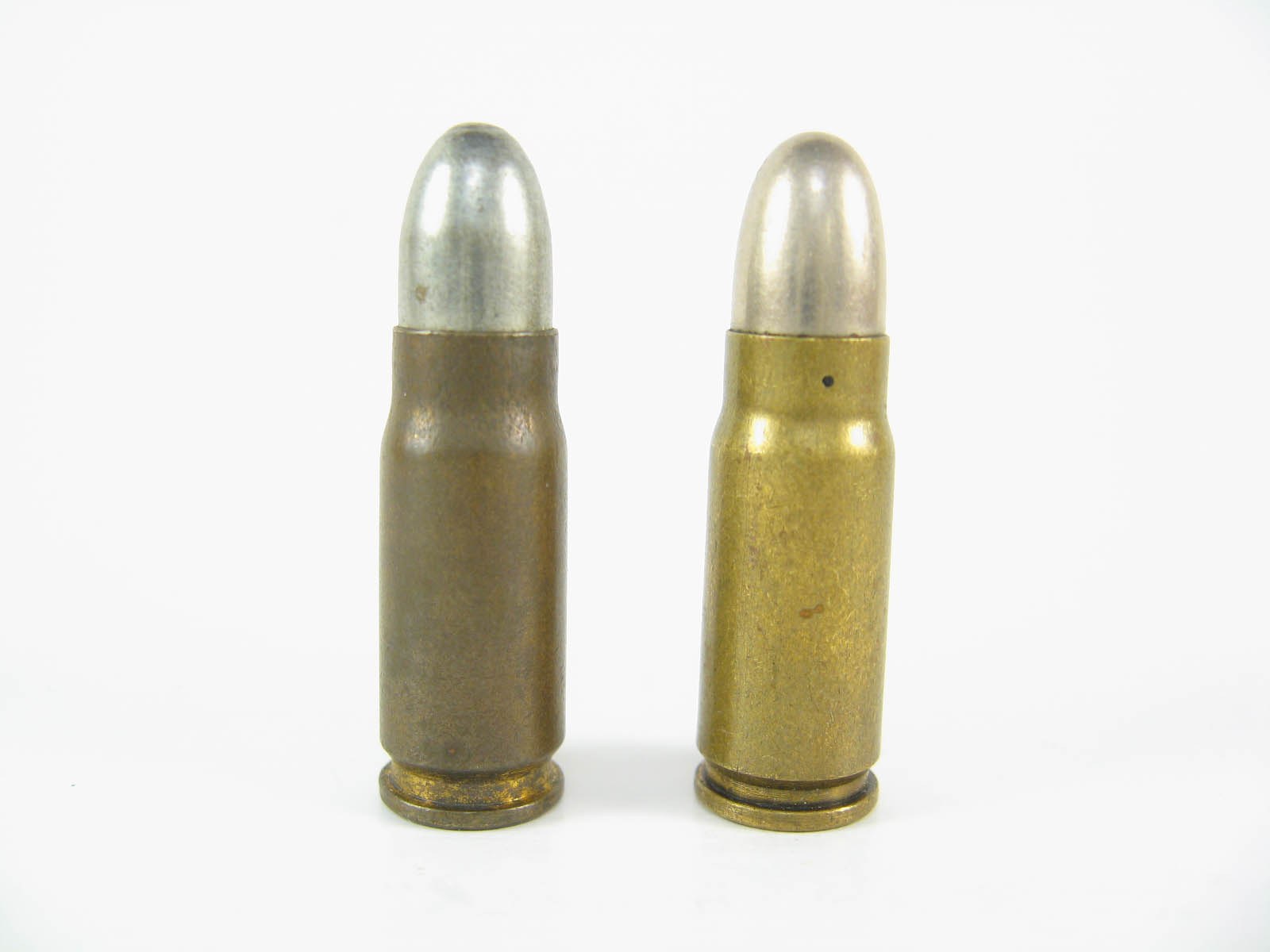
The 7.65 mm Borchardt cartridge’s place in history is as the parent of the 7.63 mm Mauser and, through it, of the 7.62 mm Tokarev. That lineage is told in the Mauser C96 dive’s cartridge volume, which records that the first C96 prototype was chambered for the Borchardt round and that Mauser adapted the case for production. This volume does not retell it. It keeps to what a C-93 owner, collector or would-be builder needs: what the factory said its cartridge was, how it relates dimensionally to cartridges that can be bought, whether those cartridges are safe in a C-93, and what is actually known about how the pistol shoots.
7.2 The factory cartridge
The DWM manual’s specification table gives the cartridge as the factory loaded it, and the Loewe manual gives the same figures.12
Table 1 — The factory cartridge
| Item | Factory figure | Equivalent |
|---|---|---|
| Length of loaded cartridge | 35 mm | 1.38 in |
| Weight of loaded cartridge | 10.55 g | 162.8 gr |
| Weight of cartridge case | 4.60 g | 71.0 gr |
| Weight of “steelcovered bullet” | 5.50 g | 84.9 gr |
| Weight of powder | 0.45 g | 6.9 gr |
| Muzzle velocity | 400 m/s | 1,312 ft/s |
| Rifling | 4 grooves, one turn in 250 mm | 1 in 9.84 in |
The conversions are this dive’s. The bullet is described as “steelcovered”, a jacket of steel rather than cupronickel or gilding metal; the factory does not say whether the steel was itself plated.
The independent American figures of 1896 are close but not identical: the ONI gives a “caliber, 0.301-inch; initial velocity, with charge of 7 grains smokeless powder and 77-grain bullet, 1,300 foot-seconds” and a cartridge length of 1.4 inches.3 The 7-grain charge agrees with the factory’s 0.45 g. The bullet does not: the ONI’s 77 grains is about 5.0 g against the factory’s 5.50 g. The two are given separately; whether the ONI weighed a lighter early bullet or made an error is not known.
Secondary sources give 85 gr at 390 m/s (English Wikipedia) and about 400 m/s (modernfirearms.net).45 No source consulted names the original powder.
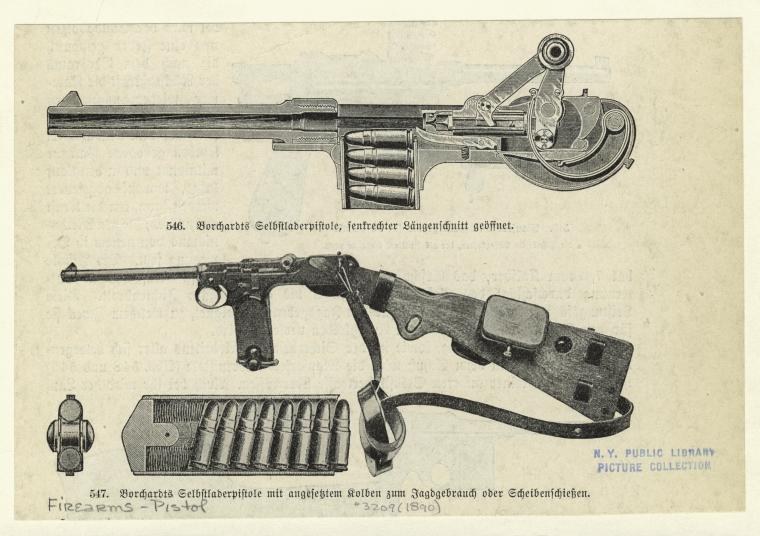
The Loewe manual adds one detail that no later account mentions: “Pistols can be fitted up with an attachable buttstock and cover for military use, also with an attachable shoulderpiece for sporting purposes. Special ammunition is prepared for the latter.”2 What the sporting ammunition was, and how it differed, is not recorded in the sources consulted.
7.3 Dimensions
No C.I.P. or SAAMI drawing exists for the 7.65 mm Borchardt. The nearest official document is the C.I.P. sheet for the 7,63 Mauser (Table IV, dated 14 June 1984, revised 19 September 2006), which was read from a third-party copy rather than from C.I.P.’s own database.6 Its cartridge maxima match, figure for figure, the dimensions published for the 7.65 Borchardt in the English Wikipedia’s cartridge article:4
Table 2 — Dimensions
| Dimension | C.I.P. 7,63 Mauser, cartridge maximum | Published for 7.65 Borchardt |
|---|---|---|
| Case length | 25.15 mm | 25.15 mm |
| Overall length | 35.08 mm | — (factory: 35 mm) |
| Rim diameter | 9.98 mm | 9.98 mm |
| Base diameter | 9.86 mm | 9.86 mm |
| Shoulder diameter | 9.60 mm | 9.60 mm |
| Neck diameter | 8.46 mm | 8.46 mm |
| Bullet diameter | 7.86 mm | 7.86 mm |
| Maximum pressure | 2,250 bar (transducer) | Not specified |
The C.I.P. Mauser barrel is specified at a bore of 7.62 mm (.300 in) and a groove diameter of 7.85 mm (.309 in), with six grooves and a twist of 250 mm.6 The C-93 had four grooves at the same twist, per its factory.1 Its bore and groove diameters were not found in any source. The ONI’s “caliber, 0.301-inch” is consistent with a .300 bore.3 Anyone shooting or reproducing a C-93 should slug the bore of the pistol in hand rather than assume the C.I.P. Mauser figures.
The identity of the two cases is supported by the matching published figures and by the period practice described below, in which the same cartridges were sold for both pistols. It is not supported by a measured C-93 chamber, which no source consulted provides.
7.4 Boxes, headstamps and the DWM number
The period ammunition trade treated the Borchardt and Mauser cartridges as one product sold under two names, with small differences.
- DWM number 403. The cartridge carried DWM’s catalogue number 403. A researcher on the International Ammunition Association forum reports a late Borchardt box holding rounds headstamped “K DWM K 403” with copper primers, an early Borchardt box marked “Cal. 7,8”, a c. 1902 DWM catalogue listing the Mauser round as 403, and the registration of “403” as a trademark in 1927 claiming use since 1893.7 Another, John Moss, notes that the earliest Borchardt box he had seen was marked “403a”, while Mauser boxes were printed with both “403” and “403a”, so the suffix does not divide the two cleanly.7
- Primer cups. Moss: “Those intended for the Mauser had brass primer cups while those intended for the Borchardt have copper primer cups.”7
- Kynoch. Moss suggests a British ”* K * B” headstamp is likely Mauser and “K B” without stars Borchardt, and flags it as unconfirmed.7
- American makers. A collector site documents a UMC 50-round box “for Borchardt Automatic Pistols”, “loaded with 85 Grs, soft pointed (lead) bullets”, headstamped “U.M.C. 30 CAL”; and a Winchester label “For Mauser and Borchardt Automatic Pistols”, headstamped “WRA 30 Mauser”.8 Moss confirms that UMC headstamped only “.30 CAL” while Winchester used “.30 Mauser”.7
The joint labelling, “For Mauser and Borchardt Automatic Pistols”, is the period trade’s own statement that it regarded the two as interchangeable. Whether it was right is the next question.
7.5 Will 7.63 Mauser and 7.62 Tokarev fit, and should they be fired?
Every source agrees that 7.63 Mauser, and the dimensionally similar 7.62 Tokarev, will chamber in a C-93. They disagree about whether the Mauser round was loaded hotter than the Borchardt, and therefore whether it is safe in the older pistol. The strongest statements on each side are quoted in full.
Against firing Mauser rounds in a C-93. Terry Wieland, writing on the 7.63 Mauser in Handloader in 2018, is the strongest named authority found:
“The 7.63 Mauser actually began life in 1893 as the 7.65 Borchardt.” “When Mauser designed the C96, it simply appropriated the Borchardt cartridge, loaded it to higher pressures with higher velocities”. “The Mannlicher was stronger than the Borchardt, but not as strong as the Mauser C96.” “So while dimensionally the ammunition is interchangeable, … it is unwise to use Mauser rounds in either the Borchardt or the Mannlicher.”9
The same article records “a smoldering controversy as to whether the two rounds are indeed interchangeable”, and on the Tokarev notes that a German wartime manual allowed Tokarev ammunition in the C96, but that “since a military Tokarev can rarely be differentiated from 7.63 Mauser by its case head”, “a high degree of caution is recommended before putting any surplus ammunition through a valuable Broomhandle.”9 That caution applies with more force to the older pistol.
The English Wikipedia’s C-93 article says that “the 7.63 mm Mauser generally had a more powerful powder charge”, that “contemporary loading data indicated it took approximately 20% more powder than the Borchardt”, and that it “is considered to be too strong to be used in a Borchardt C93”. None of those sentences is cited, and the 20 percent figure in particular is not used here.10
For the period loads having been the same. On the International Ammunition Association forum in 2014, John Moss, a long-established cartridge researcher, wrote that while early Borchardt loads may have differed, eventually “the same exact loading was used for both pistols”, that UMC’s daily production logs showed the same data for both, and that DWM came to treat them as “one and the same, and interchangeable”.7
What no source provides. No source consulted gives a measured chamber pressure for any C-93 load, or documents a particular C-93 damaged by Mauser or Tokarev ammunition.
The reading this dive takes. The two positions are less opposed than they look. Moss is talking about period commercial ammunition from DWM and UMC around and after 1900, and it is plausible that the makers converged on one load for both pistols. Wieland is warning about putting Mauser ammunition, as a category that includes modern and military loadings, into the Borchardt. The modern labels support his caution: current factory 7.63 Mauser is listed by its retailers at 1,425 to 1,500 ft/s and more with 85 to 88 gr bullets, against the factory C-93 figure of 400 m/s, about 1,312 ft/s, with an 85 gr bullet (the barrels differ, so the comparison is indicative, not exact). And 7.62 Tokarev, especially military surplus, is a hotter cartridge again.111213
So: do not fire modern factory 7.63 Mauser in an original C-93, and never fire 7.62 Tokarev or military surplus of either. The action is a balance of springs and masses set for a specific load (Volume 4), the springs in surviving pistols are 125 years old and have no commercial replacement (Volume 6), and the downside of being wrong is the loss of an irreplaceable pistol or worse. This is a precautionary position derived from the evidence above, not a measured safety limit.
7.6 Ammunition and components in October 2026
No commercially loaded 7.65 mm Borchardt was found on sale. Forgotten Weapons said as much in 2011: “Ammo is not commerciall[y] available anymore; it’s the same dimensionally as 7.63 Mauser but loaded lighter.”14 What can be bought is 7.63 Mauser ammunition and brass, and .30 Mauser dies. All prices below were read on the seller’s own page on 18 October 2026.
Table 3 — Ammunition and components in October 2026
| Item | Seller | Price | Stock | Note |
|---|---|---|---|---|
| Starline 30 Mauser (7.63×25) brass, unprimed, 100 | Graf & Sons | $28.79 | In stock | Same case dimensions as the Borchardt |
| Lee Precision 30 Mauser (7.63×25) 3-die set, SKU 90755 | Lee Precision | $46.98 | In stock | Lee also lists a sizing die alone, SKU 91213, $29.98 |
| Fiocchi 7.63 Mauser, 88 gr FMJ, 50, code 763A | Graf & Sons | $32.99 | Out of stock | Listed at 1,425 ft/s |
| Fiocchi 7.63 Mauser, 88 gr FMJ, 50, code 763A | KYGUNCO | $31.99 | Out of stock | |
| Fiocchi 7.63 Mauser, 88 gr FMJ, 50, code 763A | Midwest Gun Works | $53.99 | In stock | |
| Prvi Partizan 7.63 Mauser, 85 gr FMJ, 50, SKU PPH763 | Graf & Sons | $31.99 | In stock | The page gives two velocities, 1,720 and 1,510 ft/s |
Sources: the seller pages.151611171812 The Fiocchi box is listed at three prices on the same day, from $31.99 to $53.99; they are given separately and not averaged. The Prvi Partizan page’s two velocities contradict each other and neither can be attributed to the maker. Both factory loads are listed here only because they are what is on the market and because their brass is reloadable; per the section above, neither should be fired as loaded in an original C-93.
7.7 Handloading: the position
No published load data for the 7.65 Borchardt or for the C-93 was found in any named source accessible to this research. Wieland’s Handloader article publishes 7.63 Mauser data for the C96, which is data for a different pistol at a different pressure and is not to be transferred.9 Forum posts describing reduced loads “for the C93” exist, but they are anecdotal and are not reproduced.
What can be said from the sources:
- The target is documented. The factory load was a 5.50 g (84.9 gr) steel-jacketed bullet over 0.45 g (6.9 gr) of powder at 400 m/s from the 190 mm barrel.1 That gives a velocity to aim at, measured with a chronograph, not a recipe; the 1890s powder is unknown and no modern powder’s charge can be derived from it.
- Components exist. Starline 30 Mauser brass, standard .30 Mauser dies, and .308-in pistol bullets in the 85 gr range; Wieland notes that “since the 7.63 Mauser uses .308-diameter bullets, anything in its weight range will work”.9 The C-93’s own groove diameter is unknown; slug the bore.
- The hazard is documented. Any load must come from a published source for a cartridge of this pressure class and be worked up from below, and the safety position above still applies.
No charge weight appears in this dive, by design. The hub has shipped invented numbers before, and a charge weight for an irreplaceable 1890s action is the worst place to repeat the mistake.
7.8 Period ballistics
The only published ballistic data for the C-93 found in this research are the ONI’s of 1896 and the factory’s own claims.
Trajectory. The ONI gives “maximum ordinates, for ranges up to 550 yards, approximately”, that is, the height of the bullet’s path above the line of sight at its highest point when the sights are set for the range:3
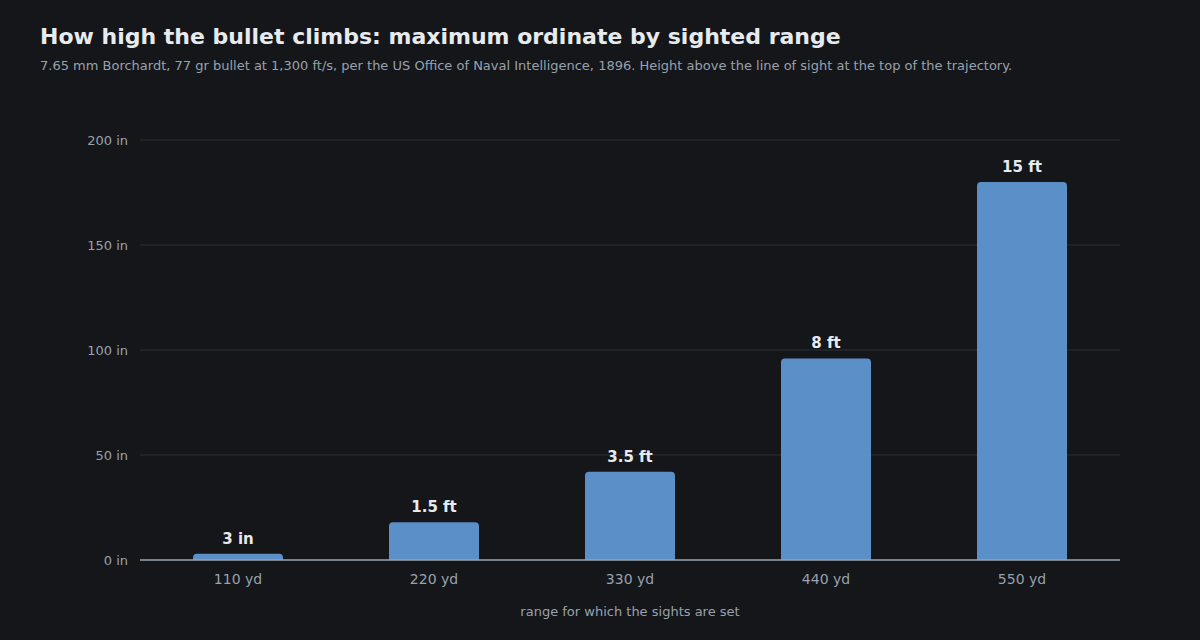
At 110 yards the trajectory rises only 3 inches, which is to say the pistol shoots flat over any distance at which a pistol is likely to hit anything. Beyond about 300 yards the arc becomes steep enough that range estimation, not the pistol, sets the limit.
Penetration. “Penetration, at a distance of 11 yards from the muzzle, in 0.75-inch pine boards spaced 0.5-inch apart, from 8 to 10.5 inches.”3 The ONI’s figure is the total thickness of pine penetrated, roughly eleven to fourteen boards on that spacing.
The factory’s claim for the stock. “With the attached buttstock a target-range of 500 meters is obtained with a penetration of from 5 to 6 centimeters of pine.”1 The first digit of the range is slightly soft on the scan and is read as 5. Whether “target-range” means the range at which a target can be engaged or the highest sight setting is not explained.
The American agent’s claim. Hermann Boker & Co. advertised “an effective range of 200 to 300 yards”.19
7.9 Accuracy: what is actually recorded
The C-93 has a reputation for accuracy, and the record behind it is thin.
Table 4 — Accuracy: what is actually recorded
| Statement | Source | Kind |
|---|---|---|
| ”24 shots … range 110 feet, and all were hits”, at the 1894 US Navy demonstration | Boston Herald, 22 November 1894, as quoted by Datig | A newspaper report of a demonstration |
| ”An excellent precision in shooting is attained by the long distance between sights (315 mm) and the uniform resistance to the recoil.” | DWM manual | Maker’s claim |
| ”Well-made and very accurate, the Borchardt was a considerable technical achievement” | Glenbow Museum label | Museum label |
| ”a very accurate, close shooting weapon” that “seems to possess great endurance" | "Lt. Robert Evans”, 12th US Infantry, as quoted by The Truth About Guns | No report or date cited |
| ”Usually when fired from a machine rest they shoot very tight groups” | Reader comment on a Forgotten Weapons post, 2015 | Anecdote |
| ”the most accurate handgun of the four that I own” | Reader comment on a Forgotten Weapons post, 2011 | Anecdote |
| ”Three shots at 25 yards” at a collectors’ gathering | LugerForum, 2011 | Anecdote |
| ”Accurate but weak at long-range penetration” | Attributed to T. Logan Metesh in a National Interest article | Page not readable; unverified |
Sources as listed.20121221423 No group size, at any range, from any trial or published test was found. The Swiss trial results of 1898 that circulate with group figures belong to the Borchardt-Luger, not the C-93 (Volume 3). No modern range test of a C-93 by American Rifleman, Guns & Ammo, Shooting Times or a comparable publication was located; Forgotten Weapons’ 2015 video on the pistol is a table-top history, not a live-fire test.22
The factory’s reasoning for the reputation is sound as far as it goes. A 315 mm sight radius is very long for a pistol; the barrel does not tilt, since barrel and receiver recoil straight back together; and with the stock fitted the pistol becomes a light carbine. The DWM manual’s argument rests on those features, and the reputation probably does too.
7.10 Recoil and handling
The inventor and the users disagree.
- Borchardt’s patent: “By reason of this close balancing of forces this new pistol imparts little or no shock to the hand”.24
- The DWM manual: “The recoil is greatly reduced, being counteracted and distributed by springs.”1
- Forgotten Weapons, 2011: “It functioned well enough, but was bulky and had unexpectedly fierce recoil.”14
- English Wikipedia lists “unexpectedly powerful recoil” among the reasons the pistol failed.10
- A YouTube range clip, as described in a National Interest article that could not be read directly, quotes its uploader: “very back heavy. The recoil was mild and the trigger is very good.” It is recorded as unverified.
Ian McCollum’s 2015 summary is that “its very bulky mainspring assembly led to it being a rather awkward handgun to use”, and that it is “a quite nice carbine when used with its detachable shoulder stock”.22 A reader of The Firearm Blog who had handled one found that “the weapon pointed very well despite its grip angle”, with “a very large sight radius and very fine sights”.25
The weight distribution explains most of this. The spring box and the toggle sit behind the hand, the long barrel in front, and the grip near the middle. Fired as a pistol, the C-93 is a heavy object pivoting about a vertical grip; fired from the shoulder, it is a 1.7 kg carbine (1,275 g pistol plus 425 g stock, holster and strap, by the factory’s table) with a long sight radius.1 The Swiss and American boards judged it as a pistol, and the factory and its agent sold it as both.
7.11 Shooting an original today
Collectors do shoot original C-93s; a LugerForum contributor in 2011 described three shots at 25 yards at a collectors’ gathering.23 The case for not doing it is in the earlier volumes: the closing spring, buffer spring and sear pin have no commercial replacement (Volume 6), no published load data exists, the factory ammunition does not, and the pistols sell for five figures (Volume 8). The case for doing it, carefully, is that the mechanism is the point of the object, and a C-93 that is never cycled teaches less than one that is.
For anyone who decides to, the sources support these precautions:
- Have a gunsmith examine it first, particularly the springs, the sear and its yielding pin, the catch lever and the extractor, and carry out the checks in Volume 6.
- Slug the bore and check the chamber with a cast, rather than assuming C.I.P. Mauser dimensions.
- Use no factory 7.63 Mauser, no Tokarev and no surplus. Use only handloads assembled to a published source and worked up from below toward, not past, the factory’s 400 m/s.
- Load one or two rounds at first, to confirm the pistol fires once per pull (Volume 6).
- Confirm the pistol’s legal status first, including the Michigan position, which differs from the federal one (Volume 8).
7.12 What could not be established
- The original powder, and the content of the Loewe “special ammunition” for sporting use.
- The bullet weight discrepancy: 5.50 g (factory) against 77 gr (ONI).
- The C-93’s bore and groove diameters.
- A measured C-93 chamber, and so the strict identity of its chamber with the C.I.P. 7,63 Mauser chamber.
- Any measured pressure for a C-93 load, original or modern.
- Any published load data for the C-93.
- Any group size from a trial or a published test.
References
Footnotes
-
Deutsche Waffen- und Munitionsfabriken, Automatic Repeating Pistol, Borchardt Patent, English edition, pp. 6–7 and specification table p. 13. Scan circulated by Forgotten Weapons; page images at https://landofborchardt.com/C93manual.html, consulted 2026-10-18. ↩ ↩2 ↩3 ↩4 ↩5 ↩6 ↩7
-
Ludw. Loewe & Co., Repeating Pistol (System Borchardt), English edition, p. 14. Page images at https://landofborchardt.com/LoeweManual.html, consulted 2026-10-18. ↩ ↩2
-
US Office of Naval Intelligence, General Information Series No. XV (July 1896), p. 131, consulted 2026-10-18. ↩ ↩2 ↩3 ↩4
-
“7.65×25mm Borchardt”, English Wikipedia, https://en.wikipedia.org/wiki/7.65%C3%9725mm_Borchardt, consulted 2026-10-18. Bibliography cited there: Barnes, Cartridges of the World, 3rd ed. (1972) pp. 152 and 177; Görtz and Sturgess (2010–11) pp. 104–138. ↩ ↩2
-
“7.65x25 Borchardt”, modernfirearms.net, https://modernfirearms.net/en/cartridge/7-65x25-borchardt-2/, consulted 2026-10-18. ↩
-
C.I.P., Tables of Dimensions of Cartridges and Chambers, Table IV, “7,63 Mauser”, dated 84-06-14, revised 06-09-19, read from a third-party copy at https://www.tiropratico.com/CIP/Commission%20Internationale%20Permanente/763mauser.pdf, consulted 2026-10-18. To be confirmed against C.I.P.’s own database before being relied on. ↩ ↩2
-
International Ammunition Association forum, “7,63 mm Mauser cartridge info”, posts by John Moss and Fede, 23–27 January 2014, https://forum.cartridgecollectors.org/t/7-63-mm-mauser-cartridge-info/14220, consulted 2026-10-18. Collector forum; the posters are established cartridge researchers. ↩ ↩2 ↩3 ↩4 ↩5 ↩6
-
Land of Borchardt, “C93 accessories”, ammunition section, https://landofborchardt.com/C93_acc.html, consulted 2026-10-18. ↩
-
Terry Wieland, “7.63mm (.30 Caliber) Mauser”, Handloader, February–March 2018, https://handloadermagazine.com/7-63mm-30-caliber-mauser, consulted 2026-10-18. ↩ ↩2 ↩3 ↩4
-
“Borchardt C-93”, English Wikipedia, https://en.wikipedia.org/wiki/Borchardt_C-93, consulted 2026-10-18. ↩ ↩2
-
Graf & Sons, “Fiocchi 7.63mm Mauser 88gr FMJ 50/bx”, https://grafs.com/products/fiocchi-ammo-763mm-mauser-88gr-fmj-50bx-20cs, consulted 2026-10-18. ↩ ↩2
-
Graf & Sons, Prvi Partizan 7.63 Mauser 85 gr FMJ, SKU PPH763, https://www.grafs.com/catalog/product/productId/77052, consulted 2026-10-18. ↩ ↩2
-
“7.63×25mm Mauser”, English Wikipedia, https://en.wikipedia.org/wiki/7.63%C3%9725mm_Mauser, consulted 2026-10-18. ↩
-
Forgotten Weapons, “Borchardt Automatic Pistol”, 2011, with site reply in comments, https://www.forgottenweapons.com/early-automatic-pistols/borchardt-automatic-pistol/, consulted 2026-10-18. ↩ ↩2 ↩3
-
Graf & Sons, Starline 30 Mauser Automatic (7.63x25mm) brass, 100, https://www.grafs.com/catalog/product/productId/17812, consulted 2026-10-18. ↩
-
Lee Precision, “3 Die Set 30 Mauser”, https://leeprecision.com/3-die-set-30-mauser, consulted 2026-10-18. ↩
-
KYGUNCO, Fiocchi 763A, https://www.kygunco.com/product/fiocchi-763a-7.63-fmj-1425fps-88gr-50rd, consulted 2026-10-18. ↩
-
Midwest Gun Works, Fiocchi Heritage 7.63mm Mauser 88 gr FMJ, code 763A, https://www.midwestgunworks.com/page/mgwi/prod/763a, consulted 2026-10-18. ↩
-
Joe Engesser, “The Borchardt C93 Pistol”, Rock Island Auction Company blog, 14 October 2024, https://www.rockislandauction.com/riac-blog/borchardt-c93-pistol, consulted 2026-10-18. ↩
-
Fred A. Datig, “The Luger: Was It The ‘World’s Best’ Pistol?”, Gun Digest, 20 April 2009, https://gundigest.com/article/thelugerpistol, consulted 2026-10-18. ↩
-
“Obscure Object of Desire: Borchardt C93”, The Truth About Guns, September 2013, https://www.thetruthaboutguns.com/obscure-object-desire-borchardt-c93-first-modern-semi-automatic-pistol/, consulted 2026-10-18. ↩
-
Ian McCollum, “C93 Borchardt: The First Successful Self-Loading Pistol (at RIA)”, Forgotten Weapons, 29 November 2015, with reader comments, https://www.forgottenweapons.com/c93-borchardt-the-first-successful-self-loading-pistol-at-ria/, consulted 2026-10-18. ↩ ↩2 ↩3
-
Ron Wood and others, “Borchardt - Luger Predecessor”, LugerForum, April 2011, https://forum.lugerforum.com/forum/showthread.php?p=192957, consulted 2026-10-18. ↩ ↩2
-
Hugo Borchardt, US Patent 571,260, specification, consulted 2026-10-18. ↩
-
Steve Johnson, “Borchardt C-93”, The Firearm Blog, 5 July 2012, reader comment, https://www.thefirearmblog.com/blog/2012/07/05/borchardt-c-93, consulted 2026-10-18. ↩
Comments (0)