Borchardt C-93 · Volume 2
Patents, Loewe and DWM: Making and Selling the C-93
A patent family filed in ten countries in six weeks, the first published descriptions, two makers, about three thousand pistols, and the unanswered question of when the last one was made
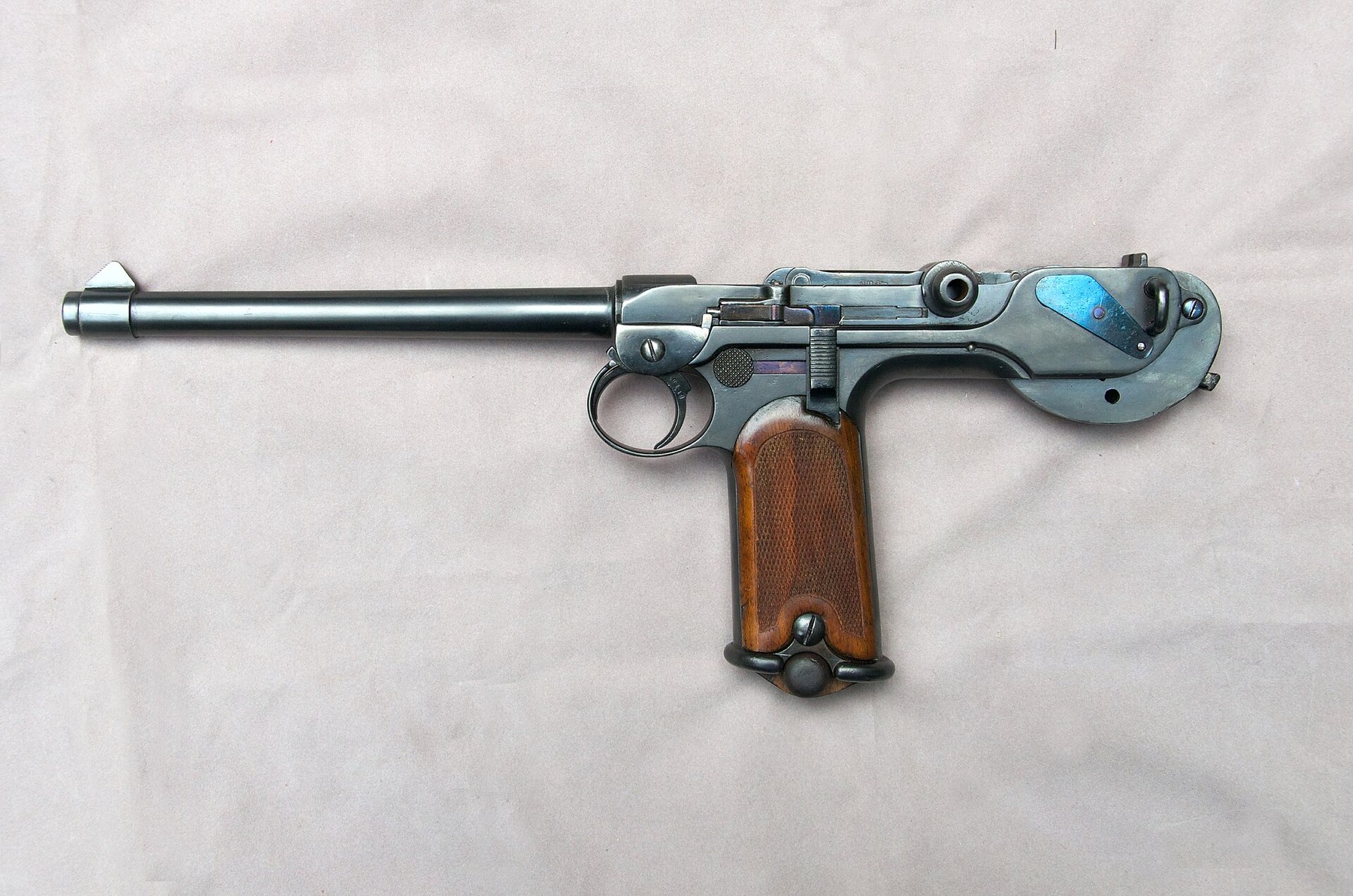
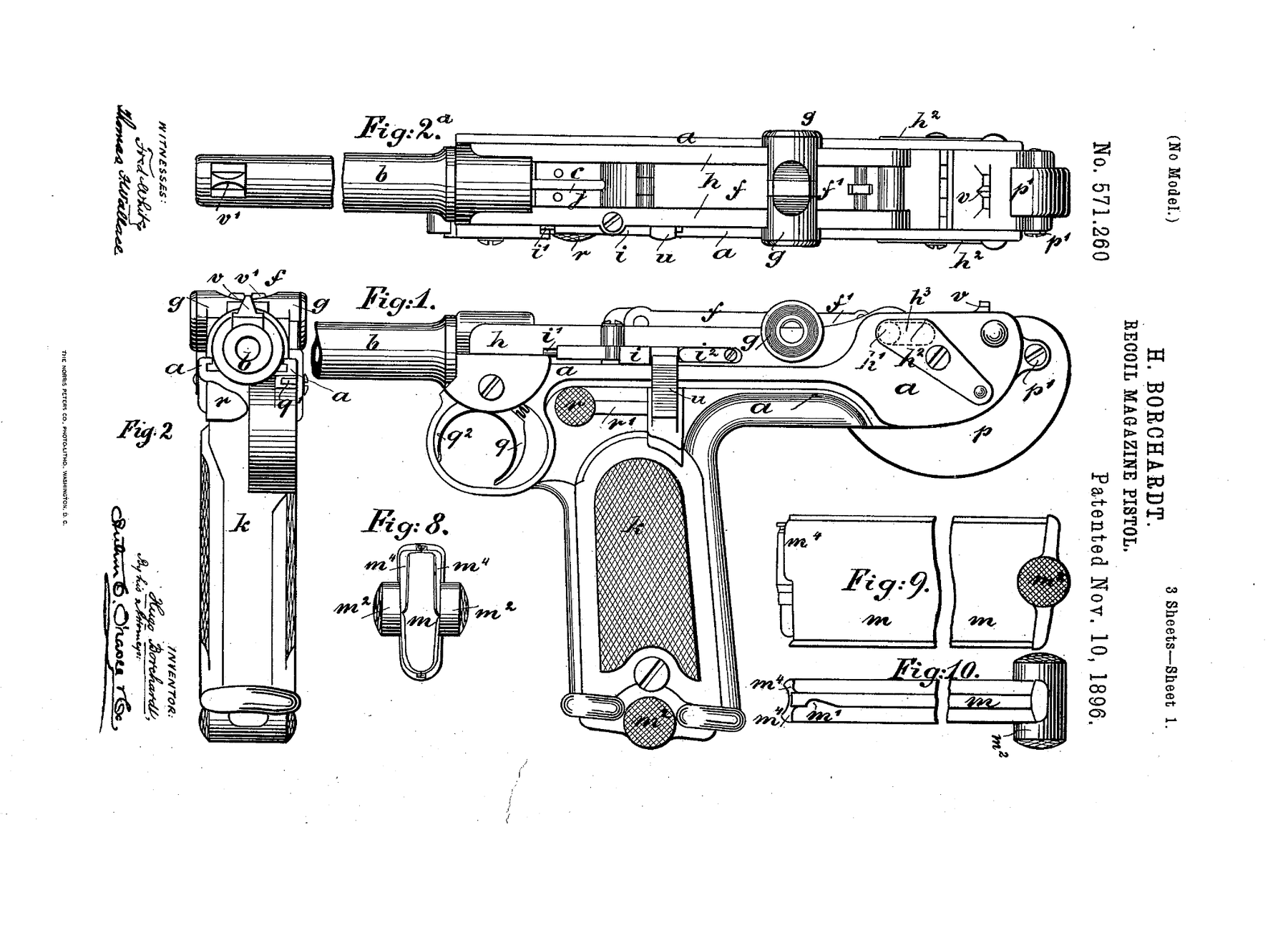
Volume 1 followed Hugo Borchardt to Berlin. This volume follows the pistol from its patents to the end of its production. It is the part of the story where the documentary record is best, because patents and factory manuals survive, and also the part where it fails at the most consequential point: nobody in the sources available to this dive can say when the last C-93 was made, and in the United States that date decides the gun’s legal status.
2.1 Ten countries in six weeks: the patent family
Borchardt’s US patent recites its own family in its opening paragraph. It is the best single source for the dates, and it shows a man in a hurry.1
Table 1 — Ten countries in six weeks: the patent family
| Country | Number | Date (1893) |
|---|---|---|
| Germany | 75,837 | 9 September |
| Austria-Hungary | 49,411 and 81,626 | 11 September |
| Switzerland | 7,296 | 16 September |
| Belgium | 106,460 | 18 September |
| Norway | 3,324 | 19 September |
| France | 232,975 | 21 September |
| Italy | 285 | 25 September |
| Spain | 15,014 | 29 September |
| Great Britain | 18,774 | 6 October |
| United States | application 488,759 filed | 21 October |
The numbers are read from the scan of the patent; the machine transcription on Google Patents garbles several of them (it renders the Austro-Hungarian number as 19,111 and the Norwegian as 3,321), so the scan is preferred.1 The English Wikipedia list gives the British patent as 1 November 1893 against the 6 October recited in the US patent itself; the patent is preferred here.2
The German patent, DRP 75,837, is the one that matters on the gun: every C-93 examined in the auction literature carries “D.R.P. / No 75837” on the toggle. Its title is “Selbstthätige, besonders als Repetirpistole verwendbare Feuerwaffe”, an automatic firearm usable especially as a repeating pistol, and the applicant is “H. Borchardt in Berlin S.W., Königgrätzerstr. 62”.3 Its text calls the toggle a Froschgelenk, literally a frog joint, rather than the Kniegelenk (knee joint) of later German usage. It has three drawing sheets with nineteen figures against the US patent’s twelve, including a three-stage schematic of the toggle opening (its Figs. 17 to 19). That schematic would be the ideal illustration for Volume 4, but the German Patent Office’s document server refused automated retrieval, and the PDF is listed as owed in this dive’s README.
The Swiss patent, 7,296, is titled “Durch den Rückstoss bethätigte Repetierpistole”, a repeating pistol worked by recoil, filed on 16 September 1893 and published on 28 February 1894.4
The US patent took three years to issue. Filed on 21 October 1893, it was granted on 10 November 1896, by which time the Loewe arms business was becoming DWM.1 It names no assignee: the patent was Borchardt’s own.
2.2 What Borchardt claimed
The US patent’s twelve claims are about the particular arrangement, not the general idea. Borchardt disclaims “broadly, a firearm having a longitudinally-movable barrel actuated by the recoil, a breech-bolt, links connecting said breech-bolt and barrel … as such firearm is, broadly, old prior to my invention.”1 What he claimed was, among other things, “the cam-faced thrust-piece a’ fixed in the frame and engaged by the rear toggle link during the recoil to double up the toggle and open the breech”, the spring arrangement, the yielding pin in the sear that stops the pistol firing more than once per pull, and the safety slide.1 Volume 4 walks through each part.
Two passages of the specification are worth quoting because they show what Borchardt thought he had achieved.
On recoil: the springs “so ease the backward movement that the buffer-spring … is subjected to but little strain. By reason of this close balancing of forces this new pistol imparts little or no shock to the hand”.1 Later users disagreed. Ian McCollum’s 2011 note on the pistol describes “unexpectedly fierce recoil”, and the encyclopaedia account lists unexpectedly powerful recoil among the reasons it failed.56
On the grip: “It is a very remarkable feature of the new pistol that the butt stands out at about right angles to the direction of the barrel at the under side of the pistol, whereby the weapon lies much more firmly and more conveniently in the user’s hand than did the old-fashioned arm having a sloping butt.”1 The near-vertical grip that every later critic singled out as the pistol’s worst feature was, to its inventor, its most remarkable one. The DWM manual repeats the claim in sales language: “The central grip has proved a great advantage in changing aim quickly, also in shooting on horseback.”7
2.3 What the pistol was called
“C-93” is a collector’s designation. No period document consulted for this dive uses it. The pistol was sold and described under several names:
Table 2 — "C-93" is a collector's designation. No period document consulted for this dive uses it. The pistol was sold and described under several names
| Name | Where it appears |
|---|---|
| Repetirpistole (repeating pistol) | German patent DRP 75,837 |
| Recoil Magazine-Pistol | US Patent 571,260 |
| Repeating Pistol (System Borchardt) | Cover of the Loewe English manual |
| Automatic Repeating Pistol, Borchardt Patent | Cover and title page of the DWM English manual |
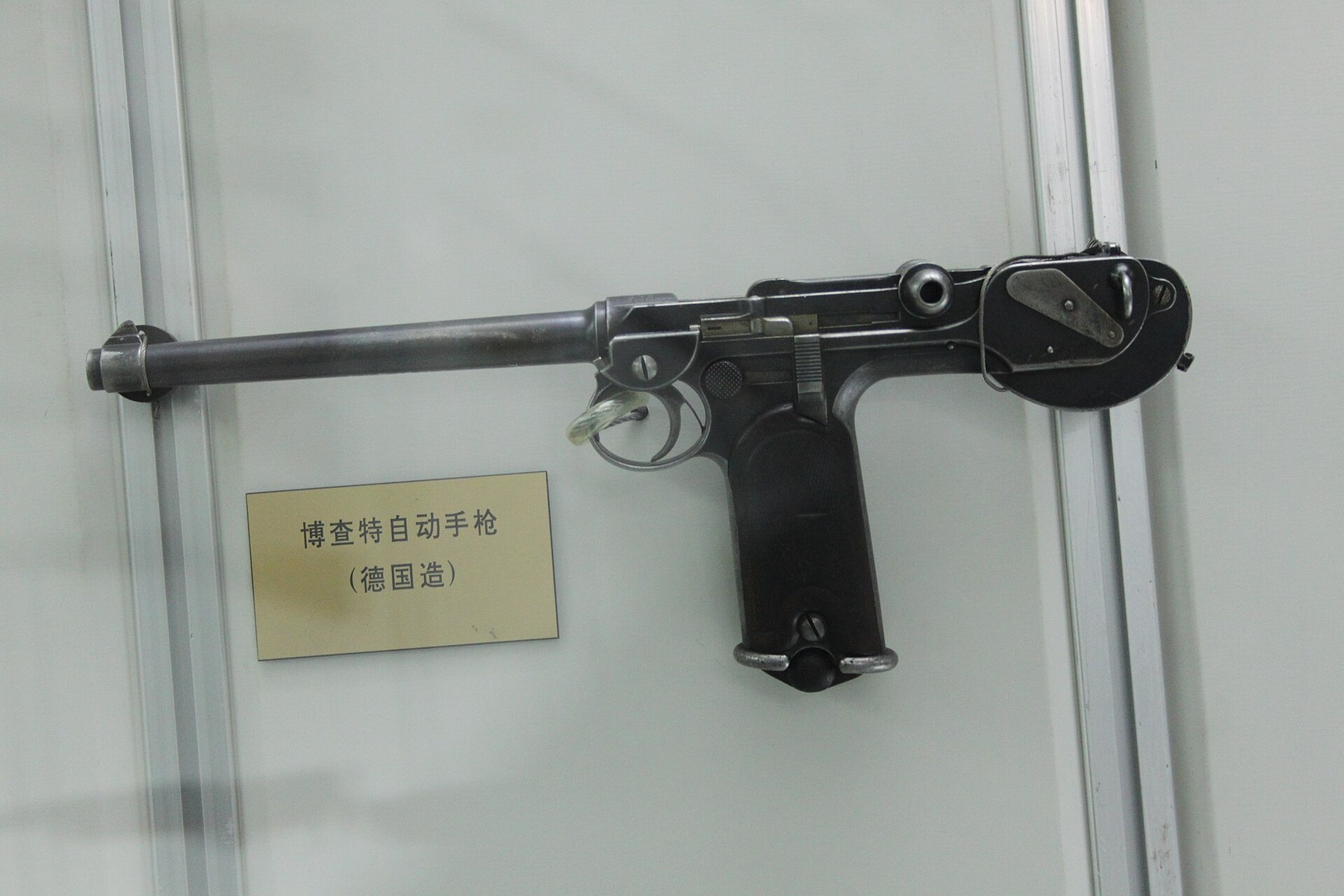
| Selbstladepistole System Borchardt | Museum label, WTS Koblenz |
| Borchardt Automatic Pistol Carbine | US Army board order of 1897, as quoted by Datig |
| Model 1893, Model 1894 | Collectors and auction houses; the Springfield Armory museum catalogues its example as “Model 1894” |
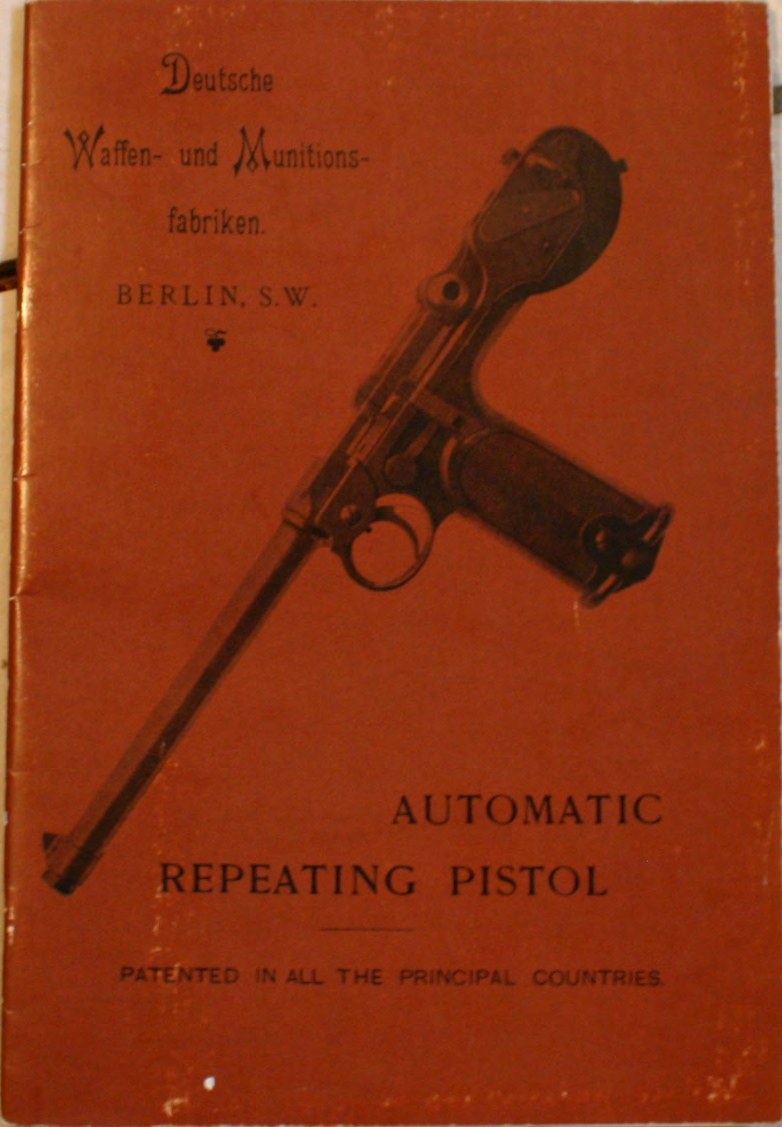
The word “repeating” in every period name is the nineteenth century’s word for what is now called self-loading or semi-automatic: a repeater was any arm that could fire several shots without reloading by hand. The US Army’s “pistol carbine” is worth noticing: the Americans, from the start, read the C-93 as a stocked arm that could be fired as a pistol, rather than a pistol that could take a stock. Pollard, writing in 1920, also calls the pistol Borchardt’s “Prometheus” model; the name appears nowhere else in the sources consulted and its origin is unexplained.8
2.4 The first published descriptions, 1895 and 1896
Two English-language technical descriptions appeared while the pistol was in Loewe production, and both are public domain and both survive.
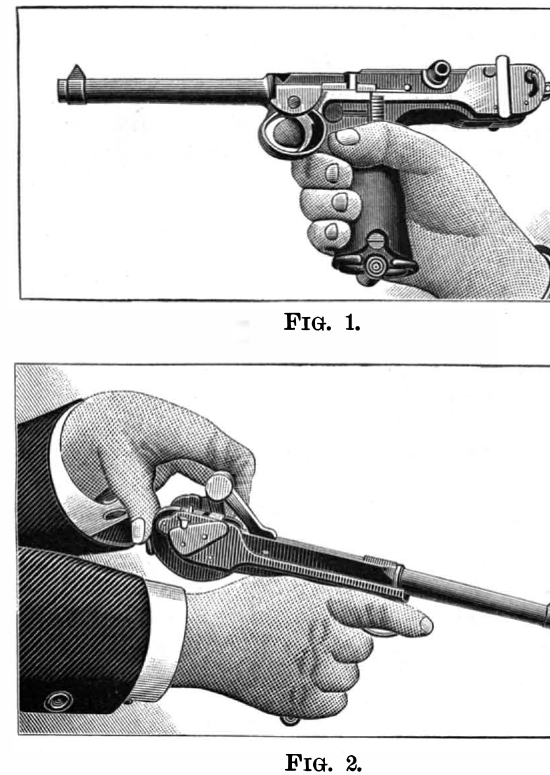
Scientific American, 3 August 1895, page 69, ran “Improved Repeating Pistol” with ten engravings. It names the maker directly: “The Borchardt repeating pistol is manufactured by Messrs. Ludwig Loewe & Company of Berlin.” It describes a pistol that “extracts the cartridge case, inserts a new cartridge and compresses the striker spring, by the force of the recoil”, and remarks that, unlike a Maxim gun, “it cannot be kept in action for an indefinite period … as the supply of cartridges is limited to eight.”9 It explains the disconnector as “a special contrivance to prevent the whole eight cartridges being fired off in a second or so”. And it ends: “For our illustrations and the foregoing particulars we are indebted to Engineering.” The earlier article in Engineering is therefore the first English-language technical description of the pistol; it was not located for this dive.
The US Office of Naval Intelligence, July 1896, printed a page and a half on the “Borchardt repeating automatic pistol” in its annual Notes on the Year’s Naval Progress, with a full-page plate of the pistol taken apart and in section, the parts numbered to match the factory’s own list.10 Its text is the source of the only published figure found for the barrel’s recoil distance, 0.118 inch, and of a set of ballistic and penetration data; both are used in Volumes 4 and 7. Its plate is reproduced in full in Volume 4.
The part numbers used by Scientific American, by ONI and by the Loewe and DWM manuals are the same (barrel 1, grip 3, receiver 34, breechblock 41, toggle links 47 and 49, closing spring 31, recoil spring 17, magazine 61 to 67). All four descend from one set of factory drawings, almost certainly the plates of the Loewe manual, and that numbering is used throughout this dive.
2.5 Loewe production, 1894 onward
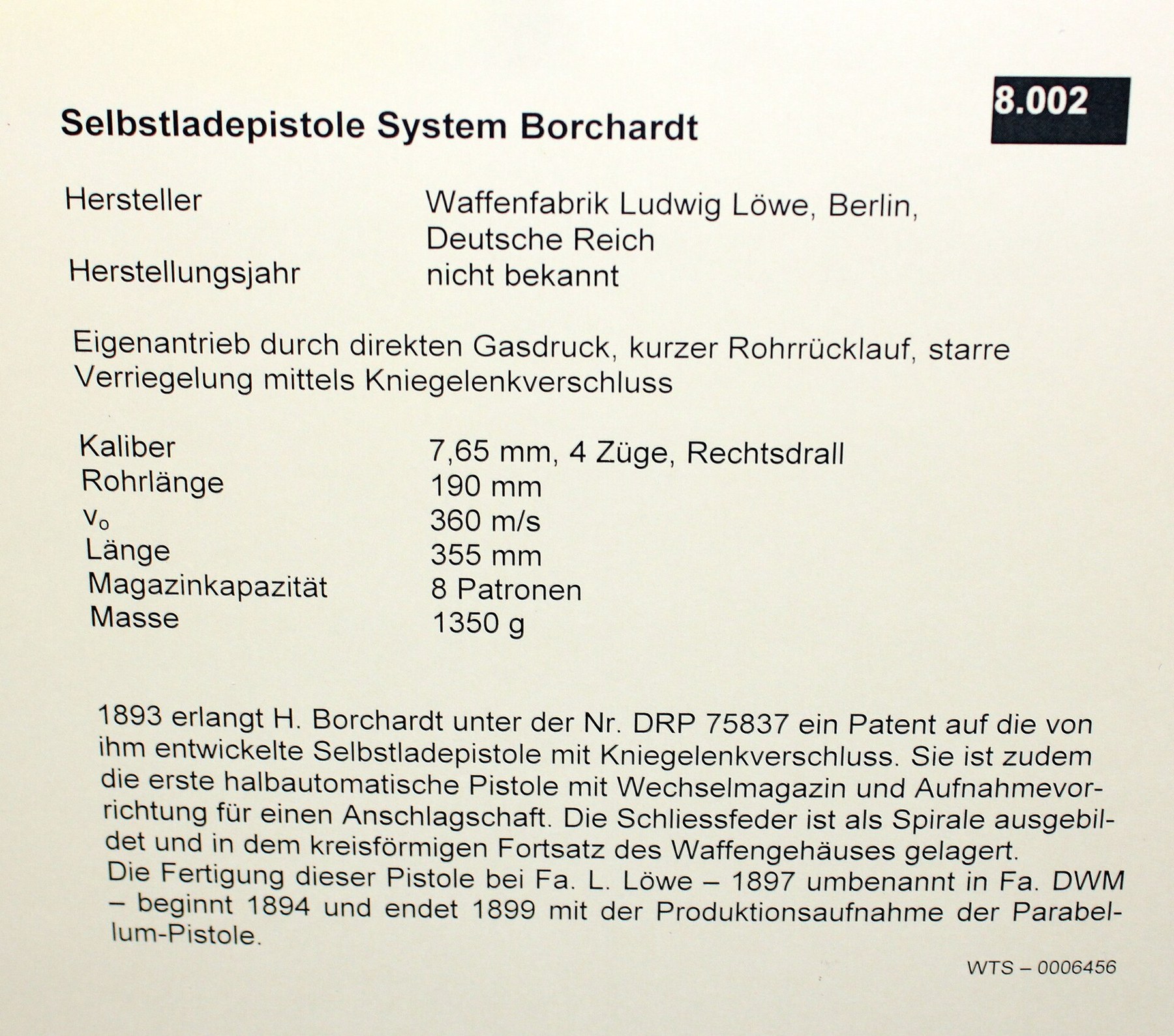
The Wehrtechnische Studiensammlung in Koblenz states on its label for its Loewe example that manufacture at Ludwig Loewe “beginnt 1894”, begins in 1894.11
The most specific account of how Loewe production actually went is Leonardo Antaris’s, in American Rifleman. Loewe, he writes, “assembled about 1,100 Model 1893s before production passed to DWM”; but of those 1,100 sets “only about 100 guns were initially completed for marketing. The other guns remained as unfinished parts as late as 1897.”12 If that is right, most Loewe-numbered pistols were not finished pistols in 1894–96 at all, but stocks of parts completed later, some of them after the name over the factory door had changed. A Rock Island lot catalogued as DWM but marked Loewe may be an example.13
The Loewe English manual is the firm’s own record of the pistol in this period. Its title page reads “Ludw. Loewe & Co., Actiengesellschaft, Machine Works and Armory, Berlin, S.W., Hollmann-Strasse 32”, printed by H. S. Hermann of Berlin.14 It is undated. It describes the pistol with a 190 mm barrel and also with a 154 mm short barrel, giving a weight of 1,250 g for the short version against 1,275 g for the standard; and its plates, according to the collector who published them, draw a pre-production short-barrel gun.1415 Short-barrelled tool-room prototypes have also passed through the auction trade, one unserialised Loewe example described with a six-inch barrel and a skeleton stock.16
Volume 5 sets out how Loewe production is identified on a gun; the short version is that Loewe pistols carry the maker’s name on top of the chamber.
2.6 The change to DWM
In 1896 Loewe’s arms business and the Karlsruhe cartridge works were merged into Deutsche Waffen- und Munitionsfabriken, seated in Berlin.17 The exact date is given differently by different sources, and the difference matters only for dating late Loewe guns:
Table 3 — In 1896 Loewe's arms business and the Karlsruhe cartridge works were merged into Deutsche Waffen- und Munitionsfabriken, seated in Berlin.[^wiki-loewe] The exact date is given differently by different sources, and the difference matters only for dating late Loewe guns
| Date | Source |
|---|---|
| 1896 | German Wikipedia (DWM); Fischer’s academic study; the Neue Deutsche Biographie entry for Georg Luger |
| November 1896 | Land of Borchardt collector site |
| 1 January 1897 | Fred Datig, Gun Digest |
| 1897 (“1897 umbenannt”) | WTS Koblenz museum label |
| ”approximately 1895” | Three Rock Island lot essays; wrong |
A reconciliation that fits all of them except the last is that DWM was constituted late in 1896 and began trading under its own name at the start of 1897. That reading was not confirmed from a commercial register or a company history.
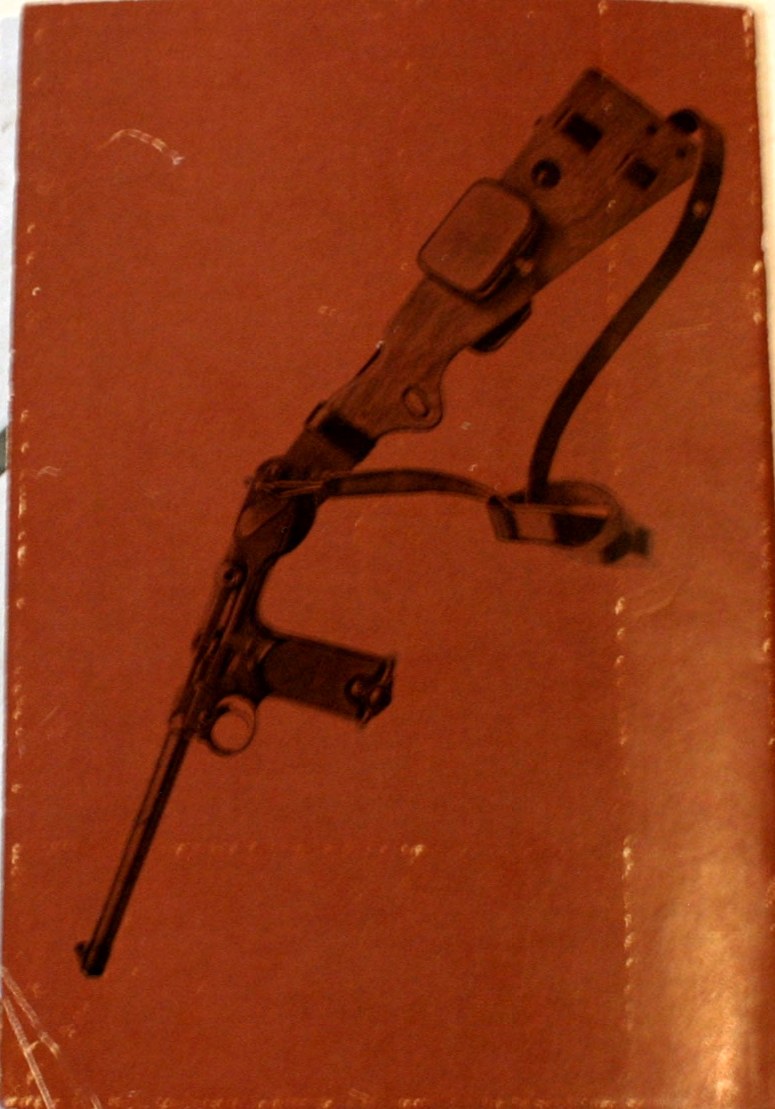
The pistol did not change in the transfer except in its markings and in small running changes; Volume 5 lists them. The DWM English manual, a near-verbatim revision of the Loewe text with new plates, is the second surviving factory document.7
2.7 How many were made
Every source agrees on roughly three thousand. They disagree on the details, and the figures are given here separately:
Table 4 — Every source agrees on roughly three thousand. They disagree on the details, and the figures are given here separately
| Figure | Source |
|---|---|
| ”3000 were ultimately made” | McCollum, Forgotten Weapons, 2015 |
| ”about 1,100” Loewe, DWM “fewer than 2,000”, “about 3,000” in all | Antaris, American Rifleman, 2017–18 |
| About 1,100 Loewe, “nearly 2,000” DWM, 3,100 in all | English Wikipedia, citing Antaris and Görtz and Sturgess |
| Production stopped “nach 3000 Exemplaren” | German Wikipedia |
| Loewe “only about 1,104” | James D. Julia lot essay, 2013 (uncited) |
| “one of just 1,100 examples produced by the Ludwig Loewe & Company” | Rock Island lot 1049-542 |
The highest serial number seen in any source consulted is 3019, one of four DWM guns with a Siamese mark listed in a 2024 Italian article; the next highest is 2956, photographed by the Ohio Gun Collectors Association.1819 Both are consistent with a total a little over 3,000.
The standard reference for serial ranges and dates is Joachim Görtz and Geoffrey Sturgess, The Borchardt & Luger Automatic Pistols (2010–11). It was not available to this dive, and several of the open questions below would probably be closed by it.
2.8 Serial numbers seen, and the Loewe-DWM boundary
No source consulted gives the serial number at which Loewe marking stops and DWM marking starts. What can be done is to list the guns that have been described with both a serial and a maker:
Table 5 — No source consulted gives the serial number at which Loewe marking stops and DWM marking starts. What can be done is to list the guns that have been described with both a serial and a maker
| Serial | Maker marking | Source |
|---|---|---|
| 13 | Loewe | James D. Julia, April 2017, lot 1516 |
| 19 | Loewe | Rock Island, December 2024, lot 1368 |
| 69 | Loewe | Rock Island blog caption, 2024 |
| 373 | Loewe | Rock Island, February 2025, lot 2503 (search summary only) |
| 429 | Loewe | Gazette Drouot, October 2026, lot 42 |
| 463 | Loewe | James D. Julia, October 2017, lot 2005 |
| 529 | Loewe | Rock Island, October 2025, lot 542 |
| 664, 881 | Loewe | Bonhams, November 2019, lots 43 and 42 |
| 1013 | Loewe, described as “one of the last to have been assembled by Loewe” | Poulin, August 2026 |
| 1105 | DWM, described as one of the first DWM-assembled | James D. Julia, April 2017, lot 1520 |
| 1475 | DWM | Rock Island lots 69-1417 and 71-1438 (the same gun twice) |
| 1681, 1723 | DWM | Rock Island lots 57-1506 and 69-3297 |
| 1962 | DWM | James D. Julia, March 2016, lot 2614 |
| 2119 | DWM | Commons photographs; Collectors Firearms listing |
| 2230 | DWM, Siamese mark | Rock Island lot 66-1558 |
| 2234 | DWM | Hermann Historica, May 2025, lot 7570 |
| 2268, 2915, 2956, 3019 | DWM, Siamese mark | all4shooters 2024; Poulin 2025; OGCA |
On that list, the change falls between serials 1013 and 1105. That is consistent with Antaris’s figure of about 1,100 Loewe guns and with the Julia figure of 1,104, and it is offered here as an inference from auction descriptions, not as a published boundary. Collectors should treat a C-93 in the 1,000 to 1,150 range with particular care when reading its markings, and should read the markings rather than infer the maker from the number.
2.9 When production ended, and why it matters
This is the most consequential open question in the dive.
Table 6 — When production ended, and why it matters
| End of production | Source | Note |
|---|---|---|
| 1898 (window 1894–1898) | German Wikipedia infobox | No citation for the end year |
| 1899, “with the start of Parabellum production” | WTS Koblenz museum label | A museum statement; source not given |
| 1902 (window 1893–1902) | English Wikipedia infobox | No in-line citation; widely copied |
| Loewe c. 1893–1896 | Rock Island lot 1049-542 | Contradicted by Antaris on finishing dates |
| Loewe 1893–1897, DWM 1897–1902 | LSB Auctions lot titles | Title only seen; site refused retrieval |
The pistol was still on sale in the United States in 1898, when Hermann Boker & Co. of New York issued a flier for it, and Antaris’s account has Loewe parts still being finished into 1897.2012 The Swiss had moved on to Luger’s redesign by November 1898, and DWM’s attention with them.21 Beyond that, the sources consulted do not establish when the last C-93 was completed.
It matters because United States federal law treats a firearm manufactured in or before 1898 as an “antique firearm”, outside the Gun Control Act entirely, and ATF’s list of stocked pistols removed from the National Firearms Act names the C-93 with its stock only under a heading confined to pistols made in or before 1898. A C-93 completed in 1899 or later is a firearm, a curio or relic by age, and with its stock attached is on no list at all. The auction trade already sells some DWM pistols as antiques and others as curios or relics, which is the market’s way of saying it does not know either.2223 Volume 8 sets out the law in full, and the Michigan position, which turns out to be stricter than the federal one regardless of date.
2.10 Selling it: New York, Amsterdam, Bangkok and London
No sales figures survive in the sources consulted, but the agents and markets can be traced.
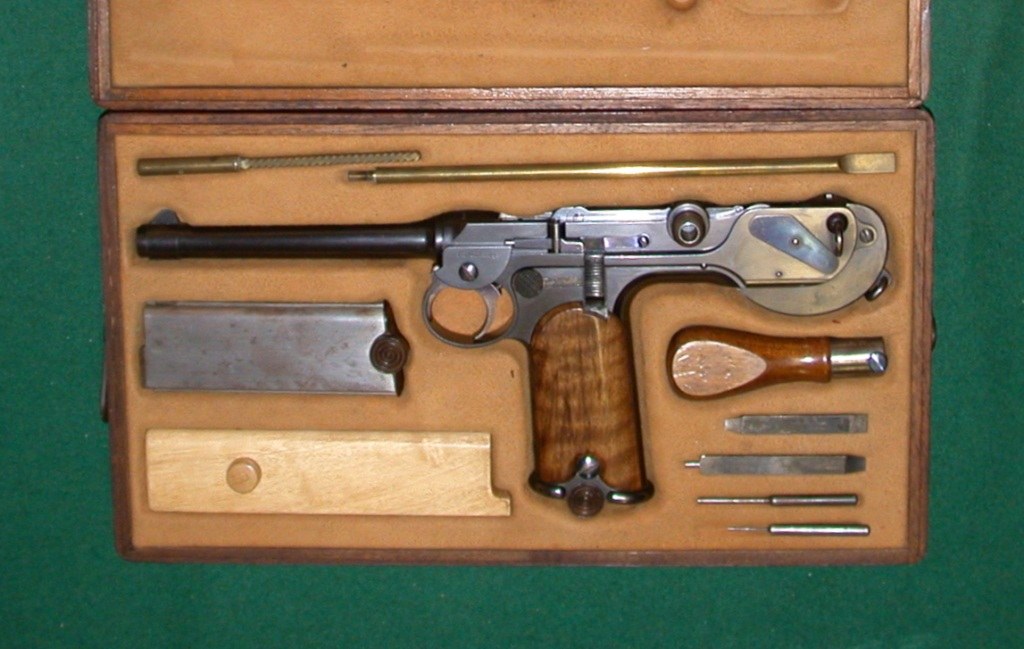
United States. Hermann Boker & Co., of 101 and 103 Duane Street, New York, sold the pistol as DWM’s American distributor. A 2024 Rock Island essay quotes the firm’s terms: the pistol “for $30.00 each. Included were ‘three extra magazines, tools, oilers, holster, and strap.’ A leather case cost an additional $5.00, and ammunition for the pistol cost $3.50 per 100 rounds”. The same flier marketed it as “light, powerful, and effective”, “the ideal weapon for the woods”, with “an effective range of 200 to 300 yards”, and a full rig with holster, sling and stock “advertised as weighing 3 3/4 pounds”.20 A collector site dates the flier to 1898.24 One English-language DWM manual in a private collection carries the stamp of Baker & Hamilton, a San Francisco hardware and arms distributor, which suggests West Coast retail as well.15
The Netherlands. A German-language DWM manual published by Land of Borchardt carries the stamp of Georges & de Watteville of Amsterdam, described as DWM’s Dutch representative, and the same site states that the Dutch military bought a stocked C-93 in 1895.15 Neither the representation nor the purchase was confirmed from a Dutch source.
Siam. Several late DWM pistols carry a small circular Siamese chakra mark on the frame. Görtz and Sturgess, as quoted in an auction listing, write that “it is possible that a small number of Borchardt pistols were acquired officially by Siam, since two late DWM production pistols, serial nos. 2915 and 2956, are known with Siamese markings to the grip.”23 An Italian article in 2024 counted four (2268, 2915, 2956 and 3019) and associated them with a longer-than-standard stock.18 A Rock Island essay describes a fifth, serial 2230, with “a small circular ‘Charkra’ Siam proof mark”.25
France. A consignor’s note with DWM serial 1723 says it was made without a stock lug and intended for sale in France. It is a consignor’s claim and is recorded as such.26
Britain. A Hampshire Cultural Trust record for a photograph of a cased Loewe pistol opens: “The Borchardt pistol was the first automatic to be put on sale in this country.”27 Pollard, in 1920, makes the same claim. It is plausible and is attributed, not adopted.
Germany. The English Wikipedia article on the Luger states that “in 1898, Germany adopted a total of 145 C93 pistols, but found that it jammed too often to be effective”. The citation was not traced, no German procurement record was found, and the claim is not adopted here. No German retail price in marks was located.
A reader comment on a Forgotten Weapons post refers to an 1898 US Treasury decision classifying the Borchardt as a carbine for tariff purposes, citing Treasury Decisions volume 34, pages 41–42. It was not traced, and is noted here only because, if real, it would be a primary record of imports in 1898 and of the “pistol carbine” reading of the gun.
2.11 What this volume could not settle
- The date the last C-93 was completed. Sources give 1898, 1899 and 1902, none with a primary citation. Load-bearing for US law (Volume 8).
- The serial number boundary between Loewe and DWM. Inferred here as between 1013 and 1105 from auction descriptions; no published boundary was found.
- The date DWM began trading, 1896 or 1 January 1897.
- The German patent drawings, including the three-stage toggle schematic. The PDF could not be retrieved automatically.
- The Engineering article of 1895 that Scientific American drew on.
- The 1898 German purchase of 145 pistols, the 1895 Dutch purchase, and the 1898 US Treasury carbine ruling.
- The German retail price.
References
Footnotes
-
Hugo Borchardt, US Patent 571,260, “Recoil Magazine-Pistol”, filed 21 October 1893, Serial No. 488,759, patented 10 November 1896. https://patents.google.com/patent/US571260A/en and the PDF from patentimages.storage.googleapis.com, consulted 2026-10-18. ↩ ↩2 ↩3 ↩4 ↩5 ↩6 ↩7
-
“Hugo Borchardt”, English Wikipedia, https://en.wikipedia.org/wiki/Hugo_Borchardt, consulted 2026-10-18. ↩
-
H. Borchardt, Deutsches Reichspatent 75,837, “Selbstthätige, besonders als Repetirpistole verwendbare Feuerwaffe”. OCR text at https://patents.google.com/patent/DE75837C/de, consulted 2026-10-18. Figure list and the term Froschgelenk from the text; the PDF was not retrievable (DEPATISnet bot challenge, DPMAregister 401). ↩
-
H. Borchardt, Swiss patent 7,296, “Durch den Rückstoss bethätigte Repetierpistole”, https://patents.google.com/patent/CH7296A/de, consulted 2026-10-18. ↩
-
Forgotten Weapons, “Borchardt Automatic Pistol”, 2011, https://www.forgottenweapons.com/early-automatic-pistols/borchardt-automatic-pistol/, consulted 2026-10-18. ↩
-
“Borchardt C-93”, English Wikipedia, https://en.wikipedia.org/wiki/Borchardt_C-93, consulted 2026-10-18. ↩
-
Deutsche Waffen- und Munitionsfabriken, Automatic Repeating Pistol, Borchardt Patent (Berlin, n.d.), English edition, pp. 6–7 and covers. Scan circulated by Forgotten Weapons, https://www.forgottenweapons.com/wp-content/uploads/2013/10/Borchardt-C93-Manual-English.pdf; page images also at https://landofborchardt.com/C93manual.html, consulted 2026-10-18. ↩ ↩2
-
H. B. C. Pollard, Automatic Pistols (London, 1920), pp. 9–10. Internet Archive
automaticpistolspollard1920, consulted 2026-10-18. ↩ -
“Improved Repeating Pistol”, Scientific American vol. 73 no. 5, 3 August 1895, p. 69. Internet Archive
scientific-american-1895-08-03, consulted 2026-10-18. Public domain. ↩ -
US Office of Naval Intelligence, General Information Series No. XV (July 1896), pp. 129–131 and plate. Internet Archive
generalinformati3533unit, consulted 2026-10-18. Public domain. ↩ -
Wehrtechnische Studiensammlung Koblenz, label “Selbstladepistole System Borchardt”, photographed as File:Pistole C 93 System Borchardt Tafel in der WTS-Koblenz.jpg, Archiv WTS-Koblenz, CC BY-SA 4.0, consulted 2026-10-18. ↩
-
Leonardo M. Antaris, “In The Beginning: Semi-Automatic Pistols of the 19th Century”, American Rifleman, posted 4 January 2018 (print vol. 165 no. 10, 2017, pp. 76–77), https://www.americanrifleman.org/articles/2018/1/4/in-the-beginning-semi-automatic-pistols-of-the-19th-century, consulted 2026-10-18. ↩ ↩2
-
Rock Island Auction Company, lot 1049-1544, consulted 2026-10-18 (a Loewe-marked pistol catalogued as DWM). ↩
-
Ludw. Loewe & Co., Repeating Pistol (System Borchardt), English edition (Berlin, n.d., before 1897), title page and p. 14. Page images at https://landofborchardt.com/LoeweManual.html, consulted 2026-10-18. ↩ ↩2
-
Land of Borchardt, “1893 C93 Borchardt German Language Manual”, https://landofborchardt.com/c93manual-article.html, consulted 2026-10-18. Collector site; the dating of DWM to November 1896, the Georges & de Watteville stamp, the 1895 Dutch purchase and the pre-production short-barrel plate are its statements. ↩ ↩2 ↩3
-
James D. Julia, Firearms, April 2017, lot 1518, https://jamesdjulia.com/?p=548182, consulted 2026-10-18. ↩
-
“Ludwig Loewe”, English Wikipedia, https://en.wikipedia.org/wiki/Ludwig_Loewe, consulted 2026-10-18. ↩
-
Giorgio Brancaglion and Roberto Allara, “Pistola da collezione Borchardt 93 in calibro 7,65x25”, all4shooters.com, 4 July 2024, https://www.all4shooters.com/it/tiro/armi-storiche-repliche/pistola-da-collezione-borchardt-93-in-calibro-7-65x25/, consulted 2026-10-18. ↩ ↩2
-
Ohio Gun Collectors Association, Borchardt article with photograph captioned “Borchardt M1893 s/n: 2956”, https://ogca.com/?p=2880, consulted 2026-10-18. ↩
-
Joe Engesser, “The Borchardt C93 Pistol”, Rock Island Auction Company blog, 14 October 2024, https://www.rockislandauction.com/riac-blog/borchardt-c93-pistol, consulted 2026-10-18. ↩ ↩2
-
Markus Käser, “Fundobjekt in der Sammlung Stiftung HAM: Chronologie zur Einführung der Selbstladepistole 1900”, Stiftung Historisches Armeematerial, Thun, January 2021, https://test.stiftung-ham.ch/wp-content/uploads/2021/01/Fundobjekt-in-der-Sammlung-Stiftung-HAM.pdf, consulted 2026-10-18. ↩
-
Poulin Auctions, lot 01-29022, Summer 2026 Premier sale, Loewe serial 1013, “STATUS: ANTIQUE”, https://www.poulinauctions.com/2026/06/13/high-condition-all-matching-borchardt-c93-made-by-loewe-caliber-7-65mm-one-of-the-last-to-have-been-assembled-by-loewe-complete-with-unnumbered-stock-cheekpiece-holster-and-shoulder-strap/, consulted 2026-10-18. ↩
-
Poulin Auctions, lot 25-3438, Fall 2025 Premier sale, DWM serial 2915, Siamese-marked, catalogued as a curio, quoting Görtz and Sturgess p. 141, https://www.poulinauctions.com/2025/08/14/, consulted 2026-10-18. ↩ ↩2
-
Land of Borchardt, “C93 accessories”, https://landofborchardt.com/C93_acc.html, consulted 2026-10-18. ↩
-
Rock Island Auction Company, lot 66-1558, “DWM 1893 pistol 7.63 mm Borchardt”, https://www.rockislandauction.com/detail/66/1558/dwm-1893-pistol-763-mm-borchardt, consulted 2026-10-18. ↩
-
Rock Island Auction Company, lot 69-3297, consulted 2026-10-18. ↩
-
Hampshire Cultural Trust, record HMCMS:DA1983.183, https://collections.hampshireculture.org.uk/object/photograph-colour-showing-automatic-borchardt-automatic-pistol-case-accessories-made-ludwig, consulted 2026-10-18. ↩
Comments (0)