Suppressor Law · Volume 7
State Law — The Eight, the Forty-Two, and Michigan
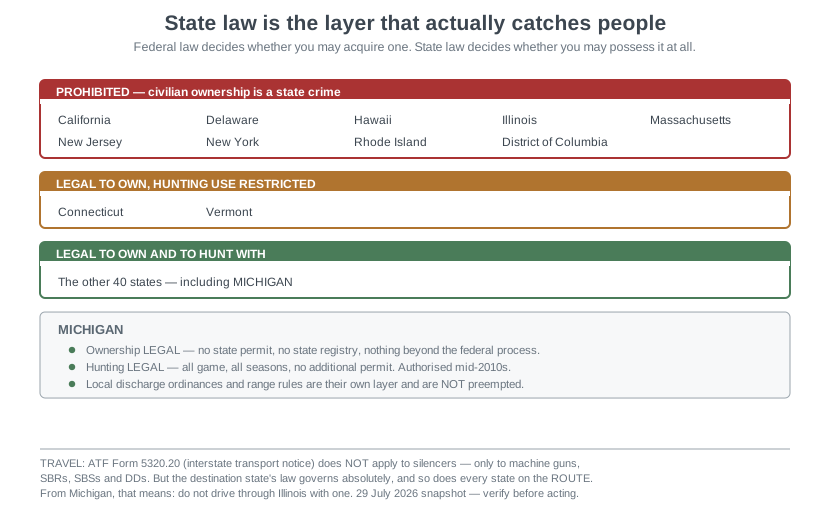
Federal law decides whether you may acquire a suppressor. State law decides whether you may possess one at all, and it is the layer that actually catches people — because it is the one that varies, the one that changes, and the one nobody checks before ordering.
Verify your own state’s current law before acting. This is a 29 July 2026 snapshot of secondary sources, not a legal opinion, and state legislatures move.
7.1 The Eight Prohibition States
Civilian suppressor ownership is prohibited in eight states, plus the District of Columbia:1
- California
- Delaware
- Hawaii
- Illinois
- Massachusetts
- New Jersey
- New York
- Rhode Island
- (and the District of Columbia)
In these jurisdictions no federal process helps you. An approved Form 4 and a $0 stamp do not create a right to possess something the state prohibits. Penalties are state felonies.
No prohibition state has been identified as having repealed as of this writing, though advocacy is active in several — and the Comeaux holding that suppressors are protected “Arms” (Volume 5) is already being discussed as a lever against those bans in commentary out of Illinois and elsewhere. That is commentary, not a ruling. The bans are in force.
7.2 The Other Forty-Two
Legal to own in the remaining 42 states, subject entirely to the federal process.1
Hunting is a separate question. More than 40 states explicitly permit hunting with a suppressor,1 but two states permit ownership while restricting hunting use:
- Connecticut — ownership legal, hunting use restricted
- Vermont — ownership legal, hunting use restricted
The trajectory over the last fifteen years has been steadily toward permitting hunting use, on noise and hearing-conservation grounds, and legislatures continue to move in that direction.
7.3 Michigan
The state that matters here.

Ownership: legal. No state permit, no state registry, no state-level requirement beyond the federal process.2 Complete the ATF process, receive approval, and you are compliant in Michigan.
Hunting: legal, for all game and all seasons, with no additional permit.2 Michigan’s authorisation dates to the mid-2010s — commonly cited as taking practical effect for hunting in 2016 — and it is broad. There is no species carve-out and no separate suppressor endorsement.
What that means practically for someone in Michigan:
- The only gate is federal. There is no second application, no state fee, and no state waiting period.
- Suppressed hunting is fully available — which, given how much of Michigan hunting happens near property lines and how loud a .30-caliber rifle is, is a genuine quality-of-life difference for you and for anyone within half a mile.
- Local ordinances still exist. Discharge ordinances, township rules, and range policies are their own layer and are not preempted by the state’s permission to own or hunt.
- Michigan’s neighbours are all permissive on ownership, which makes travel straightforward (§7.4). Illinois, however, is a prohibition state, and a route from Michigan into Wisconsin or Iowa that crosses Chicago is a route you should not take with a suppressor in the vehicle.
7.3.1 The gun in the vehicle — the rule this dive was missing
Ownership and hunting are the two questions everyone asks about Michigan. There is a third that catches more people than either, and it has nothing to do with the suppressor: how a long gun may be transported in a vehicle.
MCL 750.227d provides that a person shall not transport or possess in or upon a motor vehicle a firearm, other than a pistol, unless the firearm is unloaded and is one or more of the following:3
- Taken down
- Enclosed in a case
- Carried in the trunk of the vehicle
- Inaccessible from the interior of the vehicle
Violation is a misdemeanour — up to 90 days and/or a $100 fine.
Read the structure: it is an AND followed by an OR. Unloaded is required in every case and is not one of the four. Then any one of the four satisfies the rest.
🔴 The trap: a Michigan concealed pistol licence does not change this. The statute reads “a firearm, other than a pistol.” The CPL regime governs pistols; the rifle sits outside it entirely. A CPL holder driving with a loaded, assembled long gun in the cab is not covered by the licence, and the assumption that a carry licence is a general permission is a common and expensive misreading. In one vehicle, the pistol and the rifle are governed by two different rule sets.
⭐ And a pleasant consequence for anyone who owns a takedown rifle: “taken down” is one of the four enumerated compliance modes. A Ruger 10/22 Takedown, a takedown shotgun, or any rifle broken into its two halves satisfies the statute by being in the configuration you would already carry it in. Combine that with a bed box or a locked drawer — inaccessible from the interior — and two independent conditions are met rather than one, which is a materially more comfortable position than relying on whether a soft wrap counts as “a case.”
⚠ “Unloaded” is the condition people actually fail, because it feels like the default and is not automatic. A magazine left in a receiver half does not announce itself. Make the empty check part of putting the rifle away, not part of taking it out.
The vehicle-storage case is worked through in full — including ammunition heat, containers, and the pre-departure checklist — in the Overlanding project’s The Truck Rifle dive, volume 3.
7.4 Travel Between States
The rule that surprises people, in a good way:
ATF Form 5320.20 — the interstate transport notification — does NOT apply to silencers. It applies to machine guns, short-barreled rifles, short-barreled shotguns and destructive devices. A suppressor may be carried across state lines without notifying ATF.
But the destination state’s law governs completely. Driving a legally owned Michigan suppressor into Illinois does not make it legal in Illinois. It makes you a person in Illinois with a prohibited item.
Practical travel discipline:
- Check every state on the route, not just the destination. Ground travel through a prohibition state is the trap.
- Carry a copy of the approved stamp with the item.
- Air travel: the suppressor goes in checked baggage, declared, in a locked hard case, exactly as a firearm does — and the destination and any connecting-stop jurisdictions still apply.
- Do not rely on the Firearm Owners’ Protection Act “safe passage” provision as a plan. It exists, it is narrow, its protections are contested in practice in some jurisdictions, and it is a defence rather than a shield against being arrested. Route around prohibition states.
7.5 The Layer Below the State
Three more layers that state legality does not resolve:
Local discharge ordinances. Townships and municipalities regulate discharge, and a suppressor changes nothing about whether you may shoot somewhere. It may, in practice, change whether anybody complains — which is not the same as being permitted.
Range rules. Some ranges restrict or prohibit suppressor use, for reasons that range from insurance to habit. Ask.
Competition rules. Discipline-specific and variable (Suppressors by Caliber, Volume 8 §8.6).
7.6 Suppressors and Noise Complaints
An observation worth making because it is the actual day-to-day reason to own one.
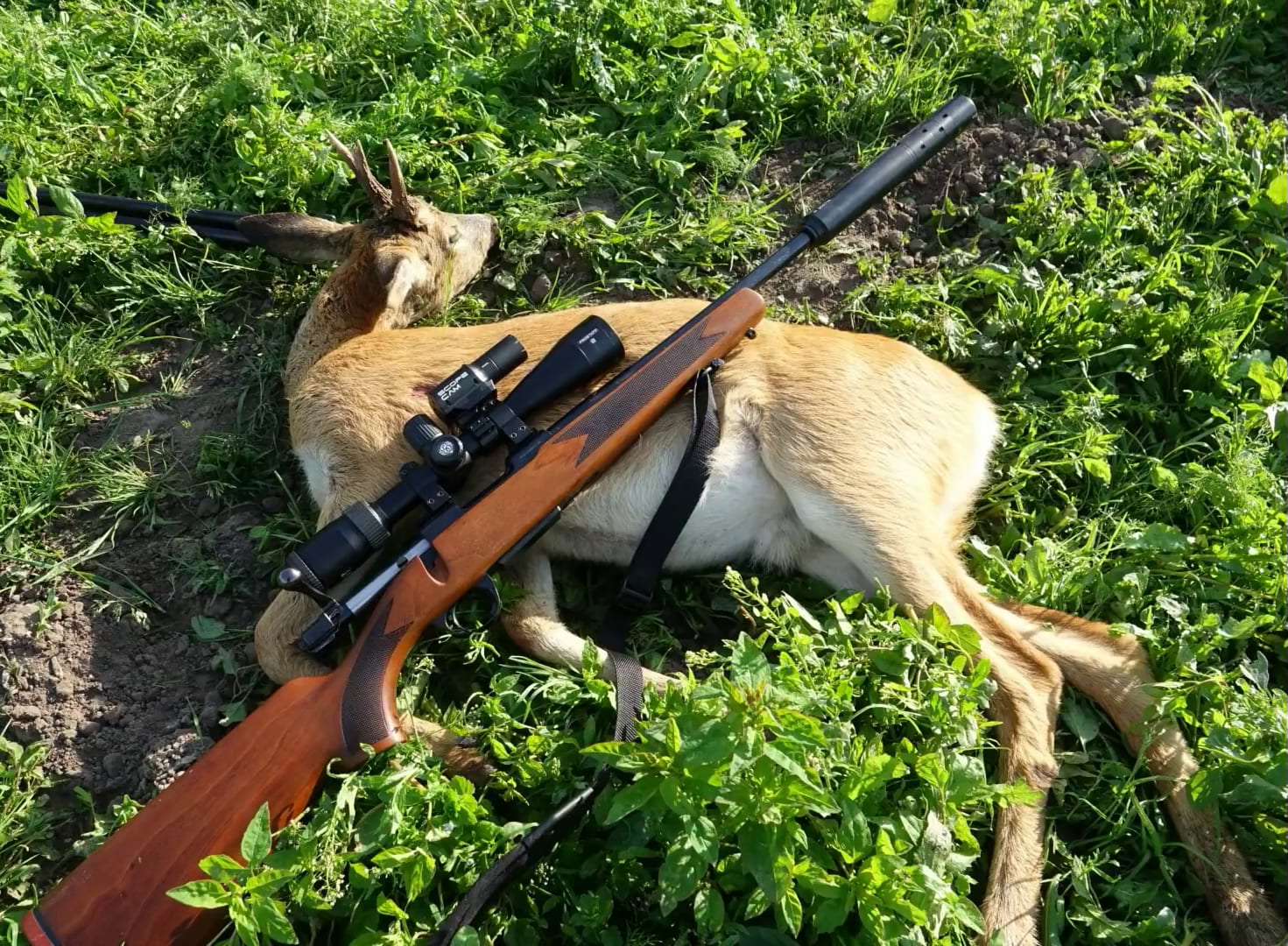
A suppressor does not give you permission to shoot anywhere. What it does is remove the thing that generates complaints, which for most private-land shooting is the muzzle blast rather than the crack — blast is a low-frequency, percussive, structure-shaking event that carries and annoys, and a suppressor removes essentially all of it.
With subsonic ammunition, the whole event effectively disappears at distance. With supersonic, the crack remains but is radiated from the bullet’s flight path rather than from your position, which changes its character substantially at a neighbour’s house.
This is the argument that has actually won suppressor legalisation in state after state, and it is a better argument than the tactical one because it is the true one: suppressors are noise-abatement equipment that also protects the shooter’s hearing.
7.7 The Checklist
Before buying, and before travelling:
- Is ownership legal in your state? Eight states plus DC say no
- Is hunting use permitted in your state? Connecticut and Vermont say no even though ownership is fine
- Are there local discharge ordinances where you shoot?
- Does your range allow suppressor use?
- If travelling: is every state on the route permissive? — not just the destination
- Copy of the approved stamp with the item?
- No Form 5320.20 needed for a suppressor — but the destination state’s law is absolute
- In Michigan, the long gun in the vehicle is its own rule (§7.3.1) — unloaded, and taken down / cased / in the trunk / inaccessible. A CPL does not cover it.
7.8 Bibliography
Footnotes
-
Eight prohibition states (California, Delaware, Hawaii, Illinois, Massachusetts, New Jersey, New York, Rhode Island) plus the District of Columbia; more than 40 states permit hunting with a suppressor; Connecticut and Vermont permit ownership while restricting hunting use. World Population Review, “Suppressor Laws by State 2026.” https://worldpopulationreview.com/state-rankings/suppressor-laws-by-state ; ammo.com, “Where Are Silencers Illegal? State Suppressor Laws in 2026.” https://ammo.com/research/are-silencers-illegal ↩ ↩2 ↩3
-
Michigan — suppressor ownership legal with the federal process and no additional state permit; hunting with a suppressor permitted for all game and seasons, authorised in the mid-2010s. Silencer Shop, “Are Suppressors Legal in Michigan?” https://www.silencershop.com/suppressor-laws-michigan ; Silencer Shop, “Suppressor Hunting Laws in Michigan.” https://www.silencershop.com/hunting-with-a-suppressor-in-michigan ↩ ↩2
-
MCL 750.227d — transporting or possessing a firearm other than a pistol in or upon a motor vehicle or self-propelled vehicle designed for land travel; the firearm must be unloaded and one or more of: taken down, enclosed in a case, carried in the trunk, or inaccessible from the interior of the vehicle. Violation is a misdemeanour punishable by up to 90 days’ imprisonment and/or a $100 fine. The statute expressly applies to “a firearm, other than a pistol,” which is why a concealed pistol licence does not reach it. https://www.legislature.mi.gov/Laws/MCL?objectName=mcl-750-227d ; https://www.legislature.mi.gov/documents/mcl/pdf/mcl-750-227d.pdf (confidence: high — this is the statutory text. Still not legal advice; the current statute controls, and pistol transport is governed separately). ↩
Comments (0)