Suppressor Law · Volume 6
Legislation — The Bills, and What Each Would Actually Do
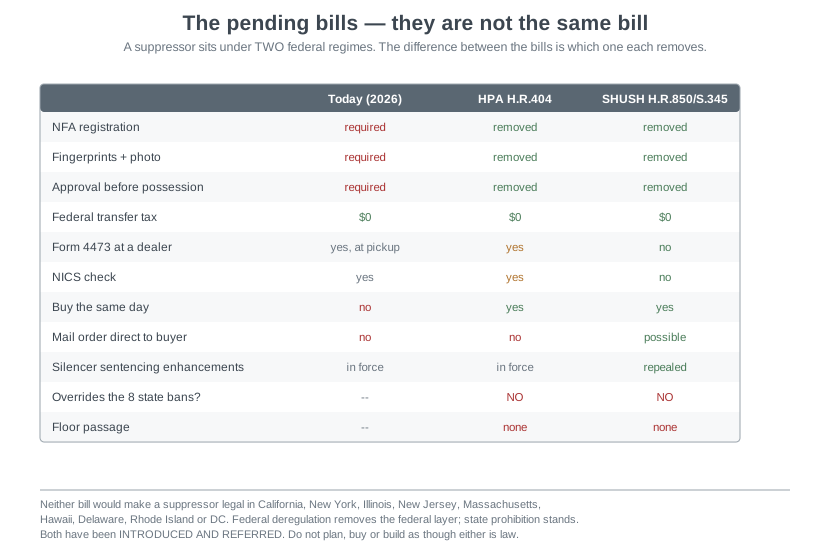
Three bills in the 119th Congress would change the suppressor’s legal status, and they are not the same bill with different names. They differ in exactly which regulatory layer they remove — which matters enormously, because a suppressor sits under two federal regimes, not one.
Status, stated up front: all three have been introduced and referred to committee. No floor passage has been identified. Do not write, plan or buy as though any of them is law.
6.1 The Two Layers a Bill Can Remove
Recall from Volume 1 that a silencer is regulated federally at two levels:
- The National Firearms Act (NFA) — registration, Form 4, fingerprints, background check, approval before transfer.
- The Gun Control Act (GCA) — the ordinary firearms regime: dealer transfers, Form 4473, NICS, interstate rules.
A bill can remove a suppressor from the first, from both, or from neither. That is the whole difference between the bills.
6.2 The Hearing Protection Act — H.R. 404
What it does: removes silencers from the NFA and treats them as ordinary firearms under the GCA.1
What that means in practice: buying a suppressor would look like buying a rifle. Walk into a dealer, fill out a Form 4473, pass a NICS check, walk out with it the same day. No registration in the NFA registry, no fingerprints, no photograph, no months-long wait, no approval-before-possession.
What it does not do: it does not deregulate suppressors. They would remain “firearms” under the GCA, with everything that implies — dealer transfers, prohibited-person rules, interstate transfer rules, and the ordinary criminal penalties.
The naming. “Hearing Protection Act” is the public-health framing described in Volume 2 — that a suppressor is protective equipment and that essentially every unsuppressed firearm exceeds the impulse threshold at which hearing damage accumulates. It has been introduced in multiple Congresses since 2015 and has never reached a floor vote.
A variant, the Constitutional Hearing Protection Act (H.R. 3228), frames the same objective differently.2
6.3 The SHUSH Act — H.R. 850 and S. 345
Silencers Help Us Save Hearing. Introduced by Rep. Michael Cloud (TX-27) in the House and Sen. Mike Lee (R-UT) in the Senate.3
What it does — this is the more aggressive bill:
- Removes silencers from the NFA, as the HPA would.
- Also excludes mufflers and silencers from regulation under the Gun Control Act entirely.4 Under the HPA a suppressor becomes a regulated firearm; under SHUSH it becomes essentially an unregulated accessory — closer to a scope than to a rifle, and closer to the pre-1934 position.
- Eliminates the mandatory-minimum sentencing enhancements for crimes committed with a silenced firearm.
- Permits active and retired law enforcement officers to carry concealed suppressors.
Endorsements: National Rifle Association, Gun Owners of America, National Association for Gun Rights, and the National Shooting Sports Foundation.3
6.4 Side by Side
Table 1 — 6.4 Side by Side
| Today (2026) | HPA (H.R. 404) | SHUSH (H.R. 850 / S. 345) | |
|---|---|---|---|
| NFA registration | Required | Removed | Removed |
| Fingerprints + photo | Required | Removed | Removed |
| Approval before possession | Required | Removed | Removed |
| Federal transfer tax | $0 | $0 | $0 |
| Form 4473 at a dealer | Yes, at pickup | Yes | No — not a GCA firearm |
| NICS check | Yes | Yes | No |
| Buy same day | No | Yes | Yes |
| Mail order direct to buyer | No | No | Possible |
| Silencer sentencing enhancements | In force | In force | Repealed |
| State bans overridden? | — | No | No |
That last row is the one people miss most often, and it is worth stating flatly: neither bill would make suppressors legal in California, New York, Illinois, New Jersey, Massachusetts, Hawaii, Delaware, Rhode Island or DC. Federal deregulation removes the federal layer. State prohibition is a separate layer, and it stands (Volume 7). Both bills contain the usual provisions encouraging states to conform, and neither preempts a state ban.
6.5 Why Neither Has Passed
Worth understanding, because it explains why the change that did happen happened the way it did.
Standalone firearms legislation is hard. Both bills need sixty Senate votes in practice, and suppressor deregulation is a bill Senate opponents will spend a filibuster on.
Reconciliation is easier — but only for money. The tax could move in a reconciliation bill because a tax rate is a budget item. The registration requirement cannot: it is regulatory, not fiscal, and reconciliation’s rules exclude it. That is exactly why 1 January 2026 delivered a $0 tax and left every other requirement standing (Volume 3). It is not an oversight — it is the shape of the only vehicle available.
The political framing is contested. The public-health argument is genuinely strong and has moved a lot of state legislatures. The opposing argument — that suppressors reduce the ability of bystanders to locate gunfire — is about supersonic ammunition, where the crack survives (How Suppressors Work, Volume 2 §2.7), and both sides tend to talk past each other on it.
6.6 What to Watch
If you are tracking whether any of this becomes real, the meaningful signals are:
- A committee markup or a floor vote scheduled on H.R. 404, H.R. 850 or S. 345. Introduction and referral are not news; a markup is.
- A merits ruling in Roberts, Brown or Jensen (Volume 5). A district court holding the post-tax registry unconstitutional would change the landscape faster than any bill.
- A cert grant on the circuit split over whether suppressors are “Arms.”
- Finalisation of the April 2026 ATF rulemaking items that are still proposals rather than final rules (Volume 3 §3.4). These are the changes most likely to actually take effect, because they are already in motion.
- State-level movement, which is where the practical wins have consistently been.
The realistic reading: the highest-probability near-term changes are administrative (the ATF package) and judicial (the three cases), not legislative. The bills have been introduced in Congress after Congress and have never moved. Something would have to change structurally for that pattern to break.
6.7 The Standing Advice
Do not plan around pending legislation. Buy under the law that exists, comply with the law that exists, and treat any of this passing as a pleasant surprise. That advice has been correct in every Congress since 2015 and there is no reason to think it is wrong now.
6.8 Bibliography
Footnotes
-
H.R. 404, Hearing Protection Act, 119th Congress (2025–2026) — removes silencers from NFA regulation and treats them as firearms under the GCA. https://www.congress.gov/bill/119th-congress/house-bill/404/text ; NRA-ILA, “The Hearing Protection Act introduced in the 119th Congress.” https://www.nraila.org/articles/20250205/the-hearing-protection-act-introduced-in-the-119th-congress ↩
-
H.R. 3228, Constitutional Hearing Protection Act, 119th Congress. https://www.congress.gov/bill/119th-congress/house-bill/3228/text ↩
-
SHUSH Act — H.R. 850 (Rep. Michael Cloud, TX-27) and S. 345 (Sen. Mike Lee, R-UT), 119th Congress. https://www.congress.gov/bill/119th-congress/house-bill/850 ; https://www.congress.gov/bill/119th-congress/senate-bill/345 ; Rep. Cloud, “Cloud and Lee Introduce Bill to Simplify Suppressor Rules.” https://cloud.house.gov/posts/release-cloud-and-lee-introduce-bill-to-simplify-suppressor-rules ; Sen. Cornyn release on the SHUSH Act. https://www.cornyn.senate.gov/news/cornyn-lee-introduce-shush-act-to-simplify-suppressor-rules ↩ ↩2
-
SHUSH Act provisions — removal from NFA registration and licensing, exclusion from GCA regulation, elimination of silencer mandatory-minimum sentencing enhancements, and LEO concealed-carry authorisation. Endorsed by NRA, GOA, NAGR and NSSF. Ibid. ↩
Comments (0)