Suppressor Law · Volume 4
Buying One — The Process, Start to Finish
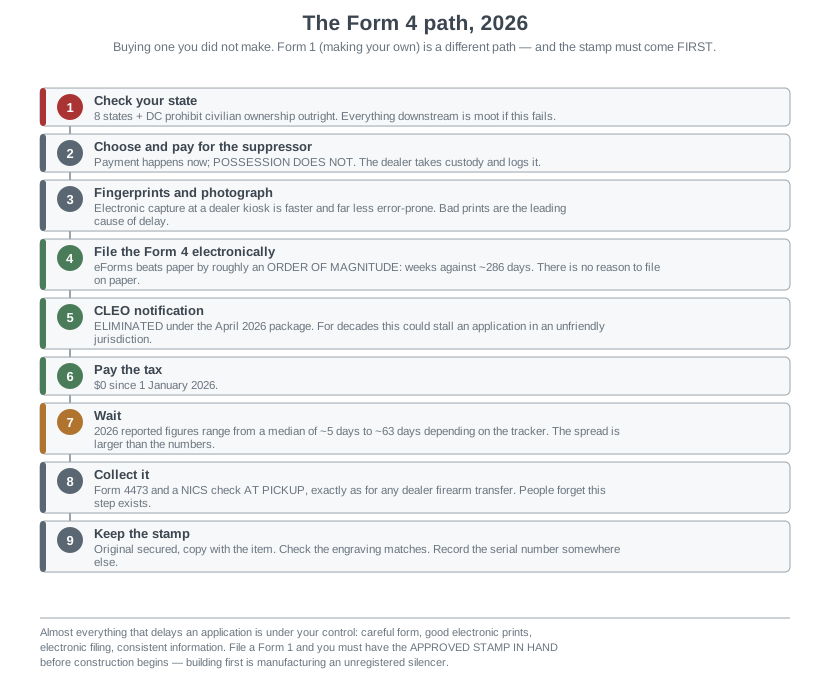
The mechanics, as they stand in mid-2026. This is the volume most likely to be out of date first, because the April 2026 rulemaking package is still partly in progress and because wait times move.
4.1 Form 4 or Form 1
Two paths, and they answer different questions.
Form 4 — transfer. You are buying a suppressor someone else made. This is what essentially everyone does. The dealer holds the item; you file; ATF approves; you collect.
Form 1 — making. You are building one yourself. Legal, and a natural fit for anyone with a lathe. You must have the approved Form 1 in hand before you begin construction. Manufacturing first and filing later is manufacturing an unregistered silencer, which is a federal felony, and it is the single most serious mistake available in this whole subject. A Form 1 build also requires engraving (Volume 8), and — worth saying plainly — you cannot sell what you make: a Form 1 item is made for your own use, not for transfer as a business.
The rest of this volume is the Form 4 path.
4.2 Individual, Trust, or Now Jointly
Individual. Simplest. You file, you are the sole registered possessor. Historically the drawback was that only you could legally possess the item — not your spouse, not a friend at the range unless you were present and it stayed under your control.
Trust. A legal entity owns the item; every named trustee may possess it independently. This solved the spouse problem, the estate problem and the multi-user problem in one instrument. Rule 41F (2016) made it more burdensome by requiring fingerprints, a photograph and a Form 5320.23 from every responsible person, for every item.
Jointly, as spouses. New in the April 2026 package: married couples may jointly register an NFA item on a Form 4.1 This removes the most common single reason people formed a trust.
How to choose in 2026:
Table 1 — How to choose in 2026:
| Situation | Reasonable answer |
|---|---|
| Single buyer, one or two items | Individual |
| Married, wants spouse to be able to possess it | Joint registration — check the current rule status first |
| Several adult users, or a collection | Trust still earns its keep |
| Estate planning matters to you | Trust — it survives you and handles succession cleanly |
A trust is not a tax dodge and never was; it is a possession-and-succession instrument. It also is not a substitute for a will, and a badly drafted one is worse than none. If you go that route, use a lawyer who does NFA trusts, not a $50 template.
4.3 The Steps
- Check your state. Eight states plus DC prohibit civilian possession outright (Volume 7). Everything downstream is moot if this fails.
- Choose and buy the suppressor. Payment happens now; possession does not. The dealer takes custody and logs it.
- Fingerprints and photograph. Traditionally FD-258 cards; now commonly captured electronically at a dealer kiosk, which is faster and less error-prone. Bad prints are a leading cause of rejection and delay.
- File the Form 4 — electronically, via ATF eForms. File electronically. See §4.4.
- CLEO notification — eliminated under the April 2026 package.1 For decades this step existed and could stall an application in an unfriendly jurisdiction.
- Pay the tax. $0 since 1 January 2026 (Volume 3).
- Wait.
- Approval issues, the dealer is notified, and you go and collect it — with a Form 4473 and a NICS check at pickup, exactly as for any firearm transfer from a dealer. People forget this step exists.
- Keep the approved stamp. See §4.6.
4.4 eForms Versus Paper
This is not close, and it is the one piece of process advice in this volume that is unambiguous.
Reported 2026 wait times vary enormously between trackers, which is itself the most useful fact about them:
Table 2 — Reported 2026 wait times vary enormously between trackers, which is itself the most useful fact about them
| Source and date | Reported |
|---|---|
| One tracker, individual eForm 4 | Median ~5 days, range 1–31 |
| Another, as of 2026-05-04 | ~18 days trust, ~4 days individual |
| Another, as of 2026-06-24 | ~25 days trust, ~63 days individual |
| Paper Form 4, last reported | ~286 days |
Sources: Silencer Shop, whereismysuppressor.com, FastBound, Silencer Central.2
The spread between electronic trackers is larger than the numbers themselves, and the individual-versus-trust ordering even reverses between them — which tells you these are samples of different populations at different moments, not a stable measurement. Read them as an order of magnitude and nothing more.
The one robust conclusion: electronic filing beats paper by roughly an order of magnitude. Weeks against most of a year. There is no reason to file on paper.
The other honest caveat: the January 2026 submission surge (Volume 3 §3.3) is still working through the system, so 2026 figures are unusually noisy. Expect variance, and expect your own experience not to match whatever number you read.
4.5 Dealers, Kiosks, and the Mail-Order Model
Local dealer. You handle the item, ask questions, and have a relationship for the next one. Usually a transfer fee. If you want advice from someone who has actually fired the thing, this is where you get it.
Kiosk systems (Silencer Shop’s is the widely deployed one). Fingerprints and photograph captured electronically once, stored, and reused for subsequent purchases. The single biggest reduction in friction available to someone buying more than one suppressor.
Mail-order / national dealers (Silencer Central and similar) ship directly to your door in participating states after approval, handling the paperwork centrally. Convenient; you buy without handling the item.
Renting first. Where a range offers suppressor rentals, use them. Shooting three cans back to back on the same host on the same day is the only decibel comparison that is actually valid (How Suppressors Work, Volume 2), and it costs an afternoon rather than a purchase.
4.6 On Approval
Keep the approved stamp. A copy with the item, the original somewhere safe. Practice varies on whether you must carry proof; the consensus practical advice is to keep a copy — paper or on your phone — wherever the suppressor goes. It costs nothing and answers a question you do not want to have to answer slowly.
Check the engraving against the form. Manufacturer, model and serial number on the can must match what is on the stamp. A mismatch is a paperwork problem you want to find on day one.
Record the serial number somewhere other than on the item, for the theft-report scenario in Volume 8.
4.7 What It Actually Costs in 2026
Table 3 — 4.7 What It Actually Costs in 2026
| Item | 2026 |
|---|---|
| The suppressor | $199 (Lyman Sonicore Skarv 22) to ~$1,500+ (premium precision rifle can) |
| Federal tax | $0 |
| Dealer transfer fee | Typically $50–150, varies |
| Fingerprints / photo | Often included, or nominal |
| Trust, if you want one | $0 (template, not recommended) to several hundred (lawyer) |
| Muzzle threading, if needed | Gunsmith rate — and must be indicated off the bore |
| Mount / booster piston per host | $50–200 |
| Alignment rod | ~$30, and non-optional |
The mounts and pistons are the line item people forget. A can serving three hosts needs three mounts, and that can approach a third of the price of the can.
4.8 What Actually Delays an Application
In rough order:
- Bad fingerprints. Smudged, incomplete, or wrong card format. Electronic capture largely fixes this.
- Inconsistent information between the form, the photograph and the identification.
- Paper filing. See §4.4.
- A trust with many responsible persons, each of whom is a separate background check.
- A background check that requires manual review — anything ambiguous in your record.
- System-wide backlogs, which in 2026 means the January surge.
Almost everything on that list is under your control. Fill the form out carefully, get good prints, file electronically, and most of the variance disappears.
4.9 Bibliography
Footnotes
-
DOJ / ATF, 34 final and proposed rule revisions, announced 2026-04-29 — CLEO notification eliminated; joint spousal registration on a Form 4; reduced trust fingerprint requirements. Status varies by item between final and proposed. SilencerCo, “ATF Announces 34 Rule Revisions.” https://silencerco.com/blog/atf-announces-34-rule-revisions-what-they-mean-for-suppressor-ownership ; Silencer Shop, “ATF Rule Changes 2026.” https://www.silencershop.com/blog/atf-rule-changes-2026 ↩ ↩2
-
Reported 2026 wait times. Silencer Shop, “ATF eForm Wait Times.” https://www.silencershop.com/atf-wait-times ; whereismysuppressor.com, “ATF Form 4 Wait Times 2026 — Full Source Breakdown.” https://whereismysuppressor.com/wait-times ; FastBound, “ATF Form 4 Wait Times.” https://www.fastbound.com/atf-form-4-wait-times/ ; Silencer Central, “NFA Wait Times: Complete Guide 2026.” https://www.silencercentral.com/blog/nfa-wait-times/ ↩
Comments (0)