Suppressor Law · Volume 5
The Litigation — Peterson, Comeaux, and the Post-Tax Challenges
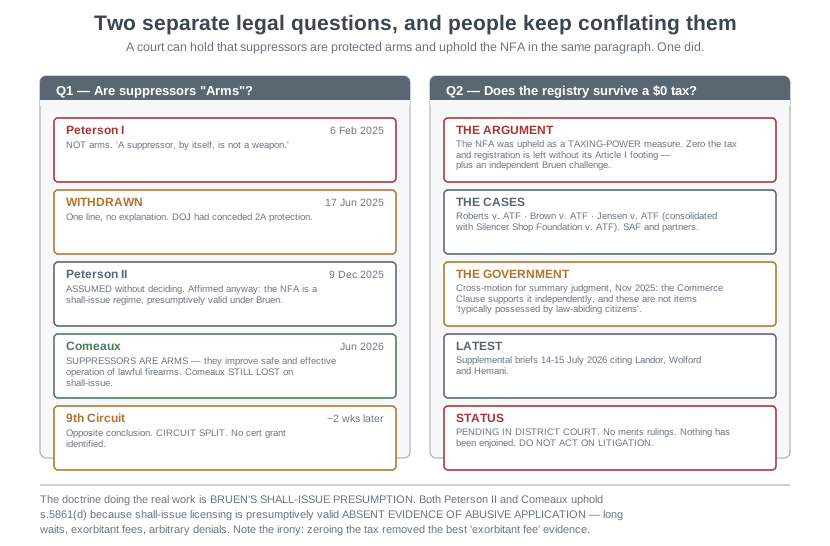
This is the fastest-moving material in the whole category, and the part most likely to be wrong by the time you read it. Everything below is as of 29 July 2026. No merits ruling has issued in the post-tax cases, and no cert grant has been identified.
There are two separate legal questions in play, and conflating them is the most common error in the popular coverage:
- Are suppressors “Arms” protected by the Second Amendment at all?
- With the tax at zero, does the NFA’s registration scheme still have a constitutional footing?
They have different cases, different courts and different answers.
5.1 Question One: Are Suppressors “Arms”?
5.1.1 United States v. Peterson — three different opinions, and people keep citing the wrong one
George Peterson operated a firearms business partly out of his Louisiana home. During a 2022 ATF investigation, a search turned up an unregistered, homemade, unserialised suppressor in a closet safe. He was charged under the NFA, convicted, and sentenced to 24 months. On appeal he argued the NFA’s registration scheme violated the Second Amendment as applied to him.1
Stage 1 — 6 February 2025. A Fifth Circuit panel, in an opinion by Chief Judge Elrod, held that suppressors are not “Arms” within the Second Amendment’s text. The reasoning: to be an “arm,” an object must itself be a weapon, and “a suppressor, by itself, is not a weapon. Without being attached to a firearm, it would not be of much use for self-defense.”2 This was covered widely and treated as a significant adverse ruling.
Stage 2 — 17 June 2025. The opinion was WITHDRAWN. The Fifth Circuit did so with a single line and no explanation: “Pursuant to the court’s directive, the opinion in this case has been withdrawn.”3 Withdrawing a published panel opinion months after issuing it is unusual. Reporting notes that by that point the DOJ had conceded in a supplemental response that suppressors are protected by the Second Amendment — the government declining to defend the panel’s own reasoning.3
🔴 The February 2025 “suppressors are not arms” holding is a withdrawn opinion. It is still quoted constantly, in both directions, by people who did not follow the case past its first week. It is not law.
Stage 3 — 9 December 2025. The revised opinion. The panel reissued and affirmed Peterson’s conviction anyway — but on completely different grounds. It assumed without deciding that the Second Amendment protects suppressors, and held that the NFA’s registration requirement survives because the NFA operates as a “shall-issue” licensing regime, and shall-issue regimes are presumptively constitutional under Bruen.1
That is a much narrower and much more durable holding. It sidesteps the “arms” question entirely and rests on the structure of the regulation: if the government must issue on objective criteria to any qualified applicant, Bruen itself says such schemes are presumptively fine.
5.1.2 United States v. Comeaux — the Fifth Circuit answers the question it dodged
In June 2026, a unanimous Fifth Circuit panel decided United States v. Comeaux, involving another Louisiana defendant charged with possessing an unregistered suppressor — and this time answered the question Peterson had left open.
Held: suppressors ARE Second Amendment “Arms.” The court’s reasoning is the mirror image of the withdrawn Peterson logic: suppressors qualify because they improve the safe and effective operation of firearms used for lawful purposes, they facilitate self-defence, and they make firearms safer and more effective.4
And Comeaux still lost. The panel agreed on the first point and not the second. As the court put it: “Though silencers are Second Amendment ‘Arms,’ because Comeaux has not alleged that the NFA’s shall-issue regime has been put toward abusive ends, he has not shown that § 5861(d) burdens his Second Amendment rights.”4
This is the crucial nuance and it is routinely lost in headlines. Comeaux is a real doctrinal win — a federal appeals court squarely holding that suppressors are constitutionally protected arms. It is not a ruling that the NFA is unconstitutional. The two are compatible: protected arms may still be regulated by a presumptively-valid shall-issue scheme.
5.1.3 The circuit split
Reporting describes the Ninth Circuit reaching the opposite conclusion on the “arms” question within roughly two weeks of Comeaux.5
A genuine circuit split on a constitutional question is the classic predicate for Supreme Court review, and the coverage has been explicit about that possibility.6
🔴 No cert petition grant has been identified as of this writing. A split makes review plausible, not scheduled. Treat “SCOTUS showdown looms” headlines as speculation about a real possibility, not as a calendar entry.
5.2 Question Two: Does the Registry Survive a Zero Tax?
The second and, structurally, larger question, and it exists only because of 1 January 2026.
The argument. The NFA was upheld historically as an exercise of the taxing power (Volume 2). Congress in 1934 taxed these items and required registration as the machinery for administering the tax. Set the tax to $0 for silencers, and — the plaintiffs argue — the registration, background-check and approval requirements are left standing without the enumerated power they were built on, exceeding Congress’s Article I authority. The complaints pair this with an independent Second Amendment argument under Bruen.7
The three cases, all brought by the Second Amendment Foundation and partners:
Table 1 — The three cases, all brought by the Second Amendment Foundation and partners
| Case | Notes |
|---|---|
| Roberts v. ATF | Reported March 2026; the Article I enumerated-powers theory plus a Bruen challenge |
| Brown v. ATF | SAF and partners; same theory |
| Jensen v. ATF | Consolidated with Silencer Shop Foundation v. ATF (Texas) |
Buckeye Firearms Association is among the organisations that joined.8
The government’s answer. DOJ and ATF filed a cross-motion for summary judgment in November 2025, defending the scheme on two grounds: that the Commerce Clause supports the regulation independently of the taxing power, and that the items in question are not “typically possessed by law-abiding citizens for lawful purposes” and so fall outside the Second Amendment’s protection.7
That second argument is worth noting for its awkward position. It is the same “not in common use” framing that Comeaux rejected in June 2026, and it sits uneasily beside the DOJ’s own 2025 concession in Peterson that suppressors are 2A-protected.3 The government’s litigating position across these cases has not been entirely consistent, and the plaintiffs have said so.
Latest procedural step. Supplemental briefs were filed on 14 and 15 July 2026, citing three then-recent Supreme Court decisions — Landor v. Louisiana, Wolford v. Lopez and United States v. Hemani — as narrowing the justifications available to the government for maintaining registration after the tax went to zero.9
Status: pending in district court. No merits rulings identified.
5.3 How to Read All This
Four points that will keep you from being misled by the coverage.
Distinguish “protected arms” from “unconstitutional regulation.” Comeaux held the first. Neither Comeaux nor Peterson held the second. A court can say suppressors are protected arms and in the same paragraph uphold the NFA, and one did.
Watch the “shall-issue” doctrine. It is doing the real work. Both the December 2025 Peterson opinion and Comeaux uphold § 5861(d) because Bruen presumes shall-issue licensing regimes valid absent evidence of abusive application — lengthy wait times, exorbitant fees, arbitrary denials. That is the door Comeaux explicitly left open: a plaintiff who does allege abusive ends may get further. And it is why the wait times in Volume 4 are not merely an inconvenience; they are potential evidence.
The zero tax cuts both ways in litigation. Plaintiffs argue it removed the constitutional footing. But it also removed the “exorbitant fee” that would be the strongest evidence of an abusive shall-issue regime. Congress may have strengthened the government’s Bruen defence in the same act that weakened its taxing-power defence. Nobody planned that; it follows from doing it through reconciliation.
Nothing has changed for you yet. No court has enjoined anything. The registration requirement is fully in force. Do not act on litigation. People who anticipated favourable rulings in other firearms cases and possessed accordingly have gone to prison for it. Peterson got 24 months for an unregistered can, and every court that has looked at his case has affirmed that conviction.
5.4 Bibliography
Footnotes
-
United States v. Peterson, No. 24-30043 (5th Cir.), revised opinion 9 December 2025 — assuming without deciding that the Second Amendment protects suppressors, affirming because the NFA’s shall-issue licensing regime is presumptively constitutional under New York State Rifle & Pistol Ass’n v. Bruen. Opinion: https://www.ca5.uscourts.gov/opinions/pub/24/24-30043-CR2.pdf ; https://law.justia.com/cases/federal/appellate-courts/ca5/24-30043/24-30043-2025-12-10.html ↩ ↩2
-
United States v. Peterson, panel opinion of 6 February 2025 (Elrod, C.J.) — suppressors not “Arms”; withdrawn. Reason/Volokh, “Second Amendment Roundup: 5th Circuit holds suppressors not to be protected ‘arms.’” https://reason.com/volokh/2025/02/17/second-amendment-roundup-5th-circuit-holds-suppressors-not-to-be-protected-arms/ ↩
-
Withdrawal, 17 June 2025. Firearms Policy Coalition, “Fifth Circuit Withdraws Flawed Suppressor Decision.” https://www.firearmspolicy.org/fifth-circuit-withdraws-flawed-suppressor-decision-in-fpc-backed-challenge-to-nfa ; NRA-ILA, 2025-06-23. https://www.nraila.org/articles/20250623/us-court-of-appeals-backtracks-on-adverse-suppressor-ruling ; The Truth About Guns, “5th Circuit Withdraws Decision In Suppressor Challenge.” https://www.thetruthaboutguns.com/5th-circuit-suppressor-ruling-withdrawn-us-v-peterson/ ↩ ↩2 ↩3
-
United States v. Comeaux (5th Cir., June 2026) — suppressors are protected “Arms”; conviction nonetheless affirmed on shall-issue grounds. Guns.com, 2026-06-21. https://www.guns.com/news/2026/06/21/federal-court-suppressors-are-arms-cueing-up-supreme-court-to-decide-split ; The Reload, “Fifth Circuit Panel Rules Silencers are Protected Arms, Can Still be Regulated.” https://thereload.com/fifth-circuit-panel-rules-silencers-are-protected-arms-can-still-be-regulated/ ; Texas Scorecard. https://texasscorecard.com/federal/fifth-circuit-rules-suppressors-are-protected-by-second-amendment/ ↩ ↩2
-
USA Carry, “Two Federal Courts, Two Weeks Apart, Split on Whether Silencers Are Protected Arms.” https://www.usacarry.com/two-federal-courts-two-weeks-apart-split-on-whether-silencers-are-protected-arms/ ↩
-
Daily Caller News Foundation, 2026-06-19, “SCOTUS Showdown Over Gun Suppressors Looms After Appeals Court Creates ‘Circuit Split.’” https://dailycallernewsfoundation.org/2026/06/19/scotus-showdown-over-gun-suppressors-looms-after-appeals-court-creates-circuit-split/ ↩
-
Roberts v. ATF, Brown v. ATF, Jensen v. ATF (consolidated with Silencer Shop Foundation v. ATF); DOJ/ATF cross-motion for summary judgment, November 2025, on Commerce Clause and “not typically possessed” grounds. Ammoland, “Roberts v. ATF Challenges Post-Tax NFA Registration Scheme in Federal Court,” 2026-03. https://www.ammoland.com/2026/03/roberts-v-atf-challenges-post-tax-nfa-registration-scheme-in-federal-court/ ; “Three NFA Lawsuits Put SBR & Suppressor Registry on Path to Supreme Court,” 2026-04. https://www.ammoland.com/2026/04/three-nfa-lawsuits-sbr-suppressor-registry-supreme-court/ ↩ ↩2
-
Buckeye Firearms Association, “BFA joins federal lawsuit challenging ATF tax stamp requirement on suppressors, short-barreled rifles.” https://www.buckeyefirearms.org/bfa-joins-federal-lawsuit-challenging-atf-tax-stamp-requirement-suppressors-sbrs ↩
-
Supplemental briefs filed 14–15 July 2026 citing Landor v. Louisiana, Wolford v. Lopez and United States v. Hemani. Ammoland, “No Tax, No Excuse: NFA Suppressor and SBR Registry Gun Rights Next Target,” 2026-07. https://www.ammoland.com/2026/07/no-tax-no-excuse-nfa-suppressor-and-sbr-registry-gun-rights-next-target/ ↩
Comments (0)