FP-45 Liberator — Repros & DIY · Volume 8
Sourcing, Cost & Cheatsheet
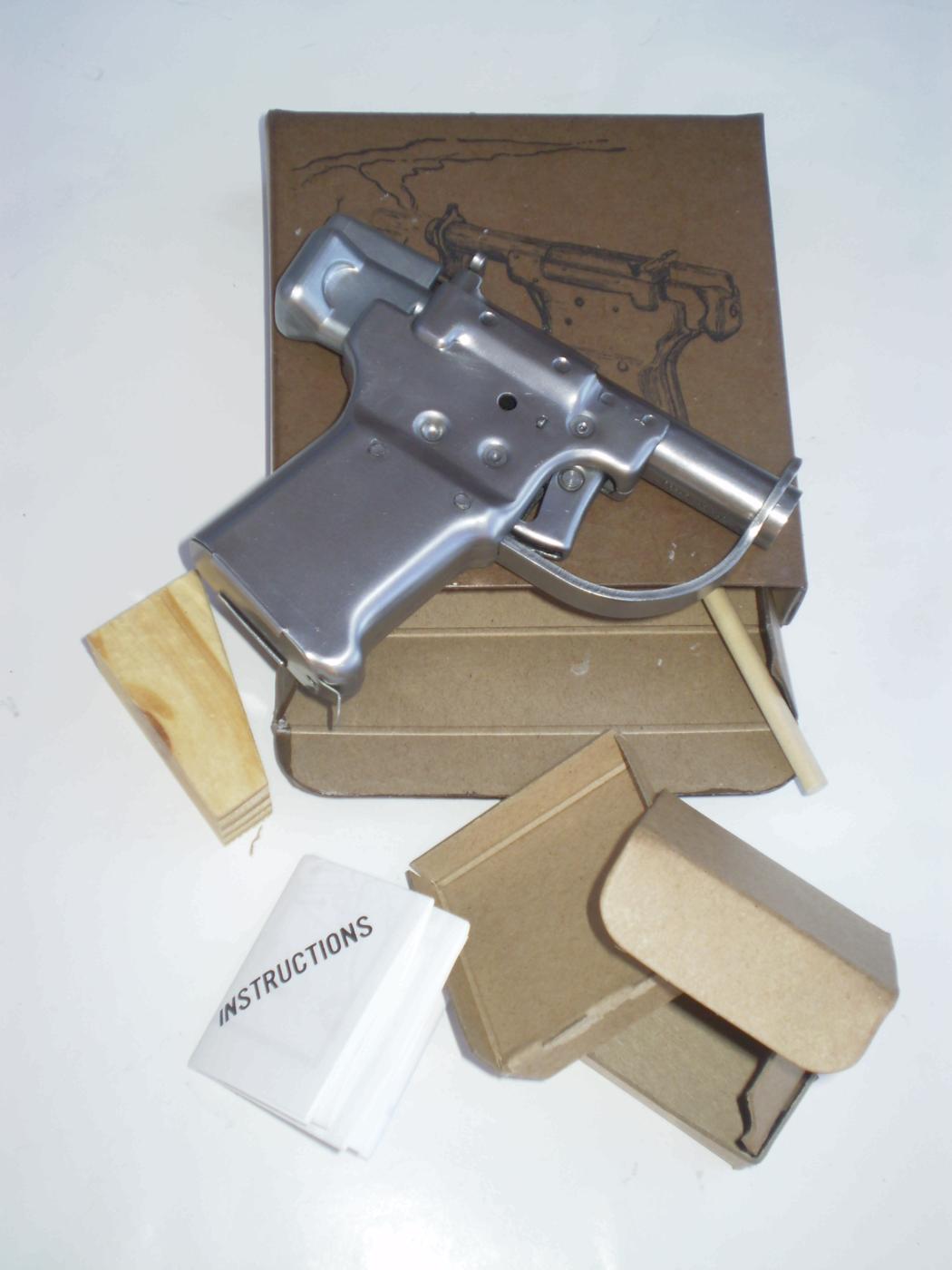
The build is designed (Volume 6), the drawings are in CAD (Volume 7), and the legal path is chosen (Volume 4). This last volume is the practical layer: what to source and from where, what it costs to build versus buy, which path suits which goal, and a laminate-ready synthesis of the whole series with the real source URLs collected in one place. It is deliberately honest about the one thing a Liberator build has going against it economically — the buy option is cheap.
8.1 What to Source
For the rifled lab build (the recommended path), the shopping list is short because the gun is simple and most of it is fabricated in-house.
Table 1 — What to Source
| Item | Make or buy | Notes |
|---|---|---|
| Rifled .45 barrel blank | Buy | The legally load-bearing part (Volume 4) and its own project to rifle. Buy a real-rifled .45 blank, ~1:16″ twist. UNVERIFIED: no specific vendor confirmed in research — use established barrel supplier channels; do not order against an invented name. |
| Steel stock (4140 or 1050 plate/bar/tube) | Buy | 3/16–1/4″ plate for milled cover slide/tube strap (B1); DOM/C.R.S. tube for the tube path (B3); thin mild sheet for laser-cut cosmetic parts (B2). |
| Music wire (assorted gauges) | Buy | Yoke spring, lock spring (Volume 6/7). Cheap; buy a range and wind to the drawing, upgrading gauge for reliable ignition. |
| Striker / small steel stock | Buy | Cold-drawn wire/bar for the Control Rod; case-harden or nitride the tip. |
| Fasteners / rivets / pins | Buy | Simple turned/wire fasteners per the drawings, or upgrade to screws/pins for a serviceable one-off. |
| Chamber reamer (.45 ACP finish) | Buy / on hand | Standard finish reamer; set headspace to the case mouth (Volume 6). |
| Heat-treat / finishing consumables | On hand | Quench/temper media, bluing or parkerizing supplies (below). |
| CAD reference STL | Free | Thingiverse/Cults3D display model for gross-shape checks only (Volume 3) — never a firing file. |
Everything else — the cover slide, tube strap, grips, snap cover, trigger guard, cam, and fixtures — is made in the shop on the mill, laser, and printers. The only thing you truly must buy for legality and sanity is the rifled barrel blank.
8.2 Buy vs Build — the Cost Reality
Here is the uncomfortable arithmetic, stated plainly. A Vintage Ordnance Model 3 reproduction costs $598–$775 (Volume 2), ships as an ordinary FFL-transfer pistol, is built better than the original in 1050 steel with a tight chamber, and requires none of your shop time.12 A scratch build’s material cost is low — a rifled blank, some steel stock, springs, and consumables likely land well under the price of the reproduction — but the labor is the real cost, and it is substantial: CAD from the drawings, milling the breech parts, laser-cutting and forming the shell, cutting and heat-treating, chambering and headspacing, spring winding, fitting, finishing, and remote proof-testing.
Table 2 — Buy vs Build — the Cost Reality
| Vintage Ordnance (buy) | Scratch lab build | |
|---|---|---|
| Out-of-pocket (approx) | $598–$775 | Materials likely < the buy price; labor is the dominant cost |
| Shop time | None | Significant (CAD, mill, laser, chamber, heat-treat, finish, proof) |
| Legal | Ordinary FFL transfer; no paperwork you file | Rifled = ordinary pistol, no federal paperwork (personal use); smoothbore = Form 1 first (Volume 4) |
| Result | Proven, better-than-original firing repro | Exactly the gun you designed; the satisfaction and knowledge are the point |
| Service life | Better than original, still unlocked-breech | As good as you build the breech; still low-round by architecture |
So why build? Not to save money — you won’t. You build for the reasons in Volume 1: the project itself, complete command of a firearm you can fully understand, the drawings-to-CAD-to-chips craft, and a gun that is yours to the last dimension. If the goal is simply to own a firing Liberator with least effort, buy the Vintage Ordnance. If the goal is to make one, the rest of this series is the path.
8.3 Decision Matrix
Table 3 — Decision Matrix
| Your goal | Recommended path | Volume |
|---|---|---|
| A Liberator on the shelf, cheapest | Non-firing resin (IMA-USA) or dummy (Horse Soldier) | 3 |
| A film/theatrical prop | Non-firing resin, 1:1, correct weight | 3 |
| A firing Liberator, least effort | Buy Vintage Ordnance Model 3 | 2 |
| A firing Liberator you built, legally simplest | Scratch build, rifled bore (ordinary pistol) | 4–7 |
| A screen/historically accurate smoothbore you built | Scratch build, smoothbore — approved Form 1 first | 4–7 |
| To understand the mechanism | Cutaway study model (if findable) + the factory drawings | 3, 7 |
| Building copies to sell | Requires a manufacturer’s (Type 07) FFL | 4 |
8.4 The Laminate-Ready Synthesis
The whole series in one panel:
- The Liberator is a stamped-steel, single-shot, smoothbore .45 ACP — trivial mechanically, rich historically, ideal as a one-off shop project. (Vol 1)
- The legal fork is the bore. Smoothbore concealable pistol = AOW, needs an approved Form 1 before manufacture (tax now $0 since 2026-01-01, but the registration and approval are unchanged). Rifled bore = ordinary Title I pistol, no federal paperwork for personal use. 26 U.S.C. § 5845(e). Confirm your state’s self-made-firearm rules. (Vol 4)
- One firing reproduction is made commercially: Vintage Ordnance, $598–$775, rifled, ships as an ordinary FFL pistol. No other firing maker exists. (Vol 2)
- The non-firing market is larger: resin (IMA-USA), dummy (Horse Soldier), 3D-printed props (Thingiverse) — display only, not build files. (Vol 3)
- Don’t reproduce the original stamping method — it only made sense at a million units. Take the geometry, not the dies. (Vol 5)
- Lab build: mill the breech parts (B1) / laser+brake the shell (B2) / tube breech (B3); 4140 heat-treated; buy a rifled .45 blank; cut a straight, correctly case-mouth-headspaced .45 ACP chamber; the “sear” is a flat cam (dwg 13114), the striker a spring pin (13120). .45 ACP SAAMI max avg 21,000 psi against an unlocked breech — the breech joint is the single most safety-critical dimension; proof-test remotely; expect a low-round-count gun. (Vol 6)
- Real blueprints exist and beat any patent — the Inland factory drawings (dwg 13108–13133+), Hagan reproduction, at survivorlibrary.com. No FP-45 patent exists (Hyde’s patents are the Grease Gun/rifle, not this). (Vol 7)
- Buy is cheaper; build is the point. (Vol 8)
8.4.1 Source URLs
- Statute — 26 U.S.C. § 5845(e): https://www.law.cornell.edu/uscode/text/26/5845
- ATF Form 1: https://www.atf.gov/firearms/docs/form/form-1-application-make-and-register-firearm-atf-form-53201
- $0 NFA tax (H.R. 1, 2026): https://www.ammoland.com/2026/01/nfa-tax-stamp-is-dead-suppressors-and-sbrs-have-a-0-tax-stamp/
- Vintage Ordnance Model 3: https://vintageordnance.com/product/wwii-fp-45-liberator-pistol-reproduction-standard-model-model-3-3/
- Vintage Ordnance, firing the original (failure data): https://vintageordnance.com/firing-the-original-fp-45-liberator-pistol/
- IMA-USA resin display: https://www.ima-usa.com/products/u-s-wwii-fp-45-liberator-resin-display-pistol
- Horse Soldier dummy: https://www.horsesoldier.com/products/firearms/handguns/10344
- Thingiverse prop: https://www.thingiverse.com/thing:3060548
- Inland factory blueprints (Hagan): https://www.survivorlibrary.com/library/liberator_pistol_blueprints.pdf
- .45 ACP pressure: https://en.wikipedia.org/wiki/.45_ACP
- FP-45 history: https://en.wikipedia.org/wiki/FP-45_Liberator
- Hub legal-ethics rules: the hub’s legal-posture notes
- Original-firearm dive:
/actual-firearms/pistols/fp-45-liberator/
That is the whole build, from why to how to how-much. Rifle the bore, respect the breech, buy the blank, cut it tight, prove it remotely — and you will have made, from 1942 factory drawings on modern machines, the simplest service pistol the United States ever fielded.
8.5 Bibliography
Footnotes
-
WWII FP-45 Liberator Pistol Reproduction, Standard Model 3. Vintage Ordnance Company. https://vintageordnance.com/product/wwii-fp-45-liberator-pistol-reproduction-standard-model-model-3-3/ — $598–$713. ↩
-
WWII FP-45 Liberator with Threaded Barrel. Vintage Ordnance Company. https://vintageordnance.com/product/wwii-fp-45-liberator-pistol-with-threaded-barrel-standard-model-3/ — $615–$775, rifled-barrel compliance. ↩
Comments (0)