FP-45 Liberator — Repros & DIY · Volume 1
Overview & the Reproduction Landscape
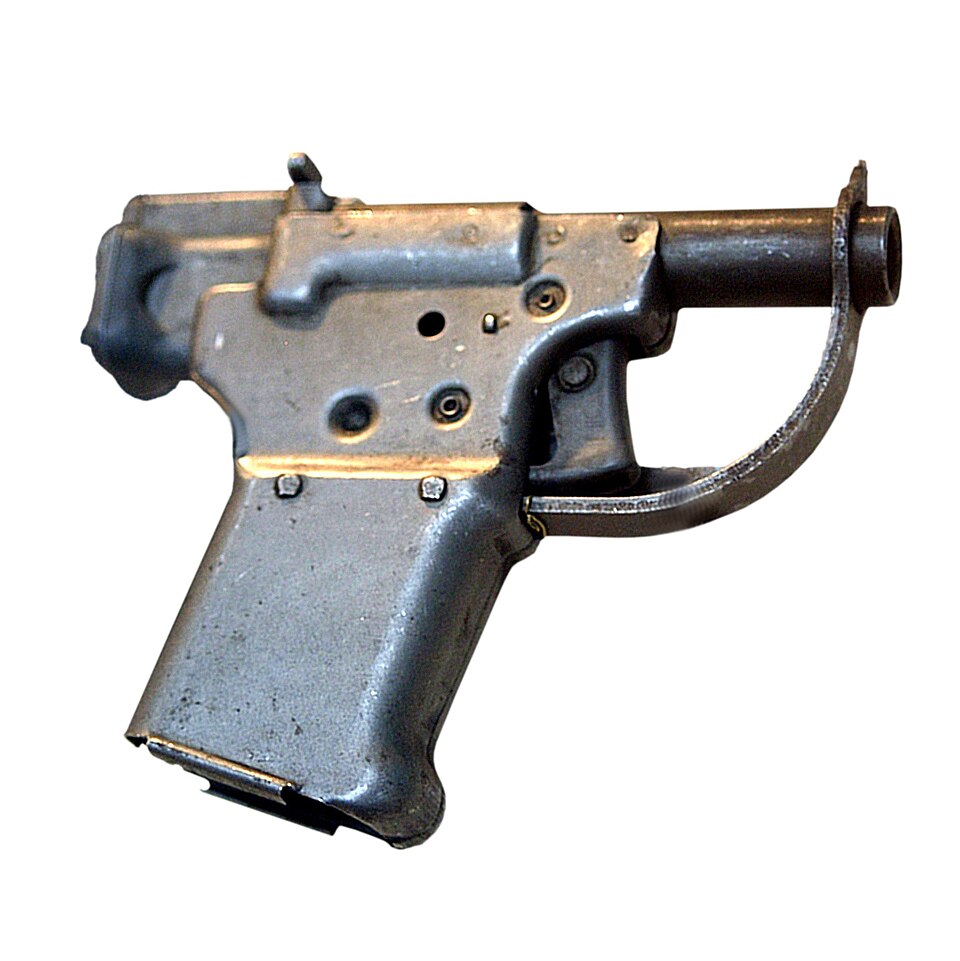
The FP-45 Liberator is the most primitive service pistol the United States ever fielded, and that is exactly why people keep rebuilding it. A stamped-steel single-shot chambered in .45 ACP, made from roughly 23 parts at a unit cost of about $2.10 and dropped by the million into occupied Europe in 1942, it was designed to be fired a handful of times and then thrown away in favor of whatever the user could take from a dead enemy.1 It is not a good gun. It is a fascinating one — a piece of industrial-design folklore compressed into something you can hold in a fist — and for a builder with a real shop it is close to the ideal weekend firearms project: mechanically trivial, historically rich, and small enough to hold every dimension on a single mill setup. This series is about reproducing it, and it is written for a machinist, not a browser. This first volume maps the whole landscape — why anyone bothers, the firing-versus-non-firing split that divides every replica ever made, and the one legal fork that decides how you build before you cut a single chip.
This is a companion to the original-firearm deep dive at /actual-firearms/pistols/fp-45-liberator/; that dive covers the wartime history and the OSS distribution story in full. Here the subject is the copy — bought, cast, printed, or machined.
1.1 Why People Build or Buy These
The FP-45 has an appeal out of all proportion to its capability, and the reasons sort into a few clean buckets.
History in the hand. Original wartime guns are genuine antiques now, expensive, fragile, and — because they were built to fire ten rounds and be discarded — mostly unsafe to shoot. A reproduction lets a collector handle, display, and (in the firing case) actually experience a Liberator without destroying a piece of history or spending original-gun money.
The build itself. For a maker, the Liberator is the rare firearm you can fully comprehend. There is no locked breech, no gas system, no magazine, no fire-control group worth the name — just a barrel, a sheet-metal receiver shell, a spring-driven striker, and a cam that releases it. Every part is on the surviving factory drawings (Volume 7), every dimension translates cleanly to CAD, and the whole thing fits in a lunchbox. It is a machinist’s history lesson.
Film, theatrical, and display use. Prop houses, museums, and reenactors want the look without the liability of a functional firearm, which is why the non-firing market (Volume 3) is larger and more varied than the firing one.
The legal puzzle as its own draw. The Liberator sits on a genuinely interesting statutory edge — a smoothbore concealable pistol that federal law treats very differently from an ordinary handgun. For builders who enjoy getting the paperwork exactly right, that edge is part of the attraction.
1.2 The Firing vs Non-Firing Split
Every Liberator replica in existence falls on one side of a hard line, and which side you want determines everything else — vendor, price, materials, and legality.
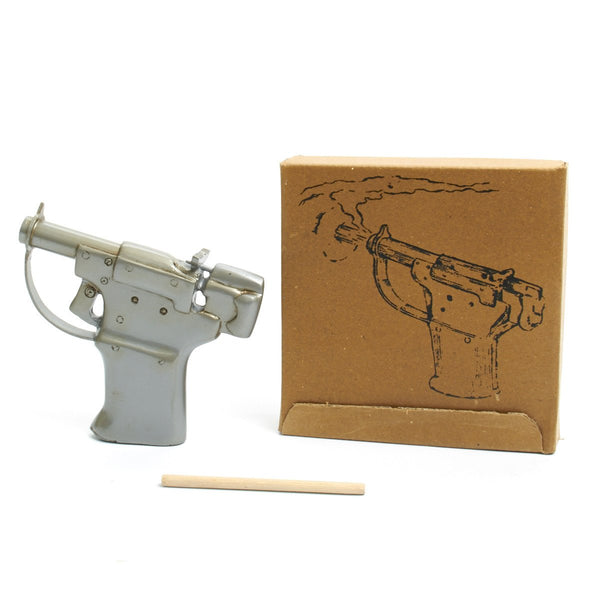
Non-firing replicas are display objects: cast resin, machined dummies, or 3D-printed props that physically cannot chamber and fire a cartridge. Under federal law they are not firearms at all.1 They are cheap, widely available, and perfect for a shelf, a film set, or a CAD-reference object. They are also, definitionally, not a gun — the chamber is blocked or undersized, there is no functioning striker, and often there is no real bore. Volume 3 covers the real vendors and what each is good for.
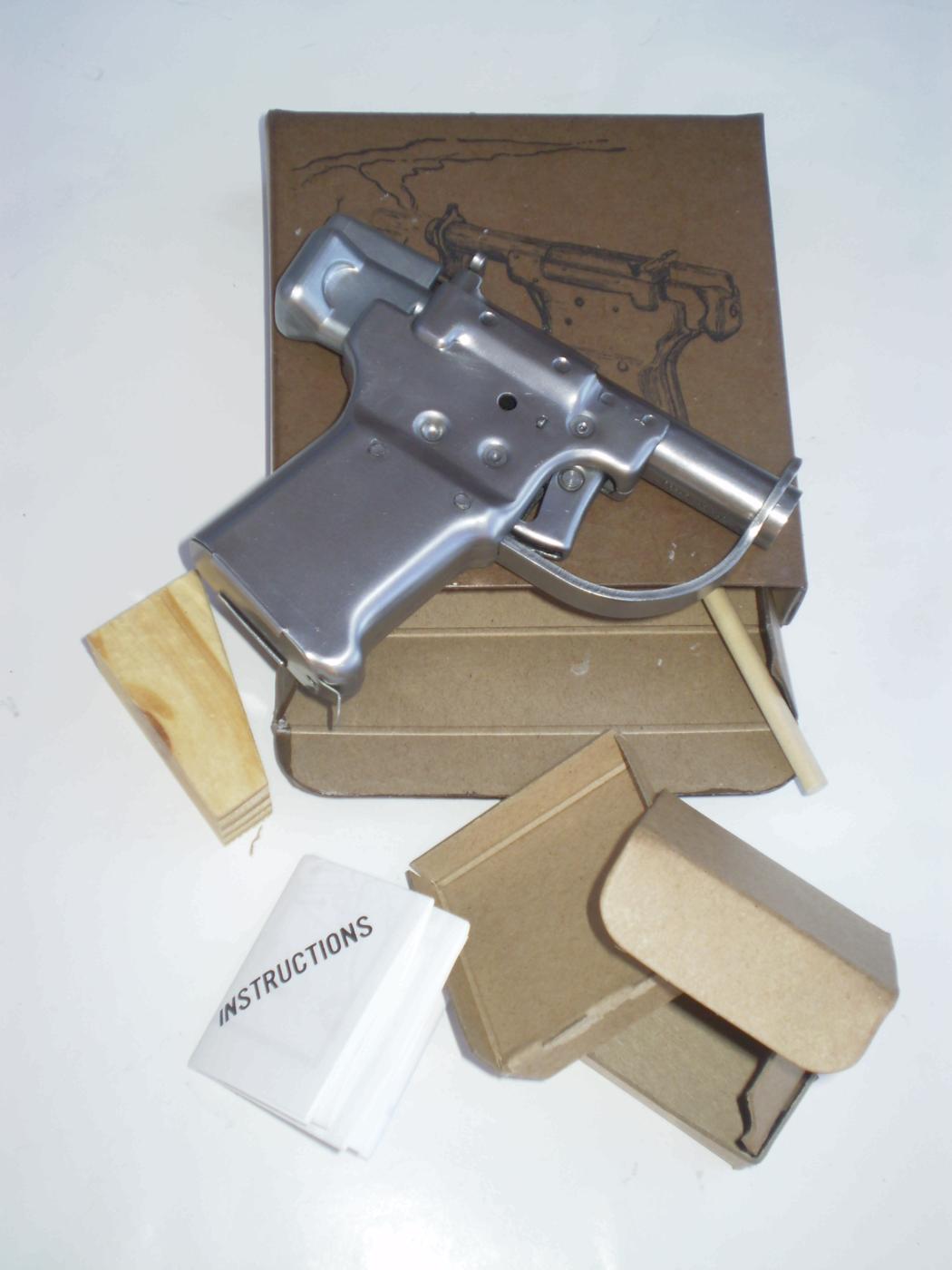
Firing reproductions actually chamber and discharge a .45 ACP round. This is a much smaller world. After extensive searching across auction houses, forums, and the gun press, exactly one current commercial maker of a functional firing FP-45 reproduction could be confirmed: Vintage Ordnance Company, LLC of Elizabethtown, Kentucky.23 Everything else on the firing side is a one-off hobbyist build. Volume 2 covers Vintage Ordnance in detail; Volumes 5 through 8 cover building your own.
Table 1 — The Firing vs Non-Firing Split
| Attribute | Non-firing replica | Firing reproduction |
|---|---|---|
| Is it a firearm (federal)? | No | Yes |
| Typical materials | Resin, zinc, PLA/nylon | Steel, machined and heat-treatable |
| Commercial makers found | Several (resin, dummy, printed) | One (Vintage Ordnance) |
| Price range (approx) | ~$30 to ~$500 | ~$598 to ~$775 |
| Good for | Display, film, CAD reference | Shooting, authentic study, the build itself |
| Legal fork applies? | No | Yes — see below |
1.3 The Rifled-Barrel Legal Fork, Stated Up Front
This is the single most important fact in the entire series, and it belongs here on page one because it dictates the design before any other decision.
Federal law defines a category of NFA-regulated weapon called an “any other weapon” (AOW) — a catch-all that includes concealable pistols firing through a smooth bore. But 26 U.S.C. § 5845(e) contains a critical carve-out: the AOW definition “shall not include a pistol or a revolver having a rifled bore.”4 The original 1942 FP-45 had a 4-inch smoothbore barrel.1 That single fact is what makes the Liberator legally unusual: a faithful, smoothbore home-built copy is almost certainly an AOW, which requires an ATF Form 1 approved before you make it; a copy with an actual rifled bore is an ordinary Title I pistol with no NFA paperwork at all.
You do not have to take this on theory. Vintage Ordnance built its commercial reproduction with a rifled barrel for exactly this reason, and says so in its own product copy: “Our reproduction has a rifled barrel and discrete markings to comply with Federal law.”5 Two unrelated hobbyist builders — a Hackaday sheet-metal-pistol project and the “Have Blue” 3D-printed clone — independently rifled their barrels for the same stated purpose of staying out of AOW territory.67 Three unrelated parties converged on the same reading of the statute. That is the fork:
- Rifle the bore → ordinary pistol → build it in your own shop, no federal paperwork (subject to state law — Volume 4).
- Smoothbore, for screen or historical accuracy → AOW → file and get an approved Form 1 first, and only then make it.
One 2026 update matters and is easy to get wrong: the NFA making tax for AOWs dropped to $0 on January 1, 2026 under H.R. 1.8 The tax stamp payment is gone — but the Form 1, the background check, the fingerprints and photo, and above all the requirement that approval come before manufacture, are all unchanged. The registration is not the tax. Say both halves out loud: no more $200, still a real approval-before-you-build process. Volume 4 walks the whole legal posture; the rest of this note is not legal advice, and the hub’s legal-posture notes applies first.
1.4 The Decision Tree
Putting it together, the whole series funnels into one branching decision:
- Do you want it to fire?
- No → non-firing replica. Buy resin (IMA-USA), a dummy (Horse Soldier), or print one. Done. (Volume 3.)
- Yes → continue.
- Buy or build?
- Buy → Vintage Ordnance, the one confirmed firing maker, ~$598–$775, ships as an ordinary FFL-transfer pistol. (Volume 2, cost comparison in Volume 8.)
- Build → continue.
- Rifled or smoothbore?
- Rifled bore → ordinary Title I pistol → machine it, no federal paperwork. This is the recommended path. (Volumes 4–8.)
- Smoothbore (historical/screen accuracy) → AOW → approved Form 1 first, then build. (Volume 4.)
For a builder with a well-equipped shop, the center of gravity is the rifled-bore lab build — a Title I pistol machined from scratch with a purchased rifled .45 barrel blank. It is legal to make for personal use with no federal paperwork, it is well within the shop’s capability, and it sidesteps both the AOW process and the original’s dismal 27-to-35-round service life (Volume 2). Volumes 5 and 6 are the heart of the series and get first-class, machinist-depth treatment; Volume 7 walks the genuine Inland factory drawings that make it possible.
1.5 What the Rest of This Series Covers
Volume 2 is the one firing reproduction that actually exists — Vintage Ordnance in full, and what to inspect on a used one. Volume 3 is the non-firing and display market — resin, dummies, and 3D prints, real vendors and prices. Volume 4 is the legal posture for a DIY build, placed deliberately before the build volumes because it determines the design. Volume 5 is the original stamping method and why you will not use it. Volume 6 is the lab build — the centerpiece, full machinist treatment. Volume 7 walks the surviving Inland factory blueprints. Volume 8 is sourcing, cost, buy-versus-build, and a laminate-ready cheatsheet. Figures that are derived or uncertain are labeled typical/approx in the text.
1.6 Bibliography
Footnotes
-
FP-45 Liberator. Wikipedia. https://en.wikipedia.org/wiki/FP-45_Liberator — manufacturing history, ~23-part construction, $2.10 unit cost, 4-inch smoothbore, AOW/C&R status. ↩ ↩2 ↩3
-
WWII FP-45 Liberator Pistol Reproduction, Standard Model 3. Vintage Ordnance Company, LLC. https://vintageordnance.com/product/wwii-fp-45-liberator-pistol-reproduction-standard-model-model-3-3/ ↩
-
No other firing FP-45 reproduction maker found across Colt Forum, AmmoLand, The Firearm Blog, GunBroker, and Guns International listings. Representative: https://www.thefirearmblog.com/blog/2010/05/11/vintage-ordnance-fp-45-liberator-pistol/ ↩
-
26 U.S.C. § 5845(e), definition of “any other weapon.” Cornell Legal Information Institute. https://www.law.cornell.edu/uscode/text/26/5845 ↩
-
WWII FP-45 Liberator Pistol with Threaded Barrel, Standard Model 3. Vintage Ordnance Company, LLC. https://vintageordnance.com/product/wwii-fp-45-liberator-pistol-with-threaded-barrel-standard-model-3/ — “Our reproduction has a rifled barrel and discrete markings to comply with Federal law.” ↩
-
Building a Sheet Metal Pistol. Hackaday, 2016. https://hackaday.com/2016/02/17/building-a-sheet-metal-pistol/ — rifled-bore vs AOW legal discussion, in-house rifling. ↩
-
Gunsmithing with a 3D Printer, Part 5. haveblue.org. https://haveblue.org/?p=1631 — 3D-printed Liberator homage, rifling added to avoid NFA registration. ↩
-
NFA Tax Stamp Is Dead: Suppressors and SBRs Have a $0 Tax Stamp. AmmoLand, January 2026. https://www.ammoland.com/2026/01/nfa-tax-stamp-is-dead-suppressors-and-sbrs-have-a-0-tax-stamp/ — H.R. 1 dropped the AOW making tax to $0 effective 2026-01-01; Form 1 approval still required. ↩
Comments (0)