FP-45 Liberator — Repros & DIY · Volume 2
Firing Reproductions
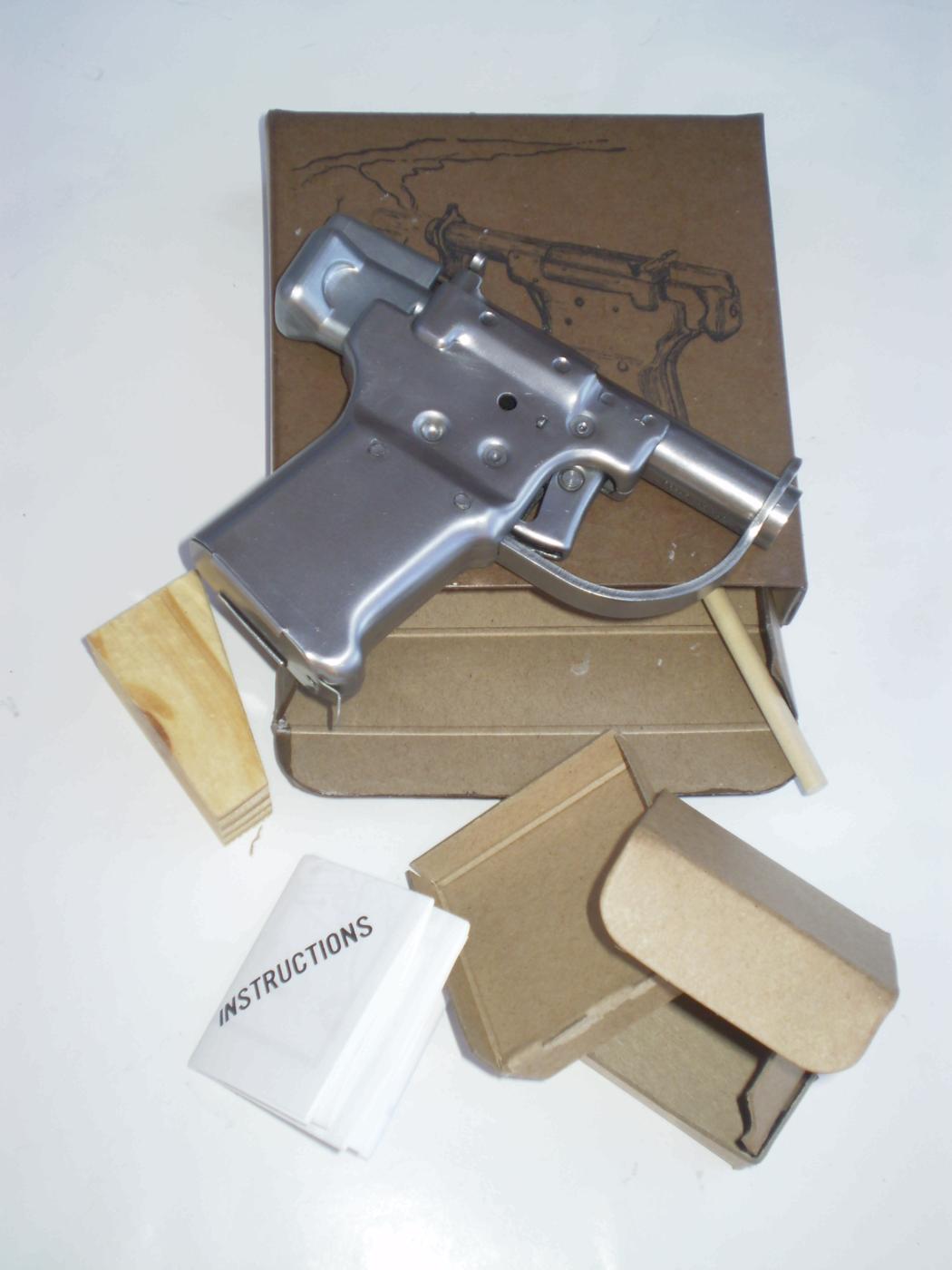
If you want a Liberator you can actually load and fire and you would rather buy it than build it, the market is exactly one company deep. This volume is about Vintage Ordnance Company, LLC — what they make, how it differs from the wartime original, why it ships as an ordinary pistol and not an NFA weapon, what it costs, and what to look for on a used example. It also documents, honestly, that despite a wide search no second commercial firing-reproduction maker could be found, so a buyer’s practical choices are Vintage Ordnance, a used Vintage Ordnance, or a scratch build.
2.1 Vintage Ordnance Company — the One Confirmed Maker
Vintage Ordnance describes itself as specializing in “exhibit grade historic arms & replicas, museum & movie consulting.”1 The relevant credential for a firing reproduction is regulatory: the company holds a Federal Firearms License and a Class 7 (Type 07) manufacturer’s license and states it manufactures entirely in the United States.2 That Type-07 license is precisely what federal law requires to make firearms for sale — a real-world confirmation of the manufacturing-FFL rule that Volume 4 explains for anyone considering building copies to sell rather than to keep.
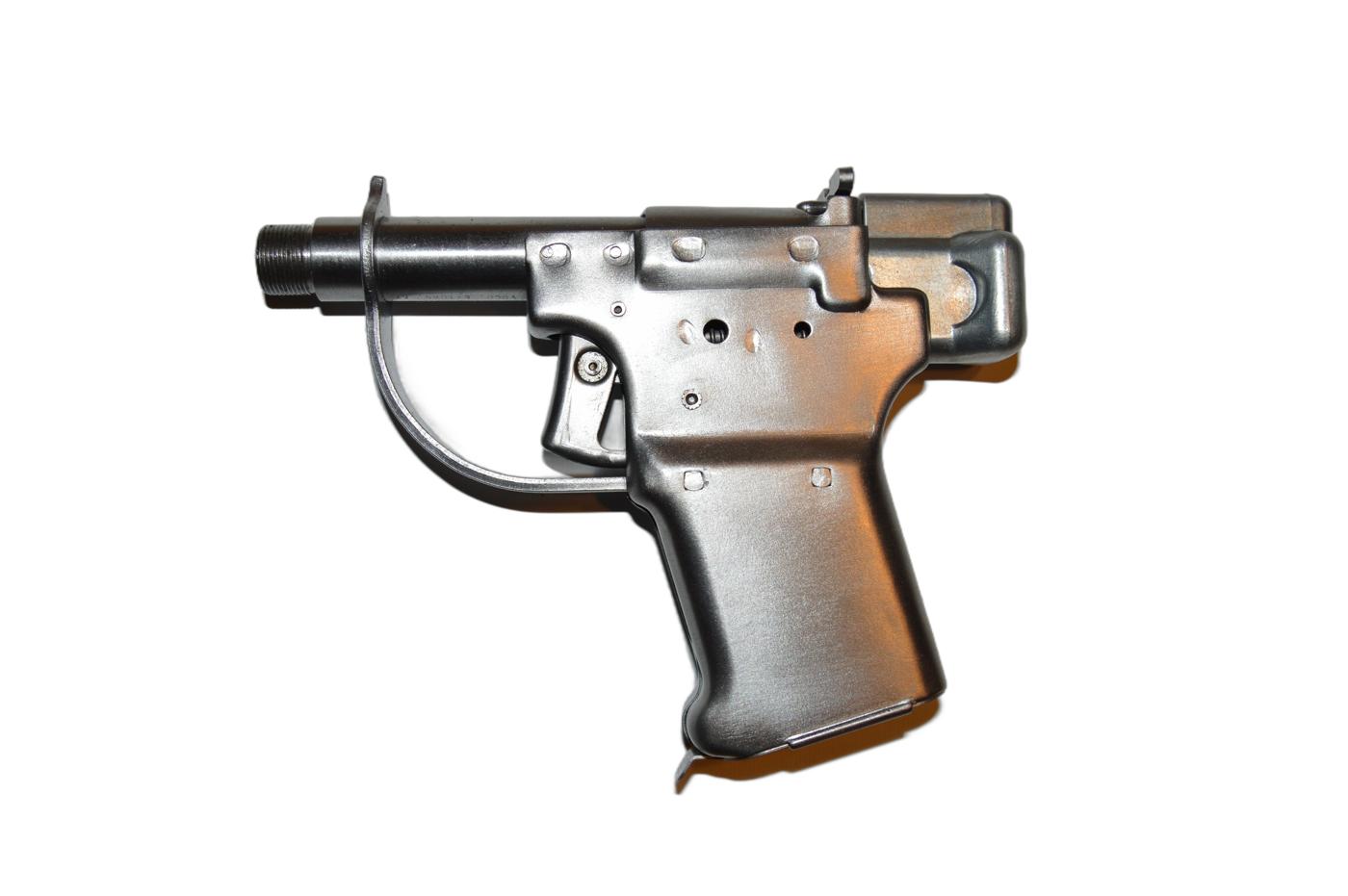
The product is the Standard Model 3 FP-45 reproduction: a single-shot .45 ACP pistol built to look like a wartime Liberator but engineered to be safer and more durable than one. A threaded-barrel Model 3 variant, with a barrel about 3/4 inch longer than standard, is also cataloged.3
2.1.1 The rifled barrel — the whole legal story in one design choice
The defining feature is the barrel, and it is the reason this pistol can be sold like any other handgun. The reproduction has a rifled bore, where the original had a 4-inch smoothbore. Vintage Ordnance states the reason in its own product copy:
“Our reproduction has a rifled barrel and discrete markings to comply with Federal law and hopefully prevent it from being unscrupulously sold as an original antique.”3
That rifled bore is what pulls the reproduction out of the AOW category under 26 U.S.C. § 5845(e)‘s rifled-bore exclusion (Volume 1, Volume 4). Because it is legally an ordinary Title I pistol, the product listing is marked “FFL NEEDED” — meaning a standard dealer-to-buyer FFL transfer, not an NFA Form 4 transfer.4 There is no tax stamp, no NFA registration, and no wait beyond a normal 4473. This is the commercial embodiment of the rifled-bore fork: the company chose rifling specifically so the gun could ship as a plain pistol.
2.1.2 Materials and construction — better than the original on purpose
Vintage Ordnance did not copy the original’s metallurgy, because the original’s metallurgy is why it failed after a few dozen rounds. The reproduction upgrades the key parts:4
- Barrel, tube strap, and cover slide are made from 1050 medium-carbon cold-rolled steel — a meaningful step up from the original’s low-carbon sheet steel.
- The cocking piece is a zinc alloy described as denser than the original’s.
- Chamber tolerances are tightened relative to the original’s notoriously loose, taper-reamed chamber.
Markings are deliberate and legally motivated: a serial number on the front of the grip frame, and company info, model, and caliber marked on the underside of the barrel behind the trigger guard, all characters a minimum of 1/16 inch high.4 The serial and markings both satisfy the manufacturer’s obligations and make the reproduction hard to pass off as an original antique.
2.1.3 Price and availability
Pricing, taken directly from the current product pages:43
Table 1 — Price and availability
| Variant | Price (approx) | Status (as of 2026-07) |
|---|---|---|
| Standard Model 3 | $598–$713 (varies by packaging: pistol alone vs box set) | Limited quantity |
| Threaded-barrel Model 3 | $615–$775 (barrel ~3/4” longer) | Special order / backorder |
For provenance, older secondary sources (a 2010 AmmoLand piece) cite an earlier price point around $599.50–$599.90 and a $650 custom-order Model 1 — read these as historical, superseded figures.2 Separately, the Blue Book of Gun Values estimates roughly $440 as an aftermarket/used value for an unfired reproduction.5 Production is a limited run — “1,000 pieces” is cited as the total — so availability is genuinely constrained and a buyer may face a backorder.4
Vintage Ordnance also sells two non-gun items in the same family: a packaging reproduction (box and instructions only, no pistol) for collectors assembling a display, and a non-firing cutaway Advanced Study Model.67 Both are covered in Volume 3.
2.2 The Original’s Failure Modes — Straight From the Maker
The most useful engineering data in this whole series comes from Vintage Ordnance’s own candid writeup on firing an original Liberator, which cites Liberator authority Ralph Hagan’s testing.8 It matters here because it defines the performance envelope any firing Liberator — original, reproduction, or scratch-built — has to live inside:
- Firing standard-pressure .45 ACP, the cover slide and tube strap began bowing after 27 rounds, and deformation became unsafe to continue by 35 rounds.
- Low-pressure cast-bullet loads did better — roughly 50–70 rounds before fatigue.
- The named root causes are the original’s conical (non-straight) chamber and up to .020 inch of headspace free play between the cover slide and the barrel breech.
Vintage Ordnance’s own summary is worth quoting because it sets expectations honestly: “They were made to fire ten rounds. They are what they are.”8 The reproduction pushes the failure point further out by using thicker, better-controlled 1050 steel and a tighter chamber — but it does not change the fundamental architecture. The breech is still closed only by a sheet-metal cover slide and tube strap, not by any locking lug. This is the single most important safety fact for the build volumes (Volume 6): even the commercial reproduction is an unlocked-breech design whose service life is bounded by fatigue of that sheet-metal joint.
2.3 No Other Firing Maker Was Found
This needs to be said plainly so a buyer does not waste weeks looking. Extensive searching — Colt Forum, AmmoLand, The Firearm Blog, American Handgunner, GunBroker and Guns International listings, Legacy Collectibles, Reddit, and general web search under alternate maker names — turned up no other current or recent commercial maker of a functional firing FP-45 reproduction. Every marketplace listing found is either a genuine WWII original or a resale of a Vintage Ordnance reproduction.9
Two leads that look like makers but are not:
- ordnance.com lists a “Reproduction of The FP-45 Liberator Pistol 1942-1945,” but it is a $30 item marked “Sold Out” with no barrel or technical specs — almost certainly a paper/document reprint (an OSS-style manual or instruction sheet), not a firearm.
UNVERIFIED:the exact nature and publisher of this item could not be confirmed; do not treat it as a gun.10 - americanliberator.cz is a Czech shooting-experience venue and museum, not a manufacturer — historical content tied to a range business, with no reproduction for sale.11
So the honest firing-side market is: buy a Vintage Ordnance (new or used), or build your own. There is no third door.
2.4 What to Inspect on a Used One
Because Vintage Ordnance is a limited run, most buyers will eventually be looking at a used example. Inspect it as you would any low-volume single-shot, with the Liberator’s specific weak points in mind:
- Confirm the rifled bore is real. Look down the barrel for genuine lands and grooves, not a cosmetic step. This confirms both what you are buying and its legal status as an ordinary pistol.
- Check the breech joint — the cover slide and tube strap. This is the fatigue-critical area on every Liberator. Look for bowing, cracking at the strap, loosened or stretched rivets, and any daylight or movement between cover slide and barrel breech. A used firing example may have rounds through it; ask the count.
- Headspace and chamber. The reproduction’s selling point is a tighter, straighter chamber than the original’s. Check for excessive free play between cover slide and barrel breech (the original’s .020-inch slop is the failure mechanism), and inspect the chamber for a clean, straight cut.
- Markings and serial. Confirm the grip-frame serial and the under-barrel maker/caliber markings are present — their absence is a red flag for either a stripped gun or a non-Vintage-Ordnance object being represented as one.
- Cocking piece and striker function. Cycle the action: the zinc cocking piece cocks the striker, the cam releases it. Confirm it cocks, holds, and releases crisply, and that the striker protrudes correctly.
For a buyer who wants a firing Liberator with the least effort and risk, a sound Vintage Ordnance reproduction is the answer — it is the only one, it is built better than the original, and it comes without the AOW paperwork. For a buyer who would rather machine one, Volumes 4 through 8 are the path. Volume 3 turns to the much larger non-firing market.
2.5 Bibliography
Footnotes
-
Vintage Ordnance Company, LLC homepage. https://vintageordnance.com/ ↩
-
FP-45 Liberator Pistol. AmmoLand, 2010. https://www.ammoland.com/2010/05/fp-45-liberator-pistol/ — company background, Type-07 FFL, historical pricing. ↩ ↩2
-
WWII FP-45 Liberator Pistol with Threaded Barrel, Standard Model 3. https://vintageordnance.com/product/wwii-fp-45-liberator-pistol-with-threaded-barrel-standard-model-3/ — rifled-barrel compliance quote; threaded variant price/status. ↩ ↩2 ↩3
-
WWII FP-45 Liberator Pistol Reproduction, Standard Model 3. https://vintageordnance.com/product/wwii-fp-45-liberator-pistol-reproduction-standard-model-model-3-3/ — barrel, materials (1050 CRS), markings, price, FFL-needed status, ~1,000-piece run. ↩ ↩2 ↩3 ↩4 ↩5
-
Vintage Ordnance Company FP-45 Reproduction Liberator Pistol. Blue Book of Gun Values. https://bluebookofgunvalues.com/products/vintage-ordnance-company-llc-pistols-single-shot-fp-45-reproduction-liberator-pistol ↩
-
FP-45 Liberator Pistol Packaging Reproduction. https://vintageordnance.com/product/fp-45-liberator-pistol-packaging-reproduction/ ↩
-
FP-45 Liberator Pistol Advanced Study Model (Discontinued). https://vintageordnance.com/product/fp-45-liberator-pistol-advanced-study-model-discontinued/ ↩
-
Firing the Original FP-45 Liberator Pistol. Vintage Ordnance Company. https://vintageordnance.com/firing-the-original-fp-45-liberator-pistol/ — Hagan’s 27-round bowing / 35-round unsafe data, conical chamber, .020” headspace, “made to fire ten rounds.” ↩ ↩2
-
No other firing FP-45 reproduction maker found across Colt Forum, AmmoLand, The Firearm Blog, GunBroker, Guns International, Legacy Collectibles. Representative: https://www.coltforum.com/threads/vintage-ordnance-fp-45-reproduction.396073/ and https://www.thefirearmblog.com/blog/2010/05/11/vintage-ordnance-fp-45-liberator-pistol/ ↩
-
Reproduction of The FP-45 Liberator Pistol 1942-1945. ordnance.com. https://ordnance.com/reproduction-of-the-fp-45-liberator-pistol-1942-1945/ — $30, sold out, likely a document not a firearm. ↩
-
FP-45 Liberator. American Liberator (Czech shooting venue/museum). https://www.americanliberator.cz/en/museum/item/fp-45-liberator-de ↩
Comments (0)