FP-45 Liberator — Repros & DIY · Volume 4
Legal Posture for a DIY Build
This volume comes before the build volumes on purpose, because the law determines the design. Whether your scratch FP-45 is an ordinary pistol you can machine this weekend with no paperwork, or an NFA-regulated weapon you may not lawfully make until the ATF approves an application, comes down to one feature you will cut into it: the bore. Get this decision right first and everything downstream — barrel choice, order of operations, whether you file a form — falls into place. Get it wrong and you have committed a federal felony by making an unregistered AOW. What follows is the statutory picture as the research supports it. It is not legal advice, the primary sources should be read directly, and the hub’s legal-posture notes — the hub’s standing legal rules — applies first and above this volume.
4.1 The Statute, Quoted
The controlling text is 26 U.S.C. § 5845(e), the NFA’s definition of “any other weapon.” Quoted verbatim:
“any weapon or device capable of being concealed on the person from which a shot can be discharged through the energy of an explosive, a pistol or revolver having a barrel with a smooth bore designed or redesigned to fire a fixed shotgun shell, weapons with combination shotgun and rifle barrels 12 inches or more, less than 18 inches in length, from which only a single discharge can be made from either barrel without manual reloading, and shall include any such weapon which may be readily restored to fire. Such term shall not include a pistol or a revolver having a rifled bore, or rifled bores, or weapons designed, made, or intended to be fired from the shoulder and not capable of firing fixed ammunition.”1
The ATF’s regulatory restatement at 27 CFR § 479.11 tracks this language essentially verbatim, including the same rifled-bore exclusion.2
The load-bearing clause is the last sentence: a concealable pistol with a rifled bore is excluded from the AOW definition. Read against the FP-45’s facts, that clause is the whole game.
4.2 Applied to a Scratch FP-45
The original 1942 FP-45 is a smoothbore concealable pistol firing a fixed cartridge through the energy of an explosive.3 That is the AOW fact pattern: concealable, fired by an explosive, smooth bore, not excluded. The original wartime guns were later reclassified as Curio & Relic under the GCA for original wartime production specifically — but C&R status governs who can buy and ship an existing antique; it does not turn a newly made smoothbore copy into an ordinary pistol.
So the fork for a home build is:
- Home-built smoothbore Liberator copy → almost certainly an AOW under § 5845(e). Making one without a prior-approved ATF Form 1 is a federal crime. Approval must come before the firearm is made, not after.4
- Home-built copy with an actual rifled bore (real lands and grooves, not a cosmetic step) → an ordinary Title I pistol, not an NFA weapon at all — and, per the next section, legal to make for personal use under federal law with no FFL, no serialization, and no ATF paperwork.
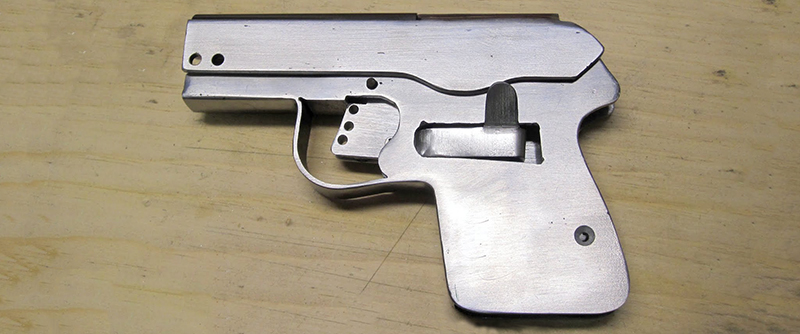
This is exactly the choice Vintage Ordnance made commercially (Volume 2), and exactly the choice two unrelated hobbyist builders — the Hackaday sheet-metal pistol and the “Have Blue” 3D-printed clone — each made independently, both stating the rifled bore was to avoid AOW classification.56 Three unrelated parties, one reading of the statute.
A candid sourcing caveat. The statute itself (§ 5845(e)) is primary-sourced and unambiguous. What could not be directly obtained in research is a primary ATF ruling document stating “BATFE has ruled that reproduction Liberators must be rifled” in the agency’s own words — atf.gov PDF fetches returned HTTP 403.7 So the “the ATF has so ruled for reproductions” characterization rests on the plain statutory logic plus the convergent conduct of a Type-07 manufacturer and two builders, not on a fetched ruling number. That is strong, but it is not the same as quoting an ATF letter, and it is flagged here honestly. If you want the agency’s own words before building smoothbore, pull the ATF Firearms Rulings / Open Letters index directly.
4.3 The Form 1 Process and the $0 Tax
If you choose the smoothbore/AOW path, the mechanism is ATF Form 1, “Application to Make and Register a Firearm.” The essential facts:
- You file the Form 1 and it must be approved before you make the item. Making first and registering later is not an option — it is the felony.4
- The application carries a background check and fingerprints and a photo. That part is unchanged.
- The tax is now $0. Effective January 1, 2026, H.R. 1 (the “One Big Beautiful Bill Act,” signed July 4, 2025) dropped the making/transfer tax for suppressors, SBRs, SBSs, and AOWs to $0.89 Machine guns and destructive devices are unaffected and still carry the $200 tax.
Say both halves clearly, because this is the most commonly garbled point in current discussion: the tax stamp payment is gone; the registration is not. You still file a Form 1, still submit prints and photo, still pass the check, and still wait for approval before manufacture. Older web sources that say “$200 to make an AOW” are describing pre-2026 law. (Historically the AOW transfer tax was $5 and the AOW making tax was $200 — a frequently confused distinction; both are now $0.)10
4.4 Personal-Use Manufacture Under Federal Law
For the rifled (ordinary pistol) path, the federal picture is permissive:
- Federal law does not require an FFL, a serial number, or ATF registration to build an ordinary (non-NFA) firearm for personal use by a non-prohibited person.11 The ATF maintains a “Privately Made Firearms” guidance page covering this territory.7
- Making for sale is different. Manufacturing firearms for sale or distribution — as opposed to personal use — requires a manufacturer’s FFL (Type 07), regardless of the AOW question. That is exactly the license Vintage Ordnance holds (Volume 2). If you ever contemplate building more than one Liberator and selling the extras, you are in manufacturer-FFL territory. Build one, for yourself, and you are not.
Two federal statutes that a builder often worries about do not bite a single-shot Liberator, and it is worth saying why:
- 18 U.S.C. § 922(o) bans post-1986 civilian machine-gun manufacture. A single-shot, manually reloaded pistol fires one round per action and is not remotely a machine gun.
- 18 U.S.C. § 922(r) governs assembling certain semi-automatic (and other enumerated) firearms from an excess of imported parts. A scratch-built single-shot break-action with no imported-parts assembly is outside its scope.
Note: these two non-applicability conclusions are a straightforward application of the statutes’ plain scope, not a fetched source stating ”§ 922(o)/(r) don’t apply to a Liberator.” Flagged per the research’s own caution.
4.5 The Undetectable Firearms Act — Only If You Print It
If any load-bearing component of the build is 3D-printed, 18 U.S.C. § 922(p), the Undetectable Firearms Act, comes into play. It bans firearms not detectable by a walk-through metal detector calibrated to 3.7 oz of 17-4 PH stainless steel, and requires major components (barrel, slide, frame) to X-ray accurately as their true shape.12
- A metal FP-45 build — CNC-milled, laser-cut sheet, or tube — does not implicate the UFA at all.
- A 3D-printed build (the Have Blue approach, useful only as a prototyping step, never as a firing gun in this series) must retain enough steel to clear the 3.7 oz threshold. In practice the rifled steel barrel and steel striker already are steel, but this is worth an explicit compliance note if you ever print a load-bearing part.6
For the path recommended here — a metal, rifled, machined pistol — the UFA is simply not a factor. It is documented here only so the printed-prototype option is not walked into blindly.
4.6 State Law Varies — Confirm Yours
Federal permissiveness for personal-use builds is not the whole picture, and state law is trending toward more regulation of self-made guns:
- California requires a DOJ-issued unique serial number for any firearm manufactured or assembled in the state.13
- Colorado’s SB 23-279 bans possession, manufacture, and sale of unserialized self-made firearms and frames/receivers, effective January 1, 2024.14
Neither of these is Michigan, so neither blocks a build here, but “federal law doesn’t require serialization” is a federal statement only. Michigan’s own rules need to be confirmed before building — the hub’s standing legal rule is to ask and confirm rather than assume when state law is material, and here it is material. If the state of residence requires serialization of self-made firearms, that requirement stands regardless of the federal baseline.
4.7 Bottom Line
Rifle the bore, and a scratch FP-45 is an ordinary pistol you can build in your own shop for personal use with no federal paperwork — subject only to your state’s self-made-firearm rules, which you must confirm. Go smoothbore for screen or historical accuracy, and it is a Title II AOW requiring a pre-approved Form 1 — now $0 tax, but still a real approval-before-manufacture process — before a single chip comes off the mill. The recommended path for this series is rifled, for the legal simplicity and for the strength and service-life reasons the build volumes lay out. Volume 5 explains the original manufacturing method and why you will not use it; Volume 6 is the lab build itself.
4.8 Bibliography
Footnotes
-
26 U.S.C. § 5845(e). Cornell Legal Information Institute. https://www.law.cornell.edu/uscode/text/26/5845 ↩
-
27 CFR § 479.11. Cornell LII. https://www.law.cornell.edu/cfr/text/27/479.11 ↩
-
FP-45 Liberator. Wikipedia. https://en.wikipedia.org/wiki/FP-45_Liberator — smoothbore original, AOW/C&R history. ↩
-
ATF Form 1, Application to Make and Register a Firearm. https://www.atf.gov/firearms/docs/form/form-1-application-make-and-register-firearm-atf-form-53201 — approval required before manufacture. ↩ ↩2
-
Building a Sheet Metal Pistol. Hackaday, 2016. https://hackaday.com/2016/02/17/building-a-sheet-metal-pistol/ — “A firearm with a rifled bore and no stock is simply a pistol.” ↩
-
Gunsmithing with a 3D Printer, Part 5. haveblue.org. https://haveblue.org/?p=1631 — rifling added to a printed barrel to avoid NFA registration. ↩ ↩2
-
Privately Made Firearms. ATF. https://www.atf.gov/firearms/privately-made-firearms (title confirmed via search; PDF fetches returned HTTP 403 in research). ↩ ↩2
-
NFA Tax Stamp Is Dead. AmmoLand, January 2026. https://www.ammoland.com/2026/01/nfa-tax-stamp-is-dead-suppressors-and-sbrs-have-a-0-tax-stamp/ ↩
-
National Firearms Act. Wikipedia. https://en.wikipedia.org/wiki/National_Firearms_Act — 2025/2026 tax changes. ↩
-
What Is an “Any Other Weapon” Under Federal Law. https://legalclarity.org/what-is-an-any-other-weapon-under-federal-law/ — AOW $5-transfer / $200-making tax history, now both $0. ↩
-
Am I Required to Apply a Serial Number to a Homemade Firearm? https://www.gunsholstersandgear.com/2017/02/21/am-i-required-to-apply-a-serial-number-to-a-homemade-firearm/ — federal no-serial baseline for personal-use builds. ↩
-
Undetectable Firearms Act (18 U.S.C. § 922(p)). https://en.wikipedia.org/wiki/Undetectable_Firearms_Act ↩
-
California DOJ self-made-firearm serialization requirement. https://oag.ca.gov/system/files/attachments/press-docs/consumer-alert.pdf ↩
-
Homemade Guns — state-law overview incl. Colorado SB 23-279. https://www.criminaldefenselawyer.com/resources/homemade-guns-are-they-legal-must-they-be-registered.html ↩
Comments (0)