Diana (RWS) Model 34 · Volume 7
The Law, Hunting, and the Rifle Documented Here
Why a spring-piston rifle is not a firearm, how Michigan's pneumatic-gun statutes treat a .177 differently from a .22, small game with an air rifle, and the configuration on hand in September 2026
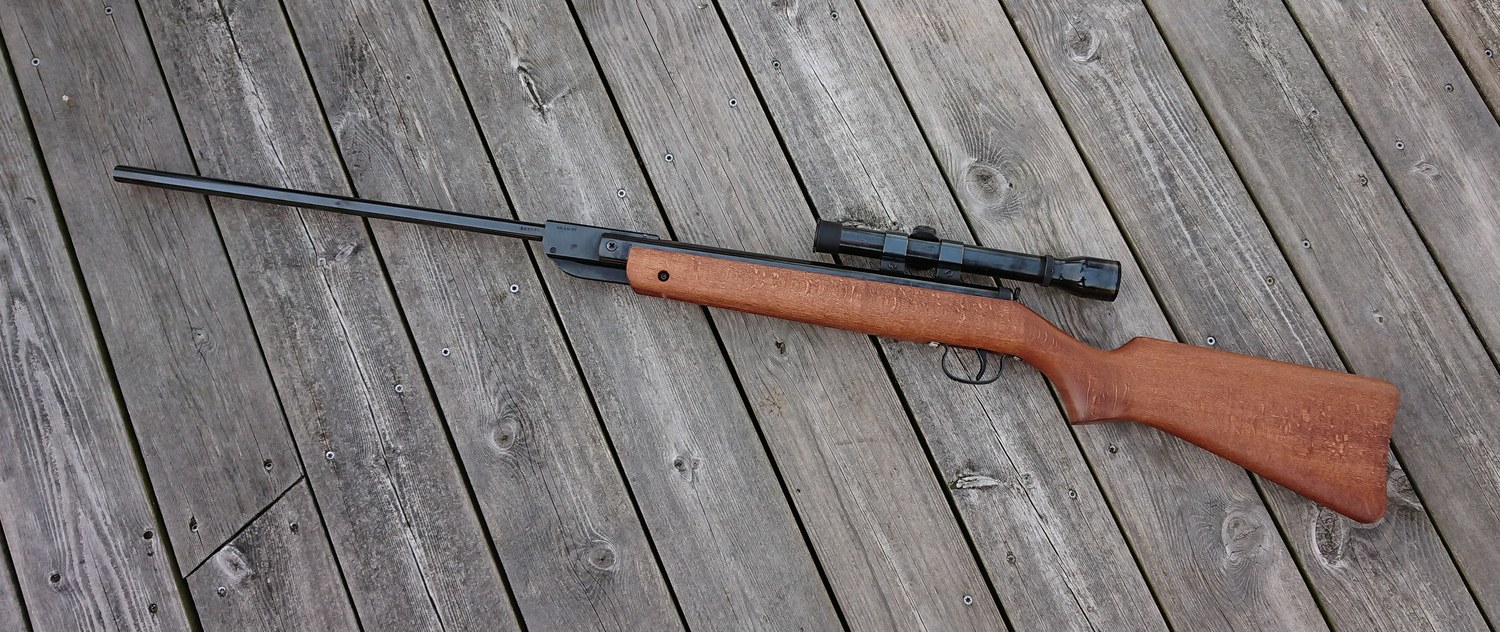
The owner of the rifle documented here lives in Michigan, and the hub’s firearm dives each end with the federal and Michigan position. For an air rifle that position is different in kind, and in one respect it is more interesting than the firearm case: Michigan’s vehicle-transport statutes draw a line through the middle of the Model 34’s caliber range, so that the .177 rifle documented here and a .22 of the same model are treated differently. The statutes are quoted, not paraphrased, because the details carry the meaning. None of this is legal advice.
7.1 Federal Law: Not a Firearm
The Gun Control Act defines a firearm as “(A) any weapon (including a starter gun) which will or is designed to or may readily be converted to expel a projectile by the action of an explosive; (B) the frame or receiver of any such weapon; (C) any firearm muffler or firearm silencer; or (D) any destructive device.”1 A spring-piston air rifle expels its pellet with compressed air, and nothing in it is an explosive. It is not a firearm, there is no federal licensing, background check or transfer record for buying one, and the National Firearms Act has nothing to say about it. The hub’s Daisy dive tells the story of the one air-powered rifle that did fall inside the definition, because its compressed air ignited a propellant (Daisy, Volume 14).
Two other federal provisions touch air guns. The Consumer Product Safety Commission has jurisdiction over them as consumer products, and the Daisy dive covers its one great fight with a maker (Daisy, Volume 16). And the federal “look-alike firearm” rule, which requires a blaze-orange plug in toy guns, expressly “does not include … traditional B-B, paint-ball, or pellet-firing air guns that expel a projectile through the force of air pressure”.2
7.2 The Threaded EMS Barrel and the Silencer Definition
Part (C) of the federal definition deserves a caution for one version of the rifle. The 34 EMS has an exchangeable barrel threaded 1/2 in UNF at the muzzle, and Diana advertises that it can be “fitted with a suppressor”.3 A firearm silencer is a firearm in its own right under that definition, whatever it is attached to, and the hub’s Suppressor Law dive sets out how the federal definition works (Suppressor Law). How the federal authorities treat a sound moderator sold for an air rifle was not researched for these volumes, and nothing here should be read as saying that any particular air-gun moderator is lawful to own. The rifle documented here is recorded as a .177 Model 34 with no modification but a scope, and nothing suggests it is an EMS.
7.3 Michigan: The Pneumatic Gun
Michigan’s penal code uses the same explosive test as federal law: “‘Firearm’ means any weapon which will, is designed to, or may readily be converted to expel a projectile by action of an explosive.”4 Since 2015 it has also defined a separate category. MCL 750.222(g) adopts the definition in the state’s firearms-preemption act, MCL 123.1101(d):
“‘Pneumatic gun’ means any implement, designed as a gun, that will expel a BB or pellet by spring, gas, or air. Pneumatic gun includes a paintball gun that expels by pneumatic pressure plastic balls filled with paint for the purpose of marking the point of impact.”5
A Diana 34 is a pneumatic gun: it is designed as a gun and it expels a pellet by spring and air. It is not a firearm. The hub’s Daisy dive verified the same two definitions against the statute (Daisy, Volume 14). Both were read again from the Michigan Legislature’s site for these volumes on 19 September 2026; MCL 750.222 shows its last amendments as 2015 PA 26, effective 1 July 2015, and 2015 PA 28, effective 10 August 2015.4
7.4 Preemption, and What a City May Still Do
MCL 123.1102 forbids a city, village, township or county to “enact or enforce any ordinance or regulation pertaining to, or regulate in any other manner the ownership, registration, purchase, sale, transfer, transportation, or possession of pistols, other firearms, or pneumatic guns”, except as federal or state law provides.5 The 2015 amendment that added pneumatic guns to that sentence also listed what local government may still do:5
- regulate conduct with a pneumatic gun that is already a state crime;
- require that anyone under 16 in possession of a pneumatic gun be supervised by a parent, a guardian or an adult 18 or older, “except that an ordinance shall not regulate possession of a pneumatic gun on or within private property if the individual below the age of 16 is authorized by a parent or guardian and the property owner or legal possessor to possess the pneumatic gun”;
- prohibit “pointing, waving about, or displaying a pneumatic gun in a threatening manner with the intent to induce fear in another individual”;
- in a city or charter township, prohibit discharge “in any area … that is so heavily populated as to make that conduct dangerous to the inhabitants of that area, except that an ordinance shall not prohibit the discharge of pneumatic guns at authorized target ranges, on other property where firearms may be discharged, or on or within private property with the permission of the owner or possessor of that property if conducted with reasonable care to prevent a projectile from crossing the bounds of the property.”
The last clause is the one a backyard shooter needs. In a city or charter township, a local ordinance may ban discharge in densely populated areas, but it may not ban shooting a pellet rifle on private property with the owner’s permission, provided reasonable care is taken that nothing leaves the property. A backstop that holds, and a pellet trap that is checked, are that reasonable care; Diana’s own manual says to place the backstop “in a location that will be safe should the backstop fail” and to check it “for wear before and after each use”.6 Which ordinances apply to a particular address was not researched.
7.5 Carrying It in a Vehicle: The .177 Line
Michigan’s two vehicle-transport sections were amended in the same 2015 act, and both draw their line for pneumatic guns at .177 caliber. Read live on 19 September 2026, MCL 750.227c(1) provides that “a person shall not transport or possess in or upon a sailboat or a motor vehicle, aircraft, motorboat, or any other vehicle propelled by mechanical means either of the following: (a) A firearm, other than a pistol, that is loaded. (b) A pneumatic gun that is loaded and expels a metallic BB or metallic pellet greater than .177 caliber.”7 Violation is a misdemeanor punishable by up to two years or $2,500.
MCL 750.227d(1) provides that in a motor vehicle a person shall not transport or possess “(b) A pneumatic gun that expels a metallic BB or metallic pellet greater than .177 caliber unless the pneumatic gun is unloaded and is 1 or more of the following: (i) Taken down. (ii) Enclosed in a case. (iii) Carried in the trunk of the vehicle. (iv) Inaccessible from the interior of the vehicle.”7 Violation is punishable by up to 90 days or $100.
The consequence is exact. A .177 Model 34, which is what the rifle documented here is, expels a pellet that is not “greater than .177 caliber”, and so falls outside both sections as written. A .22 Model 34 falls inside both, and must travel unloaded and cased, in the trunk, or otherwise out of reach. The hub’s AR-15 dive covers the same section for firearms, where the rule is stricter (AR-15 5.56, Volume 7).
Two cautions keep that from being read as licence. First, the hunting rules below ask for more when the rifle is being used to hunt. Second, Diana’s own manual is stricter than the statute: “Before you store or transport the air rifle, make sure it is unloaded and uncocked, with safety ‘ON’.”6 Carrying the rifle unloaded, uncocked and cased costs nothing and satisfies every rule that might apply.
7.6 Where the Pneumatic Gun Is Treated Like a Firearm
Other sections of the same 2015 act brought pneumatic guns into the penal code beside firearms, and they apply to a .177 rifle as much as to a .22:8
- Going armed with unlawful intent, MCL 750.226: a person shall not, “with intent to use the same unlawfully against the person of another, go armed with a pistol or other firearm, or a pneumatic gun”. A felony, up to five years.
- Felony-firearm’s pneumatic counterpart, MCL 750.227b(2): carrying a pneumatic gun and using it “in furtherance of committing or attempting to commit a felony” carries a mandatory consecutive two-year term, five and ten years for repeats.
- Weapon-free school zones, MCL 750.237a: “‘Weapon’ includes, but is not limited to, a pneumatic gun.” Possession on school property, which the section defines, is a misdemeanor subject to listed exceptions.
- Brandishing is a firearm offence under MCL 750.234e, but local government may separately forbid threatening display of a pneumatic gun, above, and Diana’s manual warns: “Do not brandish or display the air rifle in public. This may confuse people and may be a crime. Police and others may think this air rifle is a firearm subject to licensing.”6
7.7 A Correction to the Hub’s Own Record
The hub’s Daisy dive, in its Volume 16, states with an explicit warning that it was not verified that “Michigan excludes from its firearm definition smoothbore rifles or handguns designed and manufactured exclusively to propel BBs not exceeding .177 caliber by gas or air”, and infers that “a rifled pellet gun may fall outside the exclusion”. That describes Michigan law before 2015. Under the statutes in force in September 2026, the firearm definition turns only on an explosive, and a rifled .177 pellet rifle such as the Diana 34 is a pneumatic gun, not a firearm. The same dive’s Volume 14 quotes the current definitions correctly. The warning Volume 16 carried was the right one; the answer to it is recorded here and reported for correction there.
7.8 Hunting Small Game in Michigan
The Michigan Department of Natural Resources’ 2026 Small Game Hunting Regulations Summary, which states that its rules “apply through July 31, 2027”, answers the question directly on its equipment page:9
“Can I use a pneumatic gun to hunt small game? Yes. You can use a pneumatic gun to hunt small game if it meets the firearm requirements for the season and species you are hunting.”
The same summary defines a pneumatic gun in the statute’s words. It sets no minimum caliber, velocity or energy for pneumatic guns hunting small game, and none should be inferred. The rest of the rules apply as they would to a rimfire:
- “A base license is required to hunt small game, including on your own enclosed farmlands where you live.”9
- Hunter orange is required for small game, with an exemption for crow hunting only.9
- Seasons: cottontail rabbit and fox and gray squirrel from 15 September through March; red squirrel and ground squirrel, including chipmunk, year-round. Daily limit five squirrels, five rabbits and hares combined; possession limit ten of each. The 2026 summary also introduces new “small game management seasons” for fox and gray squirrel and cottontail rabbit on private land only.9 Dates and limits change; the current summary governs.
- Safety zones: 450 feet around an occupied building “when hunting with a firearm”, without written permission. The summary does not say whether that zone reaches a pneumatic gun.9
- Transport while hunting: “Rifles, shotguns, muzzleloaders and all other firearms must be unloaded in both barrel and magazine and enclosed in a case or carried in the trunk of a vehicle”. The summary does not mention pneumatic guns in that rule, and the penal code’s own .177 threshold, above, would leave a .177 outside the statutory casing requirement. Whether a conservation officer would treat a .177 air rifle carried on a hunt as a firearm for this rule could not be determined from any text located. Cased, unloaded and uncocked meets every reading.9
The deer summary for 2026 also permits a pneumatic gun “if it meets the firearm requirements for the season, species hunted and zone”, which in a firearm deer season means, among other things, “a rifle of any caliber larger than a .22-caliber rimfire”.10 A .177 spring rifle is not a deer rifle under those rules.
Whether the rifle is adequate for small game is a separate question from whether it is legal. Gaylord, writing of the 34’s power level in 2006, judged that “in .22, it’s a good hunting gun”; a .22 34P he later tested was bought for garden pests and he agreed .22 was “a lot more positive” than .177.11 That is a tester’s opinion, and shot placement governs any humane kill with a pellet.
7.9 The Maker’s Own Limits
Diana’s manual adds rules that no statute imposes, and they are the maker’s conditions for the rifle: “Intended for use by persons age 18 and older. Not a toy”; “Dangerous within 678 yard (620 metres)”; “eye protection and ear protection is required”, with safety glasses for “you and any others with or near you”; “Never ever carry the air rifle while cocked and/or while loaded”; storage “in a secure location out of the reach of unauthorized persons and separate from ammunition”.6 The 678-yard danger distance is worth keeping in mind when judging a backyard backstop.
7.10 The Rifle Documented Here
The configuration below is taken from the owner’s inventory sheet, last modified 17 September 2026, as read on 19 September 2026. It records what is known and marks what is not.
Table 1 — The Rifle Documented Here
| Item | As recorded | Status |
|---|---|---|
| Model | Diana Model 34 | Recorded |
| Maker on the sheet | RWS (the US importer’s brand; the maker is Diana) | Recorded |
| Caliber | .177 (4.5 mm) | Recorded |
| Barrel | rifled, 19.5 in | Recorded |
| Scope | a scope is fitted (“Scope”) | Installed; make, model and magnification not recorded |
| Mount | not recorded | Unknown: one-piece with stop, droop base, adjustable, or other |
| Generation, trigger, stock | not recorded | Unknown; see Volume 2 |
| Tune or repairs | not recorded | Unknown |
| Chronograph baseline | none recorded | Owed; see Volume 6 |
Optics move between rifles, and the hub records the optic’s own specification in its Scopes dive rather than in the rifle’s volume. When the scope and mount are identified, the questions in Volume 4 apply directly: whether the mount is stopped against rearward creep, whether the droop is corrected by the mount or by winding the scope near its limit, and whether the scope was made to survive a spring rifle’s recoil.
7.11 What Would Complete the Record
The owner’s own photographs would turn this dive from a study of the model into a record of the rifle. They are owed, and ranked in the dive’s README. The most useful, in order:
- The full profile of the rifle with the scope on.
- The date stamp and markings on the compression tube.
- The trigger blade, to settle T01, T05 or T06.
- The scope, mount and front of the scope base.
- The breech face and seal.
- A ten-shot chronograph string with a named pellet, and a 20-yard droop target with the reticle centred.
References
Footnotes
-
18 U.S.C. § 921(a)(3), https://www.law.cornell.edu/uscode/text/18/921 . Accessed 2026-09-19. ↩
-
15 U.S.C. § 5001(c), https://www.law.cornell.edu/uscode/text/15/5001 . Accessed 2026-09-19. ↩
-
DIANA, Katalog 2026, p. 14, https://www.diana-airguns.de/media/da/0b/3b/1772108268/DIANA_Katalog_2026_web.pdf . Accessed 2026-09-19. ↩
-
MCL 750.222, https://www.legislature.mi.gov/Laws/MCL?objectName=mcl-750-222 . Accessed 2026-09-19. ↩ ↩2
-
MCL 123.1101 to 123.1104, as amended by 2015 PA 29 (Enrolled Senate Bill 85), effective 10 August 2015, https://www.legislature.mi.gov/documents/2015-2016/publicact/pdf/2015-PA-0029.pdf ; current text at https://www.legislature.mi.gov/Laws/MCL?objectName=mcl-123-1101 . Accessed 2026-09-19. ↩ ↩2 ↩3
-
DIANA, Instructions for Use, Mod. 34 / 34 Classic / Panther 34, version 05/2025, part 45400077, pp. 3–6, https://www.diana-airguns.de/media/19/65/48/1748330254/45400077_20250523_Bedienungsanleitung_Mod_Panther%2031-34%20Classic_Web.pdf . Accessed 2026-09-19. ↩ ↩2 ↩3 ↩4
-
MCL 750.227c and 750.227d, https://www.legislature.mi.gov/Laws/MCL?objectName=mcl-750-227c and https://www.legislature.mi.gov/Laws/MCL?objectName=mcl-750-227d ; both show “Am. 2015, Act 26, Eff. July 1, 2015” as the last amendment. Accessed 2026-09-19. ↩ ↩2
-
2015 PA 26 (Enrolled House Bill 4155), effective 1 July 2015, amending MCL 750.222, 750.226, 750.227b, 750.227c, 750.227d, 750.237a and 750.528a, https://www.legislature.mi.gov/documents/2015-2016/publicact/pdf/2015-PA-0026.pdf . Accessed 2026-09-19. ↩
-
Michigan Department of Natural Resources, 2026 Michigan Small Game Hunting Regulations Summary, pp. 1, 4–7, 26, 34–37 and glossary, https://www.michigan.gov/dnr/-/media/Project/Websites/dnr/Documents/LED/digests/small_game_regs_summary.pdf . Accessed 2026-09-19. ↩ ↩2 ↩3 ↩4 ↩5 ↩6
-
Michigan Department of Natural Resources, 2026 Michigan Deer Hunting Regulations Summary, equipment questions, https://www.michigan.gov/dnr/-/media/Project/Websites/dnr/Documents/LED/digests/2026_deer_regs_summary.pdf . Accessed 2026-09-19. ↩
-
Tom Gaylord (as B.B. Pelletier), “RWS Diana 34”, Pyramyd Air blog, August 2006, https://www.pyramydair.com/blog/2006/08/rws-diana-34/ ; and “Checking out a Diana RWS 34P: Part 1”, June 2017, https://www.pyramydair.com/blog/2017/06/checking-out-a-diana-rws-34p-part-1/ ; both via Internet Archive. Accessed 2026-09-19. ↩
Comments (0)