Diana (RWS) Model 34 · Volume 4
Scopes, Mounts and Barrel Droop — Why Springers Eat Scopes, and the 21-Inch Rifle
How the forward jolt walks a mount back along the rail, what Diana's barrel droop amounts to in minutes of angle, and the mounts that correct it
The owner’s sheet records a single modification on the rifle documented here: “Scope”. It does not say which. That is appropriate, because on a Diana 34 the scope is the part of the rifle most likely to change and most likely to cause trouble. Two separate problems meet on the same 11 mm rail: the spring rifle’s recoil, which damages scopes and moves mounts, and Diana’s barrel droop, which can put the point of impact beyond the reach of a scope’s own adjustment. This volume takes them in turn. Optic theory, magnification, parallax and the general mounting procedure are in the hub’s Scopes dive and are linked rather than repeated: Optical Fundamentals and Mounting, Zeroing and Maintenance.
4.1 Two Problems, One Rail
They are worth separating because they have different fixes. Recoil damage is solved by a mount that cannot move and a scope built to survive the shock. Droop is solved by tilting the scope to match the bore. A mount can do both, and the best-known ones for the 34 were designed to, but a scope that holds zero perfectly on a drooping rifle can still run out of elevation, and a droop-corrected mount on an unanchored base will still walk.
4.2 Why Springers Eat Scopes
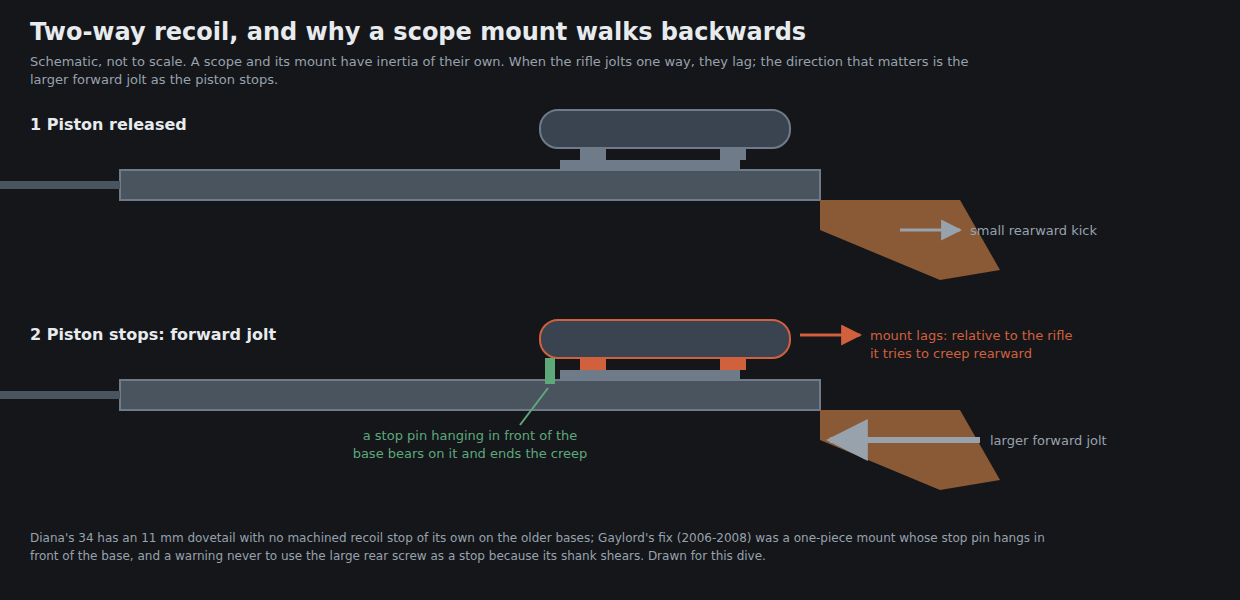
Volume 3 sets out the order of events in a shot: the piston’s forward launch kicks the rifle gently back, and the piston’s stop on its air cushion throws the rifle forward, harder, before the pellet moves. A scope and its mount are separate masses clamped to the rifle. Each forward jolt accelerates the rifle out from under them; relative to the rifle they lurch rearward, and the clamps must supply the force to drag them along.
Two consequences follow, and both are borne out by the testers.
The mount walks backward. Clamping friction alone does not hold a mount on a magnum springer. Gaylord put it flatly in 2007: “Clamping pressure alone cannot stop the movement.”1 Over hundreds of shots a mount creeps rearward along the rail until something positive stops it, and the zero moves with it.
The scope itself takes the shock. A telescopic sight’s reticle is carried in an erector tube held against its adjusting screws by a spring. A firearm’s recoil throws that assembly one way; a spring rifle’s throws it one way and then, harder, the other. The hub’s Scopes dive covers the erector mechanism (Optical Fundamentals). No test standard defining what makes a scope “airgun rated” was found in the sources consulted, so the label is treated here as a maker’s claim to be judged by the maker’s reputation and warranty. The testers’ evidence is anecdotal but consistent: Gaylord reports breaking scopes on spring rifles, including one on the 34P used for his 2011 trigger tests, “the initial one that finally gave up the ghost during my test”, and a BKL mount he tested had already survived a Hatsan 125 on which “the scope that had been in that test was destroyed”.2
4.3 The Diana Rail, and the Screw Not to Use
The 34’s scope base is an 11 mm dovetail on top of the compression tube. On older rifles it was a separate plate screwed to the tube, as Diana’s 2004 parts drawing shows; by the 2011 T06 drawing the rail is drawn as part of the compression tube (Volume 2).3
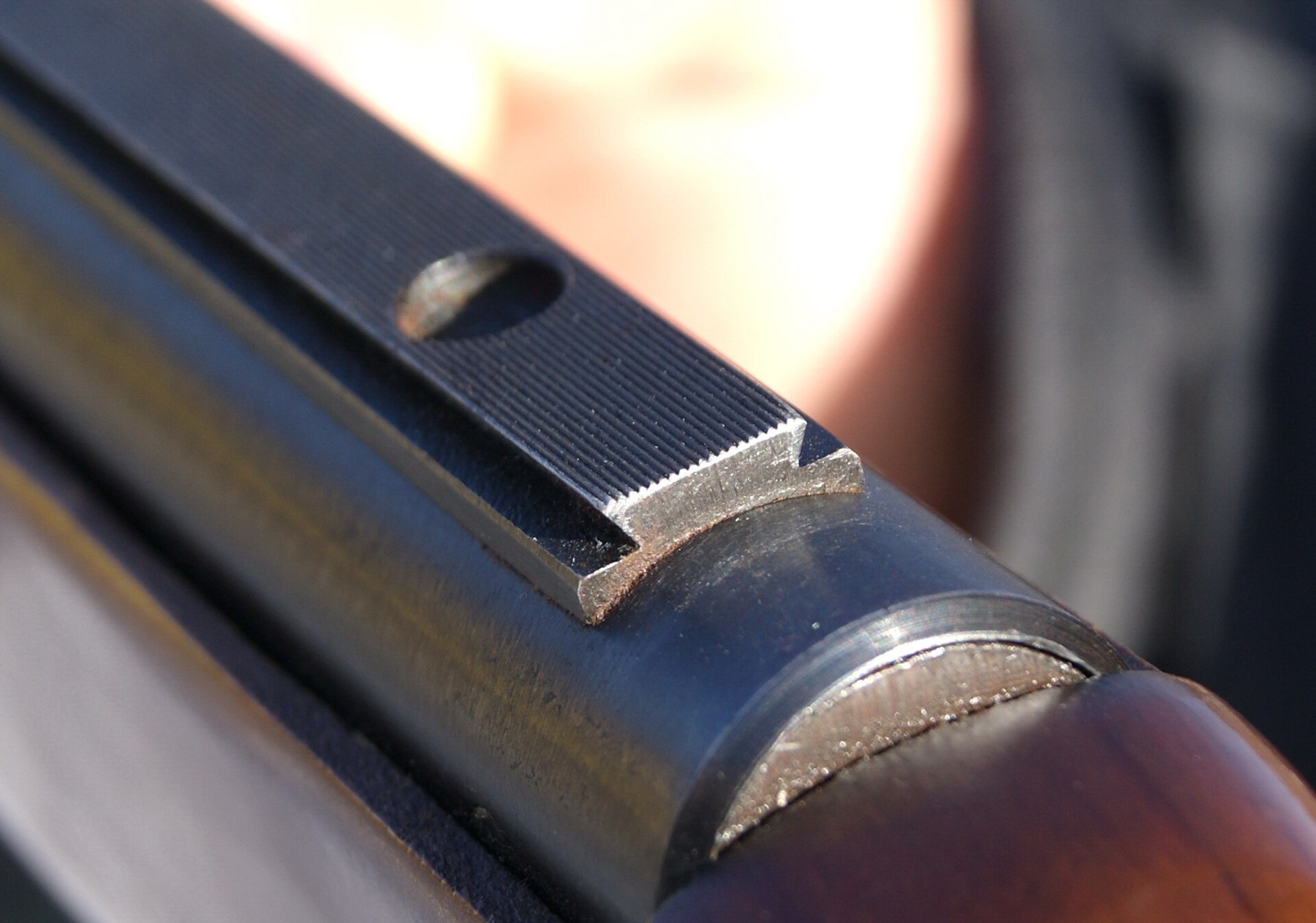
The problem with the older Diana base was that it offered nowhere to anchor a mount. Gaylord explained it in 2006 and again in 2007:
- “There is NO way to anchor a scope mount! You have to use a one-piece scope mount and let the scope stop pin hang down in front of the 11mm dovetail ramp on the receiver … a portion of the scope mount will hang off the rail at the front, but it’s the only safe way to stop the mount from moving under recoil.”4
- “There are two shallow holes for a vertical stop pin, but they aren’t deep enough to do the job. I have seen dozens of Diana spring guns with long gouges extending backward from these holes.” The earlier RWS C-Mount “has a tapered rounded Allen screw stop pin that acts like a plow when the gun moves in recoil”.1
- Most important: “The large-headed screw on the rear (left) of the scope base should NOT be used as a scope stop. It has a thin shank that will shear off under recoil.”1 In 2014 he added: “Back in the old days, shooters thought that screw was a perfect way to anchor a scope mount from moving. I cannot tell you how many hundreds of screw heads were sheared off! I did 2 of them, myself!”5
The front of the base, which Gaylord calls the ramp, is the only surface that will take the load. A one-piece mount whose stop pin hangs down in front of it turns every forward jolt into a push against solid steel.
The 34 EMS has its own answer to the stop-pin question. Its manual shows mounting holes along the tube and supplies protective stickers for “any unused mounting holes”, which Gaylord called “a solution to a problem I never heard of”.67
4.4 What Droop Is, and What It Is Not
Barrel droop is the name for a rifle whose bore points below the line of its scope base, so that a scope mounted level on the base cannot be adjusted far enough to reach the point of impact. Gaylord’s 2012 explanation is the clearest account, and it corrects the commonest misunderstanding: “barrel droop is a condition in which an air rifle shoots so low that the scope cannot be adjusted to hit the target.” The barrel is not bent. “Barrels do not bend from cocking … The term ‘droop’ doesn’t refer to a barrel that is somehow curved (or bent) downward … It means a barrel that points in a direction away from the sight line.”8
He lists the causes. In a break-barrel the usual one is lock-up: “it’s usually because of how the breech locks up at a slight angle that causes the downward slant … Most guns rely on the spring-loaded detent to both align and hold the barrel during firing. If there’s a weakness, it’s at this point.” A bore drilled off-axis, a barrel pressed into its block off-axis, and “scope base on top of the spring tube is not aligned with the bore” are the others, and of the base he says, “Of all the problems with scope alignment, this one is the most common.”8 Volume 3 shows the 34’s ball detent, which holds the barrel shut without camming it into line, and Volume 2 shows the separately screwed base of the older rifles. Both fit his account.
Two points from the same article are worth keeping. The first is that droop is not universal: “of the hundreds of rifles I test, only a small percent have a drooping problem.” The second is that it was a Diana speciality: “This company stands head and shoulders above the others when it comes to having barrel droop — both with their breakbarrels and their fixed-barrel air rifles. That company is Diana.”8 Iron sights on the barrel never show it, which is why nobody noticed until air rifles began to be scoped in the 1960s; Gaylord records that in the 1960s and 1970s the Air Rifle Headquarters and Beeman catalogues hand-selected break-barrels for scope use.8
One more cause is a genuinely bent barrel, which Gaylord describes in the same article: a rifle “fired with the barrel open, so the barrel was allowed to snap closed from the force of the mainspring … will have a bent barrel”, bent up where it leaves the base block.8 That is a different fault from droop, with a different fix, and it is one reason the loading hand stays on the barrel (Volume 3).
4.5 The 21-Inch Rifle
The best-documented case of droop on any air rifle is a Diana 34 Panther that Pyramyd Air lent to Gaylord in 2007 and that he used as a test bed for years. The number attached to it recurs in five of his reports between 2008 and 2017:
- In 2008, with the scope’s elevation adjusted “AS HIGH AS IT WOULD GO”, five pellets at 20 yards struck “over 7-1/2″ below” the aim point. “If I centered the reticle, the pellet would be almost 21″ below the aimpoint.”9
- In 2014: “a new Diana 34P can hit the target as much as 21 inches below the aim point at 20 yards when the scope is level, this rifle was used to determine that.”10
- In 2017, after a tune: “It still shoots over 20 inches low (from where a scope lines up) at 20 yards, but I have a drooper base that fixes it.” A second 34P from 2013 that he examined for a reader was “an extreme drooper — similar to my own”.11
It is one rifle, and Gaylord calls it “the champion of all droopers”.12 It is also the rifle the most popular droop-compensating base was designed around, which is why that base has, in his words, “such a pronounced droop”.5
4.6 What 21 Inches Means in Angle
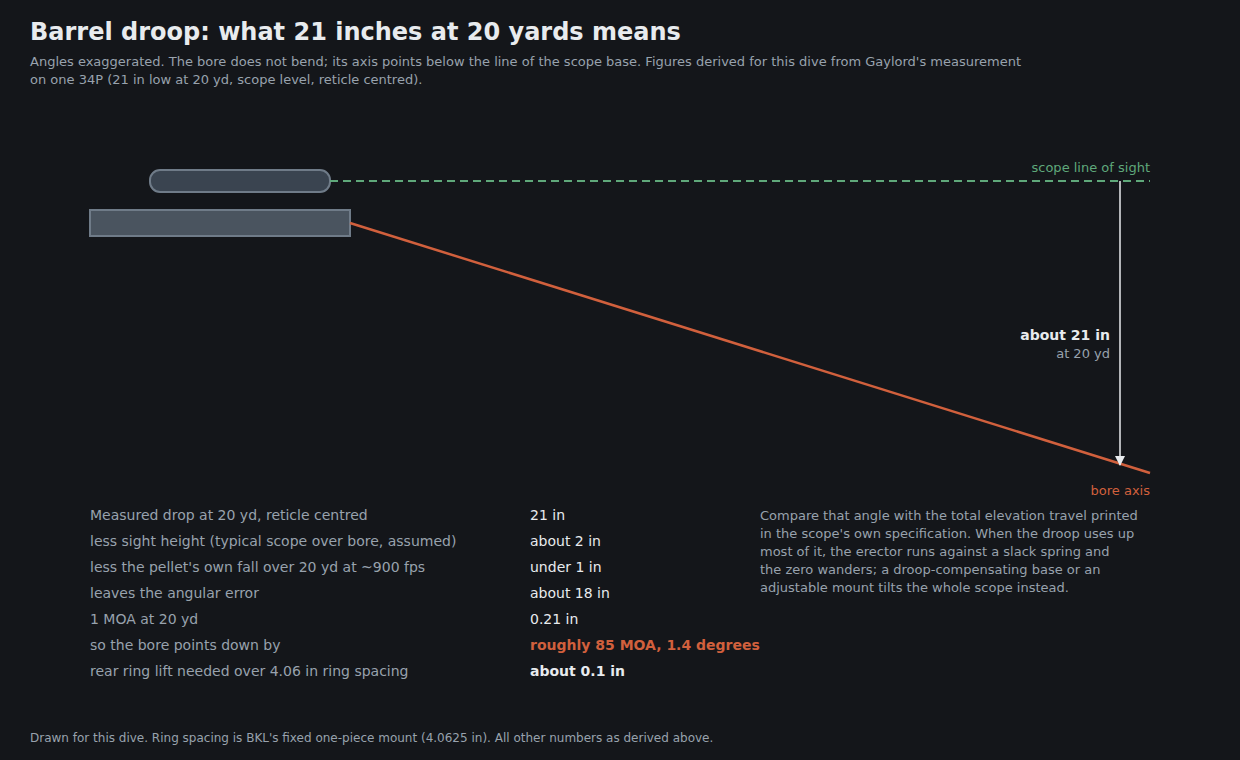
The drawing at the head of this volume converts the measurement into an angle. The arithmetic is derived for these volumes and shown so that it can be checked.
At 20 yards the pellet struck 21 inches below the centred reticle. Part of that distance is not angular error. The scope sits above the bore, so even a perfectly aligned bore starts below the line of sight; about 2 inches is typical for a scope in medium rings over a 34’s tube, an assumption rather than a measurement. And the pellet falls under gravity during its flight: at about 900 fps it takes about 0.067 seconds to cover 60 feet and falls about 0.9 inch. That leaves roughly 18 inches of error due to angle.
One minute of angle subtends 1.047 inches at 100 yards and therefore about 0.21 inch at 20 yards. Eighteen inches is about 86 minutes of angle, or 1.4 degrees. Over the 4.06-inch spacing of a one-piece mount’s rings, 1.4 degrees is a height difference of about 0.1 inch between front and rear ring.
That angle is the figure to hold against a scope’s own adjustment. The hub’s Scopes dive gives illustrative retailer figures of about 49 MOA of total adjustment for a one-inch tube and about 77 for a 30 mm tube (A History of the Telescopic Sight).13 Since a scope can only use about half its total travel for elevation from the centre, a droop of this size is beyond any ordinary scope’s reach, and Gaylord adds that “most scopes do not work well when adjusted above three-fourths of their maximum elevation.”8 Most 34s droop less than this one. How much any given rifle droops can only be found by shooting it.
4.7 Why Shims Do Not Fix It
The classic workshop answer to a drooping rifle is a shim under the rear of the scope in its ring. Gaylord’s objection is that on this rifle it cannot be done safely: “If you tried to shim the scope to compensate for this amount of droop, you’d have to use so much shim material in back that the scope tube would be at real risk of bending when the ring caps were tightened.”9 In 2017 he said the same of another 34P: “with this model shims usually don’t work — the droop is too great.”12 A tenth of an inch of lift under one ring of a one-inch tube is a large angle for a ring to hold, and the ring bores are then no longer aligned with the tube.
There is also a subtler failure, and Gaylord’s diagnostic for it is worth quoting. A scope wound up near the top of its elevation range can hold a zero poorly because “the erector tube that contains the crosshairs was ‘floating’ on top of a relaxed return spring”. His test: “dial the elevation all the way down”, or 40 to 60 clicks down, shoot at 20 yards with plenty of paper below the bull, and see whether the group tightens. If it does, the scope was the problem and the fix is to tilt the scope, not to adjust it.11 The Scopes dive’s advice to rule out the mount before blaming the scope applies here with extra force (Mounting, Zeroing and Maintenance).
4.8 The Mounts That Do
The UTG droop-compensating base (Leapers). Gaylord’s account of its origin is that he proposed to Leapers, at a SHOT Show, a base “that would fit all Diana rifles but would not bear against the large-head screw at the rear of their base”, and that a colleague “came up with the idea of correcting the droop at the same time”.5 As he described the finished product in 2008, it clamps onto the rifle’s 11 mm dovetail and slides back until “the recoil shock shoulder hangs down in front of the new base to contact the front of the rifle’s base. After that, no movement is possible”; a relief cut at the back clears the big-headed screw; and Picatinny-style slots take Weaver rings, for which he recommended caps with four screws. With the fourth prototype, his 21-inch rifle came on target at 20 yards with the scope’s elevation “between the midpoint and the three-quarters point”. Leapers also made a second base with less slope for the Diana 460 Magnum underlever.9 Current availability and price of the UTG base were not checked for these volumes.
Diana changed the base, and the UTG base stopped fitting newer rifles. Gaylord again, in 2014: “Diana, who had ignored my pleas to correct their barrel drooping problem with certain air rifles, finally changed the bases on all their rifles, so the UTG base would no longer fit about 5 years after it came on the market. Oh, well! There are still hundreds of thousands of Diana rifles made before the recent change, and the UTG Drooper Base is the best way to correct the drooping problem on them.”5 Taken with the 2008 date of his base report, that places the change at about 2013. A 34 must therefore be identified before a droop base is bought for it (Volume 2).
The BKL adjustable mount. BKL’s one-piece mount corrects droop by moving the scope rather than tilting the base. As Gaylord described it in 2011, its rear ring slides up and down on forked legs and is locked by side screws, while “the front ring is captive and is only able to rotate when the rear ring moves up and down. This prevents stress on the scope tube.” A Delrin pad under the tube makes fine elevation adjustments. On the 21-inch rifle it zeroed the scope at 25 yards “in the center of its click-adjustment range”. The rings are fixed at 4.0625 inches apart, outside, which limits the scopes it will take.2 Gaylord used BKL rings again on his 34 EMS in 2021.7
The RWS Lock Down mount. Umarex USA’s page for this mount, read in September 2026, describes four lug screws and “2 recoil pins”, says it “has been tested on the fixed-barrel side cocking RWS rifles with great success”, and says it fits 11 mm dovetails and 3/8-inch rimfire bases. It makes no claim to compensate for droop, and nothing on the page says it has been tested on a 34.14
Table 1 — The Mounts That Do
| Mount | Stops creep by | Corrects droop by | Fits | Source |
|---|---|---|---|---|
| One-piece mount with front stop pin | pin in front of the base | not at all | any 11 mm Diana base | Gaylord 2006, 2007 |
| UTG droop-compensating base | shoulder in front of the base | fixed slope in the base | Diana bases before about 2013 | Gaylord 2008, 2014 |
| BKL adjustable one-piece mount | clamp and design (tested on heavy springers) | rear ring height, front ring pivots | 11 mm dovetail; rings 4.0625 in apart | Gaylord 2011 |
| RWS Lock Down | two recoil pins, four screws | not claimed | 11 mm and 3/8 in | Umarex USA 2026 |
4.9 Diana’s Own Answers
Diana has addressed the problem itself at least twice. Its history page records that in 2015 it “präsentiert die patentierte Zero-Recoil-Mount, die den Prellschlag der Druckluftgewehre von den Zielfernrohren nimmt”, presented the patented Zero-Recoil Mount, which takes the recoil shock of air rifles off the scopes.15 No technical description, patent number or test of the Zero-Recoil Mount was found for these volumes, and none is offered.
The second answer is the 34 EMS, whose catalogue entry lists “adjustable barrel alignment with improved locking mechanism”.16 Gaylord saw the alignment shims at the 2020 SHOT Show, but his 2021 test rifle came without them and without instructions for using them, and by September 2021 he reported that the promised modular parts had not appeared.7 Whether the shims were ever supplied to owners in the United States could not be established.
4.10 A Scope for a 34
The sources consulted support a short list of requirements rather than a product recommendation.
- A mount that cannot creep: a stop that bears on the front of the base, or a design proven on heavier springers. Never the rear screw.
- A way to take out the droop the rifle actually has, measured by shooting, not assumed: a droop base for the rifle’s generation, or an adjustable mount.
- A scope that survives two-way recoil. Makers’ “airgun rated” labels are claims; the practical evidence is a maker’s warranty and other owners’ experience on magnum springers.
- Parallax adjustment for the short distances an air rifle is shot at, since a fixed-parallax rimfire or centrefire scope is usually set far beyond 20 or 30 yards. The hub’s Scopes dive covers the adjustment (Optical Fundamentals). Diana’s own 2026 catalogue shows the 34 EMS with a recommended “riflescope 3-9X40 AO”, the AO being an adjustable objective for parallax.16
- Clearance for the breech. A break-barrel’s barrel pivots just ahead of the scope base, so the scope must leave room for the barrel and the loading hand. Gaylord chose “a shorter scope” for this reason on his Panther.17
4.11 The Scope Documented Here
The owner’s sheet says only “Scope”. As of September 2026 the make, model, magnification, mount, ring height and whether any droop correction is fitted are not recorded, and they are listed as questions for the owner. If the fitted mount is a plain two-piece set on the older Diana base, or relies on the rear screw, the points above apply directly.
References
Footnotes
-
Tom Gaylord (as B.B. Pelletier), “RWS Diana 34 Panther: Part 2”, Pyramyd Air blog, June 2007, https://www.pyramydair.com/blog/2007/06/rws-diana-34-panther-part-2/ , read through an Internet Archive capture. Accessed 2026-09-19. ↩ ↩2 ↩3
-
Gaylord, “New BKL mount adjusts for barrel droop: Part 1”, July 2011, https://www.pyramydair.com/blog/2011/07/new-bkl-mount-adjusts-for-barrel-droop-part-1/ , via Internet Archive. Accessed 2026-09-19. ↩ ↩2
-
Mayer & Grammelspacher Dianawerk, “Mod. 34 TO5” spare-parts drawing, 05.2004, parts 21–22, Internet Archive capture of 23 September 2006 of http://www.diana-airguns.de/fileadmin/pdf/Technische_Infos/Mod.34_TO5.pdf ; DIANA, “Mod. 34 Classic T06”, 02.2011, part 17, https://www.diana-airguns.de/media/41/2b/f7/1746515272/Mod.%2034%20Classic%20T06%20Visier%202010.pdf . Accessed 2026-09-19. ↩
-
Gaylord, “RWS Diana 34”, August 2006, https://www.pyramydair.com/blog/2006/08/rws-diana-34/ , via Internet Archive. Accessed 2026-09-19. ↩
-
Gaylord, “Diana RWS 34P breakbarrel air rifle: Part 2”, December 2014, https://www.pyramydair.com/blog/2014/12/diana-rws-34p-breakbarrel-air-rifle-part-2/ , via Internet Archive. Accessed 2026-09-19. ↩ ↩2 ↩3 ↩4
-
DIANA, Instructions for Use, 34 EMS, 15 January 2024, part 540.70.01.1, p. 3, https://www.diana-airguns.de/media/39/b3/70/1711445342/540.70.01.1_20240115_Bedienungsanleitung_34_EMS_web.pdf . Accessed 2026-09-19. ↩
-
Gaylord, “Diana 34 Easy Modular System (EMS) Synthetic”, Parts 1, 4 and 5, March–September 2021, https://www.pyramydair.com/blog/2021/03/diana-34-easy-modular-system-ems-synthetic-part-1/ , via Internet Archive. Accessed 2026-09-19. ↩ ↩2 ↩3
-
Gaylord, “Can a fixed-barrel airgun have barrel droop?”, May 2012, https://www.pyramydair.com/blog/2012/05/can-a-fixed-barrel-airgun-have-barrel-droop/ , via Internet Archive. Accessed 2026-09-19. ↩ ↩2 ↩3 ↩4 ↩5 ↩6
-
Gaylord, “Leapers base for RWS Diana rifles: Part 3 — more testing”, July 2008, https://www.pyramydair.com/blog/2008/07/leapers-base-for-rws-diana-rifles-part-3-more-testing/ , via Internet Archive. Accessed 2026-09-19. ↩ ↩2 ↩3
-
Gaylord, “Diana RWS 34P breakbarrel air rifle: Part 1”, October 2014, https://www.pyramydair.com/blog/2014/10/diana-rws-34p-breakbarrel-air-rifle-part-1/ , via Internet Archive. Accessed 2026-09-19. ↩
-
Gaylord, “Checking out a Diana RWS 34P: Part 1” and “Part 5-2”, June–July 2017, https://www.pyramydair.com/blog/2017/06/checking-out-a-diana-rws-34p-part-1/ , via Internet Archive. Accessed 2026-09-19. ↩ ↩2
-
Gaylord, “Diana RWS 34P breakbarrel air rifle: Part 3”, January 2015, https://www.pyramydair.com/blog/2015/01/diana-rws-34p-breakbarrel-air-rifle-part-3/ , and “Checking out a Diana RWS 34P: Part 5-2”, July 2017; via Internet Archive. Accessed 2026-09-19. ↩ ↩2
-
Hub dive Types of Scopes, Volume 2, where the adjustment figures are labelled as illustrative retailer figures. ↩
-
Umarex USA, “RWS Lock Down Air Rifle Scope Mount 1 Inch”, https://www.umarexusa.com/rws-lock-down-scope-mount-1-inch . Accessed 2026-09-19. ↩
-
DIANA, “Historie”, https://www.diana-airguns.de/Informationen/DIANA/ . Accessed 2026-09-19. ↩
-
DIANA, Katalog 2026, pp. 14–15, https://www.diana-airguns.de/media/da/0b/3b/1772108268/DIANA_Katalog_2026_web.pdf . Accessed 2026-09-19. ↩ ↩2
-
Gaylord, “RWS Diana 34 Panther: Part 3”, June 2007, https://www.pyramydair.com/blog/2007/06/rws-diana-34-panther-part-3/ , via Internet Archive. Accessed 2026-09-19. ↩
Comments (0)