Diana (RWS) Model 34 · Volume 3
How It Works — Cocking, the Sear, the Piston and the Two-Way Recoil
The Diana 34's powerplant part by part through one shot: why the pellet waits for the piston, why the rifle jumps forward, and where dieseling comes from
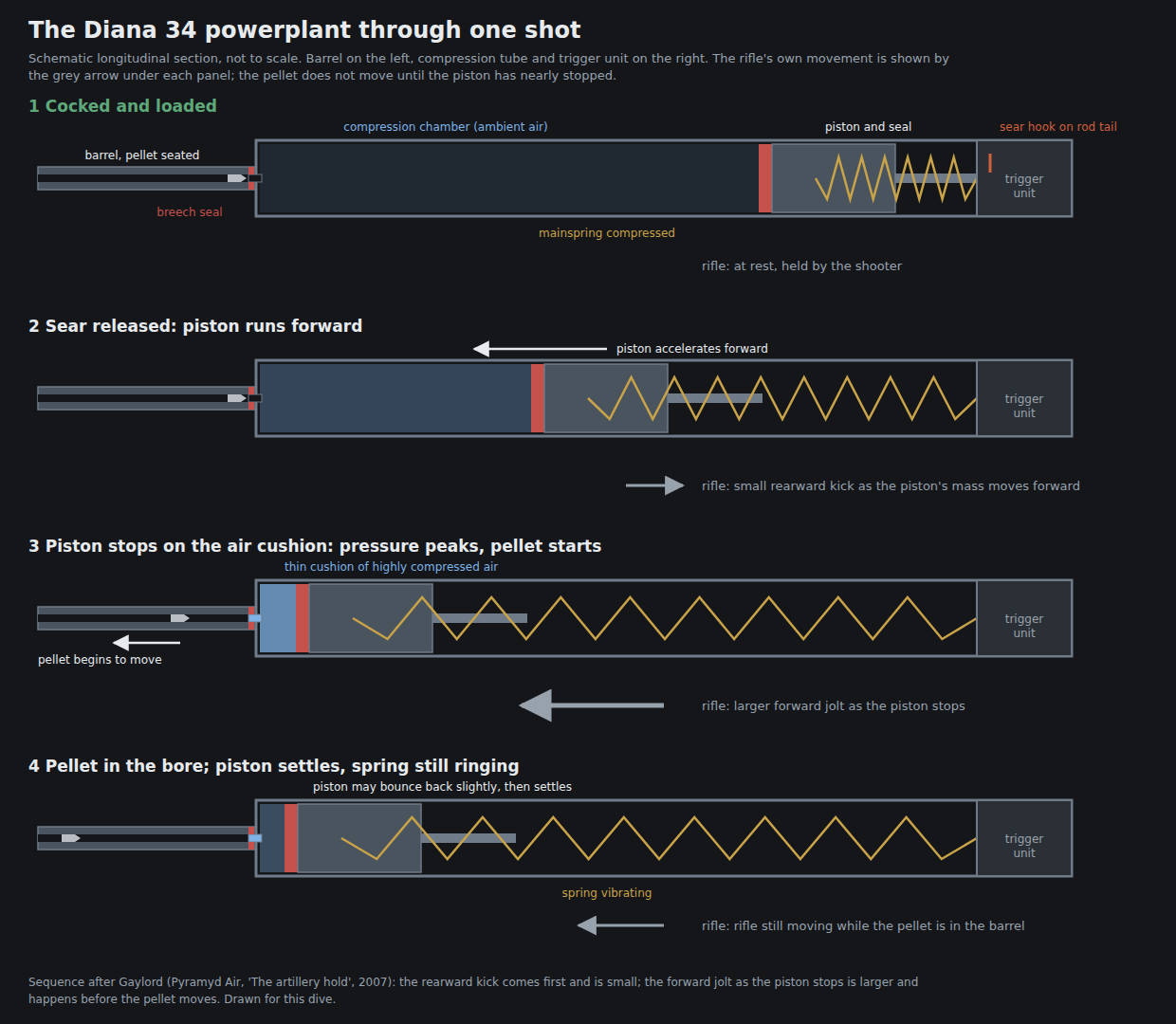
A spring-piston air rifle stores energy in a steel spring when it is cocked and gives it up in a few thousandths of a second when it is fired. Everything distinctive about shooting a Diana 34, the forward jolt, the sensitivity to how it is held, the way it destroys scopes, the occasional crack of a shot that is faster than the rest, follows from the order in which the parts move. This volume takes the rifle through one shot using the part names in Diana’s own parts list, and marks clearly which statements are Diana’s, which are a tester’s, and which are simply physics.
3.1 A Springer, Not a Catapult
The hub’s Daisy dive explains why a BB gun is not a scaled-down version of a rifle like this one: a loose steel ball cannot seal a bore, so Daisy’s lever guns shove the ball mechanically and then boost it with a puff of air (Daisy, Volume 5). The Diana 34 is the other kind of gun. Its lead pellet has a skirt that fills the rifling, the compressed air has nowhere to go but behind the pellet, and the air does all of the work. That is the design Daisy’s volume contrasts against, taken here in detail.
3.2 The Parts, by Diana’s Own Names
Diana’s spare-parts list for the T06 Mod. 34 names every part of the powerplant.1 The ones that take part in the shot are these.
Table 1 — The Parts, by Diana's Own Names
| Position | Diana’s name | Part | Function |
|---|---|---|---|
| 1–7 | Lauf kompl. | Barrel complete | Barrel pressed into its base block, with the breech lock and seal |
| 2 and 3, 4 | Druckfeder kompl., Stahlkugel | Locking spring, locking ball | The detent that holds the breech shut |
| 5, 6 | Scheibe 0,2; O-Ring 8x2,5 | 0.2 mm washer, O-ring 8 x 2.5 mm | The breech seal and the shim beneath it |
| 14 | Hebel | Cocking lever | Links the barrel’s base block to the piston |
| 17–20 | Zylinder kompl. | Compression tube | The cylinder, with the action forks at its front |
| 18 | Verschlusskegel | Locking cone | The ramp the locking ball rides over |
| 23–25 | Büchse, Linsenschraube, Schlitzmutter | Bushing, pivot screw, nut | The barrel pivot |
| 26–27 | Kolben mont., Kolbenmanschette | Piston with seal | Compresses the air |
| 28 | Druckfeder | Mainspring | Stores the cocking energy |
| 29–30 | Federführung kompl. | Spring guide | Keeps the spring straight inside the tube |
| 73 | Zylinderstift | Pin | Holds the trigger unit in the tube |
| 74 | Abschlussdeckel | End cap | Closes the rear of the tube; the safety passes through it |
| 31, 120–139 | Schloss komplett | Trigger unit complete | The sear, trigger, safety and cocking slide in one module |
In this layout the piston is hollow at the rear and the mainspring sits partly inside it. A rod runs back from the piston, through the middle of the spring and its guide, to the trigger unit at the back of the tube, and it is the tail of this rod that the sear catches. Diana’s drawing shows the rod as part of the piston assembly on the T06 rifle. On the 34 EMS, uniquely, it is a separate loose part inside the piston, so that a gas spring can take its place (Volume 2).2
3.3 Cocking
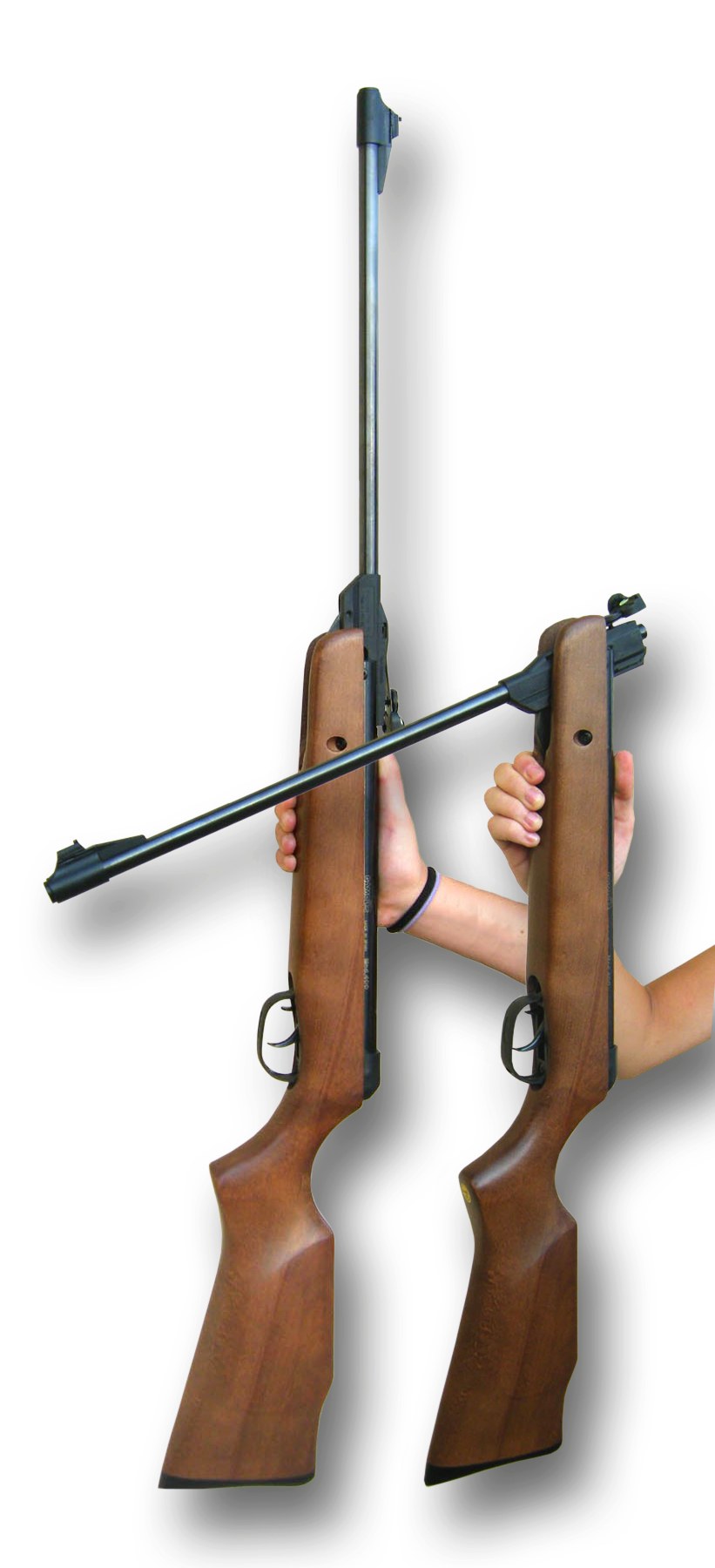
To cock the rifle the shooter breaks the barrel downward. Diana’s manual gives the whole instruction in one sentence: “Seize the stock with one hand. With the other hand, grasp the barrel near the muzzle and push the barrel down until you hear it engage with a click.”3
As the barrel swings down on its pivot, the cocking lever, hinged to the underside of the barrel’s base block, is pulled rearward. Its other end sits in a slot in the piston, reached through a slot in the underside of the compression tube, and it drags the piston back, compressing the mainspring behind it. At the end of the stroke the piston rod’s tail engages the sear in the trigger unit, which is the click. Diana adds that “the trigger and the safety engage automatically when the barrel has been moved to the break-action stop.”3
The piston is now held against the full force of the mainspring by a small hook in the trigger unit. Gaylord, who measures cocking effort with a bathroom scale, has recorded 31 and 32 pounds on new 34 Panthers and 34Ps, 29 pounds on a broken-in 34 EMS, 28 pounds on a rifle whose spring turned out to be broken, 35 pounds after that spring was replaced, and 25 pounds after a reduced-power tune.4 He states that “Diana rates the cocking effort of a model 34 at 33 pounds”; no Diana document giving that figure was found, and it is recorded as his.
3.4 Loading and Closing: The Ball Detent and the Breech Seal
With the barrel broken, the breech is exposed. Diana’s instruction is to “insert the pellet completely (flush) into the back of the barrel”, and then to “bring back the barrel to its original position”.3
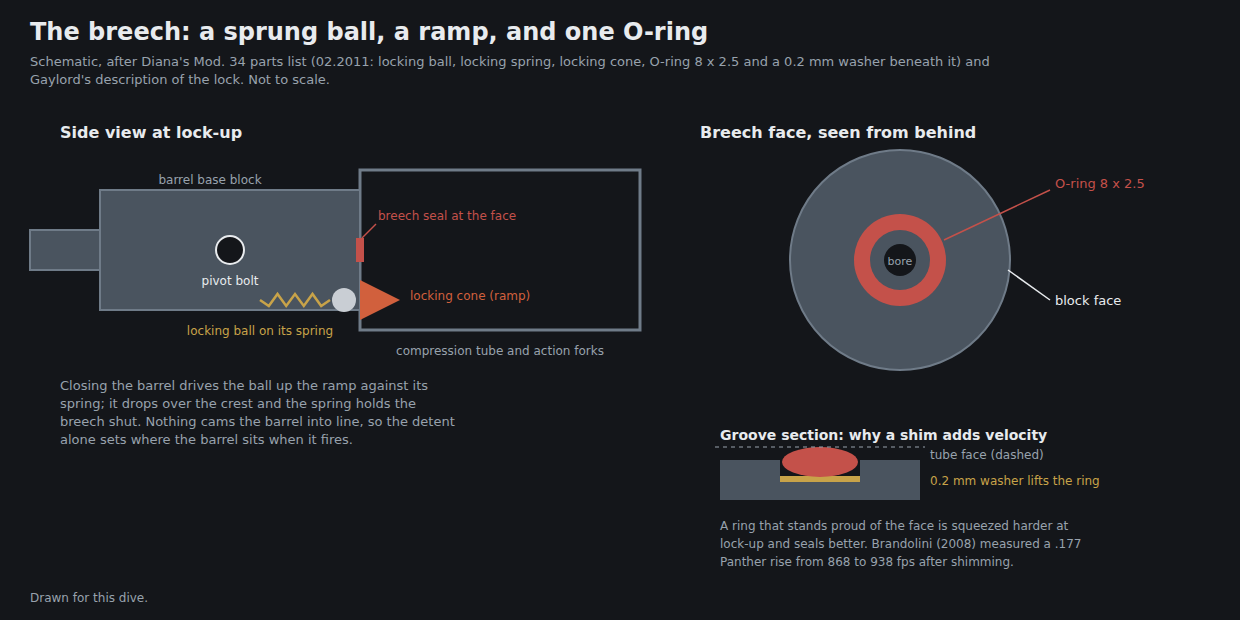
Closing the barrel does two things.
It locks the breech. Diana’s 34 uses a ball detent, not the wedge or chisel of many break-barrels. Gaylord describes it as “a ball bearing breech lock that rides over a steel inclined ramp, until the spring pushes the ball over the steel ramp to lock the breech. It is not a chisel detent, which means it can be lighter, yet still positive.”5 He adds that the ball “is held in place by two deep swages”, so that removing it “is a major exercise that involves machining”. Nothing cams the barrel hard against the tube: the detent spring alone holds the barrel in its firing position. That fact reappears in Volume 4 as one of the causes of barrel droop.
It seals the breech. Around the rear of the bore sits the breech seal, which Diana’s parts list identifies as a plain O-ring, 8 x 2.5 mm, over a 0.2 mm washer.1 When the barrel closes, the O-ring is squeezed against the face of the compression tube around the transfer port, the small hole through which the compressed air leaves the cylinder. Any air that escapes past it does no work. How much the seal matters was shown in 2008 by a guest writer on Gaylord’s blog, Vince Brandolini, who found that his .177 34 Panther gained speed when he added a thin shim under the O-ring: “the velocity (10-shot average, 7.9 Crosman Premiers) went from 868 to 938 fps — a 17% increase in power”.6 Volume 5 covers the shim and the seal as a repair.
3.5 The Trigger, the Sear and the Automatic Safety
The trigger unit is a self-contained module, which is why Diana sells it as one part (“Schloss komplett”) and why Gaylord calls Diana triggers “modular”.17 Within it, an upper hook (“Oberer Haken”) holds the piston rod’s tail; a lower lever (“Unterer Haken”) with its adjusting screw holds the hook; and the trigger blade moves the lower lever. Diana’s parts list does not name the parts “sear” and “sear catch”, and the exact geometry of the T06’s internal engagement is not described in any document located, so it is not reconstructed here beyond what the parts names show.
The trigger is two-stage: a light first stage takes up slack until the shooter feels resistance, and a firmer second stage releases the shot. On the T06, Diana’s manual assigns the three adjustment screws to “First-Stage Travel”, “Let-Off Point” and “Trigger Weight” and warns: “Please be aware that excessive adjustment may cause the air rifle to malfunction. If the trigger parameters are set too low (i.e. for very light release), this may even present serious safety risks.”3 Gaylord’s measurements of T06 let-off on 34s run from 1 pound 5 ounces to 1 pound 8 ounces; his T05 34P broke at 2 pounds 10 ounces, and a 1995 rifle at 3 pounds 6 ounces.78
The safety is automatic. Cocking pushes a slider out of the centre of the end cap, and “to disengage the safety, push the safety slider into the forward position.”3 It can also be applied by hand while the rifle is cocked. The safety blocks the trigger; it does not lock the piston. Gaylord’s warning from 2007 applies to every spring gun: “No safety is 100 percent safe, though, and you should always hold the barrel with the cocking hand when loading to catch it if the sear should slip.”9 An open barrel slammed shut by the mainspring can bend the barrel and injure the hand (Volume 4).
Two practical notes come from Gaylord’s work on 34s. A safety that will not come off sometimes needs to be pushed “both in and up with your thumb at the same time. Sort of wipe it up”, and it is off “when it barely sticks out of the black plastic end cap”.10 And on at least the 34 EMS, “it is possible to uncock this rifle by taking the safety off and pulling the trigger while restraining the barrel”; Diana’s manuals give no decocking procedure for any 34, and instead tell the owner to unload by shooting “in a safe direction at a safe target”.113
3.6 The Shot, in Order
When the trigger releases the sear, the sequence is as follows. The order of events is Gaylord’s, from his 2007 explanation of why springers must be held lightly; the physics is standard.12
- The piston starts forward. Released, the mainspring drives the piston and its seal forward along the tube. The piston is a large moving mass inside the rifle, and moving it forward pushes the rest of the rifle back: a small rearward kick. The pellet has not moved.
- The air is compressed. The piston sweeps the air in the compression chamber ahead of it towards the transfer port. The port is small and the pellet is still seated tight in the breech, so the air cannot escape as fast as the piston advances, and its pressure climbs steeply.
- The piston is stopped by the air. In Gaylord’s words, “the piston comes to a sudden stop at the end of the compression stroke, the jolt sends the rifle in the other direction (moving forward) and is much larger. The pellet has not started moving while this is happening. It sits in the breech as pressure behind it builds. When the piston comes to a stop against a thin cushion of highly compressed air, the pellet is finally overcome by the pressure and starts moving.”12
- The pellet goes down the bore. Once the pellet moves, the volume behind it grows and the pressure falls, and the piston “can settle to the end of the compression chamber”. Meanwhile “the mainspring is now vibrating wildly and sending additional vibrations into the rifle’s mass. All of this is going on while the pellet is still in the barrel.”12
The last point is the whole reason spring rifles are hard to shoot well. A firearm’s bullet leaves before most of the recoil has happened. A spring rifle’s pellet leaves after the piston has already jolted the rifle forward and while the spring is still ringing, so anything the shooter does to the rifle during that interval moves the pellet. Volume 6 takes that up as the artillery hold.
3.7 Why the Pellet Waits
A lead diabolo pellet seated flush in the breech is gripped by the rifling at its head and skirt. It will not move until the pressure behind it exceeds the force needed to push it into and along the rifling. That delay is not a defect. It is what lets the piston compress the air to a high pressure before any of it is spent on a moving pellet, and it is why a pellet that fits loosely, or one pushed too far forward, can shoot slower and less consistently. Gaylord noticed this on a Diana 48: its variable velocity “turned out to be the pellet fitting too loosely in the breech”.13
The pressure at which a pellet actually starts to move in a Diana 34 is not published. No measurement for this rifle was found in Diana’s documents or in the testing literature consulted, and none is given here. What can be said is qualitative and follows from the sequence above: the release comes at or near the end of the piston’s stroke, the air cushion in front of the piston at that moment is thin, and the pellet’s fit sets part of the timing.
3.8 Heat, Oil and Dieseling
Compressing air quickly heats it, because the work done on the gas goes into it faster than the steel around it can carry the heat away. The hub’s Daisy dive covers this at length, because the Daisy V/L deliberately used the same heating to ignite a propellant; its Volume 12 also shows how far apart the published temperature figures for that process are. No measured temperature for a Diana 34’s compression chamber was found, and none is given here.
In an air rifle the heat matters because of oil. A small amount of lubricant vaporised in the hot air ahead of the piston can ignite. Umarex USA, the US importer of RWS-branded air guns, defines it in its maintenance guidance: “Dieseling is the explosion created by the igniting of petroleum-based oil in the compression chamber due to the extreme air temperature created when the air rifle is discharged”, and it warns that “regular types of petroleum-based oils will cause your gun to diesel”.14
A little dieseling in a newly lubricated rifle is common; a loud one is a detonation. Gaylord recorded both on 34s. His new 34 EMS fired its first shot at 976 fps, against a string that averaged 919, which he threw out as “an obvious detonation”, and he saw “a spray of oil mist when the rifle fired” and “a lot of detonation back on Day One” before a heavy pellet calmed it.11 A 1995 rifle he re-lubricated and re-sprung “detonated once in 4 shots”, and in the next test its velocity with one pellet fell from 921 to 759 fps over thirteen shots as the excess burned off.8 He found soot on the crown of that rifle’s piston, and attributed it to dieseling.8 A detonation is more than a noise: it adds the energy of burning oil to the air ahead of the piston at the moment the piston is being stopped. No source located quantifies what repeated detonation does to a 34’s spring, seals or scope, and none is claimed here; the practical conclusion drawn by both the importer and the tuners is the same, to keep oil out of the compression chamber except in the small quantities they specify (Volume 5).
3.9 The Two-Way Recoil
The rifle’s own motion during the shot has two parts, in opposite directions. The piston’s forward launch pushes the rifle back, gently. The piston’s stop on the air cushion throws the rifle forward, harder. This is the reverse of what a firearm shooter expects and it is what makes a spring rifle so hard on its scope. Volume 4 develops the consequence with a diagram, and it can be stated here in one sentence: a scope and its mount have inertia of their own, and every forward jolt tries to leave them behind, so that over hundreds of shots they creep rearward along the rail unless something positive stops them.
The forward jolt is also why a spring rifle is not tamed by a firm grip. Gaylord’s discovery of the loose hold came from finding that a rifle held firmly shot worse, not better, and Volume 6 gives his measured comparison of holds.
3.10 Efficiency: How Much of the Spring Reaches the Pellet
Not all of the energy stored in the spring reaches the pellet. Some goes into moving the piston and spring, some into heat, some into friction and some leaks past the seals. Brandolini, the writer who shimmed his breech seals, is the only source located who compared the energy stored in his rifles’ mainsprings with the energy at the muzzle. He found his other springers “came out at over 30% efficient — except for the Panther which came in at less than 28%”, and after shimming the seal his .177 Panther reached 32.5 percent and a .22 Panther “close to 37%”.6 He did not publish his method for computing the stored energy, and the figures are his, from one owner’s rifles. They are given as the only measurement of their kind found, not as a property of the model.
3.11 Why Not to Dry-Fire It, or Leave It Cocked
Diana’s current 34 manual gives two cautions that follow directly from the mechanism:
- “Never leave the air rifle cocked for more than a few minutes as otherwise the piston spring can weaken.”3
- “Never dry fire the air rifle if there is no need, as this may cause damage.” The 34 EMS manual is more specific: firing without a pellet “may cause the piston to bottom out in the cylinder and result in permanent damage to the air rifle”.15
The second follows from the sequence of the shot. Without a pellet to hold the air back, the air escapes through the open bore, there is no cushion, and the piston and its seal hit the front of the cylinder at full speed.
The first is Diana’s instruction and is followed here. It is worth knowing that the only published test of the question found points the other way: Gaylord’s 1994 “Mainspring Failure Test”, reported in his Beeman R1 book and summarised on his blog in 2022, left four mainsprings in a different rifle cocked for 735 hours and found they retained between 93.25 and 96.93 percent of their power.16 That is one test, of one rifle type, and it does not override the maker’s instruction for this one.
3.12 The Gas-Spring Alternative
A gas spring, a sealed cylinder of pressurised gas in place of the coiled steel spring, is the main alternative powerplant for a break-barrel rifle. Diana makes gas-spring rifles under the name N_TEC and designed the 34 EMS to take one, but, according to Gaylord and to Vortek’s owner Tom Gore, never produced the gas spring for it.11 Vortek makes one. Gaylord’s test in December 2023 compared the same .177 34 EMS with its factory coil spring and with the Vortek unit:11
Table 2 — The Gas-Spring Alternative
| Pellet | Coil spring, fps (spread) | Vortek gas spring, fps (spread) | Gas spring energy |
|---|---|---|---|
| RWS Hobby, 7.0 gr | 927 (18) | 1,025 (9) | 16.33 ft-lbf |
| Air Arms Falcon, 7.33 gr | 919 (49) | 1,002 (9) | 16.35 ft-lbf |
| Norma Golden Trophy, 8.4 gr | 835 (17) | 917 (9) | 15.69 ft-lbf |
The gas spring was faster, far more consistent, and louder (109 dB against 101.3), and it raised the cocking effort from 29 to 35 pounds. It still needs a mainspring compressor to install, Gaylord notes, because the unit “is pressurized to 145 bar”.11 It fits only the EMS.
References
Footnotes
-
DIANA, “Mod. 34 Classic T06” spare-parts drawing and list, 02.2011, https://www.diana-airguns.de/media/41/2b/f7/1746515272/Mod.%2034%20Classic%20T06%20Visier%202010.pdf . Accessed 2026-09-19. Translations of part names are Diana’s own English column. ↩ ↩2 ↩3
-
Tom Gaylord (as B.B. Pelletier), “Diana 34 Easy Modular System (EMS) Synthetic: Part 6”, Pyramyd Air blog, December 2023, https://www.pyramydair.com/blog/2023/12/diana-34-easy-modular-system-ems-synthetic-part-6/ , read through an Internet Archive capture. Accessed 2026-09-19. ↩
-
DIANA, Instructions for Use, Mod. 34 / 34 Classic / Panther 34, version 05/2025, part 45400077, pp. 3–11, https://www.diana-airguns.de/media/19/65/48/1748330254/45400077_20250523_Bedienungsanleitung_Mod_Panther%2031-34%20Classic_Web.pdf . Accessed 2026-09-19. ↩ ↩2 ↩3 ↩4 ↩5 ↩6 ↩7
-
Gaylord, Pyramyd Air blog: “RWS Diana 34 Panther: Part 2” (June 2007); “Diana RWS 34P breakbarrel air rifle: Part 1” (October 2014); “Diana 34 EMS Synthetic: Part 2” (March 2021); “Checking out a Diana RWS 34P: Part 5” (July 2017); “RidgeRunner’s Diana 34 project: Part Five” (July 2023). All via Internet Archive. Accessed 2026-09-19. ↩
-
Gaylord, “RidgeRunner’s Diana 34 project: Part One”, May 2023, https://www.pyramydair.com/blog/2023/05/ridgerunners-diana-34-project-part-one/ , via Internet Archive. Accessed 2026-09-19. ↩
-
Vince Brandolini (guest author), “Shimming a Diana breech seal”, Pyramyd Air blog, April 2008, republished May 2017, https://www.pyramydair.com/blog/2017/05/shimming-a-diana-breech-seal-2/ , via Internet Archive. Accessed 2026-09-19. ↩ ↩2
-
Gaylord, “Checking out a Diana RWS 34P: Part 2”, June 2017, and “Diana RWS 34P breakbarrel air rifle: Part 1”, October 2014, via Internet Archive. Accessed 2026-09-19. ↩ ↩2
-
Gaylord, “RidgeRunner’s Diana 34 project”, Parts One to Four, May–June 2023, via Internet Archive. Accessed 2026-09-19. ↩ ↩2 ↩3
-
Gaylord, “RWS Diana 34 Panther: Part 1”, June 2007, https://www.pyramydair.com/blog/2007/06/rws-diana-34-panther-part-1/ , via Internet Archive. Accessed 2026-09-19. ↩
-
Gaylord, “RidgeRunner’s Diana 34 project: Part Five”, July 2023, https://www.pyramydair.com/blog/2023/07/ridgerunners-diana-34-project-part-five/ , via Internet Archive. Accessed 2026-09-19. ↩
-
Gaylord, “Diana 34 Easy Modular System (EMS) Synthetic”, Parts 2, 6 and 7, March 2021 and December 2023, via Internet Archive. Accessed 2026-09-19. ↩ ↩2 ↩3 ↩4 ↩5
-
Gaylord, “The artillery hold”, July 2007, https://www.pyramydair.com/blog/2007/07/the-artillery-hold/ ; and “The importance of the artillery hold”, April 2013, https://www.pyramydair.com/blog/2013/04/the-importance-of-the-artillery-hold/ ; both via Internet Archive. Accessed 2026-09-19. ↩ ↩2 ↩3
-
Gaylord, “Pro-Guide spring retainer system for RWS Diana rifles: Part 4”, September 2008, https://www.pyramydair.com/blog/2008/09/pro-guide-spring-retainer-system-for-rws-diana-rifles-part-4/ , via Internet Archive. Accessed 2026-09-19. ↩
-
Umarex USA, “Every 1000 Shots”, https://www.umarexusa.com/every-1000-shots . Accessed 2026-09-19. ↩
-
DIANA, Instructions for Use, 34 EMS, 15 January 2024, part 540.70.01.1, https://www.diana-airguns.de/media/39/b3/70/1711445342/540.70.01.1_20240115_Bedienungsanleitung_34_EMS_web.pdf . Accessed 2026-09-19. ↩
-
Gaylord, “How long can you leave that mainspring cocked?”, March 2022, https://www.pyramydair.com/blog/2022/03/how-long-can-you-leave-that-mainspring-cocked/ , via Internet Archive. Accessed 2026-09-19. ↩
Comments (0)