Diana (RWS) Model 34 · Volume 1
The Maker — Rastatt, a Lost Name, and Whose Rifle It Is Now
Mayer & Grammelspacher from 1890 to Ense, the forty years a Scottish firm owned the word Diana, and why an American owner calls a German rifle an RWS
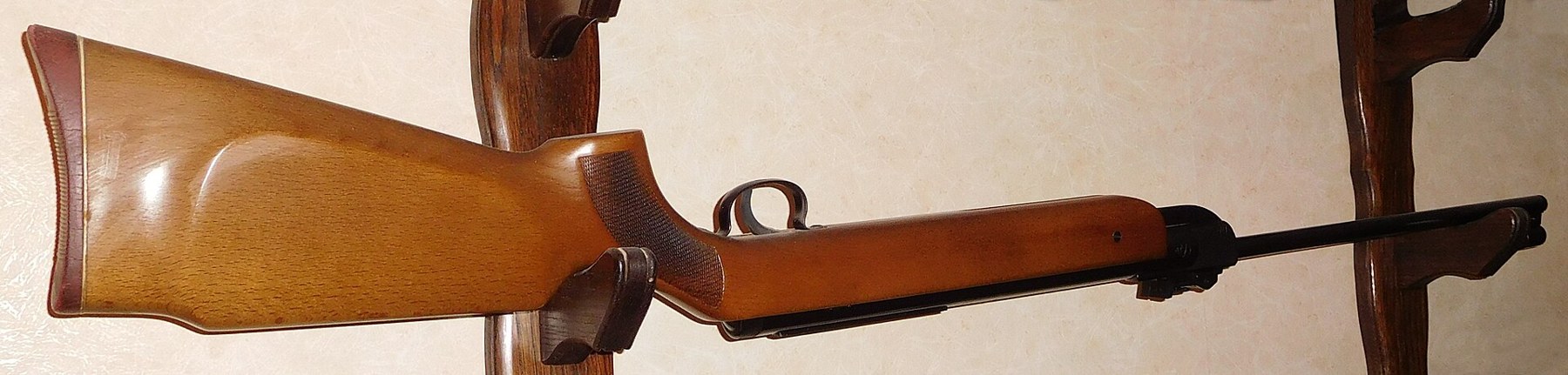
The Diana Model 34 is a single-shot, break-barrel, spring-piston air rifle made in Germany by DIANA Mayer & Grammelspacher. It has been in production, in one form or another, since 1984, and for most of that time it has been the rifle other spring-piston rifles in its price class were measured against. In the United States it has usually been sold under the name of its importer, RWS, which is why the owner’s inventory for the rifle documented in these volumes records its maker as “RWS” and its model as “Diana Model 34”.
This first volume sets out who made it. The company’s history is short on documents and long on repetition, and the one point every account of Diana should get right, that for nearly forty years after the Second World War the name Diana on an air rifle usually meant a Scottish product, is the one point the company’s own history page does not mention. Volume 2 covers the Model 34 itself and how to tell its generations apart. Volume 3 explains the powerplant. Volume 4 deals with barrel droop and scopes. Volume 5 is breakdown, maintenance and repair. Volume 6 covers pellets and the hold, and Volume 7 the law and the rifle on hand.
1.1 What the Rifle Is
The owner’s sheet gives five facts about the rifle: model “Diana Model 34”, manufacturer “RWS”, caliber 0.177, barrel “Rifled 19.5 Inches”, and a modification entry that reads simply “Scope”. The serial-number cell is blank. Every one of those facts fits the Diana Model 34 as sold in the United States from 1984 onward. None of them, on its own, says which generation of 34 this is, and the sheet does not say which scope is fitted or on what mount. Those questions are taken up in Volume 2 and Volume 7 and listed for the owner rather than guessed.
The first thing to establish is what the rifle is not. It is not a firearm. United States federal law defines a firearm as a weapon that will, is designed to, or may readily be converted to “expel a projectile by the action of an explosive”, and Michigan’s penal code uses essentially the same words.1 A spring-piston air rifle expels its pellet with air compressed by a piston. Michigan puts it in a category of its own, the “pneumatic gun”, which Volume 7 takes up in full. The distinction matters for the law and it matters for the physics, and the hub’s Daisy dive already makes the second point with an air-powered rifle that crossed the line: the Daisy V/L used a spring piston too, but only to heat air enough to light a propellant, which made it a firearm (Daisy, Volume 12). The Diana 34 does no such thing.
1.2 The Rifle in One Table
The figures below are the maker’s, from Diana’s 2026 catalogue and its current product pages, with the earlier published figures shown alongside where they differ. They are rated figures, not measurements of the rifle on hand.
Table 1 — The Rifle in One Table
| Diana, 2026 catalogue (34 Classic) | Diana flyer, March 2006 (34 Classic) | Blue Book of Airguns (Model 34, “new 1984”) | |
|---|---|---|---|
| System | Spring piston, break barrel | Spring piston, break barrel | Spring piston, break barrel |
| Calibers | 4.5 mm (.177), 5.5 mm (.22) | 4.5 mm (.177) | .177, .20 (discontinued), .22 |
| Rated velocity, .177 | 270 m/s, 890 fps | 290 m/s, 1,000 fps | 1,000 fps |
| Rated energy, .177 | 20 J, 14.8 ft-lbf | not stated | not stated |
| Barrel | 495 mm, 19.5 in | 495 mm, 19.5 in | 19.75 in |
| Overall length | 1,155 mm, 45.5 in | 1,150 mm, 45 in | 46 in |
| Weight | 3,200 g, 7.1 lb | 3.2 kg, 7.0 lb | about 7 lb |
| Trigger | T06, two-stage, three adjustments | ”match-type” | two-stage adjustable |
| Safety | automatic | automatic | not stated |
Sources: Diana catalogue 2026 pp. 16–17; Diana “New: 34 Classic” flyer, 2006; Blue Book of Airguns online, archived 2017.234
Two things in the table deserve a note. The first is the barrel length. Diana gives 495 mm, which is 19.49 inches, and the owner’s sheet says 19.5. The Blue Book’s 19.75 inches does not match Diana’s figure; it may describe an earlier barrel or a measurement that includes the muzzle cap, but no source says which. The second is the velocity. Diana rated the 2006 rifle at 1,000 fps and rates the current one at 890 fps and 20 joules, “measured with different lead pellets”, adding that “energy varies according to state laws”.2 The two ratings do not have to describe different rifles. A velocity rating is meaningless without a pellet weight, and a 20-joule rifle that shoots 890 fps is shooting a pellet of about 8.4 grains; the same energy in a 7-grain pellet is close to 1,000 fps. Volume 6 works that arithmetic through with measured strings.
1.3 Mayer and Grammelspacher, Rastatt, 1890
Rastatt is a garrison and baroque-palace town in Baden, near the Rhine and the French border. Diana’s own history page gives the founding plainly: in 1890 Jakob Mayer and Josef Grammelspacher founded “Mayer & Grammelspacher, Fabrik für Massenartikel der Eisen & Metallwarenbranche” in Rastatt, a factory for mass-produced iron and metal goods.5 It was not founded as a gun maker. The Blue Book of Airguns, the standard collector reference, dates the first air gun to about 1892, an air pistol that “showed a great resemblance to a Gaggenau patent taken on the Haviland & Gunn patent design of 1872”, cast chiefly in one piece of iron with its mainspring in the grip and marked only with the cast letters “MGR”, for Mayer & Grammelspacher, Rastatt.6
The English-language summaries of the company’s history add details that are not in either of those sources, such as Mayer’s age at the founding and Grammelspacher’s departure in 1901 “for reasons unknown”. They trace to a 1995 article by Larry Hannusch in US Airgun that was not obtained for these volumes, and they are not repeated here as fact.
1.4 A Patent and a Goddess
Two dates in the company’s own timeline matter for the Model 34.
The first is 1901. Diana’s history records that in that year Jakob Mayer received a patent for a “Verschlussvorrichtung für Luftgewehre mit Kipplauf”, a breech-locking device for break-barrel air rifles, “die bis heute in Millionen von Luftdruckwaffen Verwendung findet”: which is still used in millions of air guns today.5 The Blue Book describes it as “a spring-loaded wedge mechanism to serve as a detent lock on barrel-cocking airguns”.6 A spring-loaded detent holding the barrel shut is exactly how every break-barrel of this kind still works. It is worth noticing, though, that the Model 34 does not use a wedge. Its parts list names a steel locking ball on a locking spring bearing against a “Verschlusskegel”, a locking cone, and Tom Gaylord, who has tested more 34s in print than anyone, calls it “Diana’s time-honored ball-bearing detent”.78 The principle is Mayer’s; the part in the 34 is a ball. Volume 3 shows how it works.
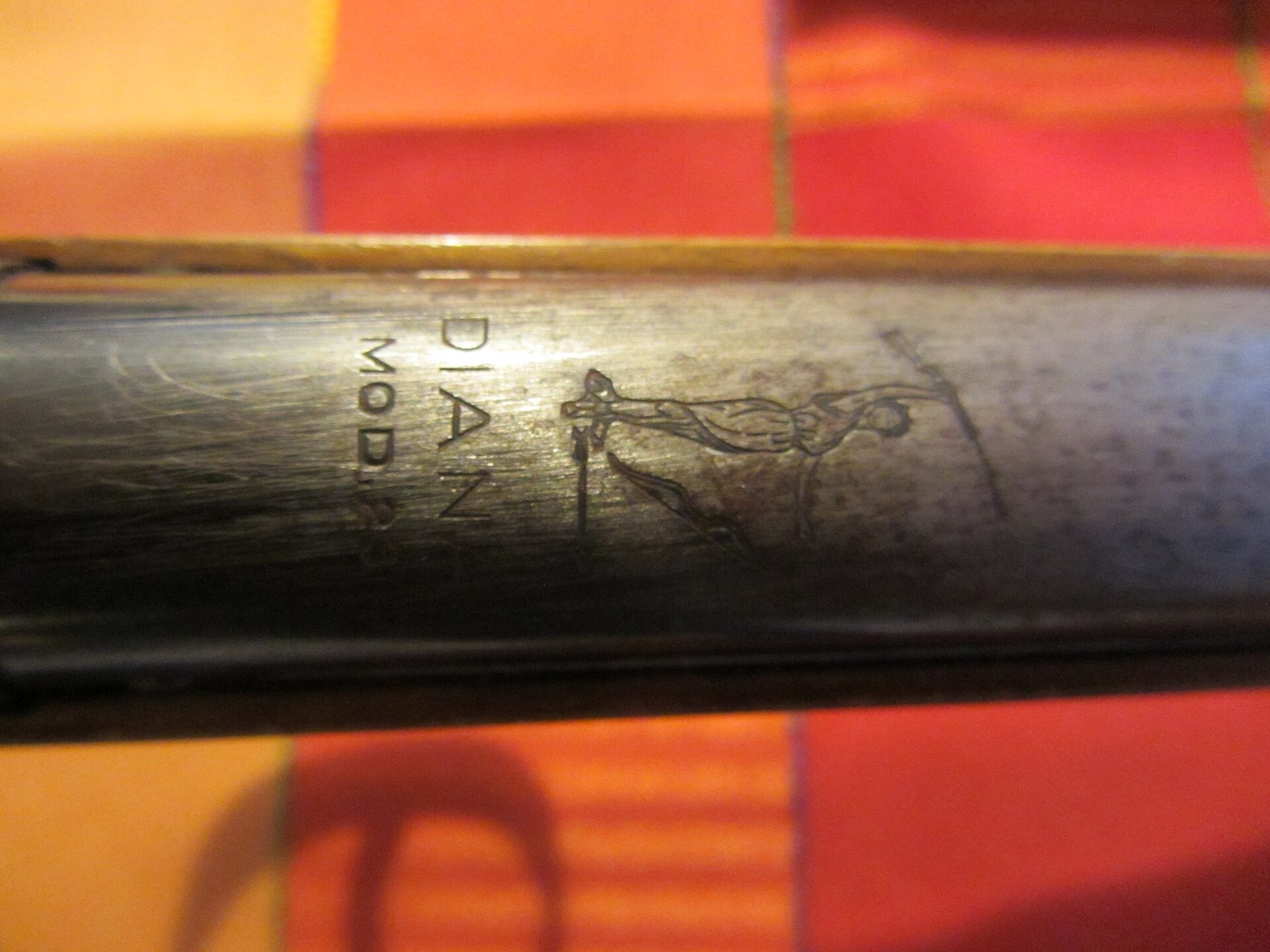
The second date is 1905, when, the company says, the name DIANA and its logo were introduced.5 The Blue Book is more cautious: “It is not known exactly when the famous Diana trademark, showing the hunting goddess Diana holding her air rifle aloft while standing on her discarded bow and arrows, was first used.”6 Diana also records a patent certificate from the imperial patent office dated 31 January 1908 in Mayer’s name, which it calls the first. The company’s own page therefore lists a patent in 1901 and a “first” imperial patent certificate in 1908. The two statements are not reconciled on the page; the likeliest reading is that the 1901 grant and the 1908 certificate are different instruments, but no document was found that says so.
The logo is the thing collectors remember. The figure at the head of this volume shows it on a Model 23: the goddess of the hunt with an air rifle over her head and the old weapons of the chase at her feet.
1.5 to 1949: Mauser Parts, Bombs and Dismantling
The inter-war company was a success. The Blue Book records that in 1930 a Model 25 sold for 25 marks, and it credits the growth of the firm to Mayer’s marketing as much as to his patents.6 Then the account darkens quickly. According to the Blue Book, from 1933 the new German government’s policies cost the company its trade-fair presence and forbade export to 28 countries; by 1940 civilian production had stopped and the works were making parts for Mauser at Oberndorf under the military maker’s code “lxr”; and Rastatt was heavily bombed.9
After the war the works were taken apart. Here the two main sources give different dates, and they are given separately. The Blue Book says the French occupied the area in 1945 and “Dianawerk was completely dismantled”.9 Diana’s own timeline says that “im Jahre 1947 erfolgt die völlige Demontage der Werksanlagen”, the complete dismantling of the works took place in 1947, and that rebuilding in Rastatt began in 1950.5 Occupation in 1945 and a dismantling completed in 1947 are compatible; a dismantling in 1945 and one in 1947 are not. These volumes do not choose between them.
1.6 Milbro: When a Scottish Firm Owned the Word Diana
What happened next is the part of the story most English-speaking owners half-know and the company’s own page leaves out.
The Blue Book gives it in one paragraph. The French sold “all of the company, including its machinery, old parts, and Diana trademark, to London-based Millard Bros. Ltd.” Under the abbreviated name Milbro, “the operation was moved to Motherwell in Scotland. The first Scottish ‘Dianas’ were produced in 1949.”9 The same paragraph says that the production of air rifles in Germany was then “subject to a death penalty”, which is how it explains the sale. No legal source for that claim was located, and it is not repeated here as established.
When the Allied Control Council again allowed air-gun production in 1950, the Mayer family restarted in their old factory in Rastatt, but without their name. The Blue Book’s list of what they sold instead is the single most useful paragraph in the company’s history for anyone looking at an old rifle: in Germany the rifles were sold as “Original”; to the Commonwealth, as “GECADO”; in England as “Condor”, “Firebird” or “Original Diana”; and under contract through large foreign firms “under the names of Winchester, Condor, Hy-Score, Beeman, Peerless, etc.”10 For roughly thirty-five years a rifle marked Diana was usually the Scottish product, and a rifle made in Diana’s own Rastatt works usually carried some other name.
The Scottish arm did not last. The Blue Book says that “by 1982, despite the advantage of the trademark, Milbro, using Dianawerk’s old machinery and materials, had gone out of business”, and that “Dianawerk repurchased their trademark in 1984.”10 English summaries that say the trademark came back “when Milbro went bust” in 1984 conflate the two dates.
1984 is also the year the Model 34 appears. The Blue Book lists it as “new 1984”.4 The rifle and the recovered name are the same age, and a 34 is therefore always a Diana: there is no “Original 34” or “Gecado 34” to confuse it with. There is, however, an earlier and unrelated Diana Model 34, made from 1928 to 1940, a .177 “similar to LG 33, except with British market style stock and pistol grip”.4 A pre-war rifle marked “Mod. 34” is not an early example of the rifle these volumes describe.

1.7 What the Company’s Own History Leaves Out
Diana’s history page is a timeline of about thirty entries from 1890 to 2025. It includes the founding, the 1901 patent, the 1905 name, the 1947 dismantling, the 1950 restart, the Model 60, the Olympic gold of 1988 (won, the page notes, with a Diana smallbore system), the 2014 takeover and the 2019 34 EMS.5 It says nothing at all about the years between 1949 and 1984: no Milbro, no Motherwell, no lost trademark, no “Original” and no “Gecado”.
That silence is the reason the rest of this volume relies on the Blue Book for the post-war decades, and the reason both are cited by name. A company history is a source for what the company chooses to record. It is not evidence that nothing else happened.
1.8 RWS: A Pellet Brand That Became a Rifle’s Name in America
The owner’s sheet records the maker as “RWS”. RWS never made the rifle. Gaylord put it bluntly in 2023, while stripping a reader’s 34: “no, it is NOT an RWS 34 — RWS doesn’t make airguns!”11 In 2014 he gave the arrangement in one line: “Diana of Germany is the manufacturer of this rifle. RWS USA imports it into this country. So, it’s really a Diana rifle; but because so many people are used to calling it an RWS, we also include that name in the title.”12
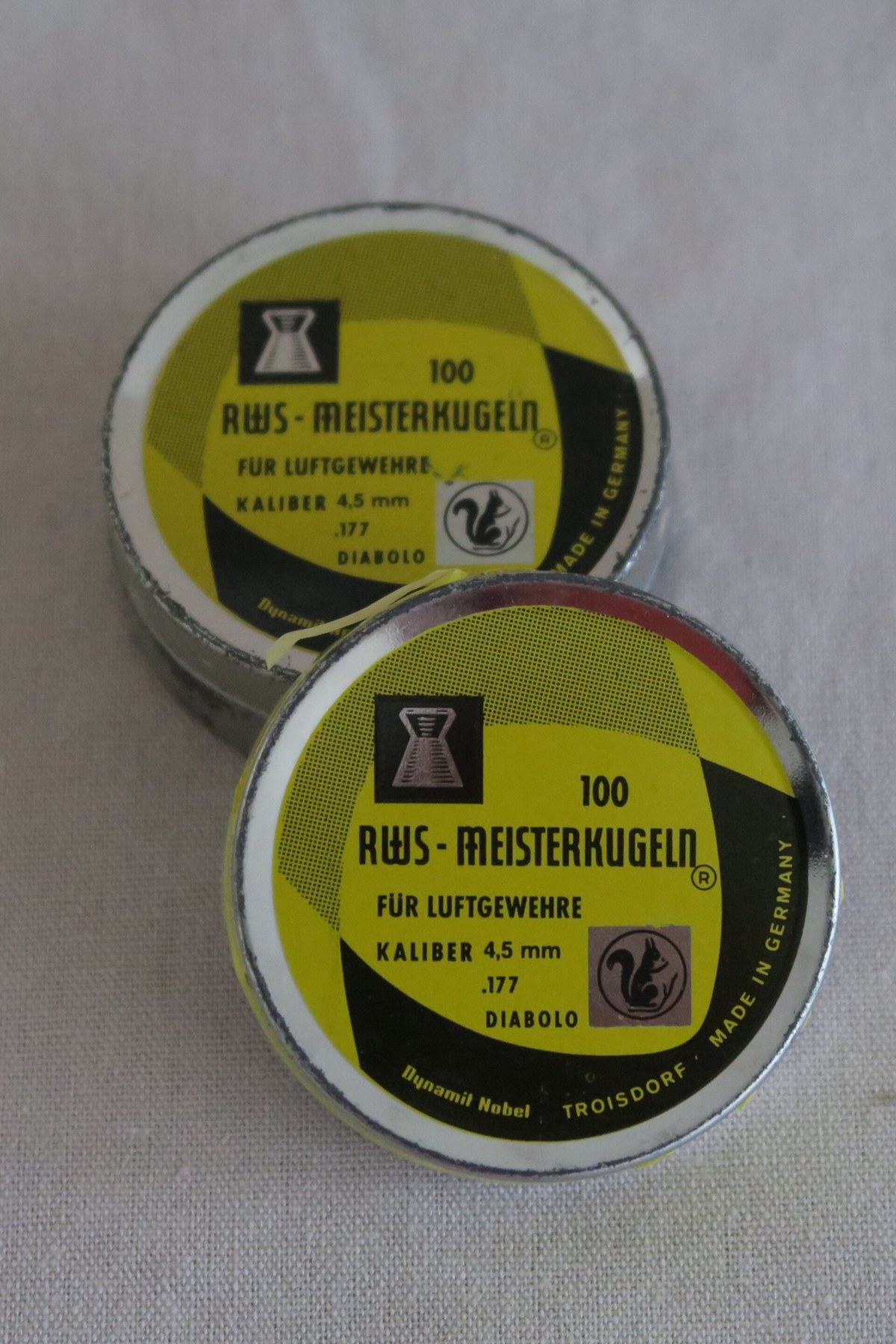
RWS is an ammunition name. Its air-gun pellets carry it; the 1970 pellet tins pictured below read “RWS-Meisterkugeln … Dynamit Nobel Troisdorf”, and Umarex USA still describes RWS Meisterkugeln as a pellet that “has been part of every ambitious air gun shooter’s equipment” for decades.13 The importing business that put the name on Diana rifles in the United States changed hands at least once. Gaylord, testing a new 34 Panther in June 2007, found its lifetime warranty card had been “issued by RUAG Ammotec, who sold their RWS USA franchise to Umarex two years ago”, which puts the change at about 2005; Umarex USA’s repair centre told him the US warranty was a limited lifetime warranty with 18 months on wear parts such as seals and mainsprings, while Diana’s own manual said two years.14
The present position in the United States could not be settled from the importer’s own site. In September 2026 Umarex USA’s RWS page listed RWS pellets, RWS spring cylinder oil and chamber lube, and an “RWS Lock Down” scope mount, and no rifles at all; its copy still described “German made RWS pellets from RUAG”.13 That is an observation about one web page on one day, not evidence that the import arrangement has ended, and the current US channel for new Diana 34s is listed in these volumes as unverified.
1.9 to 2026: German Sport Guns, Ense, and the End of Rastatt
Diana’s timeline records that in 2014 the company was taken over by German Sport Guns (GSG) of Ense, in North Rhine-Westphalia.5 GSG is best known in the United States for rimfire replicas. The German-language encyclopaedia entry on Diana reports that GSG is itself majority-owned by the L&O Holding of Emsdetten, the group that also owns SIG Sauer, J. P. Sauer, Blaser and Mauser; that ownership figure was not re-verified for these volumes.15
The move away from Rastatt can be followed in the company’s own legal notices, which German law requires every commercial site to publish. The Internet Archive holds four of them:16
Table 2 — 2014 to 2026: German Sport Guns, Ense, and the End of Rastatt
| Date of capture | Company name | Address given | Managing directors |
|---|---|---|---|
| February 2006 | Mayer & Grammelspacher Dianawerk GmbH & Co. KG | Karlstraße 34, Rastatt; register Rastatt | André Wirth, Kurt Pottiez |
| August 2021 | DIANA Mayer & Grammelspacher GmbH & Co. KG | seat Rastatt; postal Oesterweg 21, Ense; register Mannheim | Michael Swoboda, Florian Hasler |
| January 2023 and December 2024 | same | postal Auf den Geeren 23, Ense | Michael Swoboda, Florian Hasler |
| September 2026 (live) | same | Auf den Geeren 23, Ense | Michael Swoboda |
The VAT number is the same in 2006 and 2026, so this is one continuous legal entity that changed its name and moved its operations, not a new company trading on an old brand. Production of air guns at Rastatt ended in 2015, according to a Hard Air Magazine report from that year’s SHOT Show cited by the German encyclopaedia, and a regional newspaper reported in December 2024 that the old works stood empty while its conversion to housing was debated.15 Diana’s 2026 catalogue still describes the 34 Classic as “Made in Germany”.2
One loose end is recorded rather than tied. Writing in December 2023, Gaylord referred to “the original Diana corporation — not the guys who own the company today, the previous guys” as the designers of the 2019 34 EMS, and elsewhere to “Diana after the sale of the company”.17 Nothing in the legal notices shows a change of owner after 2014: the same entity, register numbers and managing director run from 2021 to 2026. Whether he meant the 2014 takeover, a change of management, or a sale not found here could not be determined.
1.10 What These Volumes Argue
The Model 34 is easy to underestimate. It was designed as the entry-level rifle in a line of three, it sold in the United States for about $90 in the 1990s, and Gaylord remembers its early examples as rifles that “buzzed when they fired like a mason jar full of hornets”.18 It is also one of very few spring-piston rifles that has been in continuous production for forty years, and it changed a great deal in that time while keeping its name. The generations differ in the parts an owner most needs to know about: the trigger, the piston that must match the trigger, the scope base, and the stock that tells them apart.
The volumes that follow argue five things. The first is that a 34 must be identified before anything is ordered for it, because a T06 trigger will not work with a T01 or T05 piston (Volume 2). The second is that the rifle’s peculiar handling, the two-way recoil and the need for a light hold, follows directly from the order in which things happen inside it (Volume 3). The third is that the 34’s barrel droop is real, large, and measurable, and that the fix is geometry rather than shims (Volume 4). The fourth is that the maker forbids home disassembly, the importer publishes a lubrication schedule, and the tuners who do open them agree on the procedure, and all three are set out with their sources (Volume 5). The fifth is that Michigan law treats a .177 air rifle differently from a .22 one in a way almost nobody notices (Volume 7).
References
Footnotes
-
18 U.S.C. § 921(a)(3), https://www.law.cornell.edu/uscode/text/18/921 ; MCL 750.222(e) and (g), https://www.legislature.mi.gov/Laws/MCL?objectName=mcl-750-222 . Both accessed 2026-09-19. ↩
-
DIANA Mayer & Grammelspacher, DIANA Katalog 2026, pp. 14–17 and 58, https://www.diana-airguns.de/media/da/0b/3b/1772108268/DIANA_Katalog_2026_web.pdf ; product pages at https://www.diana-airguns.de/Gewehre/Kipplauf/ . Accessed 2026-09-19. ↩ ↩2 ↩3
-
Mayer & Grammelspacher Dianawerk, “New: 34 Classic” flyer (PDF created 22 March 2006), formerly http://www.diana-airguns.de/fileadmin/pdf/DI_34_Classic.pdf , Internet Archive capture of 23 September 2006. Accessed 2026-09-19. ↩
-
Blue Book of Airguns, online edition, “DIANA (DIANAWERK) … Rifles”, Internet Archive capture of 23 October 2017, https://web.archive.org/web/20171023063306/http://bluebookofgunvalues.com/Airgun_Values/Manufacturers/DIANA_(DIANAWERK)_MAYER_AND_GRAMMELSPACHER_GmbH_AND_CO_KG/Categories/RIFLES?id=DIANA_DIANAWERK_MAYER_GRAMMELSPACHER_GmbH_CO_KG_RIFLES . Accessed 2026-09-19. ↩ ↩2 ↩3
-
DIANA, “Über uns … Historie”, https://www.diana-airguns.de/Informationen/DIANA/ . Accessed 2026-09-19. Translations here. ↩ ↩2 ↩3 ↩4 ↩5 ↩6
-
Blue Book of Airguns, “DIANAWERK 1892-1932: Birth of the Trademark”, Internet Archive capture of 21 October 2017, https://web.archive.org/web/20171021215651/http://bluebookofgunvalues.com/Airgun_Values/Manufacturers/DIANA_(DIANAWERK)_MAYER_AND_GRAMMELSPACHER_GmbH_AND_CO_KG/Categories/DIANAWERK_1892-1932__BIRTH_OF_THE_TRADEMARK?id=DIANA_DIANAWERK_MAYER_GRAMMELSPACHER_GmbH_CO_KG_DIANAWERK_1892_1932_BIRTH_OF_THE_TRADEMARK . Accessed 2026-09-19. ↩ ↩2 ↩3 ↩4
-
DIANA, “Mod. 34 Classic T06” spare-parts drawing and list, dated 02.2011, positions 2–4 and 18, https://www.diana-airguns.de/media/41/2b/f7/1746515272/Mod.%2034%20Classic%20T06%20Visier%202010.pdf . Accessed 2026-09-19. ↩
-
Tom Gaylord (as B.B. Pelletier), “RWS Diana 34 Panther: Part 2”, Pyramyd Air blog, June 2007, https://www.pyramydair.com/blog/2007/06/rws-diana-34-panther-part-2/ , read through an Internet Archive capture. Accessed 2026-09-19. ↩
-
Blue Book of Airguns, “DIANAWERK 1933-1949: Loss of the Trademark”, Internet Archive capture of 21 October 2017, https://web.archive.org/web/20171021163743/http://bluebookofgunvalues.com/Airgun_Values/Manufacturers/DIANA_(DIANAWERK)_MAYER_AND_GRAMMELSPACHER_GmbH_AND_CO_KG/Categories/DIANAWERK_1933-1949__LOSS_OF_THE_TRADEMARK?id=DIANA_DIANAWERK_MAYER_GRAMMELSPACHER_GmbH_CO_KG_DIANAWERK_1933_1949_LOSS_OF_THE_TRADEMARK . Accessed 2026-09-19. ↩ ↩2 ↩3
-
Blue Book of Airguns, “DIANAWERK 1950-1984: Regaining the Trademark”, Internet Archive capture of 21 October 2017, https://web.archive.org/web/20171021163941/http://bluebookofgunvalues.com/Airgun_Values/Manufacturers/DIANA_(DIANAWERK)_MAYER_AND_GRAMMELSPACHER_GmbH_AND_CO_KG/Categories/DIANAWERK_1950-1984__REGAINING_THE_TRADEMARK?id=DIANA_DIANAWERK_MAYER_GRAMMELSPACHER_GmbH_CO_KG_DIANAWERK_1950_1984_REGAINING_THE_TRADEMARK . Accessed 2026-09-19. ↩ ↩2
-
Gaylord, “RidgeRunner’s Diana 34 project: Part Two”, Pyramyd Air blog, June 2023, https://www.pyramydair.com/blog/2023/06/ridgerunners-diana-34-project-part-two/ , via Internet Archive. Accessed 2026-09-19. ↩
-
Gaylord, “Diana RWS 34P breakbarrel air rifle: Part 1”, Pyramyd Air blog, October 2014, https://www.pyramydair.com/blog/2014/10/diana-rws-34p-breakbarrel-air-rifle-part-1/ , via Internet Archive. Accessed 2026-09-19. ↩
-
Umarex USA, “RWS Rifles and Pellets”, https://www.umarexusa.com/rws . Accessed 2026-09-19. ↩ ↩2
-
Gaylord, “RWS Diana 34 Panther: Part 1”, Pyramyd Air blog, June 2007, https://www.pyramydair.com/blog/2007/06/rws-diana-34-panther-part-1/ , via Internet Archive. Accessed 2026-09-19. ↩
-
Wikipedia (German), “Diana (Waffenhersteller)”, citing Hard Air Magazine, “Diana News from SHOT Show 2015”, and Badische Neueste Nachrichten, 16 December 2024; used here only for those citations and flagged where not independently checked. https://de.wikipedia.org/wiki/Diana_(Waffenhersteller) . Accessed 2026-09-19. ↩ ↩2
-
DIANA legal notices (Impressum): Internet Archive captures of http://www.diana-airguns.de/impressum.php (8 February 2006) and https://www.diana-airguns.de/impressum (11 August 2021, 4 January 2023, 6 December 2024); live page https://www.diana-airguns.de/Informationen/Impressum/ . Accessed 2026-09-19. ↩
-
Gaylord, “Diana 34 Easy Modular System (EMS) Synthetic: Part 6”, December 2023, https://www.pyramydair.com/blog/2023/12/diana-34-easy-modular-system-ems-synthetic-part-6/ ; “Learn how it works”, December 2023, https://www.pyramydair.com/blog/2023/12/learn-how-it-works/ ; both via Internet Archive. Accessed 2026-09-19. ↩
-
Gaylord, “Checking out a Diana RWS 34P: Part 1”, June 2017, https://www.pyramydair.com/blog/2017/06/checking-out-a-diana-rws-34p-part-1/ ; “Diana RWS 34P breakbarrel air rifle: Part 2”, December 2014, https://www.pyramydair.com/blog/2014/12/diana-rws-34p-breakbarrel-air-rifle-part-2/ ; both via Internet Archive. Accessed 2026-09-19. ↩
Comments (0)