Diana (RWS) Model 34 · Volume 6
Pellets and the Hold — Weight, Velocity, and the Artillery Hold
What published chronograph strings from .177 and .22 Model 34s show about pellet weight and energy, why the rifle is hold-sensitive, and how to find the right hold for one rifle and one pellet
A spring rifle is fussier about its ammunition, and about how it is held, than any firearm most shooters own. Both facts follow from the mechanism in Volume 3: the pellet’s fit sets part of the timing of the shot, and the rifle is still moving while the pellet is in the bore. This volume collects the published chronograph and group data for the Model 34, nearly all of it from one tester, Tom Gaylord, and sets out the hold that makes the rifle shoot.
6.1 The Pellet in a Spring Rifle
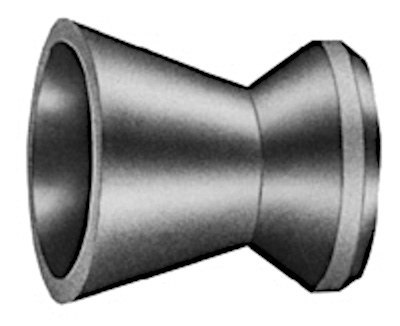
Air-rifle pellets are diabolos: a solid head, a narrow waist and a thin hollow skirt that flares to seal the bore. They come in four common head shapes, wadcutter (flat), domed (round), pointed and hollow point, and in a wide range of weights for each caliber. In .177 the weights used in the tests below run from 7.0 to 10.65 grains; in .22, from 11.9 to 14.5 grains.
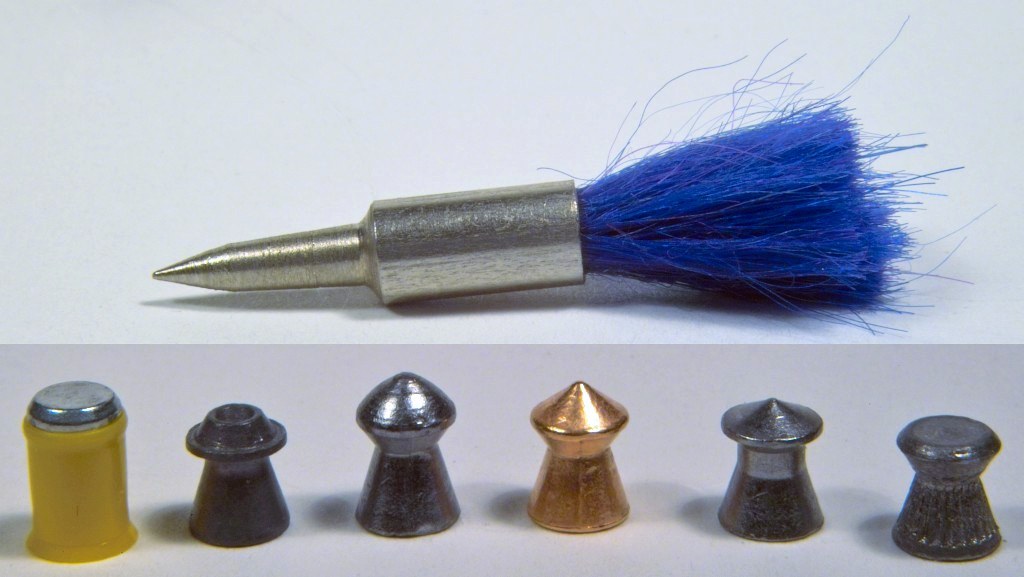
Diana’s manual has three pellet rules: “Use only the proper size and type of projectile as it is marked on the air rifle”, “Never reuse ammunition”, and “only use flawless pellets that match the calibre”, inserted “completely (flush) into the back of the barrel”.1
6.2 What a Rating Means
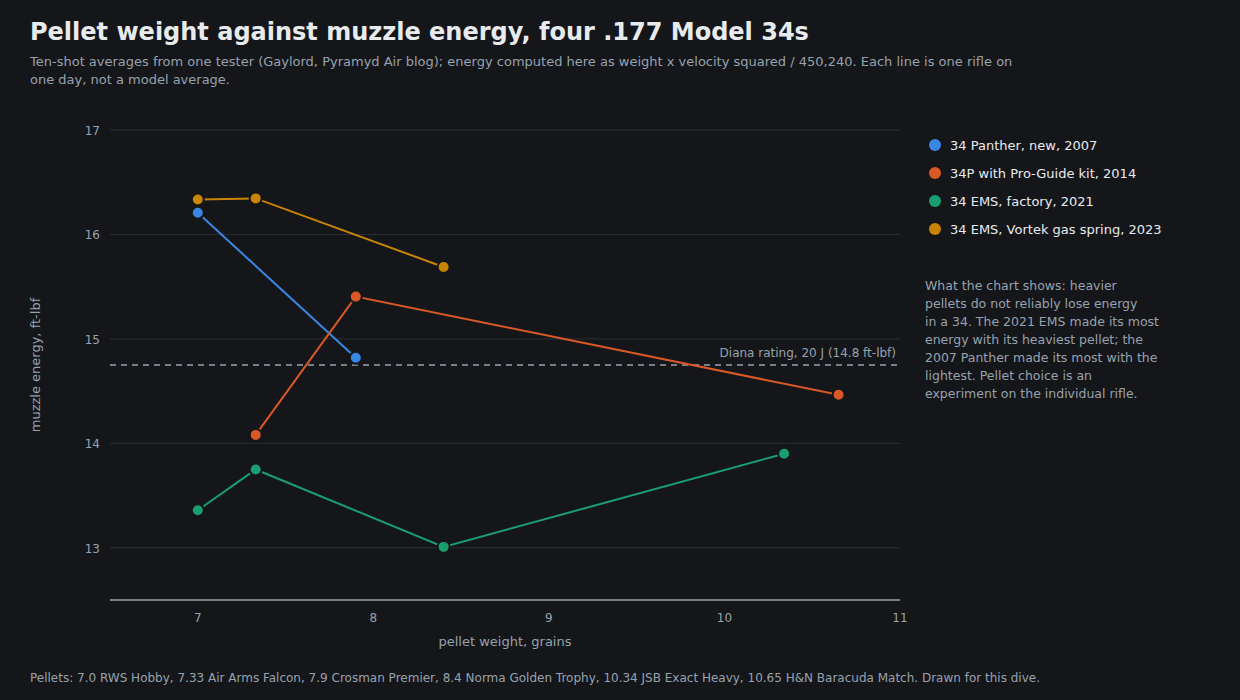
Diana rates the current .177 Model 34 at 270 m/s (890 fps) and 20 joules (14.8 ft-lbf), and the .22 at 225 m/s (740 fps) and 22 joules (16.2 ft-lbf), “measured with different lead pellets”.2 Energy in foot-pounds is the pellet weight in grains times the velocity in feet per second squared, divided by 450,240. So Diana’s two .177 figures describe a pellet of about 8.4 grains: 8.4 x 890 x 890 / 450,240 = 14.8. The same 20 joules would put a 7.0-grain pellet at about 974 fps, which is why the 2006 flyer’s rating of 1,000 fps and the 2026 rating of 890 fps do not by themselves say the rifle got weaker (Volume 1).3
A velocity rating with no pellet weight attached is therefore not a specification. An energy figure, or a velocity with the pellet named, is.
6.3 Published Strings from .177 Model 34s
Every string below is a ten-shot average from Gaylord’s Pyramyd Air blog reports, except where noted. Energy is computed here from his average velocity and the stated pellet weight. The H&N Baracuda Match is taken at 10.65 grains, the weight given for it in a later report; Gaylord notes that it “underwent a weight change” between his tests, so the 2007 and 2011 Baracuda rows are the least certain.4
Table 1 — Published Strings from .177 Model 34s
| Rifle and year | Pellet | Weight, gr | Average fps (range) | Energy, ft-lbf |
|---|---|---|---|---|
| 34 Panther, new, 2007 | RWS Hobby | 7.0 | 1,021 | 16.2 |
| Crosman Premier | 7.9 | 919 | 14.8 | |
| H&N Baracuda Match | 10.65 | 820 | 15.9 | |
| same rifle, T06 piston and Pro-Guide kit, 2011 | RWS Hobby | 7.0 | 1,021 (1,011–1,031) | 16.2 |
| Crosman Premier | 7.9 | 956 (937–971) | 16.0 | |
| H&N Baracuda Match | 10.65 | 801 (795–808) | 15.2 | |
| same rifle, 2014 | Air Arms Falcon | 7.33 | 930 (913–941) | 14.1 |
| Crosman Premier | 7.9 | 937 (923–958) | 15.4 | |
| H&N Baracuda Match, 4.52 mm head | 10.65 | 782 (771–792) | 14.5 | |
| 34 EMS, factory, 2021 | RWS Hobby | 7.0 | 927 (919–937) | 13.4 |
| Air Arms Falcon | 7.33 | 919 (892–941) | 13.8 | |
| Norma Golden Trophy | 8.4 | 835 (828–845) | 13.0 | |
| JSB Exact Heavy | 10.34 | 778 (770–796) | 13.9 | |
| same EMS, Vortek gas spring, 2023 | RWS Hobby | 7.0 | 1,025 (1,021–1,030) | 16.3 |
| Air Arms Falcon | 7.33 | 1,002 (998–1,007) | 16.4 | |
| Norma Golden Trophy | 8.4 | 917 (912–921) | 15.7 | |
| 1995 Model 34, suspect spring, 2023 | Crosman Premier Heavy | 10.5 | 709 (704–719) | 11.7 |
| JSB Exact RS | 7.33 | 857 (847–867) | 12.0 | |
| same rifle, Vortek PG4 12 ft-lbf kit, 2023 | Crosman Premier Heavy | 10.5 | 655, then 678 | 10.0, then 10.7 |
Sources: Gaylord 2007, 2011, 2014, 2021, 2023.45678 For the 1995 rifle, Gaylord gives 12.84 ft-lbf for the JSB Exact RS, a figure that implies a heavier pellet than the 7.33 grains used for that name elsewhere; the energy here is computed at 7.33 grains and the difference is not resolved.
Gaylord’s own 2006 summary of the model, before any of these tests, was that although “rated at 1,000 f.p.s. in .177, it actually achieves around 920-950 with light Hobby pellets and in the high 700s with heavier Beeman Kodiaks. That’s when the gun is running right.”9
6.4 Published Strings from a .22 Model 34
Table 2 — Published Strings from a .22 Model 34
| Rifle and year | Pellet | Weight, gr | Average fps (range) | Energy, ft-lbf |
|---|---|---|---|---|
| .22 34P, bought 2013, tested 2017 (spring later found broken at one end) | JSB Exact RS | 13.43 | 639 (629–654) | 12.2 |
| RWS Hobby | 11.9 | 736 (718–757) | 14.3 | |
| RWS Superdome | 14.5 | 701 (691–707) | 15.8 | |
| same rifle, Vortek kit, 2017 | JSB Exact RS | 13.43 | 627 (613–641) | 11.7 |
| RWS Hobby | 11.9 | 727 | 14.0 | |
| RWS Superdome | 14.5 | 689 (641–703) | 15.3 |
Source: Gaylord 2017.10 His 2006 summary for .22 was “the high 500s/low 600s with heavy pellets and the high 600s/low 700s with light pellets”.9
6.5 What the Numbers Show
Four things stand out, and each is stated only as far as the data go.
Heavier pellets do not reliably lose energy in a 34. The usual rule of thumb for spring rifles is that light pellets give more energy. In these strings it holds for some rifles and fails for others. The factory 34 EMS made its most energy, 13.9 ft-lbf, with its heaviest pellet, and Gaylord remarked that it was “tuned to favor heavier pellets — something not common in a spring-piston airgun”. The .22 34P made its most with the heaviest pellet tried, the 14.5-grain Superdome, and its least with the 13.43-grain JSB. The 2007 Panther made its most with the lightest.610
The pellet affects consistency as much as speed. On the same .22 rifle the JSB string spread 25 fps and the Superdome 16; Gaylord’s conclusion was that “maybe JSB Exact RS pellets are not well-suited to this rifle! They generate a lot less power and they have a much larger velocity spread. This is why owning a chronograph is so valuable.”10
A tune does not usually add power. The Pro-Guide kit, the Vortek kit and the reduced-power PG4 kit all left velocity about the same or lower. Vortek’s owner told Gaylord his kit “was designed to make the rifle perform at the factory spec, but with much longer spring life”.10 Only the gas-spring conversion added substantial speed.
Individual rifles differ more than models do. The 2021 EMS shot about 2 to 3 ft-lbf below the 2007 Panther with the same pellets. Nothing in the data separates the effect of the model from that of the individual rifle and its break-in.
6.6 Fit, Head Size and Seating
A pellet that fits loosely spoils a spring rifle’s shot, because the pellet moves before the air has built up behind it (Volume 3). Gaylord traced erratic velocity in a Diana 48 to exactly that: “the pellet fitting too loosely in the breech”.11 Some pellet makers sell the same design in several head diameters, and Gaylord’s 34P tests used H&N Baracudas with 4.52 mm and 4.53 mm heads; the 4.53 mm version gave his best group of that session.12
Seating matters too. Diana’s instruction is to push the pellet in “flush”. Gaylord reports that Diana “has long been criticized for having an angled breech that deforms the lower half of the pellet skirt when the barrel is closed”, and that the 34P he examined in 2017, bought in 2013, had a new “specially counterbored” breech, deeper at the top than the bottom, “to make the pellet sit parallel to the bore”. On that rifle, pellets that had been falling out stayed put once each was seated “deep into this new counterbored breech with the tip of my finger”.13 Some older rifles lack the counterbore (Volume 2).
6.7 Accuracy: Published Groups
All groups are ten shots, measured centre to centre, with the tester’s rest and hold noted.
Table 3 — Accuracy: Published Groups
| Rifle | Distance | Sights | Pellet | Group, in | Source |
|---|---|---|---|---|---|
| 34 Panther, new, 2007 | 35 yd | scope | Crosman Premier 7.9 | 0.460 (a single group) | Gaylord 20074 |
| same rifle, T06, 2011 | 25 yd | scope | Crosman Premier 7.9 | 0.443 | Gaylord 20115 |
| same rifle, 2014 | 25 yd | scope | H&N Baracuda Match 4.53 | 0.572 | Gaylord 201512 |
| Crosman Premier 7.9 | 0.848 (8 in 0.442) | ||||
| .22 34P, 2017 | 25 yd | open | JSB Exact Jumbo Heavy | 0.76 | Gaylord 201714 |
| 25 yd | scope | RWS Superdome | 0.70 | ||
| 34 EMS, 2021 | 10 m | open | JSB Exact Heavy 10.34 | 0.392 | Gaylord 20216 |
| 25 yd | scope | Crosman Premier Heavy 10.5 | 0.619 | ||
| 50 yd | scope, rested on bag | JSB Exact Heavy 10.34 | 1.348 | ||
| 1995 Model 34, tuned, 2024 | 25 yd | scope | JSB Exact 8.44 | 1.4 (6 in 0.19, outside) | RidgeRunner 202415 |
| 50 yd | scope | H&N Baracuda Match | 2.8 (5 in 0.76) |
Gaylord notes that ten-shot groups “are approximately 40 percent larger than 5-shot groups with the same rifle”.14 The 2024 result is the most instructive on the list: six of ten shots in one ragged hole, the other four spread over more than an inch. Gaylord’s comment was that the owner “has found the correct place to balance his Diana 34 but he isn’t doing it consistently”, and his advice was “to get the rifle off the bag and use the artillery hold”.15
6.8 Why the 34 Is Hold-Sensitive
Volume 3 sets out the order of events: the piston starts forward and kicks the rifle gently back; it stops on the compressed air and throws the rifle forward, harder; only then does the pellet move; and the spring is still vibrating while the pellet is in the bore. Whatever the shooter’s hands do in that interval is imparted to the pellet. Gaylord: “It is physically impossible for a shooter to overcome these movements by holding the rifle tight, so Gaylord found that by holding it as loose as possible and allowing the rifle to move as much as it wanted to, the movements would tend to be the same every time.”16
The point is not that the rifle must not move. It is that it must move the same way every shot. Gaylord’s analogy is the one that named the technique: a field gun “moves a lot during recoil, yet the gun is extremely accurate over a huge distance … because the gun moves the same way every time”.16 He traces the same principle to a firearm source, the benchrest shooter Harvey Donaldson in American Rifleman, May 1936: “The secret of fine rest shooting is to hold the rifle so it will be free to recoil in the same way for each shot.”17
6.9 The Artillery Hold
Gaylord named the hold after discovering it on a Beeman C1, when a rifle that shot “about one-third inch” at 10 meters with the recommended firm grip shot 0.13 inch when he “laid the forearm across my open palm and caressed the wrist only enough to pull the trigger”. He is explicit that he did not invent it: “People had been holding firearms that way for decades.”18 His description of how it is done:16
- Forearm on the flat of the open palm. “Do not grasp the stock with your fingers or you create new nodes that dampen the vibrations of the rifle.”
- Grip hand as light as possible, the trigger finger pulling “STRAIGHT BACK”.
- Butt resting lightly on the shoulder, “Do not pull it in tight.”
- “Lay the gun”: aim with the body relaxed. “Align the sights then close your eyes and relax. When you open your eyes again, the sights should still be on target. If they moved off, the pellet would have gone in the same direction.” Repeat until the sights stay put, then fire.
On a bench, the hand rests on the bag and the rifle rests on the hand: “we don’t normally rest the rifle directly on sandbags or other rests. Instead, we rest it on our hands, which are placed on the rest.”17
Gaylord’s measured comparison of holds was made with a Beeman R8, not a 34, and is given as evidence about spring rifles in general. At 25 yards, with ten shots each: rested directly on the bag, 0.593 inch; a firm “deer hunter” hold, 0.949 inch, strung horizontally “due to tense muscles”; a light hold without settling in, 0.728 inch with four wild shots; the artillery hold with the hand at the trigger guard, 0.475 inch; and the same hold with the hand far forward, 0.405 inch.19
6.10 Where the Hand Goes
The off hand’s position along the stock changes where the rifle’s vibrations are damped and how the rifle balances, and on a 34 it changes the group. Gaylord’s recorded positions:
- In 2006: “I like putting my open palm under the start of the cocking slot.”9
- On the 2007 Panther: “the rifle on the flat of my open palm just in front of the triggerguard. Yes that makes the gun muzzle-heavy.”4
- On the 34P in 2015, the same rifle preferred different positions with different pellets: Crosman Premiers grouped with “the classic artillery hold — with my off hand back near the triggerguard”, and scattered when he moved the hand forward; Baracudas grouped best with the hand slid “about 2 inches up the cocking slot”. His conclusion: “Premier lites want the classic artillery hold, and Baracuda Match pellets want the off hand slid forward. That seems odd, but I’m never completely surprised by anything a spring-piston rifle wants to do.”12
- On the .22 34P in 2017, moving the hand between the front, middle and rear of the cocking slot moved the point of impact; the best group came with the hand “touching the front of the triggerguard”, and with a scope, with “the heel of that hand just touches the front of the triggerguard and my left index finger is in the rear of the very long cocking slot”.14
- On the thumbhole-stocked 34 EMS, “a true artillery hold isn’t possible, but I held the rifle as loosely as possible”, with the hand at the rear of the cocking slot.6
The position that works is the one found by testing a given rifle with a given pellet.
6.11 Is the Hold Always Necessary?
Not always. In his second R8 test, Gaylord found that rifle “capable of shooting groups just as tight when rested directly on a sandbag as when held with the artillery hold”, its best group of 0.379 inch coming off the bag, and he says the same of the TX200. He added that “this test required the utmost in precision holding — whether in the hands or on the bag. There could be absolutely no tension on the rifle.”19 He shot the 34 EMS at 50 yards “rested directly on the sandbag”.6 The principle underneath the hold is consistency and the absence of tension; the open palm is the most reliable way to get it, not the only way.
6.12 A Method for One Rifle
The sources support a simple procedure for a given 34, and the rifle documented here has no recorded data of its own yet.
- Chronograph first. Ten shots each of three or four pellets across the weight range, recorded with the date. This is the baseline the maintenance schedule in Volume 5 depends on, and it shows which pellets the powerplant likes before accuracy is tested.
- Group at a known distance with the two or three most consistent pellets, ten shots each, using the artillery hold with the hand at the trigger guard.
- Move the hand a few inches forward, then to the middle of the cocking slot, with the best pellet, and repeat.
- Keep the rest the same between comparisons: same bag, same hand position on it, same shoulder pressure.
- Only then change the scope or mount, and only if the groups are good and the zero moves (Volume 4).
6.13 Lead, and Lead-Free Pellets
Diana’s manual warns that “lead pellets are toxic to humans and animals”, that handlers should not touch mouth, eyes or nose and should “wash your hands after handling lead pellets”, and carries the California Proposition 65 lead warning.1 Lead-free pellets exist for the 34. In a guest report on his tuned 1995 rifle at 10 yards, RidgeRunner put ten H&N Field Target Trophy Green (5.71 grains) and ten H&N Baracuda Green (6.64 grains) into 0.63 inch each, against 0.41 inch for the lead H&N Field Target Trophy.20 No chronograph data for lead-free pellets in a 34 were found.
References
Footnotes
-
DIANA, Instructions for Use, Mod. 34 / 34 Classic / Panther 34, version 05/2025, part 45400077, pp. 4–7, https://www.diana-airguns.de/media/19/65/48/1748330254/45400077_20250523_Bedienungsanleitung_Mod_Panther%2031-34%20Classic_Web.pdf . Accessed 2026-09-19. ↩ ↩2
-
DIANA, Katalog 2026, pp. 14–17, https://www.diana-airguns.de/media/da/0b/3b/1772108268/DIANA_Katalog_2026_web.pdf . Accessed 2026-09-19. ↩
-
Mayer & Grammelspacher Dianawerk, “New: 34 Classic” flyer, 2006, Internet Archive capture of 23 September 2006 of http://www.diana-airguns.de/fileadmin/pdf/DI_34_Classic.pdf . Accessed 2026-09-19. ↩
-
Tom Gaylord (as B.B. Pelletier), “RWS Diana 34 Panther”, Parts 2 to 4, Pyramyd Air blog, June–July 2007, https://www.pyramydair.com/blog/2007/06/rws-diana-34-panther-part-2/ , read through Internet Archive captures. Accessed 2026-09-19. ↩ ↩2 ↩3 ↩4
-
Gaylord, “Comparing the T05 trigger to the T06”, Parts 2 and 3, June 2011, https://www.pyramydair.com/blog/2011/06/comparing-the-t05-trigger-to-the-t06-part-2/ , via Internet Archive. Accessed 2026-09-19. ↩ ↩2
-
Gaylord, “Diana 34 Easy Modular System (EMS) Synthetic”, Parts 2 to 5, March–September 2021, https://www.pyramydair.com/blog/2021/03/diana-34-easy-modular-system-ems-synthetic-part-2/ , via Internet Archive. Accessed 2026-09-19. ↩ ↩2 ↩3 ↩4 ↩5
-
Gaylord, “Diana 34 Easy Modular System (EMS) Synthetic: Part 7”, December 2023, https://www.pyramydair.com/blog/2023/12/diana-34-easy-modular-system-ems-synthetic-part-7/ , via Internet Archive. Accessed 2026-09-19. ↩
-
Gaylord, “RidgeRunner’s Diana 34 project”, Parts One and Five, May and July 2023, https://www.pyramydair.com/blog/2023/05/ridgerunners-diana-34-project-part-one/ , via Internet Archive. Accessed 2026-09-19. ↩
-
Gaylord, “RWS Diana 34”, August 2006, https://www.pyramydair.com/blog/2006/08/rws-diana-34/ , via Internet Archive. Accessed 2026-09-19. ↩ ↩2 ↩3
-
Gaylord, “Checking out a Diana RWS 34P”, Parts 2 and 5, June–July 2017, https://www.pyramydair.com/blog/2017/06/checking-out-a-diana-rws-34p-part-2/ , via Internet Archive. Accessed 2026-09-19. ↩ ↩2 ↩3 ↩4
-
Gaylord, “Pro-Guide spring retainer system for RWS Diana rifles: Part 4”, September 2008, https://www.pyramydair.com/blog/2008/09/pro-guide-spring-retainer-system-for-rws-diana-rifles-part-4/ , via Internet Archive. Accessed 2026-09-19. ↩
-
Gaylord, “Diana RWS 34P breakbarrel air rifle”, Parts 2 and 3, December 2014 and January 2015, https://www.pyramydair.com/blog/2015/01/diana-rws-34p-breakbarrel-air-rifle-part-3/ , via Internet Archive. Accessed 2026-09-19. ↩ ↩2 ↩3
-
Gaylord, “Checking out a Diana RWS 34P: Part 2”, June 2017, https://www.pyramydair.com/blog/2017/06/checking-out-a-diana-rws-34p-part-2/ , via Internet Archive. Accessed 2026-09-19. ↩
-
Gaylord, “Checking out a Diana RWS 34P”, Parts 3 and 5-2, June–July 2017, https://www.pyramydair.com/blog/2017/06/checking-out-a-diana-rws-34p-part-3/ , via Internet Archive. Accessed 2026-09-19. ↩ ↩2 ↩3
-
RidgeRunner (guest author), with editor’s summary by Gaylord, “RidgeRunner’s Diana 34 Project: Part Seven”, February 2024, https://www.pyramydair.com/blog/2024/02/ridgerunners-diana-34-project-part-seven/ , via Internet Archive. Accessed 2026-09-19. ↩ ↩2
-
Gaylord, “The artillery hold”, July 2007, https://www.pyramydair.com/blog/2007/07/the-artillery-hold/ , via Internet Archive. Accessed 2026-09-19. ↩ ↩2 ↩3
-
Gaylord, “The importance of the artillery hold”, April 2013, https://www.pyramydair.com/blog/2013/04/the-importance-of-the-artillery-hold/ , via Internet Archive, quoting Harvey Donaldson, “Rest Shooting and Schuetzen Loading”, American Rifleman, May 1936, as reprinted in Yours Truly, Harvey Donaldson (Wolfe, 1980). Accessed 2026-09-19. ↩ ↩2
-
Gaylord, “The Beeman C1: Part 1 — the rifle that created the artillery hold”, May 2009, https://www.pyramydair.com/blog/2009/05/the-beeman-c1-part-1-the-rifle-that-created-the-artillery-hold/ , via Internet Archive. Accessed 2026-09-19. ↩
-
Gaylord, “Testing the effect of hold on an accurate spring-piston air rifle”, Parts 1 and 2, August–September 2013, https://www.pyramydair.com/blog/2013/08/testing-the-effect-of-hold-on-an-accurate-spring-piston-air-rifle/ , via Internet Archive. Accessed 2026-09-19. ↩ ↩2
-
RidgeRunner (guest author), “RidgeRunner’s Diana 34 Project: Part Six”, November 2023, https://www.pyramydair.com/blog/2023/11/ridgerunners-diana-34-project-part-six/ , via Internet Archive. Accessed 2026-09-19. ↩
Comments (0)