Diana (RWS) Model 34 · Volume 5
Keeping It Working — Breakdown, Maintenance and Repair
What Diana permits, what the importer's schedule says, how the tuners strip a 34 against a compressed mainspring, which parts wear, and what they cost in September 2026
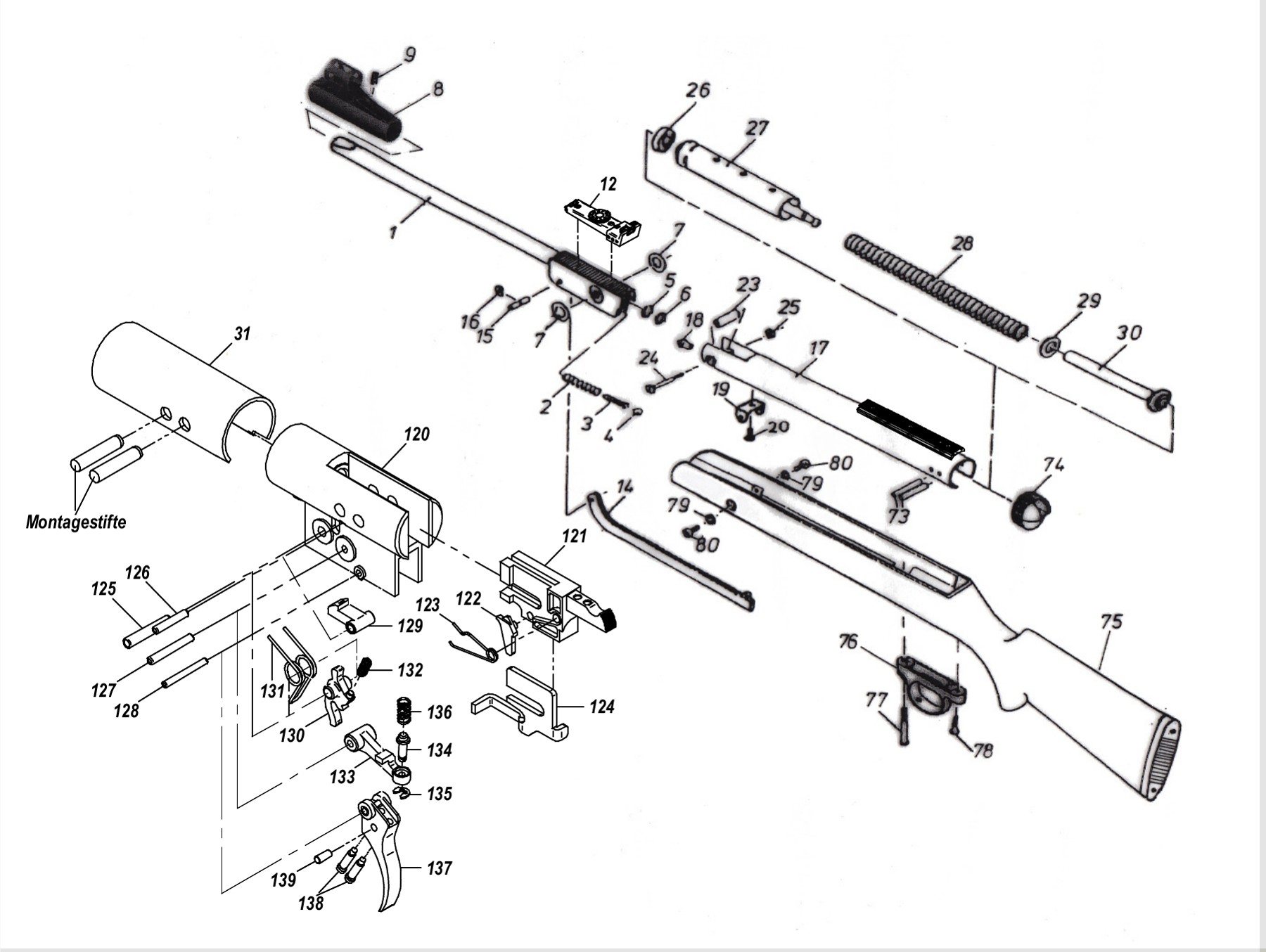
This volume is the working manual for the rifle. It draws on four kinds of source, and it keeps them apart. Diana’s own manuals say what the maker permits an owner to do, which is very little. Diana’s parts lists name every part and give its part number. The US importer, Umarex USA, publishes a lubrication schedule. And the tuners, above all Tom Gaylord, who has stripped more 34s in print than anyone, describe how the rifle actually comes apart. No Diana workshop manual or disassembly procedure for the 34 was found, and the procedure given here is the tuners’, attributed to them throughout.
5.1 Three Authorities That Do Not Agree
The maker says: do not open it. Diana’s current manual for the 34, 34 Classic and Panther 34 opens with a caution in capitals: “Warranty is void if the rifle is dismantled without authorization. All repairs must be made by authorized personnel.” Its safety list repeats it: “Do not attempt to disassemble or tamper with the air rifle. Unauthorized repairs or functional modifications may render it unsafe and will void your warranty.”1 The manual gives no stock removal, no lubrication schedule and no disassembly of any kind.
The importer says: oil it every 1,000 shots. Umarex USA’s guidance, written for air rifles generally rather than the 34 specifically, names five points to lubricate “at 1000 shot intervals (or after every two tins of 500 count RWS pellets)”, some of which require the stock to come off.2
The tuners say: grease it once and leave it. Gaylord has written that “the Diana seal is self-lubricating”, and Vortek, the most widely used maker of 34 tune kits, sells a piston seal it says needs “no special, expensive super lubes”.34 After a kit is fitted, Gaylord judged the lubrication good for “probably … a good 10 years”.5
These do not have to be reconciled to be used. The maker’s rule governs the warranty; a rifle old enough to have outlived its warranty, on a bench equipped with a spring compressor, is in a different position. The importer’s schedule is for an unopened factory rifle. The tuners’ practice is for a rifle that has been opened and re-lubricated. The sections below say which is which.
5.2 The Stored Energy Warning
A cocked 34 holds its mainspring compressed against a small hook. An uncocked 34 still holds its mainspring under a large preload. Gaylord measured a 1995 rifle’s spring standing “at least three inches, if not more” proud of the tube once released: “There was an extraordinary amount of pretension on the mainspring.”6 The end cap and trigger unit are what hold that spring in, and they are held in turn by two cross-pins. Pull the pins without restraint and the trigger unit and spring leave the tube with all of that energy.
Gaylord learned it on another rifle: “The heavy solid steel end cap got away from me, sailed across the room and broke a desk drawer divider in two! Had my arm been there instead, I’m thinking it might have been broken … I instantly understood the need for a mainspring compressor!”7 Of the 34 specifically: “Diana 34s are not difficult to work on if you have a mainspring compressor, but it’s next to impossible without one.”8 Vortek’s gas-spring conversion for the 34 EMS is no safer to fit without one: it is “pressurized to 145 bar” and still needs a compressor to install.9
The rules that follow from this are not optional. The rifle must be uncocked and unloaded before any work. The pins are never removed unless the trigger unit is held by a compressor. Eye protection is worn, as Diana’s manual requires for “performing maintenance on the air rifle”.1 And nobody stands behind the compressor’s axis while it is let down.
5.3 What the Owner May Do Under the Manual
Diana’s manual allows the owner four things.1
- Adjust the sights. Rear-sight elevation screw: clockwise lowers the point of impact; windage screw: counter-clockwise moves the point of impact right if it is too far left.
- Adjust the trigger, unloaded and uncocked, with a flat-head screwdriver: screw for first-stage travel, screw for let-off point, screw for trigger weight, with the warning that settings that are too light “may even present serious safety risks” (Volume 3).
- Clean the barrel: “Use a cleaning rod appropriate for the caliber of the barrel, along with suitable cleaning agents”, break the barrel open until it clicks, “clean the barrel with some gun oil. Insert the cleaning rod from the back of the barrel. Do not remove the barrel seal.” Then: “After cleaning, relieve the tension of the piston spring. To do so, shoot in a safe direction at a safe target.” Outside metal is wiped “using a cloth which has been slightly dampened with some gun oil”.
- Clear a jammed pellet: repeat the loading steps without loading another pellet; if it still does not fire, “cock the air rifle and leave the barrel open. The safety will automatically engage”, and push the pellet out with a rod “from the muzzle end, ensuring not to damage the muzzle or the inside of the barrel.”
The 34 EMS manual adds the replacement of its front sight base.10 That is the whole of the maker’s permitted maintenance.
5.4 Taking the Action Out of the Stock
No Diana document describing stock removal was found. Diana’s parts list shows what holds the action in the stock: a trigger guard, part 76, fastened by a countersunk screw and a wood screw, parts 77 and 78, and two screws with toothed washers, parts 79 and 80, through the fore-end into the stock retainer on the compression tube.11 Umarex USA notes only that “some air rifles require the stock be removed” to reach the mainspring.2
From the parts list and the tuners’ accounts, a stock removal must account for the following, in no particular authority’s order: the rifle uncocked and unloaded; the fore-end screws and the trigger-guard screws removed; the barrelled action lifted out; and, on reassembly, the plastic rear cap through which the safety passes. Gaylord’s warning about that cap is specific: “Don’t forget the plastic rear cap that the safety passes through. If you do, everything has to come out of the stock for a do-over.”12 He also checks stock-screw tightness first when a 34 will not group.13
5.5 Detail Strip: The Tuners’ Procedure
The sequence below is assembled from Gaylord’s published strip-downs of a 34P in 2017, a 1995 34 in 2023 and a 34 EMS in 2023, with one reassembly detail from his 2008 work on a Diana 48, which uses the same pinned trigger block. It is a tuner’s procedure, not Diana’s, and doing it voids the warranty.14
- Stock off (above), rifle uncocked and unloaded.
- Compressor on. “Put a little tension on the end cap.” Gaylord’s 2017 compressor “spans the Diana safety and presses in on the back of the trigger — exactly where you want it”; in 2023 he used “a deep wall socket to press in on the trigger assembly. That takes tension off the two crosspins.”14 Of all Diana break-barrels from about 1980 on he writes: “two pins hold the powerplant together.”9
- Pins out. With the load taken by the compressor, “the two crosspins then came out with finger pressure”, or with a pin punch.14
- Let the spring down. Back the compressor off slowly until “all tension is off”. On one rifle “the trigger block is pushed out this far by the mainspring” before tension was gone.14
- Trigger unit, spring guide and mainspring out. The trigger comes out as one module.
- Barrel off, to free the piston. “The barrel has to come off for this, because the cocking link must be separated from the piston body.” The 34 “has a pivot screw that comes out easily”; the pivot itself is a hollow bushing the screw passes through, with thin washers either side. With the pivot screw out, the barrel slides out of the action forks.14
- Piston out of the front of the tube.
On the 34 EMS the barrel need not come off to change the powerplant, because Vortek’s EMS kit replaces the loose piston rod and slides into the existing piston.9 The same was true of Vortek’s PG4 kit in an older 34: “I didn’t have to take the barrel off because this kit just slides inside!“8
5.6 Reassembly, and the Traps in It
Reassembly reverses the strip, and Gaylord’s accounts are full of the places it goes wrong.1215
- Piston before barrel. “The piston has to go into the rifle when the barrel is off the spring tube, so the cocking link will fit into the piston’s cocking slot.” Then the base block goes back into the forks, with the pivot washers either side of the bushing.
- The piston seal and the tube’s slots. Seals are cut on the sharp edges of the cocking slot as the piston goes in. Gaylord found his 34P’s original seal “chipped in a couple places” and afterwards “was very careful to tuck in the new seal past all sharp edges of the mainspring tube as the piston slid in, which is usually where such damage happens”; with a tight aftermarket seal he “had to use a screwdriver to ease it past all the cutouts”.15
- Aligning the pins. “The tricky part is getting the two holes to line up all the way through the both sides of the spring tube and also the trigger assembly. I have found that putting the rear pin in first sometimes helps, but I have also put the front pin in first at times. When the holes align the pins will go through with finger pressure.” Rotating the trigger unit by pushing on the trigger helps align them.12 A tapered punch helps draw the holes into line.16
- The trigger unit’s own pins. “Watch the three crosspins in the trigger assembly. They are very loose and want to fall out, but putting them back can be difficult because spring tension in the assembly pushes the holes they pass through out of alignment.”12
- Release the trigger before the second pin. From the Diana 48 procedure: “When the rear pin is all the way in, pull the trigger once to release it. If you don’t, you’ll discover later that the rifle won’t cock and the safety slide will be stuck.”16 And later: “make sure that the safety doesn’t slip into lockup as the trigger unit goes in. That happened to me and required another strip-down to correct.”16
- The rear cap before the action goes back in the stock.
5.7 What Any Correct Procedure Must Account For
Because no maker’s procedure exists, it is worth stating what any correct one has to handle, independent of the tuners’ order of steps: the mainspring’s preload, which exceeds three inches on a factory spring; the two cross-pins that alone retain it; the trigger unit’s loose internal pins; the piston’s coupling to the cocking lever, which cannot be undone without removing the barrel on non-EMS rifles; the piston seal’s passage past the tube’s slots; the matching of piston to trigger generation (Volume 2); the release of the trigger during pinning; and the rear cap. A procedure that ignores any of these either fails or injures someone.
5.8 Cleaning and Lubrication
The bore. Diana’s instruction is a rod from the breech, “some gun oil”, and the seal left in place.1 Umarex USA’s schedule adds a nylon bore brush with cleaner, patches until clean, a final lightly oiled patch, cleaning from the breech “if possible”, and a warning: “Do not allow the bore cleaner to make contact with any seals/o-rings.”2 Gaylord’s own practice with a new 34 Panther was a bronze brush with bore paste, which he did against the manual, saying “I am not recommending that you do the same”; he found a deliberate-feeling constriction near the muzzle while doing it, and inferred that “Diana has intentionally choked the bore”.17
The importer’s five points. Umarex USA’s schedule, every 1,000 shots, uncocked and unloaded:2
Table 1 — Cleaning and Lubrication
| Point | What and how much | Why, per Umarex USA |
|---|---|---|
| Piston seal | ”two drops of RWS Chamber Lube down in the compression chamber port” (through the transfer port, barrel broken) | Seal moves smoothly, wears less; a worn seal loses velocity |
| Breech seal | ”one drop of RWS Chamber Lube to the outer edge” | A dry seal leaks and loses velocity |
| Mainspring | ”6 drops of RWS Spring Cylinder Oil”; the stock may have to come off | ”Maintain proper flex and free movement” |
| Trigger hinges and barrel pivot | ”Just one drop” of Spring Cylinder Oil | Prevent sticking |
| Barrel | cleaned as above | Debris and rust cost velocity and accuracy |
It closes with the warning that governs all of it: “Too much lubrication can be damaging to your air rifle.” And it is explicit that anything in the compression chamber must be “a non-petroleum based lubricant. Regular types of petroleum-based oils will cause your gun to diesel” (Volume 3).2
The tuners’ lubrication. When a 34 is opened, the tuners grease rather than oil. On a 1995 rifle Gaylord used “moly grease” on the cocking-link end and the slots in the piston and tube where the link slides, on the pivot washers and bushing, a proprietary spring grease on the mainspring, and “a couple drops” of a light oil in the cocking-link joint.12 With a Vortek kit he lubricated “the piston seal (very sparingly), the rear of the piston body and the mainspring with the special grease that came in the Vortek kit”, on the kit maker’s advice that the seal “will wear in to become incredibly slick with use, so it doesn’t need much lubrication”.5 The ball detent benefits from lubrication too: a new rifle that was hard to break open improved once he “lubed the ball bearing detent”.8 The cost of overdoing it is dieseling, sometimes violent, until the excess burns off; one 34 he re-greased “detonated once in 4 shots”.12
5.9 The Inspection Schedule
Diana’s manual asks for “inspection and maintenance of the air rifle at regular intervals” and a check after any drop.1 It gives no intervals. The schedule below combines the importer’s interval with the checks the tuners report making.
Table 2 — The Inspection Schedule
| When | Check | Source |
|---|---|---|
| Every session | Breech seal present, not torn or flattened; stock screws and pivot tight (barrel should stay where it is put when broken open); scope mount and stop not moved | Umarex USA; Gaylord 2017213 |
| After any drop | Function, sights, scope zero | Diana manual1 |
| Every 1,000 shots | The importer’s five lubrication points | Umarex USA2 |
| Periodically, and whenever it “feels different” | A ten-shot chronograph string with a known pellet, recorded, compared with the last | Gaylord 2017, 2022, 202318 |
The last line matters more on a 34 than on most rifles, for a reason given below: its commonest serious failure makes the rifle feel better, not worse.
5.10 Malfunctions and Their Diagnosis
Table 3 — Malfunctions and Their Diagnosis
| Symptom | Likely causes, in order | What to do | Source |
|---|---|---|---|
| Velocity down, rifle feels normal | Breech seal leaking or not proud enough; pellet too loose in the breech | Inspect and shim or replace the O-ring; try a tighter pellet | Brandolini 2008; Gaylord 20081916 |
| Velocity down, rifle smoother and easier to cock | Broken mainspring, one or both ends | Chronograph to confirm; replace the spring | Gaylord 2017, 202218 |
| A bump or hesitation near the end of the cocking stroke | Broken plastic spring guide; or the guide’s mouth deformed by the piston rod | Replace or ream the guide | Gaylord 2006, 20232012 |
| Barrel very hard to break open on a new rifle | Ball detent not broken in, dry | Lubricate the detent; it eases with use | Gaylord 20238 |
| Will not cock after reassembly; safety stuck | Trigger not released during pinning; safety locked up as the unit went in | Strip and repin, releasing the trigger | Gaylord 200816 |
| Safety will not come off | Slider needs to be pushed in and up together | ”Sort of wipe it up” | Gaylord 20238 |
| Smoke, loud cracks, erratic fast shots | Excess or petroleum lubricant dieseling | Stop oiling the chamber; shoot heavier pellets until it settles | Umarex USA; Gaylord 2021, 20232912 |
| Buzz or twang after the shot | Clearance between spring, guide and piston; dry spring | A tune kit with close-fitting guides | Gaylord 2008, 2017165 |
| Groups open or the zero wanders | Mount creeping; scope wound up near its limit; hold inconsistent | Volume 4 and Volume 6 before touching the powerplant | Gaylord 2012, 2017 |
| Front sight element broken | The fibre-optic element is fragile | Keep the hood on | Gaylord 2007, 20141721 |
| Rear sight will not adjust | Elevation screw missing (sometimes removed for a scope) | Replace the screw | Gaylord 20236 |
5.11 The Breech Seal
The breech seal is the cheapest part on the rifle and the one most worth checking. Diana’s parts list calls it an O-ring, 8 x 2.5 mm, part number 30031200, with a 0.2 mm washer, part number 30031300, beneath it.11 Vortek sells a “Diana 34 Breech Seal” that it describes as an O-ring that “fits snug into breech grove of the Diana/RWS 34”, for $1.25 as listed on 19 September 2026.4
Replacing it is a matter of picking out the old ring without scratching the groove and pressing in a new one. The more interesting repair is the shim. Brandolini’s 2008 procedure: remove the O-ring; “you may or may not find a factory shim under the ring. Both my Panthers had shims”; punch a washer to fit the groove and put it under the ring so that the seal “protrudes far more prominently”. He measured the groove of a closely related rifle at about .540 inch outside and .340 inch inside, and made shims from coffee-can plastic about .015 inch thick and soda-can aluminium about .005 inch, noting that “Diana uses steel”. His .177 Panther went from 868 to 938 fps; his .22 Panther from under 600 to over 700. “There’s no set rule” for how much to add, “and frankly I don’t know of any way of telling beyond trial and error”; he reports that the wax-paper leak test “didn’t work for me”.19 A chronograph is the judge.
5.12 The Piston Seal
Diana lists the piston seal (“Kolbenmanschette”) as part 30236600, with a different seal, 30071600, for the reduced-power F rifle, and the piston complete with its seal as 30777000 or, for the F rifle, 30777100.11 Gaylord found the factory seal in good condition on every rifle he opened for this purpose, including one “like new” in a rifle with a broken spring.5
Aftermarket seals are listed by Vortek, whose “ProSEAL28” is described as CNC-machined urethane “impregnated” with molybdenum disulfide, at $16.95, and by ARH, whose “Apex Large Seals, Diana, RWS34-54” were $12.95, on sale at $10.90, on 19 September 2026.422 Fitting a tight aftermarket seal is not trivial: Gaylord took 45 minutes over a Vortek seal, finding that “the seal material likes to be warmed by flexing, before it will hook the flared top of the piston.”5
5.13 The Mainspring: Fatigue and Breakage
Two different things happen to a 34’s mainspring, and they have different symptoms.
Breakage. The 34 has a known weakness here. Gaylord: “An older Diana from 1986 to 2000 will often have a broken mainspring from improper stress relief … One inch of spring will be broken off one end of the mainspring. Sometimes it’s an inch off both ends of the spring.” The broken piece winds into the rest of the spring, “with the result that the airgun will shoot smoother than it ever has”. The problem is “still happening today, though not as often as it used to. It takes a chronograph to find it because the rifle will shoot smoother than ever.”18 On a .22 34P he found a spring broken “about one inch from the end on the spring guide end”, with a cant in the last coil at the other end. His rule of thumb for the loss: with one end broken the rifle “will have the same velocity”; “when the other end breaks, as it often does, the rifle gets even smoother and easier to cock. But at that point a .22 will lose about 150 f.p.s.”18 He also mentions that “Diana has had problems in the past from over-hardening their mainsprings”.5
Fatigue and bending. A spring can also take a set, shorten and bend without breaking. A 1995 rifle Gaylord opened had a spring “bent in several places”, rubbed shiny where it pressed against the inside of the piston, which, paradoxically, was why it shot smoothly.6 His test for straightness: “roll it on a flat surface and watch both ends.”6
Specification. Gaylord measured that 1995 factory spring at 0.126-inch wire, 33 coils, 0.825-inch outside diameter and 0.565-inch inside diameter, in a piston of about 0.925 to 0.950 inch inside diameter.612 Diana’s part numbers are 30153400 for the full-power spring and 30323600 for the reduced-power F spring.11 Aftermarket replacements listed on 19 September 2026:
Table 4 — Specification. Gaylord measured that 1995 factory spring at 0.126-inch wire, 33 coils, 0.825-inch outside diameter and 0.565-inch inside diameter, in a piston of about 0.925 to 0.950 inch inside diameter.[^6][^12] Diana's part numbers are 30153400 for the full-power spring and 30323600 for the reduced-power F spring.[^11] Aftermarket replacements listed on 19 September 2026
| Seller | Item | Stated dimensions | Price |
|---|---|---|---|
| Vortek | Diana 34 OEM Replacement Spring, “for OEM+ power 34,36,38” | .820 in OD x .125 in wire, 32 coils | $35.00 |
| ARH | NEW-GRT RWS 31, 34, 36, 38, 40, 45, 46, 48, 54, 300 Spring | not stated on the list page | $25.00, on sale $20.00 |
Sources: Vortek product catalogue; ARH tune-kit page.422
5.14 The T06 Trigger
The T06 trigger is sold by Diana only as a complete unit, part 30784400, and it requires the T06 piston, part 30777000 (Volume 2).11 Its adjustments are the owner’s, within the manual’s warning; internal repair is not described by any source located, and the tuners replace the unit rather than repair it. On the 34 EMS the trigger is a modified T06 with a steel bushing held by a 5 mm Allen screw at its front, designed for a gas spring Diana never made. When Gaylord fitted Vortek’s EMS gas spring he removed the bushing on Vortek’s instruction; a reader objected that the bushing is “strictly necessary for correct trigger operation”, and Vortek’s owner replied that Diana’s engineers had approved the installation without it. That exchange is reported, not resolved.9
5.15 Tune Kits and Who Still Sells Them
A “tune kit” for a 34 replaces the mainspring and its guides, and sometimes the seals, with parts made to fit more closely, so that the rifle shoots with less vibration; some also change the power. Gaylord’s view, repeated over many years, is that “tunes do not increase the accuracy of the gun. They make them more pleasant to shoot.”21
Table 5 — Tune Kits and Who Still Sells Them
| Maker and kit | Contents, as stated | Claimed performance | Price, 19 September 2026 | Status |
|---|---|---|---|---|
| Vortek, Diana 34 PG4 Delrin Glide, 12 ft-lbf | Delrin inner and outer damping guides, spring, lubricant, two washers | 12 ft-lbf; about 825 fps with 7.9 gr .177 | $120.00; $136–137 with Vortek piston seal and breech seal | Listed; “Not designed for the new EMS34” |
| Vortek, Diana 34 PG4 Delrin Glide HO | as above | up to 16 ft-lbf; about 930 fps with 7.9 gr .177 | $120.00; up to $138 with seals | Listed; not for the EMS |
| Vortek, 34 EMS gas-spring conversion | gas spring and lock washer | Gaylord measured 1,025 fps, 7.0 gr, .177 | price not captured | Reported by Gaylord, December 2023 |
| ARH, GRT MK2 RWS-Diana kit, for 31, 34, 36, 38, 40, 45, 46, 300 | not stated on the list page | not stated | $89.00 | Listed |
| ARH, GSX-OS RWS-Diana kit, for 34, 36, 38, 40, 45, 46, 300 | not stated | not stated | $89.00 | Listed |
| Air Venturi Pro-Guide | spring, outer rear guide, piston seal, top hat | Gaylord’s 34P: 919 to 936 fps, Premier 7.9 gr | about $100 when sold | Discontinued (“now-obsolete”, Gaylord 2014) |
Sources: Vortek store listings; ARH tune-kit page; Gaylord 2014, 2023.422219
Two cautions go with the table. Gaylord’s 2017 and 2023 Vortek installations were of kits Vortek calls “Pro Guide 2” and “PG4-Steel”; the current listings are “PG4 Delrin Glide”, and no source was found comparing the versions. And ARH’s site now states that “we no longer offer any tuning or repair services”, that its “target audience is skilled gunsmiths and airgunsmiths”, and that it supplies “no instructions or advice on assembly, dis-assembly or exploded diagrams”.22 The name is historic; the company’s “since 1980” date on its own site does not match the 1960s and 1970s Air Rifle Headquarters catalogues Gaylord cites, and the relationship between the two was not established.
5.16 Owner, Gunsmith or Factory
Table 6 — Owner, Gunsmith or Factory
| Job | Who | Basis |
|---|---|---|
| Sights, trigger adjustment within limits, barrel cleaning, pellet jam | Owner | Diana manual |
| Lubrication to the importer’s schedule | Owner | Umarex USA; not described by Diana |
| Stock off, breech seal replacement or shim | Owner with basic tools; outside the manual | Parts list; Brandolini |
| Mainspring, guides, piston seal, tune kit, trigger unit swap | Owner with a spring compressor and experience, or an airgunsmith; voids the warranty | Gaylord; Vortek |
| Anything under warranty | The importer or Diana’s authorised service | Diana manual |
| Barrel straightening after an open-barrel discharge | A qualified airgunsmith | Gaylord 2012 |
For owners in Germany, Diana’s downloads page now states that it no longer services “the older generation of DIANA models (Model 25, Mod. 35 etc.)”, because stocking of parts for them has ended, and refers owners to an independent gunsmith.23 That notice does not mention the 34, which is still in production, and Diana still publishes its parts drawing. Who provides warranty service for a 34 in the United States in 2026 could not be confirmed (Volume 1).
References
Footnotes
-
DIANA, Instructions for Use, Mod. 34 / 34 Classic / Panther 34, version 05/2025, part 45400077, pp. 2–11, https://www.diana-airguns.de/media/19/65/48/1748330254/45400077_20250523_Bedienungsanleitung_Mod_Panther%2031-34%20Classic_Web.pdf . Accessed 2026-09-19. ↩ ↩2 ↩3 ↩4 ↩5 ↩6
-
Umarex USA, “Every 1000 Shots”, https://www.umarexusa.com/every-1000-shots ; and “Spring Cylinder Oil”, https://www.umarexusa.com/rws-spring-cylinder-oil-packaged . Accessed 2026-09-19. ↩ ↩2 ↩3 ↩4 ↩5 ↩6 ↩7 ↩8
-
Tom Gaylord (as B.B. Pelletier), “RWS Diana 34 Panther: Part 2”, Pyramyd Air blog, June 2007, https://www.pyramydair.com/blog/2007/06/rws-diana-34-panther-part-2/ , read through an Internet Archive capture. Accessed 2026-09-19. ↩
-
Vortek Products, store catalogue (product data read 2026-09-19): “Diana 34 Breech Seal”, “Diana Piston Seal 28mm”, “Diana 34 OEM Replacement Spring”, “DIANA 34 PG4-DELRIN GLIDE TuneKit-12FT/LB”, “DIANA 34 PG4 DELRIN-GLIDE HO Full Power-Tune Kit”, https://vortekproducts.com/ . Accessed 2026-09-19. ↩ ↩2 ↩3 ↩4 ↩5
-
Gaylord, “Checking out a Diana RWS 34P: Part 4” and “Part 5”, July 2017, https://www.pyramydair.com/blog/2017/07/checking-out-a-diana-rws-34p-part-4/ , via Internet Archive. Accessed 2026-09-19. ↩ ↩2 ↩3 ↩4 ↩5 ↩6
-
Gaylord, “RidgeRunner’s Diana 34 project: Part One” and “Part Two”, May–June 2023, https://www.pyramydair.com/blog/2023/06/ridgerunners-diana-34-project-part-two/ , via Internet Archive. Accessed 2026-09-19. ↩ ↩2 ↩3 ↩4 ↩5
-
Gaylord, “The Beeman C1: Part 1 — the rifle that created the artillery hold”, May 2009, https://www.pyramydair.com/blog/2009/05/the-beeman-c1-part-1-the-rifle-that-created-the-artillery-hold/ , via Internet Archive. Accessed 2026-09-19. ↩
-
Gaylord, “RidgeRunner’s Diana 34 project: Part Five”, July 2023, https://www.pyramydair.com/blog/2023/07/ridgerunners-diana-34-project-part-five/ , via Internet Archive. Accessed 2026-09-19. ↩ ↩2 ↩3 ↩4 ↩5
-
Gaylord, “Diana 34 Easy Modular System (EMS) Synthetic”, Parts 2, 6 and 7, March 2021 and December 2023, https://www.pyramydair.com/blog/2023/12/diana-34-easy-modular-system-ems-synthetic-part-6/ , via Internet Archive. Accessed 2026-09-19. ↩ ↩2 ↩3 ↩4 ↩5 ↩6
-
DIANA, Instructions for Use, 34 EMS, 15 January 2024, part 540.70.01.1, https://www.diana-airguns.de/media/39/b3/70/1711445342/540.70.01.1_20240115_Bedienungsanleitung_34_EMS_web.pdf . Accessed 2026-09-19. ↩
-
DIANA, “Mod. 34 Classic T06” spare-parts drawing and list, 02.2011, https://www.diana-airguns.de/media/41/2b/f7/1746515272/Mod.%2034%20Classic%20T06%20Visier%202010.pdf . Accessed 2026-09-19. Diana’s list gives price codes, not prices. ↩ ↩2 ↩3 ↩4 ↩5
-
Gaylord, “RidgeRunner’s Diana 34 project: Part Three” and “Part Four”, June 2023, https://www.pyramydair.com/blog/2023/06/ridgerunners-diana-34-project-part-three/ , via Internet Archive. Accessed 2026-09-19. ↩ ↩2 ↩3 ↩4 ↩5 ↩6 ↩7 ↩8 ↩9
-
Gaylord, “Checking out a Diana RWS 34P: Part 3”, June 2017, https://www.pyramydair.com/blog/2017/06/checking-out-a-diana-rws-34p-part-3/ , via Internet Archive. Accessed 2026-09-19. ↩ ↩2
-
Gaylord, “Checking out a Diana RWS 34P: Part 4”, July 2017; “RidgeRunner’s Diana 34 project: Part Two”, June 2023; “Diana 34 EMS Synthetic: Part 6”, December 2023; all via Internet Archive. Accessed 2026-09-19. ↩ ↩2 ↩3 ↩4 ↩5
-
Gaylord, “Comparing the T05 trigger to the T06: Part 2”, June 2011, https://www.pyramydair.com/blog/2011/06/comparing-the-t05-trigger-to-the-t06-part-2/ , and “Checking out a Diana RWS 34P: Part 5”, July 2017; via Internet Archive. Accessed 2026-09-19. ↩ ↩2
-
Gaylord, “Pro-Guide spring retainer system for RWS Diana rifles”, Parts 3 and 4, August–September 2008, https://www.pyramydair.com/blog/2008/08/pro-guide-spring-retainer-system-for-rws-diana-rifles-part-3/ , via Internet Archive. The rifle is a Diana 48, whose trigger block is pinned into the tube in the same way. Accessed 2026-09-19. ↩ ↩2 ↩3 ↩4 ↩5 ↩6
-
Gaylord, “RWS Diana 34 Panther: Part 1” and “Part 3”, June 2007, via Internet Archive. Accessed 2026-09-19. ↩ ↩2
-
Gaylord, “How long can you leave that mainspring cocked?”, March 2022, https://www.pyramydair.com/blog/2022/03/how-long-can-you-leave-that-mainspring-cocked/ ; “Checking out a Diana RWS 34P: Part 4” and “Part 5”, July 2017; via Internet Archive. Accessed 2026-09-19. ↩ ↩2 ↩3 ↩4
-
Vince Brandolini (guest author), “Shimming a Diana breech seal”, Pyramyd Air blog, April 2008, republished May 2017, https://www.pyramydair.com/blog/2017/05/shimming-a-diana-breech-seal-2/ , via Internet Archive. Accessed 2026-09-19. ↩ ↩2
-
Gaylord, “RWS Diana 34”, August 2006, https://www.pyramydair.com/blog/2006/08/rws-diana-34/ , via Internet Archive. Accessed 2026-09-19. ↩
-
Gaylord, “Diana RWS 34P breakbarrel air rifle”, Parts 1 and 2, October and December 2014, https://www.pyramydair.com/blog/2014/10/diana-rws-34p-breakbarrel-air-rifle-part-1/ , via Internet Archive. Accessed 2026-09-19. ↩ ↩2 ↩3
-
Air Rifle Headquarters (ARH), home page https://airrifleheadquarters.com/ ; “Tune Kits”, https://airrifleheadquarters.com/page/page/251488.htm ; “Piston Seals”, https://airrifleheadquarters.com/page/page/251485.htm . Accessed 2026-09-19. ↩ ↩2 ↩3 ↩4
-
DIANA, “Downloads”, https://www.diana-airguns.de/Informationen/Downloads/ . Accessed 2026-09-19. ↩
Comments (0)