Positional and Inertial Aiming · Volume 5
Other Ways to Find a Gun in a Room — Cameras at the Screen, Ultrasound, Magnetic Fields, UWB and Optical Flow
The position half of the aiming problem, and every published way of measuring it that is not a camera in the gun: what the PlayStation Move, the Power Glove, the Razer Hydra, ultra-wideband radios and mouse-type flow sensors actually measure, how good their makers say they are, and what that accuracy is worth at 2 m from a 55-inch screen
5.1 Why Position Is Half the Problem
Volume 1 showed that the aim point depends on where the gun is as well as which way it points: moving the gun 10 cm sideways without turning it moves the aim point 10 cm, 158 pixels on the reference screen. An orientation sensor cannot see that. A system that wants to aim without a camera in the gun therefore needs two measurements — the gun’s position in the room and its direction — and a calibration that ties both to the screen. Its aim error is the position error plus the direction error times the distance.
Every method in this volume measures the position half. None of them, on its own, measures the direction well enough for a light gun, and only one of them (magnetic tracking) measures direction at all. This volume collects the evidence for each — what has been built and published — and turns each maker’s stated accuracy into pixels. New ideas that nobody has published, with a feasibility rating and a bench test each, belong to Experimental Sensing.
5.2 A Camera at the Screen
Sony’s PlayStation Move put the camera at the television and a lit sphere on the controller (the history is in History of Light Guns, Volume 7, §7.5). The camera gives the sphere’s position — across the image directly, and in depth from the sphere’s apparent size — and the controller’s gyroscope, accelerometer and magnetometer give its orientation (Volume 3, §3.8).
The arrangement inverts the light gun’s strengths. Position, which a camera in the gun gets for free as part of the homography, is measured well. Direction, which a camera in the gun measures exactly, now comes from an inertial estimate whose yaw has only a magnetometer for a reference — the axis Volume 3 showed is the hardest indoors. An error of 1° in that estimate is 55 pixels at 2 m whatever the camera does. The Move was a capable motion controller; as a light gun it was a pointer whose accuracy was set by its worst sensor.
5.3 Ultrasonic Time of Flight
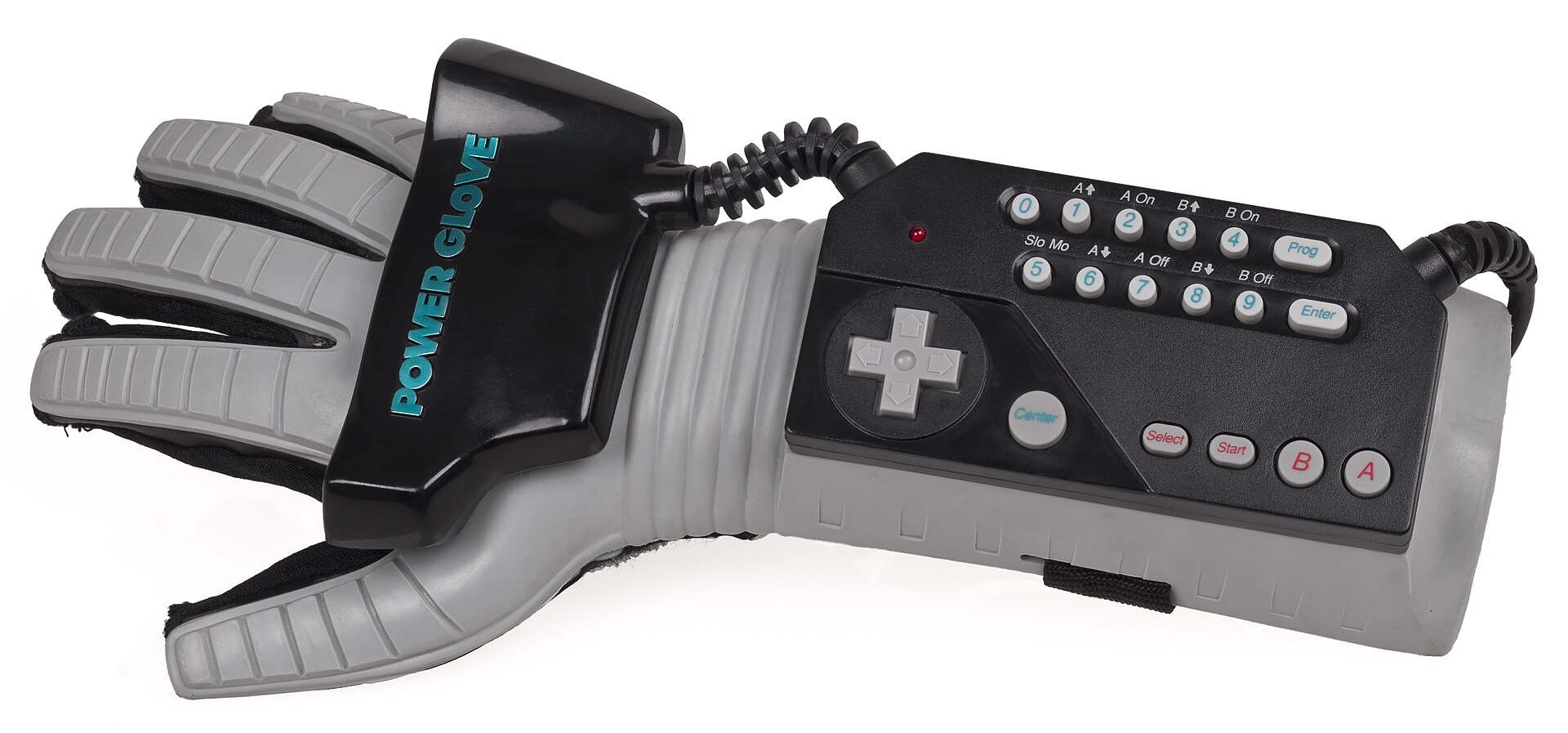
The Power Glove is the best-known consumer use of ultrasonic position tracking. The design descends from Thomas Zimmerman’s prototype hand tracker, which used “a pair of ultrasonic transmitters” (as cited in Wikipedia’s article from a 2017 oral history; not read here). The community FAQ maintained by J. Eric Townsend in the 1990s, with Randy Shedden’s technical notes, records how it behaved in use:1
- the receiver array used “inexpensive microphones”, and mounting it on a monitor made a clean signal hard to get, so users hung it on a wall with low ultrasonic reflection instead;
- “you must point your knuckles at the receiver array” for position to register;
- “The PG can only track roll”, because turning the hand in yaw or pitch turned the transmitters away from the array.
That last point is the instructive one. The glove found its position by timing sound, but its orientation came only from the geometry of two transmitters, and only about one axis. For aiming, it measured the wrong half.
The physics sets its own limit. Time of flight converts to distance through the speed of sound, which is about 343 m/s at 20 °C and rises about 0.6 m/s per °C. A 10 °C error in the assumed air temperature is a 1.8 % error in range: 35 mm at 2 m. Ultrasonic systems either measure the temperature or calibrate the speed of sound against a known distance; multipath off walls and furniture (the FAQ’s advice about the monitor) is the other limit. The figure often quoted for the Power Glove — about a quarter of an inch at five feet — comes from secondary sources and could not be confirmed.
5.4 Magnetic-Field Tracking
A magnetic tracker drives a base station’s coils with a known alternating field and measures, with three orthogonal coils in the handheld unit, the field’s strength and direction. From that it solves both position and orientation, which no other method in this volume does. The consumer example is the Razer Hydra (2011), built on Sixense technology. TechCrunch’s report of the January 2010 demonstration describes it as using “a magnetic field generated at a certain… frequency”, with “a lag of about 40 milliseconds” and a precision of “about 1 mm for position and 1 degree for orientation”.2 Those are demonstration figures from the maker’s side.
One degree is 55 pixels at 2 m: the Hydra’s orientation, on its own figure, was not light-gun grade. Magnetic trackers are also disturbed by conductive and ferromagnetic material near the field — the reason professional systems specify a clear volume around the source. For this gun the problem is the same as for a magnetometer (Volume 3, §3.8), and worse: a magnetic tracker’s sensor would sit a few centimetres from a steel-plunger solenoid pulsed at amps.
5.5 Ultra-Wideband Radio
Ultra-wideband (UWB) radios measure distance by timing pulses between two devices, and with two antennas on one end they measure the angle of arrival from the phase difference (PDoA). Qorvo’s DW3000 family is the common part; a distributor listing for the two-antenna DW3220 reproduces Qorvo’s description of “asset location accuracy of up to 10 cm” and PDoA support.3 Qorvo’s own product pages and data sheets could not be read on the day (they returned HTTP 429 to every request), and an angle-of-arrival accuracy of about 5°, which appears in search summaries of those pages, is unconfirmed.
At 10 cm the position half alone is 158 pixels. UWB’s use in pointing is real but coarse: patent filings describe remotes that combine UWB ranging and angle of arrival with an IMU to decide which device a remote points at — the television or the speaker, not a pixel on the television. No light gun or screen pointer using UWB for aim was found.
5.6 Optical Flow
An optical-flow sensor is a mouse sensor with a lens: it images whatever it faces and reports how far the image moved between frames. PixArt’s PMW3901, as the PX4 autopilot documentation puts it, is “an optical flow ASIC that computes the flow internally and provides a difference in pixels between each frame”, “similar to what you would find in a computer mouse, but adapted to work between 80 mm and infinity”.4
For aiming it has two problems. It is relative, like a gyroscope: it reports change, so it drifts and needs an absolute reference. And its flow mixes rotation and translation in a way that depends on the distance to whatever it sees, so a flow of N pixels means a different aim change for a gun facing a wall at 2 m than one facing a wall at 4 m. Pointed at the screen it is worse still, because the picture moves by itself. A gyroscope measures rotation without either problem, more cheaply. No light-gun use was found.
5.7 The Error Budget
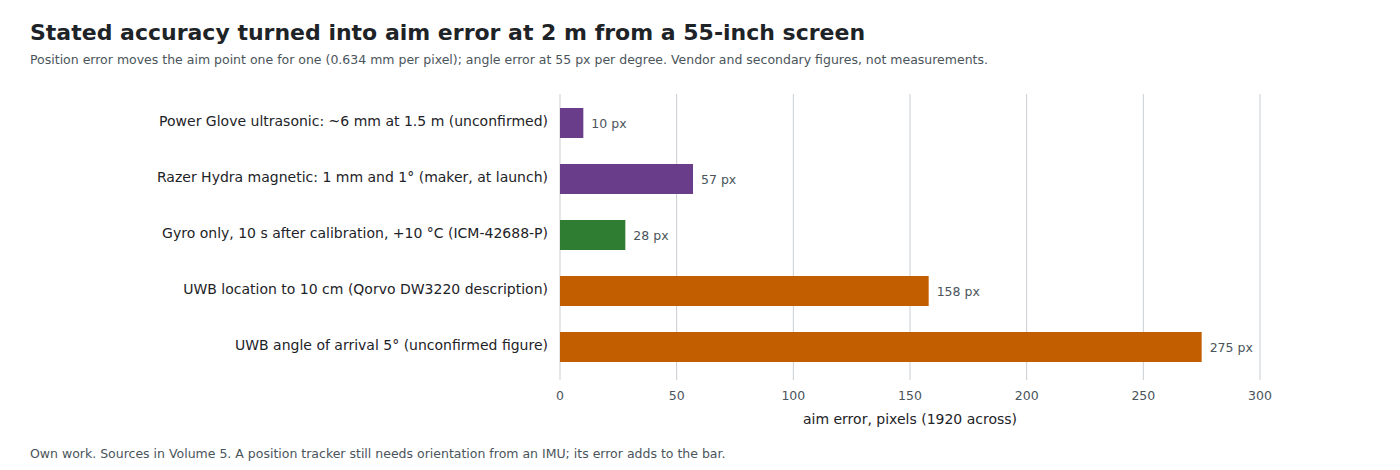
Table 1 — 5.7 The Error Budget
| System | What it measures | Stated accuracy | Aim error at 2 m | Status of the figure |
|---|---|---|---|---|
| Camera at the screen (Move) | position; orientation from the IMU | not published | set by the IMU’s yaw | — |
| Power Glove (ultrasonic) | position; roll only | about 6 mm at 1.5 m | about 10 px, position only | secondary, unconfirmed |
| Razer Hydra (magnetic) | position and orientation | 1 mm, 1° | about 57 px | maker, at a 2010 demonstration |
| UWB, DW3220 class | range, angle of arrival | location to 10 cm | 158 px | distributor reproducing maker |
| UWB angle of arrival | direction to the anchor | about 5° | 275 px | unconfirmed |
| Optical flow | relative motion | — | drifts | — |
| Gyroscope, 10 s after calibration, +10 °C | relative rotation | ICM-42688-P datasheet | 28 px | datasheet (Volume 3) |
The pattern is the one Volume 4 drew from the products: position trackers locate the gun, but the direction they report (when they report one at all) is worth tens of pixels at best. A light gun’s bar is the camera in the gun, which measures the aim point directly.
5.8 Why None of Them Is in This Gun
Table 2 — 5.8 Why None of Them Is in This Gun
| Method | Why not for this build |
|---|---|
| Camera at the screen | Replaces the camera in the gun with a weaker aim (direction from an IMU); needs a second camera and a host-side tracker; no open firmware for a light gun. |
| Ultrasonic | Measures position, not direction; temperature and multipath limits; a transmitter at the gun and a receiver array at the screen. |
| Magnetic field | Direction is worth about 57 px on the maker’s own figure, and the gun’s solenoid sits beside the sensor. |
| UWB | Position at 10 cm is 158 px; angle is unconfirmed and coarse; useful for “which screen”, not “which pixel”. |
| Optical flow | Relative, distance-dependent, and confused by a moving picture; a gyroscope does the relative job better. |
A camera in the gun already measures position and direction together. What it lacks is coverage when the markers are out of view, and the only sensor that helps with that at the gun’s scale is the gyroscope: Volume 6.
5.9 What Could Not Be Verified
- The Power Glove’s position accuracy and update rate (the “quarter inch at five feet” and “30 times a second” figures circulate without a primary source); US patent 4,988,981 could not be read (Google Patents returned HTTP 503).
- Zimmerman’s “pair of ultrasonic transmitters” is quoted from Wikipedia’s citation of a 2017 Mental Floss oral history, not read.
- Qorvo’s own data-sheet figures for DW3000-family ranging and angle-of-arrival accuracy (HTTP 429 on every attempt).
- The UWB pointing-remote patents (Apple, 2021, as reported; US 11,501,633; US 12,067,863) were found by search; none was read in full.
- An independent measurement of the Razer Hydra’s accuracy: a 2018 evaluation against optical motion capture was found by search but its page returned HTTP 404.
Sources
Footnotes
-
J. Eric Townsend, Mattel PowerGlove FAQ, version 0.3 (c. 1994), with technical notes by Randy Shedden, republished on Mellott’s VR, 23 May 2013, https://mellottsvrpage.com/?p=552, read 2026-10-19. ↩
-
Devin Coldewey, “Razer and Sixense combine to form an actually compelling motion controller for PCs”, TechCrunch, 8 January 2010, https://techcrunch.com/2010/01/08/razer-and-sixense-combine-to-form-an-actually-compelling-motion-controller-for-pcs/, read 2026-10-19. ↩
-
LCSC, product listing C5441013, Qorvo DW3220TR13, introduction text, https://www.lcsc.com/product-detail/C5441013.html, read 2026-10-19 (distributor reproducing the maker’s description). ↩
-
PX4 Autopilot User Guide, “PMW3901-Based Flow Sensors”, https://docs.px4.io/main/en/sensor/pmw3901.html, read 2026-10-19. ↩
Comments (0)