IR Point Tracking · Volume 4
Field of View, Distance and Screen Size — The Playing Envelope
How close the player can stand before emitters leave the camera's view, square against diamond; how far before the points grow too dim, too close together or too coarse; what the wide lens and the LED beam each cost at close range; and three living rooms worked through for the Wii-class camera, the PixArt R2 and the R3
4.1 The Envelope in One Sentence
The player must stand far enough back that all four emitters stay in the camera’s view wherever the gun aims on the picture, near enough that the emitters are still bright enough, far enough apart in the image and resolved finely enough to aim with, and within the emitters’ beams. Each clause is a limit, and each depends on the camera.
Reference Electronics, Volume 3 set out the first limit for the purpose of choosing a camera, with emitters assumed at the picture’s corners and only the horizontal axis considered. This volume refines that limit for the actual layouts and both axes, and adds the others.
4.2 The Near Limit: Field of View
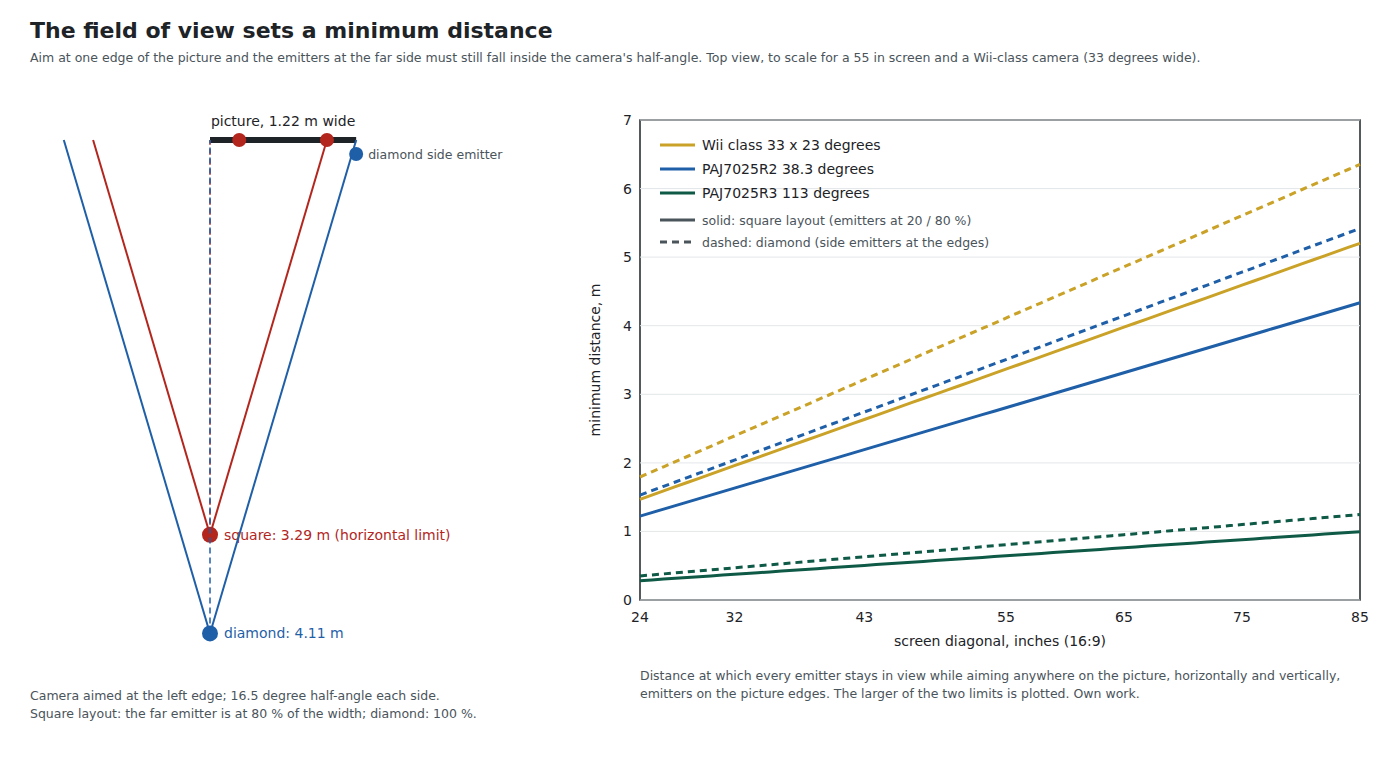
When the gun aims at the left edge of the picture, the camera’s axis passes through that edge, and the rightmost emitter lies at the far side. It stays in view only if its angle from the axis is within the camera’s half-angle. Ignoring the small angle of the gun’s own tilt, the minimum distance is the horizontal span from the aimed edge to the farthest emitter, divided by the tangent of the horizontal half-angle; and likewise vertically. The layout sets the spans:
- Square (OpenFIRE’s default; emitters above and below the picture at 20 and 80 % of its width): horizontally, aiming at one edge puts the far emitter at 80 % of the width; vertically, aiming at the bottom edge puts the top pair a full picture height away.
- Diamond (GUN4IR; one emitter at the middle of each edge): horizontally the far emitter is a full width away; vertically a full height.
With the half-angles of each camera (Wii class 16.5° by 11.5°, WiiBrew; PixArt R2 19.15° each way and R3 56.5° each way, from the datasheets’ 38.3° and 113°), the minimum distance, taking the larger of the two axes, is:
Table 1 — With the half-angles of each camera (Wii class 16.5° by 11.5°, WiiBrew; PixArt R2 19.15° each way and R3 56.5° each way, from the datasheets' 38.3° and 113°), the minimum distance, taking the larger of the two axes, is
| Screen, 16:9 | Picture, m | Wii class, square | Wii class, diamond | R2, square | R2, diamond | R3, square | R3, diamond |
|---|---|---|---|---|---|---|---|
| 32 in | 0.71 × 0.40 | 1.96 | 2.39 | 1.63 | 2.04 | 0.38 | 0.47 |
| 43 in | 0.95 × 0.54 | 2.63 | 3.21 | 2.19 | 2.74 | 0.50 | 0.63 |
| 55 in | 1.22 × 0.68 | 3.37 | 4.11 | 2.81 | 3.51 | 0.64 | 0.81 |
| 65 in | 1.44 × 0.81 | 3.98 | 4.86 | 3.32 | 4.14 | 0.76 | 0.95 |
| 75 in | 1.66 × 0.93 | 4.59 | 5.61 | 3.83 | 4.78 | 0.88 | 1.10 |
Metres. Arithmetic in the dive’s 04-templates/calc_radiometry.py.
Three things in the table refine the camera-choice table of Reference Electronics:
- The square layout lets the player stand about 20 % closer than the corner or diamond assumption, because its emitters sit inside the picture’s width.
- For the Wii-class camera with a square layout, the vertical axis sets the limit, not the horizontal. Its field is 23° tall against 33° wide, a squatter shape than a 16:9 picture’s, so aiming at the bottom edge loses the top emitters (3.37 m for 55 inches) slightly before aiming at a side loses the far emitter (3.29 m). Mounting the bars closer to the picture’s top and bottom edges helps directly; a bar 5 cm outside each edge adds 0.1 m to the span and about half a metre to the Wii camera’s minimum distance.
- The PixArt cameras’ square fields reverse that: for the R2 and R3 the horizontal span dominates on a 16:9 picture.
The firmware’s missing-point reconstruction (Volume 3, 3.7) lets play continue somewhat inside these distances, at the cost of an estimate that drifts if the player moves while a point is out of view. The table is where the gun works exactly.
4.3 The Near Limit: Beams and Lens Edges
The R3’s wide field makes very close play possible: 0.64 m from a 55-inch picture. Two other things then become limits.
The emitters’ beams. At 0.8 m from a 55-inch screen, a gun on the centreline is 32° off the axis of each square-layout emitter (Volume 2, 2.5). The SFH 4547’s half angle is ±30° and the TSHG6400’s ±27°, so even a centred player gets less than half of each emitter’s on-axis intensity, and a player standing to one side much less.
The lens’s edges. The R3 datasheet gives a relative illumination of 38.5 % at the edge of the field, and a distortion of −30 %. Aiming at a corner from close range puts the far emitters near the edge of the field, where the lens delivers about two-fifths of the light it delivers on axis. The distortion compresses the image toward the edge; the ESP32 port carries a correction for it that its author marks “Theoretical starting point, NOT a measured lens calibration” (Volume 1).
At the R3’s closest distances these multiply: half the intensity from the beam, two-fifths from the lens, and an R3 that already collects a thirty-ninth of the R2’s light (Volume 2, 2.8). The R3’s field of view lets it see all four emitters from 0.64 m; whether they are bright enough there is a separate question, and an emitter bar for close play should fan or aim its LEDs toward the playing position.
4.4 The Far Limit: Signal
Irradiance falls as the square of distance (Volume 2, 2.4). For a camera of a given sensitivity there is a distance beyond which the dimmest emitter no longer clears the threshold, and the point vanishes. The datasheets do not give the threshold in absolute units, so that distance is a measurement. What can be said without measuring:
- The R3 has about one sixth of the R2’s range with the same emitters and gain: its entrance pupil collects 1/39 of the R2’s light, and the square root of 39 is about 6.3 (Volume 2, 2.8). PixArt’s own pages give the R2 “up to 7 meters” and the R3 a 3 m working distance, a ratio of 2.3, so PixArt’s test conditions evidently differ between the two (the R3’s higher gain settings would close part of the gap); the pages do not say.
- The far limit and the near limit pull opposite ways for each lens. The R3 can play close and must play near; the R2 and the Wii-class camera must play far and can.
- Sunlight shortens the range by raising the background against which the threshold must be set (Volume 5).
4.5 The Far Limit: Geometry and Resolution
Long before an emitter disappears, distance degrades the measurement in two geometric ways.
The points draw together. The square layout’s top pair on a 55-inch screen subtends 20.7° at 2 m and 10.4° at 4 m. In camera pixels that is 80 and 40 for the Wii-class camera, 53 and 27 for the R2, and only 18 and 9 for the R3 (Volume 3, 3.6). Everything the homography learns about perspective is in the small differences between those spans, so the estimate gets noisier as the spans shrink.
Each pixel covers more screen. An angular error δ becomes an error of about d × δ on the screen. For one native pixel:
Table 2 — Each pixel covers more screen. An angular error δ becomes an error of about d × δ on the screen. For one native pixel
| Camera | Pixel | 1 m | 2 m | 3 m | 4 m |
|---|---|---|---|---|---|
| Wii class, one of 1,024 reported counts | 0.032° | 0.6 mm | 1.1 mm | 1.7 mm | 2.2 mm |
| Wii class, one native pixel | 0.26° | 4.5 mm | 9.0 mm | 13.5 mm | 18.0 mm |
| PixArt R2, one native pixel | 0.39° | 6.8 mm | 13.6 mm | 20.5 mm | 27.3 mm |
| PixArt R3, one native pixel, average | 1.15° | 20 mm | 40 mm | 60 mm | 81 mm |
A 1080p pixel on a 55-inch screen is 0.63 mm. Sub-pixel centroiding (Volume 1, 1.6) is what brings the useful resolution from the native-pixel rows toward the reported-count row; how close it gets is the bench measurement of Volume 6. The table shows the scale of the problem: for the R3 at 3 m, a centroid that wanders by a tenth of a pixel moves the aim point by 6 mm, about ten screen pixels.
4.6 Off to the Side and Off the Screen
Players to the side. A second player, or one seated off-centre, sees the emitters at an angle. The four-point homography handles the perspective exactly (Volume 3), so the limits are the emitters’ beams (a player 30° off the emitters’ axes gets half the intensity) and the camera’s field, which matters less because the screen subtends a smaller horizontal angle seen obliquely.
Shots off the screen. Many games reload when the trigger is pulled with the gun pointed off the picture, and OpenFIRE treats a position pinned at the edge of its range as “off screen” (Open-Source Firmware, Volume 2). To compute such a position at all, the camera must still see the emitters, or enough of them to reconstruct the rest, while aimed beyond the edge. An off-screen aim a quarter of a picture width past the edge needs the far emitters to fit inside the half-angle from that much further away; for the Wii-class camera on a 55-inch picture with the square layout, the horizontal span grows from 0.97 m to 1.28 m and the minimum distance from 3.3 m to 4.3 m. How OpenFIRE behaves when the points are lost off-screen, rather than pinned at the edge, is a firmware question for Open-Source Firmware; from the sensing side, the reload shot needs margin in the field of view, and a wide lens supplies it.
4.7 Three Rooms, Worked
Square layout, gun on the centreline. “Baseline” is the separation of the top pair in the camera’s pixels; “one pixel” is the screen distance a native pixel spans at that distance; “LED angle” is the angle from each emitter’s axis to the gun.
Table 3 — 4.7 Three Rooms, Worked
| Room | LED angle | Wii-class camera | PixArt R2 | PixArt R3 |
|---|---|---|---|---|
| 32 in monitor at a desk, 0.8 m | 20° | loses points (needs 1.96 m); baseline 115 px; 1 px = 4 mm | loses points (needs 1.63 m); baseline 76 px; 1 px = 5 mm | all four in view; baseline 26 px; 1 px = 16 mm |
| 55 in television, 2.5 m | 11° | loses points (needs 3.37 m); baseline 64 px; 1 px = 11 mm | loses points (needs 2.81 m); baseline 43 px; 1 px = 17 mm | all four in view; baseline 14 px; 1 px = 50 mm |
| 55 in television, 1.5 m | 18° | loses points (needs 3.37 m) | loses points (needs 2.81 m) | all four in view; baseline 24 px; 1 px = 30 mm |
| 75 in television, 3.5 m | 11° | loses points (needs 4.59 m); baseline 63 px; 1 px = 16 mm | loses points (needs 3.83 m); baseline 41 px; 1 px = 24 mm | all four in view; baseline 14 px; 1 px = 70 mm |
The pattern is the decision Reference Electronics made, seen from the other side. In every ordinary room only the R3 keeps the four emitters in view across the whole picture; in every one it does so with the fewest pixels between them and the coarsest pixels on the screen. The narrow cameras need a room larger than most living rooms or a lens of their own (the community’s clip-on wide-angle lenses, Reference Electronics, Volume 3); the wide camera needs its sub-pixel centroiding and its emitters to do the work that its pixels cannot.
4.8 Why This, and Why Not the Others
This volume does not choose a camera; Reference Electronics, Volume 3 chose the PixArt PAJ7025R3 for the kit (decision D18, proposal P-RE16) with the R2 as the bench comparison. The envelope supports that choice and adds three requirements to the R3-against-R2 bench comparison:
Table 4 — This volume does not choose a camera; [Reference Electronics, Volume 3](/light-guns/building-the-electronics/reference-electronics/vol-3/) chose the PixArt PAJ7025R3 for the kit (decision D18, proposal P-RE16) with the R2 as the bench comparison. The envelope supports that choice and adds three requirements to the R3-against-R2 bench comparison
| Requirement | Why | Section |
|---|---|---|
| Measure the R3’s range with the kit bar, at the playing distance, aimed at a corner | Its pupil collects 1/39 of the R2’s light and its field edge 38.5 % of its centre | 4.3, 4.4 |
| Measure centroid noise in screen millimetres at 2.5 m | One R3 pixel is 50 mm on a 55-inch screen at that distance | 4.5 |
| Test the off-screen reload shot | It needs field-of-view margin beyond the picture’s edge | 4.6 |
The square layout (Volume 3, 3.9) is supported here as well: it lets every camera play about 20 % closer than the diamond.
4.9 What Could Not Be Verified
- Any absolute range for any camera. The threshold is unpublished; range is measured, not computed.
- The Wii camera’s field of view on units other than the one WiiBrew measured.
- How the R3’s relative illumination falls across the field between its centre and the 38.5 % at the edge, and its real distortion; the ESP32 port’s model is theoretical.
- OpenFIRE’s behaviour when every point is lost during an off-screen shot.
Sources
- WiiBrew wiki, Wiimote, “IR Camera: Optical Characteristics” (33° by 23°, one unit), https://wiibrew.org/wiki/Wiimote, read 2026-10-19.
- PixArt Imaging, PAJ7025R2 Product Datasheet v1.3, Table 6, and PAJ7025R3 Product Datasheet v1.0, optics, partial copies as described in Volume 1; PixArt product pages (range “up to 7 meters”, working distance 3 m) as read for Reference Electronics, Volume 3.
- ams OSRAM SFH 4547 and Vishay TSHG6400 datasheets (half angles).
- Alessandro Satanassi, OpenFIRE-Firmware-ESP32,
lightgun/lib/OpenFIREPosition/OpenFIRECameraProfile.h(R3 lens model), read 2026-10-19. - Own arithmetic:
04-templates/calc_radiometry.pyand04-templates/make_envelope_svg.py, 2026-10-19.
Comments (0)