Power Supplies · Volume 3
USB Power Alone — What 500 mA, 900 mA, 1.5 A and 3 A Can Do for Recoil
The port's real budget, the boost converters that turn 5 V into a kick, why efficiency and inrush matter, and the arithmetic that explains why every USB-only gun fades in rapid fire
3.1 Why Anyone Wants One Cable
A wall brick works, but it adds a second cable to a gun that is already tethered by USB, a second plug to lose, and a brick on the floor. The Sinden gun’s selling point for its recoil model is that it has none of that: “No external power required, just connect to computer USB.”1 For a gun meant to be picked up and played in a living room, one cable is a genuine advantage.
The cost is physics, and this volume puts numbers on it. The short version: USB can supply the pulse only through storage, and it cannot supply the average of anything but a small coil at a modest rate. Every USB-only gun therefore fades in sustained fire, and the only design choice is how gracefully.
3.2 What a USB Port Will Actually Give
A USB device may not simply take what it wants. The current it may draw is set by the port type and by negotiation:
Table 1 — A USB device may not simply take what it wants. The current it may draw is set by the port type and by negotiation
| Source | Current a device may rely on | Power at 5 V | How the device knows |
|---|---|---|---|
| USB 2.0 port, before configuration | 100 mA | 0.5 W | always |
| USB 2.0 port, after configuration | 500 mA | 2.5 W | the host accepts the device’s configuration |
| USB 3.x port, after configuration | 900 mA | 4.5 W | as above, SuperSpeed |
| USB Type-C source advertising 1.5 A | 1.5 A | 7.5 W | the pull-up current on the CC pin |
| USB Type-C source advertising 3.0 A | 3.0 A | 15 W | the pull-up current on the CC pin |
The USB 2.0 figures are the bus-powered rules restated in TI’s power-switch datasheets: under 100 mA at power-up, and inrush limiting required if the device’s load exceeds 44 Ω in parallel with 10 µF.2 The Type-C levels are the ones a Type-C port controller decodes: “Default” (500 mA on USB 2.0, 900 mA on USB 3.1), 1.5 A and 3 A, signalled by the source’s CC pull-up current of 80, 180 or 330 µA.3 Higher power than 15 W needs USB Power Delivery and a different voltage, which belongs to the USB-C Power Delivery dive.
Most light guns are plugged into USB-A ports on a PC, a Raspberry Pi or a MiSTer, and a USB-A port is a USB 2.0 or 3.x port: 500 or 900 mA. A Type-C cable from a Type-C port only reaches 1.5 or 3 A if the host advertises it. A gun with a Type-C receptacle can read that advertisement on its CC pins and choose its charge rate accordingly; a gun with a micro-USB or a captive USB-A lead cannot and must assume the lowest figure.
Many host ports will in practice supply more than they advertise before their protection acts. A design that relies on that will work on one PC and fail on another, or on a single-board computer whose ports may share one budget; check the host’s own documentation. The figures to design for are the advertised ones. The platform specifics belong to the Linux and Retro Distros and PC Windows dives.
From the port’s watts, subtract the electronics. Vol 1 estimated a Pico, camera and a few LEDs at about 0.75 W (150 mA); a rumble motor adds more, which is why GUN4IR asks for at least 300 mA for its gun with rumble.4 What is left, times the efficiency of whatever converts it, is the power available to recharge the kick.
3.3 The One Equation: Energy per Shot Against Watts In
If a shot costs E joules and the gun can put P watts into storage, the shortest interval at which full-strength shots can be sustained is E / P. Nothing about the storage changes that. The table applies it to the three coils of Vol 1, with 0.75 W reserved for the electronics and 85 % conversion efficiency:
Table 2 — If a shot costs E joules and the gun can put P watts into storage, the shortest interval at which full-strength shots can be sustained is E / P. Nothing about the storage changes that. The table applies it to the three coils of [Vol 1](/light-guns/power-and-connectivity/power-supplies/vol-1/), with 0.75 W reserved for the electronics and 85 % conversion efficiency
| Source | Watts left for recoil | 12 V, 12 Ω coil (0.54 J) | 24 V, 12 Ω coil (2.16 J) | 24 V, 6 Ω coil (4.32 J) |
|---|---|---|---|---|
| USB 2.0, 500 mA | 1.49 W | 2.8 shots/s | 0.7 shots/s | 0.3 shots/s |
| USB 3.x, 900 mA | 3.19 W | 5.9 shots/s | 1.5 shots/s | 0.7 shots/s |
| Type-C or BC1.2, 1.5 A | 5.74 W | 10.6 shots/s | 2.7 shots/s | 1.3 shots/s |
| Type-C, 3.0 A | 12.11 W | 22 shots/s | 5.6 shots/s | 2.8 shots/s |
OpenFIRE’s default autofire is 8 shots per second.5 Against that figure, only two cells clear it: the small 12 V coil on a 1.5 A or 3 A Type-C source. No ordinary USB-A port can sustain default autofire at full strength with any coil in the table, and a 24 V coil of the size an arcade-style kick needs cannot be sustained even from a 3 A Type-C port. These are upper bounds, because the energy figures ignore the coil’s inductance and back-EMF and the efficiency is a round number; a real gun will do slightly better on energy per shot and somewhat worse on efficiency.
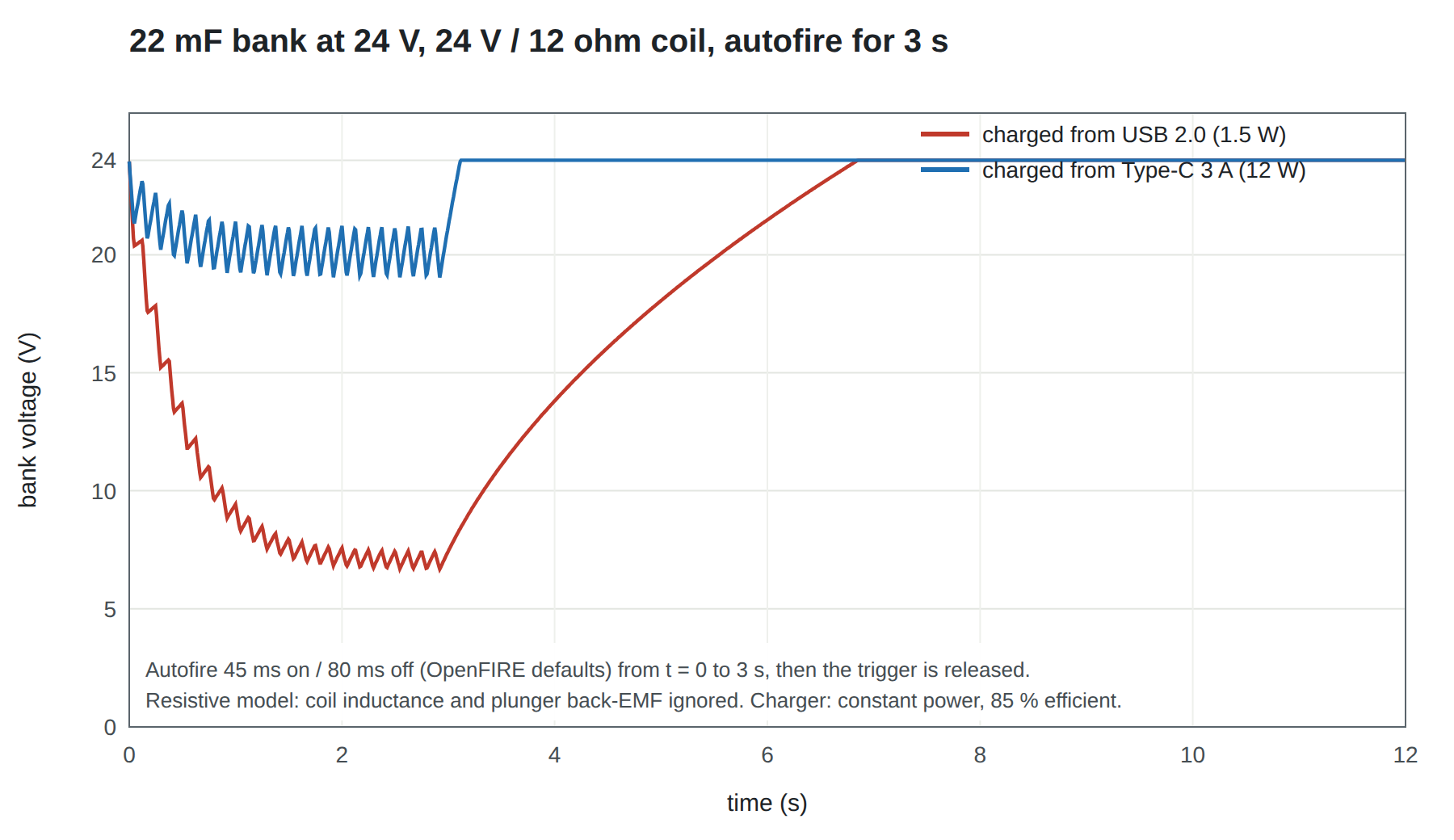
The chart shows what the table means in a game. From a USB 2.0 port the eighth shot of a burst carries under a fifth of the energy of the first: the gun is still firing the solenoid, but the kick has faded to a tap. That is exactly the behaviour the Sinden wiki describes as normal for its USB-powered recoil, and its three remedies are the three terms of E / P: lower the strength (E), fire less often, or lengthen the “Pulse speed” delay between shots (more time at P).6
3.4 Can USB Drive a Coil Directly?
Only a small one. A 5 V coil drawing under the port’s budget, minus the electronics, can be switched straight from VBUS. On a USB 2.0 port that leaves about 350 mA: a coil of 15 Ω or more at 5 V, 1.7 W while on. That is less than a sixth of the Adafruit 12 V solenoid’s 12 W, and it is in the territory of a buzz rather than a kick. A rumble motor, which is what OpenFIRE’s README specifies as a “5V gamepad rumble motor,” is the honest use of direct 5 V power.7
Driving a larger coil directly from VBUS fails in one of three ways, depending on the host: the port’s current limit folds back and VBUS sags, which can upset everything else on the gun; the host’s over-current protection disconnects the port, which looks like the gun resetting; or the host simply supplies it and the design appears to work until it meets a stricter port. None of these is acceptable in a product, and the second is one of the “resets when firing” causes of Vol 5.
3.5 Boost Converters: Modules and ICs
Anything more than a buzz needs the port’s 5 V converted to the coil’s voltage and stored. That is a boost converter charging a capacitor bank: architecture C in Vol 1. The boost does not need to supply the pulse. It needs to deliver a steady trickle of power, within the port’s budget, into the bank, and the bank supplies the pulse.
That one requirement disqualifies most cheap boost modules as they come, because they limit switch current, not input current, and their switch limit is far above a USB port’s budget. A boost converter’s inductor is in series with its input, so the inductor’s peak current is the input’s peak current. A converter that limits switch current at 4 A will draw up to 4 A from the port whenever its output is below regulation, which is the whole time it is recharging a bank after a shot.
Table 3 — Boost Converters: Modules and ICs
| Part | Output range | Current limit (source) | USB-safe as it comes? | Price, 2026-10-18 |
|---|---|---|---|---|
| MT3608 (Aerosemi), common “MT3608 mini” modules | up to 28 V (datasheet copies) | 4 A internal switch limit | No: will draw amps from VBUS into a discharged bank | modules widely sold; IC datasheet only on third-party mirrors8 |
| MT3608L (Aerosemi) | up to 20 V (LCSC listing) | adjustable (LCSC: “Adjustable current limiting”) | Cannot reach 24 V | $0.058 at LCSC9 |
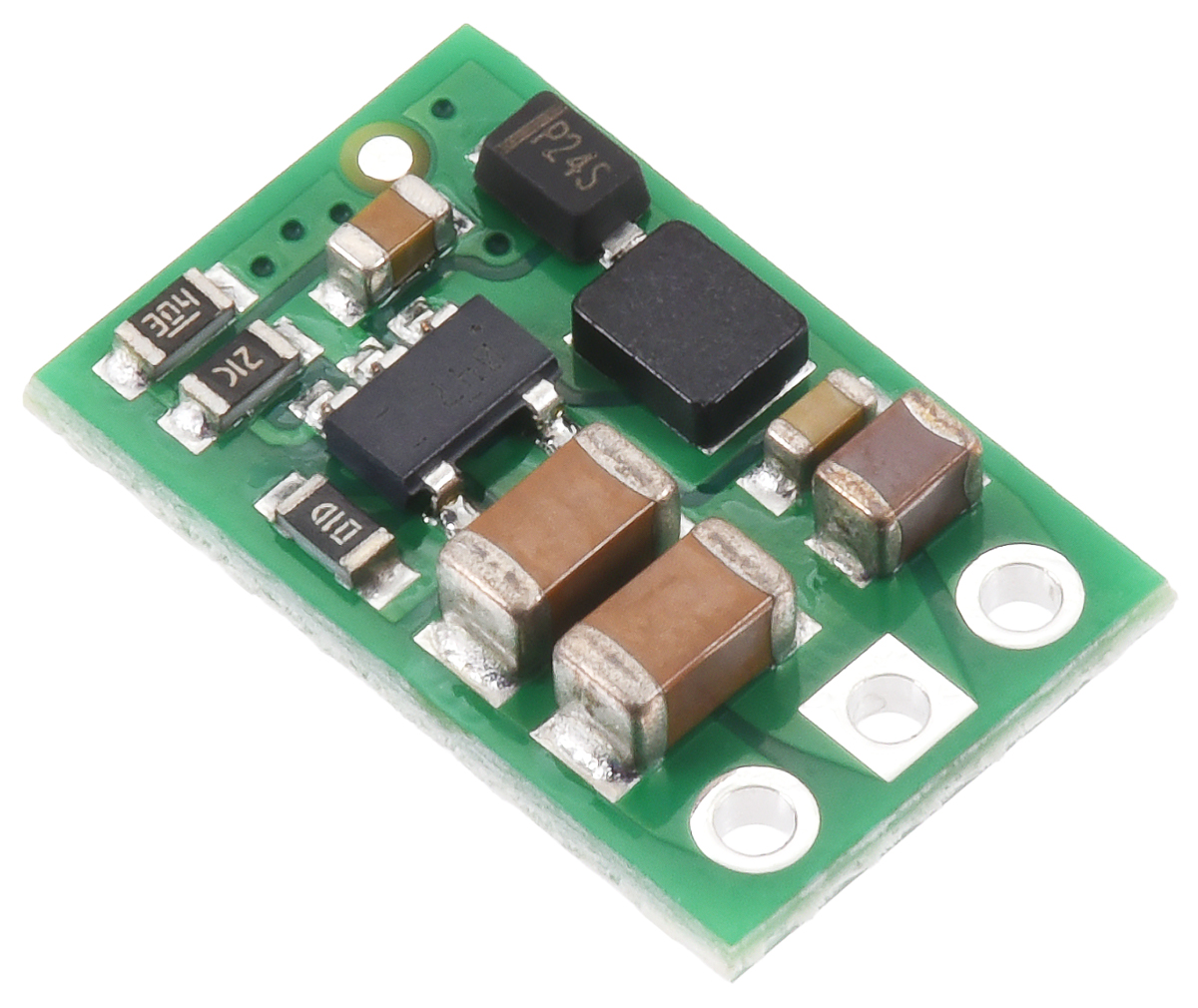
| Pololu U3V9F24 (fixed 24 V module) | 24 V | ”actively limit the instantaneous input currents to 2.2 A when boosting” | No: 2.2 A exceeds USB 2.0 and 3.x | $3.75 at Pololu10 |
| TI TPS55340 (IC) | up to 38 V | 6.6 A switch limit typical; adjustable soft-start | No: needs a front-end limit | TI product page11 |
Each of these can be made USB-safe by limiting what reaches its input. The front end has three parts:
- A current-limited load switch between VBUS and the boost. TI’s TPS2553, for example, has a resistor-set limit adjustable from 75 mA to 1,700 mA, accurate to ±6 % at 1.7 A, in a SOT-23-6.12 Set below the port’s grant, it keeps the port safe whatever the boost does. In current limit it behaves as a linear pass element and dissipates the difference between VBUS and its sagging output, so the boost’s input undervoltage lockout must be set so the pair settles rather than oscillates. It also provides the soft-start and the enable that sections 3.7 and the diagram below need.
- A boost whose own peak current is limited to roughly the same figure, so that the load switch is a backstop rather than a regulator. Parts with a programmable input current limit exist for low output voltages, TI’s TPS61252 (100 to 1,500 mA, ±20 % at 500 mA) being an example, but its output tops out at 6.5 V.13 At 24 to 50 V output, the usual approach is a general boost IC such as the TPS55340 with its switch limit and soft-start set conservatively, or a purpose-built capacitor-charger controller of the kind made for photoflash circuits, which regulate primary current by design.
- Firmware control. The microcontroller enables the charger only after the host has configured the device, disables it in suspend, measures the bank through a divider, and scales each pulse to the bank’s voltage so that a partly charged bank gives a consistent, if weaker, kick.
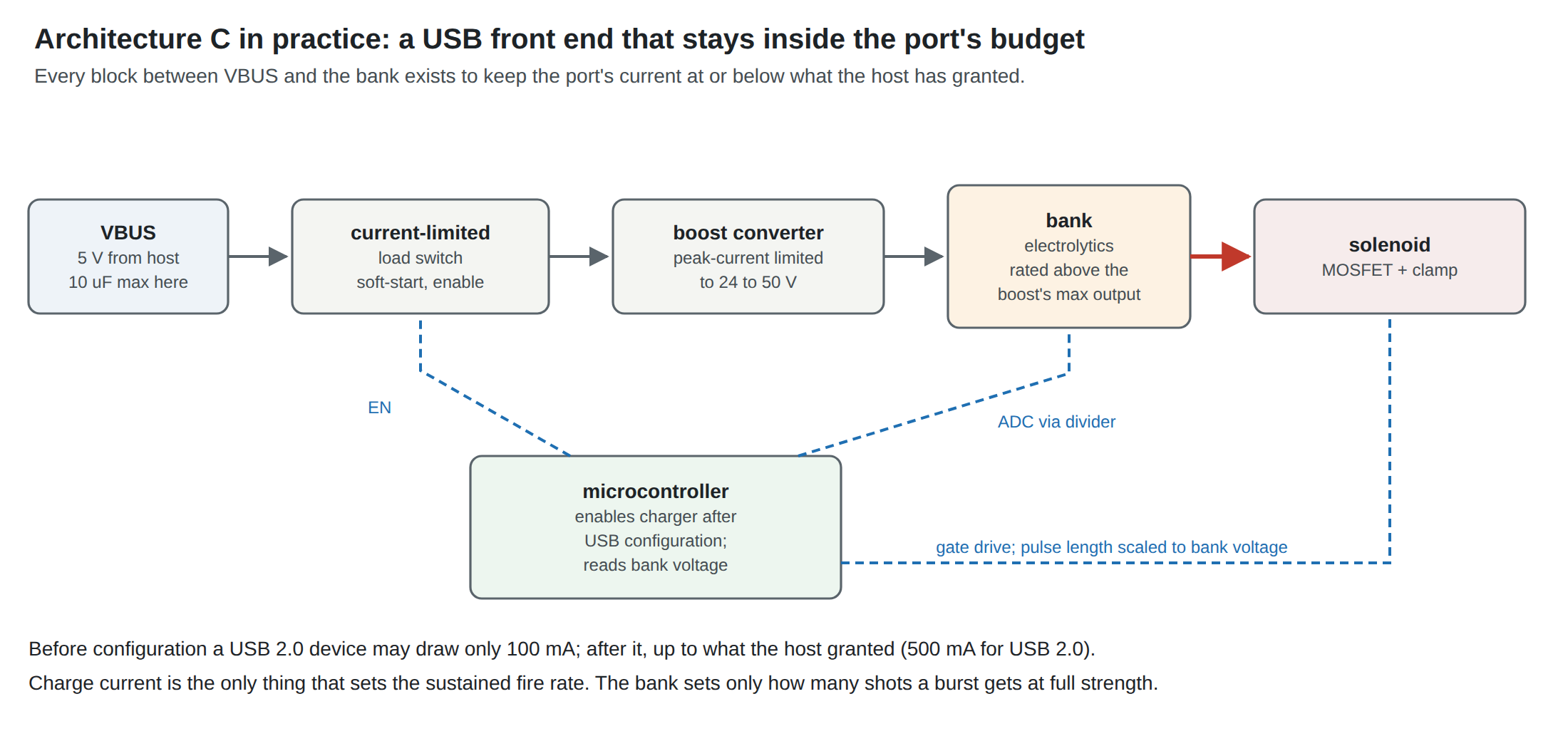
Why this, and why not the others. The front end is a proposal for the later USB-only guns (architecture C), not for Stages 1 and 2, which run from a brick. Criteria: the port’s budget is never exceeded whatever the bank’s state; the output reaches a 24 V-class rail; enumeration and suspend can be honoured by an enable pin; maker’s datasheet.
Table 4 — Boost Converters: Modules and ICs
| Block | Pick | Why | Why not the others |
|---|---|---|---|
| Input limit | TI TPS2553 load switch, resistor-set below the port’s grant | Limit set to ±6 % at 1.7 A, enable pin for the configured/suspend rules, soft-start, SOT-23-6 | A polyfuse trips far above its hold current and too slowly; a fixed-limit USB switch cannot be set to 500 or 900 mA as the port requires |
| Boost | TI TPS55340, switch limit and soft-start set conservatively, behind the TPS2553 | Reaches 38 V, so it covers a 24 V rail with a bank charged above it; maker’s datasheet | MT3608 modules: 4 A switch limit, IC datasheet only on mirrors; MT3608L: 20 V maximum; Pololu U3V9F24: 2.2 A input limit, over the USB 2.0 grant, and fixed at 24 V; TPS61252: 6.5 V maximum |
| Dedicated capacitor charger | Considered, not chosen | Regulates primary current by design, which is the ideal behaviour | The class was identified but no part’s datasheet was read for this dive; it stays a candidate for the Fully Wired dive |
The circuit design of this front end, as a schematic for capture, belongs to the Reference Electronics dive; the sizing of the bank is Vol 4.
3.6 Efficiency, and Where the Watts Go
At 2.5 W in, every loss is a visible fraction of the recoil budget. The losses in a USB-to-bank chain are:
- The cable and connector. A USB cable’s VBUS and ground conductors are often thin. At 500 mA the drop is small; at 3 A on a long, cheap cable it can be several hundred millivolts, which is power lost before the gun sees it.
- The load switch. At 85 mΩ (TPS2553) and 0.5 A, about 21 mW, negligible.12
- The boost. Pololu quotes 70 to 95 % for its module “depending on input voltage, output voltage, and load.”10 The conversion ratio matters: 5 V to 50 V is harder than 5 V to 24 V, and efficiency usually falls as the ratio rises.
- The bank. Electrolytic leakage is small at room temperature, but a large bank held at full voltage for hours of play is a continuous load, and its ESR loses a little energy on every pulse.
- The coil and driver. Not a supply loss, but the MOSFET’s on-resistance and the wiring take a share of the bank’s energy before the coil does.
The table’s 85 % is a round planning figure. The real number for a chosen design should be measured: input power from VBUS against energy delivered to the bank over a timed charge. Vol 6 gives the procedure.
3.7 Inrush, Enumeration and Suspend
A USB-only gun is a USB device, and three USB rules apply to it that a brick-powered gun can mostly ignore.
Inrush. A device whose load exceeds 44 Ω in parallel with 10 µF must limit its inrush.2 Nuvoton’s application note puts the USB-IF compliance limit at 50 µC of inrush charge, about 10 µF at 5 V.14 A recoil bank is thousands of times larger. It must never sit on VBUS directly; it sits behind the boost, and the boost’s own input capacitor sits behind a soft-started load switch. The Pico’s own VBUS input carries its own decoupling, which counts towards the total.
Enumeration. Until the host has configured the device, a USB 2.0 gun may draw only 100 mA. A charger that starts the moment the gun is plugged in breaks that rule. The firmware should hold the charger off until the USB stack reports the device as configured, and start it gently.
Suspend. When a host suspends the bus, a device must drop to a very small suspend current. A charger running through a suspend breaks that rule, and some hosts respond by cutting the port. The firmware should stop charging on suspend; the bank can hold its charge until resume.
None of these is exotic, and none is enforced by every host. A gun that breaks them will work on the bench and fail on some customer’s machine. Kits of this gun may be sold, so for any kit design these rules are binding requirements, not good practice: the charger is held off until the device is configured, stopped in suspend, and kept behind a soft-started switch, and the gun’s own VBUS capacitance is counted against the inrush limit.
3.8 What USB-Only Recoil Can and Cannot Do
Table 5 — What USB-Only Recoil Can and Cannot Do
| Can | Cannot | |
|---|---|---|
| Single shots, paced | Full-strength kick from any coil, given enough bank and a long enough interval (E / P) | Instant full strength from a cold start: the bank must charge first |
| Bursts | A few full-strength shots, then fading; more with a larger bank | Sustained autofire at full strength from a USB-A port with any coil larger than a 12 V, 1 A class |
| Coil choice | 12 V, 1 A class coils are realistic on USB 3.x and Type-C | Arcade-class 24 V, 2 to 4 A coils at arcade rates |
| Type-C 3 A | About 5 shots/s sustained from a 24 V, 2 A class coil | 8 shots/s at full strength with that coil |
The design consequence: a USB-only gun should be designed to fade gracefully. Measure the bank voltage, scale each pulse so the kick declines smoothly rather than collapsing, and let the firmware’s autofire slow down rather than continue firing weak pulses. This is a firmware feature, and it is what the Sinden wiki’s advice to adjust strength and pulse delay is asking the player to do by hand.6
The alternative to fading is more input power. A Type-C source at 3 A gives six times a USB 2.0 port; USB Power Delivery at 9, 15 or 20 V gives far more, and that is the subject of the USB-C Power Delivery dive. A battery in the gun, which can be charged slowly and discharged hard, is the subject of LiPo Batteries. And a wall brick, after all, gives sixty watts for twenty dollars.
Footnotes
-
Sinden Lightgun shop, “Sinden Lightgun With Recoil.” https://www.sindenshop.com/products/sinden-lightgun-with-recoil (accessed 2026-10-18). ↩
-
Texas Instruments, TPS2550/TPS2551 datasheet SLVS736C. https://ti.com/document-viewer/TPS2551/datasheet/GUID-3A669CF6-5087-423F-A37A-125E11D34815 (accessed 2026-10-18). ↩ ↩2
-
Texas Instruments, TUSB321 datasheet SLLSEO6C, “Type-C Current Mode.” https://www.ti.com/document-viewer/TUSB321/datasheet/type-c-current-mode-sllsen98842 (accessed 2026-10-18). ↩
-
GUN4IR, “UK and EU Exclusive - GUN4IR® GC2 Pre-Modded lightgun set.” https://www.gun4ir.com/products/uk-exclusive-gun4ir®-gc2-pre-modded-lightgun-set (accessed 2026-10-18). ↩
-
TeamOpenFIRE, OpenFIRE-Firmware,
OpenFIREmain/OpenFIREprefs.h, commit 8b651a2. https://github.com/TeamOpenFIRE/OpenFIRE-Firmware (accessed 2026-10-18). ↩ -
Sinden Lightgun wiki, “Recoil Issues,” last edited 29 December 2022, Internet Archive capture of 6 March 2026. https://web.archive.org/web/20260306211156/https://www.sindenwiki.org/wiki/Recoil_Issues ↩ ↩2
-
TeamOpenFIRE, OpenFIRE-Firmware,
README.md, commit 8b651a2. https://github.com/TeamOpenFIRE/OpenFIRE-Firmware (accessed 2026-10-18). ↩ -
Aerosemi MT3608 datasheet, as mirrored by third-party datasheet sites (4 A switch current limit, 1.2 MHz, 2 to 24 V input, up to 28 V output); Aerosemi’s own site was not retrieved. Example mirror: https://www.radiolocman.com/datasheet/pdf.html?di=177837 (accessed 2026-10-18). ↩
-
LCSC, “XI’AN Aerosemi Tech MT3608L,” C2932326: output “600mV~20V,” operating voltage 2.2 to 16 V, 1.2 MHz, “Adjustable current limiting,” $0.0581 each. https://lcsc.com/product-detail/DC-DC-Converters_XI-AN-Aerosemi-Tech-MT3608L_C2932326.html (accessed 2026-10-18). ↩
-
Pololu, “24V Step-Up Voltage Regulator U3V9F24,” item 5588: $3.75 (1), input 2.6 to 20 V, input current limited to 2.2 A when boosting, 70 to 95 % efficiency, about 1.6 MHz, 13.6 × 8.6 × 2.8 mm. https://www.pololu.com/product/5588 (accessed 2026-10-18). ↩ ↩2
-
Texas Instruments, TPS55340 product page: 2.9 to 32 V input, switch current limit 6.6 A typical, Vout up to 38 V, 100 kHz to 1.2 MHz, adjustable soft-start. https://www.ti.com/product/TPS55340 (accessed 2026-10-18). ↩
-
Texas Instruments, TPS2553 product page: adjustable current limit 75 to 1,700 mA, ±6 % at 1.7 A, 2.5 to 6.5 V, 85 mΩ. https://www.ti.com/product/TPS2553 (accessed 2026-10-18). ↩ ↩2
-
Texas Instruments, TPS61252 product page: input current limit programmable from 100 to 1,500 mA, ±20 % at 500 mA, Vin 2.3 to 6 V, Vout up to 6.5 V. https://www.ti.com/product/TPS61252 (accessed 2026-10-18). ↩
-
Nuvoton, “How much capacitor can VBUS use when using the USB function?” technical FAQ (50 µC inrush limit, about 10 µF at 5 V). https://www.nuvoton.com/support/technical-support/faq/d79b4cf1-04f1-11ea-b113-05daf7eedf03/ (accessed 2026-10-18). ↩
Comments (0)