Power Supplies · Volume 2
Wall Supplies — Bricks, Pulse Ratings, Hiccup Trips, Connectors and Cable Drop
What a brick's label does and does not tell you about a 45 ms solenoid pulse, the trip band that decides whether it fires, the connector and wire between brick and gun, and specific units with dated prices
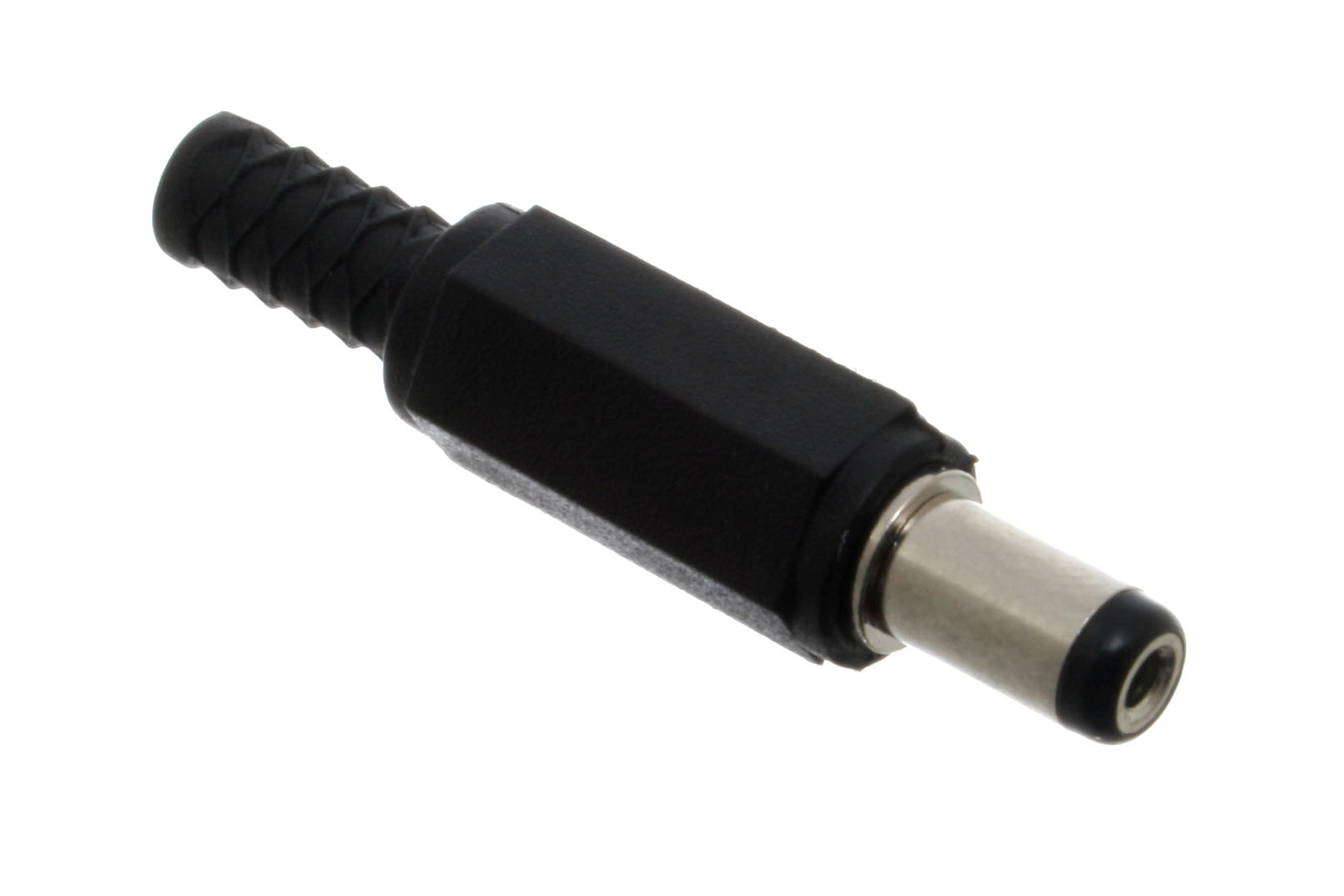
The wall brick is the default answer to recoil power, and in most builds it is the right one: it is cheap, it is isolated from the mains, and it can supply far more than any USB port. It also fails in ways its label never mentions. This volume reads a brick datasheet against a solenoid pulse, line by line, and ends with specific units.
Throughout, “the pulse” means a coil switched fully on for a few tens of milliseconds. OpenFIRE’s defaults are 45 ms on and 80 ms off in autofire.1 The coil arithmetic is in Vol 1.
2.1 Sizing Starts With the Coil, Not the Brick
Measure the coil’s DC resistance before choosing a supply. Divide the intended supply voltage by it. That is the pulse current, and every other number in this volume is compared with it.
There are good reasons not to trust the label for this. Vol 1 showed a maker’s product page whose description understates its own coil’s current by a factor of four, and the same generic type number sold at two retailers as a 12 V part and a 24 V part. A DMM on the coil’s leads settles both.
Three numbers then describe the load:
Table 1 — Three numbers then describe the load
| Quantity | Formula | Example: 24 V, 6 Ω coil, 45 ms on / 80 ms off |
|---|---|---|
| Pulse current | V / R | 4.0 A |
| Pulse power | V² / R | 96 W |
| Average power in autofire | pulse power × duty | 96 W × 0.36 = 34.6 W |
A supply has to pass three tests against these: it must deliver the pulse current without tripping, it must deliver it without sagging so far that the kick changes, and it must sustain the average without overheating. Bricks almost always pass the third. The first is where they fail.
2.2 What a Brick Datasheet Actually Promises
Mean Well’s GST60A series is a good example to read because it is a widely sold, well-documented industrial brick, and the 24 V model is a natural choice for a 24 V coil. The current datasheet (file dated 2026-04-03) gives the following for the GST60A24-P1J:2
Table 2 — What a Brick Datasheet Actually Promises
| Datasheet line | GST60A24 | What it means for a pulse |
|---|---|---|
| Rated current | 2.5 A | Continuous. Says nothing about pulses. |
| Rated power | 60 W | Continuous. |
| Voltage tolerance | ±3.0 % | Includes load regulation: up to about 0.7 V of sag at full load is within specification. |
| Load regulation | ±3.0 % | Static figure; no transient-response figure is given. |
| Ripple and noise | 150 mVp-p | Measured at 20 MHz bandwidth with 0.1 µF and 47 µF at the end of a 12-inch twisted pair. |
| Overload | 105 to 150 % of rated output power, “Hiccup mode, recovers automatically after fault condition is removed” | The trip lies somewhere between 2.63 A and 3.75 A, unit to unit. |
| Over-voltage | 25.2 to 32.4 V, shut down, re-power to recover | Relevant if the coil’s flyback energy is returned to the supply rail (Vol 5). |
| Hold-up time | 15 ms at 115 VAC, 50 ms at 230 VAC, full load | Not relevant to pulses; relevant to brown-outs on the mains. |
| Output cable | UL1185 18 AWG, 1,800 mm | 75 mΩ round trip before any extension (section 2.8). |
| Standard plug | P1J: 5.5 mm outer, 2.1 mm inner, 11 mm, centre positive | Other plugs to order (section 2.7). |
| Pin assignment note | ”-V not connected to AC FG” | The output floats from mains earth despite the three-pin inlet. Vol 5 explains why that is good. |
What is missing matters as much. There is no peak or pulse rating, no over-current detection time, no hiccup retry period, no transient-response figure, and no statement of how much capacitance may be hung on the output. Each of these decides how the brick behaves with a solenoid, and none of them is published. They can only be measured.
2.3 The Trip Band and Hiccup Mode
“105 to 150 % of rated output power” is a band, not a threshold. Two bricks of the same type can trip at 2.7 A and 3.7 A. For a pulse load that has two consequences.
A coil whose pulse current falls inside the band will work on some bricks and not on others. This is the most likely explanation for Ultimarc’s observation that a 3 A eBay supply “gives stronger recoil than some 4A supplies”:3 a supply’s label rates its continuous output, not where in its own trip band it happens to sit, how long it tolerates excess current, or how hard it sags while doing so. Two supplies with the same label can deliver quite different pulses, and a lower-rated one with a generous trip can out-kick a higher-rated one with a tight trip.
Hiccup is the worst possible response to a pulse. A brick in hiccup mode shuts its output down when it detects an overload and tries again after a delay. For a continuous fault that is a sensible way to limit dissipation. For a recoil pulse it means the output disappears for the remainder of the pulse and stays away for the retry period, during which every trigger pull fires nothing. The player experiences a gun whose recoil works for slow, single shots and then stops for a moment in rapid fire.
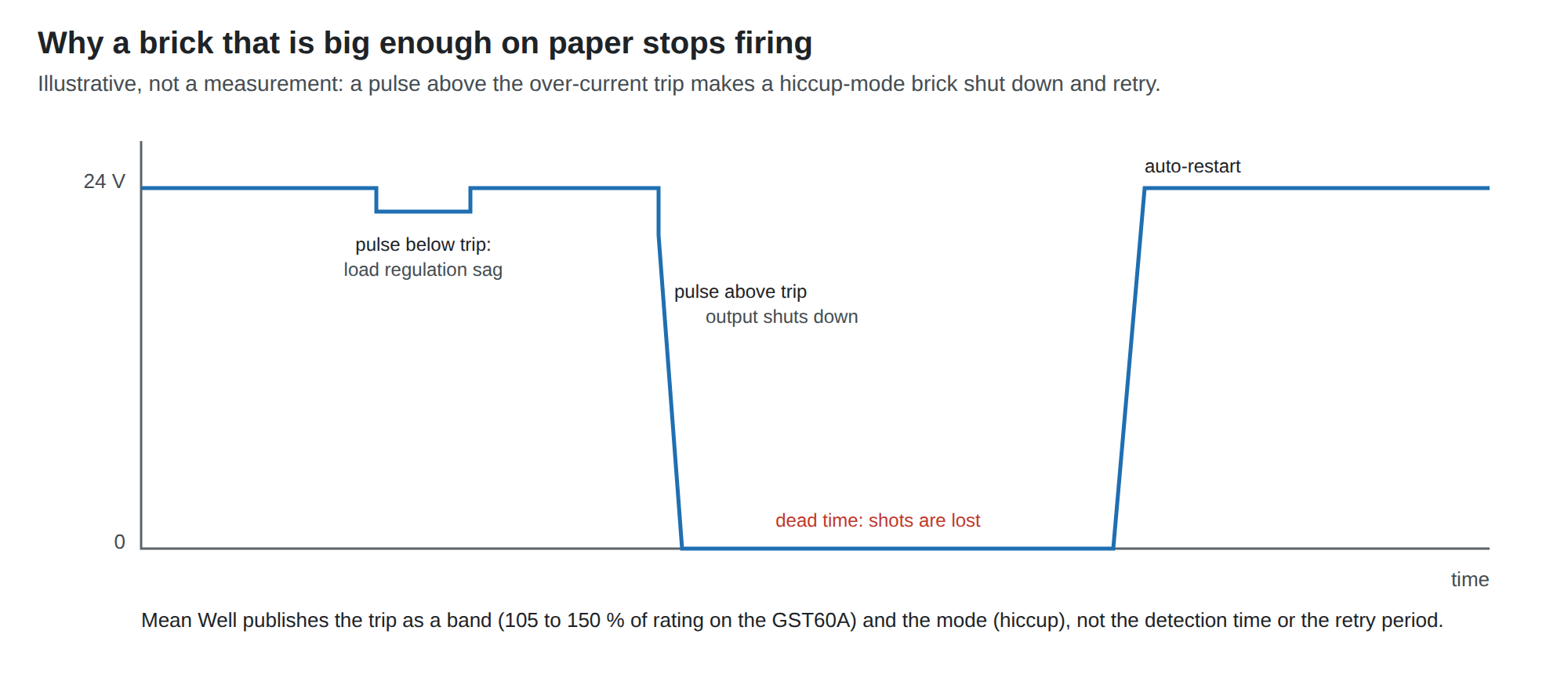
The practical rule follows: a brick must carry the pulse current below the bottom of its trip band, not merely below its upper limit. For the GST60A24, that bottom is 105 % of 2.5 A, about 2.6 A. A 24 V coil of 12 Ω (2 A) fits with margin. A 24 V coil of 6 Ω (4 A) does not fit at all, even though a 4 A pulse at a low duty averages far less than 60 W.
2.4 Supplies That Are Rated for Peaks
A small number of supplies are designed for exactly this load. Mean Well’s NSP series is rated for peak output, and its datasheet sets out the rule precisely.4 For the NSP-75-24:
- Rated: 24 V, 3.2 A, 76.8 W continuous.
- Peak: 6.3 A, 150 W, for 5 seconds.
- Overload behaviour (12 to 60 V models): “Normally works within 105 ~ 200% rated output power for more than 5 seconds and then constant current limiting without shutdown (Vout>30%)”: constant-current limiting rather than hiccup, which is far kinder to a coil.
- The peak-load rule in its function manual: average power must not exceed rated power, each peak must be no longer than 5 seconds, and the duty of the peak, t/T, must not exceed 35 %.
- Output adjustment: 21 to 26 V.
Against a 24 V, 6 Ω coil this is nearly ideal: the 4 A pulse is well inside the 6.3 A peak and the 34.6 W autofire average is under half the rating. One detail is worth noticing. OpenFIRE’s default autofire timing, 45 ms on in a 125 ms period, is a 36 % duty, one point over the NSP’s 35 % ceiling for peak operation. Single shots and any game played without held autofire are far inside it; a builder who leaves the gun on default autofire and wants to stay within the letter of the datasheet can lengthen the off-time slightly. This is a datasheet reading, not a predicted failure.
The NSP is an enclosed open-frame supply, 99 × 97 × 30 mm with screw terminals for mains and output.4 It belongs in a cabinet, under a bench, or in a properly earthed project box, not loose on a living-room floor. For a desk or a TV stand, a desktop brick of the GST type, chosen so that the pulse sits below its trip band, is the safer object.
The output adjustment is also a gift for development. A 21 to 26 V trimmer lets one supply explore how kick varies with voltage without changing hardware, which is exactly the question the Solenoid Recoil dive asks.
2.5 Linear Versus Switching, and GUN4IR’s Preference
GUN4IR’s sets ask for “a standard (non switching if possible) 12v power supply rated for 2A (or more).”5 The page gives no reason. Three plausible ones, none confirmed by GUN4IR:
- Overload behaviour. A transformer-and-linear-regulator supply, or an unregulated transformer supply, sags under overload rather than hiccuping. The kick weakens; it does not vanish.
- Output capacitance. Linear supplies typically carry a large reservoir capacitor after the rectifier, which supplies the first part of a pulse by itself.
- Noise. A linear supply puts no switching noise on the gun’s ground. With a correctly grounded gun this should not matter (Vol 5); with an incorrectly grounded one it might.
Unregulated linear wall adapters have also become hard to buy: efficiency regulations pushed the market to switch-mode, and a 12 V, 2 A linear brick is now a speciality item. The first reason above can be had from a switch-mode supply too, by choosing one with constant-current overload behaviour (such as the NSP) or by keeping the pulse below the trip band. The second can be added deliberately, with a limiter and a bank (Vol 4).
2.6 Two Guns, One Brick
Ultimarc requires one supply per gun.3 RetroShooter ships one 24 V adapter, with a split output cable, for a two-gun set.6 Both positions are coherent once the trip band is understood.
Two coils sharing a brick add their pulse currents when the players fire together, which in a co-operative shooter they will. A brick that carries one 2 A pulse with room to spare may be inside its trip band with two. Whether a shared brick works therefore depends on the coil current, the brick’s real trip point, and how often the pulses overlap. RetroShooter, which chose both its coil and its adapter, can make that calculation. Ultimarc, whose customers supply their own bricks, cannot, and its rule also follows from relying on the brick’s current limit as protection (section 2.9): a shared brick doubles the current available to a single faulted gun.
For a DIY build the rule is simple: share a brick only if it carries the sum of both pulse currents below the bottom of its trip band.
2.7 Connectors: Barrel Jacks, GX12 and XT30
The connector between the brick and the gun has three jobs: carry the pulse current without heating or dropping much voltage, refuse to mate with the wrong supply, and survive being plugged and unplugged by a player. The common choices do these unequally.
2.7.1 The 5.5 mm barrel jack
Nearly every brick ends in a 5.5 mm barrel plug, and the outer diameter is the only thing the two common sizes share. The inner bore is 2.1 mm or 2.5 mm. Mean Well’s GST60A ships with the 2.1 mm plug (P1J) as standard, while the GST90A ships with the 2.5 mm plug (P1M) as standard; other plugs are available to order.27 Ultimarc’s AimTrak requires 2.1 mm.3
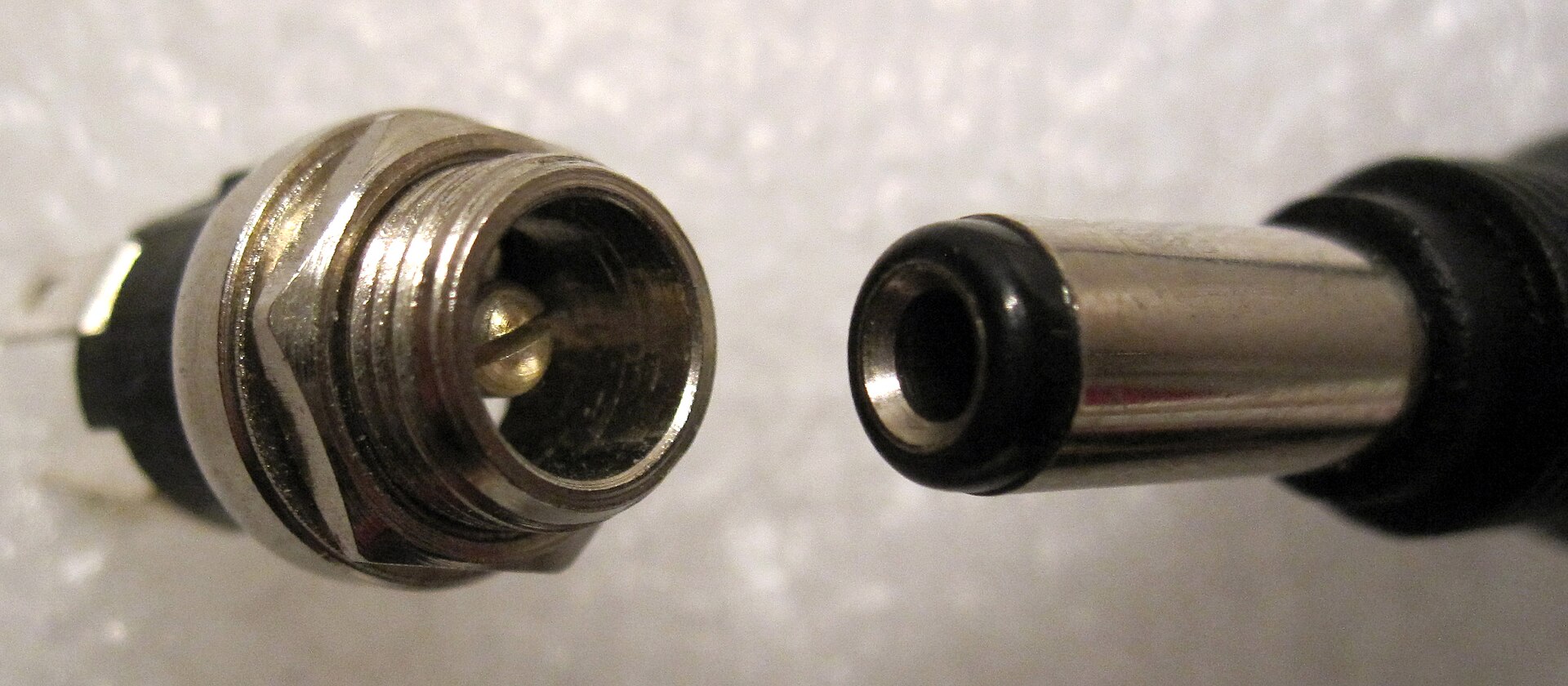
The mismatch is the barrel jack’s main trap. A 2.5 mm-bore plug goes onto a 2.1 mm pin and appears to work, but contact is made along one side of the pin only, and an intermittent contact carrying several amps behaves like a supply that fails at random. A 2.1 mm plug will not enter a jack with a 2.5 mm pin at all, which is the safer failure.
Current rating is the second trap. Same Sky’s (formerly CUI’s) PJ-002A, one of the commonest through-hole jacks, is rated 24 V and 2.5 A, with a 2.0 mm centre pin that accepts 2.1 mm plugs.8 A 4 A coil pulse exceeds that rating; for a short, low-duty pulse the contact will not overheat, but the rating is a contact-resistance and heating limit, and contact resistance is voltage drop. For coil currents above 2.5 A, choose a jack rated for the current (the same family has 5 A “H” variants) and check the mating plug’s rating too.
Barrel jacks have no voltage keying. A 12 V brick and a 24 V brick with the same plug are interchangeable, and a 24 V supply plugged into a gun built for a 12 V coil will drive four times the power into it. Label the jack.
2.7.2 GX12 aviation connectors
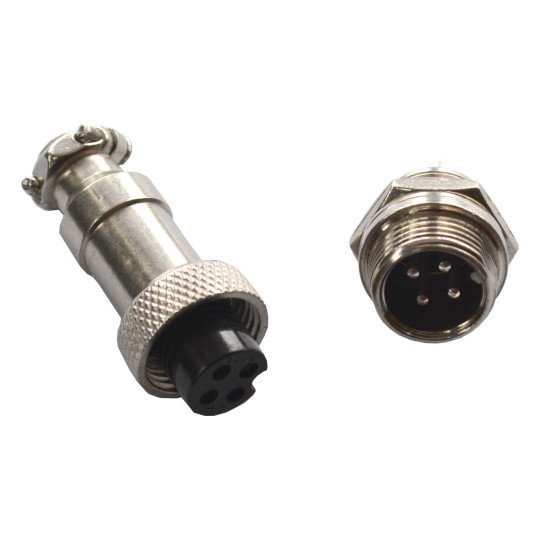
GX12 (12 mm) circular connectors are popular on home-built arcade guns because they lock, they look the part, and the multi-pin versions can carry the solenoid supply and other signals in one plug. Olimex’s datasheet for its four-pin GX12 gives a rated current of 5 A and a nominal voltage of 250 VAC / 300 VDC;9 other sellers’ figures for nominally the same connector vary, and at least one seller lists two different current ratings on the same page. Use the figure from the datasheet of the part actually bought.
Two cautions apply. GX12 connectors are not designed for hot-plugging, and while the coupling ring is being turned the pins can touch the wrong sockets briefly; on a multi-pin connector carrying 24 V next to logic lines, that can put 24 V onto a logic pin. Disconnect power first, or allocate pins so that a one-position misalignment cannot connect the supply to anything that matters. And the pin count invites putting USB through the same connector; doing so creates the shared-ground problem described in Vol 5 unless the solenoid’s return has its own pin.
2.7.3 XT30
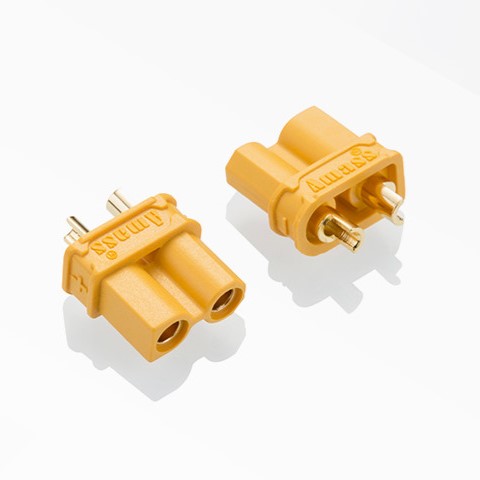
The XT30 is listed by distributors at 15 A continuous and 30 A peak.10 It is polarised, it grips firmly, and it is overwhelmingly rated for any light-gun coil. Inside a gun, between a power board and a coil, or between a bank and its load, it is an excellent choice. As the connector a player plugs into the wall brick it is less friendly than a barrel jack: it takes a firm pull to separate and is not what any commercial brick ships with.
2.7.4 Summary
Table 3 — Summary
| Connector | Rated current (source) | Polarised | Locks | Hot-plug safe | Best use |
|---|---|---|---|---|---|
| 5.5 × 2.1 mm barrel, PJ-002A class | 2.5 A (Same Sky) | yes, by geometry | no | yes | brick to gun, coils up to about 2 A |
| 5.5 × 2.1 mm barrel, high-current jack | 5 A class | yes | no | yes | brick to gun, larger coils |
| GX12, four-pin | 5 A (Olimex) | keyed | screw ring | no | cabinet guns, multi-pin harnesses |
| XT30 | 15 A continuous (distributor listings) | yes | friction | yes, with care | inside the gun; bank to coil |
2.8 The Cable: Voltage Drop Over a Gun Lead
A solenoid’s force falls with current, and current falls with every ohm in the loop. The loop includes the brick’s own cable, any extension, the connector contacts, the gun’s internal wiring, the MOSFET’s on-resistance and the coil itself. The cable is usually the largest controllable term.
The table gives the round-trip drop (both conductors) for copper at 20 °C, computed in the dive’s script:
Table 4 — The table gives the round-trip drop (both conductors) for copper at 20 °C, computed in the dive's script
| Wire | Length of cable | Loop resistance | Drop at 2 A | Drop at 4 A |
|---|---|---|---|---|
| 18 AWG | 1.8 m (GST60A24’s own lead) | 75 mΩ | 0.15 V | 0.30 V |
| 18 AWG | 3 m | 126 mΩ | 0.25 V | 0.50 V |
| 22 AWG | 3 m | 318 mΩ | 0.64 V | 1.27 V |
| 24 AWG | 3 m | 505 mΩ | 1.01 V | 2.02 V |
| 24 AWG | 5 m | 842 mΩ | 1.68 V | 3.37 V |
| 26 AWG | 5 m | 1.34 Ω | 2.68 V | 5.36 V |
| 28 AWG | 5 m | 2.13 Ω | 4.26 V | 8.52 V |
Two things stand out. First, the brick’s own lead is not the problem: Mean Well uses 18 AWG on the 24 V GST60A and 16 AWG on the 12 V model.2 The problem is the lead to the gun, which builders often make from multi-core cable whose conductors are 26 or 28 AWG because that is what fits beside the USB pair. Five metres of 28 AWG costs a 4 A coil more than a third of a 24 V supply. Second, the drop is a loss of force, but in a gun whose return current shares a conductor with the USB ground it is also a ground shift. That is the subject of Vol 5, and the reason OpenFIRE’s README asks for a minimum gauge on this run.11
Practical rules: run the solenoid supply on its own pair, at 22 AWG or heavier for 3 m at 2 A, 20 AWG or heavier for larger coils or longer runs; keep the pair twisted; and measure the voltage at the coil during a pulse once the gun is built.
2.9 When the Brick Is the Safety Device
Ultimarc’s instruction not to use a supply above 4 A because “the mechanism relies on the current-limiting feature on the supply to prevent overload” deserves a closer look.3 It means the AimTrak design accepts that its coil can be left energised by some fault, and counts on the brick’s current limit to keep the dissipation survivable while the fault lasts. Swap the brick for a bigger one and the coil, the driver and the wiring lose that limit.
Any DIY gun has the same exposure. A coil left on, through a firmware hang, a MOSFET that fails short (the commonest MOSFET failure), or a gate left floating at power-up, dissipates its full V²/R continuously: 96 W in the 6 Ω example, which will cook the coil and soften a printed shell long before anyone notices. OpenFIRE’s optional TMP36 temperature monitoring, with its default warning at 38 °C and shut-off at 45 °C, is a firmware defence against slow overheating;1 it cannot help when the MOSFET has failed short.
A brick that will supply much more than the coil needs should therefore be paired with protection in the gun:
- A fuse in the solenoid supply, time-lag, sized above the RMS current of the worst firing pattern (a 4 A pulse at 36 % duty is 2.4 A RMS) and checked against the fuse maker’s pulse (I²t) derating, so that it survives autofire but opens on a stuck-on coil. Choose it from the fuse maker’s datasheet, not by guesswork.
- A gate pull-down, so a floating gate at boot cannot turn the coil on. The OSH Park driver board OpenFIRE links carries a 100 k resistor that appears to serve this purpose.12
- A hardware maximum on-time, if the design warrants it: an AC-coupled gate drive that cannot hold the MOSFET on for longer than a set time, whatever the microcontroller does. The circuit belongs to the Reference Electronics dive.
2.10 Recommended Units, With Dated Prices
These are suggestions for a builder starting now. Each price is as listed on 2026-10-18 on the page named. The right choice still depends on the measured coil resistance.
Table 5 — Recommended Units, With Dated Prices
| Coil (measured) | Pulse current | Suggested supply | Why | Price, 2026-10-18 |
|---|---|---|---|---|
| 12 V, ≥ 6 Ω | ≤ 2 A | Mean Well GST60A12-P1J (12 V, 5 A, 5.5 × 2.1 mm) | Pulse far below the 5.25 A bottom of the trip band | $24.86 at TRC Electronics;13 $19.40 at DigiKey14 |
| 24 V, ≥ 10 Ω | ≤ 2.4 A | Mean Well GST60A24-P1J (24 V, 2.5 A, 5.5 × 2.1 mm) | Below the 2.63 A bottom of the trip band; floating output | $24.86 at TRC Electronics;15 $19.40 at DigiKey16 |
| 24 V, ≥ 7 Ω | ≤ 3.5 A | Mean Well GST90A24-P1M (24 V, 3.75 A) | Next size up. Note the 2.5 mm standard plug | $39.46 at TRC Electronics17 |
| 24 V, 4 to 6 A pulses (two stages at once; not this project, D16) | ≤ 6.3 A peak | Mean Well NSP-75-24 (3.2 A, 6.3 A peak 5 s, 21 to 26 V adjustable) | Rated for peaks; constant-current overload; adjustable | $39.46 at TRC Electronics18 |
| AimTrak with recoil | as Ultimarc specifies | 24 V ≤ 4 A or 36 V ≤ 3 A, 5.5 × 2.1 mm, one per gun | Maker’s requirement | brick not sold by Ultimarc3 |
Two notes on the table. The two prices for the same GST60A part on the same day, $24.86 and $19.40, are both as listed; TRC states that its prices include import tariff.15 And none of these choices removes the need for the protection in section 2.9: a brick that can deliver 5 A into a coil designed for 1 A will do so continuously if the MOSFET fails.
For bench work before any of this is bought, the lab’s 50 A linear supply and its programmable supplies are better than any brick: they set voltage and current limit independently, they do not hiccup, and they make the coil’s own behaviour visible. Vol 6 sets out the bench sequence.
2.11 The Rail Is Decided: 24 V, One Stage at a Time
Three owner decisions of 18 October 2026 settle what this section used to leave open.
- D14: the recoil rail is 24 V class, 18–28 V working, the rail the Solenoid Recoil dive argued for in its Volume 8. With D13, the coil current is regulated from the first driver board, the coil is chosen so that its hot I·R is about half the rail (roughly 5–12 Ω), and the pulse ends at landing.
- D16: the recoil stage and the ejection-port stage never fire at the same instant. The Reference Electronics board carries a second identical power stage for the port, but the firmware sequences the two outputs and interlocks them, so the rail only ever supplies one stage’s current.
- D17: there is no USB-only prototype stage. The build goes straight from the bench supplies to the 24 V brick. USB alone cannot sustain full-strength autofire (Vol 3), so architecture C stays where Vol 6 put it, in the later dives.
What that means for the supply:
- Coil current is the regulation target, about 1 to 2.4 A. With hot I·R near 12 V, a 12 Ω coil is regulated near 1 A and a 5 Ω coil near 2.4 A. The brick sees that current at its peak, while the current rises with the full rail across the coil. Once the driver is chopping, the coil’s current recirculates between PWM pulses and the average drawn from the rail falls to about I × (I·R_hot ÷ V_rail), roughly half; the bulk capacitor at the board smooths the chopping. Size the brick on the target current, not on the coil’s V/R.
- One stage sets the brick. Because the stages are sequenced, the peak on the rail is one stage’s target, at most about 2.4 A. The pick is the Mean Well GST60A24-P1J class, whose trip band starts at 2.63 A (105 % of 2.5 A).2 It is the smallest floating desktop brick whose band clears the top of the coil range, and it ships with the 2.1 mm plug.
- The GST90A24 is the step up, not the default. Its band starts at 4.13 A (110 % of 3.75 A).7 It is needed only if a coil chosen on the bench has to be regulated above about 2.4 A, or if the D16 interlock is ever relaxed.
- The NSP-75-24 case falls away. It was the answer to two coils firing together (up to about 4.8 A of peaks) and to OpenFIRE’s 45 ms fixed pulse. D16 removes the first and regulated drive ended at landing removes the second: a pulse of about 10 to 12 ms at 8 shots a second is about a 10 % duty, far from the NSP’s 35 % peak-duty rule. What remained against it then decides it: an open enclosed frame with screw terminals, a cabinet part rather than a floor brick, and an over-voltage band of 28–36 V that would force every capacitor on the rail up to 50 V.4
- 35 V capacitors are enough. The over-voltage protection of the 24 V GST60A and GST90A acts between 25.2 and 32.4 V;27 a 35 V part is above every GST band. The 50 V rating was needed only with an NSP on the rail.
- 20 V USB Power Delivery sits at the bottom of the window, at reduced forcing: the PD tolerance and cable drop can leave as little as 17.75 V at the gun, just under 18 V (USB-C Power Delivery, Volume 2). A PD sink is the USB-C Power Delivery dive’s subject.
Fixed-voltage drive with a per-gun pulse width, which on a 24 V rail with a “12 V” coil of 6 to 12 Ω draws 2 to 4 A, now happens only on the bench, before the regulated driver board exists, and the bench runs on the lab’s programmable supplies rather than a brick (Vol 6).
Table 6 — The Rail Is Decided: 24 V, One Stage at a Time
| Case | Coil and drive | Peak on the rail | Supply |
|---|---|---|---|
| The design: 24 V, regulated, stages sequenced (D13, D14, D16) | 5–12 Ω, regulated to 1–2.4 A, ended at landing | ≤ 2.4 A | GST60A24-P1J |
| A bench-chosen coil needing more than 2.4 A | regulated above 2.4 A | ≤ 3.7 A | GST90A24 (order the 2.1 mm plug) |
| Bench, before the regulated board | ”12 V” coil, 6–12 Ω, fixed voltage, trimmed pulse | 2–4 A | the lab’s programmable supplies (Vol 6) |
| 12 V rail (other builds; not this project’s rail) | 12 V coil, ≥ 6 Ω, fixed voltage | ≤ 2 A | GST60A12-P1J |
| Two stages at once | — | — | Not a case: the firmware forbids it (D16) |
2.12 Why This, and Why Not the Others
The rule for this project is that every pick states its reasons and the reasons each alternative lost.
The brick. Criteria, in order: a published overload band, so that the pulse can be placed below the bottom of it; a floating output (Vol 5); a desktop enclosure that is safe on a living-room floor; the 5.5 × 2.1 mm plug as standard; a maker’s datasheet; and stock at more than one distributor.
Table 7 — Why This, and Why Not the Others
| Candidate | Verdict | Reason |
|---|---|---|
| Mean Well GST60A24 (P1J) | Pick (D14, D16) | One stage at a time on the 24 V rail, and its trip band from 2.63 A clears the 2.4 A top of the regulated range. Overload band published (105–150 %), output not connected to earth, 2.1 mm plug as standard, 18 AWG lead, stocked by TRC and DigiKey at about $20–25. The 12 V GST60A12 is the same family for a 12 V build |
| Mean Well GST90A24 | Step up for 2.4–3.7 A regulated targets | Same family and same floating output; trip from 4.13 A. Its standard plug is the 2.5 mm P1M, so order the 2.1 mm plug or fit a matching jack |
| Mean Well NSP-75-24 | Rejected (D16) | The only candidate rated for peaks (6.3 A for 5 s), with constant-current overload instead of hiccup and 21–26 V adjustment; it was the pick for two stages firing together. With the stages sequenced (D16) one stage never needs it, and against it remain an open enclosed frame with screw terminals (a cabinet part, not a floor brick) and a 28–36 V over-voltage band that forces 50 V capacitors. Development work runs on the lab supplies instead |
| Mean Well GST120A24 | Rejected | 5 A, but the four-pin DIN version has its “-V connected to AC FG”: an earthed output, which adds the ground loop of Vol 519 |
| Unbranded “24 V 5 A” bricks | Rejected | No overload band, no protection type and no plug drawing to design against; the label’s current is all that is known |
| Linear transformer bricks | Rejected | The overload behaviour GUN4IR may be after can be had from the NSP; linear 24 V bricks are now speciality items (section 2.5) |
| Laptop bricks (19–20 V) | Not chosen | Inside Vol 8’s window at reduced forcing, but proprietary plugs and many are earthed; no published trip band |
| A USB PD charger | Deferred | 20 V at up to 3 A reaches the bottom of the window (as low as 17.75 V at the gun, USB-C PD Vol 2); it needs a PD sink in the gun, which is its own dive |
The connector at the gun. Criteria: the pulse current with margin for two stages; a plug that every candidate brick already has; safe to unplug live; panel mounting in the magazine base plate, where the cable leaves the MP7 donor by decision; a maker’s datasheet.
Table 8 — Why This, and Why Not the Others
| Candidate | Verdict | Reason |
|---|---|---|
| Same Sky PJ-005A, panel-mount, 2.0 mm pin | Was the pick; withdrawn at the gun (D31) | 5 A, 24 Vdc, 30 mΩ contact resistance, panel mount with nut and washer, 5,000 cycles.20 Mates the bricks’ 5.5 × 2.1 mm plug with no adapter and is safe to pull live. 5 A covers two stages in the regulated case |
| Same Sky PJ-063AH | Alternative | 8 A, but a right-angle PCB jack; right only if the carrier board’s edge reaches the base plate21 |
| Same Sky PJ-002A | Rejected | 2.5 A rating; under a single 24 V interim pulse, never mind two |
| GX16 (or GX12), one plug for USB and the 24 V rail | Pick (D31, 19 October 2026) | Locks, and one hole in the base plate carries everything. Its faults are real and are handled, not ignored: not for hot-plugging, so it is mated before the brick goes into the wall; a one-position slip can bridge pins, so the 24 V pin is placed where a slip meets only its own return; the solenoid return gets its own pin, apart from USB ground (the Vol 5 fault); no brick ships with it, so the brick’s own plug meets the cable at the far end. USB on the RP2040 is full speed (12 Mbit/s), which tolerates a connector that is not impedance-matched over a short run |
| XT30 | Rejected at the wall; used inside | No brick ships with it, so every user needs an adapter lead. Inside the gun the Reference Electronics board uses JST VH (10 A) for its power connectors; XT30 stays the choice for a separate bank |
| A captive cable, no jack | Not chosen yet | Removes a contact, but the brick then cannot be unplugged at the gun; revisit if the base plate has no room for a jack |
The owner’s decision (D31, 19 October 2026): one GX connector at the gun for everything. The barrel jack’s advantages, live unplugging and a plug every brick already has, are given up for a single locking plug in the base plate, and the barrel jack moves to the far end of the cable, where the brick’s own plug and the PC’s USB lead meet a small junction. Inside the umbilical the DC pair and the USB lead stay separate conductors, so the grounding of Vol 5 is unchanged; they simply share one connector shell at the gun. The current rating of a GX16 is still known only from sellers, whose figures run from 5 to 20 A (Olimex lists its 4-pin GX16 at 20 A; Fully Wired, Volume 3), so the part bought is the one whose datasheet gives a figure. The paragraph that follows was written for the PJ-005A and stands as the record of why it was the pick.
Two cautions on the jack. The PJ-005A’s 24 Vdc rating sits at the nominal rail, and an adjustable supply set to 26 V would exceed it; the voltage figure is an insulation rating, and the jack’s 500 Vac withstand is far above any of these, but a builder running above 24 V should know the number is being passed. And the datasheet gives the centre pin as 2.0 mm without naming the mating plug; the fit with the GST60A’s P1J plug is to be checked on the bench. Prices for the jacks were not readable on 2026-10-18.
Footnotes
-
TeamOpenFIRE, OpenFIRE-Firmware,
OpenFIREmain/OpenFIREprefs.handOpenFIREFeedback.cpp, commit 8b651a2 (19 April 2026). https://github.com/TeamOpenFIRE/OpenFIRE-Firmware (accessed 2026-10-18). ↩ ↩2 -
Mean Well, GST60A series specification, file GST60A-SPEC 2026-04-03. https://www.meanwell.com/Upload/PDF/GST60A/GST60A-SPEC.PDF (downloaded 2026-10-18). ↩ ↩2 ↩3 ↩4 ↩5
-
Ultimarc, “AimTrak Light Gun With Recoil.” https://www.ultimarc.com/light-guns/aimtrak-light-gun/aimtrak-light-gun-with-recoil/ (accessed 2026-10-18). ↩ ↩2 ↩3 ↩4 ↩5
-
Mean Well, NSP-75 series specification, file NSP-75-SPEC 2026-03-13, specification table and “Function Manual: 1. Peak Power.” https://www.meanwell.com/Upload/PDF/NSP-75/NSP-75-SPEC.PDF (downloaded 2026-10-18). ↩ ↩2 ↩3
-
GUN4IR, “UK and EU Exclusive - GUN4IR® GC2 Pre-Modded lightgun set.” https://www.gun4ir.com/products/uk-exclusive-gun4ir®-gc2-pre-modded-lightgun-set (accessed 2026-10-18). ↩
-
RetroShooter, “RS3 Reaper Pro – 2 Gun,” box contents and adapter photograph. https://retroshooter.com/?p=16293 (accessed 2026-10-18). ↩
-
Mean Well, GST90A series specification, file GST90A-SPEC 2026-04-03 (standard plug P1M, 5.5 × 2.5 mm; “-V not connected to AC FG”). https://www.meanwell.com/Upload/PDF/GST90A/GST90A-SPEC.PDF (downloaded 2026-10-18). ↩ ↩2 ↩3
-
Same Sky (formerly CUI Devices), PJ-002A DC power jack datasheet, date 03/11/2025, rev 1.05: “2.0 mm center pin,” rated input 24 Vdc, 2.5 A. https://jp.sameskydevices.com/product/resource/pj-002a.pdf (downloaded 2026-10-18). ↩
-
Olimex, CONNECTOR-GX12-4 datasheet (“Rated current: 5A,” “Nominal voltage: 250VAC 300VDC”), hosted by DigiKey. https://mm.digikey.com/Volume0/opasdata/d220001/medias/docus/5560/Olimex%20-%20CONNECTOR-GX12-4.pdf ; product page https://olimex.com/Products/Components/Connectors/CONNECTOR-GX12-4 (€1.55, out of stock, 2026-10-18). ↩
-
Pimoroni, “Amass XT30 Connector”: continuous current 15 A, peak 30 A. https://shop.pimoroni.com/products/amass-xt30-connector (accessed 2026-10-18). Amass’s own datasheet was not retrieved. ↩
-
TeamOpenFIRE, OpenFIRE-Firmware,
README.md, commit 8b651a2. https://github.com/TeamOpenFIRE/OpenFIRE-Firmware (accessed 2026-10-18). ↩ -
Prozac4545, “Gun4IR_Solenoid v1.1,” OSH Park shared project (silkscreen shows MOSFET, DIODE, 1K, 100K). https://oshpark.com/shared_projects/bjY4d7Vo (accessed 2026-10-18). The resistors’ function is read from the layout, not from a published schematic. ↩
-
TRC Electronics, “MEAN WELL GST60A12-P1J,” $24.86 (qty 1, tariff included). https://www.trcelectronics.com/products/mean-well-gst60a12-p1j (accessed 2026-10-18). ↩
-
DigiKey, search listing for GST60A12-P1J, $19.40. https://www.digikey.com/en/products/detail/mean-well-usa-inc/GST60A12-P1J/7703712 (accessed 2026-10-18). ↩
-
TRC Electronics, “MEAN WELL GST60A24-P1J,” $24.86 (qty 1, tariff included). https://www.trcelectronics.com/products/mean-well-gst60a24-p1j (accessed 2026-10-18). ↩ ↩2
-
DigiKey, search listing for GST60A24-P1J, $19.40. https://www.digikey.com/en/products/detail/mean-well-usa-inc/GST60A24-P1J/7703715 (accessed 2026-10-18). ↩
-
TRC Electronics, “MEAN WELL GST90A24-P1M,” $39.46 (qty 1). https://www.trcelectronics.com/products/mean-well-gst90a24-p1m (accessed 2026-10-18). ↩
-
TRC Electronics, “MEAN WELL NSP-75-24,” $39.46 (qty 1), availability “Contact Us.” https://www.trcelectronics.com/products/mean-well-nsp-75-24 (accessed 2026-10-18). ↩
-
Mean Well, GST120A series specification, file GST120A-SPEC 2025-03-28 (four-pin DIN pin assignment: “-V connected to AC FG”). https://www.meanwell.com/Upload/PDF/GST120A/GST120A-SPEC.PDF (downloaded 2026-10-18). ↩
-
Same Sky, PJ-005A DC power jack datasheet, rev 1.09, 05/27/2026: “2.0 mm center pin,” “panel mount,” rated input 24 Vdc, 5 A, contact resistance 30 mΩ. https://www.sameskydevices.com/product/resource/pj-005a.pdf (downloaded 2026-10-18). ↩
-
Same Sky, PJ-063AH DC power jack datasheet, 09/30/2025: 2.0 mm centre pin, 8.0 A, 24 Vdc, right-angle through hole. https://www.sameskydevices.com/product/resource/pj-063ah.pdf (accessed 2026-10-18). ↩
Comments (0)