Licensing, IP and Kits · Volume 3
Patents and Freedom to Operate — Which Live Patents Sit Close to a Light-Gun Kit
How a patent binds a kit seller and why selling parts is no way round it; the patents found round light-gun sensing and recoil, with their claims and estimated expiry dates; Sinden's recoil patent read element by element against the category's own solenoid stage; the Wii Remote family's end; the camera maker's pointing patents; and what to ask a patent attorney before a kit is sold
3.1 How a patent reaches a kit
A US utility patent runs “20 years from the date on which the application for the patent was filed in the United States”, subject to maintenance fees and to any term adjustment for USPTO delay (35 U.S.C. § 154(a)(2)). What it protects is set by its claims, not its title or its drawings, and a claim reads on a product only if the product has every element of it. One missing element puts a product outside that claim, which is why the tables in this volume go element by element.
Three parts of 35 U.S.C. § 271 matter to a kit:
- § 271(a): whoever “makes, uses, offers to sell, or sells any patented invention” in the US infringes. A finished gun is made by its seller.
- § 271(b): “Whoever actively induces infringement of a patent shall be liable as an infringer.” Instructions that tell a buyer to assemble the claimed combination are the classic inducement.
- § 271(c): selling “a component of a patented machine … especially made or especially adapted for use in an infringement of such patent, and not a staple article or commodity of commerce suitable for substantial noninfringing use” is contributory infringement.
So a kit of parts is not a way round a patent. A carrier board designed only to drive a solenoid in a gun, sold with instructions to fit it, is the textbook “especially adapted” component.
Patent rights also end at the first authorised sale. “A patented item’s initial authorized sale terminates all patent rights to that item”, and the rule reaches method claims and components that “substantially embody” the patent (Quanta Computer v. LG Electronics, 553 U.S. 617 (2008)). A genuine camera bought through its maker’s channel carries that exhaustion for the maker’s own patents on the camera. It does not license anyone else’s patent on what the gun does with it.
3.2 What was searched
Google Patents was searched on 20 October 2026 by assignee (Sinden Technology, PixArt Imaging), by keyword (“light gun” with recoil, infrared or camera, US grants since 2006) and through the Nintendo and Sinden patents named in an IPWatchdog survey of gun-shaped game controllers (24 September 2025). Each patent below was then read on its Google Patents page, claims included; the claims of the two Sinden patents and the Nintendo family are saved in this dive’s research files. The expiry dates are Google’s estimates, which Google itself labels an assumption: they presume every maintenance fee is paid.
This is a reading of patents, not a freedom-to-operate search. Not searched: Namco and Bandai Namco’s GunCon patents, Ultimarc, Retro Shooter, Blamcon, and patents on IR emitter bars, USB HID descriptors or haptics in general. A professional search would cover them.
3.3 The timeline
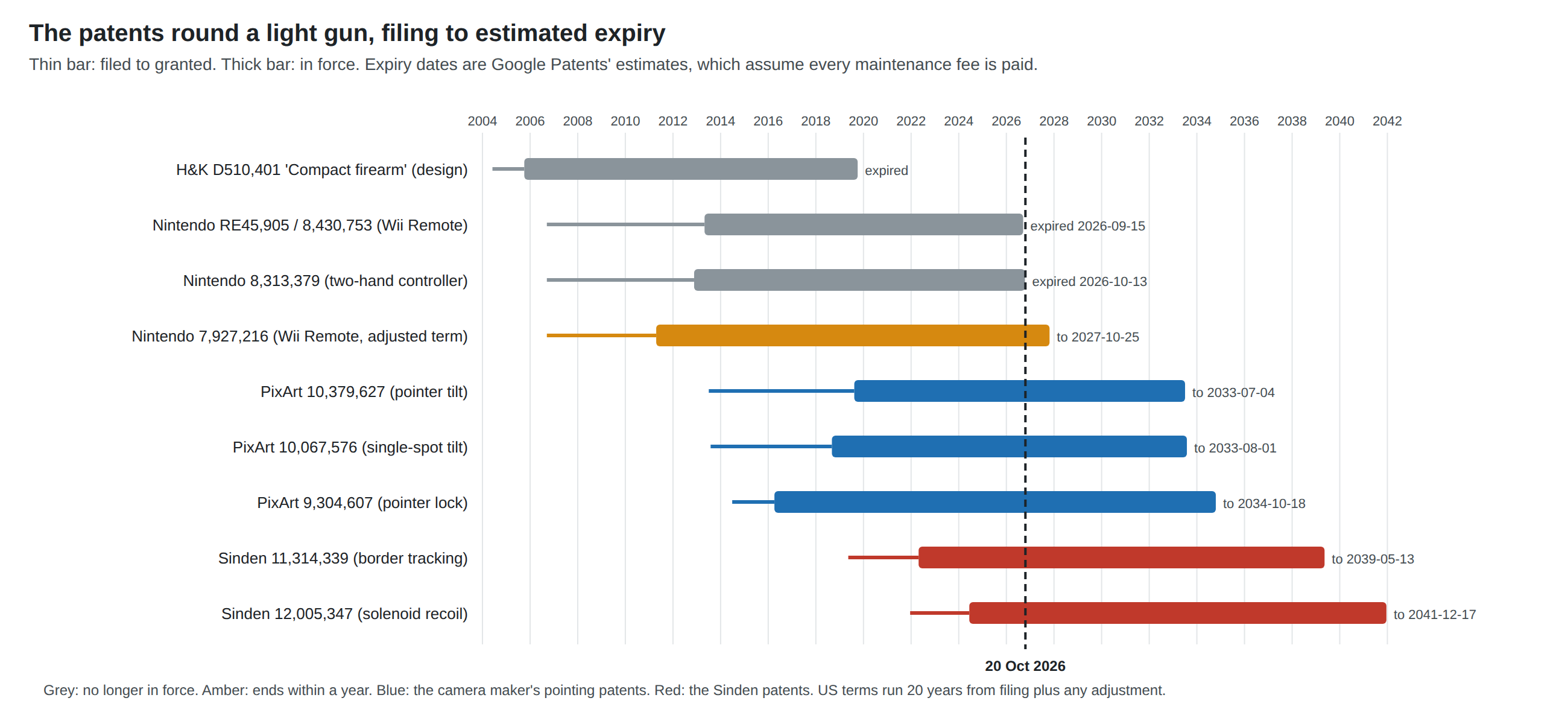
Table 1 — 3.3 The timeline
| Patent | Holder | Filed | Granted | Estimated end | What its claim 1 needs, in short |
|---|---|---|---|---|---|
| US 12,005,347 B2 | Sinden Technology Ltd | 17 Dec 2021 | 11 Jun 2024 | 17 Dec 2041 | Solenoid recoil with a capacitor, current monitoring, energy returned to the capacitor, pulse ended on current |
| US 11,314,339 B2 | Sinden Technology Ltd | 13 May 2019 (GB priority 13 May 2018) | 26 Apr 2022 | 13 May 2039 | A border applied round the display content, detected by a camera to compute aim |
| US 9,304,607 B2 | PixArt Imaging | 28 Jun 2014 | 5 Apr 2016 | 18 Oct 2034 (adjusted) | A handheld pointer’s “pointer-lock mode” method |
| US 10,067,576 B2 | PixArt Imaging | 8 May 2014 | 4 Sep 2018 | 1 Aug 2033 (adjusted) | Tilt-angle adjustment from images of “only one light spot” |
| US 10,379,627 B2 | PixArt Imaging | 27 Aug 2017 | 13 Aug 2019 | 4 Jul 2033 (adjusted) | Pointing coordinates computed with a tilt angle from a reference’s movement |
| US 7,927,216 B2 | Nintendo | 15 Sep 2006 | 19 Apr 2011 | 25 Oct 2027 (adjusted) | A one-hand wireless controller with accelerometer and IR imaging, and a finger depression on the underside |
| RE45,905 E1; US 8,430,753 B2 | Nintendo | 2013; 2011 (from 2006) | 2016; 2013 | 15 Sep 2026 | A wireless one-hand controller with a lower trigger, inertial sensor and 2-D radiation detector |
| US 8,313,379 B2 | Nintendo | 24 Sep 2010 (from 2006) | 20 Nov 2012 | 13 Oct 2026 (adjusted) | A one- and two-hand elongated controller with two light markers |
3.4 Sinden’s recoil patent
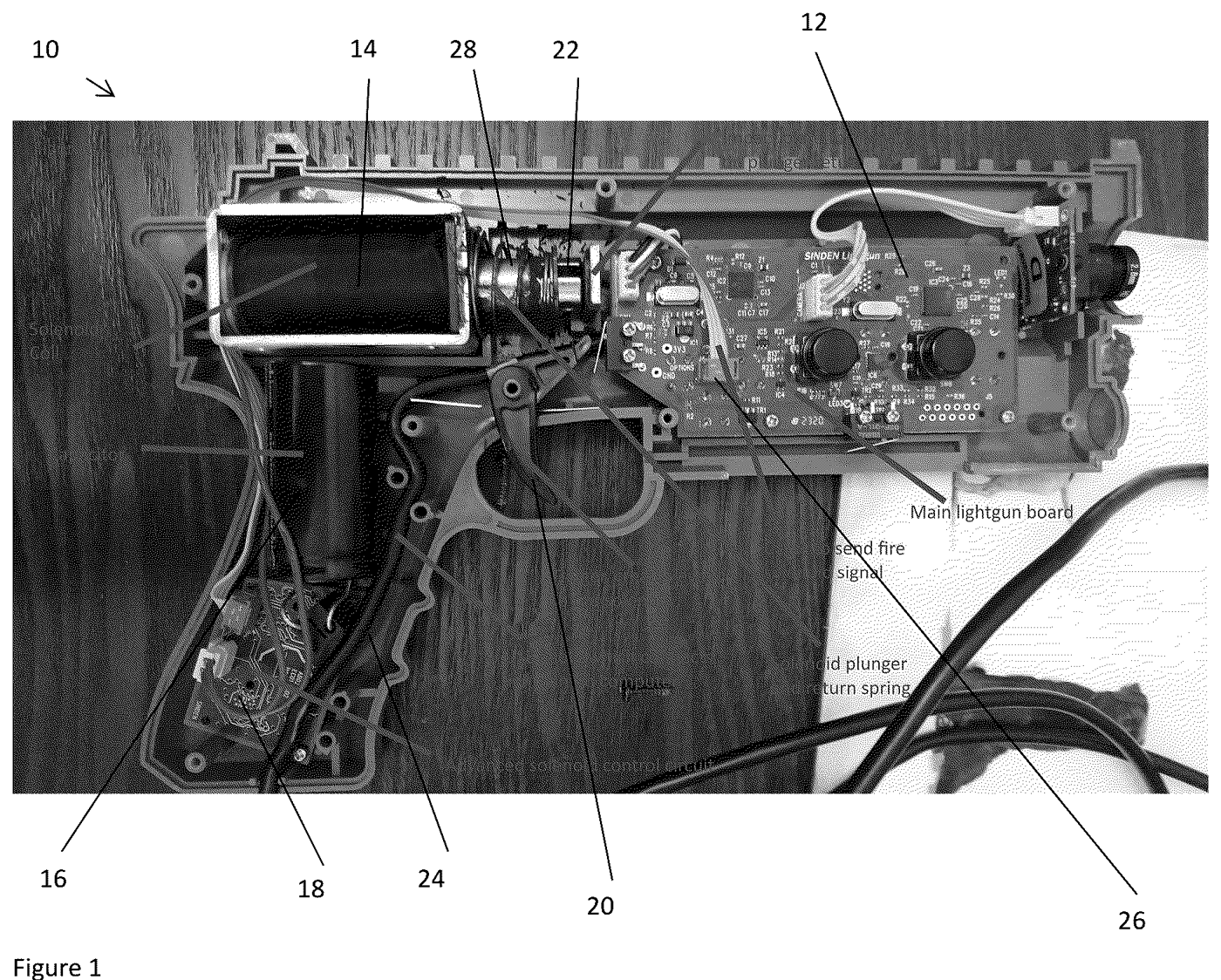
US 12,005,347 B2, “In or relating to gaming controllers”, was filed by Sinden Technology Ltd on 17 December 2021 and granted on 11 June 2024, naming Garry Brown and Andrew James Sinden as inventors. Its first figure is a photograph of a Sinden gun opened up: solenoid at the top rear, a large capacitor in the grip, a separate solenoid control board, and the main light-gun board.
Claim 1 is the only independent claim. In full:
“A gaming controller configured to provide a recoil effect when a trigger is pulled, the gaming controller comprising: a solenoid including a plunger movable between a first non-energised position and a second energised position when a current pulse is applied in response to pulling the trigger; a capacitor configured to draw and hold current; a current measuring device configured to monitor the current drawn by the solenoid when the trigger is pulled; a switch configured to enable the harvesting of energy from the energised solenoid back into the capacitor; and a control circuitry configured to control at least one parameter of the current pulse and to terminate the current pulse based on the monitored current drawn.”
The dependent claims add USB power (claim 4), inrush limiting (claims 5 and 6), and a temperature sensor inside the solenoid (claim 12). Figures 8 and 9 show what “based on the monitored current” means in the description: the coil current rises, peaks, dips as the plunger moves, and the controller reads thresholds on the current and on its slope to find where the plunger is.
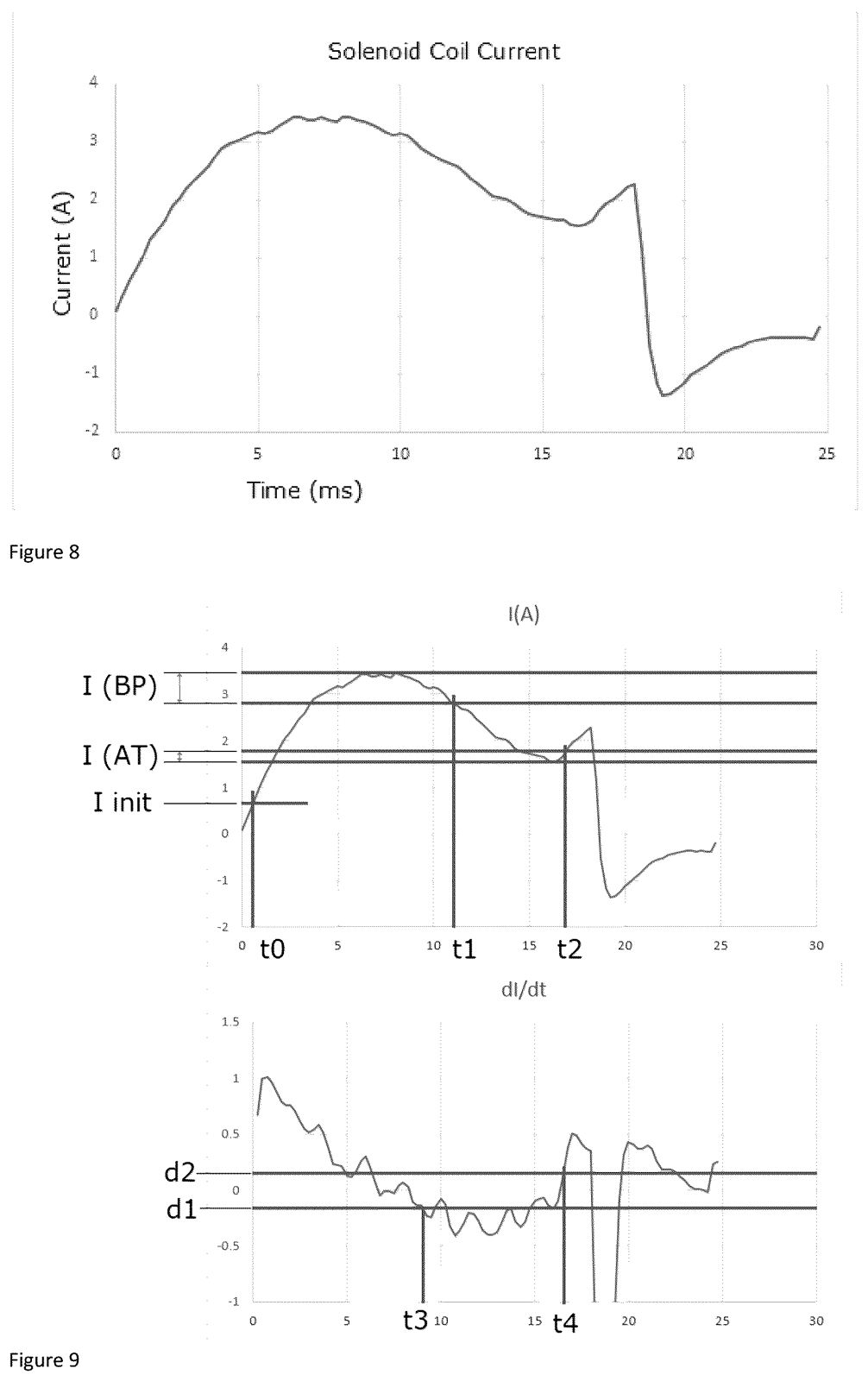
That dip is the “cusp” the Solenoid Recoil dive uses as a free position sensor: the plunger’s back-EMF pulls the current down as it moves, and the bottom of the cusp marks its landing (Solenoid Recoil Vol 2, Vol 6). The physics is old and public. What the patent claims is a particular combination built round it.
3.5 Claim 1 against the category’s solenoid stages
Three stages are on the table. The stock OpenFIRE stage is a logic-level MOSFET with a diode across the coil, driven for a fixed time. The reference stage of decision D13 is a TI DRV8251A H-bridge with integrated current regulation: above a set trip current it brakes for 25 µs and drives again, its IPROPI pin mirrors the coil current, and at the end of a shot both inputs go low so the bridge coasts and “the coil’s stored energy returns to V_SOL” through the body diodes into the board’s 1000 µF bulk capacitor (Reference Electronics Vol 5 §5.12). The fork holds the command for the measured landing time plus 2 ms, a time set on the bench rather than read from the current shot by shot (Our Firmware Vol 3 §3.2).
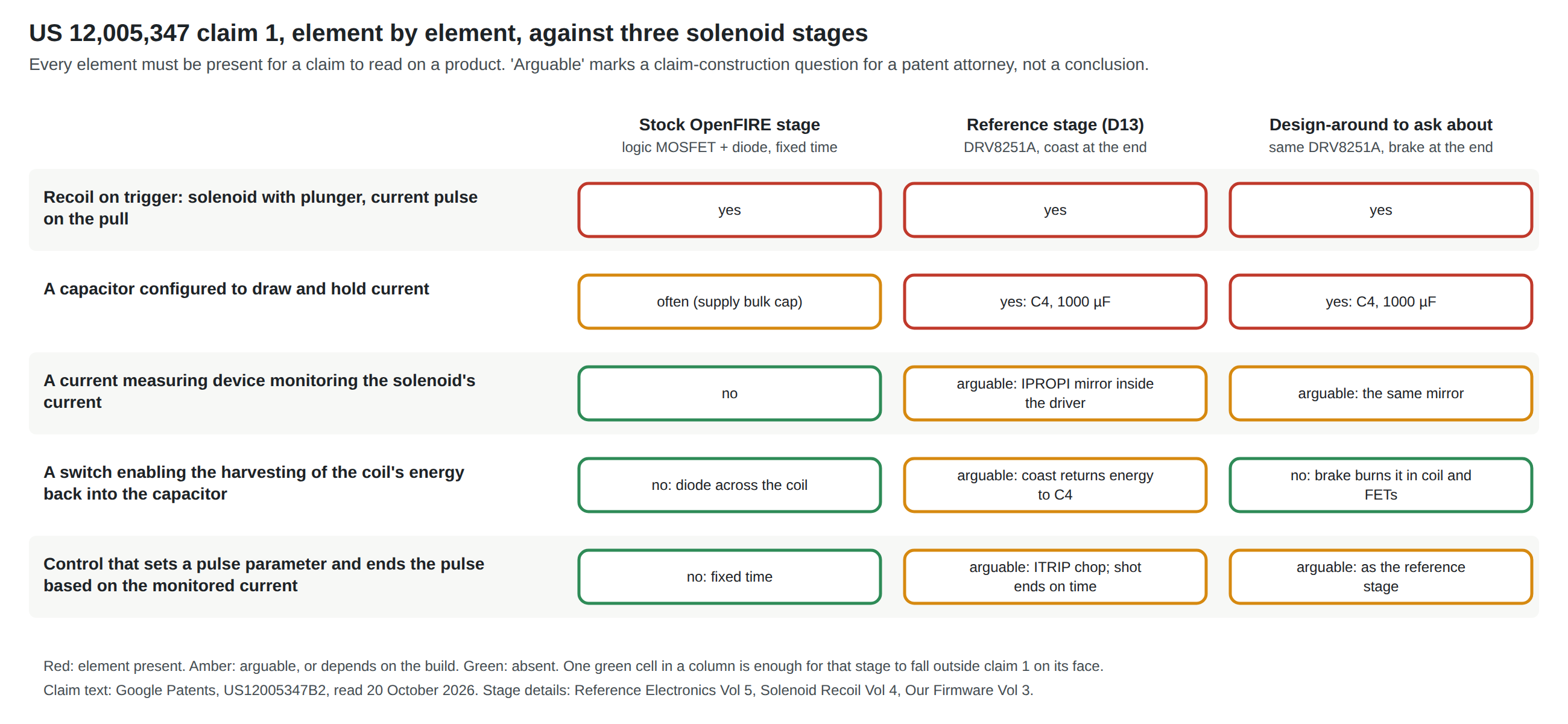
Read element by element:
- Recoil on trigger, solenoid, current pulse. Every stage has it.
- A capacitor “configured to draw and hold current”. The carrier’s bulk capacitor C4 is there for exactly that. Present.
- A current measuring device monitoring the solenoid’s current. The stock stage has none. The DRV8251A measures the coil current internally to regulate it and mirrors it on IPROPI; on the carrier, IPROPI goes only to a resistor and a test point, not to the Pico. Whether an internal regulation loop is “a current measuring device configured to monitor the current drawn” is a claim-construction question.
- “A switch configured to enable the harvesting of energy from the energised solenoid back into the capacitor”. The stock stage dumps the energy in its diode. The reference stage, when it coasts, does return the energy to the capacitor, by turning its switches off and letting the body diodes conduct. Whether that is “a switch configured to enable the harvesting” is again for an attorney, but it is the element the category’s own design comes closest to.
- Control that sets a pulse parameter and ends the pulse “based on the monitored current”. The DRV8251A’s trip current is a pulse parameter set by current, and each chop ends on current; the shot itself ends on a bench-set time. A future feature that ended the shot on the detected cusp, which the Solenoid Recoil dive’s bench method makes tempting, would sit squarely in this element and in Figure 9.
The cheap design-around to put to an attorney. The DRV8251A’s truth table offers a brake as well as a coast: with both inputs high, the two low-side switches short the coil and its energy is dissipated in the coil and the switches instead of being returned to the capacitor. Ending each shot in brake, then coasting only once the current has reached zero, would remove element 4 on its face. It is not free. The carrier grounds IN2 (Reference Electronics Vol 5 §5.12), so the brake needs IN2 brought to a GPIO or to a small piece of logic, a board change on a carrier whose pin budget is already tight (row FW-6). And it costs release time: the brake is the slow-decay path, so the plunger releases more slowly than with the coast’s fast decay, which the Reference Electronics dive chose the bridge to get (Reference Electronics Vol 5 §5.12; Solenoid Recoil Vol 4, “Turn-off: diode, Zener and TVS clamps”). The other route is the discrete stage with a Zener clamp (Solenoid Recoil Vol 4), which gives fast release by burning the energy, at the cost of the regulation D13 chose. And the firmware should not end shots on the measured cusp in any kit build until an attorney has looked at element 5.
None of this is a conclusion that the reference stage infringes or that the brake variant does not. A granted patent is presumed valid, its claims mean what a court says they mean, and the doctrine of equivalents can reach a product that lacks an element literally. That is why §3.10 lists this patent first.
3.6 Sinden’s border patent
US 11,314,339 B2, “Control device for detection” (Sinden Technology Ltd; inventor Andrew James Sinden), claims priority from a British application of 13 May 2018, was granted on 26 April 2022, and has a Google-estimated end of 13 May 2039. Its British counterpart, GB 2574080 B, was granted on 19 August 2020. Claim 1, its only independent claim, begins:
“A method for detecting a display, the method comprising the steps of: applying a border to completely surround display content within a display area of the display, wherein the applied border is configured to aid the detection of the display; receiving an image signal from an image detection means; detecting, by an image processor, that the received image signal comprises an image of at least a portion of a display; determining, by the image processor, an array of pixel coordinates … that define at least a part of an outline of the display; calculating … an orientation of the image detection means in relation to the display; and … communicating a pointing alignment … to a processor in communication with the display, and wherein the border surrounds the display content within the display area by being overlayed on an edge of the display content that is detected by the imaging detection means.”
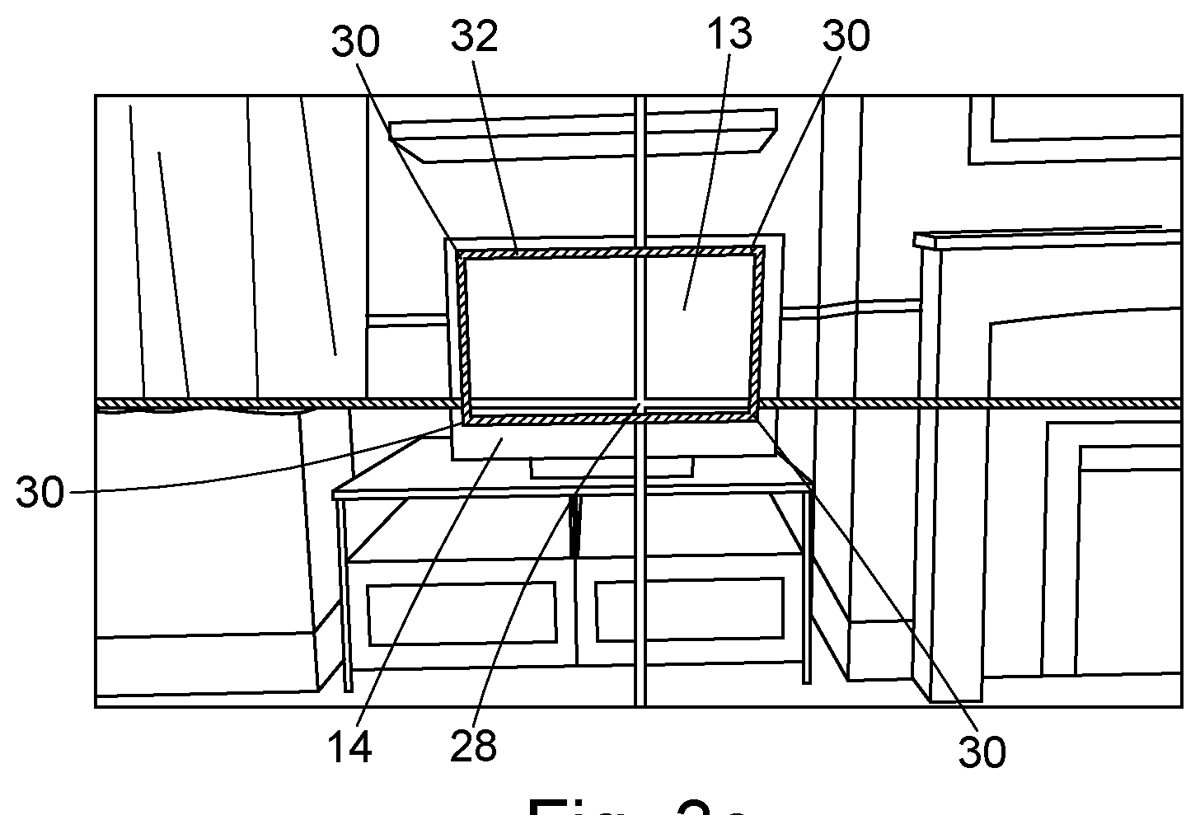
Claim 11 is an apparatus “configured to carry out the method of claim 1”, and claim 13 a computer-readable medium with instructions for it, so all three stand or fall with claim 1’s elements. The first of them is an applied border round the display content. An IR-LED gun of the OpenFIRE kind applies nothing to the picture: it finds four infrared emitters with a blob-tracking camera. On its face it lacks the first element. An open border-tracking gun, the subject of the Border Tracking dive, would apply a border and detect the display’s outline from it, which is the claim’s core. That dive does not mention the patent; it is reported here for its owners. Anyone building a border-tracking product for sale in the US before 2039 needs an opinion on this patent first. A private build for personal use is still “use”, but no realistic enforcement story runs against a hobbyist’s own gun, and this dive does not pretend otherwise.
3.7 The Wii Remote family
The Wii Remote was the first mass-market controller with an infrared camera finding light sources by a screen, and Nintendo patented it broadly. The family’s widest claim reads like a description of a camera light gun:
“A wireless handheld remote controller configured to be held in one hand, comprising: a housing including an upper surface and a lower surface; at least one digit operable detector disposed on the upper surface; at least one depressible trigger disposed on said lower surface; an inertial sensor mounted in the housing; a two dimensional radiation detector; a processor that processes an output of the radiation detector and determines an illumination pattern; a wireless transceiver that transmits information based on signals generated by the inertial sensor and the processor; and an output device operatively coupled to the transceiver.”
That is claim 1 of both the reissue RE45,905 and US 8,430,753, and Google’s estimated end for both is 15 September 2026, five weeks before this volume was written. US 8,313,379, the one- and two-hand controller with two markers, ended on an adjusted 13 October 2026.
One member is still in force. US 7,927,216, granted 19 April 2011, has a patent-term adjustment that carries it to 25 October 2027. Its claim 1 is narrower: a one-hand housing with the thumb on the upper surface and “a depression … positioned and dimensioned so as to accept the user’s index finger” with a control in it, an accelerometer, an imaging module sensing infrared that “determines positions of illuminated stationary objects”, and “a wireless transceiver” sending both. Every claim read in this family needs a wireless transceiver. A cabled gun lacks it. A wireless kit gun with an IMU (decision D36 puts one on the carrier) and an IR camera has the electronic elements; whether a pistol grip and trigger are the claimed housing is the attorney’s question. The simple course is that no wireless kit ships before 26 October 2027, and the wireless plans in Fully Wireless are well behind that date anyway.
US 8,267,786, also Nintendo’s and running to an adjusted 2030, claims a controller in two separately held units (the Wii Remote with its Nunchuk). A single gun is one unit.
3.8 The camera maker’s patents
PixArt Imaging, which makes the PAJ7025R3 camera the category chose for its kit (decision D18, row P-RE16), holds live US patents on handheld pointers: a “pointer-lock mode” method (US 9,304,607, to October 2034), tilt correction from “images of only one light spot” (US 10,067,576, to August 2033), and pointing with a tilt angle from a reference’s movement (US 10,379,627, to July 2033). Their claim 1s are narrow methods, and none was mapped against OpenFIRE’s four-point solution for this volume.
Two points follow anyway. Buying the camera through PixArt’s own channel (its one Americas distributor, WPG Americas, per decision D32) exhausts PixArt’s patents on the camera itself (§3.1). And the stopgap Wii Remote camera (D18) is harvested from a genuine Nintendo product, which carries the same exhaustion for that part: it is not the problem for a kit. Its problem is supply, which is why D18 ruled it out of the design.
3.9 Design patents and the MP7
A design patent protects ornamental appearance, for “15 years from the date of grant” today (35 U.S.C. § 173; 14 years for applications filed before 13 May 2015). H&K holds or held design patents on its guns: “Weapon” (D429,308, granted 8 August 2000, expired 2014, with the “HK” mark forming part of the claimed design), “Compact firearm” (D510,401, filed 2 June 2004, granted 4 October 2005, expired 2019; the drawings show a compact gun with an adjustable stock, and the model is not named), and “Handgun” (D593,629, granted 2 June 2009, expired 2023, with P30 and P3000 insignia). No design patent identifiable as the MP7 was found, and any filed in the MP7’s introduction years would have expired by the same arithmetic. The MP7’s look is therefore a trademark question (Volume 2), not a patent one.
3.10 What to ask a patent attorney
Before any kit is sold, an opinion on these points, in this order:
- US 12,005,347 against the carrier’s solenoid stage as built, coast and brake variants, with the firmware’s pulse logic. Does claim 1 read on either, literally or by equivalents? Would ending on the measured cusp change the answer?
- US 7,927,216, only if a wireless kit is planned before 26 October 2027.
- US 11,314,339, only if a border-tracking mode is ever offered.
- A clearance search of what this volume did not cover: GunCon and arcade patents, IR emitter bars, and anything filed since 2022 on camera light guns.
- Whether the buyer’s assembly from a kit changes the seller’s exposure under § 271(b) and (c), and what the instructions may say.
3.11 Why this, and why not the others
Read the claims of the few close patents rather than buy a full search now. Nothing is being sold, the design is still moving, and an opinion is only good for the design it was given. Reading the close patents now lets the design avoid the obvious problems (the brake variant costs one routed pin and a firmware change, not a new driver) and gives the eventual attorney a short, specific brief. A full search would be bought against a design that will change.
Not: ignore patents until there are sales. Section 271 has no small-seller exemption, and § 271(c) makes the carrier board itself the problem.
Not: change the recoil design now. The brake-at-end variant can be tried on the first carrier with a wire from IN2 to a spare pin or a test clip, and D13’s regulation stays. Only if the bench and an attorney both favour it does the next carrier revision route IN2. Whether to adopt it is a decision for the owner after the bench measures its cost and an attorney weighs its value. It is proposed as a row in Volume 5, not decided here.
3.12 What could not be verified
- Whether the maintenance fees on each patent have been paid; Google’s expiry dates assume they have. USPTO Patent Center was not checked.
- The descriptions of US 12,005,347 and US 11,314,339 beyond the claims and figures, including how they define “switch” and “border”.
- Whether Sinden acquired US 12,005,347 (IPWatchdog’s word) or filed it originally; Google lists Sinden Technology as the original applicant.
- The PixArt claims against OpenFIRE’s algorithm; and the model shown in H&K’s D510,401.
Sources
- Google Patents pages, read 20 October 2026: US12005347B2; US11314339B2; GB2574080B; US7927216B2; USRE45905E1; US8430753B2; US8313379B2; US8267786B2; US9304607B2; US10067576B2; US10379627B2; USD429308S; USD510401S1; USD593629S1. https://patents.google.com/patent/US12005347B2/en and likewise.
- 35 U.S.C. §§ 154, 173, 271, Cornell LII, read 20 October 2026.
- Quanta Computer, Inc. v. LG Electronics, Inc., 553 U.S. 617 (2008), syllabus, Cornell LII.
- IPWatchdog, “From Duck Hunt to VR: A Brief History of Gun-Like Peripherals for Video Games (and Their Patents)”, 24 September 2025 (leads only).
- Reference Electronics Vol 5 §5.12; Solenoid Recoil Vols 2, 4 and 6; Our Firmware Vol 3 §3.2; owner decisions D13, D18, D32, D36.
Comments (0)