Licensing, IP and Kits · Volume 4
Product Rules for a US Kit — FCC Part 15, the CPSC's Toy Line, the Brick, Prop 65 and Selling Abroad
Why a cabled light gun is a Class B digital peripheral that must be authorised before it is marketed, and why a kit cannot lean on the home-built exemption; the CPSC's line between a toy and a general-use product and how marketing draws it; the defect-reporting duty every seller carries; the wall brick's federal efficiency rule and why a listed brick is bought, not built; California's Proposition 65 and the small-business exemption; and what selling outside the US would add
4.1 Which product rules reach a light gun
A cabled camera light gun with a 24 V recoil stage meets four federal product regimes in the US, plus one state regime that matters out of proportion to its size:
Table 1 — A cabled camera light gun with a 24 V recoil stage meets four federal product regimes in the US, plus one state regime that matters out of proportion to its size
| Regime | Reaches the gun because | Section |
|---|---|---|
| FCC Part 15 | It is a digital device that connects to a computer | 4.2–4.4 |
| CPSC, Consumer Product Safety Act | It is a consumer product; whether it is a children’s product is a marketing choice | 4.5–4.6 |
| CPSC, 16 CFR part 1272 | Only if its shell looks like a real firearm | 4.6, and the Imitation Firearm Law dive |
| DOE, 10 CFR 430.32(w) | Only if an external power supply ships in the box | 4.7 |
| Hazardous materials, 49 CFR 173.185 | Only if a lithium pack ships; decision LB-7 ships none | LiPo Batteries Vol 7 |
| California Proposition 65 | Only for a business with ten or more employees | 4.8 |
The radio rules for a wireless gun are covered in Fully Wireless Vol 6 and add to, rather than replace, what follows.
4.2 FCC Part 15: the cabled gun
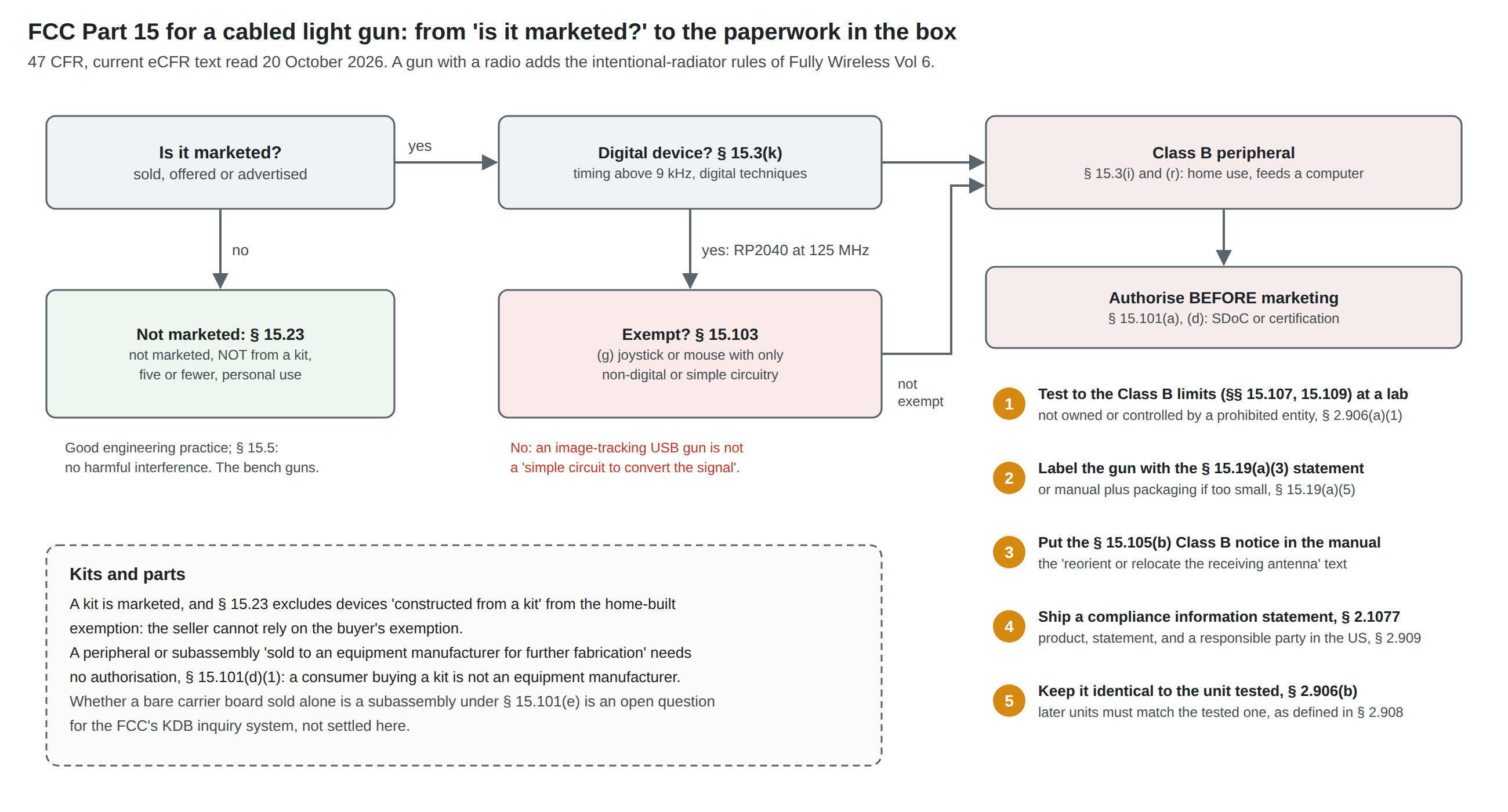
It is a digital device. Part 15 defines one as “an unintentional radiator (device or system) that generates and uses timing signals or pulses at a rate in excess of 9,000 pulses (cycles) per second and uses digital techniques” (47 CFR 15.3(k)). An RP2040 clocked at 125 MHz running USB is one without argument.
It is a peripheral, and Class B. A peripheral is “an input/output unit of a system that feeds data into and/or receives data from the central processing unit of a digital device”, including “any device that is connected external to the digital device” (§ 15.3(r)). A Class B device is one “marketed for use in a residential environment” (§ 15.3(i)). A light gun for home gaming is both.
It is not exempt. The only exemption that comes close is § 15.103(g): “Joystick controllers or similar devices, such as a mouse, used with digital devices but which contain only non-digital circuitry or a simple circuit to convert the signal to the format required (e.g., an integrated circuit for analog to digital conversion) are viewed as passive add-on devices”. A gun that runs image tracking, a USB stack and a solenoid controller on a 125 MHz processor is not a simple conversion circuit, and § 15.103(i) adds that equipment is exempt only if every device in it qualifies.
So it is authorised before it is marketed. “Unintentional radiators shall be authorized prior to the initiation of marketing, pursuant to the procedures for certification or Supplier’s Declaration of Conformity (SDoC)”; for “Class B personal computers and peripherals” either is allowed, and “Peripheral devices … shall be authorized under Supplier’s Declaration of Conformity, or a grant of certification, as appropriate, prior to marketing” (§ 15.101(a), (d)). SDoC is the practical route: the responsible party “makes measurements or completes other procedures found acceptable to the Commission to ensure that the equipment complies”, and nothing is filed with the FCC unless it asks (§ 2.906(a)). The measurements are the Class B conducted and radiated emission limits, made at a test laboratory that is not “owned by, controlled by, or under the direction of a prohibited entity” (§ 2.906(a)(1)).
The radiated side is where a light gun’s own design matters. The solenoid’s switching edges, the camera’s clock and the USB lead all radiate, and a cable that carries the 24 V rail beside USB is an antenna for both. The category’s grounding and cable decisions (D31’s single GX connector, D34’s solid ground plane, the Fully Wired dive’s cable) were made for signal integrity and the OpenFIRE README’s EMI warnings; they are also the emissions design.
4.3 The home-built exemption and kits
Section 15.23(a) reads in full: “Equipment authorization is not required for devices that are not marketed, are not constructed from a kit, and are built in quantities of five or less for personal use.” The builder is still “expected to employ good engineering practices to meet the specified technical standards to the greatest extent practicable”, and § 15.5 (no harmful interference) applies (§ 15.23(b)).
That is the rule for every gun built on the bench for the family’s own use. It is not a rule a kit seller can use, for two reasons in its own words: a kit is marketed, and a device “constructed from a kit” is outside the exemption even in the buyer’s hands. Two other provisions look like routes and are not:
- Sold to a manufacturer. “No authorization is required for a peripheral device or a subassembly that is sold to an equipment manufacturer for further fabrication; that manufacturer is responsible for obtaining the necessary authorization” (§ 15.101(d)(1)). A consumer who buys a kit is not an equipment manufacturer.
- Subassemblies. “Subassemblies to digital devices are not subject to the technical standards in this part unless they are marketed as part of a system”, and they include “CPU boards … other than those used in personal computers, that are marketed without an enclosure or power supply” (§ 15.101(e)(2)), where a CPU board is one whose “primary function … is to execute user-provided programming” (§ 15.3(bb)). Whether a bare carrier board, sold alone, falls here is genuinely unclear: its purpose is to run one firmware in one gun, and it is marketed as part of a light-gun system. This is a question for the FCC’s own Knowledge Database inquiry, not one this dive answers. A kit of the complete electronics, which is what routes A to C ship, is marketed as a system.
The plain reading, then: whatever form the kit takes, the electronics in it are authorised under SDoC before the first one is offered for sale. “Marketing” in § 2.803(a) includes “offering for sale … including advertising for sale”. Pre-orders are the one exception: § 2.803(d)(2)(i) allows conditional sales and their advertising before authorisation, provided the buyer is told prominently that “delivery to the end user is conditional upon successful completion of the applicable equipment authorization process” and what refund applies if it fails, and, for an SDoC device, nothing is physically shipped until the process is complete (§ 2.803(d)(2)(i)(B)).
4.4 The paperwork Part 15 puts in the box
Table 2 — 4.4 The paperwork Part 15 puts in the box
| Item | Rule | What it says |
|---|---|---|
| Label on the gun | § 15.19(a)(3) | “This device complies with part 15 of the FCC Rules. Operation is subject to the following two conditions: (1) This device may not cause harmful interference, and (2) this device must accept any interference received, including interference that may cause undesired operation.” If the device is too small for 4-point type, the statement goes in the manual and on the packaging or a removable label (§ 15.19(a)(5)). For a gun with a cable to a separate box, only the main control unit needs it (§ 15.19(a)(4)). |
| Manual notice | § 15.105(b) | The Class B paragraph beginning “This equipment has been tested and found to comply with the limits for a Class B digital device”, with its four remedies (“Reorient or relocate the receiving antenna” and the rest). |
| Compliance information statement | § 2.1077(a) | Product name and model; the compliance statement; and “the identification, by name, address and telephone number or Internet contact information, of the responsible party”, who “must be located within the United States”. In the manual or on a separate sheet (§ 2.1077(c)). |
| Responsible party | § 2.909(b) | “The manufacturer or, if the equipment is assembled from individual component parts … the assembler”; a party that modifies the equipment becomes responsible (§ 2.909(b)(4)). For a kit, the seller. |
The § 2.909(b)(4) rule cuts both ways for a hobby product: a buyer who rewires the gun or fits a different camera board becomes the responsible party for what they built. The manual should say that changes not approved by the seller are the buyer’s responsibility, which is what the rule already provides.
4.5 CPSC: toy or general-use product
Every light gun sold to the public is a consumer product. The question that sets the cost of compliance is whether it is a children’s product: “a consumer product designed or intended primarily for children 12 years of age or younger” (16 CFR 1200.2(a)(1)). The regulation decides that on four statutory factors:
- “A statement by a manufacturer about the intended use of such product, including a label on such product if such statement is reasonable.”
- “Whether the product is represented in its packaging, display, promotion, or advertising as appropriate for use by children 12 years of age or younger.”
- “Whether the product is commonly recognized by consumers as being intended for use by a child 12 years of age or younger.”
- The CPSC staff’s Age Determination Guidelines of September 2002 “and any successor to such guidelines”.
Three things in the regulation’s own text bear on a light gun. “Toys and articles that are subject to the small parts regulations … and in ASTM F963 would fall within the definition”. General-use products include “products with which consumers older than 12 would be as likely, or more likely to interact”, but “products used by children 12 years of age or younger that have a declining appeal for teenagers are likely to be considered children’s products”. And among its examples of general-use items is a hobbyist’s: “model railways and trains made for hobbyists”, alongside collectibles distinguished by “high cost, limited production, fragile features”.
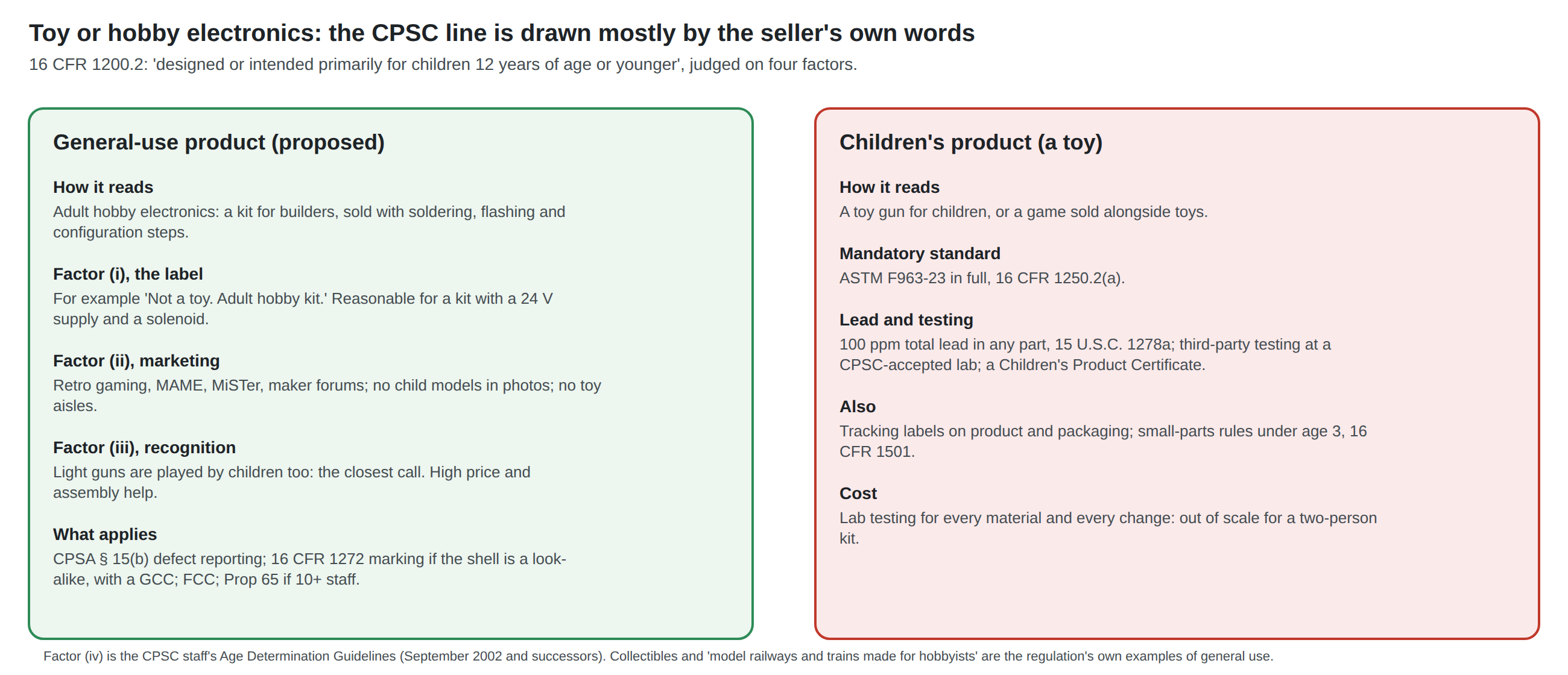
If it were a children’s product, the costs are of a different order. “Each toy must comply with all applicable provisions of ASTM F963-23” (16 CFR 1250.2(a), as amended 12 December 2025); total lead is limited to 100 parts per million “for any part of the product” (15 U.S.C. § 1278a(a)(2)); and, per the CPSC’s own guidance as summarised in the Imitation Firearm Law dive’s research, third-party testing at a CPSC-accepted laboratory, a Children’s Product Certificate and tracking labels follow. A light gun has a 24 V supply, a solenoid striking a metal stop, a lead-bearing brass or solder joint in places, and a long list of parts from different suppliers. Third-party testing of every material for a two-person kit business is out of scale.
The plan is a general-use product, and everything about how it is sold should say so: an adult hobby electronics kit, labelled as not a toy, sold to the retro-gaming (MAME, MiSTer) and maker audiences, photographed without children, priced as hobby electronics, and requiring assembly and configuration. The label alone does not decide it (“if such statement is reasonable”); the whole presentation does. Factor 3 is the honest weak point. Light-gun games are played by children, and a finished, ready-to-play gun in bright colours would be close to the line. A kit that needs building is further from it.
4.6 Duties that apply either way
Reporting a defect. “Every manufacturer (including an importer), distributor, and retailer of a consumer product who obtains information which reasonably supports the conclusion that the product contains a defect which could create a substantial product hazard” must inform the Commission (16 CFR 1115.4, under CPSA § 15(b)). It applies to general-use products and to a two-person business. For a kit with a solenoid and a 24 V rail, the realistic triggers are a stuck-on solenoid that overheats, a connector that shorts the rail, or a brick that fails unsafely. The kit’s records should be good enough to know which units went where.
Look-alike marking. A shell that imitates a real firearm needs the blaze-orange marking of 16 CFR part 1272, and the CPSC treats that marking rule as one that calls for a General Certificate of Conformity. That whole subject, including the 2023 move of the rule from Commerce to the CPSC and the 2026 removal of the old 15 CFR part 272, belongs to the Imitation Firearm Law dive. For this dive’s routes: route A’s donor is the buyer’s own, already-marked airsoft gun; route B’s original shell is designed not to imitate a firearm; route C’s MP7 shell needs the marking and the certificate.
4.7 The 24 V brick
Efficiency is federal law. “All direct operation external power supplies manufactured on or after February 10, 2016” must meet the Level VI standards, and every external power supply subject to them “shall be clearly and permanently marked in accordance with the International Efficiency Marking Protocol for External Power Supplies” (10 CFR 430.32(w)(1)(ii), (iii) and (w)(4)). A brick in a kit box must be a Level VI brick, marked as one.
Safety listing is the buyer’s protection and the seller’s. No federal rule was found that requires a consumer’s wall brick to carry a safety listing. The reasons to ship only a listed one are liability and the buyer’s house: a brick is the one part of the kit that touches mains. The category’s chosen brick shows what to look for. Mean Well’s GST60A datasheet (file dated 2 April 2026) lists the series’ safety approvals as “UL62368-1, CSA C22.2 No.62368-1, TUV BS EN/EN62368-1” among others, emissions to “FCC PART 15 / CISPR22” Class B conducted and radiated, and a withstand of 3 kVAC input to output. DigiKey’s and Mouser’s listings give it as Level VI. Its price and why it was chosen are in Power Supplies Vol 2 and Vol 6.
Buy it, never build it. A seller who designed a mains supply would take on the safety standard, the efficiency test and certification, and the emissions of a switch-mode converter. A seller who ships a listed, Level VI brick in its maker’s packaging takes on none of those, and the brick’s own FCC status covers the brick. The kit’s own FCC test is then run with that brick, because the gun’s emissions are measured as the buyer will use it.
Or ship none. As with the battery (LB-7), the kit can specify the brick and let the buyer buy it: “24 V, at least 2.5 A, the plug the kit names, Level VI, UL 62368-1 listed”. That removes the efficiency rule from the kit and leaves the buyer to choose a brick the gun was never tested with. Volume 5 weighs it.
4.8 California’s Proposition 65
Proposition 65 requires a “clear and reasonable warning” before exposing anyone in California to a listed chemical, and lead, common in solder, brass and PVC cable jackets, is listed. Two facts set its reach for this project:
- The ten-employee threshold. The statute’s duty falls on a “person in the course of doing business”, which “does not include any person employing fewer than 10 employees” (California Health and Safety Code § 25249.11(b)). A two-person kit business is outside it.
- Retailers and supply chains still ask. If kits are ever sold through a larger retailer, the regulations let the manufacturer meet the duty with a label or a written notice to the retailer (27 CCR § 25600.2(b)), and the retailer is responsible itself only in listed cases (§ 25600.2(e)). Internet sales carry their own rule: the warning goes on the product display page, or behind a clearly marked “WARNING” link, or otherwise prominently before purchase (§ 25602(b)).
The cheapest course is the one that removes the question: RoHS-compliant (lead-free) solder, boards and parts, and cables without lead-stabilised PVC where the datasheet says so. That is the default for most modern electronic parts anyway.
4.9 Selling outside the US
Selling abroad is a separate project, and nothing in this dive plans for it. Two facts, read from official sources, show its size:
- EU General Product Safety Regulation. Regulation (EU) 2023/988 has applied since 13 December 2024. Under its Article 16 a product cannot be placed on the EU market without a responsible economic operator (manufacturer, importer, authorised representative or fulfilment service provider) that “in all cases must be established in the EU or NI”, and the product or its documents must carry a type or serial number, the manufacturer’s name and postal and electronic address, and instructions and safety information (UK OPSS guidance, published 3 December 2024).
- RoHS. The UK’s RoHS regulations cover, among their eleven categories, “Toys, leisure and sports equipment” and “IT and telecommunications equipment” (SI 2012/3032, Schedule 1). Their substance limits were not read for this dive.
On top of those come CE or UKCA marking under the EMC regime, take-back registration for electrical waste in each country, and that country’s own replica-gun law. A US-only kit, shipped only to US addresses, keeps all of it out of scope.
4.10 Why this, and why not the others
SDoC for the electronics, tested as sold, before the first sale. It is what § 15.101 requires, it is the cheaper of the two routes it allows, and it can be prepared for on the lab’s own bench with the TinySA before a lab is paid.
Not: rely on § 15.23. It excludes kits in its own words.
Not: sell bare boards to dodge Part 15. The subassembly question is open, the board is useless without the rest, and a kit of the complete electronics is plainly a system.
A general-use product, presented as one throughout. A children’s product’s testing regime is out of scale, and nothing about an adult hobby kit needs it.
Not: a finished, ready-to-play gun first. It is the product nearest to the toy line (factor 3) and the one with the most liability. Kits first.
A listed Level VI brick, bought, or none. Building a mains supply is a certification project in itself.
4.11 What could not be verified
- The FCC’s position on a bare carrier board under § 15.101(e); no KDB publication was read.
- The text of 47 CFR 15.107 and 15.109 (the limits) was not re-read for this dive; they are cited by number.
- Mean Well’s Level VI marking for the GST60A24, read from distributor listings; the datasheet’s feature list is an image.
- The EU GPSR text itself (EUR-Lex was not reachable); the summary is the UK government’s guidance. UK and EU RoHS substance limits.
- Whether the CPSC’s Age Determination Guidelines have a successor edition that treats video-game controllers specifically.
Sources
- 47 CFR 2.803, 2.906, 2.909, 2.1077, 15.3, 15.19, 15.23, 15.101, 15.103, 15.105, eCFR current text, read 20 October 2026.
- 16 CFR 1115.4, 1200.2, 1250.1–1250.2, 1501.1, eCFR current text, read 20 October 2026.
- 15 U.S.C. § 1278a, Cornell LII, read 20 October 2026.
- 10 CFR 430.32(w), eCFR current text, read 20 October 2026.
- Mean Well, GST60A series datasheet (file dated 2 April 2026), https://www.meanwell.com/Upload/PDF/GST60A/GST60A-SPEC.PDF, fetched 20 October 2026; DigiKey listing GST60A24-NC and Mouser GSTx0A page (Level VI, LPS), read 20 October 2026.
- California Health and Safety Code § 25249.11(b) (via FindLaw; leginfo.legislature.ca.gov refused automated reads that day); 27 CCR §§ 25600.2, 25602, Cornell LII, read 20 October 2026.
- UK Office for Product Safety and Standards, “EU Regulation 2023/988 on General Product Safety”, 3 December 2024, gov.uk; The RoHS Regulations 2012 (SI 2012/3032), Schedule 1, legislation.gov.uk; both read 20 October 2026.
- Imitation Firearm Law dive research notes (CPSC role and certificates), read 20 October 2026.
Comments (0)