Licensing, IP and Kits · Volume 2
H&K's Marks and the MP7's Look — What a Kit May Carry, Show and Say
The five live US registrations a light-gun kit runs into, read from the USPTO, including an MP7 registration for toy weapons; how trade dress protects a product's shape and where it stops; H&K's record of defending the look of its guns; the licensed-airsoft model; and nominative fair use applied line by line to the copy on a box
2.1 Two kinds of right in one gun
A real MP7 carries H&K’s rights in two forms at once. Its marks are moulded and engraved on it: “HK MP7A1” on the grip, “Heckler & Koch GmbH, Made in Germany” on the receiver. Its shape is the other form: a compact, stubby receiver, a grip with the magazine inside it, a folding foregrip and a sliding wire stock. Marks are protected by registration and by use. A shape can be protected as trade dress, but only if it clears two hurdles that marks do not face.
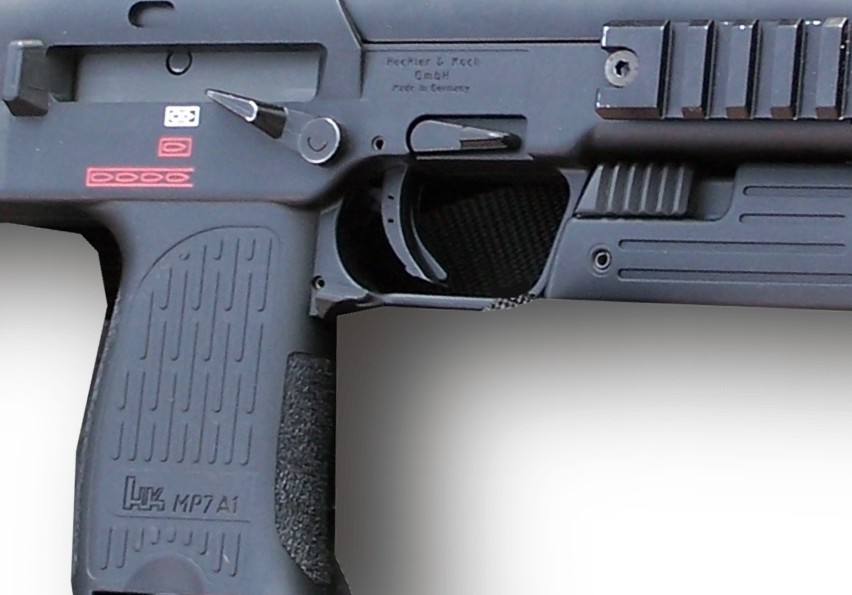
MP7 Printed Build Vol 3 §3.7 sets the rule for the category’s own shell: no H&K logo or text, and any moulded lettering in the starter file deleted from a kit version. This volume adds what the USPTO’s records actually hold, how far the shape is protected, and what the words on a box and a listing may say.
2.2 What the USPTO’s records show
The USPTO’s Trademark Status and Document Retrieval system (TSDR) was read for each registration on 20 October 2026. The leads came from an aggregator’s index of Heckler & Koch GmbH’s 70 US filings; every number below was confirmed on TSDR itself, and none is quoted from the aggregator.
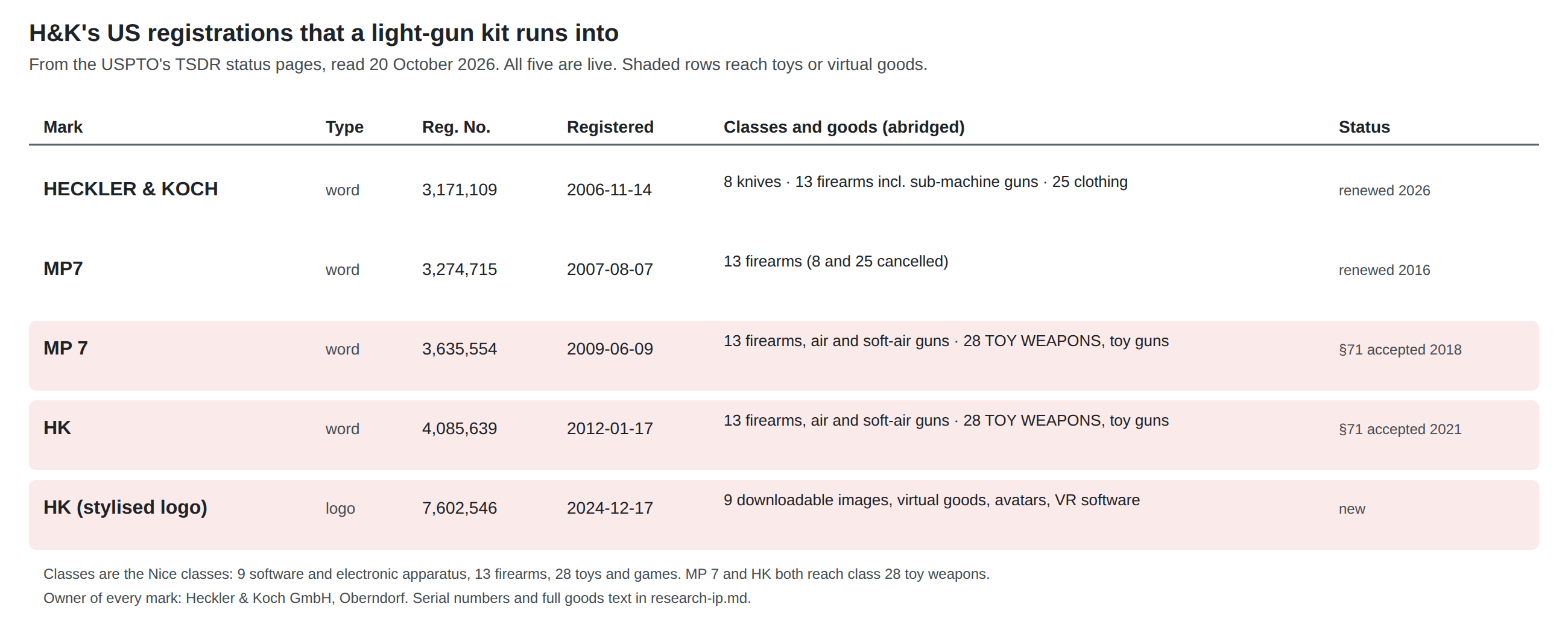
Table 1 — 2.2 What the USPTO's records show
| Mark | Reg. No. | Registered | Live classes and goods, quoted | Status on TSDR |
|---|---|---|---|---|
| HECKLER & KOCH (standard characters) | 3,171,109 | 14 Nov 2006 | 13: “firearms, namely small arms and pistols …; sub-machine guns, semi automatic and automatic weapons, namely rifles, pistols”; also 8 (knives) and 25 (clothing) | Live; second renewal, status dated 21 Aug 2026 |
| MP7 (standard characters) | 3,274,715 | 7 Aug 2007 | 13: “firearms, namely, sidearms, small arms, ammunition and projectiles, explosives; fireworks; covers for firearms” | Live; renewed; classes 8 and 25 cancelled under Section 8 |
| MP 7 (standard characters) | 3,635,554 | 9 Jun 2009 | 13: “Firearms; air pistols; air guns; stun guns; soft-air weapons, namely, air guns”. 28: “Toy weapons; air pistols, namely, toy guns; air guns, namely, toy guns; pistols, namely, toy guns; paintball guns” | Live; Section 71 declaration accepted 2018 |
| HK (standard characters) | 4,085,639 | 17 Jan 2012 | 13: “Firearms; air pistols; air guns; stun guns; soft-air weapons”. 28: “Toy weapons; toy air pistols; toy air guns; toy pistols; paintball guns” | Live; Section 71 accepted 2021 |
| HK (stylised, with illustration) | 7,602,546 | 17 Dec 2024 | 9 only: downloadable image files of firearms and other goods, some authenticated by non-fungible tokens; software for creating digital designs, characters and avatars for virtual and augmented-reality environments; downloadable virtual goods | Live |
Three things follow for a kit.
- There are two MP7 registrations, not one. The 2007 registration is a US filing for firearms. The 2009 one (“MP 7”, with a space, filed through the Madrid system in 2008) is the one that reaches toys and soft-air guns. The space does not matter to a buyer, and is unlikely to matter to a court.
- “HK” is registered as a word, not only as the logo. Plain letters “HK” next to a product name are a use of a registered mark, whatever the typeface.
- H&K’s 2024 logo registration covers virtual goods. It is in class 9 and is about image files, avatars and virtual environments, not controllers. It shows that H&K files for the places its guns appear in games, and a game-adjacent product should expect the brand to be watched there too.
The shape has not been registered. Among the 70 filings in the index, one is a drawing with no words: application 78/545,427, filed 11 January 2005, described as “the configuration of a firearm”, class 13. Its drawing shows a rifle with a bipod, not an MP7, and it was abandoned on 20 February 2006 after an Office action went unanswered. No MP7 configuration registration was found. That leaves the MP7’s shape protected, if at all, as unregistered trade dress (Section 2.4), which is harder for H&K to enforce but not impossible.
2.3 Why class 28 matters
A registration does not stop at its listed goods. The Lanham Act’s test is whether a use is “likely to cause confusion, or to cause mistake, or to deceive as to the affiliation, connection, or association … or as to the origin, sponsorship, or approval” of the goods (15 U.S.C. § 1125(a)(1)(A)). Goods that buyers expect to come from one source count as related. A gun-shaped game controller sold to people who know the MP7 sits close to “toy weapons” and “soft-air weapons”, and both are listed goods of a live MP7 registration. So the question for a kit is not whether “MP7” can be used at all; it is whether a particular use says who made the product or who approved it. Section 2.7 takes that up.
2.4 Trade dress: when a shape is a mark
Section 43(a) of the Lanham Act protects unregistered trade dress, and the Supreme Court has set two limits that matter for a shape.
Secondary meaning is required for a product’s design. “In a §43(a) action for infringement of unregistered trade dress, a product’s design is distinctive, and therefore protectible, only upon a showing of secondary meaning” (Wal-Mart Stores v. Samara Bros., 529 U.S. 205 (2000)). H&K would have to show that buyers see the MP7’s shape and think “Heckler & Koch”. For a gun that has appeared in many films and video games under its own name, that showing is plausible. The dive does not assume it fails.
Functional features are never protected. The statute puts the burden on the claimant for unregistered trade dress: “the person who asserts trade dress protection has the burden of proving that the matter sought to be protected is not functional” (15 U.S.C. § 1125(a)(3)). And “an expired utility patent has vital significance in resolving a trade dress claim, for a utility patent is strong evidence that the features therein claimed are functional” (TrafFix Devices v. Marketing Displays, 532 U.S. 23 (2001)). A grip angle, a magazine in the grip, a rail on top: features that work rather than decorate are the weak part of any gun-shape claim. The overall look, the particular combination of surfaces and proportions that makes an MP7 recognisable at a glance, is the strong part.
For a kit that means the risk scales with how much the shell looks like an MP7, not with any one feature. A light gun with a compact receiver and a magazine in the grip is not an MP7. A 1:1 shell that a stranger would call an MP7 from across a room is the shape the claim is about.
2.5 H&K and other makers in court
H&K and the GSG-5. H&K sued German Sport Guns and its US importer American Tactical Imports in 2009 over the GSG-5, a .22 rifle patterned on the MP5 (S.D. Ind., No. 1:09-cv-00039). The parties settled in October 2009; the settlement agreement, dated 8 October 2009, included HK USA’s covenant “not to sue GSG or any of its customers, distributors, dealers or importers” over the redesigned GSG-522, and the defendants’ statement that they made “no admission of liability”. The dispute then came back as a fight over that settlement, which was still producing rulings five years later (Heckler & Koch, Inc. v. German Sport Guns GmbH, 71 F. Supp. 3d 866 (S.D. Ind. 24 December 2014), cross-motions for summary judgment decided in part). How the court treated the trade-dress claim was not read for this dive; what the record shows is that H&K defends the look of its guns against close copies, and does so for years.
Glock against an airsoft seller. The closest precedent for a replica is not H&K’s. In Glock, Inc. v. The Wuster Inc., d/b/a AirSplat.com (N.D. Ga., No. 1:14-cv-00568), filed in 2014 over airsoft replicas of Glock pistols, the court ruled for Glock on 15 September 2020, finding infringement of “GLOCK’s registered trademarks and trade dress” under the Lanham Act, that the defendant “intended to, and did, create actual market confusion”, and granting a permanent injunction against selling Glock replicas. That account is Glock’s press release as reported by The Firearm Blog; the order itself was not read. Its relevance is the product: an airsoft replica, sold without a licence, by a retailer.
2.6 The licensed model
The licensed-airsoft trade shows how the MP7’s look is sold legitimately. Umarex sells H&K-licensed air and airsoft guns; in the US, retailers list the airsoft MP7s under its Elite Force brand. Umarex USA’s own product page for the “HK MP7 GBB Airsoft Rifle” ($379.99, read 20 October 2026) states: “Licensed Trademark of Heckler & Koch GmbH”. Its H&K brand page sells “officially licensed Heckler & Koch air pistols” and writes “Heckler & Koch®‘s VP9®” with the registration symbol. The licence terms themselves are not public.
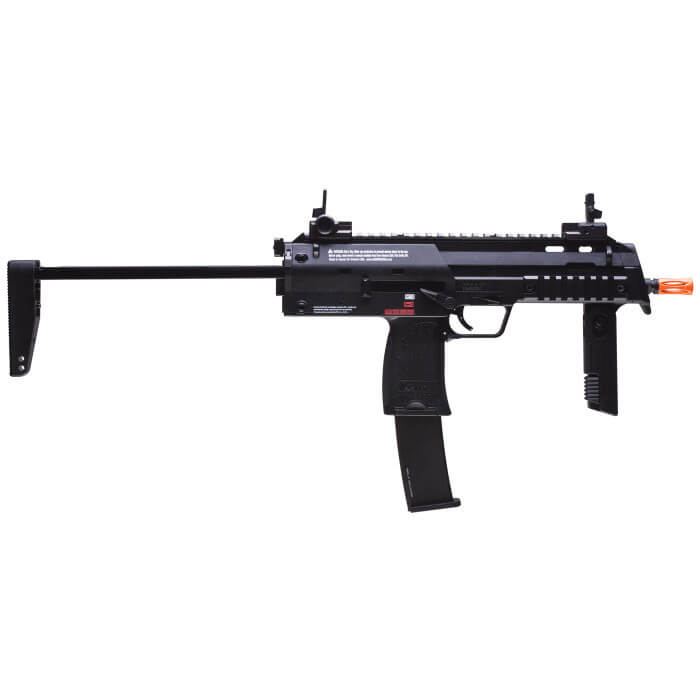
For this category the licensed gun matters twice. It is the donor for route A (MP7 Donor Build Vol 1 compares the Elite Force guns), so a route A kit can be sold for a gun that already carries H&K’s marks lawfully. And it is the template if the owner ever wants an MP7-shaped product of his own: a written licence from H&K, of the kind Umarex holds. Nothing found suggests H&K licenses at hobby scale, and the cost and terms are unknown; it is listed in Volume 5 as a route, not a plan.
2.7 Saying what the kit fits
A kit for route A has to say what gun it fits, and the only way to say that is to name the gun. Trademark law allows it under nominative fair use. The Ninth Circuit’s test, the one most courts follow in some form, has three requirements (New Kids on the Block v. News America Publishing, 971 F.2d 302 (9th Cir. 1992)):
“First, the product or service in question must be one not readily identifiable without use of the trademark; second, only so much of the mark or marks may be used as is reasonably necessary to identify the product or service; and third, the user must do nothing that would, in conjunction with the mark, suggest sponsorship or endorsement by the trademark holder.”
The court’s own examples set the limits. A repair shop could advertise that it repairs Volkswagens, because “Church did not use Volkswagen’s distinctive lettering style or color scheme, nor did he display the encircled ‘VW’ emblem” (Volkswagenwerk v. Church, 411 F.2d 350 (9th Cir. 1969), as quoted); and “a soft drink competitor would be entitled to compare its product to Coca-Cola or Coke, but would not be entitled to use Coca-Cola’s distinctive lettering”. The dilution statute carries the same idea: fair use, “including a nominative or descriptive fair use … other than as a designation of source for the person’s own goods”, is not dilution (15 U.S.C. § 1125(c)(3)(A)).
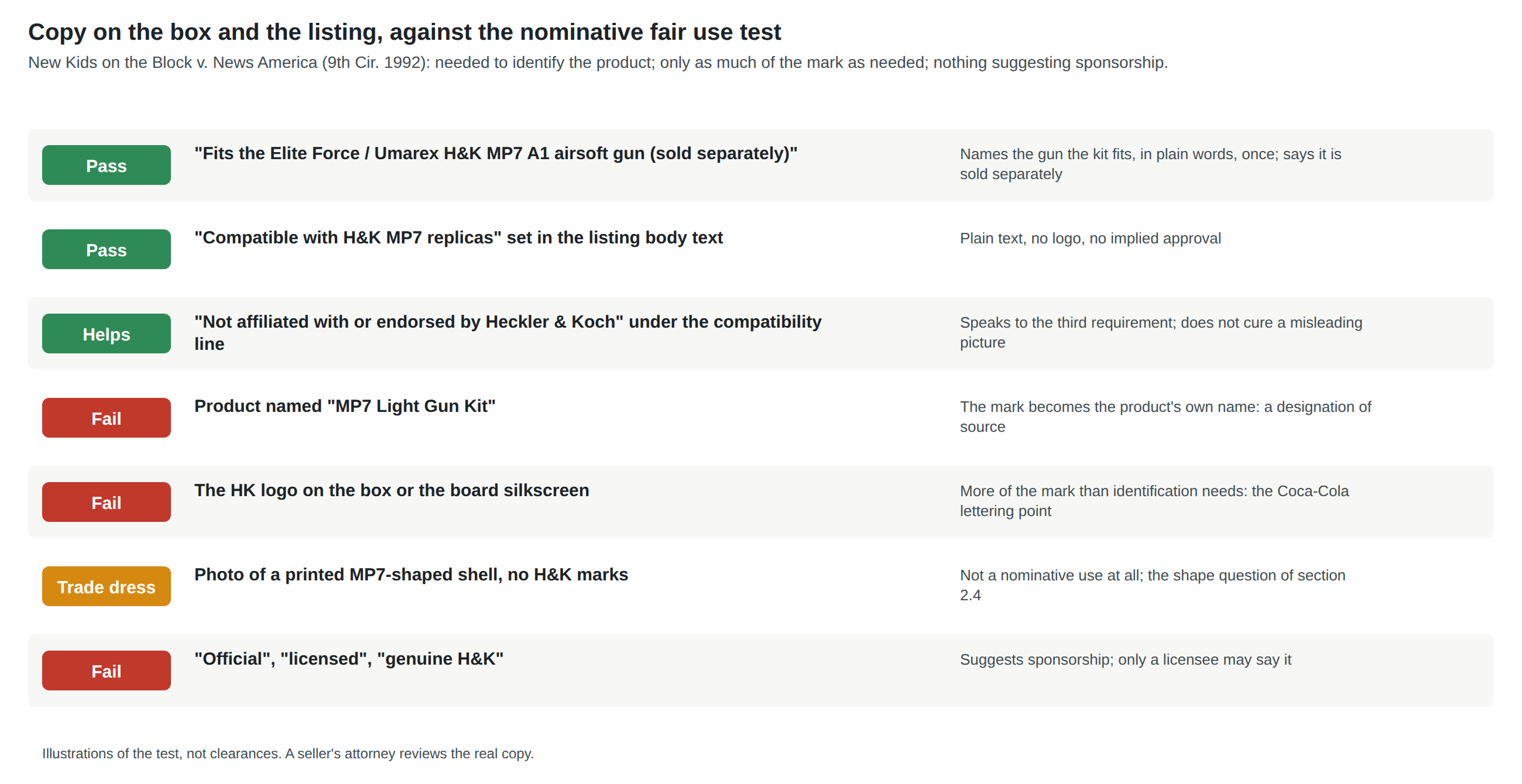
Applied to a kit:
- Name the product something of its own. The kit’s name is its designation of source. “MP7” in the product name fails the test at the first word.
- Use the words, never the logo, and use them once where they identify what the kit fits. The HK logo on a box, a board silkscreen or a listing photo is “distinctive lettering”.
- Say what it is not. A line such as “Not affiliated with or endorsed by Heckler & Koch GmbH” next to the compatibility statement speaks to the third requirement. It does not cure a listing whose pictures say the opposite.
- Photograph the kit, and the donor only as the donor. A photo of the electronics fitted in a customer’s licensed airsoft gun shows what the kit does; the gun in that photo carries its own licensed marks lawfully. A photo of a printed MP7-shaped shell is not a nominative use at all. It is the trade-dress question of Section 2.4.
- Never “official”, “licensed”, “genuine” or “H&K-approved”. Those words claim sponsorship, and only a licensee may use them.
2.8 What a kit may carry, show and say
Table 2 — 2.8 What a kit may carry, show and say
| Route A: electronics for a licensed airsoft MP7 | Route B: original shell | Route C: MP7 shell, own geometry | Route D: MP7 files | |
|---|---|---|---|---|
| H&K marks on any part | Never | Never | Never | Never (and deleted from every file) |
| Product name | Its own | Its own | Its own | Its own |
| ”Fits the H&K MP7 A1 airsoft gun” in words | Yes, once, with a non-affiliation line | Not needed | Not a nominative use: the shell is the shape | As route C |
| Photos | Kit; kit fitted in the buyer’s licensed gun | Kit and shell | Shell: the trade-dress risk on show | Renders of the shell: same risk |
| Trade-dress exposure | Low: no shape is sold | None | High, scales with likeness | High, and a shared file cannot be recalled |
| What would make it clean | Already clean, subject to copy review | Already clean | A licence from H&K | A licence from H&K |
Route C is the only one where the category’s own D42 decision (the builders’ own geometry) is not the end of the matter. D42 solves the model licence. It does not touch H&K’s rights, because those attach to the look, not to who drew it. That is said in MP7 Printed Build Vol 3 §3.9 and holds here without change.
2.9 Correction to MP7 Printed Build Vol 3
MP7 Printed Build Vol 3 §3.7 reads: “No US registration for an MP7 word mark or trade dress turned up in this survey’s searching, which is not the same as there being none; the USPTO’s own records were not searched.” The USPTO’s records show two live MP7 word-mark registrations, Nos. 3,274,715 (class 13) and 3,635,554 (classes 13 and 28, toy weapons and soft-air guns). No MP7 trade-dress registration was found. The volume’s own caveat anticipated this, and its conclusions (no marks on a kit; the realistic MP7 is the riskiest product) stand; the sentence should be updated. This is reported for the owning dive, not edited here.
2.10 What could not be verified
- The trade-dress holdings in Heckler & Koch v. German Sport Guns, 71 F. Supp. 3d 866: the opinion’s disposition was read, not its analysis.
- The Glock v. Wuster order: reported from Glock’s release via The Firearm Blog; the order was not read.
- The terms of Umarex’s H&K licence, and whether H&K licenses at any scale below a manufacturer’s.
- Pending H&K filings (“HK USA HECKLER KOCH”, serial 98/828,850, listed in the aggregator index with classes 9 and 28) were not read on TSDR.
- Which rifle the abandoned 2005 configuration application shows; the drawing is a rifle with a bipod and no model is named.
Sources
- USPTO TSDR status pages, read 20 October 2026: serial 78/749,524 (Reg. 3,171,109); 78/833,673 (Reg. 3,274,715); 79/056,359 (Reg. 3,635,554); 79/054,782 (Reg. 4,085,639); 79/387,061 (Reg. 7,602,546); 78/545,427 (abandoned application). https://tsdr.uspto.gov/statusview/sn79056359 and likewise.
- GleanMark, Heckler & Koch GmbH owner index, https://gleanmark.com/owner/hecklerkochgmbh, read 20 October 2026 (leads only).
- 15 U.S.C. § 1125, Cornell LII, read 20 October 2026.
- Wal-Mart Stores, Inc. v. Samara Brothers, Inc., 529 U.S. 205 (2000), syllabus; TrafFix Devices, Inc. v. Marketing Displays, Inc., 532 U.S. 23 (2001), syllabus; Cornell LII.
- New Kids on the Block v. News America Publishing, Inc., 971 F.2d 302 (9th Cir. 1992), CourtListener opinion 587692, read 20 October 2026.
- Heckler & Koch, Inc. v. German Sport Guns GmbH, 71 F. Supp. 3d 866 (S.D. Ind. 2014), vLex excerpt, https://case-law.vlex.com/vid/892433324.
- The Firearm Blog, “Glock Prevails in Lawsuit After More Than Six Years”, 24 September 2020, https://www.thefirearmblog.com/blog/2020/09/24/glock-lawsuit-six-years/.
- Umarex USA, “HK MP7 GBB Airsoft Rifle”, https://www.umarexusa.com/hk-mp7-black, and “Heckler & Koch”, https://umarexusa.com/Heckler-Koch, read 20 October 2026.
- MP7 Printed Build Vol 3 §§3.7, 3.9; owner decision D42.
Comments (0)