Licensing, IP and Kits · Volume 5
The Kit Plan — What to Ship, the Paper in the Box, Warranty and Liability, and Ten Gates Before the First Sale
The recommended order of the five routes and why; what a route A box holds and the rule behind each sheet of paper in it; whether the brick ships; warranty disclosure, the mail-order rule and 'Made in USA'; liability, insurance and records; the ten gates before the first kit ships; proposed decision rows; and the questions only the owner can answer
5.1 The plan in one paragraph
Sell, if and when a kit is sold, the electronics for a buyer’s own licensed airsoft MP7 first (route A): built and tested boards, a flashed Pico, the camera, the kick module, the GX16 lead and a listed Level VI brick, with no battery, no shell and no files. Present it as adult hobby electronics, name it something of its own, mention the MP7 only in words and only to say what it fits, and authorise it under the FCC’s Supplier’s Declaration of Conformity before anything ships. Before that, get a patent attorney’s opinion on Sinden’s recoil patent against the solenoid stage as built. An original, non-MP7 shell (route B) is the natural second product. An MP7-shaped shell (route C) waits for a licence from H&K, and MP7 files (route D) are never published. Nothing in this paragraph is decided; §5.10 proposes it as rows for the owner.
5.2 The routes, in order, and why
Table 1 — 5.2 The routes, in order, and why
| Order | Route | For it | Against it |
|---|---|---|---|
| 1 | A. Electronics for a licensed airsoft MP7 | No shape is sold, so no trade-dress exposure; the donor is already marked and licensed; no shell to print or certify; the buyer’s donor carries the realism | Needs the buyer to own a specific airsoft gun (about $380 for Umarex’s GBB, read 20 October 2026); fitting instructions per donor (MP7 Donor Build) |
| 2 | B. Electronics plus an original shell | Clean of H&K’s rights and of the starter file’s licence; sells to anyone; everything learned packaging the MP7 carries over | A new industrial design, and a product without the MP7’s pull |
| 3 | C. Electronics plus an MP7 shell | The product people would most want | H&K’s marks, two of them registered for toy weapons, and its trade dress (Volume 2); look-alike marking and a certificate (16 CFR 1272); clean only with a licence from H&K |
| — | D. Files | No inventory | MP7 files carry the trade-dress risk to every downloader and cannot be recalled; D12 keeps CAD private anyway; and GPL duties still attach to any firmware binary offered |
| — | E. Finished gun | Simplest for the buyer | Most liability; nearest the CPSC’s toy line (Volume 4, factor 3); every unit is the seller’s assembly |
Why A before B. Route A sells the work that is already done (the electronics, the firmware fork, the donor conversion) and needs no new shape. B needs an industrial design that does not yet exist.
Why not C, even with D42’s own geometry. D42 solved the model licence, and MP7 Printed Build Vol 3 says plainly it did not solve H&K’s rights. Volume 2 adds that “MP 7” is registered for “Toy weapons” (Reg. No. 3,635,554) and that H&K has litigated the look of its guns. A licence is the clean way, and the Umarex model shows it exists; nothing found says H&K licenses at hobby scale.
5.3 What ships, assembled or not
Built and tested boards, not parts to solder. Three reasons, each from an earlier volume:
- The FCC test covers what ships. Later units must be identical to the one tested (47 CFR 2.906(b), with “identical” defined in § 2.908). Boards reflowed in the lab from one BOM are; boards soldered by fifty buyers are not, and a buyer who modifies the equipment becomes its responsible party (§ 2.909(b)(4)).
- The 24 V stage is where a build error hurts someone. A reversed TVS, a solder bridge on the DRV8251A or a missing fuse is a fire risk, and a stuck-on solenoid is the most likely defect report (Volume 4, §4.6).
- The GPL’s “Installation Information” is easier on a known board. The buyer must be able to install modified firmware (Our Firmware Vol 6 §6.5); a tested board with a reachable BOOTSEL and the documented procedure satisfies it.
The buyer’s work is mechanical: fitting the camera at the muzzle, the kick module and the lead into their own donor, as MP7 Donor Build describes, and running the calibration.
5.4 Whether the brick ships
Ship it. The Power Supplies dive chose the GST60A24 on a specific property: its overload trip band starts at about 2.63 A, above the regulated stage’s 2.4 A top, so the brick does not hiccup mid-shot. A buyer’s own “24 V 2.5 A” brick may not have that margin, and a gun that stutters on autofire is a support problem and a returned kit. Shipping the brick also means the FCC test is run with the supply the buyer will use.
The cost of shipping it is small: it must be Level VI and marked (10 CFR 430.32(w)), which a listed Mean Well brick already is (Volume 4, §4.7). Why not specify only: it moves the brick’s risks to the buyer while keeping the support burden. Why not build one: a mains supply is its own certification project.
5.5 The paper in the box
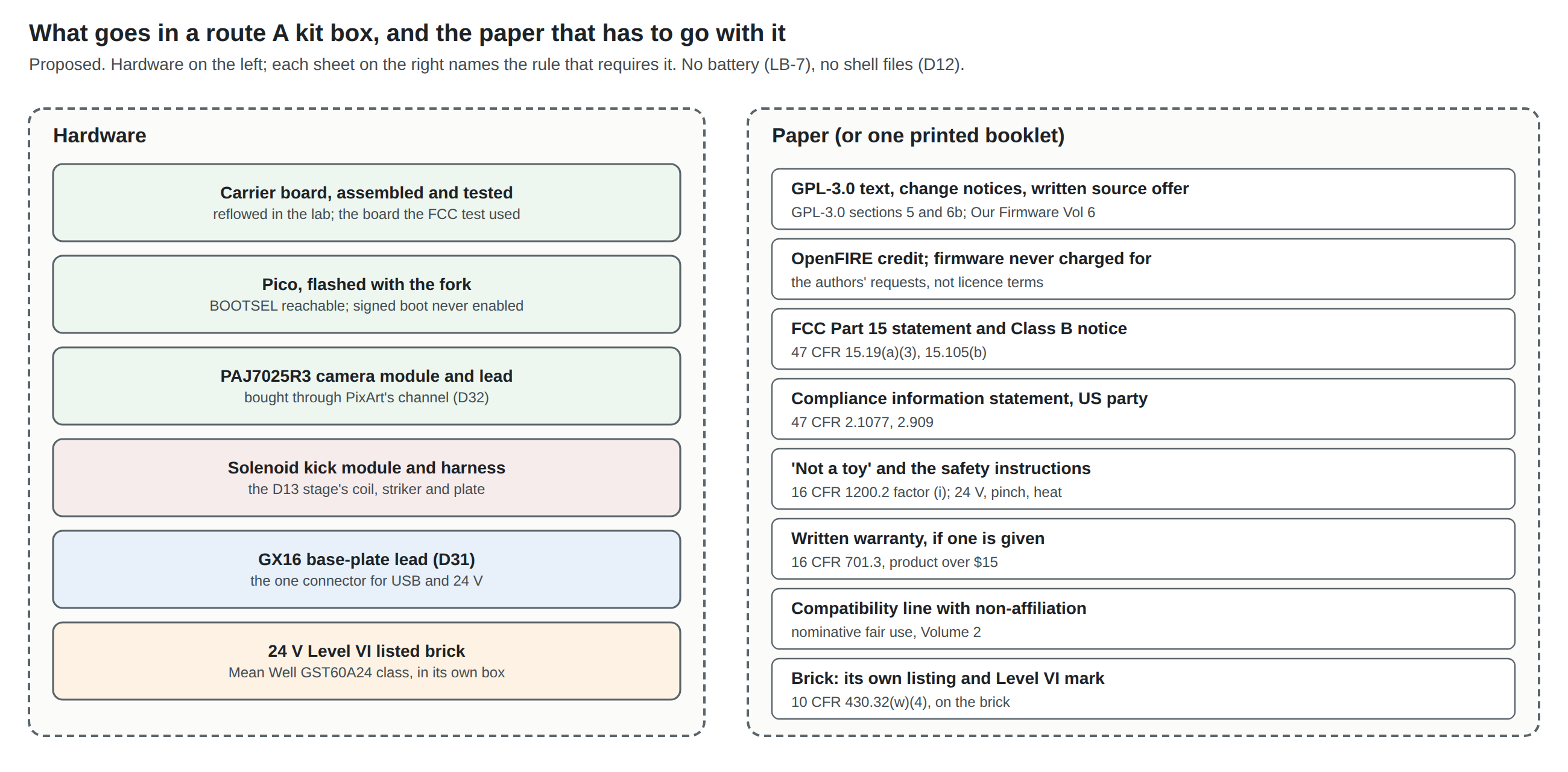
Table 2 — 5.5 The paper in the box
| Sheet | Rule | Where it is set out |
|---|---|---|
| GPL-3.0 text; notices of the fork’s changes with dates; a written offer of the Corresponding Source for at least three years | GPL-3.0 §§5, 6(b) | Our Firmware Vol 6 §6.4 |
| How to install modified firmware (BOOTSEL, the UF2 procedure) | GPL-3.0 §6, Installation Information | Our Firmware Vol 6 §6.5 |
| OpenFIRE’s name and credits; a statement that the firmware is free | The authors’ requests (not licence terms) | Open-Source Firmware Vol 1 |
| The Part 15 two-condition statement, on the gun or as § 15.19(a)(5) allows | 47 CFR 15.19(a)(3) | Volume 4, §4.4 |
| The Class B notice | 47 CFR 15.105(b) | Volume 4, §4.4 |
| Compliance information statement with a US responsible party | 47 CFR 2.1077, 2.909 | Volume 4, §4.4 |
| ”Not a toy” and the safety instructions: 24 V, the solenoid’s strike and pinch points, heat after long autofire, disconnect before opening | 16 CFR 1200.2(a)(1)(i); good practice | Volume 4, §4.5 |
| A written warranty, if one is given | 16 CFR 701.3 | §5.6 |
| ”Fits the H&K MP7 A1 airsoft gun (sold separately). Not affiliated with or endorsed by Heckler & Koch GmbH.” | Nominative fair use | Volume 2, §2.7 |
| The USB identity the gun reports | D24, row FW-7 | Our Firmware Vol 6 §6.6 |
No USB logo appears anywhere: the USB-IF reserves it for licensees whose products pass its compliance testing (Our Firmware Vol 6 §6.6). No H&K logo appears anywhere either.
5.6 Warranty
A warranty is a choice, but once a written one is given for a consumer product “actually costing the consumer more than $15.00”, federal rules govern how it is written. It must “clearly and conspicuously disclose in a single document in simple and readily understood language” a list of terms, starting with whom it covers if not every owner, what parts and properties are covered and excluded, and “what the warrantor will do in the event of a defect, malfunction or failure to conform” (16 CFR 701.2, 701.3(a)). A kit of electronics is a consumer product well above $15.
What a sensible kit warranty covers, within that frame: the boards and parts as shipped, for a stated period, against defects in materials and assembly; not damage from fitting, from a different supply, or from modified hardware. The GPL itself says the duty to supply Installation Information “does not include a requirement to continue to provide support service, warranty, or updates for a work that has been modified or installed by the recipient” (Our Firmware Vol 6 §6.5), so modified firmware can be excluded consistently with the licence. State law on implied warranties and on disclaimers was not researched for this dive.
5.7 Selling by post
Shipping promises. The FTC’s Mail, Internet, or Telephone Order Rule makes it unfair to take an order without “a reasonable basis to expect that it will be able to ship” within the time stated, or, “if no time is clearly and conspicuously stated, within thirty (30) days after receipt of a properly completed order” (16 CFR 435.2(a)(1)). A two-person shop building boards in batches should state a realistic time on the listing, not rely on the 30-day default.
Pre-orders. The FCC allows conditional sales before authorisation, with a prominent statement that “delivery to the end user is conditional upon successful completion of the applicable equipment authorization process”, a note that the FCC’s rules do not address consumer protection, and the refund policy if authorisation fails. For an SDoC device nothing may be physically transferred until the process is complete (47 CFR 2.803(d)(2)(i)). The FTC’s rule on shipping times applies to pre-orders too.
“Made in USA”. It may be said only if “final assembly or processing of the product occurs in the United States, all significant processing that goes into the product occurs in the United States, and all or virtually all ingredients or components of the product are made and sourced in the United States” (16 CFR 323.2). A kit with a Raspberry Pi Pico, a PixArt camera from Taiwan and a Mean Well brick cannot make the unqualified claim. “Assembled and tested in Michigan” describes what is done here without it.
5.8 Liability, insurance and records
These are business questions, and this dive researched them least; what follows is a list of what to settle, not advice on how.
- Who sells. The FCC’s responsible party and the CPSC’s manufacturer are whoever sells the kit, and the FCC’s must be in the US (47 CFR 2.1077, 2.909). Whether that is the owner personally or a company is the first business decision, and it shapes the next two.
- Insurance. Product liability insurance for a small electronics seller is a broker’s quote, not something this dive can price; no quote was sought. A product with a 24 V solenoid and a mains brick is the kind an insurer will ask about.
- Records. The CPSA’s defect-reporting duty (16 CFR 1115.4) and the GPL’s three-year source offer both assume the seller can say which units went where, with which board revision and firmware. A serial number on each carrier, logged against the firmware hash and the buyer, does both.
5.9 Ten gates before the first kit ships
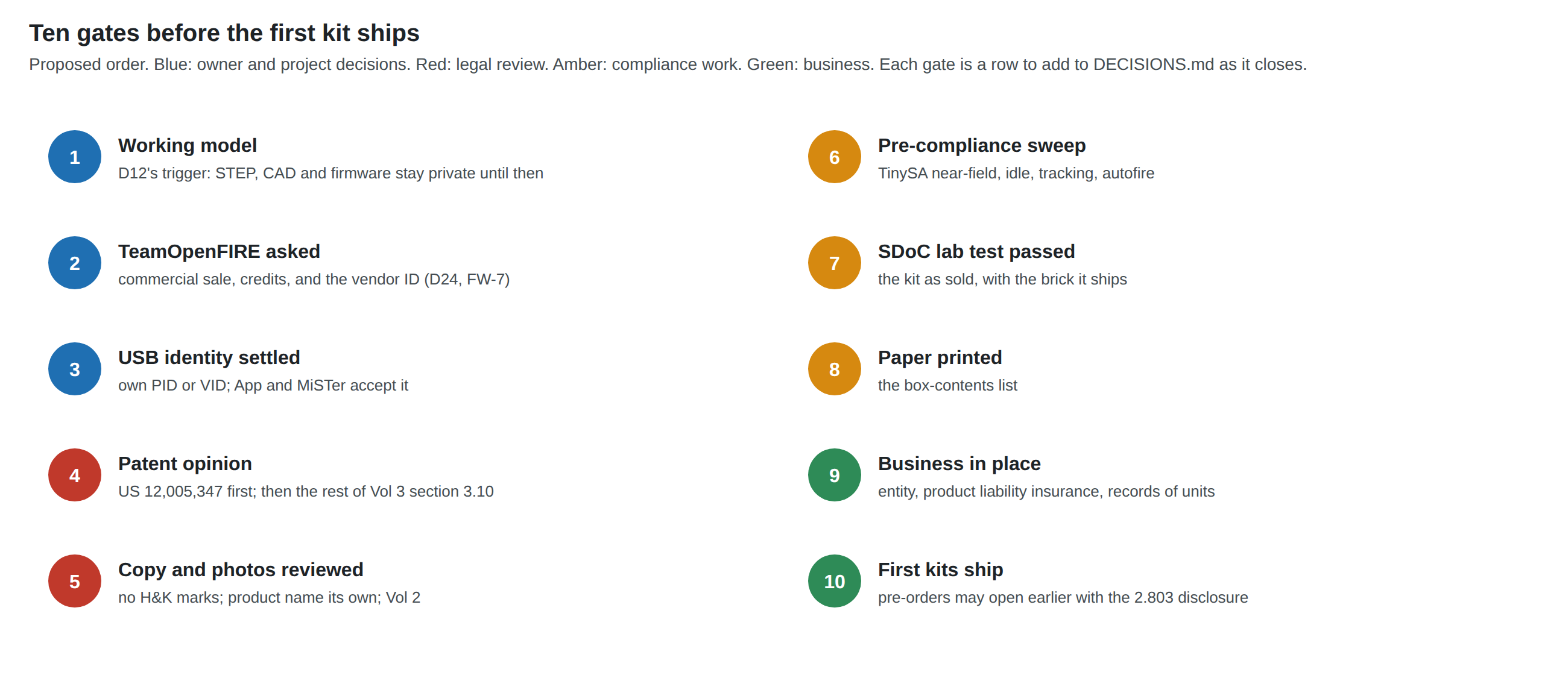
The order matters in two places. The patent opinion (gate 4) comes before the lab test (gate 7), because a change to the solenoid stage after an SDoC test means testing again. And TeamOpenFIRE is asked early (gate 2), because their answer can settle the USB identity (gate 3) and because their README asks commercial sellers to talk to them first.
5.10 Proposed decision rows
For Light-Guns/DECISIONS.md, all Proposed; none is decided here.
Table 3 — 5.10 Proposed decision rows
| ID | Decision | Options | Pick | Why not the others | Source |
|---|---|---|---|---|---|
| LK-1 | Kit route order | A; B; C; D; E | A first, B second; C only under an H&K licence; never D for MP7 files; E not first | C and D carry H&K’s registered marks and trade dress; E is nearest the toy line with most liability | Vols 2, 4, 5 |
| LK-2 | Product name and copy | MP7 in the name; own name + compatibility line | Own name; “fits” line in words once, with non-affiliation; no H&K logo anywhere | MP7 in the name is a designation of source; the logo is “distinctive lettering” (New Kids fn. 7) | Vol 2 §2.7 |
| LK-3 | Recoil stage and US 12,005,347 | Coast at end (as drawn); brake at end; discrete Zener-clamped | Keep the D13 stage; bench the brake-at-end variant on the first carrier; patent opinion before any sale; no cusp-ended shots in kit firmware until then | Changing now is premature; the Zener stage loses D13’s regulation | Vol 3 §3.5 |
| LK-4 | Wireless kits | Before 26 Oct 2027; after | After 25 Oct 2027, or with an opinion on US 7,927,216 | Every claim in the family read needs a wireless transceiver; a cabled kit is outside it | Vol 3 §3.7 |
| LK-5 | FCC route | § 15.23; bare boards; SDoC on the kit | SDoC on the kit as sold, before marketing; pre-orders only under § 2.803(d)(2)(i) | § 15.23 excludes kits; the subassembly question is open | Vol 4 §§4.2–4.3 |
| LK-6 | CPSC category | Toy; general-use | General-use adult hobby electronics, presented so throughout | A children’s product needs ASTM F963-23, lead limits and third-party testing | Vol 4 §4.5 |
| LK-7 | Brick | Ship listed Level VI; specify; build | Ship the GST60A24-class brick | Specifying loses the trip-band margin the stage was sized for; building is a certification project | Vol 5 §5.4 |
| LK-8 | Parts chemistry | Any; RoHS throughout | RoHS (lead-free) solder, boards and parts | Keeps Prop 65 moot if a retailer asks; costs nothing extra on modern parts | Vol 4 §4.8 |
| LK-9 | Market | US only; abroad | US addresses only | The EU needs an EU-established responsible operator, CE marking and take-back schemes | Vol 4 §4.9 |
5.11 Questions for the owner
- Route A first? A kit for owners of the Elite Force MP7, or is a realistic MP7 shell the product that matters? The second needs a licence from H&K.
- Patent opinion: when? At the working model (gate 1), or now, while the solenoid stage can still change cheaply? And should the brake-at-end variant be benched on the first carrier?
- Any wireless kit before October 2027? If not, US 7,927,216 drops off the list.
- The brick in the box? Recommended yes.
- Who sells? The owner personally or a company; it sets the FCC responsible party and the insurance.
- US-only?
5.12 What could not be verified
- Product liability insurance cost and terms for a small kit seller; no quotes sought.
- State law on implied warranties and disclaimers.
- Whether H&K licenses its marks or the MP7’s look at hobby scale, and on what terms.
- The cost of an SDoC test at a US laboratory for a Class B peripheral; no quotes sought.
Sources
- 16 CFR 323.2, 435.2, 701.2, 701.3; 47 CFR 2.803, 2.906, 2.908 (cited), 2.909, 2.1077; 10 CFR 430.32(w); eCFR current text, read 20 October 2026.
- Umarex USA, “HK MP7 GBB Airsoft Rifle”, $379.99, https://www.umarexusa.com/hk-mp7-black, read 20 October 2026.
- Volumes 1 to 4 of this dive; Our Firmware Vol 6; Open-Source Firmware Vol 1; MP7 Printed Build Vol 3; Power Supplies Vols 2 and 6; owner decisions D12, D13, D24, D31, D32, D42 and rows FW-7, LB-7.
Comments (0)