Licensing, IP and Kits · Volume 1
Selling a Kit — What Changes the Day a Light Gun Is Offered for Sale
The owner decisions that make licences and product rules binding, five ways a kit could be sold and which rules each one triggers, the three kinds of rights and the three kinds of rules a seller meets, where the category's other dives already cover each thread, and the findings this dive adds
1.1 Why this dive exists
Two owner decisions turn this category from a hobby build into something that has to be right on paper as well as on the bench. D11: kits may be sold later, so licences, trademarks and USB rules are “binding, not advisory”. D12: STEP, CAD and firmware stay private until a working model exists. Between them they set the shape of every volume here. Nothing is sold yet and nothing has to be filed today, but every choice made now (which firmware, which camera, which recoil stage, which shell geometry, which brick) either keeps a kit possible or quietly closes it off.
Most of the category’s dives already carry a “what this means for a kit” section for their own subject. This dive is the umbrella: it pulls those threads into one kit plan and covers the ground none of them owns. That ground is H&K’s registered marks and the MP7’s look, the live patents around light guns, the product rules for a cabled electronic gun sold in the US, and the plain business of selling something by post.
1.2 Not legal advice
This dive is planning, written from the statutes, regulations, registrations and patents themselves, each read on the date given. It is not legal advice, and it does not replace a trademark or patent attorney’s opinion before a product is sold. Where a question turns on how a court or an agency would read a phrase, the dive says so and leaves it as a question.
1.3 Five ways to sell
A “kit” can mean several different products, and each one triggers a different set of rules. The five that the category’s dives have proposed between them:
Table 1 — A "kit" can mean several different products, and each one triggers a different set of rules. The five that the category's dives have proposed between them
| Route | What ships | Where it was proposed |
|---|---|---|
| A. Electronics kit | Carrier board, Pico, camera, recoil stage, harness; the buyer fits it to a licensed airsoft MP7 they already own | MP7 Donor Build, MP7 Printed Build Vol 3 §3.7 |
| B. Electronics plus an original shell | Route A plus printed parts for a compact gun that is not an MP7 | MP7 Printed Build Vol 3 §3.7 |
| C. Electronics plus an MP7 shell | Route A plus printed MP7 parts drawn from the builders’ own geometry (D42) | MP7 Printed Build Vol 3 §3.9, route 2 |
| D. Files only | Shell files and firmware for the buyer to print and flash | not proposed; listed because it is the commonest hobby model |
| E. Finished gun | Assembled and tested | not proposed; the reference case for the rules |
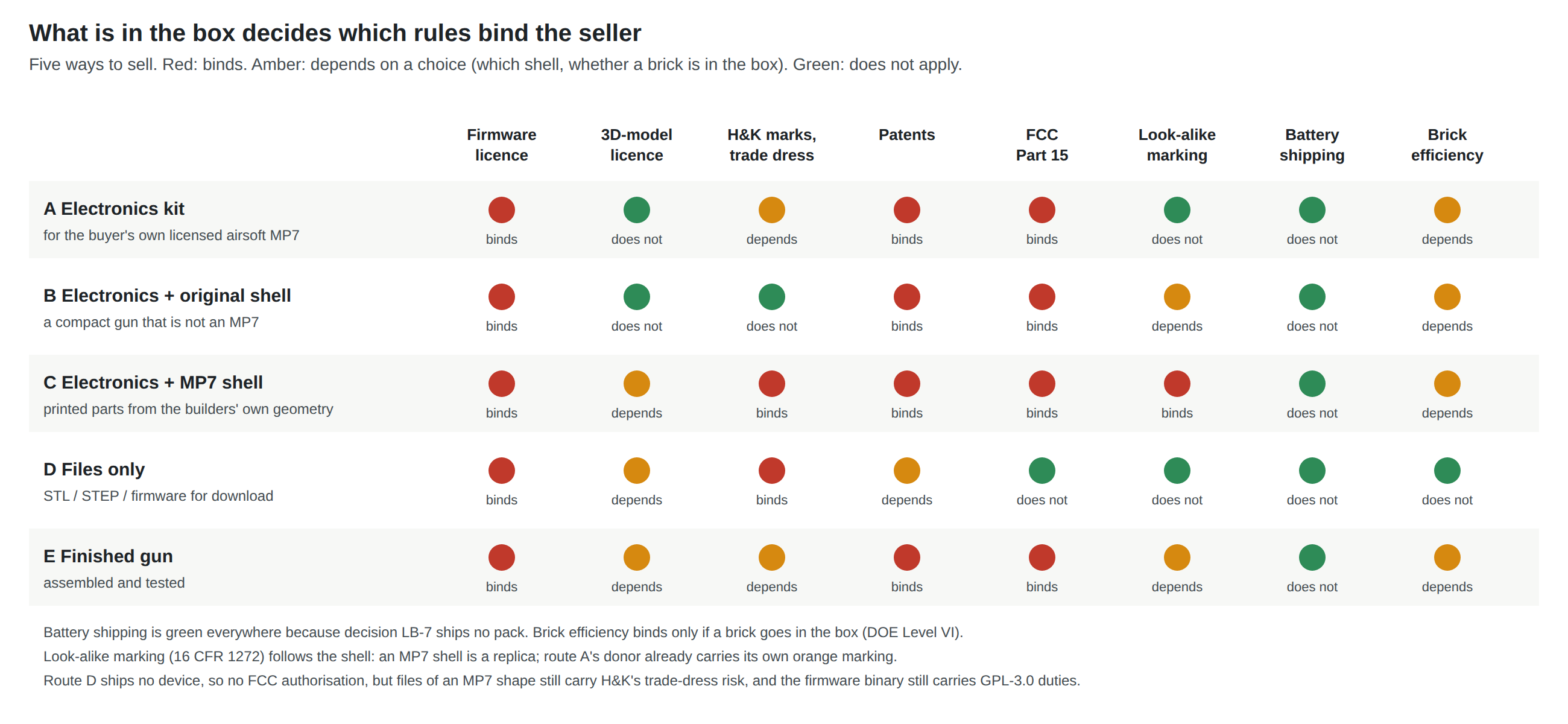
The matrix is the whole dive in one picture. Three things stand out:
- Firmware licence and patents bind everything that contains the electronics. Choosing route A over route C changes nothing about GPL-3.0 or about a patent on how the solenoid is driven.
- The MP7’s look is a separate risk from everything else, and it is the one that route A and route B avoid outright. That is the argument for them in Volume 5.
- Battery shipping is green everywhere because decision LB-7 ships no pack (LiPo Batteries Vol 7 §7.6). Reversing LB-7 would turn that column red for every route.
1.4 Three kinds of rights
Rights belong to other people and are infringed; the remedy is theirs to pursue.
Copyright and its licences. The firmware is someone’s copyright, released under a licence; OpenFIRE’s is GPL-3.0. A bought CAD model is someone’s copyright, sold under a licence that may forbid commercial use. A user guide is copyright too (decision D26 keeps the GUN4IR guide summarised, never copied). Copyright protects expression, not function: nobody owns the idea of four infrared LEDs round a television.
Trademarks and trade dress. H&K owns “MP7”, “HK” and “HECKLER & KOCH” as registered US marks (Volume 2 lists them from the USPTO’s own records), and trade dress law can protect a product’s shape if it is not functional and buyers recognise it as a brand. Trademark law is about confusion over who made or approved a product, so it governs the copy on the box and the listing as much as the shape in the box.
Patents. A patent protects a way of doing something, as defined by its claims, for a fixed term. It binds whoever “makes, uses, offers to sell, or sells” the claimed invention (35 U.S.C. § 271(a)), whether or not they have ever heard of the patent. Volume 3 finds live patents close to two parts of this category’s design.
1.5 Three kinds of rules
Rules come from the state, apply to everyone selling a class of product, and are enforced by an agency.
Radio emissions. A light gun with a 125 MHz microcontroller and a USB link is a digital device under the FCC’s Part 15 and, sold for home use, a Class B peripheral. It has to be authorised before it is marketed. A wireless gun adds the intentional-radiator rules Fully Wireless Vol 6 covers. Volume 4.
Product safety. Whether the gun is a toy (and so under the mandatory toy standard ASTM F963-23, lead limits and third-party testing) or an adult hobby product is largely decided by how it is marketed. A replica’s orange marking is a CPSC rule now (16 CFR part 1272), owned by the Imitation Firearm Law dive. The wall brick has its own federal efficiency rule. Volume 4.
Selling at a distance. Written warranties on products over $15, shipping promises, “Made in USA” claims, and the duty to report a dangerous defect to the CPSC all apply to a two-person kit business as much as to a large one. Volume 5.
1.6 Where each thread is already covered
This dive links rather than repeats. The table is the map; each row says what the other dive owns and what is added here.
Table 2 — 1.6 Where each thread is already covered
| Thread | Owned by | Added here |
|---|---|---|
| What GPL-3.0 §§5–6 demand of a kit; a kit as a GPL “User Product”; the USB vendor ID routes and prices | Our Firmware Vol 6 | Where the source offer and Installation Information go in the box (Volume 5) |
| The licence of every open and closed firmware, quoted from its repository | Open-Source Firmware Vol 1 §1.12 | Nothing |
| What a modified OpenFIRE build owes | Open-Source Firmware Vol 7 §7.9 | Nothing |
| 3D-model licences, the Fusion personal-use licence (D41), the two clean routes to a kit shell (D42) | MP7 Printed Build Vol 3 | H&K’s registrations from the USPTO; trade-dress case law; what copy may say (Volume 2) |
| UN 38.3, the 2026 IATA state-of-charge rule, USPS, “ship no pack” (LB-7) | LiPo Batteries Vol 7 | Nothing |
| FCC rules for the radio, modular grants, § 15.23 for a home-built radio gun | Fully Wireless Vol 6 | The cabled gun’s own Part 15 duties (Volume 4) |
| PD sink controllers and their USB-IF certifications | USB-C Power Delivery Vol 3 | Nothing |
| 15 U.S.C. § 5001, 16 CFR part 1272, state and city look-alike law, shipping a replica | Imitation Firearm Law | Nothing; Volume 4 points there |
| Patents on light-gun sensing and recoil | none | Volume 3 |
| CPSC children’s-product line, toy standard, brick efficiency, Prop 65, abroad | none | Volume 4 |
| Warranty, mail-order rule, insurance, the kit checklist | none | Volume 5 |
1.7 The firmware and model threads in brief
Two threads are fully covered elsewhere and are summarised here only so this dive’s kit plan reads complete.
Firmware. OpenFIRE is GPL-3.0 throughout, so a kit that ships it must ship (or offer for at least three years) the exact source of the binary in the box, carry the licence, mark the fork’s changes, and leave the buyer able to install modified firmware. On an RP2040 that last duty is nearly free: BOOTSEL stays reachable and the RP2350’s signed boot stays off. The authors also ask, outside the licence, that the OpenFIRE name and credits be kept, that the firmware never be charged for, and that commercial sellers talk to them first (Our Firmware Vol 6 §§6.4–6.5). The kit must not carry OpenFIRE’s USB vendor ID 0xF143 without TeamOpenFIRE’s agreement; decision D24 and row FW-7 set the order of the routes to an ID of its own, from asking TeamOpenFIRE to a Raspberry Pi product ID to the USB-IF’s US$6,000 vendor ID (§6.6). GUN4IR’s DIY licence (“no commercial use allowed”) and the closed firmwares rule themselves out of any kit (Open-Source Firmware Vol 1).
Models. The $3 Cults3D STEP bought for the first gun is licensed for private use only, and so is the Fusion seat it is edited in (D41). Neither can be the base of a kit. Decision D42 adopts route 2 of MP7 Printed Build Vol 3 §3.9: the kit’s shell is drawn from scratch in a separate project, every dimension sourced, and the bought file never touches it. That route is clean of model licences, and that volume says plainly that it is not clean of H&K’s rights. Volume 2 takes that up.
1.8 What this dive found
The findings below are new to the category; each is sourced in its volume.
- “MP7” is a registered US trademark, and one of its two registrations covers toy guns. USPTO Reg. No. 3,635,554 (registered 9 June 2009, live) lists Class 28: “Toy weapons; air pistols, namely, toy guns; air guns, namely, toy guns; pistols, namely, toy guns; paintball guns”. “HK” (Reg. No. 4,085,639) has the same Class 28 goods, and a 2024 “HK” logo registration (No. 7,602,546) covers downloadable virtual goods and software for virtual environments. MP7 Printed Build Vol 3 §3.7 reports that no US MP7 registration turned up in its searching, which had not reached the USPTO’s records. Volume 2.
- A live US patent, held by Sinden, claims a recoil controller close to the category’s chosen stage. US 12,005,347 (granted 11 June 2024; Google’s estimated expiry 17 December 2041) claims a gaming controller with a solenoid, a capacitor, a device that monitors the coil current, a switch that returns the coil’s energy to the capacitor, and control that ends the pulse based on the monitored current. Decision D13’s regulated DRV8251A stage monitors current through IPROPI and, at the end of a shot, returns the coil’s energy to the 1000 µF bulk capacitor. Whether it falls inside the claim is a question for a patent attorney before any kit is sold. Volume 3.
- Sinden’s border-tracking patent runs to about 2039, and its only independent claim begins by “applying a border to completely surround display content”. An infrared-LED gun applies no border; an open border-tracking gun would. Volume 3.
- The broad Wii Remote claims have run out. The reissue RE45,905 and US 8,430,753, whose claim 1 covers a wireless one-hand controller with a trigger, an inertial sensor and a two-dimensional infrared detector, reached Google’s estimated expiry on 15 September 2026. One family member, US 7,927,216, runs to an adjusted 25 October 2027, and every claim read needs a wireless transceiver. Volume 3.
- The FCC’s home-built exemption excludes kits by name. Section 15.23 waives authorisation for devices “not constructed from a kit”; a kit seller cannot lean on the buyer’s exemption. Volume 4.
- A brick in the box must be DOE Level VI and marked so (10 CFR 430.32(w)). Buying a listed Level VI brick, as the category already proposes, settles it. Volume 4.
1.9 How the volumes run
Table 3 — 1.9 How the volumes run
| Vol | Title | What it settles |
|---|---|---|
| 1 | Selling a Kit | The map |
| 2 | H&K’s Marks and the MP7’s Look | What a kit may carry, show and say |
| 3 | Patents and Freedom to Operate | Which live patents are close, and what to ask an attorney |
| 4 | Product Rules for a US Kit | FCC Part 15, the CPSC line between toy and hobby product, the brick, Prop 65, abroad |
| 5 | The Kit Plan | What to ship, the paperwork in the box, warranty and liability, the checklist, the decisions |
Sources
- Owner decisions D11, D12, D24, D26, D41, D42 and rows FW-7, LB-7, P-PB-2,
Light-Guns/DECISIONS.md. - 35 U.S.C. § 271, Cornell LII, read 20 October 2026.
- Each finding in §1.8 is sourced in its own volume.
Comments (0)