Imitation-Firearm Law · Volume 6
The Printed MP7, and the Checklists
Whether a 3-D-printed realistic MP7 body is a look-alike firearm (it is), what the new state 3-D-printing laws do and do not reach, what printing changes in practice, and two checklists with the reason for each line: one for the single gun used indoors in Ovid, and one for a kit offered for sale
6.1 Printing does not change what it is
The first build is a 3D-printed MP7 (decision D35), built for realism (MP7 Printed Build, Vol 7). None of the laws in Volumes 1–5 asks how an object was made. The federal definition covers “replica nonguns”. Chicago’s covers a device “made of plastic, wood, metal or any other material”. New York’s and Boston’s say the same. Australia’s says “of any material or colour”. A printed MP7 that looks like an MP7 is a look-alike firearm, a California imitation firearm, a Connecticut facsimile, a Chicago replica firearm, a British realistic imitation and a Canadian replica firearm, exactly as an airsoft MP7 shell would be. The MP7 Donor Build, Vol 3 reached the same conclusion for a converted airsoft gun: “a replica nongun with a USB cable”. The material is irrelevant.
Printing does change three practical things, set out in § 6.3. It does not bring the gun under any law aimed at printed guns, because those laws are aimed at guns that work.
6.2 The 3-D-printing laws reach working guns only
Several states have moved against printed firearms. The one enacted in 2026 that was checked for this dive is Colorado’s HB26-1144, “Prohibit Three-Dimensional Printing Firearms & Components”. It was signed on 4 May 2026 as Session Law chapter 94 and took effect on 1 July 2026.1 Its official summary says it prohibits knowingly making by 3D printing “a potentially functioning firearm, unfinished frame or receiver, large-capacity magazine, or rapid-fire device”. It also says the prohibitions “apply only to potentially functional firearms and components”. Two points from that summary matter here:
- A light gun’s shell is not a “potentially functioning firearm” or a frame or receiver of one. It is outside the law.
- The act defines 3-D printing as “additive and subtractive manufacturing”, so CNC machining is caught too. That is worth knowing for the planned MP7 Machined Aluminum build. A machined MP7 body is still outside the law as long as it cannot become a working firearm, and that is the design rule that dive is built on.
Other measures were found only as bills or proposals. They include New York bills on distributing printing files for firearms (S9827, A1777-A), a New York gubernatorial proposal for printer standards, and a Washington proposal to require printers to block gun prints. None was read in force for this dive. Connecticut’s code includes a section titled “Manufacture of firearm from polymer plastic without detectable security exemplar” (§ 53-206i), but it too concerns firearms.2
No state law was found that treats a printed replica differently from any other replica. The practical risk from printer-blocking rules is not legal. A future printer or slicer that refuses gun-shaped models could refuse an MP7 shell. That would be a supply problem for a kit business that prints its own parts.
6.3 What printing does change
- The orange band can be the part itself. A muzzle sleeve printed in orange filament carries its colour all the way through. It cannot wear through to black the way paint does, which makes “permanently affixed” easier to argue. Bond or pin the sleeve rather than screwing it on: the CPSC’s own example of a non-permanent marking is “a plastic, orange plug that has threading” (Volume 1, § 1.7).
- A person who prints shells for sale is a manufacturer. The CPSA defines “manufactured” as “to manufacture, produce, or assemble”. Owning the printer makes the seller the manufacturer, with the marking and certificate duties of Volume 1. Outsourcing to a print farm abroad makes the seller the importer, with the same duties plus electronic filing at the border.
- Carriers notice printed weapons. FedEx’s US list prohibits “Any firearm or other weapon manufactured using a 3-D printing machine” (Volume 4, § 4.5). A light gun is not a weapon, but the parcel description should leave no room for doubt.
The printed shell’s file is a separate matter. Distributing a file for a non-functional replica falls outside the firearm-file laws found here, which concern firearms. The project’s own rule keeps the CAD private until a working model exists (category CLAUDE.md), and the model-licence questions belong to MP7 Printed Build, Vol 3 and Licensing, IP and Kits.
6.4 How realistic is too realistic
The printed build aims to look like an MP7 at a few metres: H&K’s dimensions, the polymer finish and the weight (MP7 Printed Build, Vol 7). Legally, every step toward realism moves the object further into each definition. The British definition makes the point most sharply: realistic means indistinguishable “for all practical purposes”, and a difference visible only “on a close examination” does not count. Realism costs nothing legally while the gun stays in a house in Ovid. Michigan has no imitation-firearm statute, Ovid has no replica ordinance, and the house rule (D29) covers the trip out. Realism starts to matter when the gun or its design leaves the house:
- Carried: in a city with an ordinance, the orange band is the difference between lawful and unlawful (Grand Rapids). In New York City and Chicago, nothing makes a realistic MP7 lawful (Volume 3).
- Sold: the realistic version cannot go to California, New York, Connecticut, New York City, Chicago or abroad (Volumes 2–5).
Leaving H&K’s markings off the shell, as the Printed Build proposes for both the private gun and a kit, is a trademark decision. It also makes the gun look a little less like the real thing to anyone who sees it out of context.
6.5 Three kinds of kit
If a kit is sold (D11), the legal burden depends on what is in the box. There are three distinct products:
Table 1 — If a kit is sold (D11), the legal burden depends on what is in the box. There are three distinct products
| Product | § 5001 / 16 CFR 1272 | CA, NY, CT, NYC, Chicago | Abroad | Notes |
|---|---|---|---|---|
| A. Electronics only (board, camera, solenoid, cable, firmware) | Not a look-alike: no marking, no certificate under part 1272 | Sellable | Sellable (electronics rules apply) | The buyer prints or supplies the shell and is its maker |
| B. Toy-coloured shell (bright colour all over, or clear) | Marked by colour, option (d) or (c); certificate | CA, CT: yes. NY, NYC: no if the muzzle is open. Chicago: probably yes if plainly a toy | UK: yes. Canada: doubtful. Australia: police certification | Choose a colour on every list (Vol 2, § 2.9) |
| C. Realistic shell (black MP7, orange band) | Option (b) band, fitted permanently; certificate | No | No | Also the H&K trade-dress question (Licensing, IP and Kits) |
Product A is the cleanest, and it is also the product that the project’s design work is most clearly about. Product C is what the private gun is. Selling it means a shop that refuses five US jurisdictions and every foreign address, and a certificate for every SKU.
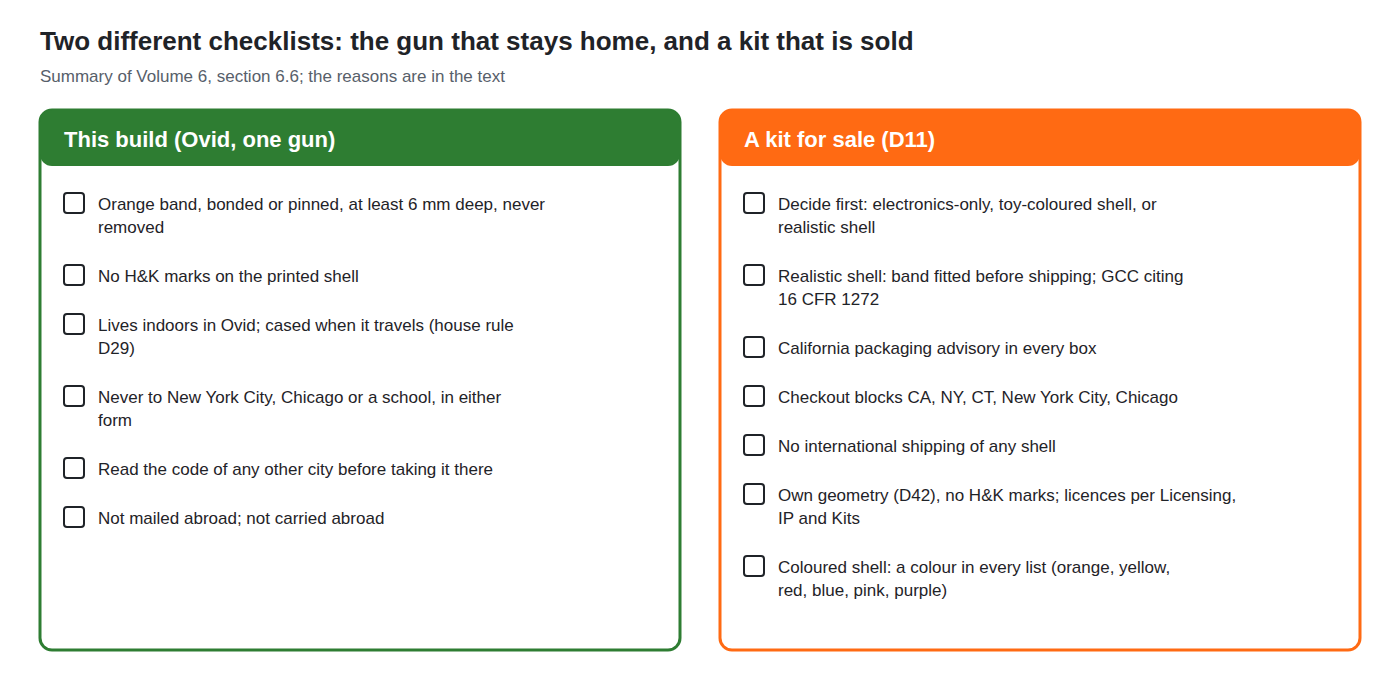
6.6 Checklist: this build
For the one printed MP7, used indoors in Ovid for gaming (D27). The reason for each line is given beside it.
Table 2 — 6.6 Checklist: this build
| Do | Why |
|---|---|
| Fit an orange band at least 6 mm deep round the muzzle, bonded or pinned, and never remove it | 16 CFR 1272.3(b). It is the exemption in Grand Rapids-type ordinances, and possession with the marking removed is itself an offence there (Donor Build Vol 3). It also tells a police officer what the object is. |
| Keep H&K’s marks off the shell | A trademark matter (Printed Build Vol 7). It also makes the gun a little less convincing out of context. |
| Store it indoors and out of sight of windows; carry it cased, out of sight, in the trunk | House rule D29 (Donor Build Vol 3 § 3.9). California’s open-display rule shows how a state treats a replica in a car (PC § 20170). |
| Never take it into New York City or Chicago, or onto school property | NYC § 10-131(g) and Chicago § 4-144-190 ban possession outright. Some school-zone laws name replicas outright (MN § 609.66); Michigan’s (§ 750.237a) is unclear for a replica, and the Donor Build treats it as reaching one. |
| Read a city’s code for “imitation”, “replica”, “facsimile” and “toy” before taking it there | Michigan cities may regulate replicas (Donor Build Vol 3); the four words are the ones the ordinances in Vol 3 use. |
| Do not post it abroad or take it abroad | UK, Canada and Australia law (Vol 5); FedEx and UPS international rules (Vol 4). |
| Do not lend or give it away in Connecticut, and do not sell it into CA, NY or CT | CT § 53-206c(b) bans giving; CA § 20165, NY GBL § 872 (Vol 2). |
6.7 Checklist: a kit for sale
Table 3 — 6.7 Checklist: a kit for sale
| Do | Why |
|---|---|
| Decide first which of the three products (§ 6.5) is being sold | It decides everything below. Product A needs almost none of it. |
| Use the project’s own geometry, not a licensed or downloaded model | D42; model licences (Printed Build Vol 3); trade dress (Licensing, IP and Kits). |
| Realistic or toy shell: fit the marking before shipping; never ship a loose orange part for the buyer to attach | 16 CFR 1272.2 lists “manufacture” and “ship”; the CPSC holds the domestic manufacturer or importer responsible for permanence (Vol 1). |
| Issue a General Certificate of Conformity citing “16 CFR part 1272”, available within 24 h, and furnish it to resellers | 15 U.S.C. 2063(a); 16 CFR 1110.11 and 1110.13 (Vol 1). |
| Label, package and advertise for adults; do not market to under-13s | The children’s-product rules (CPC, third-party testing, ASTM F963) are much heavier (Vol 1; Licensing, IP and Kits). |
| Put the California advisory in every box | PC § 20160 for any California sale. Its three warnings are good practice everywhere. |
| Tell the buyer, in the box and on the listing, that the band stays on | CA PC § 20150; Grand Rapids § 9.177 (Donor Build Vol 3). |
| Block CA, NY, CT, New York City and Chicago at checkout for any realistic shell; block NY and NYC for any open-muzzle shell | Vol 2, Vol 3. |
| No international shipping of any shell | UK s. 36, Canada s. 84 and 104, Australia reg 4F (Vol 5); FedEx item 8; UPS (Vol 4). |
| Describe parcels as “video game controller (light gun), non-firing” | Accurate; FedEx US item 10 (Vol 4). |
| Toy shell: choose bright orange, yellow, red, blue, pink or purple over the whole exterior | Every US list and the UK’s accept these; white fails the UK, green fails Boston (Vol 2, § 2.9). |
| Re-read this dive’s statutes before launch and once a year | Illinois SB 2123 is pending; the 15 CFR → 16 CFR move shows how rules shift; CPSC penalty amounts adjust in December 2026. |
6.8 Open questions for the owner
- Which kit, if any? Product A (electronics only), B (toy-coloured shell) or C (realistic shell). The legal case strongly favours A, then B. C is lawful in most of the US with the right marking and certificate, but it cannot go to five US jurisdictions or abroad.
- Colour, if B. The colour that works everywhere is one of orange, yellow, red, blue, pink or purple.
- Whether a lawyer reviews the plan before any sale. This dive reads the texts. It does not replace a lawyer’s opinion on the open questions in Volume 1, § 1.12.
6.9 What could not be verified
- Colorado HB26-1144’s signed text. Only the General Assembly’s bill page and summary were read.
- Printer-blocking and file-distribution bills in New York and Washington: their status was not confirmed on the legislatures’ sites.
- Whether any law anywhere treats a printed replica differently from a moulded one. None was found, but the search was not exhaustive.
Sources
Footnotes
-
Colorado General Assembly, HB26-1144, “Prohibit Three-Dimensional Printing Firearms & Components”, bill page https://leg.colorado.gov/bills/hb26-1144, read 2026-10-20 (status: signed 05/04/2026; Session Law Chapter 94; effective 07/01/2026; summary text quoted). ↩
-
Connecticut General Statutes, chapter 943 table of sections (§ 53-206i title), https://www.cga.ct.gov/current/pub/chap_943.htm, read 2026-10-20. ↩
Comments (0)