Imitation-Firearm Law · Volume 2
State Look-Alike Laws for a Kit Seller
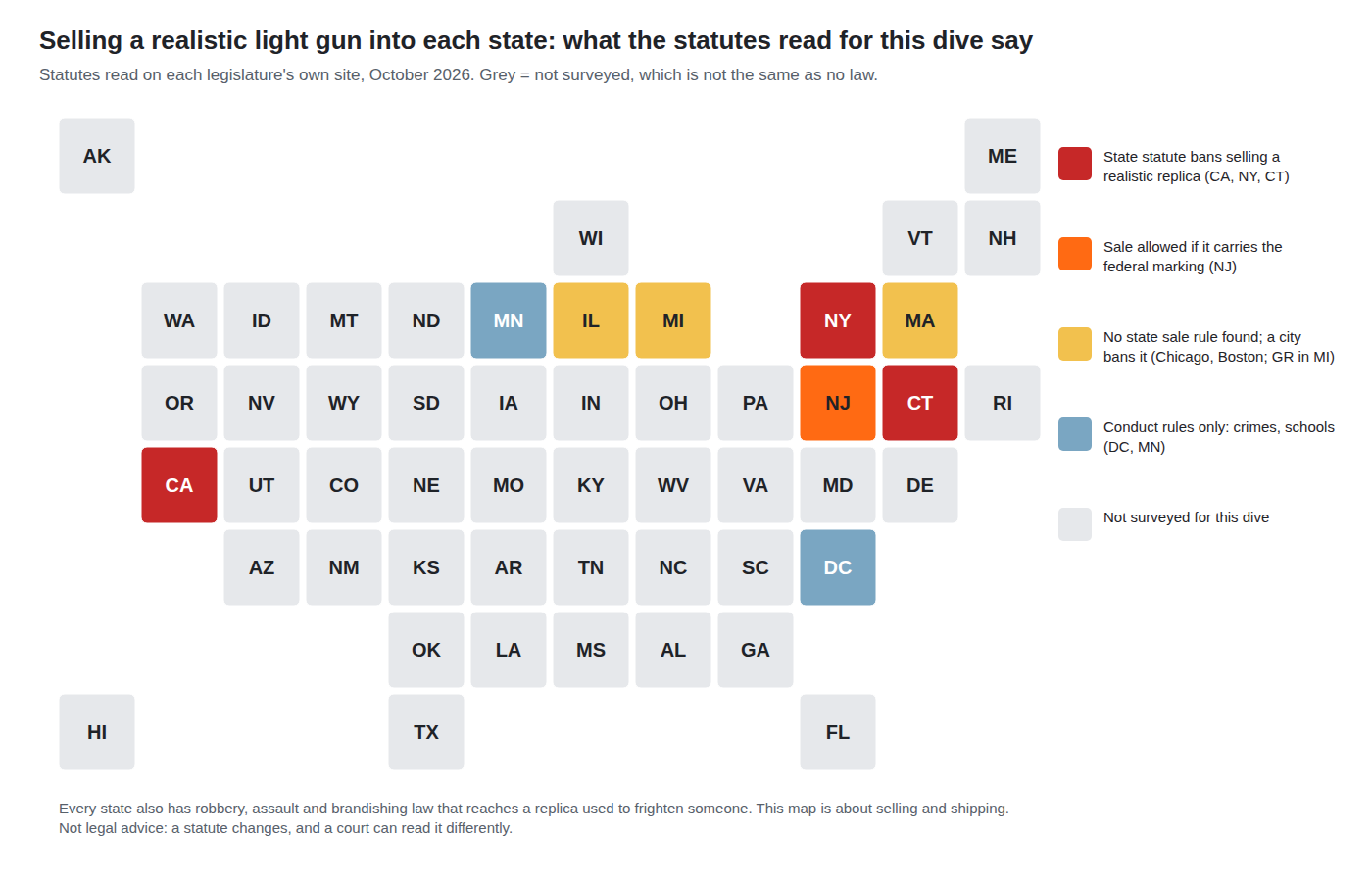
Which states ban the sale of a realistic replica outright, which accept the federal marking, which leave it to their cities, and which only punish misuse: California, New York, New Jersey, Connecticut, Illinois, Massachusetts, Michigan, Minnesota and the District of Columbia, each read from the legislature's own text
2.1 Why a seller reads state law differently from an owner
An owner asks whether the gun can be carried, displayed or kept. A seller asks a different question: can it be sold to someone there, and shipped to them? Some states that say little about possession say a great deal about sale. Their laws are aimed at the shop and the mail-order house, not the person holding the gun. Three of the states read here make it unlawful to sell a realistic replica at all, however it is marked. One accepts the federal marking. In the rest, the risk sits in a city ordinance or in the general criminal law.
The MP7 Donor Build has already read Michigan for an owner in Ovid (Vol 3): there is no Michigan imitation-firearm statute, and conversion takes the gun out of state preemption so that cities can regulate it. This volume adds the states that matter to a seller. It reads each one’s text on the legislature’s own site, and asks of each the same two questions:
- Can a realistic MP7 light gun (black, with an orange band at the muzzle per 16 CFR 1272.3(b)) be sold and shipped to a buyer there?
- Can a plainly coloured one (a bright colour all over, or clear) be sold there?
2.2 The table
Table 1 — 2.2 The table
| State | Statute (read 2026-10-20) | Realistic MP7, orange band | Bright-coloured gun | Penalty for the seller |
|---|---|---|---|---|
| California | Penal Code §§ 16700, 20150–20180 | No sale (§ 20165), unless solely for export out of state | Yes, if the entire exterior is a listed colour or clear (§ 16700(b)(5)); packaging advisory required (§ 20160) | Civil fine to $10,000 per violation (§ 20165); marking failure a misdemeanour (§ 20155) |
| New York | General Business Law §§ 870–873 | No sale (§ 872) | No, if the muzzle is open: § 871(2)(b) also requires a barrel closed for ½ in | AG action, civil penalty to $1,000 per violation (§ 873) |
| Connecticut | Gen. Stat. § 53-206c | No sale, and no gift | Yes, if “because of its distinct color … [it] cannot reasonably be perceived to be a real firearm” | Class B misdemeanour |
| New Jersey | N.J.S.A. 56:17-1 (P.L. 2019, c.481) | Yes, if it conforms to the federal marking rule | Yes | Civil penalty to $500, then $1,000 |
| Illinois | none found (bills only) | Yes at state level; no in Chicago (Vol 3) | Yes at state level | — (city fines) |
| Massachusetts | none found | Yes at state level; Boston restricts public-property sale and use (Vol 3) | Yes | — (city fines) |
| Michigan | none (Donor Build Vol 3) | Yes at state level; cities may regulate | Yes | — (city ordinances) |
| Minnesota | §§ 609.66, 609.713 | Yes (no sale rule) | Yes | — (school-property and threat offences only) |
| District of Columbia | D.C. Code § 22-4504(b) | No sale rule found | — | — (crime-of-violence enhancement only) |
The table is about selling and shipping. Every state also has robbery, assault and threatening-display law that reaches a replica used to frighten someone. Michigan’s armed-robbery statute says so in terms (Donor Build Vol 3). None of that changes for a seller.
2.3 California: a commercial-sale ban with a colour exit
California’s imitation-firearm law is Division 4 of Title 3 of Part 6 of the Penal Code, “Imitation Firearms”, §§ 20150–20180. The definition sits in § 16700. Older sources cite the pre-2012 numbers (§ 12550 and its neighbours). The 2010 recodification (Stats. 2010, ch. 711, operative 1 January 2012) moved everything to the current numbers. There is no § 20166.
The definition is the widest in this volume. It reaches anything that looks real, with no reference to colour or marking:1
- (a)(1) As used in this part, “imitation firearm” means any BB device, toy gun, replica of a firearm, or other device that is so substantially similar in coloration and overall appearance to an existing firearm as to lead a reasonable person to perceive that the device is a firearm.
The sale ban is § 20165:
(a) Any person who, for commercial purposes, purchases, sells, manufactures, ships, transports, distributes, or receives, by mail order or in any other manner, an imitation firearm, except as authorized by this section, is liable for a civil fine in an action brought by the city attorney or the district attorney of not more than ten thousand dollars ($10,000) for each violation.
The authorised purposes in § 20165(b) are: “Solely for export in interstate or foreign commerce”; theatrical productions; “a certified or regulated sporting event or competition”; military, civil defence or ceremonial use; and school displays. A home gaming peripheral is none of them.
The exits are in § 16700(b), which removes five things from the definition “as used in Section 20165”. Two matter here:
- (b)(4) airsoft guns that, on top of the federal orange ring, have a fluorescent trigger guard and fluorescent 2 cm bands. A light gun is not an airsoft gun, so this exit is closed to it. It does explain why California-legal airsoft guns look the way they do.
- (b)(5): “a device where the entire exterior surface of the device is white, bright red, bright orange, bright yellow, bright green, bright blue, bright pink, or bright purple, either singly or as the predominant color in combination with other colors in any pattern, or where the entire device is constructed of transparent or translucent materials”.
So a realistic black MP7 light gun cannot be sold into California, orange band or not, while a bright-blue one can. Section 20165 applies to anyone who “sells … ships … for commercial purposes”, including a seller in another state shipping to a California buyer. Its export exception lets a California-based maker sell out of state. It does not let anyone sell in.
Three more California rules attach to sellers:
- § 20155: “Any manufacturer, importer, or distributor of toy, look-alike, or imitation firearms that fails to comply with any applicable federal law or regulation governing the marking … is guilty of a misdemeanor.” The federal rule of Volume 1 is therefore also a California crime for a seller.
- § 20160: any imitation firearm made after 1 July 2005 must, “at the time of offer for sale in this state”, come with “a conspicuous advisory in writing as part of the packaging”. The advisory must say three things: that the product may be mistaken for a firearm by law enforcement officers or others; that altering its coloration or markings to make it look more like a firearm is dangerous and may be a crime; and that brandishing or displaying it in public may cause confusion and may be a crime. The fines run from $1,000 to $10,000 per action. A bright-coloured gun sold in California needs this too, because the § 16700(b) exits apply only to § 20165.
- § 20150: altering the required colour or markings “in a way that makes the imitation firearm … look more like a firearm” is a misdemeanour. The section does not apply to manufacturers. It does reach a customer who paints a bright-blue kit black.
California also bans open display in a public place (§ 20170), and its list of public places includes “An automobile, whether moving or not”. The penalty is an infraction, and a misdemeanour on a third offence (§ 20180). The exception for an imitation “packaged or concealed so that it is not subject to public viewing” (§ 20175) is the legal basis of the cased-transport habit in the Donor Build house rule.
2.4 New York: a sale ban that an open muzzle cannot pass
New York’s law is Article 39-B of the General Business Law, “Imitation Weapons”. Its stated purpose is to safeguard the public “by banning the importation, manufacture, distribution and sale of such imitation weapons”.2 Section 872:
No person, firm, corporation or agent or employee thereof shall import, manufacture, sell, hold for sale or distribute within the state any imitation weapon unless such device is imported, manufactured, sold, held for sale and distributed: 1. solely for subsequent transportation in interstate commerce; or 2. solely for lawful use in a theatrical production …
The definition in § 871(2) is where a light gun runs into trouble. An “imitation weapon” is anything that “substantially duplicates or can reasonably be perceived to be an actual firearm” unless it meets every one of four conditions:
(a) either (i) is colored white, bright red, bright orange, bright yellow, bright green, bright blue, bright pink or bright purple on the entire exterior surface or as the predominant color …; or (ii) is constructed entirely of transparent or translucent materials …; and (b) has a barrel that is closed for a distance of not less than one-half inch from the front-end of its barrel with the same material of which the imitation weapon is made, unless it is a water gun; and (c) has legibly stamped thereon, the name of the manufacturer or some trade name, mark or brand …; and (d) does not have attached thereto a laser pointer …
Condition (b) is the trap. A camera light gun looks out of its muzzle, so its barrel is not closed. Unless the camera sits behind at least half an inch of solid body material, which defeats it, even a bright-yellow MP7 light gun fails § 871(2)(b). If it “can reasonably be perceived to be an actual firearm”, it stays an imitation weapon. An MP7 outline in yellow probably still can be. The two-condition test of “bright colour and closed barrel” was written for toys that shoot nothing and see nothing.
Two practical routes are left for New York. One is a shell that cannot “reasonably be perceived to be an actual firearm” at all: an arcade-style gun, not an MP7. The other is an electronics-only kit (Volume 1, § 1.6). Enforcement is by the Attorney General, with a civil penalty of up to $1,000 per violation and “no proof … that the defendant knowingly or intentionally violated such provision” (§ 873). New York City adds a possession ban (Volume 3).
2.5 Connecticut: no sale and no gift
Connecticut’s § 53-206c, “Sale, carrying and brandishing of facsimile firearms prohibited”, dates from 1988.3 Its definition fits a light gun closely: “‘Facsimile of a firearm’ means (A) any nonfunctional imitation of an original firearm which was manufactured, designed and produced since 1898”. The operative rule:
(b) No person shall give, offer for sale or sell any facsimile of a firearm. The provisions of this subsection shall not apply to any facsimile of a firearm, which, because of its distinct color, exaggerated size or other design feature, cannot reasonably be perceived to be a real firearm.
Two features stand out. The ban covers giving as well as selling, so a free sample or a prize at a gaming event is caught too. And the exit is a judgement, not a list: “distinct color, exaggerated size or other design feature”. An orange muzzle band on a black gun is a design feature, but a black MP7 with an orange tip can plainly still “reasonably be perceived to be a real firearm”. So no realistic MP7 to Connecticut, as a sale or a gift. A bright-coloured one is probably outside the ban. Violation is a class B misdemeanour.
2.6 New Jersey: the federal marking is enough
New Jersey regulates sale, not possession. P.L. 2019, c.481 (approved 21 January 2020, codified at N.J.S.A. 56:17-1) reads in part:4
b. A person shall not sell, transfer, or assign a toy gun or imitation firearm as defined in subsection v. of N.J.S.2C:39-1 unless it is: (1) a color other than black, blue, silver, or aluminum; (2) marked with a non-removable orange stripe that is at least one inch in width and runs the entire length of the barrel on each side of the barrel; and (3) equipped with a barrel at least one inch in diameter that is closed at a distance of at least one-half inch from the front end of the barrel with the same material from which the toy gun or imitation firearm is made; or (4) is regulated under and conforms with the provisions of 15 CFR 272.1 et seq.
Conditions (1)–(3) are a New Jersey design standard that a camera gun fails, again because of the closed barrel. Condition (4) is the alternative: conform to the federal rule. A realistic MP7 with a permanent orange muzzle band can be sold into New Jersey under (4). The penalty is up to $500 for a first offence and $1,000 after.
There is a wrinkle. Condition (4) names 15 CFR 272.1, the Commerce regulation that NIST removed on 19 February 2026 (Volume 1, § 1.2). The same requirements now live at 16 CFR part 1272. A court would very likely read (4) as pointing to the federal rule in force, but the statute has not been amended to say so.
New Jersey’s criminal code separately defines an imitation firearm (N.J.S.A. 2C:39-1(v)), quoted by the state judiciary’s model jury charge as “an object or device reasonably capable of being mistaken for a firearm”. It punishes possessing one for an unlawful purpose (2C:39-4(e)) and possessing one on school property (2C:39-5(e)(3)). Those apply to the buyer, not the sale.5
2.7 Illinois, Massachusetts and Michigan: the cities decide
Illinois has no statewide sale or colour law. Bills to create one have been filed repeatedly: SB 2166 (2015), SB 2886 (2016), SB 194 (2017) and SB 3094 (2022). None passed. SB 2123 of the 104th General Assembly would make it an unlawful practice under the Consumer Fraud Act “to knowingly sell, give, or deliver within the State … an imitation firearm”. Its last action was “Referred to Assignments” on 7 February 2025.6 It is pending, not law. If it passes, Illinois joins the red group. The binding rule today is Chicago’s outright ban on buying, possessing or selling any replica firearm (Volume 3).
Massachusetts has no statewide imitation-firearm statute either. The state’s own law library says plainly: “Toy guns and BB guns are not firearms in Massachusetts”. It lists only c. 148 § 39 (fireworks, which exempts cap pistols) and c. 269 § 12B.7 Section 12B governs minors and air rifles: no one under 18 may have an air rifle or BB gun in a public place unaccompanied. It is not an imitation-firearm law, and the hub’s E-11 legal volume, which cites it as one, is wrong on that point (recorded in this dive’s notes). Boston restricts replicas on public property (Volume 3).
Michigan is covered in the Donor Build, Vol 3. For a seller, two points carry over. The state has no sale rule. And because a non-firing replica is outside the state’s firearms-preemption statute, any Michigan city may regulate its sale, as Grand Rapids regulates its display.
2.8 Minnesota and the District of Columbia: misuse, not sale
These two show the most common pattern in American law: nothing on sale, and specific crimes for misuse.
Minnesota defines a “replica firearm” as “a device or object that is not defined as a dangerous weapon, and that is a facsimile or toy version of, and reasonably appears to be a pistol, revolver, shotgun, sawed-off shotgun, rifle, machine gun, rocket launcher, or any other firearm”.8 It punishes displaying one “in a threatening manner” to cause terror (§ 609.713 subd. 3, up to a year and a day). It punishes using or brandishing one on school property (a gross misdemeanour) and merely possessing one there (a misdemeanour) (§ 609.66 subd. 1d). A seller is untouched; the buyer is told, in effect, never to take it to a school.
The District of Columbia’s Code bars possessing “any other firearm or imitation firearm while committing a crime of violence or dangerous crime”. The penalty is up to 15 years, with a 5-year mandatory minimum (§ 22-4504(b)).9 No D.C. sale rule for imitation firearms was found, though the D.C. Code was not searched exhaustively. The hub’s E-11 volume cites § 22-4504 as “imitation-firearm restrictions in public spaces”. The section is the concealed-carry statute, and its imitation-firearm content is the crime-of-violence enhancement.
2.9 The colour safe harbours compared
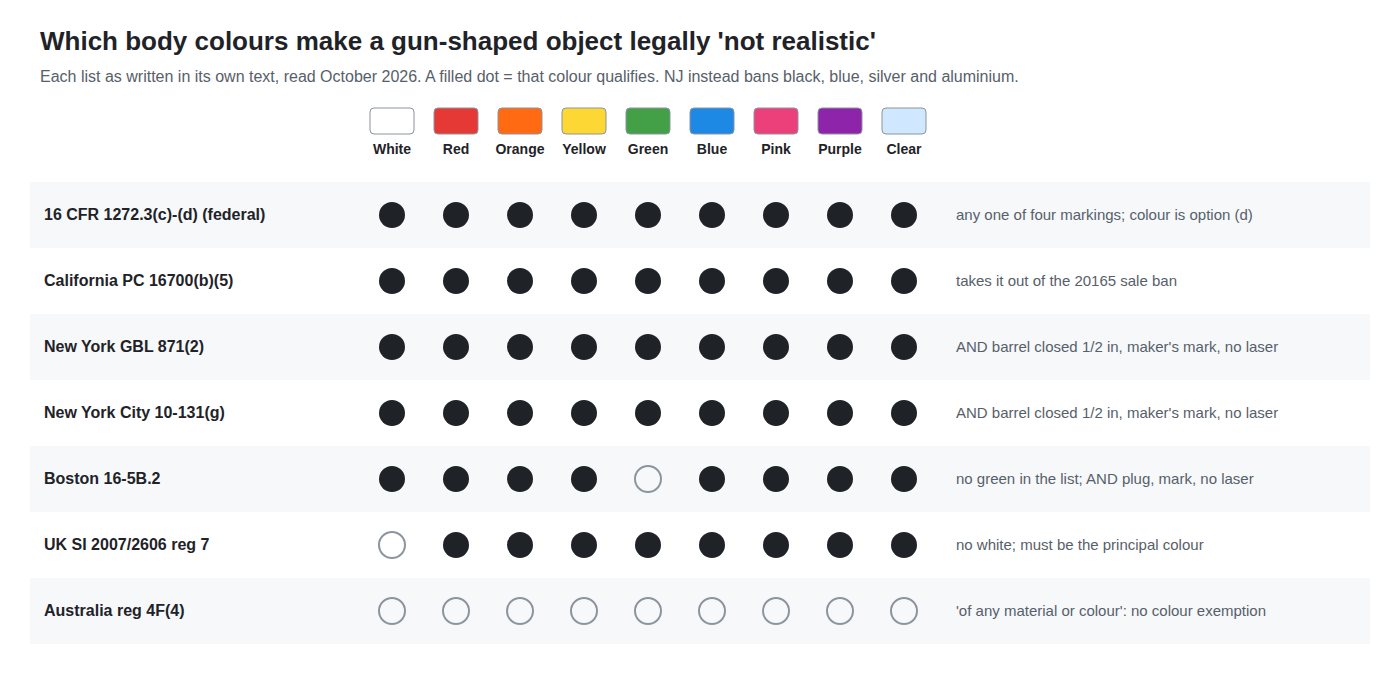
Every list that makes a gun-shaped object legally “not realistic” names nearly the same colours. They are not quite the same, and each adds its own conditions.
Three lessons for a kit designer:
- Choose a colour that is in every list. Bright orange, yellow, red, blue, pink or purple appears in all of the US lists and in the UK’s. White is missing from the UK’s; green is missing from Boston’s.
- “Entire exterior surface … or as the predominant color”. A black gun with a bright-blue stock is not predominantly blue. The safe-harbour shell is a coloured shell, not a coloured accent.
- A closed barrel is the condition a camera gun cannot meet. New York State, New York City, Boston and New Jersey’s own route (1)–(3) all require one. For these places the only clean products are an electronics-only kit, or a shell that does not look like a firearm at all.
2.10 The other states
The grey states on the map were not surveyed. Grey does not mean they have no law. The statutes most likely to matter, wherever a buyer is, follow the Minnesota pattern: replica-specific robbery, assault, threatening-display and school-zone offences. Those bind the buyer, not the seller. A sale ban like California’s, New York’s or Connecticut’s is the exception. Some sellers say so in their terms: the prop-gun maker NewRuleFX’s “Realistic Guns State Legal Notice” (updated January 2023) says it cannot ship to New York.10 The same notice still cites 15 CFR part 272, which shows how slowly the 2023 move has filtered through.
Before shipping into a state not on the table, read that state’s code for “imitation firearm”, “replica firearm”, “look-alike” and “facsimile”. Each term is used by at least one state read here.
2.11 What could not be verified
- New Jersey’s 2C:39-1(v), 2C:39-4(e) and 2C:39-5(e)(3) were not read on the legislature’s site. The definition is quoted from the New Jersey courts’ model jury charge.
- Whether any court has held a state colour or closed-barrel rule preempted by § 5001(g) as an “inconsistent” marking. None was read.
- Hawaii. The E-11 volume cites HRS § 134-16 as a look-alike law. The legislature’s page for that section returned a 404 on 2026-10-20, so the claim is neither confirmed nor refuted here.
- The D.C. Code for a sale rule; the 40 grey states; Illinois SB 2123’s fate.
Sources
Footnotes
-
California Penal Code §§ 16700, 20150, 20155, 20160, 20165, 20170, 20175, 20180 and 417.4, California Legislative Information, https://leginfo.legislature.ca.gov/faces/codes_displaySection.xhtml?lawCode=PEN§ionNum=20165 (and the same pattern for each section), read 2026-10-20 in a browser (the site refuses automated readers). Division heading: “DIVISION 4. IMITATION FIREARMS [20150 - 20180]”. § 16700 as amended by Stats. 2016, ch. 198 (AB 1798); § 20155 as amended by Stats. 2018, ch. 185 (AB 2176). ↩
-
New York General Business Law §§ 870, 871 (revision of 2023-03-10), 872, 873, NYS Senate Open Legislation, https://www.nysenate.gov/legislation/laws/GBS/871 (and /870, /872, /873), read 2026-10-20. ↩
-
Connecticut General Statutes § 53-206c (P.A. 88-237), Chapter 943, https://www.cga.ct.gov/current/pub/chap_943.htm, read 2026-10-20. ↩
-
New Jersey P.L. 2019, c.481 (A4260), approved 21 January 2020, C.56:17-1 and C.56:17-2, https://pub.njleg.gov/Bills/2018/PL19/481_.HTM, read 2026-10-20. ↩
-
New Jersey Courts, Model Criminal Jury Charges, weapons charges, https://njcourts.gov/sites/default/files/charges/weapons11.pdf, as summarised in search results 2026-10-20 (the charge PDF itself was not opened). ↩
-
Illinois General Assembly, Bill Status of SB2123, 104th General Assembly, https://www.ilga.gov/Legislation/BillStatus?DocNum=2123&GAID=18&DocTypeID=SB&SessionID=114, read 2026-10-20. Earlier bills: SB2166 (99th GA), SB2886 (99th), SB194 (100th), SB3094 (102nd), texts on ilga.gov. ↩
-
Massachusetts Trial Court Law Libraries, “Massachusetts law about guns and other firearms”, https://www.mass.gov/info-details/massachusetts-law-about-guns-and-other-firearms; M.G.L. c. 148 § 39 and c. 269 § 12B, https://malegislature.gov/Laws/GeneralLaws/PartIV/TitleI/Chapter269/Section12B; all read 2026-10-20. ↩
-
Minnesota Statutes §§ 609.66 subd. 1d and 609.713 subd. 3, Office of the Revisor of Statutes, https://www.revisor.mn.gov/statutes/cite/609.66 and /609.713, read 2026-10-20. ↩
-
D.C. Code § 22-4504, Council of the District of Columbia, https://code.dccouncil.gov/us/dc/council/code/sections/22-4504, read 2026-10-20. ↩
-
NewRuleFX, “Realistic Guns State Legal Notice”, https://www.newrulefx.com/pages/realistic-guns-state-legal-notice, read 2026-10-20 (“Updated, NewRuleFX 1/2023”). ↩
Comments (0)