Imitation-Firearm Law · Volume 4
Shipping a Replica Gun
What USPS Publication 52, UPS's published rules and the 2026 FedEx Service Guide actually say about non-firing replicas, inside the United States and abroad; the FedEx line on 3-D-printed weapons; and how to pack and label a kit so that the carrier, the state and the buyer are all satisfied
4.1 A replica is not a firearm, to a carrier
All three carriers have detailed rules for firearms: licensed shippers, contracts, adult signatures, no handguns by ground. None of those rules applies to a light gun, because each carrier’s “firearm” is the legal one. In USPS Publication 52 it is “any device, including a starter gun, which will, or is designed to, or may readily be converted to, expel a projectile by the action of an explosive”.1 FedEx accepts firearms “as defined by the United States Gun Control Act of 1968”.2 A light gun expels nothing.
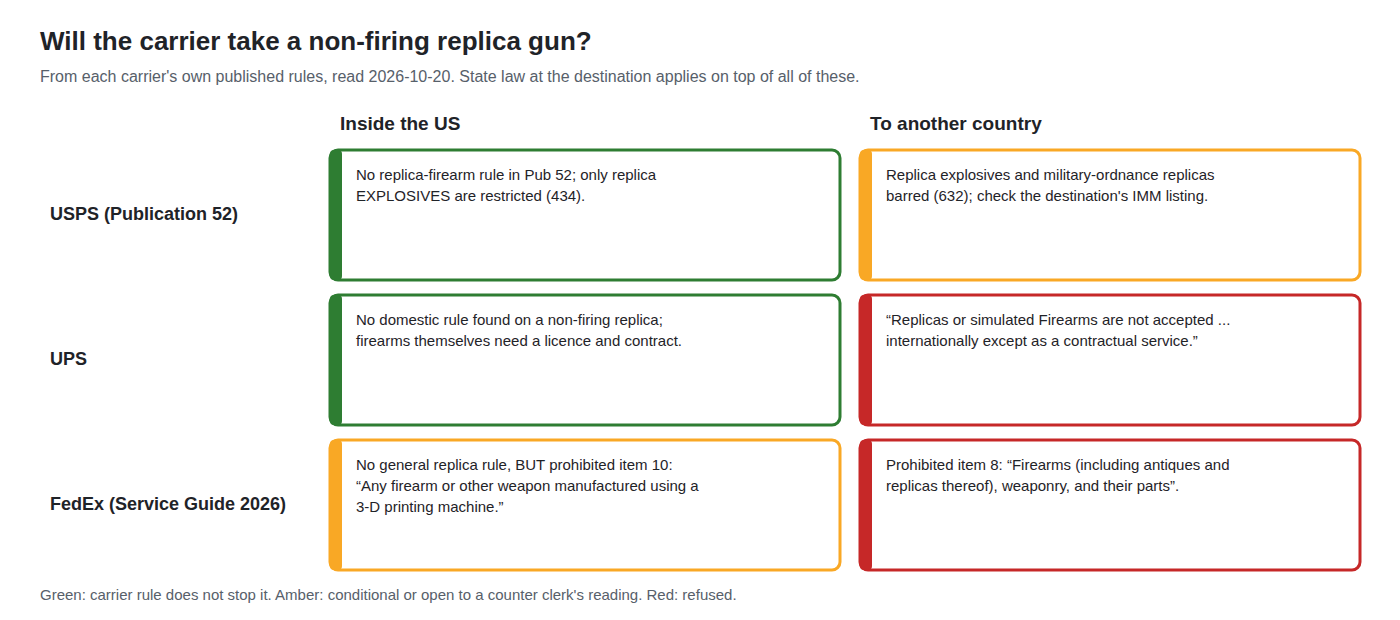
What the carriers do say about replicas is short, and it is different at home and abroad. The detail is below. In outline: inside the United States, none of the three bars a non-firing replica gun, though FedEx bars anything that might be called a weapon made on a 3D printer. To another country, two of the three refuse replica guns. The carrier’s rules are also only one layer. Destination state law (Volume 2) and city law (Volume 3) apply on top. A carrier happy to take a parcel to Los Angeles does not make the sale lawful under California Penal Code § 20165, which reaches anyone who “ships” an imitation firearm for commercial purposes.
4.2 USPS: Publication 52
Publication 52, “Hazardous, Restricted, and Perishable Mail”, is the Postal Service’s rulebook. Section 43, “Firearms”, has five parts.3 The only one about replicas is 434, “Replica or Inert Explosive Devices”:
Replica or inert explosive devices that are not dangerous but resemble explosive devices (i.e., simulated grenades) are mailable provided all following conditions are met: The package is presented by the mailer at a retail counter. Registered Mail service is used. The address side of the package is labeled with “REPLICA EXPLOSIVE” using letters at least 1/4-inch high.
That rule covers replica explosives. Publication 52 contains no rule on replica firearms, so a replica gun is ordinary mail inside the United States. The firearm rules of 432 do not apply to it: the certification that a weapon is unloaded and not concealable, the ban on outer markings, and tracking with a signature.
International mail is different. Section 632, “Inert Replica and Explosive Devices”, lists what is prohibited:
Military ordnance, ammunition, and shells. Grenades. Similar devices that were originally designed for military or combative use (including training).
Read with its heading, the list is about ordnance and explosive devices. A clerk could read “similar devices … originally designed for military or combative use” more widely, and an MP7 was designed for military use. On top of that, section 63 says every international item is subject to “the mailing limitations imposed by an individual country”, listed in the International Mail Manual’s country listings.4 For the three countries in Volume 5, the destination’s own law forbids the import anyway.
4.3 UPS
UPS’s US page of prohibited and restricted items lists, among “the items we can carry under certain criteria”, “Firearms and weapons (including inert and replica explosive weapons)”. These are accepted “on a contractual basis for shippers with regular volume and the ability to comply with all applicable laws and regulations”.5 The phrase covers replica explosive weapons; it says nothing on replica guns.
UPS’s “How To Ship Firearms” page does address replica guns, for international shipments only:6
UPS does not accept Firearms or Firearm Parts for shipment internationally. Replicas or simulated Firearms are not accepted for shipment internationally except as a contractual service.
Inside the United States, no UPS page read for this dive restricts a non-firing replica gun. The UPS Tariff/Terms and Conditions of Service, the governing document, was not read in full. Its firearms section (3.7) should be checked before an account is opened for a kit business.
4.4 FedEx: the 2026 Service Guide
The FedEx Service Guide is a single document of terms and rates; the 2026 edition is effective 5 January 2026.2 Its US terms say:
Only customers holding a Federal Firearms License (FFL) and federal, state, or local government agencies may ship firearms with FedEx. … FedEx will transport and deliver firearms, antique firearms, and replica firearms, all as defined by the United States Gun Control Act of 1968 …
“Replica firearms … as defined by the” Gun Control Act means replicas of antique firearms, the only replicas the Act defines. A non-firing modern replica is not a firearm under the Act, so the FFL rule does not reach it.
The US prohibited items list (items 1–14) has no general replica-gun entry. Two entries come close:
Items resembling a bomb, hand grenade, or other explosive device … This includes, but is not limited to, inert products such as novelty items, training aids, and works of art.
Any firearm or other weapon manufactured using a 3-D printing machine.
The international prohibited items list is plain:
- Firearms (including antiques and replicas thereof), weaponry, and their parts (acceptable between the U.S. and Puerto Rico).
FedEx will not take a replica gun to another country.
4.5 The FedEx line on 3-D printing
Item 10 of the US list matters most to this project, because the first build is a printed MP7 (decision D35). A light gun is not a firearm. Whether a printed light gun is an “other weapon” is a question of words, and it plainly is not one: it cannot hurt anyone. But a parcel description such as “3D printed MP7” invites a clerk, or a scanner looking at an X-ray image, to apply item 10 without asking. Three habits avoid the question:
- Describe the contents as what they are. “Video game controller (light gun), non-firing”, not “replica MP7”. The description is not a disguise. It is accurate, and it is the category the product belongs to.
- Ship the orange band fitted (Volume 1, § 1.7). It is required anyway, and it tells anyone who opens the box what the object is.
- Pack the kit so the parts read as parts. A shell in labelled bags beside a circuit board looks like a kit, not a weapon.
For volume shipping, the safer course is a carrier whose rules have no 3-D-printing clause. On the pages read here, that means USPS or UPS. Or the FedEx account representative can be asked to confirm in writing that non-firing printed controllers are acceptable.
4.6 Shipping the airsoft donor is different
An airsoft gun is an air gun, not a light gun, and the rules change:
- USPS treats air guns separately from firearms (“Air guns are not regulated as firearms”), but “When compressed air is included in packages, shipments must adhere to the hazardous materials requirements” (Pub 52, 431.7). The Postal Service “may require the mailer to open packages containing firearms or air guns” (432.1). A gas-blowback donor ships with its magazine empty.
- A donor that still has its gas or electric firing system is an airsoft gun under § 5001(c), and its orange marking stays on in transit (MP7 Donor Build, Vol 3).
- Lithium batteries, in an electric donor or in a later wireless light gun, are hazardous materials in the mail. The LiPo Batteries dive, Vol 7 covers them.
None of this applies to the finished light gun unless it carries a battery.
4.7 Packing and labelling a kit
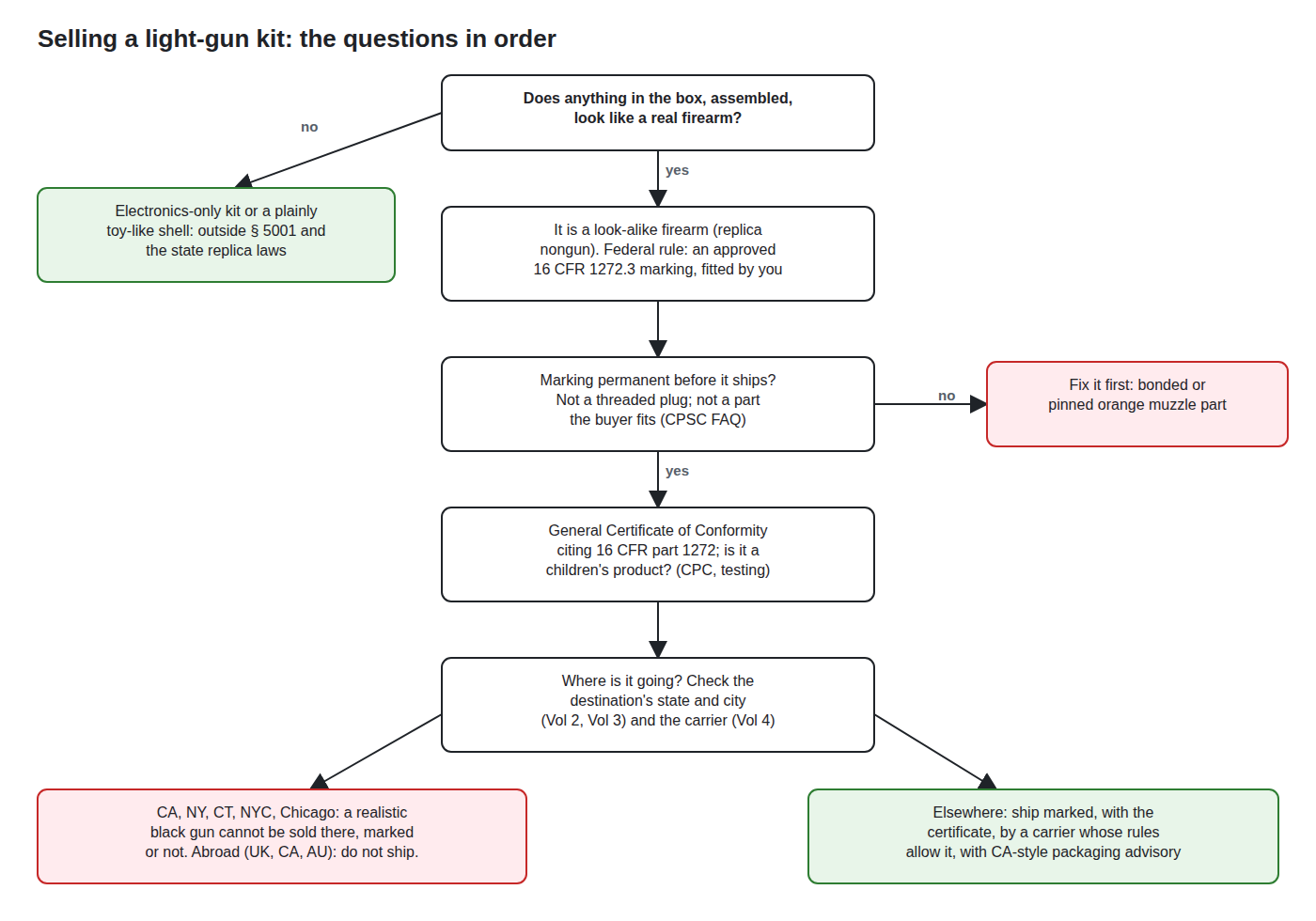
Putting the volumes together, a shipped realistic MP7 kit needs:
Table 1 — Putting the volumes together, a shipped realistic MP7 kit needs
| Item | Why |
|---|---|
| Orange muzzle band bonded or pinned to the barrel before packing | 16 CFR 1272.2–.3; CPSC: a threaded plug is “non-permanent” (Vol 1) |
| General Certificate of Conformity citing 16 CFR part 1272, with the shipment or online by URL and identifier | 15 U.S.C. 2063(a); 16 CFR 1110 (Vol 1) |
| Written advisory in the packaging: may be mistaken for a firearm by police; altering colour or markings is dangerous and may be a crime; displaying in public may cause confusion and may be a crime | Required for California sales (PC § 20160), and good practice everywhere |
| ”The orange band must stay on” in the instructions and on the listing | Grand Rapids-type ordinances; CA PC § 20150 (Vol 3) |
| No shipments to CA, NY, CT, New York City or Chicago | Vol 2, Vol 3 |
| No international shipments of a realistic shell | UPS and FedEx rules; UK, Canada, Australia law (Vol 5) |
| Contents description “video game controller (light gun), non-firing” | Accurate, and it keeps the parcel out of FedEx’s 3-D-printed-weapon item by description |
| Plain outer box | Common sense for any gun-shaped object; not required by Pub 52 for a replica |
4.8 What could not be verified
- The UPS Tariff/Terms and Conditions of Service (section 3.7, Firearms) was not read; only UPS’s web pages.
- The International Mail Manual country listings for the UK, Canada and Australia were not read.
- Whether any carrier has refused a non-firing light gun in practice. No report was found.
- The FedEx Service Guide is the 2026 edition and changes each January. The 3-D-printing items are recent additions to it and may be reworded.
Sources
Footnotes
-
USPS, Publication 52, 431.1 “Firearms”, 431.7 “Air Guns” and 432.1 “General”, Postal Explorer, https://pe.usps.com/text/pub52/pub52c4_009.htm and https://pe.usps.com/text/pub52/pub52c4_010.htm, read 2026-10-20. ↩
-
FedEx, FedEx Service Guide 2026 (rates “effective January 5, 2026”), https://www.fedex.com/content/dam/fedex/us-united-states/services/Service_Guide_2026.pdf, linked from https://www.fedex.com/en-us/service-guide.html, read 2026-10-20: US terms “Firearms” (p. 155) and “Prohibited items” (items 1–14); International shipments (U.S. edition) “Prohibited items”, item 8. ↩ ↩2
-
USPS, Publication 52, 434 “Replica or Inert Explosive Devices”, https://pe.usps.com/text/pub52/pub52c4_012.htm; 632 “Inert Replica and Explosive Devices”, https://pe.usps.com/text/pub52/pub52c6_009.htm; read 2026-10-20. ↩
-
USPS, Publication 52, 63 “Restricted Matter: International Mail” and 631 “Firearms”, https://pe.usps.com/text/pub52/pub52c6_007.htm and https://pe.usps.com/text/pub52/pub52c6_008.htm, read 2026-10-20. ↩
-
UPS, “List of Prohibited Items for Shipping | UPS - United States”, https://www.ups.com/us/en/support/shipping-support/shipping-special-care-regulated-items/prohibited-items, read 2026-10-20 (page undated). ↩
-
UPS, “How To Ship Firearms | UPS - United States”, https://www.ups.com/us/en/support/shipping-support/shipping-special-care-regulated-items/prohibited-items/firearms, read 2026-10-20 (page undated). ↩
Comments (0)