Imitation-Firearm Law · Volume 1
The Federal Rule for Makers and Sellers
15 U.S.C. § 5001 read from the seller's side: the regulation that moved to the Consumer Product Safety Commission and now sits at 16 CFR part 1272, what \"manufacture\" and \"enter into commerce\" mean for a kit, the exemptions and the waiver, the certificate a seller must issue, and the penalties that reach a seller through the Consumer Product Safety Act
1.1 What this dive covers, and what it leaves to others
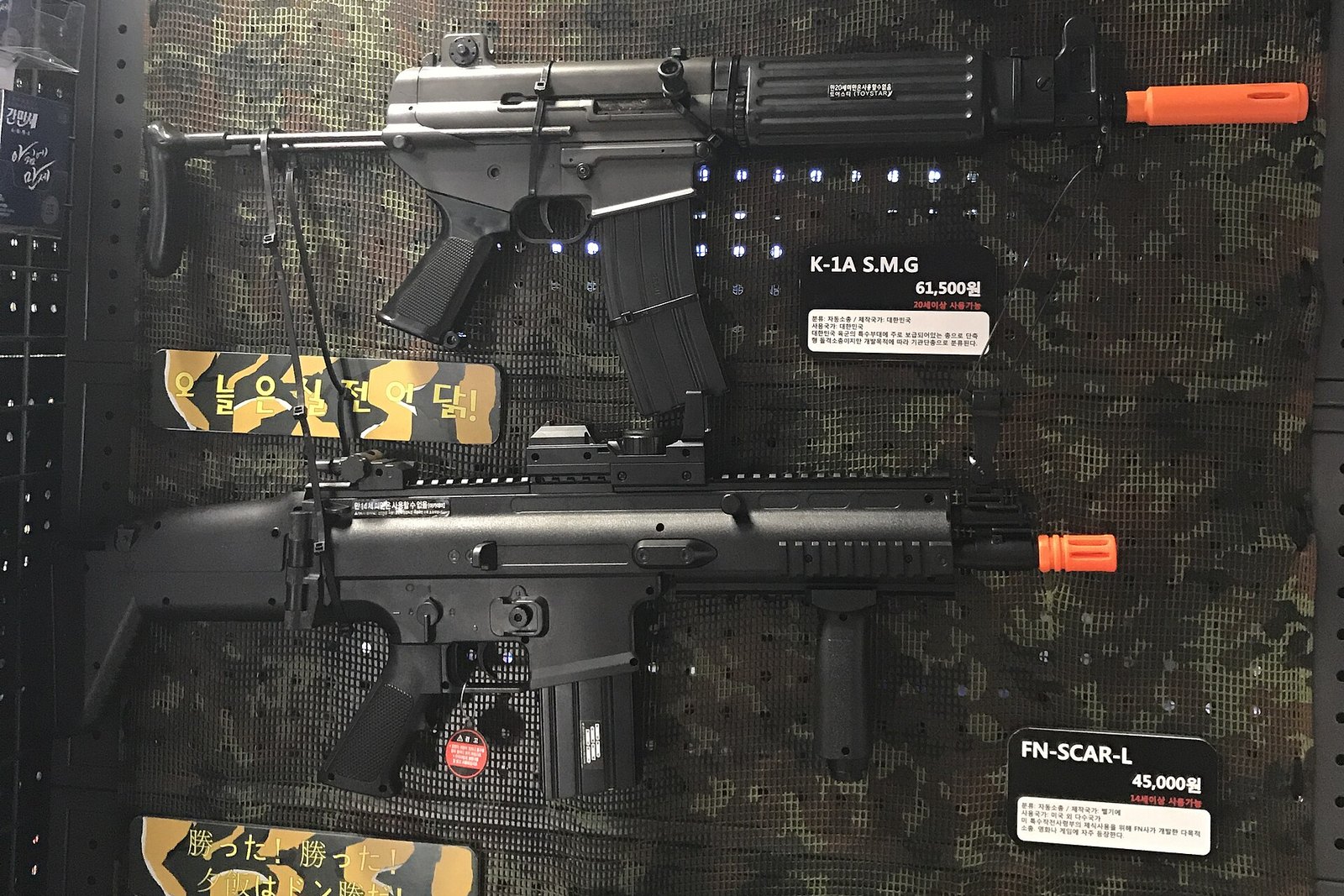
A light gun built into a realistic MP7 shell fires nothing. Even so, it is the kind of object imitation-firearm law was written for. The MP7 Donor Build, Volume 3 has already worked through the federal statute, the four approved markings, the camera at the muzzle, Michigan’s statutes and city ordinances, and the house rule for transport and storage, all for one gun owned and used in Ovid, Michigan. None of that is repeated here.
This dive covers the next step: making the gun and selling it, as a finished printed MP7 or as a kit. Ownership on the Decisions log puts that step in scope. Kits may be sold (decision D11). The first build is a 3D-printed MP7 (D35). Any kit is to use the project’s own geometry (D42). Selling brings in law that a private owner never meets:
- the federal rule as it applies to whoever manufactures and enters the gun into commerce (this volume);
- states that ban the sale of a realistic replica outright (Volume 2);
- cities that ban possessing one (Volume 3);
- carriers’ own rules (Volume 4);
- other countries (Volume 5);
- what a printed body changes, and a checklist with the reasons (Volume 6).
Licences, trademarks, H&K’s trade dress and general product safety belong to the planned Licensing, IP and Kits dive. The hub’s prop-gun legal treatment is the E-11, Volume 10.
Nothing in this dive is legal advice. Every statute and regulation quoted was read on the issuing body’s own site on the date given. A court can read any of them differently. Anyone actually selling should have a lawyer check the plan.
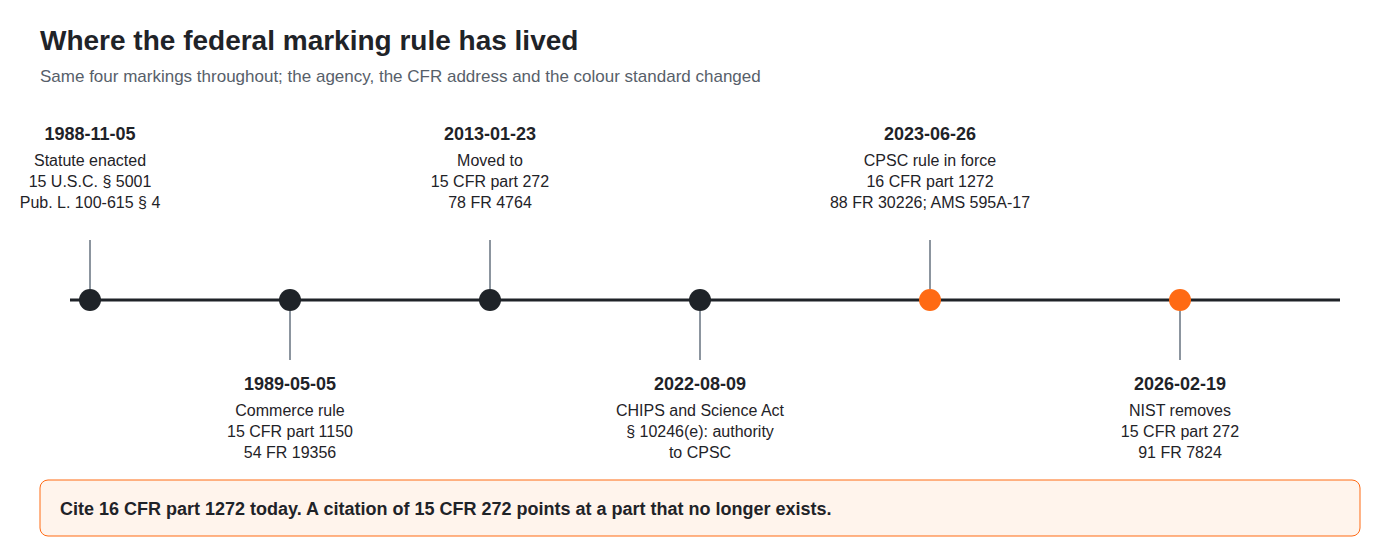
1.2 The regulation has moved: 16 CFR part 1272
The rest of this hub, like most of the internet, cites the marking regulation as 15 CFR part 272, a Department of Commerce rule. That part no longer exists. The rule has moved twice:
- In August 2022 the CHIPS and Science Act amended § 5001. It replaced the Secretary of Commerce with the Consumer Product Safety Commission as the body that approves markings, may approve alternatives, may grant waivers and may change the system.12
- The CPSC adopted the Commerce rule “with non-substantive and conforming changes” as a new 16 CFR part 1272, in force on 26 June 2023.3 The Commission vote was 4–0.
- On 19 February 2026 NIST removed 15 CFR part 272. Its reason: the old part “now lacks an underlying statutory authorization and has been rendered obsolete by the new, operative marking requirements issued by the Consumer Product Safety Commission”.4 eCFR now shows “PART 272 [RESERVED]”.5
The substance did not change. The four markings, the 6 mm figures and the exclusions are the same. The colour reference changed: Federal Standard 595B was cancelled in 2017, and colour 12199 is now cited from SAE’s AMS STD 595A-17. The CPSC says the colour itself is “identical”.3 One small trap remains. New Jersey’s 2019 sale law still points at “15 CFR 272.1 et seq.” (Volume 2), a cross-reference that now leads nowhere.
1.3 Part 1272 in its own words
The whole part is short. Its applicability section, read on eCFR on 2026-10-20:6
§ 1272.1 Applicability. This part applies to toy, look-alike, and imitation firearms (“devices”) having the appearance, shape, and/or configuration of a firearm and produced or manufactured and entered into commerce on or after May 5, 1989, including devices modelled on real firearms manufactured, designed, and produced since 1898.
It does not apply to (a) non-firing collector replicas of pre-1898 firearms, (b) traditional BB, paintball and pellet air guns as described in ASTM F589-85, or (c) “decorative, ornamental, and miniature objects” no larger than 38 mm by 70 mm, length measured without the stock.
The prohibition:
§ 1272.2 Prohibitions. No person shall manufacture, enter into commerce, ship, transport, or receive any toy, look-alike, or imitation firearm (“device”) covered by this part as set forth in § 1272.1 unless such device contains, or has affixed to it, one of the markings set forth in § 1272.3, or unless this prohibition has been waived by § 1272.4.
Section 1272.3 lists the four approved markings in the same words as the old § 272.3, which the Donor Build volume quotes in full. For a camera at the muzzle the one that matters is (b):
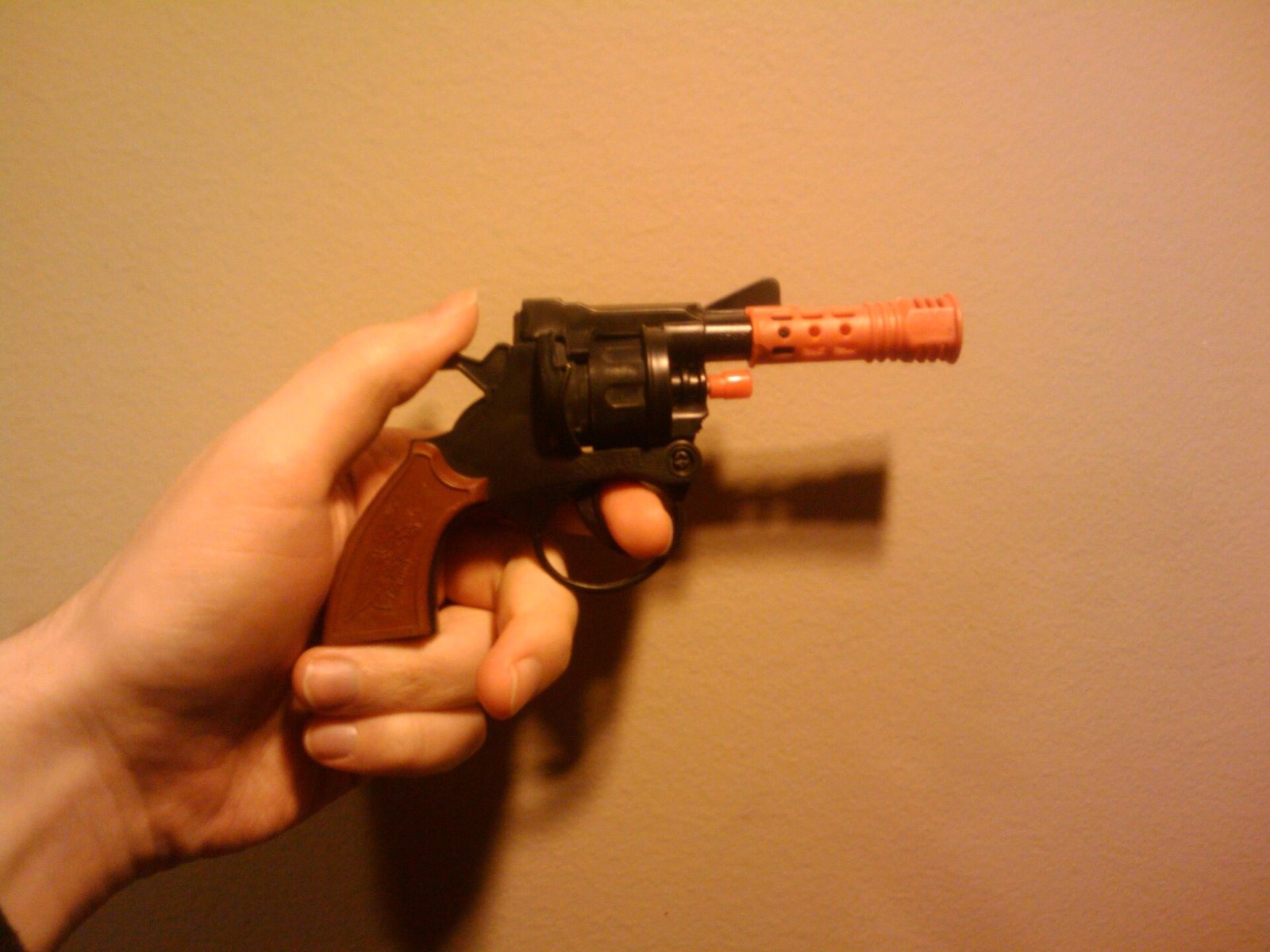
(b) A blaze orange (AMS STD 595A-17 color 12199) or orange color brighter than that specified by the AMS standard color number, marking permanently affixed to the exterior surface of the barrel, covering the circumference of the barrel from the muzzle end for a depth of at least 6 millimeters.
Sections 1272.4 (waiver) and 1272.5 (preemption) are covered in §§ 1.8 and 1.11.
1.4 Five acts, not one
Section 5001(a) and § 1272.2 both list five separate acts: manufacture, enter into commerce, ship, transport, receive. Each is unlawful on its own if the device is unmarked. For a business, that means the marking must be in place before the device is made, not just before it is sold. It also means a carrier that transports an unmarked replica, and a customer who receives one, are each inside the text.
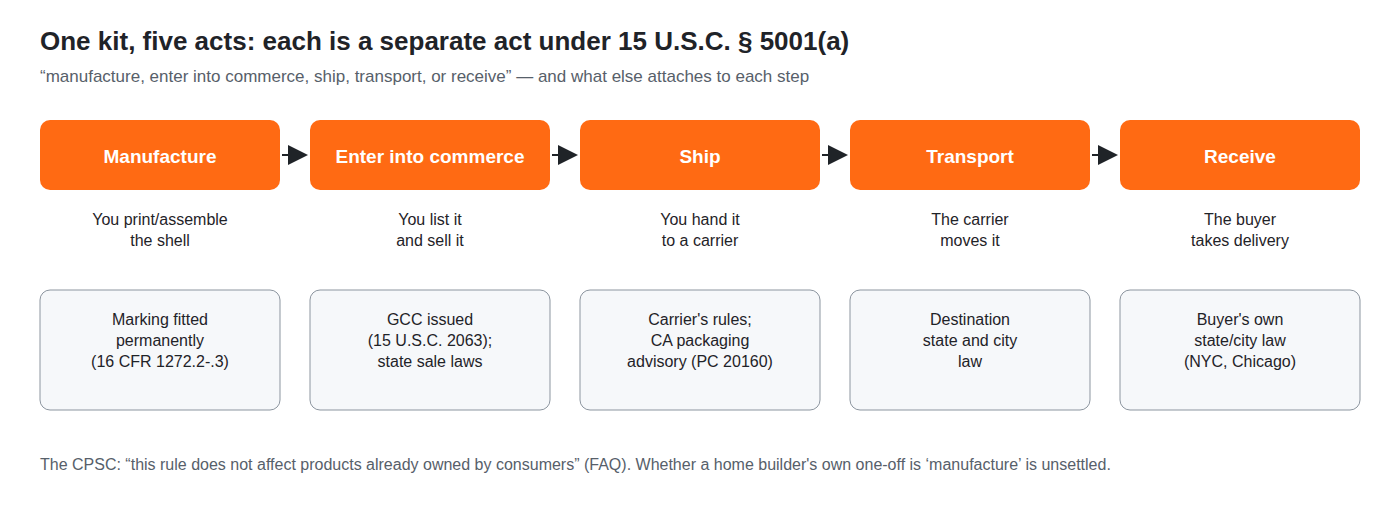
The CPSC’s answer to one question limits how far this reaches: “No, this rule does not affect products already owned by consumers.”7 That answer concerns marked products already bought. It does not settle whether a hobbyist who builds one gun at home “manufactures” it. The Donor Build volume left that question open, and this dive found no case or agency statement that closes it. For anyone who sells, it does not matter: selling is “enter into commerce” whatever “manufacture” means.
1.5 Who is a “manufacturer”
Section 5001 defines none of its verbs. The CPSC administers it alongside the Consumer Product Safety Act (CPSA), and the CPSA’s definitions are the ones the agency applies when it asks who must certify (§ 1.9):8
- “Manufactured” means “to manufacture, produce, or assemble.” Assembling a kit-maker’s parts into a finished gun is manufacture.
- “Manufacturer” means “any person who manufactures or imports a consumer product.” A US seller who has shells printed by a print farm overseas and ships them in is a manufacturer twice over: as importer, and as assembler if it finishes them.
- “To distribute in commerce” means “to sell in commerce, to introduce or deliver for introduction into commerce, or to hold for sale or distribution after introduction into commerce.”
- “Commerce” reaches trade between states and trade that “affects” it. A sale through a website to a buyer in another state is plainly inside it.
A one-person business printing MP7 shells in a spare room and selling them online is therefore a manufacturer that enters devices into commerce. That is the same position as Daisy or KWA.
1.6 A kit is still a look-alike firearm
The statute’s definition covers “replica nonguns” (MP7 Donor Build, Vol 3), and § 1272.1 covers anything “having the appearance, shape, and/or configuration of a firearm”. Neither text says what happens to a gun shipped in pieces. Two readings follow from the words; no agency statement on kits was found:
- The shell parts, together, have the “configuration” of a firearm. A box holding an MP7 upper, lower, stock and muzzle, which the buyer screws together, is a disassembled replica. Treating it as one is the safe reading, and the one a regulator is likely to take.
- An electronics-only kit is not a device at all. A board, camera, solenoid and cable with no gun-shaped parts has no “appearance, shape, and/or configuration of a firearm”. It is outside § 5001, and outside every state replica law in Volume 2. That makes it the cleanest product the project could sell. The buyer supplies or prints the shell and becomes the one who “manufactures” it.
Between the two sits a kit whose shell is unmistakably a toy: a bright colour all over, or clear. That is option (d) or (c) of § 1272.3. It is marked by its whole body, and it also passes the colour safe harbours of most of the states in Volume 2. The colour comparison in Volume 2 shows where it does not.
1.7 “Permanently affixed”
Options (a) and (b) require the marking to be “permanently affixed”, and the statute says the plug must be “an integral part, permanently affixed”. The CPSC’s FAQ:7
“Neither the statute nor the regulation specifically defines ‘permanently affixed’.” … “An example of a non-permanent fixture is a plastic, orange plug that has threading.”
The same answer puts responsibility for permanence on “the domestic manufacturer or importer of record”. For a kit seller, three things follow:
- A screw-on orange muzzle part is the CPSC’s own example of a non-permanent marking. The printed MP7’s orange muzzle sleeve is to be “bonded or pinned rather than screwed” (MP7 Printed Build, Vol 7). That is the right call, and this is the reason for it.
- The marking has to be on before the kit leaves. A loose orange sleeve that the customer is told to glue on is a marking the buyer affixes, not the manufacturer. Ship the barrel or muzzle part with the sleeve already bonded.
- Paint over a black print is weaker than a part moulded or printed in orange. Paint is “affixed” but wears and can be sanded off. A sleeve printed in orange filament (the colour runs all the way through) bonded to the barrel is the stronger case. Matching colour 12199 without the standard to hand means picking a filament at least as bright as blaze orange, which the rule allows (“or orange color brighter”).
1.8 Exemptions and the waiver
The exemptions in § 1272.1 do not fit a light gun. An MP7 is not a pre-1898 design. A light gun is not a “traditional” BB, paintball or pellet gun. And an MP7 replica, 415 mm long with the stock in and 169.5 mm high on H&K’s figures (MP7 Printed Build, Vol 7), is far beyond the 38 × 70 mm miniature limit.
The only waiver is for film and stage:6
§ 1272.4 Waiver. The prohibitions set forth in § 1272.2 may be waived for any toy, look-alike, or imitation firearm that will be used only in the theatrical, movie, or television industry.
The request goes by email and by post to the CPSC’s Office of Compliance and Field Operations, with “a sworn affidavit” and “a sample of the item”. A home gaming peripheral is not “used only in the theatrical, movie, or television industry”, so the waiver is not a route for a kit. The statute’s other power, § 5001(b)(2), lets the CPSC approve “an alternate marking or device for any toy, look-alike, or imitation firearm not capable of being marked” under the plug rule. A light gun can be marked under option (b), so that power does not help either. The CPSC also states that it “does not conduct pre-market approval of consumer goods”.7
1.9 The CPSC’s role: the certificate
Since 2023 the marking rule has been one of the rules the CPSC enforces. That brings the agency’s certification machinery with it. The Consumer Product Safety Act requires every manufacturer of a product “subject to a consumer product safety rule under this chapter or similar rule, ban, standard, or regulation under any other Act enforced by the Commission” to issue a certificate, which “shall accompany the applicable product or shipment”.9 The CPSC’s business guidance for toy, look-alike and imitation firearms spells out what that means:10
- General-use product: a General Certificate of Conformity (GCC), citing “16 CFR part 1272 – Toy, look-alike, and imitation firearms”. No laboratory test is needed, “because the regulation does not contain a testing methodology”. An internal quality-assurance programme can support it.
- Children’s product (designed or intended primarily for children 12 or younger): a Children’s Product Certificate, plus lead limits, tracking labels, the toy standard ASTM F963, and “likely” third-party testing at a CPSC-accepted laboratory.
A light-gun kit sold as an adult maker’s project for a PC or arcade emulator is a general-use product. How it is labelled, advertised and packaged decides that. The CPSA’s four factors are the maker’s statement, packaging and advertising, how consumers see it, and the CPSC’s age-determination guidelines. A children’s product is a much heavier burden, and it belongs to Licensing, IP and Kits.
The certificate’s content is fixed by 16 CFR 1110.11. It must identify the product (SKU, model number or similar), cite each rule, give the certifier’s name and address, name a records contact, state the date and place of manufacture, state the date and place of any testing, and carry an attestation.11 For a US-made product it must be issued “on or before the date the finished product is distributed in commerce”. It must be available to the CPSC within 24 hours of a request, and furnished to every distributor or retailer.
1.10 Penalties
Section 5001 is headed “Penalties for entering into commerce of imitation firearms”, but its text contains no penalty. The penalties reach a seller through the CPSA:
- 15 U.S.C. § 2068(a)(1) makes it unlawful to “sell, offer for sale, manufacture for sale, distribute in commerce, or import” any consumer product “not in conformity with … any similar rule, regulation, standard, or ban under any other Act enforced by the Commission”. Part 1272 is such a rule.12
- § 2068(a)(6) makes it unlawful to “fail to furnish a certificate required by this chapter or any other Act enforced by the Commission”.
- § 2069 sets a civil penalty for a knowing violation, defined to include knowledge “obtainable upon the exercise of due care”. Each product is a separate violation. The adjusted maximums in force since 2022 are $120,000 per violation and $17,150,000 for a related series.13 The next adjustment is due in December 2026.
Applying the CPSA’s penalty provisions to part 1272 is a reading of § 2068’s text. This dive found no CPSC enforcement action under part 1272 to confirm it, but the search was not exhaustive. States add their own penalties on top. California makes it a misdemeanour for a “manufacturer, importer, or distributor” to fail “to comply with any applicable federal law or regulation governing the marking” (Volume 2).
1.11 Preemption: what states can and cannot do
Section 5001(g), restated in § 1272.5, supersedes state and local laws “which provide for markings or identification inconsistent with” the federal rule. It also bars states from prohibiting (1) “the sale or manufacture of any look-alike, nonfiring, collector replica of an antique firearm developed prior to 1898” and (2) “the sale (other than prohibiting the sale to minors) of traditional B-B, paint ball, or pellet-firing air guns”.1
What it does not bar matters more to a seller. Nothing in § 5001(g) stops a state from banning the sale of a realistic modern replica. The two protected classes are pre-1898 collector replicas and traditional air guns, and a light gun is neither. California, New York and Connecticut use that room, and so do New York City and Chicago (Volumes 2 and 3). Their colour safe harbours are arguably not “markings … inconsistent with” the federal rule. They are conditions on sale that a federally marked gun can still fail. No court decision on that question was read for this dive.
1.12 What could not be verified
- Whether a home builder’s own one-off gun is “manufacture” under § 5001(a). Not settled by any source found.
- Any CPSC enforcement action under 16 CFR part 1272 (recall, penalty, notice of violation). None located; the search was not exhaustive.
- How the CPSC would treat a gun shipped as a kit of shell parts. No agency statement found. The reading in § 1.6 is an inference from the text.
- SAE AMS STD 595A-17 itself was not read. The CPSC’s statement that colour 12199 is unchanged is taken from the rule’s preamble.
Sources
Footnotes
-
15 U.S.C. § 5001, text and amendment notes via Cornell Legal Information Institute, https://www.law.cornell.edu/uscode/text/15/5001, read 2026-10-20. The House’s uscode.house.gov showed “Site is currently under maintenance” that day. ↩ ↩2
-
Pub. L. 117-167, div. B, title II, § 10246(e), 9 August 2022, 136 Stat. 1492, as recorded in the § 5001 amendment notes (above). ↩
-
Consumer Product Safety Commission, “Marking of Toy, Look-Alike, and Imitation Firearms”, direct final rule, 88 FR 30226, 11 May 2023 (FR Doc. 2023-09999), effective 26 June 2023; correction 88 FR 40086, 21 June 2023. https://www.federalregister.gov/documents/2023/05/11/2023-09999/marking-of-toy-look-alike-and-imitation-firearms, read 2026-10-20. ↩ ↩2
-
National Institute of Standards and Technology, “Eliminating Obsolete Marking Requirements for Toy, Look-Alike, and Imitation Firearms”, final rule, 91 FR 7824, 19 February 2026 (FR Doc. 2026-03307, RIN 0693-AB73), effective 19 February 2026. https://www.federalregister.gov/documents/2026/02/19/2026-03307/eliminating-obsolete-marking-requirements-for-toy-look-alike-and-imitation-firearms, read 2026-10-20. ↩
-
eCFR, Title 15, part 272, https://www.ecfr.gov/current/title-15/part-272, read 2026-10-20: “PART 272 [RESERVED]”. ↩
-
16 CFR part 1272, eCFR, https://www.ecfr.gov/current/title-16/chapter-II/subchapter-B/part-1272, read 2026-10-20. Source note: “88 FR 30228, May 11, 2023”. ↩ ↩2
-
CPSC, “Toy Look-Alike and Imitation Firearms” (FAQ), https://www.cpsc.gov/FAQ/Toy-Look-Alike-and-Imitation-Firearms, read 2026-10-20 (page undated). ↩ ↩2 ↩3
-
15 U.S.C. § 2052(a)(2), (3), (7), (10), (11), https://www.law.cornell.edu/uscode/text/15/2052, read 2026-10-20. ↩
-
15 U.S.C. § 2063(a)(1) and (g)(3), https://www.law.cornell.edu/uscode/text/15/2063, read 2026-10-20. ↩
-
CPSC, Business Guidance, “Toy, Lookalike, Imitation Firearm”, https://www.cpsc.gov/Business—Manufacturing/Business-Education/Business-Guidance/Toy-Lookalike-Imitation-Firearm, read 2026-10-20 (page undated). ↩
-
16 CFR §§ 1110.11 and 1110.13, eCFR, https://www.ecfr.gov/current/title-16/chapter-II/subchapter-B/part-1110, read 2026-10-20. ↩
-
15 U.S.C. § 2068(a)(1), (6), https://www.law.cornell.edu/uscode/text/15/2068, read 2026-10-20. ↩
-
15 U.S.C. § 2069(a), (d), https://www.law.cornell.edu/uscode/text/15/2069; CPSC, “Civil Penalties; Notice of Adjusted Maximum Amounts”, 86 FR 68244, 1 December 2021 (effective after 1 January 2022), https://www.federalregister.gov/documents/2021/12/01/2021-26082/civil-penalties-notice-of-adjusted-maximum-amounts; both read 2026-10-20. ↩
Comments (0)